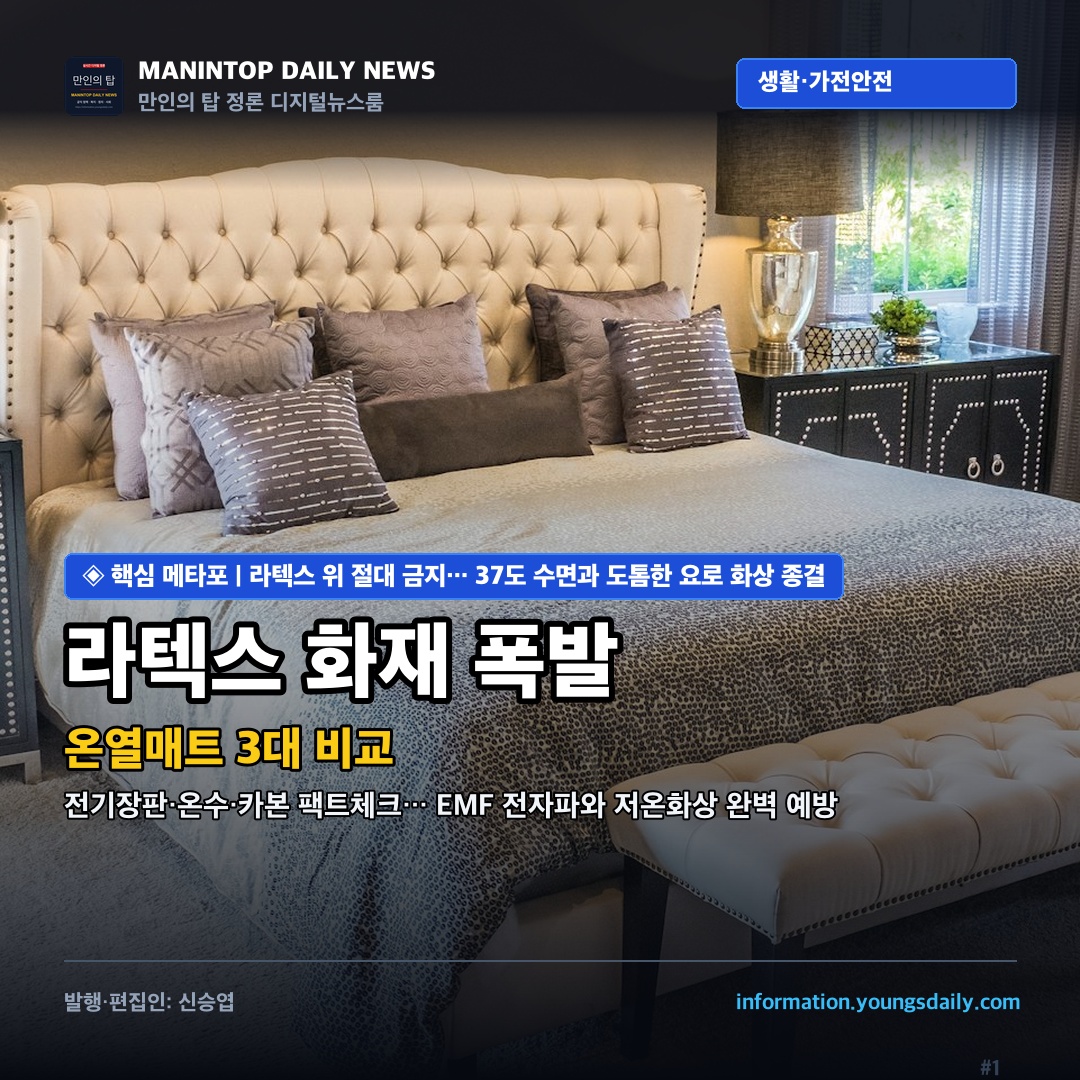
라텍스 위에 깔았다간 화재 폭발… 전기장판·온수·카본매트 3대 방식 비교와 저온화상 완벽 예방책
만인의 탑 편집국11월 11, 2026
▲ 라텍스 위에 깔았다간 화재 폭발… 전기장판·온수·카본매트 3대 방식 비교와 저온화상 완벽 예방책 (공식 보도 자료)
📌 핵심 브리핑 · 주요 쟁점 및 핵심 요약
라텍스 위에 깔았다간 화재 폭발이라는 소방당국의 강력한 경고처럼, 겨울철 한파와 함께 난방비를 아끼려는 가정마다 개인용 온열기기를 꺼내면서 화재와 저온화상 위험이 함께 커지고 있습니다. 전통적인 구리 열선 기반의 1세대 전기장판부터 물을 순환시키는 2세대 온수매트, 그리고 첨단 탄소 섬유를 적용한 3세대 카본매트까지 시장에 쏟아져 나오고 있지만, 무자계나 EMF 인증, DC 저전압 같은 복잡한 마케팅 용어 속에서 내게 꼭 맞는 안전한 제품을 고르기는 쉽지 않습니다. 한국소비자원이 주요 10개 브랜드 탄소매트를 정밀 시험평가한 결과 제품 간 최고 온도가 25℃나 벌어지고 발열 속도도 4배 이상 차이가 났으며, 매년 발생하는 난방기기 화재 중 전기장판이 압도적 1위를 차지하는 것으로 드러났습니다. 본 심층 가이드에서는 세대별 장단점과 한 달 3,000원대 전기요금의 진실부터 전자파를 50% 줄이는 꿀팁, 무늬만 워셔블인 세탁의 함정, 그리고 피부 속을 태우는 저온화상 응급처치법까지 알기 쉽고 자연스럽게 총정리합니다.
SPONSORED · ADVERTISEMENT
전기장판 vs 온수매트 vs 카본매트: 3세대 난방 기술의 장단점과 전기세의 진실
추운 겨울 침대를 따뜻하게 덥혀주는 온열매트는 발열 방식에 따라 크게 3세대로 나뉩니다. 1세대 '전기장판'은 구리나 니켈 열선에 전기를 흘려 열을 내는 가장 전통적인 방식입니다. 2만 원에서 15만 원 수준으로 가격이 저렴하고 전원을 켜면 빠르게 따뜻해지지만, 열선이 지나가는 특정 부위만 뜨거워지는 국소 과열이 심하고 접어서 보관하면 내부 피복이 찢어져 합선 화재가 날 위험이 큽니다. 피복 수명은 보통 5년 안팎이며 아무리 길어도 10년을 넘겨 쓰면 절대 안 됩니다. 2세대 '온수매트'는 매트 속에 얇은 물 호스를 깔고 외부 보일러에서 데운 물을 돌리는 방식입니다. 매트 위에 전선이 없으니 전자파 걱정을 덜어 큰 인기를 끌었지만, 대신 물을 데우는 보일러 본체에서 소음과 전자파가 발생합니다. 게다가 한 달에 한두 번씩 물을 채워줘야 하고, 몇 달에 한 번씩 물을 빼내 청소해야 하며, 봄에 보관할 때는 호스 속 물을 완벽히 빼서 말려야 하는 등 관리가 여간 까다로운 게 아닙니다. 3세대 '카본매트(탄소매트)'는 금속 대신 첨단 탄소 섬유를 발열체로 사용합니다. 전기를 먹는 양이 전기장판보다 20~30% 적어서, 100W 제품을 하루 8시간씩 한 달 내내 틀어도 전기요금이 3,600원에서 6,200원 수준에 불과합니다. 유연성이 뛰어나 접어서 보관해도 열선이 부러지지 않고, 피부 깊숙이 4~5mm까지 침투해 체온을 올려주는 원적외선이 뿜어져 나오는 것도 큰 장점입니다. 가격은 싱글 기준 5만 원대부터 고급형은 30만 원대를 호가합니다. 다만 주의할 점이 있습니다. 시중의 카본매트 중에는 발열선 전체를 순수 탄소섬유로 짠 진짜 탄소매트가 있는 반면, 일반 금속 열선에 겉 피복만 탄소 가루를 묻혀놓고 비싸게 파는 '무늬만 카본매트'도 적지 않습니다. 제품 사양표에서 발열선 자체의 소재를 꼼꼼히 확인해야 합니다.
영유아와 노약자는 40~60℃ 온화한 온도에서도 저온화상을 입을 수 있어 수면 시 37℃ 이하 설정과 도톰한 요 패드가 필수적이다.
전자파 공포의 진실: '무자계 열선'과 진짜 'EMF 인증' 구별법
온열매트를 살 때 가장 많이 신경 쓰는 부분이 바로 '전자파'입니다. 많은 제조사들이 '무자계 열선 탑재로 전자파 100% 차단'이라고 광고하지만, 여기에는 교묘한 마케팅 함정이 있습니다. '무자계(無磁界)'는 전류가 흐르는 두 가닥의 전선을 나란히 두고 전류 방향을 반대로 흐르게 만들어 자기장끼리 부딪쳐 상쇄되도록 유도한 '설계 방식'일 뿐입니다. 자기장을 줄여주는 원리일 뿐 전기장까지 없애주는 것이 아니며, 실제 제품에서 전자파가 얼마나 줄어들었는지를 법적으로 보증하는 시험 성적서가 아닙니다. 반면 'EMF 인증'은 한국기계전기전자시험연구원(KTC)에서 실제 완성된 매트에 정밀 계측기를 대고 전자파를 잰 뒤 발급하는 공인 민간 인증입니다. 통과 기준이 전기장 10V/m 이하, 자기장 2mG 이하로, 정부 법정 기준치(전기장 4,166V/m, 자기장 833mG)보다 무려 400배나 엄격합니다. 따라서 상세페이지의 말만 믿지 말고 정식 EMF 마크와 인증 번호가 있는지 확인해야 합니다. 전원 공급 방식도 중요합니다. 일반 220V 교류(AC)가 직접 들어가는 매트보다는, 어댑터를 통해 안전한 24V 직류 저전압(DC)으로 바꿔 공급하는 제품이 교류 자기장이 거의 생기지 않아 훨씬 안전합니다. 이때 전압을 변환하며 열과 전자파가 나오는 어댑터는 머리맡이 아닌 발 쪽 바닥에 30cm 이상 띄워두어야 합니다. 전자파를 즉시 반으로 줄이는 가장 확실한 생활 꿀팁도 있습니다. 국립전파연구원 시험 결과, 매트 바로 위에 3~5cm 두께의 도톰한 요나 패드를 깔고 잠자리에 들면 신체와 열선 사이에 안전거리가 확보되어 몸에 닿는 자기장의 세기가 50%나 뚝 떨어집니다. 조절기 역시 머리에서 최대한 멀리 두고 주무시는 것이 정석입니다.
난방 매트 세대 구분
발열 메커니즘 및 특징
소비전력 및 한 달 전기요금
장단점 및 안전 주의사항
1세대 전기장판
금속 열선 저항 발열 (2만~15만 원)
누진제 영향 (소비전력 보통 수준)
가격 저렴하나 국소 과열·단선 화재 취약, 수명 5~10년
2세대 온수매트
보일러 온수 순환식 (7만~40만 원)
모터순환식 보통 / 자연순환식 다소 높음
매트 위 전자파 제로, 보일러 소음·주기적 물 보충 배수 번거로움
3세대 카본매트
탄소섬유 발열 및 원적외선 (5만~40만 원)
전기장판 대비 20~30% 절감 (월 3,600~6,200원)
저전력·원적외선 심부 온열, 순수 탄소선 vs 탄소 피복선 구별 필수
EMF 전자기파 인증
한국기계전기전자시험연구원 실측치
전기장 10V/m 이하, 자기장 2mG 이하
법정 인체보호기준의 1/400 수준 통과 제품만 공인 인증 부여
소방 화재 절대 금기
라텍스·메모리폼 침구 위 혼용 금지
열 축적 시 발화점 초과로 대형 화재
접어서 보관 금지(헐겁게 원통형 보관), 단독 벽체 콘센트 사용
SPONSORED · ADVERTISEMENT
한국소비자원 시험 데이터: 최고 온도 25℃ 편차와 '물세탁'의 치명적 함정
한국소비자원이 시중에 유통되는 주요 탄소매트 10개 제품을 직접 구매해 정밀 시험평가한 결과는 놀라웠습니다. 최고 온도로 설정했을 때 매트 표면 온도가 최저 39℃에서 최고 64℃까지 제품에 따라 무려 25℃나 차이가 났습니다. 39℃ 제품은 고온 찜질을 원하는 분에게 너무 미지근할 수 있고, 64℃까지 치솟는 제품은 자칫 깊은 잠에 빠졌을 때 심각한 화상을 입을 위험이 큽니다. 매트 부위별 온도 균일성도 천차만별이었습니다. 귀뚜라미 제품은 위치별 편차가 0.4℃로 고르게 따뜻했던 반면, 일월 제품은 편차가 10.5℃에 달해 어느 곳은 뜨겁고 어느 곳은 차가운 편온 현상이 나타났습니다. 발열 속도(35℃ 도달 시간)는 10만 원 미만 저가형이 평균 19분으로, 10만 원 이상 중고가형(평균 34분)보다 두 배 가까이 빨랐습니다. 이는 저가형이 얇은 비닐 장판 구조라 열이 바로 올라오기 때문이며, 고가형은 두툼한 솜과 누빔 원단이 열을 품어주느라 천천히 올라오는 구조적 차이입니다. 또한 최근 거의 모든 탄소매트가 '워셔블(물세탁 가능)'을 내세우고 있지만, 일반 이불처럼 아무 때나 세탁기에 넣고 돌려도 된다는 뜻이 절대 아닙니다. 소비자원과 제조사가 권장하는 세탁 횟수는 제품 수명 전체를 통틀어 '5회 미만(최대 10회)'입니다. 세탁할 때 물살과 비틀림이 가해지면 내부 탄소 열선과 방수 접속 단자가 피로도를 이기지 못하고 고장 나기 때문입니다. 세탁할 때는 빨래를 사정없이 비트는 통돌이 세탁기를 절대 쓰면 안 되며, 드럼세탁기에서 30℃ 이하 미온수, 울코스, 중성세제(울샴푸), 대형 세탁망을 사용해야 합니다. 가장 중요한 것은 '건조기 절대 금지'입니다. 고온 열풍 건조기를 돌리면 내부 열선 피복이 녹아 전원을 꽂는 순간 불이 납니다. 그늘진 평지에서 3~5일 동안 속까지 완벽히 바짝 말려야 합니다. 가장 현명한 방법은 매트 위에 지퍼형 전용 커버를 씌워 커버만 자주 빨아 쓰고, 매트 본체는 세탁하지 않는 것입니다.
라텍스나 메모리폼 매트리스 위에 온열매트를 깔면 열이 갇혀 대형 화재로 이어지므로 단독 바닥 사용과 규격 콘센트 연결을 준수해야 한다.
40도에서도 살이 익는 '저온화상'의 공포와 라텍스 화재 절대 금기
겨울철 온열매트 사고의 대부분은 펄펄 끓는 뜨거운 온도가 아니라, 따끈하다고 느끼는 40~60℃ 사이의 은근한 온도에서 발생합니다. 바로 소리 없는 살인자라 불리는 '저온화상'입니다. 사람은 잠에 깊이 빠지거나 술을 마신 상태에서는 피부 감각이 둔해져 위험을 감지하지 못합니다. 40℃ 안팎이라도 한 부위가 30분에서 1시간 이상 계속 눌려 있으면, 열이 피부 깊숙이 축적되면서 겉은 멀쩡해 보여도 표피를 뚫고 진피층과 피하 지방의 단백질이 서서히 변성되어 살이 익어 들어갑니다. 아침에 일어났을 때 피부에 빨간 반점이나 물집이 잡혔다면 이미 진피층 깊숙이 파괴된 심각한 2도 이상의 중증 화상일 가능성이 높습니다. 특히 피부가 얇은 영유아(1~3세)나 말초 감각이 둔한 당뇨 환자, 어르신들은 자는 동안 반드시 매트 온도를 체온 수준인 37℃ 이하로 낮추거나 2~3시간 타이머를 맞춰야 합니다. 화상이 발생했을 때 절대 해서는 안 될 치명적인 실수들이 있습니다. 얼음을 상처에 직접 문지르면 혈관이 수축해 피부 조직이 괴사하고, 물집을 터뜨리면 천연 보호막이 사라져 2차 세균 감염이 일어납니다. 된장이나 소주를 바르는 민간요법은 절단이나 패혈증을 부르는 자살행위입니다. 흐르는 미온수나 찬물에 15~20분간 환부를 대어 열기를 뺀 뒤, 깨끗한 수건으로 느슨하게 감싸고 즉시 화상 전문 병원으로 가야 합니다. 마지막으로 생명을 지키는 소방 절대 수칙입니다. 소방청 통계상 최근 10년간 난방기기 화재 1위는 2,443건을 기록한 '전기장판'이었습니다. 화재의 가장 결정적인 원인은 바로 '라텍스나 메모리폼 매트리스 위에서의 사용'입니다. 라텍스는 열을 흡수해 가두는 성질이 강해서, 매트를 켜두면 열이 밖으로 나가지 못하고 내부에 쌓이다가 순식간에 발화점을 넘어 불이 붙어 유독가스를 뿜어냅니다. 라텍스 위에서는 어떤 온열매트도 절대 써선 안 되며, 매트를 보관할 때도 칼처럼 접지 말고 느슨하게 원통형으로 말아서 보관해야 온 가족의 안전을 지킬 수 있습니다.
Fire Hazards on Latex Bedding: The 3-Generation Heating Mat Comparison and Low-Temperature Burn Prevention Guide
Fire Hazards on Latex bedding and severe low-temperature burn incidents surge every winter as households turn to personal heating mats to offset soaring utility bills. While the marketplace has evolved across three distinct generations—from traditional metallic 1st-generation electric blankets to water-circulating 2nd-generation mats and advanced 3rd-generation carbon fiber systems—consumers frequently struggle to navigate technical jargon such as non-magnetic wiring, EMF certification, and low-voltage DC power. Standardized laboratory benchmarks conducted by the Korea Consumer Agency across ten leading carbon mat brands reveal extreme disparities, with maximum surface temperatures diverging by up to 25 degrees Celsius and warmup intervals varying by four-fold, while fire agency statistics identify electric floor mats as the single largest cause of winter heating fires. This safety guide provides an objective technical comparison across all three generations, clarifying electromagnetic safety certifications, washability boundaries, and medically validated first-aid protocols for insidious low-temperature dermal burns.
📌 Key Takeaways
Three-Generation Heating Mat Spectrum: 1st Gen Electric (affordable/wire wear), 2nd Gen Hydronic (zero surface EMF/cumbersome drainage), 3rd Gen Carbon (3,000 KRW monthly power/far-infrared).
Verified EMF Standards and 50% Reduction: Distinguish mechanical non-magnetic layouts from laboratory EMF marks; placing a 3-5cm pad halves magnetic field exposure.
Latex Fire Ban and Low-Temperature Burn First Aid: Never pair mats with heat-trapping latex mattresses, maintain sleep dials below 37C, and cool burns with running water.
Electric Blanket Versus Water Mat Versus Carbon Mat: Evolutionary Trade-offs and Utility Truths
Personal bedtime heating appliances classify into three generational architectures based on internal thermal conduction media. First-generation electric blankets rely on copper or nickel-alloy resistance coils. While affordable between 20,000 and 150,000 KRW with rapid thermal response, concentrated wiring induces uneven hotspotting, and repeated folding fractures degraded PVC or silicone sheathing, triggering short-circuit fires. Their maximum safe operating lifespan should never exceed ten years. Second-generation hydronic mats circulate boiler-heated water through flexible silicone tubing embedded within fabric mattresses. While successfully eliminating electromagnetic fields across sleeping surfaces, external boilers introduce operational pump hum and localized radiation. Furthermore, hydronic systems require periodic water replenishments, quarterly cleanouts, and complete drainage before seasonal storage, remaining vulnerable to leaks and mechanical pump failures. Third-generation carbon mats utilize aerospace-grade polyacrylonitrile-derived carbon fiber filaments. Drawing 20 to 30 percent less electrical power than traditional electric blankets, a standard 100-watt model operating eight hours daily incurs monthly utility expenses between 3,600 and 6,200 KRW. Outstanding mechanical ductility allows standard folded storage without breakage, while emitting far-infrared radiation that penetrates four to five millimeters into dermal tissues to elevate core temperatures. However, consumers must differentiate authentic woven carbon fiber cores from deceptive hybrid wires featuring standard copper alloy threads coated in cheap carbon dust, which fail to deliver promised durability benefits.
▲ Official Press Archive & Contextual Documentation
Deciphering Electromagnetic Realities: Non-Magnetic Wire Marketing Versus Certified EMF Standards
Electromagnetic field anxiety heavily influences consumer purchasing decisions, leading manufacturers to deploy confusing promotional terminology. The label 'non-magnetic wiring' designates a physical circuit layout where twin conductors run parallel with opposite current flows, canceling opposing magnetic fields. While an effective mechanical layout strategy, it suppresses magnetic emissions without eliminating electric fields, serving merely as an engineering blueprint rather than certified proof of total radiation safety. Conversely, genuine EMF certification issued by the Korea Testing Certification Institute represents rigorous empirical testing on finished commercial goods. Passing thresholds require electric fields below 10 V/m and magnetic fields under 2 mG—roughly four hundred times stricter than statutory national limits. Verifying accredited EMF serial numbers provides genuine assurance. Power architecture also dictates baseline radiation. Premium models converting 220-volt alternating current into 24-volt direct current (DC) via external adapters eliminate alternating magnetic fields across sleeping surfaces. Users should position power converter bricks at least thirty centimeters away on footboard floors. Finally, empirical research demonstrates that placing a three to five-centimeter quilted mattress topper over heating mats reduces bodily magnetic exposure by fifty percent by establishing physical distance from internal elements.
Heating Mat Generation
Core Mechanism & Features
Power Usage & Monthly Utility Bill
Pros, Cons & Safety Protocols
1st Gen Electric Blanket
Metal wire resistance heat (20k-150k KRW)
Standard load (vulnerable to tier surcharges)
Inexpensive and fast, but prone to wire kinks and local overheating
2nd Gen Hot Water Mat
Circulating boiler water (70k-400k KRW)
Moderate motor draw / Higher natural siphon
Zero EMF on mat surface, but boiler noise and regular water draining
3rd Gen Carbon Mat
Carbon fiber & far-infrared (50k-400k KRW)
20-30% power savings (3,600-6,200 KRW/mo)
Deep tissue warmth and bend flexibility; distinguish genuine carbon fiber
EMF Safety Certification
KTC laboratory verified threshold
Electric field under 10V/m, magnetic under 2mG
400 times stricter than government baseline; authentic testing mark
Fire Prevention Mandates
Strictly ban usage on latex/memory foam
Trapped heat causes spontaneous combustion
Never fold tightly (roll into cylinder), use dedicated wall outlets
Consumer Agency Benchmark Findings: 25-Degree Temperature Spreads and Washable Traps
Comprehensive laboratory testing conducted by the Korea Consumer Agency across ten leading carbon mat models revealed dramatic performance and safety divergences. At maximum dial settings, surface temperatures ranged from 39 to 64 degrees Celsius—a 25-degree spread. Units capping at 39 degrees restrict high-heat therapy, whereas models spiking to 64 degrees present severe thermal burn vulnerabilities. Temperature distribution consistency also varied widely: Guitudami models demonstrated exceptional uniformity with just 0.4 degrees of variance, while Ilwol units exhibited erratic 10.5-degree shifts across bed zones. Warm-up times to 35 degrees averaged 19 minutes among budget units under 100,000 KRW, compared to 34 minutes for premium models over 100,000 KRW. Thin vinyl construction transmits heat rapidly in budget units, while multi-layered quilted fabrics in premium models absorb and distribute warmth gradually. Crucially, marketing claims promoting 'washable' mats require strict contextual understanding. Official manufacturer guidelines restrict lifetime washings to fewer than five to ten cycles. Repeated mechanical agitation degrades internal carbon bundles and water-resistant terminals over time. Laundering requires drum washers exclusively—top-load agitator machines twist and sever internal filaments. Users must select gentle wool cycles beneath 30 degrees Celsius, using mild neutral detergents inside protective mesh bags. Mechanical tumble dryers are strictly prohibited, as high heat melts internal insulation to provoke immediate short circuits. Washed mats must dry flat in shaded areas for three to five full days. Utilizing a removable quilted topper remains the safest hygiene strategy.
▲ Institutional Field Data & Media Archive
The Silent Peril of Low-Temperature Burns and Strict Latex Fire Prohibitions
Most winter heating trauma stems not from searing temperatures, but from prolonged exposure to mild temperatures between 40 and 60 degrees Celsius—a clinical condition known as low-temperature burns. During deep sleep, alcohol intoxication, or neurological sedation, sensory nociceptors fail to trigger natural withdrawal reflexes. Maintaining contact with a 40-degree heat source for thirty to sixty minutes allows thermal energy to pool within tissues, denaturing dermal and subcutaneous proteins beneath deceptively intact epidermal layers. Discovering morning erythema or blisters typically signifies deep partial-thickness burns requiring complex wound debridement or surgical grafting. Toddlers and diabetic patients must limit sleeping temperatures below 37 degrees Celsius or utilize automated timer cutoffs. Immediate burn first aid dictates cooling affected sites under gently running tap water for fifteen to twenty minutes. Never apply direct ice cubes, which induce frostbite and secondary ischemic necrosis; never rupture intact fluid blisters, which act as sterile biological dressings; and strictly reject folk concoctions. Loose sterile gauze wrapping preceding professional emergency transport prevents deep tissue deterioration. Finally, fire marshals stress imperative preventative protocols. National statistics identify floor heating mats as the primary cause of residential heating fires, totaling 2,443 cases over a decade. The leading catalyst is combining heating mats with heat-trapping latex or memory foam mattresses. Latex possesses immense thermal retention and low ignition thresholds: trapped heat accumulates until combustible thresholds ignite catastrophic structural blazes. Heating mats must never be paired with latex, and should always be loosely rolled into cylinders rather than creased.
Recommended Deep-Dive Investigations TOP 3
GLOBAL REPORT
1월이 시작되면 감기는 이미 우리 곁에 와 있습니다. 2월, 3월, 4월까지 이어지는 추위와 건조함은 코와 목을 가장 먼저 공격합니다. 아침에 일어나자마자 막혀 있는 코. 계속 흐르는 콧물. 괜히 칼칼해지는 목. 이 증상은 “시작”일 뿐입니다. 한 번 무너지면 일주일, 길면 한 달까지 끌고 갑니다. 약을 먹으면 잠깐 괜찮아집니다. 하지만 며칠 뒤 또 반복됩니다. 왜일까요? 감기는 ‘치료’의 문제가 아니라 ‘관리’의 문제이기 때문입니다. 대부분은 감기가 오고 나서 약을 찾습니다. 하지만 진짜 중요한 건 감기가 오기 전에 코와 목을 지키는 것입니다. 건조한 실내 공기, 차가운 바깥 공기, 눈에 보이지 않는 세균. 코와 목은 매일 공격받고 있습니다. 지긋지긋하죠! 그런데도 우리는 아무 준비 없이 버티고 있습니다. 이번 겨울도 그렇게 보낼 건가요? 사실 방법은 어렵지 않습니다. 코를 깨끗하게 관리하고, 목을 따뜻하게 보호하고, 점막을 촉촉하게 유지하고, 기관지를 미리 관리하고, 외부 공기를 차단하는 것. 이 다섯 가지만 꾸준히 해도 감기약 없이 겨울을 보내는 것이 충분히 가능합니다. 🔥 이제부터 그 방법을 하나씩 살펴보겠습니다. 🔥 1. 코와 목을 먼저 관리해야 하는 과학적 이유 감기의 대부분은 코 점막에서 시작됩니다. 국제 학술지 Nature Reviews Microbiology 와 Journal of Allergy and Clinical Immunology 에 실린 호흡기 감염 관련 연구들에서는, 감기 바이러스가 비강 상피세포에 먼저 부착해 증식한다는 점을 설명하고 ...
리모델링사업이 진행 중인 아파트를 매매할 때 “계약금 10%를 언제까지 내야 하느냐”는 질문이 특히 많이 나옵니다. 이주공고(이주 안내)가 7~11월쯤이라고 들으면, 그 시점에 맞춰 계약금도 움직일 것 같아서 더 헷갈리기 쉽습니다. 하지만 실제 납부기한은 ‘이주공고가 언제냐’만으로 자동 결정되지 않는 경우가 많습니다. 1) 계약금 10% 납부기한: 결국 ‘문서에 적힌 일정’이 기준 계약금 10%를 언제까지 납부해야 하는지는, 내가 서명하는 매매계약서(특약 포함) 와 사업주체/조합이 제시한 공고·안내문 에 적힌 납부 일정이 기준이 됩니다. 실제 공고문에서는 분양대금 납부의 큰 틀(계약금→중도금→잔금)을 먼저 안내하고, 상세 일정은 별도 표나 유의사항으로 제시하는 방식이 흔합니다. 또, 계약서 문구에 따라 지급 시점이 조건부로 설정될 수도 있습니다. 예를 들어 한 사례 소개 자료에서는 용역계약서에 잔금(10%) 지급시기가 “사업승인 후”로 기재되어 있었다는 점이 언급됩니다. 이런 식으로 ‘사업 단계’와 지급을 연동하는 문구가 들어가면, 질문의 답은 계약서 문구를 확인해야만 확정됩니다. 관련 내용은 링크 에서 문구 사례를 확인할 수 있습니다. 2) 입주자모집공고에서 확인되는 ‘납부 순서’와 잔금 마감 시점 공고문에 적힌 문구를 보면, 납부 순서와 잔금 마감에 대한 기준이 비교적 명확하게 제시되는 경우가 있습니다. 예를 들어 한 입주자모집공고에는 “분양금액(주택가격)은 계약금, 중도금, 잔금의 순서로 납부”하며 “잔금은 입주(열쇠 수령일) 전에 완납”해야 한다고 안내되어 있습니다. (문구 확인: 링크 ) 이 문구가 의미하는 바는 최소 2가지입니다. 분양/공급 형태의 문서에서는 ‘계약금→중도금→잔금’ 흐름이 공식적으로 안내될 수 있습니다. 잔금은 “입주(열쇠 수령)” 이전에 완납해야 한다는 마감 기준이 문서에 적혀 있을 수 있습니다. 다만, 위 공고문 문구는 잔금 마감에 대한 기준을 보여주지만, 계약금 10%의...
윤석열 전 대통령 탄핵 인용 소식을 접하면, 가장 궁금한 지점은 ‘헌재가 정확히 무엇을 위헌·위법으로 봤는가’입니다. 또한 탄핵과 별개로 진행되는 형사재판(내란 우두머리 혐의 등)이 어디까지 왔는지도 함께 정리할 필요가 있습니다. 아래 내용은 제공된 기사/게시물 스니펫과 링크에서 확인되는 범위만 모아, 일반인이 흐름을 이해하기 쉽게 정리한 것입니다. 1) 탄핵 인용 관련: 스니펫에서 확인되는 ‘판단의 골격’ 제공된 근거 중 조국혁신당 사이트에는 헌법재판소가 윤석열 탄핵 심판에서 “피청구인의 위헌·위법행위는 국민 신임 …”이라는 취지로 판단했다는 문장이 인용돼 있습니다( 링크 ). 이 인용문만 놓고 보면, ‘위헌·위법행위’가 있었는지와 그로 인해 ‘국민의 신임’이 어떻게 평가됐는지가 핵심 축으로 소개됩니다. 다만 질문에서 요청하신 세부 항목, 즉 비상계엄 선포 자체를 문제 삼은 구체적 이유, 계엄 이후 조치(포고령, 국회 통제 등)의 어떤 지점이 헌법 위반인지, 국회의 권한행사 방해 및 정치활동 제약을 어떤 논리로 판단했는지 등은, 이번에 제공된 근거의 제목/스니펫만으로는 조항·사실관계·판단 구조가 그대로 제시돼 있지 않습니다. 따라서 이 글에서는 ‘헌재가 무엇을 문제 삼았다’는 세부 리스트를 단정적으로 재구성하기보다, 현재 확인 가능한 문구 수준의 요약(위헌·위법행위 → 국민 신임의 문제로 평가)까지만 적습니다. 만약 헌재 결정문 전문(주문 및 이유)이 추가로 확인되면, 그때는 문장 단위로 ‘어떤 행위’와 ‘어떤 헌법 원리/조항’이 연결되는지(예: 권력분립, 국회의 권한, 정치적 기본권 등) 구조화해 정리하는 것이 가장 정확합니다. 2) 형사 절차(내란 혐의) 관련: 체포영장과 1심 선고 언급 탄핵 심판과 별도로, 12·3 비상계엄 사태로 내란 혐의를 받는 윤석열 대통령에 대해 2024년 12월 31일 체포 영장이 발부됐다는 BBC 보도가 있습니다( 링크 ). 해당 보도는 ‘현직 대통령’에 대한 체포영장 발부라는 점을 함께 언급합니다. 또...