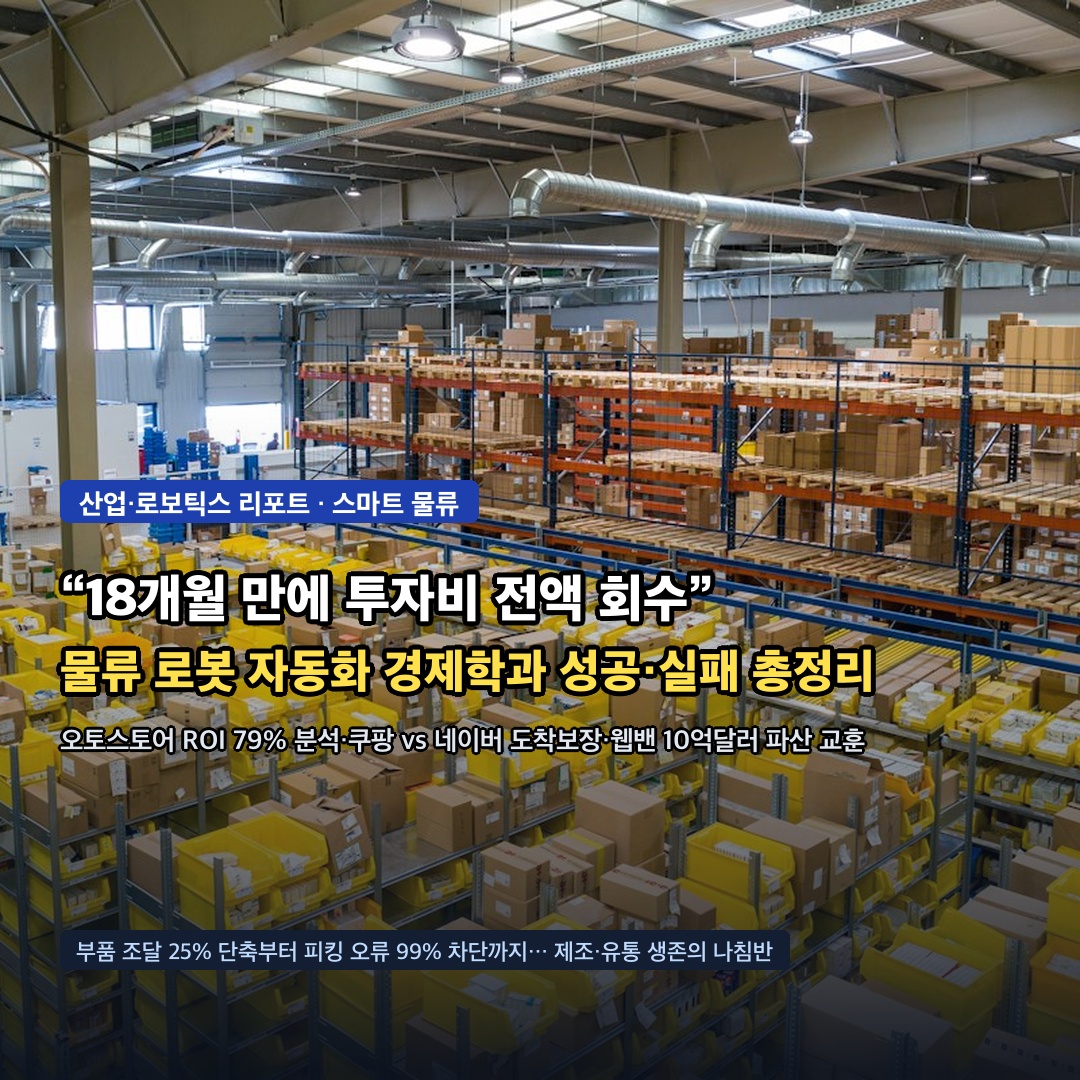
[산업·테크] "18개월 만에 원금 회수"… 물류 로봇·자동화 도입 경제학과 쿠팡·테슬라 성공·실패 총정리
만인의 탑 편집국11월 13, 2026
▲ [산업·테크] "18개월 만에 원금 회수"… 물류 로봇·자동화 도입 경제학과 쿠팡·테슬라 성공·실패 총정리 (공식 보도 자료)
📌 핵심 브리핑 · 주요 쟁점 및 핵심 요약
[산업·테크] "18개월 만에 원금 회수"가 실현된다는 글로벌 분석 지표가 잇따라 입증되면서, 유통과 제조 현장을 뒤흔드는 물류 로봇과 스마트 자동화 시스템 도입이 기업들의 최대 생존 전략으로 부상했습니다. 가파른 인건비 상승과 일손 부족, 다품종 소량 주문의 급증이라는 삼중고 속에서 물류는 단순한 보관 창고를 넘어 공급망의 성패를 가르는 핵심 전략 인프라로 격상되었습니다. 초기 수십억 원의 막대한 설비 투자 부담에도 불구하고, 글로벌 시장에서는 3년 내 79%의 투자 수익률(ROI)을 달성하며 단 1.5년 만에 초기 비용을 전액 회수하는 성공 공식이 속속 확인되고 있습니다. 테슬라와 삼성전자의 제조 로봇 혁신부터 쿠팡 로켓그로스와 네이버 도착보장의 물류비 실측 해부, 그리고 하루 6만 건을 소화하는 대구 풀필먼트센터의 성공과 10억 달러를 날린 미국 웹밴의 뼈아픈 파산 교훈까지 물류 로봇 자동화의 모든 것을 알기 쉽고 생생하게 총정리해 드립니다.
SPONSORED · ADVERTISEMENT
1. 18개월 만에 투자비 뽑는다: 오토스토어 ROI 79%와 테슬라·삼성전자의 로봇 성과
물류 자동화 시스템 도입을 가로막는 가장 큰 걸림돌은 항상 '비싼 초기 설치비'였습니다. 하지만 글로벌 물류 로봇 전문기업 오토스토어(AutoStore)의 '총 경제 효과(TEI)' 실측 연구 보고서는 이러한 편견을 완전히 뒤엎었습니다. 약 87억 4,000만 원(673만 달러)의 시스템 구축 비용을 투입한 기업들을 3년간 추적 조사한 결과, 공간 절감과 인력 효율화로 거둔 총 경제적 효과는 무려 156억 7,000만 원(1,205만 달러)에 달했습니다. 할인율을 감안한 순현재가치(NPV)만 69억 2,000만 원으로, 3년 투자 수익률(ROI) 79%를 달성하며 설치 후 단 18개월(1.5년) 만에 투자 원금을 전액 회수한 것으로 나타났습니다.
가장 극적인 비용 절감은 물류센터의 최대 병목 구간인 '피킹(Picking, 물품 집품)' 공정에서 터져 나왔습니다. 사람이 직접 선반을 돌아다니며 물건을 찾던 기존 수작업 방식과 달리, 로봇이 큐브형 저장 공간에서 물품을 꺼내 작업자 앞으로 가져다주는 'GTP(Goods to Person)' 방식을 통해 오출고율을 무려 99% 줄였습니다. 이에 따른 오배송 및 재작업 손실 방지 효과만 3년간 약 32억 5,000만 원(250만 달러)에 달했습니다. 프로모션이나 연말 성수기에도 임시 직원을 뽑지 않고 로봇 가동 시간만 늘려 5억 4,000만 원의 인건비를 아꼈습니다.
글로벌 테크 기업들도 로봇 물류를 통해 공정 효율을 극대화하고 있습니다. 테슬라는 기가팩토리 생산라인에 인공지능 기반 실시간 경로 최적화 AMR(자율이동로봇)을 투입해 공정 간 부품 조달 시간을 25% 단축시켰고, BMW는 완성차 조립 라인에 AGV(무인운반차)를 깔아 내부 물류비를 30% 절감했습니다. 아마존은 대규모 AMR 플릿으로 주문 처리 속도를 40% 끌어올리고 작업자 도보 이동 거리를 절반으로 줄였습니다. 국내 대표 주자인 삼성전자 역시 반도체 클린룸과 제조 라인에 AGV·AMR을 연계해 생산성을 20% 높였으며, 5G 특화망을 깔아 로봇 제어 응답 속도를 30% 추가로 향상시켰습니다.
이커머스 유통 시장에서는 단일 택배사와 독점 계약을 맺던 오랜 관행이 무너지고 있습니다. 상품의 크기, 배송 속도, 고객 클레임 특성에 따라 배송 파트너를 조각처럼 쪼개어 맡기는 '모듈형 물류'가 새로운 대세로 자리 잡았습니다. 대표적으로 슈즈 멀티숍 ABC마트는 온라인 신발 주문 급증에 맞춰 대량 물동량 자동화 설비를 갖춘 CJ대한통운으로 파트너를 전격 교체했습니다. 패션 플랫폼 무신사는 서울·수도권 당일 배송은 딜리박스에, 전국 권역 배송은 한진에, 수거와 검수가 핵심인 중고 의류(무신사 유즈드)는 롯데글로벌로지스에 분리 위탁하는 고도화된 삼원화 체계를 가동 중입니다.
오픈마켓 1인 판매자들의 실측 데이터를 바탕으로 국내 양대 이커머스인 쿠팡 로켓그로스와 네이버 도착보장(CJ대한통운 제휴)의 풀필먼트 원가를 비교해 보면 매우 흥미로운 사실이 드러납니다. 평균 판매가 1만 원짜리 극소 부피 상품을 기준으로 집계한 결과, 매출액 대비 순수 물류비 비중은 쿠팡이 36.85%(매출 2,328만 원 중 물류비 858만 원), 네이버가 37.92%(매출 3,702만 원 중 물류비 1,404만 원)로 1%포인트 안팎의 근소한 차이를 보였습니다.
하지만 운영 방식에서는 극명한 차이가 갈립니다. 쿠팡은 입고 수량을 판매자가 자유롭게 낱개 단위로 조절할 수 있고, 고객의 단순 변심이나 교환 요청 시 풀필먼트 센터 자체 재고로 즉각 맞교환을 처리해 줍니다. 반면 네이버 도착보장은 초기 설정한 대형 박스 내 입수량 단위로만 입고해야 하므로 재고 보관비 부담이 추가 발생할 위험이 있습니다. 또한 고객 반품 시 물건이 판매자의 사무실이나 창고로 회수되어 직접 검수하고 재발송해야 하는 운영 부담이 뒤따릅니다. 주문 접수 즉시 출고 작업이 자동으로 들어가 고객이 옵션 실수 등으로 1분 만에 취소하려 해도 취소가 불가능해지는 클레임 구조도 네이버의 숙제로 꼽힙니다.
구분 항목
사안의 핵심 실태
사회적 파급 효과
향후 대응 및 전망
로봇 기술 방식
AGV vs AMR 이동 로봇
AGV는 마그네틱/QR 추종, AMR은 LiDAR/SLAM 자율주행
정형 반복 이송(AGV)과 다품종 동적 공정(AMR)으로 분화
투자 수익 지표
오토스토어 TEI 실측 분석
3년 내 ROI 79% 달성 및 투자금 회수 기간 18개월
피킹 오류 99% 감소로 3년간 32.5억 원 손실 절감 입증
글로벌 제조 성과
테슬라·BMW·삼성전자
테슬라 조달 25% 단축, BMW 물류비 30% 절감
삼성전자 5G 특화망 연계로 물류 운영 속도 30% 추가 향상
이커머스 원가 비교
쿠팡 로켓그로스 vs 네이버
매출 대비 물류비 비중: 쿠팡 36.85% vs 네이버 37.92%
쿠팡은 자율 입고·즉각 맞교환, 네이버는 박스 단위 경직적
성공 사례 모델
쿠팡 대구 풀필먼트센터
쉘프 이송 AGV 및 소팅 로봇으로 피킹 속도 300% 향상
작업자 도보 이동거리 제로화 및 일일 6만 건 안정 처리
실패 사례 교훈
미국 웹밴 및 국내 저온센터
웹밴 10억 달러 고정식 캐로젤 과잉투자로 2001년 파산
저온 배터리 급방전 방지 및 점진적 모바일 로봇 확장 필수
정부 우수 신기술
국토교통부 제8호 (위킵)
시계열 AI 머신러닝 기반 사전 포장(Pre-pack) 연동
주문-출고 리드타임 36시간→7시간(80%) 단축 및 비용 50% 절감
SPONSORED · ADVERTISEMENT
3. 하루 6만 건 쿠팡 대구의 성공 vs 10억 달러 웹밴의 파산: 자동화 성패 가른 결정적 요인
수천억 원의 첨단 로봇 설비를 들여놓는다고 해서 무조건 성공하는 것은 아닙니다. 현장의 물리적 특성을 무시하거나 지나치게 경직된 설계를 고집했다가 천문학적인 손실을 보고 파산한 사례는 오늘날 기업들에게 서늘한 경고를 던집니다.
대표적인 성공 모델은 쿠팡 대구 풀필먼트센터입니다. 바닥의 QR코드를 따라 선반을 통째로 들어 나르는 쉘프 이송형 AGV와 패키지 자동 소팅 로봇을 대거 투입해, 본사와 공급사 간 긴밀한 협력으로 단 16주 만에 셋업을 완료했습니다. 핵심은 '사람과 로봇의 동선 분리'였습니다. 로봇이 움직이는 구역에 사람이 들어가지 않도록 물리적으로 안전 구역을 격리해 안전사고를 원천 차단했습니다. 그 결과 피킹 및 소팅 속도가 종전 대비 300% 이상 폭증하며 하루 최대 6만 건의 주문을 물 흐르듯 처리하고 있습니다. 작업자의 도보 이동 거리가 사라져 피로도가 낮아지고 현장 이직률도 뚝 떨어졌습니다. 유럽 대형 약국 체인인 체코 Dr. Max 역시 프라하 거점에 셔틀형 ASRS 로봇 9대와 AI 3D 머신비전을 도입해 의약품 피킹 수작업을 100% 대체하고 100% 가동률을 유지하고 있습니다.
반면 뼈아픈 실패 사례도 명확합니다. 국내 C사는 냉장·냉동 저온 물류센터에 의욕적으로 로봇을 도입했으나 처참한 실패를 맛보았습니다. 영하의 저온 환경에서 로봇의 리튬이온 배터리가 급격히 방전되어 실가동 시간이 계획의 절반 이하로 곤두박질쳤기 때문입니다. 게다가 신선식품이 바닥에 떨어져 터졌을 때 내용물이 로봇 하부와 정밀 센서에 스며들어 부식되는 치명적인 문제가 반복되어 결국 설비를 철수해야 했습니다. 미국 식료품 배송 스타트업 웹밴(Webvan)의 비극도 유명합니다. 2000년대 초반 센터 1곳당 3,500만 달러짜리 초대형 고정식 회전 캐로젤 설비를 무려 12개 센터에 깔며 10억 달러(약 1조 3,000억 원) 이상을 쏟아부었습니다. 하지만 온라인 장보기 수요 예측에 실패해 실제 가동률이 25%에 머물렀고, 눈덩이처럼 불어나는 고정비와 유지보수 비용을 감당하지 못해 2001년 충격적인 파산을 맞았습니다. 초기에는 수요에 맞춰 대수를 유연하게 늘릴 수 있는 모바일 로봇(AMR) 기반의 점진적 투자가 필수적이라는 뼈저린 교훈입니다.
▲ 이커머스 풀필먼트 센터 출고 분류 및 모바일 로봇(AMR) 동선 최적화 모니터링 자료
4. AI 사전 포장 신기술과 실전 도입 체크리스트: 바닥 평탄도부터 5단계 도입 로드맵까지
물류 자동화는 이제 인공지능(AI)과 결합하여 주문이 들어오기도 전에 포장을 끝내는 수준으로 진화하고 있습니다. 국토교통부가 지정한 제8호 우수 물류신기술인 위킵(Wekeep)의 시스템이 대표적입니다. 시계열 예측 AI(SARIMA 및 LSTM 순환신경망)를 활용해 과거 주문 패턴과 계절별 수요를 분석한 뒤, 주문 접수 전에 미리 상자를 접고 물품을 담아두는 '사전 포장(Pre-pack)'과 자동 발주를 실행합니다. 이를 통해 주문에서 출고까지 걸리던 리드타임을 종전 36시간에서 단 7시간으로 80% 단축시켰고, 1인당 시간당 피킹 생산성을 60건에서 100건으로 66% 끌어올렸으며, 연간 물류 운영비를 절반(50%)으로 줄이는 기염을 토했습니다.
그렇다면 물류 로봇을 성공적으로 도입하기 위해 기업들은 무엇을 준비해야 할까요? 전문가들은 장비 가격표만 보지 말고 '건축 환경'과 '총 소유 비용(TCO)'을 반드시 따져야 한다고 조언합니다. 첫째, 로봇 도입 전 바닥의 '평탄도와 마모 저항성(AR)'을 확인해야 합니다. 바닥이 울퉁불퉁하거나 미세하게 패여 있으면 로봇 센서가 오작동을 일으키거나 바퀴가 헛돌아 전체 플릿이 멈춰 섭니다. 둘째, 고밀도 입체 랙과 셔틀을 세울 수 있는 충분한 천장 층고를 확보해야 하며, 배터리 급속 충전 스테이션의 전력 용량과 충전 동선을 설계해야 합니다.
마지막으로 무리한 전면 교체 대신 5단계의 점진적 도입 로드맵을 밟아야 합니다. 먼저 1단계 '요구사항 분석'으로 피킹 병목과 다빈도 출고 상품을 정의하고, 2단계에서 고정 라인용 AGV와 협업용 AMR 중 '기술 선택'을 마칩니다. 이어 3단계 '사전 개념검증(POC)'을 통해 파일럿 구역에서 로봇의 실제 처리량과 충돌 회피 알고리즘을 실증 검증해야 합니다. 4단계에서 기존 창고관리시스템(WMS)과 로봇 관제 소프트웨어를 연동하고, 마지막 5단계에서 시간당 처리량(UPH)과 오피킹률 등 핵심 성과 지표(KPI)를 실시간 모니터링하며 대수를 단계적으로 늘려가는 것이 실패를 막는 가장 안전한 길입니다.
[Industry & Tech] "Full Payback in 18 Months": The Economics of Warehouse Robotics and Success-Failure Case Studies from Coupang to Tesla
[Industry & Tech] "Full Payback in 18 Months" is rapidly becoming an empirical reality across advanced supply chains, propelling warehouse robotics and automated storage systems to the forefront of corporate survival strategies. Navigating rising labor expenditures, chronic manpower deficits, and explosive e-commerce velocity, logistics has evolved from static warehousing into high-stakes operational infrastructure. Despite significant capital expenditures, empirical benchmarks confirm that modern automated facilities capture a 79% return on investment (ROI) over three years, fully recouping initial investments within 18 months. Spanning robotics implementations by Tesla and Samsung, detailed cost breakdowns comparing Coupang Rocket Growth with Naver Guaranteed Delivery, the 60,000-order daily throughput of Coupang's Daegu mega-center, and catastrophic lessons from Webvan's $1 billion bankruptcy, this comprehensive guide decodes the transformative economics of warehouse automation.
📌 Key Takeaways
The analysis of AutoStore's TEI indicates that an investment of 8.7 billion won will yield a 79% ROI over three years, with full capital recovery within 18 months and a proven 99% reduction in picking errors.
Tesla has shortened parts procurement by 25%, BMW has reduced logistics costs by 30%, and Samsung Electronics has enhanced smart factory logistics speed by an additional 30% through the integration of a specialized 5G network.
Coupang has successfully improved picking speed in Daegu by 300% and has presented a five-step gradual implementation roadmap to prepare for the bankruptcy of Webvan's $1 billion fixed facilities.
1. Full Payback in 18 Months: AutoStore's 79% ROI and Robotics Triumphs at Tesla and Samsung
The primary barrier preventing corporations from modernizing warehousing has long been daunting upfront capital expenditure. However, the Total Economic Impact (TEI) study published by global robotics pioneer AutoStore definitively overturns this hesitation. Examining enterprise deployments averaging $6.73 million (8.74 billion won) in total implementation costs over three years, researchers documented cumulative economic benefits reaching $12.05 million (15.67 billion won). Delivering a net present value (NPV) of $5.32 million, the automated cube system yielded an accredited 79% three-year ROI, achieving full capital payback within precisely 18 months.
The most dramatic savings materialized at the logistics facility's primary choke point: order picking. Moving away from manual walking across sprawling aisles, Goods-to-Person (GTP) robotics—where automated bots retrieve bins from high-density grids directly to ergonomic picking stations—slashed outbound picking errors by 99%. Eliminating returns, repackaging, and customer friction generated $2.5 million (3.25 billion won) in direct risk avoidance. During peak promotional periods, facilities expanded capacity simply by adjusting robotic operating schedules rather than hiring temporary laborers, preserving an additional $410,000 in operational payroll.
Global manufacturing powerhouses are demonstrating identical competitive advantages. Tesla deployed AI-directed AMRs throughout its Gigafactory network, compressing intra-assembly parts replenishment cycles by 25%. BMW integrated automated guided vehicles (AGVs) across vehicle assembly lines to curtail internal logistics overhead by 30%. Amazon deployed vast AMR fleets across fulfillment centers, lifting order processing speed by 40% while halving physical employee walking distances. Samsung Electronics seamlessly connected AGVs and AMRs across ultra-clean semiconductor fabs, driving a 20% productivity leap and leveraging private 5G network slices to boost real-time robotic telemetry speeds by an additional 30%.
▲ Articulated robotic arm executing automated box palletizing and high-speed package handling
2. The Modular Logistics Revolution: Deconstructing Coupang Rocket Growth vs Naver Guaranteed Delivery
Within e-commerce distribution, the conventional era of contracting a single carrier for enterprise shipping has collapsed. Retailers are aggressively adopting 'Modular Logistics'—slicing fulfillment responsibilities across specialized logistics vendors based on geographic density, speed expectations, and reverse-logistics complexity. Shoe retailer ABC Mart decisively switched its primary enterprise shipping provider from Hanjin to CJ Logistics to secure massive automated sorting capabilities. Fashion giant Musinsa operates a sophisticated tripartite matrix: partnering with Delybox for same-day metropolitan delivery, Hanjin for nationwide regional networks, and Lotte Global Logistics for reverse-logistics authentication within its secondhand resale channel (Musinsa Used).
Analyzing empirical ledger data from independent merchants provides transparent cost comparisons between Coupang Rocket Growth and Naver Guaranteed Delivery (partnered with CJ Logistics LoIS). Examining identical ultra-compact products retailing at 10,000 won reveals strikingly parallel top-line logistics costs: Coupang logged an aggregate logistics expense ratio of 36.85% (8.58 million won on 23.28 million won revenue), while Naver logged 37.92% (14.04 million won on 37.02 million won revenue)—a narrow divergence of barely one percentage point.
However, day-to-day operational mechanics diverge sharply. Coupang allows flexible, item-level inventory inbounding and executes instant customer replacements directly from fulfillment center safety stocks. Conversely, Naver's automated CJ network enforces rigid carton-count inbounding parameters, creating excess inventory holding charges. Furthermore, Naver routes return parcels back to the merchant's physical warehouse for manual inspection and restocking, shifting operational labor back to the seller. Naver's real-time automated fulfillment trigger also locks customer orders immediately, sparking friction when buyers attempt to cancel mistaken orders within minutes of checkout.
Category
Core Factual Findings
Socioeconomic Impact
Subsequent Measures
Robotics Architecture
AGV vs AMR Autonomous Mobile
AGV follows magnetic/QR, AMR leverages LiDAR/SLAM AI
Fixed repetitive transfer (AGV) vs dynamic layouts (AMR)
Economic ROI Metrics
AutoStore TEI Empirical Study
79% 3-year ROI with capital payback period of 18 months
99% picking error reduction saving $2.5M over 3 years
Manufacturing Impact
Tesla, BMW, and Samsung
Tesla cuts parts lead-time 25%, BMW slashes logistics 30%
Samsung adds 30% speed boost via private 5G network control
Fulfillment Cost Parity
Coupang Rocket vs Naver CJ
Logistics cost share: Coupang 36.85% vs Naver 37.92%
Coupang offers flexible intake; Naver enforces strict box units
Flagship Success Case
Coupang Daegu Mega-Center
Shelf-moving AGVs drive 300% surge in order picking speed
Webvan $1B fixed carousel over-expansion led to 2001 bankruptcy
Cold-chain battery drain highlights need for scalable AMR rollout
Certified Innovation
MOLIT Certified Tech 8 (Wekeep)
Time-series AI machine learning predicts pre-packing demand
Cut lead-time 80% from 36h to 7h with 50% annual cost savings
3. 60K Daily Orders at Coupang Daegu vs Webvan's $1B Bankruptcy: What Determines Success?
Investing hundreds of millions of dollars into cutting-edge automated machinery does not guarantee business profitability. Ignoring physical warehouse realities or committing to rigid engineering architectures has precipitated catastrophic failures, serving as a cautionary warning for industrial planners.
The premier domestic benchmark remains Coupang's Daegu Mega-Fulfillment Center. Integrating hundreds of shelf-lifting AGVs that glide along QR gridlines with autonomous parcel sorting robots, engineering teams completed deployment in a rapid 16-week window. The decisive design breakthrough centered on total physical segregation between humans and automated machinery, walling off high-speed robotic grid zones to engineer out occupational hazards. Consequently, sorting and picking velocity accelerated by 300%, effortlessly handling 60,000 daily orders. By eliminating miles of daily walking for personnel, physical fatigue vanished and facility retention surged. Similarly, European pharmacy giant Dr. Max deployed nine shuttle-based ASRS units with 3D machine vision in Prague, replacing 100% of manual pharmaceutical picking labor while maintaining flawless 100% operational uptime.
In painful contrast stand catastrophic miscalculations. A leading domestic retailer deployed autonomous robots across cold-storage grocery warehouses with disastrous outcomes. Sub-zero temperatures accelerated lithium-ion battery discharge rates, slashing operational uptime to less than half of planned projections. Furthermore, when dropped food packages ruptured, corrosive organic liquids seeped into underlying guidance sensors and robotic chassis, causing recurring electrical shorts and forcing complete equipment decommissioning. Even more legendary is the $1 billion bankruptcy of early dot-com grocery pioneer Webvan. Webvan committed over $35 million per warehouse into massive, rigid carousel architectures across 12 mega-facilities. Overestimating the consumer adoption speed of online grocery delivery, actual facility utilization stagnated at 25% to 30%. Crushed by astronomical fixed depreciation and maintenance overhead, Webvan filed for bankruptcy in 2001. This collapse cemented a timeless industrial axiom: enterprise automation must prioritize modular, scalable AMR mobile platforms over irreversible monolithic fixtures.
▲ E-commerce fulfillment outbound dispatch and autonomous mobile robot (AMR) route monitoring
4. Predictive AI Pre-Packing Innovations and Actionable 5-Step Automation Checklists
Logistics robotics has converged with machine learning to achieve predictive fulfillment, boxing customer orders before they are even placed. The Ministry of Land, Infrastructure and Transport (MOLIT) officially certified this breakthrough as National Excellent Logistics Technology 8, developed by Wekeep. Leveraging recurrent neural networks (LSTM) and seasonal time-series models (SARIMA), the engine analyzes historical demand swings to trigger automated pre-packing and dynamic replenishment API dispatches. This predictive model compressed order-to-dispatch lead times from 36 hours down to 7 hours (an 80% reduction), propelled hourly picking productivity per worker from 60 to 100 units (a 66% surge), and halved total annual fulfillment operating expenses.
Executing successful robotics integration requires facilities to look beyond hardware price tags to evaluate architectural floor readiness and Total Cost of Ownership (TCO).
First, industrial floors must meet stringent flatness tolerances and abrasion resistance (AR) standards. Uneven concrete surfaces or micro-pitting disrupt SLAM laser sensors and induce wheel slippage, paralyzing entire robotic fleet corridors. Second, facilities must engineer sufficient clear heights to accommodate vertical ASRS shuttle arrays and build robust electrical infrastructure capable of handling high-ampere rapid battery charging docks without thermal bottlenecks.
Finally, enterprises must execute a methodical 5-step gradual implementation roadmap: Step 1 initiates comprehensive Requirement Analysis to isolate picking bottlenecks and high-velocity SKUs. Step 2 guides Technology Selection between fixed-path AGVs, adaptive AMRs, and vertical ASRS. Step 3 mandates pilot Proof of Concept (POC) validation within an isolated test zone to verify real-world collision avoidance algorithms and throughput. Step 4 oversees software integration connecting Warehouse Management Systems (WMS) to centralized Fleet Management platforms. Step 5 drives disciplined metric-driven scaling, tracking Units Per Hour (UPH) and system uptime before expanding capital commitments across enterprise networks.
Recommended Deep-Dive Investigations TOP 3
GLOBAL REPORT
1월이 시작되면 감기는 이미 우리 곁에 와 있습니다. 2월, 3월, 4월까지 이어지는 추위와 건조함은 코와 목을 가장 먼저 공격합니다. 아침에 일어나자마자 막혀 있는 코. 계속 흐르는 콧물. 괜히 칼칼해지는 목. 이 증상은 “시작”일 뿐입니다. 한 번 무너지면 일주일, 길면 한 달까지 끌고 갑니다. 약을 먹으면 잠깐 괜찮아집니다. 하지만 며칠 뒤 또 반복됩니다. 왜일까요? 감기는 ‘치료’의 문제가 아니라 ‘관리’의 문제이기 때문입니다. 대부분은 감기가 오고 나서 약을 찾습니다. 하지만 진짜 중요한 건 감기가 오기 전에 코와 목을 지키는 것입니다. 건조한 실내 공기, 차가운 바깥 공기, 눈에 보이지 않는 세균. 코와 목은 매일 공격받고 있습니다. 지긋지긋하죠! 그런데도 우리는 아무 준비 없이 버티고 있습니다. 이번 겨울도 그렇게 보낼 건가요? 사실 방법은 어렵지 않습니다. 코를 깨끗하게 관리하고, 목을 따뜻하게 보호하고, 점막을 촉촉하게 유지하고, 기관지를 미리 관리하고, 외부 공기를 차단하는 것. 이 다섯 가지만 꾸준히 해도 감기약 없이 겨울을 보내는 것이 충분히 가능합니다. 🔥 이제부터 그 방법을 하나씩 살펴보겠습니다. 🔥 1. 코와 목을 먼저 관리해야 하는 과학적 이유 감기의 대부분은 코 점막에서 시작됩니다. 국제 학술지 Nature Reviews Microbiology 와 Journal of Allergy and Clinical Immunology 에 실린 호흡기 감염 관련 연구들에서는, 감기 바이러스가 비강 상피세포에 먼저 부착해 증식한다는 점을 설명하고 ...
리모델링사업이 진행 중인 아파트를 매매할 때 “계약금 10%를 언제까지 내야 하느냐”는 질문이 특히 많이 나옵니다. 이주공고(이주 안내)가 7~11월쯤이라고 들으면, 그 시점에 맞춰 계약금도 움직일 것 같아서 더 헷갈리기 쉽습니다. 하지만 실제 납부기한은 ‘이주공고가 언제냐’만으로 자동 결정되지 않는 경우가 많습니다. 1) 계약금 10% 납부기한: 결국 ‘문서에 적힌 일정’이 기준 계약금 10%를 언제까지 납부해야 하는지는, 내가 서명하는 매매계약서(특약 포함) 와 사업주체/조합이 제시한 공고·안내문 에 적힌 납부 일정이 기준이 됩니다. 실제 공고문에서는 분양대금 납부의 큰 틀(계약금→중도금→잔금)을 먼저 안내하고, 상세 일정은 별도 표나 유의사항으로 제시하는 방식이 흔합니다. 또, 계약서 문구에 따라 지급 시점이 조건부로 설정될 수도 있습니다. 예를 들어 한 사례 소개 자료에서는 용역계약서에 잔금(10%) 지급시기가 “사업승인 후”로 기재되어 있었다는 점이 언급됩니다. 이런 식으로 ‘사업 단계’와 지급을 연동하는 문구가 들어가면, 질문의 답은 계약서 문구를 확인해야만 확정됩니다. 관련 내용은 링크 에서 문구 사례를 확인할 수 있습니다. 2) 입주자모집공고에서 확인되는 ‘납부 순서’와 잔금 마감 시점 공고문에 적힌 문구를 보면, 납부 순서와 잔금 마감에 대한 기준이 비교적 명확하게 제시되는 경우가 있습니다. 예를 들어 한 입주자모집공고에는 “분양금액(주택가격)은 계약금, 중도금, 잔금의 순서로 납부”하며 “잔금은 입주(열쇠 수령일) 전에 완납”해야 한다고 안내되어 있습니다. (문구 확인: 링크 ) 이 문구가 의미하는 바는 최소 2가지입니다. 분양/공급 형태의 문서에서는 ‘계약금→중도금→잔금’ 흐름이 공식적으로 안내될 수 있습니다. 잔금은 “입주(열쇠 수령)” 이전에 완납해야 한다는 마감 기준이 문서에 적혀 있을 수 있습니다. 다만, 위 공고문 문구는 잔금 마감에 대한 기준을 보여주지만, 계약금 10%의...
윤석열 전 대통령 탄핵 인용 소식을 접하면, 가장 궁금한 지점은 ‘헌재가 정확히 무엇을 위헌·위법으로 봤는가’입니다. 또한 탄핵과 별개로 진행되는 형사재판(내란 우두머리 혐의 등)이 어디까지 왔는지도 함께 정리할 필요가 있습니다. 아래 내용은 제공된 기사/게시물 스니펫과 링크에서 확인되는 범위만 모아, 일반인이 흐름을 이해하기 쉽게 정리한 것입니다. 1) 탄핵 인용 관련: 스니펫에서 확인되는 ‘판단의 골격’ 제공된 근거 중 조국혁신당 사이트에는 헌법재판소가 윤석열 탄핵 심판에서 “피청구인의 위헌·위법행위는 국민 신임 …”이라는 취지로 판단했다는 문장이 인용돼 있습니다( 링크 ). 이 인용문만 놓고 보면, ‘위헌·위법행위’가 있었는지와 그로 인해 ‘국민의 신임’이 어떻게 평가됐는지가 핵심 축으로 소개됩니다. 다만 질문에서 요청하신 세부 항목, 즉 비상계엄 선포 자체를 문제 삼은 구체적 이유, 계엄 이후 조치(포고령, 국회 통제 등)의 어떤 지점이 헌법 위반인지, 국회의 권한행사 방해 및 정치활동 제약을 어떤 논리로 판단했는지 등은, 이번에 제공된 근거의 제목/스니펫만으로는 조항·사실관계·판단 구조가 그대로 제시돼 있지 않습니다. 따라서 이 글에서는 ‘헌재가 무엇을 문제 삼았다’는 세부 리스트를 단정적으로 재구성하기보다, 현재 확인 가능한 문구 수준의 요약(위헌·위법행위 → 국민 신임의 문제로 평가)까지만 적습니다. 만약 헌재 결정문 전문(주문 및 이유)이 추가로 확인되면, 그때는 문장 단위로 ‘어떤 행위’와 ‘어떤 헌법 원리/조항’이 연결되는지(예: 권력분립, 국회의 권한, 정치적 기본권 등) 구조화해 정리하는 것이 가장 정확합니다. 2) 형사 절차(내란 혐의) 관련: 체포영장과 1심 선고 언급 탄핵 심판과 별도로, 12·3 비상계엄 사태로 내란 혐의를 받는 윤석열 대통령에 대해 2024년 12월 31일 체포 영장이 발부됐다는 BBC 보도가 있습니다( 링크 ). 해당 보도는 ‘현직 대통령’에 대한 체포영장 발부라는 점을 함께 언급합니다. 또...