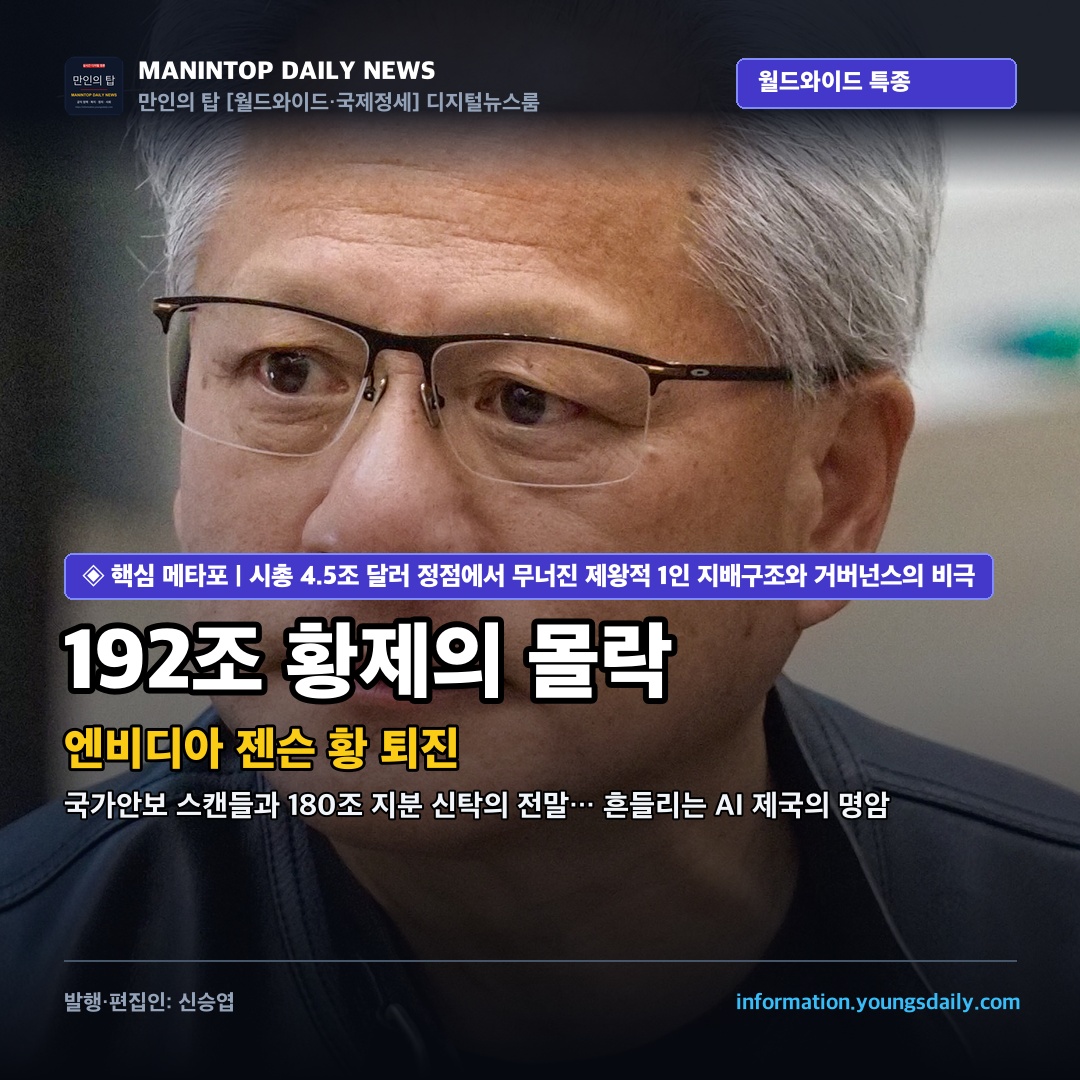
▲ 33년간 세계 최대 인공지능 제국을 이끌었던 젠슨 황 최고경영자가 전격 사임하며 180조 원 지분의 신탁 관리와 지배구조 개편이 초미의 관심사로 떠올랐다. / 글로벌 반도체 거버넌스 보도 사진 자료
시가총액 4조 5,000억 달러라는 전무후무한 기업 신화를 일구며 전 세계 인공지능 산업의 절대 권력자로 군림해 온 192조 원의 황제 젠슨 황이 창립 33년 만에 치명적인 국가안보 스캔들과 사내 비위 의혹으로 전격 퇴진하면서 글로벌 경제가 거대한 충격에 휩싸였습니다. 외국 정보기관 연루설과 연방수사국의 고강도 조사 속에서 황제의 급작스러운 몰락이 공식화되자마자 하루 만에 엔비디아 시가총액 801조 원이 허공으로 증발했고, 월스트리트는 창업자가 쥐고 있던 180조 원 규모의 주식 지분이 시장에 쏟아질지 모른다는 극심한 공포에 휩싸였습니다. 하지만 미국 증권거래위원회 공시를 정밀 분석한 결과, 젠슨 황 지분의 92%는 부인 로리 황과의 엄격한 부부 공동 신탁에 묶여 있어 단기 대량 매각은 법적으로 불가능한 철옹성 구조임이 밝혀졌습니다. 향후 최대 103조 원에 달할 것으로 추산되는 세기의 이혼 재산 분할 셈법부터 차기 2인자가 전무한 권력 승계의 안개, 개당 4만 달러에 달하는 차세대 블랙웰 칩의 발열 결함과 대중국 매출 0원 공식화, 그리고 한국 기업들과 맺었던 10조 원 규모 26만 장 공급 협약의 불확실성까지, 엔비디아 제국이 맞닥뜨린 빛과 그림자의 전말을 누구나 알기 쉽고 흥미진진하게 긴급 해부합니다.
33년 만의 불명예 퇴진… 앨리스 황과 FBI 수사의 충격적 전말
1993년 작은 벤처기업으로 출발해 전 세계에서 가장 값비싼 4조 5,000억 달러 가치의 기업을 일궈낸 젠슨 황의 시대가 충격적인 불명예로 막을 내렸습니다. 엔비디아 이사회는 11월 12일 젠슨 황이 최고경영자직에서 즉시 물러난다고 전격 발표했습니다. 이번 낙마의 결정적 도화선은 단순한 사생활 스캔들을 넘어 국가안보와 첨단 기술 패권이 뒤엉킨 첩보전 의혹이었습니다.
외신에 따르면 젠슨 황의 혼외 관계 상대로 지목된 인물은 메가스피드 임원 출신의 앨리스 황입니다. 대만 현지 언론들은 그녀가 중국 국가안전부 산하 공작 조직에 연계되었을 가능성을 제기하며 접근 의도에 주목했습니다. 이에 대해 중국 외교당국은 즉각 사실무근이라고 반박했으나, 미 연방수사국(FBI)이 관련 조사에 착수했고 도널드 트럼프 대통령까지 조사를 공식 확인하면서 사태는 걷잡을 수 없이 번졌습니다.
이사회 특별조사위원회는 핵심 기술 유출 정황은 아직 발견되지 않았다고 밝혔지만, 사내 직원에 대한 연쇄적인 추가 비위 의혹까지 터져 나오자 젠슨 황은 결국 고개를 숙였습니다. 그는 전사 메모를 통해 배우자에게 큰 상처를 준 과오를 인정하며 스스로를 강하게 자책했습니다. 이와 동시에 젠슨 황은 약 1억 800만 달러(약 1,400억 원)에 달하는 주식 보상 권리를 즉각 박탈당했고, 사임 발표 직후 엔비디아 시가총액은 장중 한때 801조 원이나 급락했습니다.
180조 지분과 192조 재산의 행방… '부부 공동 신탁' 철옹성과 103조 이혼 셈법
젠슨 황의 개인 순자산은 약 1,445억 달러(우리 돈 약 192조 원)에 달합니다. 시장의 가장 큰 공포는 그가 보유한 엔비디아 지분 3.58%, 즉 약 180조 원 규모의 주식이 시장에 무더기 매물로 쏟아져 주가를 폭락시킬지 여부였습니다. 그러나 미국 증권거래위원회 공식 공시 문서를 정밀 추적한 결과, 시장의 우려는 기우에 불과한 것으로 확인되었습니다.
젠슨 황이 단독 명의로 보유하여 마음대로 매도할 수 있는 주식은 7,010만 주(약 16조 원)로 전체 지분의 8%에 불과합니다. 나머지 92%에 달하는 6억 6,900만 주는 젠슨 황과 아내 로리 황이 공동 수탁자로 묶여 있는 다중 가족 신탁과 취소 불가 신탁에 분산 예치되어 있습니다. 부부 양측의 상호 합의와 법원의 인가 없이는 단 한 주도 독단적으로 처분하거나 의결권을 행사할 수 없는 완벽한 잠금장치가 걸려 있습니다.
아직 아내 로리 황이 공식 이혼 소송을 제기하지는 않았지만, 만약 캘리포니아주 법률에 따라 부부 공동재산 분할 소송으로 이어질 경우 로리 황의 몫은 최대 775억 달러(약 103조 원)에 이를 것으로 추산됩니다. 다만 법조계 자산 전문가들은 주식을 대량 매도할 경우 주가 폭락으로 부부 모두에게 막대한 손실이 발생하므로, 주식 지분은 신탁에 그대로 보존한 채 현금과 부동산 등 기타 자산을 분할하는 합의안을 도출할 가능성이 매우 높다고 분석하고 있습니다.
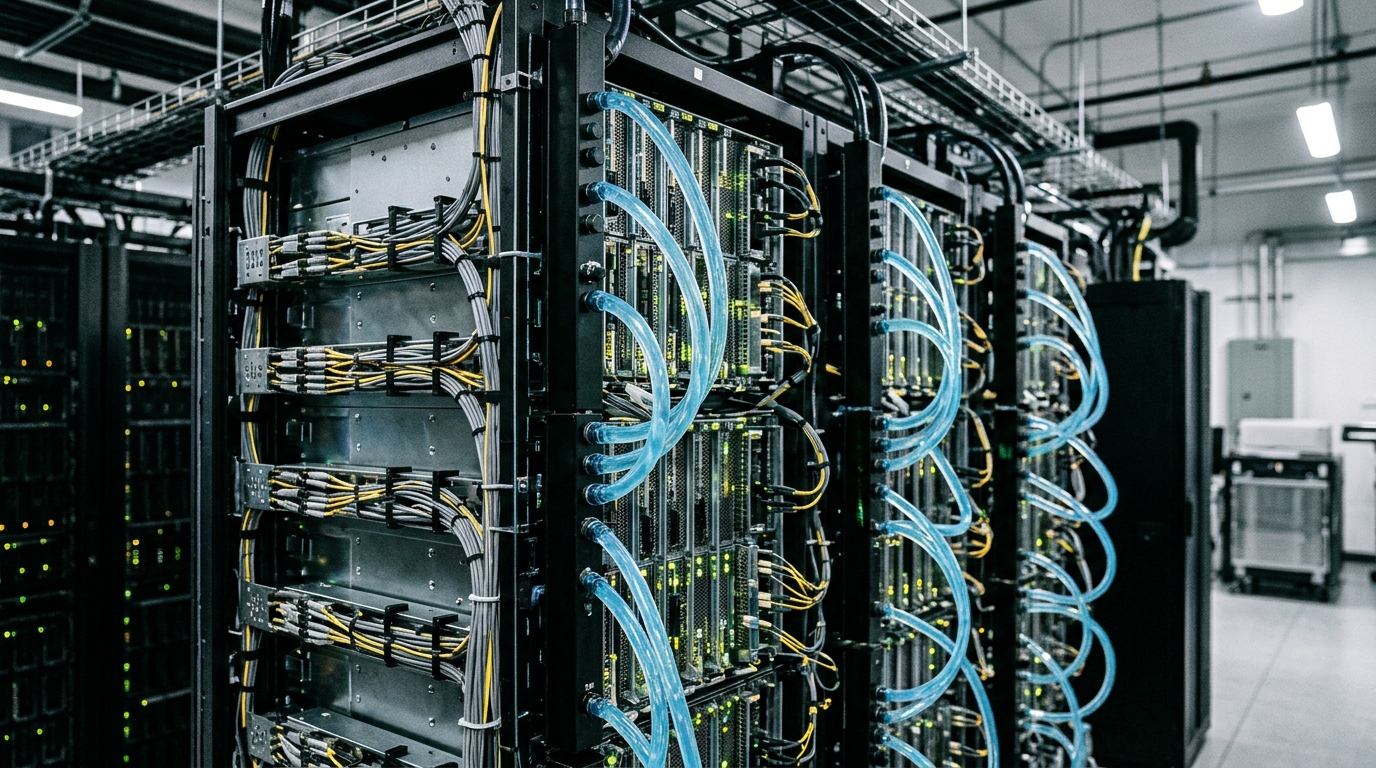
▲ 첨단 수랭식 냉각 배관과 초고속 광섬유망으로 연결된 차세대 인공지능 데이터센터 서버 랙 전경. 개당 4만 달러에 달하는 블랙웰 칩의 발열 문제와 고객사 납품 일정이 시험대에 올랐다. / 차세대 AI 컴퓨팅 인프라 보도 사진 자료
포스트 젠슨 황의 안개… '재무통' 크레스 임시 체제와 2인자 없는 승계 위기
창사 이래 33년간 모든 전권이 1인에게 집중되었던 엔비디아는 사상 초유의 거버넌스 재편에 착수했습니다. 이사회는 시장의 충격을 완화하기 위해 베테랑 최고재무책임자(CFO)인 콜레트 크레스를 임시 최고경영자로 긴급 선임했습니다. 크레스는 오랜 기간 회사의 재무 건전성을 책임져 온 인물로 시장 안정화에는 최적이지만, 기술 개발과 비전을 이끌 엔지니어링 리더십에는 한계가 있다는 평가를 받습니다.
동시에 1993년부터 이사로 재직한 하비 존스가 역사상 최초의 독립 이사회 의장으로 취임하며 1인 제왕적 통치 구조의 종식을 선언했습니다. 그러나 가장 심각한 문제는 사내에 준비된 차기 후계자가 전무하다는 점입니다. 젠슨 황은 생전 약 60명에 달하는 핵심 임원들로부터 일대일 직속 보고를 받는 수평형 구조를 고수해 왔고, 후계자 양성을 의도적으로 기피해 왔기 때문입니다.
현재 차기 사령탑 후보로는 엔비디아 출신인 르네 하스 Arm 최고경영자, 강력한 라이벌인 리사 수 AMD 대표, 그리고 트럼프 대통령이 공개 추천한 팀 쿡 애플 대표까지 거론되고 있습니다. 엔비디아는 글로벌 헤드헌팅 업체를 통해 외부 영입 절차를 밟고 있으나, 창업자의 독보적인 카리스마와 결단력을 온전히 대체하기까지는 상당한 진통이 불가피합니다.
4만 달러 '블랙웰'의 발열 결함과 대중국 매출 '0원'의 이중 악재
경영진 공백과 더불어 엔비디아의 핵심 기술과 시장 기반에도 심각한 균열이 발생하고 있습니다. 개당 가격이 4만 달러(약 5,584만 원)에 달하는 차세대 인공지능 가속기 블랙웰은 설계 초기부터 극심한 발열과 물리적 결함에 시달렸습니다. 젠슨 황은 사임 전 공식 석상에서 정상 구동을 위해 칩셋 내부의 7가지 반도체를 처음부터 다시 설계해야 했다고 시인한 바 있습니다.
재설계 이후에도 고집적 서버 랙 환경에서 심각한 과열 현상이 지속되자, 엔비디아는 협력사들에게 서버 랙 구조 설계를 재차 변경할 것을 요청했습니다. 이로 인해 마이크로소프트, 메타, 구글 등 주요 고객사들의 데이터센터 구축 일정이 줄줄이 지연되는 차질을 빚고 있습니다.
지정학적 리스크 역시 엔비디아의 숨통을 조이고 있습니다. 미국 상무부는 싱가포르 등 제3국을 통한 우회 수출로를 원천 봉쇄하기 위해 반도체 시리얼 번호를 일일이 대조하는 전수 추적 시스템을 가동했습니다. 과거 엔비디아 데이터센터 매출의 20% 이상을 차지하던 중국 시장의 공식 매출은 사실상 0원으로 전락했습니다. 젠슨 황 스스로도 "중국 시장을 화웨이에 통째로 내주었다"고 한탄했듯이, 중국의 토종 기술 자립은 엔비디아에 영구적인 시장 상실을 안겨주었습니다.
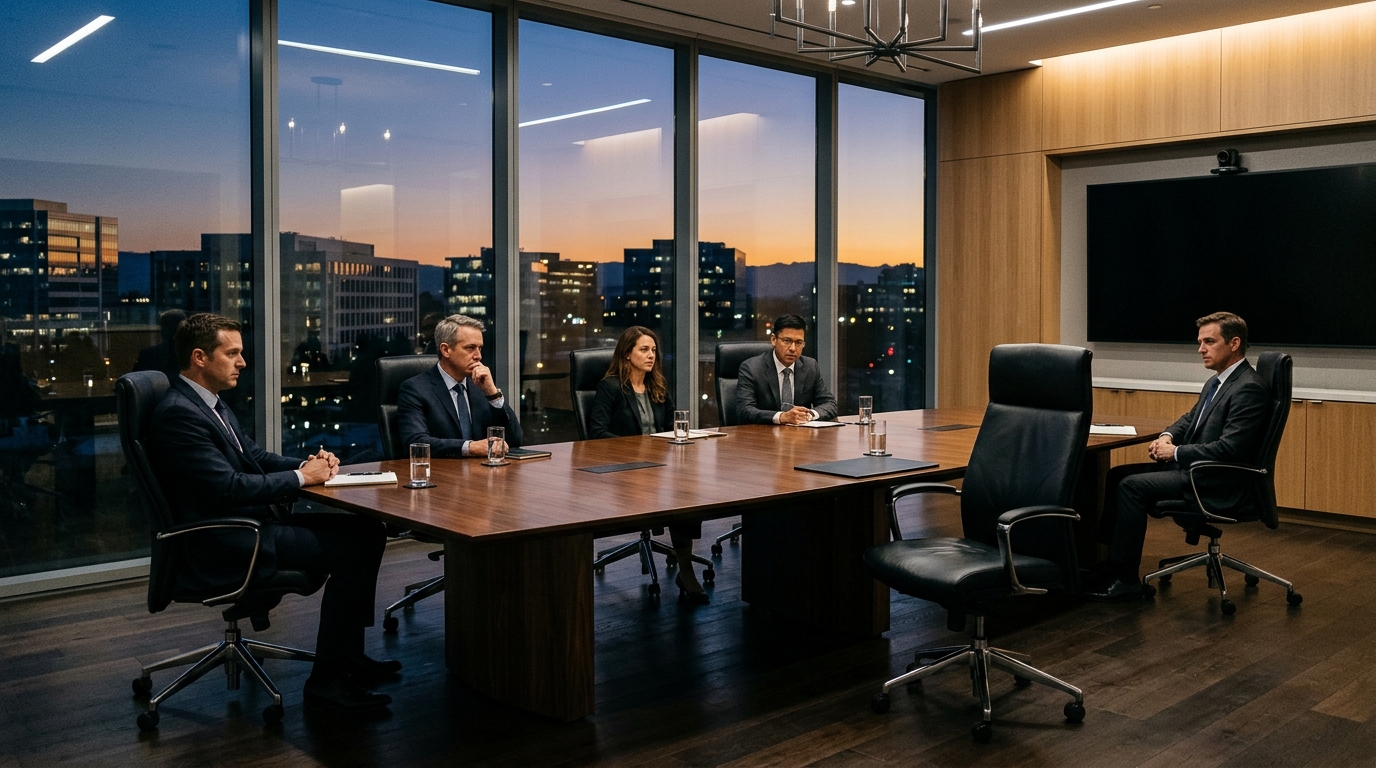
▲ 실리콘밸리 기업 회의실 전경. 33년간 모든 결정을 독점해 온 창업자의 빈자리를 채우기 위한 독립 이사회와 차기 경영진 인선 작업이 긴박하게 진행되고 있다. / 실리콘밸리 기업 지배구조 보도 사진 자료
10조 원 '한국 26만 개 공급'과 시총 4.5조 신화가 남긴 뼈아픈 역설
젠슨 황의 퇴진은 대한민국 산업계에도 막대한 후폭풍을 예고하고 있습니다. 젠슨 황은 지난해 정상급 회담을 거쳐 총 10조 원 규모에 달하는 차세대 블랙웰 GPU 26만 개를 한국에 우선 배정하기로 전격 약속했습니다. 삼성전자 5만 개, SK하이닉스 5만 개, 현대자동차 5만 개, 네이버 6만 개, 그리고 정부 5만 개로 구성된 이 프로젝트는 한국을 세계 3위권 인공지능 강국으로 도약시킬 핵심 인프라 청사진이었습니다.
그러나 강력한 톱다운 결단력을 행사하던 젠슨 황이 사라진 임시 체제에서는 의사결정 속도가 지연되거나 국가별 물량 배정의 우선순위가 재조정될 수 있다는 우려가 커지고 있습니다. 반면 고대역폭 메모리(HBM)를 생산하는 국내 반도체 기업들에게는 고객 다변화의 계기가 될 수 있다는 신중한 낙관론도 함께 교차하고 있습니다.
결국 이번 사태는 기업의 지배구조에 대한 뼈아픈 교훈을 남겼습니다. 엔비디아는 이직률 2.7%, 직원 지지율 98%라는 완벽한 '원팀' 조직문화를 자랑했으나, 그 이면에는 1인의 제왕적 권한을 견제할 수 있는 시스템이 전무했습니다. 단 한 사람의 낙마로 전 세계 1위 기업 전체가 마비되는 초유의 사태는, 아무리 찬란한 성공 신화라도 투명한 거버넌스가 결여되면 하루아침에 모래성처럼 흔들릴 수 있음을 증명하고 있습니다.
WORLDWIDE SPECIAL INVESTIGATION | Global Tech Hegemony and Corporate Governance Analysis
Official Editorial Release | Global News Desk
[EXCLUSIVE] The Fall of the $144 Billion Emperor: Inside Jensen Huang's Ouster and the $130 Billion Trust Shield
Photo coverage of the corporate governance transformation at Nvidia following the abrupt resignation of founder Jensen Huang after 33 years of undisputed leadership. / Global Semiconductor Governance Press Archive
Reigning as the supreme architect of the global computing revolution after catapulting Nvidia to a historic $4.5 trillion market capitalization, founder Jensen Huang—commanding a personal fortune of $144.5 billion—has abruptly resigned in disgrace following explosive national security allegations and ethics investigations. As federal authorities confirmed an inquiry into foreign intelligence contacts and workplace misconduct, the unprecedented fall of Silicon Valley's most powerful chief executive triggered an instant $600 billion wipeout in enterprise valuation, fueling market anxiety over whether his $130 billion equity stake would flood global exchanges. However, a forensic examination of regulatory filings reveals that 92 percent of Huang's shareholdings are legally locked inside an impenetrable joint-trust structure co-managed with his wife Lori Huang, completely insulating the stock against panic dumping. From potential $75 billion community property divorce calculations and a high-stakes leadership vacuum with no institutional heir, to thermal design flaws hobbling the $40,000 Blackwell accelerator and the precarious fate of South Korea's 260,000-unit GPU alliance, this comprehensive investigation unpacks the anatomy of Nvidia's greatest corporate reckoning.
The Disgraceful Exit After 33 Years: Alice Huang and the Federal Inquiry
The 33-year reign of Jensen Huang, who built a modest startup into the world's most valuable enterprise with a historic 4.5-trillion-dollar valuation, came to an abrupt and ignominious conclusion. On November 12, the Nvidia board of directors announced Huang's immediate resignation as chief executive officer. The catalyst behind this sudden departure extended far beyond personal misconduct, entangling national security vulnerabilities and high-stakes geopolitical competition.
According to international reports, the individual identified in the workplace ethics breach was Alice Huang, a former executive at Megaspeed. Taiwanese media raised serious questions regarding potential links to intelligence apparatuses within China's Ministry of State Security. While Chinese diplomatic officials vehemently dismissed these claims, the Federal Bureau of Investigation initiated inquiries, and President Donald Trump publicly confirmed federal oversight.
Although an independent board committee affirmed that proprietary source code and technical blueprints were not compromised, subsequent allegations involving internal employees compounded the crisis. In an emotional farewell memo to staff, Huang admitted personal failure and profound remorse toward his spouse. Concurrently, Huang forfeited approximately 108 million dollars in unvested performance shares, while Nvidia equity shed roughly 600 billion dollars in intraday market value.
The Fate of $144 Billion Wealth: Joint Trusts and the $75 Billion Divorce Calculation
With Jensen Huang's total personal fortune estimated at 144.5 billion dollars, Wall Street immediately confronted the specter of a massive overhang event—specifically, whether his 3.58 percent equity stake in Nvidia, valued at roughly 130 billion dollars, would be liquidated across public exchanges. However, a rigorous analysis of regulatory filings submitted to the Securities and Exchange Commission establishes that short-term dumping is legally impossible.
Huang directly controls only 70.1 million shares (roughly 12 billion dollars), representing merely 8 percent of his total holdings. The overwhelming balance of 92 percent—encompassing 669 million shares—is legally segregated within living trusts, irrevocable entities, and limited liability corporations co-managed with his wife Lori Huang. Neither party can unilaterally sell shares or alter voting rights without reciprocal consent and formal legal authorization.
While Lori Huang has not filed for legal separation or marital dissolution, California's statutory community property framework would establish her entitlement at between 75 billion and 77.5 billion dollars in the event of formal divorce proceedings. Family law and estate specialists note that both parties have strong economic incentives to avoid open-market block sales that would trigger catastrophic share price declines, favoring structured settlements utilizing cash reserves and alternative assets.
Hyperscale artificial intelligence datacenter server racks equipped with advanced liquid cooling distribution systems. Thermal dissipation challenges on the 40,000-dollar Blackwell processor have strained client delivery schedules. / Advanced Computing Infrastructure Press Archive
The Leadership Vacuum: Interim Chief Colette Kress and the Succession Dilemma
Accustomed to 33 years of centralized governance under a single founder, Nvidia has been forced into an emergency leadership transition. The board installed veteran Chief Financial Officer Colette Kress as interim chief executive officer to stabilize operations and reassure institutional shareholders. While Kress possesses peerless mastery over capital structure and Wall Street communications, industry observers note her lack of technical engineering pedigree.
Concurrently, Silicon Valley veteran Harvey C. Jones was appointed the first independent board chairman in corporate history, establishing formal corporate checks. Nonetheless, the core dilemma remains a complete absence of an internal crown prince. Huang famously maintained a flat reporting architecture where roughly 60 senior executives reported directly to him, purposefully avoiding the designation of an operational second-in-command.
Prominent external contenders highlighted by financial media include Arm chief executive Rene Haas—himself an Nvidia alumnus—as well as AMD leader Lisa Su and Apple head Tim Cook, whom President Trump publicly endorsed. Retaining executive search firms to evaluate candidates, Nvidia faces the delicate challenge of preserving its innovation cadence without Huang's charismatic leadership.
The $40,000 Blackwell Thermal Snags and Chinese Market Revenue at Zero
Beyond executive turmoil, Nvidia's product pipeline and geopolitical landscape face compounding pressures. The flagship Blackwell accelerator, commanding a unit price tag near 40,000 dollars, has encountered structural yield and thermal dissipation bottlenecks. Prior to his exit, Huang publicly disclosed that engineers had to fundamentally redesign seven distinct silicon components inside the packaging architecture to ensure operational viability.
Even following component-level revisions, severe server rack overheating persists in high-density hyperscale deployments, prompting Nvidia to request structural alterations from chassis manufacturers. Consequently, deployment timelines for anchor customers including Microsoft, Meta, and Alphabet have experienced operational friction.
Simultaneously, aggressive enforcement by the Department of Commerce has severed clandestine diversion channels through Southeast Asian hubs. With federal authorities tracking individual silicon serial numbers, official Chinese data center compute revenue has effectively collapsed to zero dollars. Huang's own concession that Nvidia ceded mainland dominance to domestic champion Huawei marks a permanent structural realignment of global technology demand.
Silicon Valley corporate boardroom at twilight. The independent board of directors navigates the search for permanent executive leadership following three decades of centralized founder authority. / Silicon Valley Corporate Governance Press Archive
The $7 Billion South Korea Alliance and the Paradox of Imperial Culture
The shockwaves of Huang's ouster reverberate across South Korea's technology sector. During high-level multilateral summits last year, Huang finalized an extraordinary agreement committing 260,000 Blackwell processors valued at approximately 7 billion dollars across South Korea's industrial giants. Allocating 50,000 units each to Samsung Electronics, SK Hynix, Hyundai Motor Group, and the national government, alongside 60,000 to Naver, the pact aimed to cement Korea as the world's third-largest artificial intelligence compute hub.
Without Huang's personal commitment to prioritize the alliance, domestic conglomerates face potential timeline delays or quota renegotiations under interim management. Conversely, global hyperscalers seeking to diversify away from Nvidia hardware may create fresh commercial opportunities for South Korean memory leaders supplying high-bandwidth memory (HBM) modules.
Ultimately, Nvidia's crisis delivers an enduring governance lesson. The company prided itself on an enviable corporate culture featuring a 2.7 percent turnover rate and 98 percent CEO approval ratings under its 'One Team' doctrine. Yet this collaborative veneer concealed an absolute monarchy where institutional oversight was absent. The overnight vulnerability of a 4.5-trillion-dollar colossus demonstrates that visionary brilliance without robust governance mechanisms remains perilously fragile.
Asset & Ownership Category
Share Volume / Valuation
Fiduciary Authority
Disposal Constraints and Market Implications
Direct Personal Ownership
70.1 Million Shares (~$12 Billion)
Jensen Huang Sole Title
Subject to internal insider trading and volume limits
Three Family Co-Trusts
669 Million Shares (92% of Total)
Jensen Huang & Lori Huang Co-Trustees
Requires mutual consent and court approval (Zero overhang)
Family Philanthropic Foundation
58.7 Million Shares (~$9 Billion)
Lori Huang President & Director
Charitable nonprofit assets barred from private monetization
Lori Huang Sole Trust
~$5 Billion in Assets
Lori Huang Sole Trustee
Completely autonomous without Jensen Huang authority
California Divorce Potential
$75 Billion to $77.5 Billion
Statutory Community Property Division
Structured cash and asset transfers favor preserving equity
MANINTOP Worldwide Tech and Global Finance Editorial Desk
Reporting and Production Director: Seung Youb Ssin, Publisher and Editor-in-Chief
Official Distribution: information.youngsdaily.com
1월이 시작되면 감기는 이미 우리 곁에 와 있습니다. 2월, 3월, 4월까지 이어지는 추위와 건조함은 코와 목을 가장 먼저 공격합니다. 아침에 일어나자마자 막혀 있는 코. 계속 흐르는 콧물. 괜히 칼칼해지는 목. 이 증상은 “시작”일 뿐입니다. 한 번 무너지면 일주일, 길면 한 달까지 끌고 갑니다. 약을 먹으면 잠깐 괜찮아집니다. 하지만 며칠 뒤 또 반복됩니다. 왜일까요? 감기는 ‘치료’의 문제가 아니라 ‘관리’의 문제이기 때문입니다. 대부분은 감기가 오고 나서 약을 찾습니다. 하지만 진짜 중요한 건 감기가 오기 전에 코와 목을 지키는 것입니다. 건조한 실내 공기, 차가운 바깥 공기, 눈에 보이지 않는 세균. 코와 목은 매일 공격받고 있습니다. 지긋지긋하죠! 그런데도 우리는 아무 준비 없이 버티고 있습니다. 이번 겨울도 그렇게 보낼 건가요? 사실 방법은 어렵지 않습니다. 코를 깨끗하게 관리하고, 목을 따뜻하게 보호하고, 점막을 촉촉하게 유지하고, 기관지를 미리 관리하고, 외부 공기를 차단하는 것. 이 다섯 가지만 꾸준히 해도 감기약 없이 겨울을 보내는 것이 충분히 가능합니다. 🔥 이제부터 그 방법을 하나씩 살펴보겠습니다. 🔥 1. 코와 목을 먼저 관리해야 하는 과학적 이유 감기의 대부분은 코 점막에서 시작됩니다. 국제 학술지 Nature Reviews Microbiology 와 Journal of Allergy and Clinical Immunology 에 실린 호흡기 감염 관련 연구들에서는, 감기 바이러스가 비강 상피세포에 먼저 부착해 증식한다는 점을 설명하고 ...
리모델링사업이 진행 중인 아파트를 매매할 때 “계약금 10%를 언제까지 내야 하느냐”는 질문이 특히 많이 나옵니다. 이주공고(이주 안내)가 7~11월쯤이라고 들으면, 그 시점에 맞춰 계약금도 움직일 것 같아서 더 헷갈리기 쉽습니다. 하지만 실제 납부기한은 ‘이주공고가 언제냐’만으로 자동 결정되지 않는 경우가 많습니다. 1) 계약금 10% 납부기한: 결국 ‘문서에 적힌 일정’이 기준 계약금 10%를 언제까지 납부해야 하는지는, 내가 서명하는 매매계약서(특약 포함) 와 사업주체/조합이 제시한 공고·안내문 에 적힌 납부 일정이 기준이 됩니다. 실제 공고문에서는 분양대금 납부의 큰 틀(계약금→중도금→잔금)을 먼저 안내하고, 상세 일정은 별도 표나 유의사항으로 제시하는 방식이 흔합니다. 또, 계약서 문구에 따라 지급 시점이 조건부로 설정될 수도 있습니다. 예를 들어 한 사례 소개 자료에서는 용역계약서에 잔금(10%) 지급시기가 “사업승인 후”로 기재되어 있었다는 점이 언급됩니다. 이런 식으로 ‘사업 단계’와 지급을 연동하는 문구가 들어가면, 질문의 답은 계약서 문구를 확인해야만 확정됩니다. 관련 내용은 링크 에서 문구 사례를 확인할 수 있습니다. 2) 입주자모집공고에서 확인되는 ‘납부 순서’와 잔금 마감 시점 공고문에 적힌 문구를 보면, 납부 순서와 잔금 마감에 대한 기준이 비교적 명확하게 제시되는 경우가 있습니다. 예를 들어 한 입주자모집공고에는 “분양금액(주택가격)은 계약금, 중도금, 잔금의 순서로 납부”하며 “잔금은 입주(열쇠 수령일) 전에 완납”해야 한다고 안내되어 있습니다. (문구 확인: 링크 ) 이 문구가 의미하는 바는 최소 2가지입니다. 분양/공급 형태의 문서에서는 ‘계약금→중도금→잔금’ 흐름이 공식적으로 안내될 수 있습니다. 잔금은 “입주(열쇠 수령)” 이전에 완납해야 한다는 마감 기준이 문서에 적혀 있을 수 있습니다. 다만, 위 공고문 문구는 잔금 마감에 대한 기준을 보여주지만, 계약금 10%의...
윤석열 전 대통령 탄핵 인용 소식을 접하면, 가장 궁금한 지점은 ‘헌재가 정확히 무엇을 위헌·위법으로 봤는가’입니다. 또한 탄핵과 별개로 진행되는 형사재판(내란 우두머리 혐의 등)이 어디까지 왔는지도 함께 정리할 필요가 있습니다. 아래 내용은 제공된 기사/게시물 스니펫과 링크에서 확인되는 범위만 모아, 일반인이 흐름을 이해하기 쉽게 정리한 것입니다. 1) 탄핵 인용 관련: 스니펫에서 확인되는 ‘판단의 골격’ 제공된 근거 중 조국혁신당 사이트에는 헌법재판소가 윤석열 탄핵 심판에서 “피청구인의 위헌·위법행위는 국민 신임 …”이라는 취지로 판단했다는 문장이 인용돼 있습니다( 링크 ). 이 인용문만 놓고 보면, ‘위헌·위법행위’가 있었는지와 그로 인해 ‘국민의 신임’이 어떻게 평가됐는지가 핵심 축으로 소개됩니다. 다만 질문에서 요청하신 세부 항목, 즉 비상계엄 선포 자체를 문제 삼은 구체적 이유, 계엄 이후 조치(포고령, 국회 통제 등)의 어떤 지점이 헌법 위반인지, 국회의 권한행사 방해 및 정치활동 제약을 어떤 논리로 판단했는지 등은, 이번에 제공된 근거의 제목/스니펫만으로는 조항·사실관계·판단 구조가 그대로 제시돼 있지 않습니다. 따라서 이 글에서는 ‘헌재가 무엇을 문제 삼았다’는 세부 리스트를 단정적으로 재구성하기보다, 현재 확인 가능한 문구 수준의 요약(위헌·위법행위 → 국민 신임의 문제로 평가)까지만 적습니다. 만약 헌재 결정문 전문(주문 및 이유)이 추가로 확인되면, 그때는 문장 단위로 ‘어떤 행위’와 ‘어떤 헌법 원리/조항’이 연결되는지(예: 권력분립, 국회의 권한, 정치적 기본권 등) 구조화해 정리하는 것이 가장 정확합니다. 2) 형사 절차(내란 혐의) 관련: 체포영장과 1심 선고 언급 탄핵 심판과 별도로, 12·3 비상계엄 사태로 내란 혐의를 받는 윤석열 대통령에 대해 2024년 12월 31일 체포 영장이 발부됐다는 BBC 보도가 있습니다( 링크 ). 해당 보도는 ‘현직 대통령’에 대한 체포영장 발부라는 점을 함께 언급합니다. 또...