2025-2026절기 독감 3가 전환과 코로나19 동시접종: 이상반응 0.035% 팩트와 국가보상 총정리
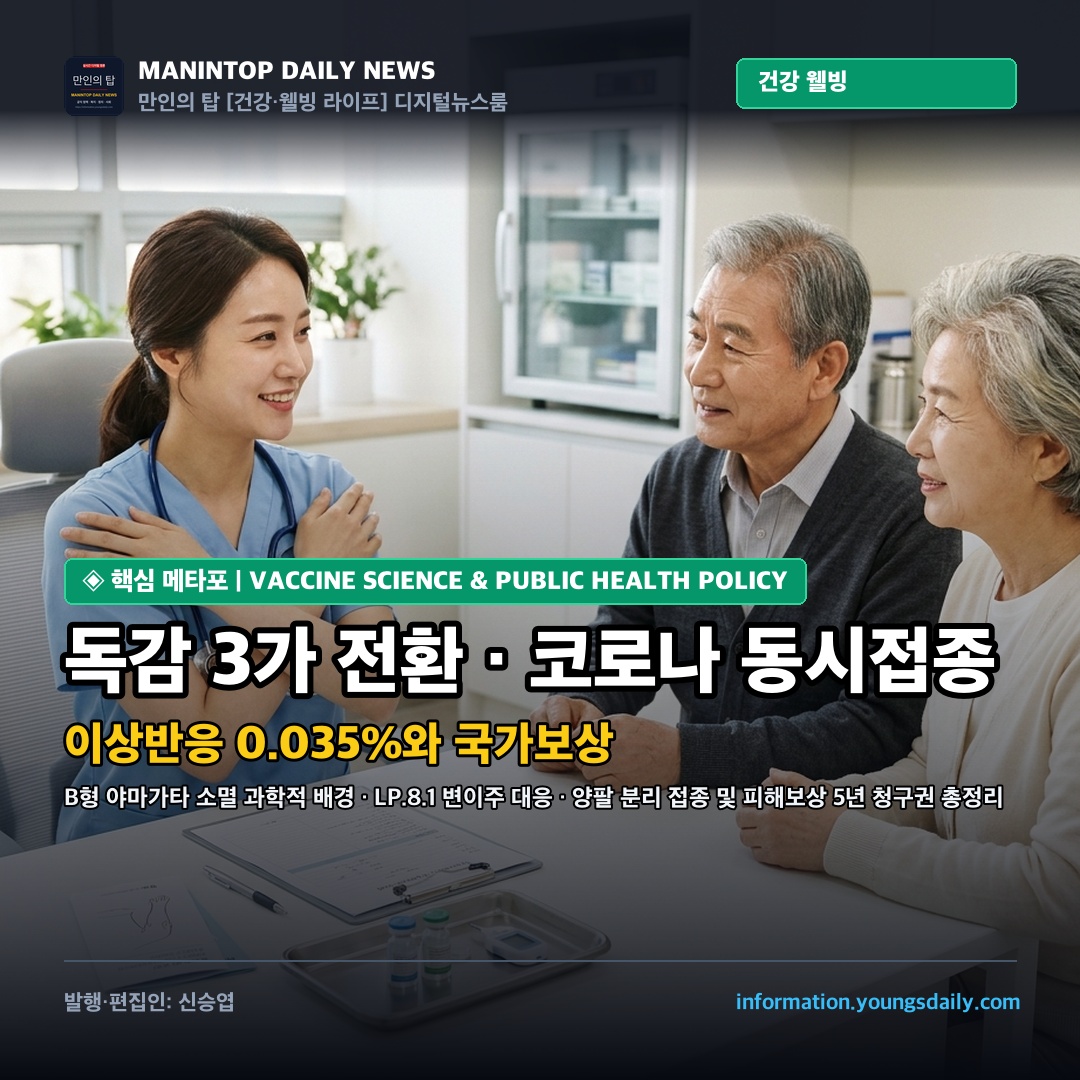
▲ 서울 시내 예방접종 전담 클리닉에서 간호사가 어르신 부부에게 인플루엔자 3가 백신과 코로나19 LP.8.1 단가 백신의 양팔 분리 접종 원칙을 친절히 안내하고 있다. 동시접종은 병원 방문 번거로움을 줄이고 겨울철 중증 합병증을 막는 핵심 방패다. [사진: 만인의 탑 의학 DB]
1. 독감 백신이 4가에서 3가로 바뀐 이유: B형 야마가타 바이러스의 자연 소멸
이번 2025-2026절기 국가예방접종(NIP) 안내문을 받아본 시민들이 가장 먼저 품는 의문은 "왜 4가였던 독감 백신이 3가로 줄었는가"입니다. 가수가 줄어들었다고 하니 혹시 예방 효과나 방어 범위가 후퇴한 것은 아닌지 걱정하는 목소리가 적지 않습니다.
하지만 결론부터 말씀드리면 이는 방어력 축소가 아니라, 전 세계 바이러스 생태계 변화에 맞춘 국제 공인의 '과학적 최적화'입니다. 세계보건기구(WHO)와 질병관리청의 공식 발표에 따르면, 기존 4가 백신에 포함되어 있던 4개 바이러스주(A형 H1N1, A형 H3N2, B형 Victoria, B형 Yamagata) 중 'B형 야마가타(Yamagata)' 계통 바이러스가 2020년 3월 코로나19 팬데믹 발발 이후 전 세계 감시망에서 단 한 건도 검출되지 않았습니다. 인류의 마스크 착용과 손 씻기, 국가 간 이동 제한 등 강력한 방역 조치 속에서 야마가타 바이러스가 지구상에서 사실상 자연 소멸된 것입니다.
자연계에 더 이상 존재하지 않는 유령 바이러스 항원을 백신에 계속 넣을 이유는 없습니다. 이에 따라 WHO는 백신 조성에서 야마가타 항원을 제외할 것을 공식 권고했고, 미국은 이미 2024-2025절기에 선제적으로 3가 백신으로 전환을 완료했습니다. 대한민국 질병관리청 예방접종전문위원회 역시 심의를 거쳐 2025년 8월 28일 이번 절기 국가필수예방접종 백신을 3가(A형 2종 + B형 빅토리아 1종)로 최종 확정했습니다. 불필요한 항원을 덜어냄으로써 백신 생산의 정밀도와 공급 안정성을 극대화한 합리적 결정입니다.
| 비교 항목 | 기존 4가 백신 체제 | 2025-2026절기 3가 전환 체제 | 정책적 의의 |
|---|---|---|---|
| 포함 바이러스 항원 | A형(H1N1, H3N2) + B형(빅토리아, 야마가타) | A형(H1N1, H3N2) + B형(빅토리아) | B형 야마가타 계통 공식 제외 |
| 도입 배경 및 근거 | 두 가지 B형 바이러스의 동시 유행 방어 | 2020년 이후 전 세계 자연 소멸 확인 | WHO 공식 권고 및 질병관리청 심의 확정 |
| 글로벌 동기화 현황 | 전 세계 표준 규격 운영 | 미국(24-25 선도), 영국·일본·한국(25-26) | 국제 감염병 표준 규격 전면 일치 |
| 면역 방어력 영향 | 유행 항원 및 미유행 항원 혼합 | 실제 유행 바이러스 100% 방어 유지 | 방어력 손실 없는 정밀 생산 최적화 |
2. 코로나19 최신 변이 'LP.8.1' 단가 백신과 고면역원성 백신의 진화
코로나19 바이러스는 끊임없는 변이를 통해 기존 항체를 회피하려는 특성이 강합니다. 질병관리청은 2025년 하반기부터 국내외 호흡기 감염병의 주류로 자리 잡은 오미크론 하위 계통의 'LP.8.1' 변이주(JN.1 계통의 직계 후손)를 이번 절기 신규 단가 백신의 단일 표적으로 채택했습니다.
미국 식품의약국(FDA) 백신·생물의약품자문위원회(VRBPAC)는 LP.8.1 단가 백신 도입을 만장일치로 의결했으며, 국내 유행 변이인 NB1.8.1 및 해외 유행 변이인 XFG와의 교차 중화항체 형성 시험에서도 뛰어난 면역 반응을 나타냈습니다. 특히 65세 이상 고령층과 면역저하자는 백신 접종이나 감염으로 형성된 항체의 유효 반감기가 3~6개월로 짧기 때문에, 과거에 백신을 맞았거나 감염된 적이 있더라도 올겨울 새로운 변이에 맞춘 백신을 다시 접종하는 것이 필수적입니다.
백신 제조 방식에서도 주목할 변화가 있습니다. 전통적인 독감 백신은 유정란(달걀)에서 바이러스를 증식시키는 방식을 사용해 왔으나, 바이러스가 달걀 단백질에 적응하는 과정에서 미세한 돌연변이(egg-adaptation)를 일으켜 실제 유행 바이러스와의 일치도가 낮아지는 한계가 지적되어 왔습니다. 반면 동물 세포를 배양해 만드는 '세포배양 독감 백신'은 이러한 변이를 원천 차단해 항원 일치도가 매우 높습니다. 특히 계란을 먹고 전신 두드러기나 호흡 곤란을 겪는 중증 계란 알레르기 환자의 경우 보건소나 지정 의료기관에서 세포배양 백신을 지원받을 수 있습니다. 여기에 더해 면역 노화로 항체 형성이 더딘 고령층을 위해 일반 백신보다 항원량을 4배 늘린 고용량(High-Dose) 백신이나 면역증강제(MF59)를 배합한 고면역원성 백신도 비급여 선택지로 활발히 처방되고 있습니다.
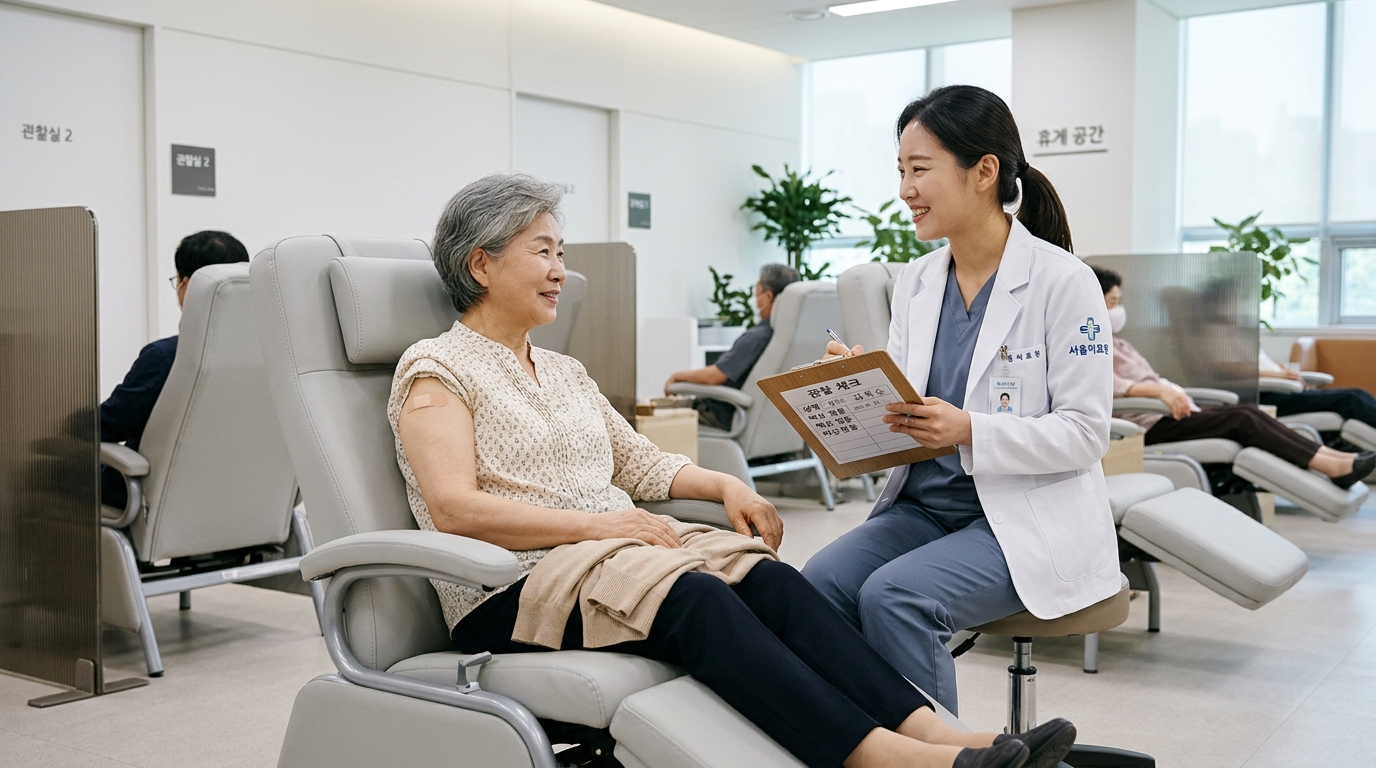
▲ 접종 의료기관의 관찰 휴게실에서 접종을 마친 시민이 체크리스트를 확인하는 전담 의료진의 보살핌 속에 20~30분간 머무르며 급성 이상반응 여부를 관찰하고 있다. 충분한 원내 대기는 안전 접종의 제1원칙이다. [사진: 만인의 탑 의학 DB]
3. 코로나19·독감 동시접종 팩트체크: 30만 명 실사용 데이터가 증명한 0.035%
"같은 날 양팔에 백신 두 대를 한꺼번에 맞으면 부작용이 두 배로 커지거나 면역 반응이 서로 충돌하지 않을까?" 많은 국민들이 접종 직전까지 가장 크게 망설이는 대목입니다.
그러나 국가 통계와 대규모 글로벌 임상시험 결과는 이 같은 우려가 기우임을 명백한 숫자로 보여줍니다. 질병관리청이 2022-2023절기 국가 예방접종 사업에 참여한 국민 중 독감 백신과 코로나19 백신을 같은 날 동시에 접종받은 30만 8,117명을 전수 분석한 결과, 방역당국에 보고된 이상반응 의심 신고는 단 108건에 불과했습니다. 동시접종자 대비 신고율은 0.035%로 극히 미미한 수준이었으며, 신고된 증상의 대다수 역시 주사 부위 통증, 미열, 뻐근함, 가벼운 근육통 등 며칠 내 자연 회복되는 일시적 경증 반응이었습니다.
학술적 유효성도 확고히 입증되었습니다. 국제 저명 학술지 란셋 계열의 'eClinicalMedicine(2025년)'에 게재된 1,499명 대상 3상 무작위 배정 임상시험에서 독감과 코로나19 백신을 동시 투여한 집단은 각각 따로 맞은 집단과 비교했을 때 중화항체 역가와 면역 반응에서 완벽한 '비열등성(동등 이상의 효과)'을 입증했으며 중대한 안전성 차이는 전혀 발생하지 않았습니다. 대한백신학회 추계학술대회에서 발표된 연구에서도 동시접종이 단독 접종과 대등한 높은 항체 형성을 유도함이 재확인되었습니다. 병원을 두 번 찾아가는 번거로움을 덜면서 겨울철 감염병 트윈데믹(동시 유행)을 한 번에 예방할 수 있는 가장 효율적인 전략입니다.
다만 안전한 동시접종을 위해서는 의료진과 환자 모두가 지켜야 할 철칙이 있습니다.
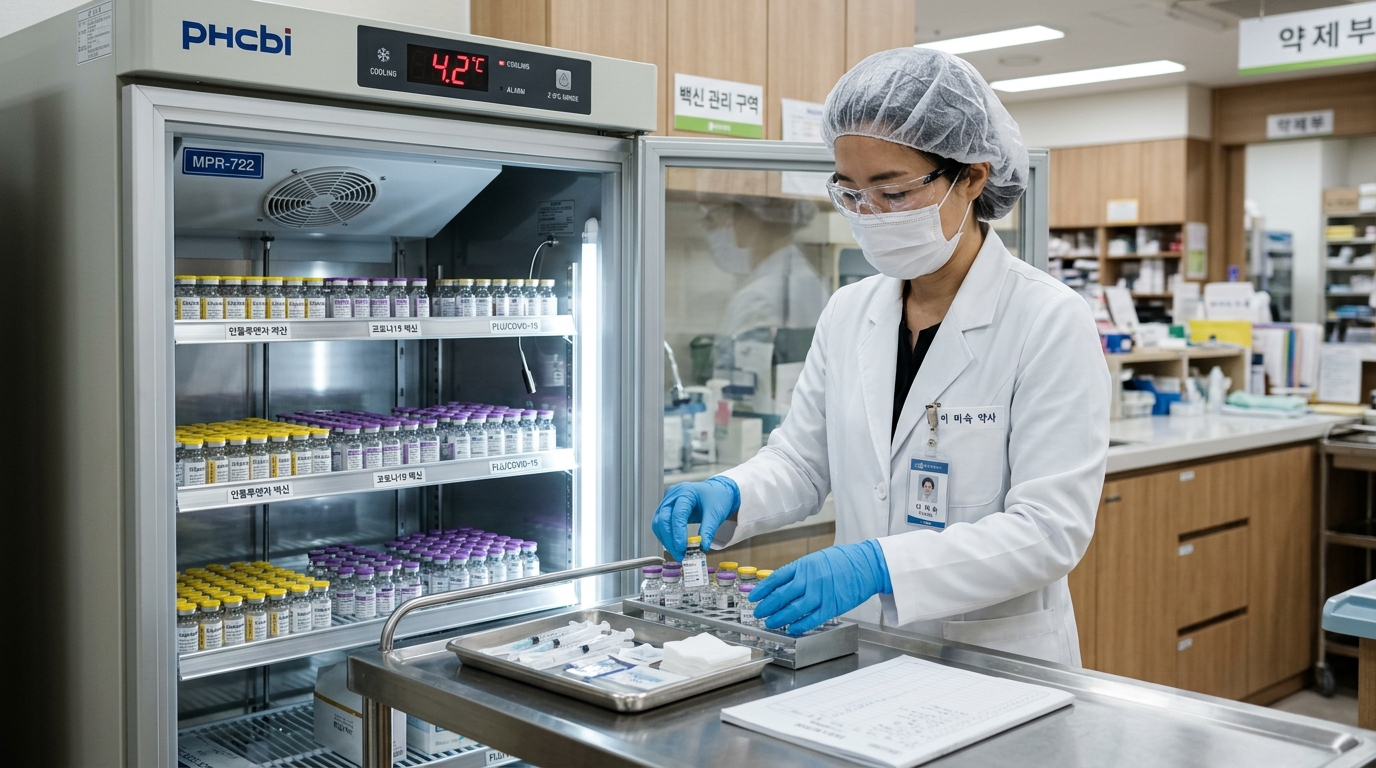
▲ 병원 약제부 클린벤치에서 약사가 4.2℃ 정밀 적정 온도로 유지되는 전문 콜드체인 냉장고에서 인플루엔자 및 코로나19 백신 바이알을 꺼내 무균 조제대를 거쳐 안전하게 검수하고 있다. [사진: 만인의 탑 의학 DB]
4. 국민 실생활 Q&A: 주사 부위 문지르기부터 독감 치료제 보험 혜택까지
예방접종을 둘러싸고 인터넷 커뮤니티나 단체 대화방에 떠도는 수많은 속설 중 잘못된 상식을 의학 팩트로 바로잡습니다.
5. 복수 백신 접종 간격 규정: 사백신과 생백신의 '4주 간격' 공식
가을과 겨울철에는 독감, 코로나19뿐만 아니라 폐렴구균, 대상포진, 파상풍 백신까지 함께 맞으려는 분들이 많습니다. 백신의 종류에 따라 지켜야 할 간격 규정을 완벽히 숙지해야 합니다.
가장 핵심적인 원칙은 '불활성화 백신(사백신)'과 '약독화 생백신(생백신)'의 구분입니다. 독감, 코로나19, 파상풍(Tdap), 폐렴구균, A·B형 간염 등 병원체를 죽여서 만든 불활성화 백신끼리는 같은 날 동시에 맞아도 되고, 날짜를 달리하여 맞더라도 최소 대기 기간이 전혀 없습니다. 오늘 독감을 맞고 내일 폐렴구균을 맞아도 면역 형성에 아무런 지장이 없습니다.
반면 살아있는 바이러스를 약화시켜 만든 생백신(MMR, 수두, 대상포진 생백신 등)끼리는 같은 날 동시에 맞거나, 만약 따로 맞을 경우에는 반드시 최소 4주(28일) 이상의 간격을 두어야 합니다. 먼저 투여된 생백신 바이러스가 유도한 체내 인터페론 반응이 뒤이어 들어온 다른 생백신의 증식을 억제해 면역 형성을 방해하기 때문입니다.
특히 65세 이상 어르신들의 폐렴구균 접종 순서도 매우 중요합니다. 대한감염학회 가이드라인에 따르면 15가 단백결합 백신(PCV15)과 23가 다당 백신(PPSV23)을 순차 접종할 경우, 건강한 65세 이상 고령자는 PCV15를 먼저 접종하고 최소 1년 뒤에 PPSV23을 접종하는 것이 가장 높은 항체가를 유도합니다. 다만 면역저하자의 경우 간격을 8주로 단축해 접종합니다. 최근에는 단 한 번의 접종으로 완료하는 20가 단백결합 백신(PCV20)도 널리 활용되고 있습니다.
6. 백신 피해 시 국가가 책임진다: '예방접종피해 국가보상제도' 5년 청구 가이드
접종 후 예기치 못한 이상반응으로 병원 치료를 받게 되었을 때 국가가 법적으로 치료비와 간병비를 물어주는 제도가 바로 감염병예방법 제71조에 따른 '예방접종피해 국가보상제도'입니다. 국민 대다수가 제도의 존재를 몰라 본인 돈으로 치료비를 메우는 안타까운 사례가 많습니다.
제도가 도입된 1995년부터 2024년까지 30년간 질병관리청에 접수된 피해보상 신청 1,640건 중 국가가 보상을 결정한 사례는 870건으로 인용률이 무려 53.0%에 달합니다. 절반 이상의 신청자가 정당한 국가 보상을 받았습니다.
| 보상 급여 종류 | 지급 기준 및 보상 한도 내역 | 법정 소멸시효 |
|---|---|---|
| 진료비 | 건강보험공단 부담금을 제외한 실제 본인부담금 전액 지원 | 피해 발생일로부터 5년 이내 |
| 정액 간병비 | 입원 진료를 받은 경우에 한해 1일당 정액 50,000원 지급 | 피해 발생일로부터 5년 이내 |
| 장애인 일시보상금 | 중증 장애 시 사망보상금의 100%, 경증 장애 시 55% 지급 | 장애 진단일로부터 5년 이내 |
| 사망 일시보상금 | 사망 당시 최저임금법상 월 최저임금액 × 240배 일시 지급 | 사망일로부터 5년 이내 |
| 장제비 | 사망 일시보상금 지급 대상자 유족에게 정액 300,000원 지급 | 사망일로부터 5년 이내 |
보상금 신청은 환자의 주민등록 주소지 관할 보건소에서 연중 수시로 접수할 수 있습니다. 특히 본인부담금 액수에 따라 심의 절차가 두 갈래로 나뉩니다.
2025-2026 Trivalent Flu Transition and COVID-19 Co-Administration: 0.035% Adverse Event Data and National Compensation Guide
▲ A dedicated nurse at a Seoul immunization center explains the dual-arm co-administration protocol for trivalent influenza and COVID-19 LP.8.1 vaccines to an attentive senior couple. Simultaneous administration mitigates healthcare visits while shielding vulnerable populations against respiratory syndemics. [Photo: MANINTOP Medical DB]
1. Why Flu Vaccines Dropped from Quadrivalent to Trivalent: Natural Extinction of the B-Yamagata Lineage
The transition of the 2025-2026 National Immunization Program from quadrivalent to trivalent influenza formulations has prompted questions regarding whether immunological breadth has been compromised.
Epidemiological and virological evidence confirms that this shift represents international consensus rather than a reduction in protection. According to the World Health Organization (WHO) and the Korea Disease Control and Prevention Agency (KDCA), the B-Yamagata lineage virus has had zero detections across global surveillance networks since March 2020. Stringent non-pharmaceutical interventions during the pandemic effectively drove the Yamagata lineage into natural extinction.
Retaining an extinct viral antigen in manufacturing yields no clinical benefit. Consequently, the WHO recommended removing Yamagata from flu formulations. The United States transitioned during the 2024-2025 season, while the United Kingdom, Japan, and South Korea synchronized for the 2025-2026 cycle. On August 28, 2025, the KDCA Expert Committee formally established the national standard as a trivalent vaccine incorporating two influenza A subtypes (H1N1, H3N2) and one influenza B lineage (Victoria). Omitting the obsolete antigen enhances production efficiency and manufacturing purity.
| Metric | Prior Quadrivalent Regimen | 2025-2026 Trivalent Regimen | Strategic Rationale |
|---|---|---|---|
| Antigenic Strains | A(H1N1, H3N2) + B(Victoria, Yamagata) | A(H1N1, H3N2) + B(Victoria) | Complete omission of obsolete B-Yamagata |
| Scientific Basis | Dual B-lineage co-circulation coverage | Documented global extinction since 2020 | WHO directive & KDCA expert consensus |
| Global Adoption | Universal global benchmark | US (24-25), UK, Japan, Korea (25-26) | Synchronized international standards |
| Immunological Efficacy | Mixed active and inactive antigens | Preserves 100% circulating protection | Optimized batch consistency and safety |
2. COVID-19 LP.8.1 Monovalent Vaccine and High-Immunogenicity Platforms
SARS-CoV-2 requires continuous antigenic updates to counteract immune evasion. For the current respiratory season, health authorities designated the LP.8.1 variant: a sublineage of JN.1 dominating transmission across North America, Europe, and Asia: as the primary target antigen.
The US FDA Vaccines and Related Biological Products Advisory Committee (VRBPAC) voted unanimously for LP.8.1 monovalent formulations. Laboratory neutralization assays demonstrated cross-reactive neutralization against emerging variants, including domestic NB1.8.1 and international XFG. Because circulating neutralizing antibody titers decline within 3 to 6 months among older adults and immunocompromised patients, revaccination with an updated variant strain remains essential regardless of previous infection history.
Advances in manufacturing platforms also warrant attention. Conventional egg-based production can induce egg-adaptation mutations during viral passaging, diminishing antigenic fidelity with wild-type strains. Cell-culture influenza vaccines utilize mammalian cell lines, eliminating egg-adaptive alterations. Designated public medical centers offer cell-culture vaccines for patients with documented severe egg anaphylaxis. Furthermore, high-dose formulations containing fourfold antigen concentrations and MF59-adjuvanted vaccines provide specialized alternatives for adults aged 65 and older confronting immunosenescence.
▲ A vaccinated citizen rests in an ergonomic post-injection lounge under nurse observation. Maintaining a mandatory 20 to 30 minute clinical observation interval remains essential for monitoring acute reactogenicity. [Photo: MANINTOP Medical DB]
3. Co-Administration Safety: 300,000 Real-World Doses Validate 0.035% Adverse Event Rate
Concerns over whether simultaneous dual-vaccine administration amplifies side effects or induces immunological interference represent the primary barrier to co-vaccination uptake.
Empirical data refute these concerns. A KDCA registry analysis of 308,117 individuals who received simultaneous influenza and COVID-19 vaccines during the 2022-2023 season documented only 108 suspected adverse event reports: an overall rate of just 0.035%. The vast majority comprised mild, self-limiting local symptoms including injection-site tenderness, low-grade pyrexia, myalgia, and fatigue.
Clinical immunogenicity has likewise been validated. A Phase 3 randomized controlled trial of 1,499 adults published in eClinicalMedicine (2025) demonstrated that simultaneous administration of an mRNA COVID-19 vaccine and a seasonal influenza vaccine achieved non-inferior antibody titers compared to single-agent administration, without elevating safety risks. Similar findings presented by Moderna at the Korean Vaccine Society fall conference confirmed robust antibody responses. Co-administration saves clinical visits while conferring dual protection against seasonal respiratory syndemics.
Safe clinical execution relies on strict procedural guidelines:
▲ A pharmacist inspects influenza and COVID-19 vaccine vials beside a 4.2°C cold-chain medical refrigerator. Precise temperature control and meticulous lot documentation ensure vaccine integrity. [Photo: MANINTOP Medical DB]
4. Everyday Clinical Guidelines: Rubbing Versus Pressing and Antiviral Coverage
Navigating common questions surrounding post-vaccination care ensures maximum clinical benefit and alleviates unwarranted anxiety.
5. Multi-Vaccine Spacing Guidelines: Inactivated Versus Live Formulations
Adult patients frequently seek simultaneous protection against pneumococcal disease, herpes zoster, tetanus, and seasonal viruses. Proper administration intervals depend on biological classification.
Inactivated formulations (influenza, COVID-19, Tdap, pneumococcal, hepatitis A/B) carry zero spacing restrictions. They may be administered simultaneously or separated by any arbitrary timeframe without compromising immunogenicity.
Conversely, live attenuated parenteral vaccines (MMR, varicella, live zoster) must either be administered on the same day or spaced by a mandatory minimum interval of 4 weeks (28 days). Premature administration of a second live vaccine exposes replicating viral vectors to interferon and cytokine cascades induced by the first, blunting antibody formation.
Sequential pneumococcal vaccination requires strict chronological adherence. Korean Infectious Diseases Society guidelines mandate that individuals aged 65 and older receive the 15-valent conjugate vaccine (PCV15) first, followed by the 23-valent polysaccharide vaccine (PPSV23) at least one year later. For immunocompromised individuals, this interval is compressed to 8 weeks. Alternatively, single-dose 20-valent conjugate vaccine (PCV20) administration provides comprehensive lifetime protection without sequential scheduling.
6. National Vaccine Injury Compensation: A 5-Year Statutory Claim Protocol
Under Article 71 of the Infectious Disease Control and Prevention Act, the South Korean government provides statutory compensation for verified adverse events arising from national immunizations.
Over the 30-year span from 1995 to 2024, the KDCA processed 1,640 compensation claims, approving 870 cases for an overall statutory award rate of 53.0%. More than half of all applicants secured legal redress.
| Benefit Category | Statutory Calculation Standard | Statute of Limitations |
|---|---|---|
| Medical Expenses | 100% of out-of-pocket patient co-payments (excluding NHIS shares) | Within 5 years of injury |
| Caregiving Allowance | Fixed allowance of 50,000 KRW per day for inpatient care | Within 5 years of injury |
| Disability Compensation | 100% of death benefit for severe; 55% for moderate disability | Within 5 years of diagnosis |
| Lump-Sum Death Benefit | 240 times the statutory monthly minimum wage at death | Within 5 years of death |
| Funeral Grant | Fixed grant of 300,000 KRW payable to surviving relatives | Within 5 years of death |
Claims are filed through the claimant's municipal public health center, operating under a bifurcated assessment framework:
내가 찾는 상품 키워드, 지금 얼마나 검색될까?
네이버 월간 검색량 + 구글 볼륨 + 아이템스카우트 실시간 상품수와 경쟁강도 배지를 0.5초 만에 무료로 확인하세요.