[심층기획] '종부세 전면 개편' 2026 격돌… 실거주 14억 비과세 vs 비거주 징벌 과세와 지방재정 뇌관
만인의 탑 편집국11월 11, 2026
[심층기획] '종부세 전면 개편' 2026 격돌… 실거주 14억 비과세 vs 비거주 징벌 과세와 지방재정 뇌관
만인의 탑 정치·경제 정책보도팀 | 세제·부동산 심층기획2026년 11월 11일
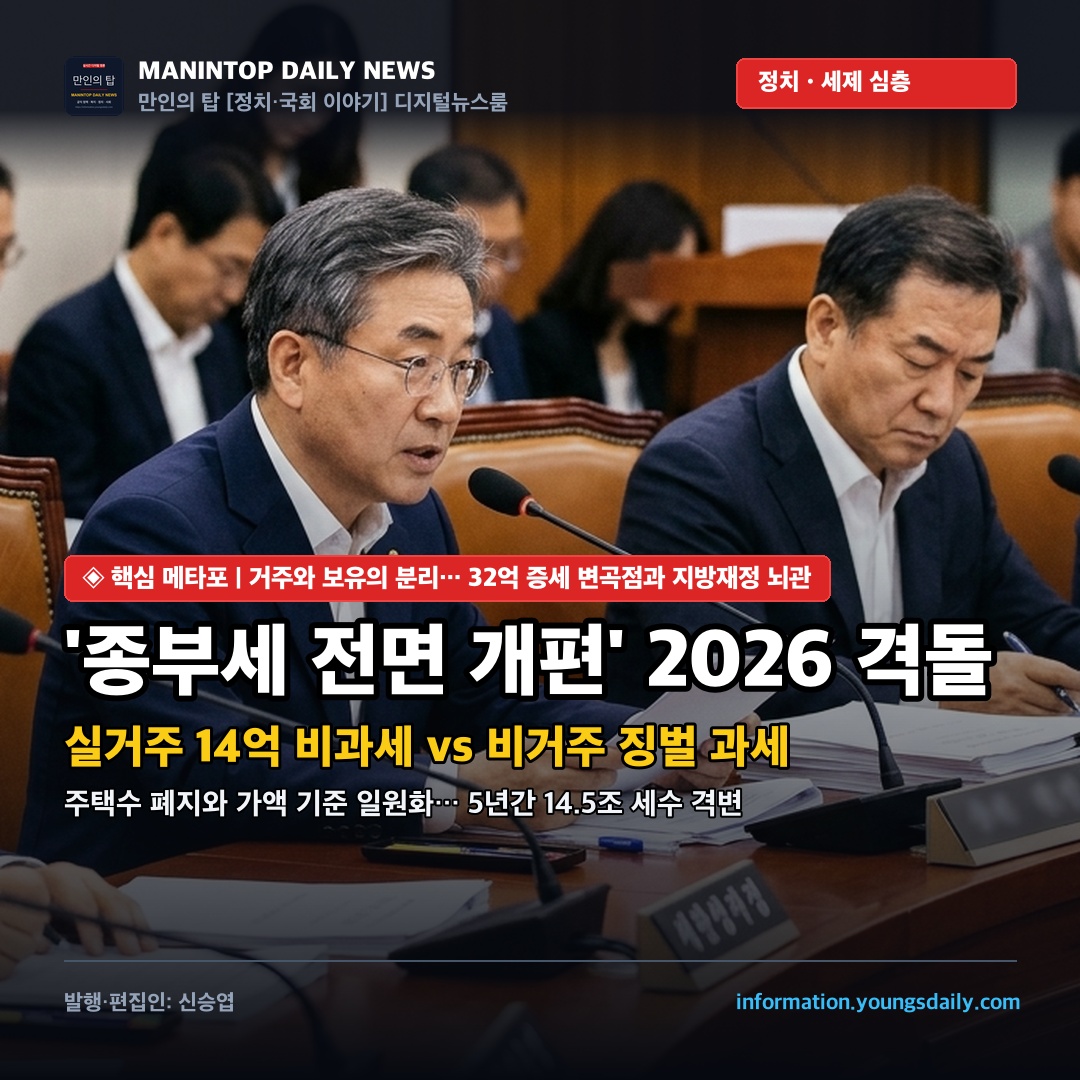
▲ 국회 기획재정위원회 회의실에서 여야 의원들과 정부 관계자들이 종합부동산세 개편안 및 실거주 과세 기준의 타당성을 두고 열띤 공방을 벌이고 있다. / 공식보도자료
대한민국 자산 시장과 정치 지형에서 가장 뜨거운 뇌관인 종합부동산세가 2026년 세법개정안을 통해 과거와는 완전히 다른 새로운 과세 질서로 재편됩니다. 지난 수년간 부동산 세제를 지배해 온 잣대였던 주택 수 중심의 다주택자 규제가 물러나고, 그 자리에 주택 합산 가액과 실제 거주 여부가 새로운 핵심 평가 지표로 들어섰습니다. 이번 개편의 본질은 실거주 1주택자의 세 부담은 획기적으로 덜어주되, 실제로 거주하지 않고 자산으로만 보유한 주택과 초고가 부동산에 대해서는 기본공제를 대폭 깎고 세율을 인상하는 보유와 거주의 분리에 있습니다. 이에 따라 같은 1주택자라도 내가 들어가 사느냐 전세를 주느냐에 따라 세금이 극명하게 갈리면서 부동산 시장과 여야 정치권에 거센 격랑이 일고 있습니다.
실거주 1주택 14억 비과세와 비거주 징벌 과세… 보유와 거주의 전격 분리
구체적인 산식을 살펴보면 제도의 변화가 일상에 미치는 영향이 대단히 입체적입니다. 거주 목적의 1세대 1주택자는 종부세 기본공제 금액이 기존 공시가격 12억 원에서 14억 원으로 2억 원 상향 조정됩니다. 시가로 환산하면 약 20억 원 상당의 주택까지 종부세 비과세권에 들어가면서, 서울 마포나 용산, 성동 등 이른바 마용성 일대 아파트 실거주자를 포함해 전국적으로 약 12만 명에 달하는 1주택자가 과세 대상에서 완전히 벗어나게 됩니다. 반면 지방 근무나 자녀 교육 등으로 인해 자기 집에 살지 못하는 비거주 1주택자는 공제액이 종전 12억 원에서 9억 원으로 3억 원이나 깎이면서 과세표준이 곧바로 상승하게 됩니다.
다주택자에 대한 과세 방식 역시 대대적인 손질이 단행되었습니다. 과거 정부 시절 최고 5.0%까지 치솟았던 다주택 징벌적 중과세율이 폐지되고 가액 기준의 단일 누진세율 체계로 일원화되었지만, 다주택자 1인당 기본공제는 기존 9억 원에서 4억 원 수준으로 절반 넘게 축소되었습니다. 주택 수가 많더라도 저가 주택을 여러 채 보유한 경우에는 세 부담이 급증하지 않지만, 고가 주택을 여러 채 쥐고 있는 자산가는 대폭 줄어든 기본공제와 가액 합산 구조로 인해 이전보다 훨씬 촘촘한 세금 그물망에 걸려들게 설계된 것입니다.
시가 32억 2천만 원 증세 변곡점… 초고가 주택 2.0% 최고세율과 양도세 장특공제 축소
이번 세법개정안에서 납세자들이 가장 유심히 들여다보아야 할 핵심 수치는 바로 시가 32억 2천만 원입니다. 구윤철 부총리 겸 재정경제부 장관의 공식 브리핑에 따르면 시가 20억 원 이하 1주택 실거주자는 세금이 완전히 면제되고, 20억 원에서 30억 원 구간도 종전보다 세액이 줄어들며, 30억 원부터 40억 원 구간은 대체로 중립적인 흐름을 유지합니다. 그러나 주택 시가가 32억 2천만 원을 넘어 과세표준 6억~12억 원 구간에 진입하는 순간 세율이 종전보다 0.3%포인트 오른 1.3%로 상향 조정되면서 실질적인 세금 인상이 본격화됩니다.
시가 45억 원을 넘는 초고가 단지부터는 과세표준 세율이 1.5%로 뛰고, 시가 71억 원을 초과하는 최고가 부동산에는 2.0%의 세율이 정조준됩니다. 여기에 전년 대비 세금 급증을 제어하던 세부담 상한선이 기존 150%에서 200%로 풀리고, 공정시장가액비율 역시 현행 60%에서 2027년 70%, 2028년 80%로 단계적 현실화되면서 초고가 자산가의 보유세는 해마다 가파르게 치솟게 됩니다. 고령자 및 장기보유 세액공제(최대 80%)의 경우에도 연령별 공제는 유지되지만 보유기간 공제가 거주기간 공제로 전환되며, 공제 금액 상한선이 2027년 800만 원, 2028년 600만 원으로 제한되어 부유층의 감면 통로가 물리적으로 차단됩니다.
과세 제도 구분
종전 과세 체계
2026 개편안 확정 체계
시장 체감 및 정책 시사점
1주택자 기본공제
공시가 12억 원 (거주 여부 무관)
실거주 14억 원 / 비거주 9억 원
실거주 12만 명 종부세 제외 vs 갭투자 3억 공제 박탈
다주택자 기본공제
인당 공시가격 9억 원
공시가격 4억 원 수준 축소
다주택자 중과 폐지 대신 기본공제 축소로 과표 상승 유도
공정시장가액비율
전 구간 60% 동결
2027년 70% → 2028년 80%
과표 자동 상승으로 고가 주택 및 다주택자 세부담 단계적 인상
양도세 장특공제
보유 40% + 거주 40% (최대 80%)
2029년 거주 80% 전액 전환
단순 10년 보유자 공제 0%로 소멸, 매물 잠김 우려 대두
매각 단계의 양도소득세 장기보유특별공제 역시 보유에서 실거주 중심으로 혁명적인 수술이 이뤄집니다. 기존에는 실거주를 하지 않아도 10년을 보유하기만 하면 최대 40%(보유 40%와 거주 40% 합산 총 80%)의 양도세 감면 혜택을 챙길 수 있었으나, 2028년부터는 거주 60%와 보유 20%로 재편되고 2029년에는 오직 거주기간만 80%를 인정하는 구조로 바뀝니다. 거주하지 않고 갭투자로 집을 쥐고 있던 다주택자나 임대인은 2029년부터 장특공제 혜택이 사실상 0%로 소멸하게 되며, 공제 상한 금액도 2028년 20억 원, 2029년 10억 원으로 묶여 부동산 출구 전략에 막대한 차질을 빚게 됩니다.
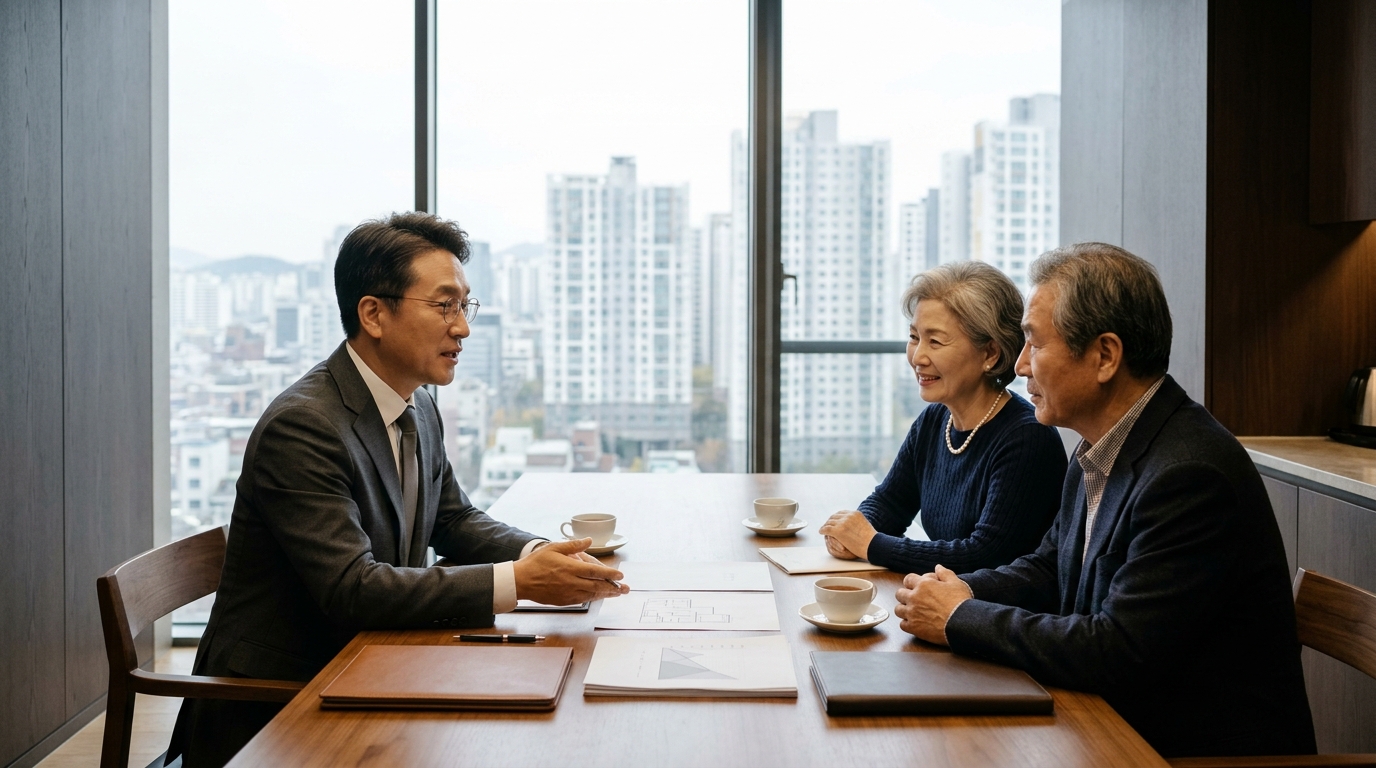
▲ 서울 도심 세무 컨설팅 룸에서 전문 세무사가 부동산 소유자와 2026 종부세 개편안 및 양도세 절세 전략을 분석하고 있다. / 현장취재사진
국회예산정책처 5개년 14.5조 세수 순증… 상위 2.5% 핀셋 증세와 전월세 전가 공방
국회예산정책처가 발간한 2026년 세법개정안 정밀 분석 보고서는 이번 세제 개편의 성격을 가장 객관적으로 드러내는 나침반 역할을 합니다. 예산정책처 추계에 따르면 정부의 세법개정안이 시행될 경우 향후 5년간(2027~2031년) 누적 세수는 총 14조 5,000억 원(순액법 기준 연평균 4조 1,000억 원) 순증하는 것으로 나타났습니다. 소득세에서 서민·청년 지원 확대로 4조 원이 줄고, 법인세에서 국내생산세액공제 신설 등으로 1조 8,000억 원이 감면되지만, 종합부동산세 한 항목에서만 무려 10조 5,000억 원의 막대한 세수가 쏟아져 들어오기 때문입니다.
계층별 귀착 효과를 살펴보면 정부의 정책적 타깃이 명확히 드러납니다. 서민과 중산층은 소득세 감면과 실거주 공제 확대로 5년간 세 부담이 5조 2,000억 원 줄어드는 반면, 고소득자와 고자산가는 4조 8,000억 원의 세금을 더 내야 합니다. 통계청 2024년 주택소유통계에 따르면 전체 주택 소유자 1,598만 명 가운데 주택분 종부세를 내는 사람은 39만 8,000명으로 상위 약 2.5%에 불과합니다. 결국 이번 개편안은 전체 유주택자의 2.5%에 해당하는 초고자산가에게 세 부담을 집중시키고 이를 통해 확보한 재원으로 중산층과 기업을 지원하는 정밀한 핀셋 증세 구조를 띠고 있습니다.
예결위 여야 난타전과 당내 감세론 균열… 51건 해명자료와 세수결손 복구론
이러한 세수 증대안을 두고 국회 예산결산특별위원회에서는 여야가 타협 없는 설전을 벌였습니다. 국민의힘 배준영 의원은 정부가 개편안 발표 직후 쏟아지는 비판을 방어하기 위해 해명자료만 51건을 낸 점을 정조준하며 반도체 호황으로 국세 수입이 넉넉한 상황에서 국민에게 3조 4,000억 원 순증세를 강요하는 최악의 세제라고 맹폭했습니다. 특히 비거주 1주택자의 공제를 9억 원으로 깎은 조치에 대해 직장 이전 등으로 불가피하게 집을 비운 실수요자를 투기꾼 취급했다며, 집주인이 늘어난 종부세를 메우기 위해 임대료를 올리면 결국 무주택 청년들에게 세 부담이 고스란히 전가될 것이라고 경고했습니다.
이에 대해 더불어민주당 황명선 의원은 전임 정부의 무분별한 부자 감세로 무너진 국가 재정과 세수 결손을 정상화하기 위한 불가피한 공정 과세라며 정부안을 적극 방어했습니다. 구윤철 부총리 역시 시가 30억 원 이하 실거주 1주택자의 부담은 실질적으로 덜어주었다는 점을 역설하며, 임대차 시장 불안에 대해서는 월세 세액공제 확대와 주택 공급 확대로 정면 돌파하겠다고 밝혔습니다. 하지만 거대 여당인 민주당 내부에서도 수도권 중산층의 표심 이탈을 우려해 비거주 1주택자라도 기본공제를 거주자와 동일하게 14억 원으로 맞춰야 한다는 감세론이 터져 나오면서 당정 간 미묘한 균열이 감지되고 있습니다.
세목 및 지역 구분
종전 규모 및 재원 성격
5개년 세수 및 재정 변동
귀착 효과 및 지방재정 파급
종합부동산세
전액 부동산교부세로 전국 재분배
5개년 누적 +10조 5,000억 원 순증
상위 2.5% 고자산가에 증세 부담 집중
소득세 및 법인세
국가 일반회계 및 지방교부세 재원
소득세 -4조 원, 법인세 -1.8조 원 감세
서민·중산층 5.2조 원 세부담 경감 효과
서울특별시 (지방세 전환 시)
종부세 징수액의 61.6% 점유
세수 +2조 747억 원 폭증
강남구 등 세수 과잉 및 순세계잉여금 누적
농어촌 취약 지자체
부동산교부세 수평 재정조정 수혜
전남 -3,259억, 경북 -2,342억 급감
자체 세입 기반 취약 지역 복지·인프라 직격탄
이재명 국토보유세 vs 윤석열 재산세 통합… 부동산교부세 붕괴와 지방재정 위기
이번 세제 논쟁의 이면에는 양대 정치 진영을 대표하는 근본적인 조세 철학의 대립이 자리잡고 있습니다. 이재명 진영은 부동산의 과도한 불로소득을 환수하고 수직적 형평성을 세우기 위해 종부세를 장기적으로 모든 토지에 부과하는 국토보유세(기본소득토지세)로 전환하고 이를 전 국민에게 기본소득으로 똑같이 배분해야 한다는 구상을 제시합니다. 반면 윤석열 진영은 부동산 세제의 징벌적 성격을 걷어내고 시장 기능을 회복하기 위해 종부세를 전면 폐지하고 지방세인 재산세에 통폐합하며 1세대 1주택에 대해서는 비과세를 실현해야 한다는 정반대의 시장주의적 해법을 내세워 왔습니다.
그러나 정치권이 종부세를 폐지하고 재산세로 통합하자는 주장을 펼칠 때 반드시 마주해야 하는 치명적인 복병이 바로 부동산교부세와 지방재정의 연결고리입니다. 국세로 징수되는 종부세는 중앙정부가 임의로 쓰는 돈이 아니라 전액 부동산교부세라는 이름으로 전국 기초자치단체에 재분배됩니다. 재정력이 열악한 낙후 지자체일수록 교부세를 더 많이 배분받아 사회복지와 지역 인프라 재원으로 활용하고 있습니다. 나라살림연구소 실증 분석에 따르면 종부세를 폐지해 지자체 재산세로 돌릴 경우, 고가 주택의 60% 이상이 몰려 있는 서울시만 세수가 2조 747억 원 폭증하는 반면 전남(-3,259억 원), 경북(-2,342억 원), 강원(-2,274억 원) 등 재정자립도가 취약한 농어촌 지자체들의 금고는 수천억 원대의 직격탄을 맞게 됩니다.
[In-Depth Analysis] South Korea's 2026 Real Estate Holding Tax Overhaul: 1.4B Won Residency Exemption vs Non-Residency Levies
MANINTOP Politics & Economic Policy Desk | Special Report on Real Estate TaxationNovember 11, 2026
▲ Lawmakers inside the National Assembly Strategy and Finance Committee chamber deliberate over real estate holding tax revisions and actual residency criteria. / Official Press Photo
South Korea's Comprehensive Real Estate Holding Tax, long recognized as the most politically volatile flashpoint in domestic wealth and housing policy, is undergoing a profound structural transformation under the government's 2026 tax overhaul. The multi-tiered punitive system calibrated primarily around the raw count of owned houses is stepping aside, replaced by an integrated tax base grounded in aggregate asset valuation and verified actual residency. At its conceptual foundation, this reform bifurcates ownership from residency, slashing holding tax burdens for bona fide owner-occupants while curtailing statutory deductions and raising bracket rates on non-residing landlords and ultra-luxury real estate holdings. Consequently, homeowners holding identical single-unit assets face radically divergent tax obligations depending entirely on whether they personally inhabit their properties or lease them out to tenants, sending seismic reverberations across national real estate markets and parliamentary corridors.
Residency Exemption at 1.4 Billion Won vs Non-Occupant Penalties: Decoupling Ownership and Living
A closer examination of the statutory formulas illustrates the acute real-world ramifications of this policy pivot. For single-homeowner households who physically reside in their properties, the baseline deduction for the Comprehensive Real Estate Holding Tax increases from 1.2 billion won to 1.4 billion won in published official values, corresponding to approximately 2.0 billion won in prevailing market prices. This adjustment extends full tax exemption to an estimated 120,000 owner-occupants nationwide, including numerous middle-class families residing across central Seoul districts such as Mapo, Yongsan, and Seongdong. Conversely, single-homeowners compelled to live elsewhere due to employment relocations or family care have their baseline deduction reduced from 1.2 billion won down to 900 million won, directly expanding their taxable bracket base and producing immediate tax increases.
Taxation mechanics governing multiple-home owners have likewise undergone fundamental restructuring. While the historic punitive surcharge brackets reaching up to 5.0 percent have been eliminated in favor of a unified progressive rate schedule based on aggregate property valuation, the personal baseline deduction for multi-homeowners has been cut steeply from 900 million won to approximately 400 million won. Owners of multiple low-cost provincial properties will avoid punitive tax spikes, but affluent investors holding portfolios of premium residential assets will face an increasingly stringent fiscal perimeter created by slashed baseline thresholds and unified value aggregations.
The 3.22 Billion Won Inflection Point: Top Rates at 2.0 Percent and Slashed Holding Credits
Within the revised tax architecture, the decisive fiscal inflection point for property owners centers around the market benchmark of 3.22 billion won. Official briefings released by Deputy Prime Minister and Minister of Economy and Finance Koo Yun-cheol confirm that single-unit owner-occupants holding properties valued below 2.0 billion won enjoy complete tax exemption, while properties between 2.0 billion and 3.0 billion won witness meaningful reductions in calculated liabilities, with the 3.0 billion to 4.0 billion won corridor maintaining broadly neutral fiscal impact. However, the instant an asset surpasses 3.22 billion won, entering the tax base bracket between 600 million and 1.2 billion won, the applicable marginal rate climbs by 0.3 percentage points to 1.3 percent, initiating steep progressive increases.
For luxury complexes valued above 4.5 billion won, the statutory base tax rate elevates to 1.5 percent, while premier assets exceeding 7.1 billion won face a top-tier rate of 2.0 percent. Compounding these rate increases, the statutory ceiling limiting year-over-year tax hikes has been expanded from 150 percent to 200 percent, and the fair market value assessment ratio climbs incrementally from 60 percent to 70 percent in 2027 and 80 percent in 2028. Although age-based credits for seniors remain intact, tenure deductions are transitioning strictly into residency deductions, accompanied by newly instituted credit caps of 8 million won in 2027 and 6 million won in 2028, effectively closing legacy tax mitigation corridors for high-net-worth property holders.
Tax Policy Item
Previous Tax Framework
2026 Adopted Structure
Market Impact & Policy Implications
Single Home Baseline
1.2 billion won (Residency irrelevant)
1.4B residing / 900M non-residing
Exempts 120,000 residents vs removes 300M deduction for non-residents
Multi-Home Baseline
900 million won per individual
Reduced to ~400 million won
Replaces count surcharges with lowered thresholds to lift taxable base
Assessment Ratio
Frozen at 60% across all tiers
70% in 2027 to 80% in 2028
Progressive expansion lifts effective tax bases across luxury properties
Parallel transformations are overhauling long-term holding special deductions within capital gains tax codes, pivoting the statutory framework from passive ownership to verified physical residency. Historically, non-residing investors holding properties for ten years could claim up to 40 percent in tenure deductions, combining with residency bonuses to reach an 80 percent maximum relief. Under the 2028 timetable, this ratio adjusts to 60 percent residency and 20 percent holding, evolving by 2029 into an exclusive 80 percent credit available solely for actual physical residency. Non-occupant investors leveraging gap investment strategies face zero special deductions by 2029, alongside rigid deduction caps of 2.0 billion won in 2028 and 1.0 billion won thereafter, fundamentally disrupting traditional property divestment roadmaps.
▲ Inside a professional tax consultancy in downtown Seoul, property advisors analyze 2026 holding tax revisions and strategic divestment plans. / Field Documentation Photo
NABO Projects 14.5 Trillion Won Surplus: The Upper 2.5 Percent Incidence and Rent Spillovers
An authoritative evaluation published by the National Assembly Budget Office provides crucial empirical verification regarding the structural nature of this fiscal overhaul. According to NABO budgetary simulations, full implementation of the tax package will generate a cumulative net revenue increase of 14.5 trillion won over the five-year projection window from 2027 to 2031, averaging 4.1 trillion won annually on a net-balance basis. While individual income tax receipts decline by 4.0 trillion won due to expanded relief for working-class households and youths, and corporate taxes decline by 1.8 trillion won through domestic manufacturing investment incentives, the Comprehensive Real Estate Holding Tax independently yields an immense 10.5 trillion won in net receipts.
Distributional incidence analysis underscores the surgical precision of the government's fiscal strategy. Middle-income and working-class citizens experience a cumulative 5.2 trillion won reduction in tax obligations over five years, whereas high-income earners and affluent property holders shoulder an additional 4.8 trillion won burden. Statistics Korea's 2024 housing census indicates that out of 15.98 million residential property owners nationwide, holding tax liabilities fall upon just 398,000 individuals, representing the top 2.5 percent wealth echelon. The statutory overhaul operates as a targeted tax calibrated to extract surplus capital from the upper 2.5 percent tier to reinforce social safety nets and corporate industrial foundations.
Budget Committee Gridlock and Party Rifts: 51 Rebuttal Briefs Against Fiscal Restoration
These fiscal projections sparked fierce ideological clashes inside the National Assembly Special Committee on Budget and Accounts. Representative Bae June-young of the conservative People Power Party launched scathing criticisms, pointing out that economic authorities were compelled to issue 51 separate explanatory briefs to address public backlash following the initial announcement. Emphasizing robust national tax receipts propelled by booming semiconductor exports, Bae condemned the 3.4 trillion won net tax hike as unwarranted. He specifically highlighted that slashing non-residency deductions to 900 million won unfairly penalizes bona fide homeowners relocated for employment, warning that landlords will inevitably pass elevated tax costs onto young renters in the form of higher monthly deposits.
In counter-deliberation, Representative Hwang Myung-sun of the Democratic Party robustly defended the legislation, characterizing it as an essential restoration of fiscal integrity following severe revenue deficits caused by indiscriminate tax cuts under the prior administration. Deputy Prime Minister Koo Yun-cheol similarly emphasized that tax burdens are genuinely alleviated for middle-class homeowners holding residences under 3.0 billion won, pledging to counter rental market pressures through enhanced rental tax credits and expanded urban housing supply. Nonetheless, internal rifts emerged within the ruling Democratic Party as metropolitan lawmakers, wary of suburban middle-class voter pushback, began demanding that the 1.4 billion won baseline deduction be extended equally to non-residing single homeowners.
Tax & Region Tier
Baseline Fiscal Structure
5-Year Net Revenue Shift
Distributional & Local Finance Impact
Holding Tax (National)
Redistributed fully as local allocation grants
+10.5 trillion won 5-year cumulative
Focuses tax increases on upper 2.5% asset holders
Income & Corporate Taxes
General national budget & regional transfers
Income -4.0T won, Corporate -1.8T won
Delivers 5.2T won in working-class relief
Seoul Metropolitan Area
Generates 61.6% of national holding tax
+2.07 trillion won local windfall
Surplus reserves accumulate in affluent districts
Rural Municipalities
Receives equalizing allocation transfers
Jeonnam -325.9B, Gyeongbuk -234.2B
Fiscal shocks jeopardize local social welfare funding
Lee's Universal Land Tax vs Yoon's Property Tax Consolidation: Provincial Fiscal Vulnerabilities
Beneath the parliamentary conflict lies an irreconcilable divide between the governing philosophies of rival political camps. The faction led by President Lee Jae-myung advocates long-term replacement of the holding tax with a universal Land Holding Tax coupled to basic income dividends, seeking to eliminate unearned real estate gains and redistribute revenues equally across the populace to lower speculative expectations. Conversely, the market-oriented doctrine championing former President Yoon Suk-yeol's legacy seeks the outright abolition of the Comprehensive Real Estate Holding Tax, proposing to fold holding levies entirely into municipal property taxes while establishing comprehensive holding exemptions for single-homeowner households.
Crucially, legislative proposals aiming to dismantle the holding tax and absorb it into local property taxes collide directly with the fragile architecture of intergovernmental transfers. Comprehensive Real Estate Holding Taxes are collected as national revenues but redistributed entirely to provincial and municipal governments in the form of Real Estate Allocation Taxes, with 50 percent weighted toward fiscal weakness indices to support disadvantaged rural jurisdictions. Empirical modeling by the Center for Good Budgeting warns that abolishing this redistributive framework would hand Seoul an unneeded 2.07 trillion won windfall due to its dense concentration of luxury real estate, while depriving fiscally vulnerable provinces such as South Jeolla (-325.9 billion won), North Gyeongsang (-234.2 billion won), and Gangwon (-227.4 billion won) of essential local welfare resources.
PRO SOURCING ENGINE만인의 탑 빅데이터 솔루션
★ 가입 시 600 크레딧(120회) 전원 무료
내가 찾는 상품 키워드, 지금 얼마나 검색될까?
네이버 월간 검색량 + 구글 볼륨 + 아이템스카우트 실시간 상품수와 경쟁강도 배지를 0.5초 만에 무료로 확인하세요.
MANINTOP NEWSLETTER
📬 만인의 탑 뉴스레터 무료 구독
오늘 보신 정책·시사 뉴스가 유익하셨나요? 매일 엄선되는 알짜 복지 혜택과 국회 실시간 속보를 이메일로 가장 먼저 받아보세요. (평생 무료)
1월이 시작되면 감기는 이미 우리 곁에 와 있습니다. 2월, 3월, 4월까지 이어지는 추위와 건조함은 코와 목을 가장 먼저 공격합니다. 아침에 일어나자마자 막혀 있는 코. 계속 흐르는 콧물. 괜히 칼칼해지는 목. 이 증상은 “시작”일 뿐입니다. 한 번 무너지면 일주일, 길면 한 달까지 끌고 갑니다. 약을 먹으면 잠깐 괜찮아집니다. 하지만 며칠 뒤 또 반복됩니다. 왜일까요? 감기는 ‘치료’의 문제가 아니라 ‘관리’의 문제이기 때문입니다. 대부분은 감기가 오고 나서 약을 찾습니다. 하지만 진짜 중요한 건 감기가 오기 전에 코와 목을 지키는 것입니다. 건조한 실내 공기, 차가운 바깥 공기, 눈에 보이지 않는 세균. 코와 목은 매일 공격받고 있습니다. 지긋지긋하죠! 그런데도 우리는 아무 준비 없이 버티고 있습니다. 이번 겨울도 그렇게 보낼 건가요? 사실 방법은 어렵지 않습니다. 코를 깨끗하게 관리하고, 목을 따뜻하게 보호하고, 점막을 촉촉하게 유지하고, 기관지를 미리 관리하고, 외부 공기를 차단하는 것. 이 다섯 가지만 꾸준히 해도 감기약 없이 겨울을 보내는 것이 충분히 가능합니다. 🔥 이제부터 그 방법을 하나씩 살펴보겠습니다. 🔥 1. 코와 목을 먼저 관리해야 하는 과학적 이유 감기의 대부분은 코 점막에서 시작됩니다. 국제 학술지 Nature Reviews Microbiology 와 Journal of Allergy and Clinical Immunology 에 실린 호흡기 감염 관련 연구들에서는, 감기 바이러스가 비강 상피세포에 먼저 부착해 증식한다는 점을 설명하고 ...
리모델링사업이 진행 중인 아파트를 매매할 때 “계약금 10%를 언제까지 내야 하느냐”는 질문이 특히 많이 나옵니다. 이주공고(이주 안내)가 7~11월쯤이라고 들으면, 그 시점에 맞춰 계약금도 움직일 것 같아서 더 헷갈리기 쉽습니다. 하지만 실제 납부기한은 ‘이주공고가 언제냐’만으로 자동 결정되지 않는 경우가 많습니다. 1) 계약금 10% 납부기한: 결국 ‘문서에 적힌 일정’이 기준 계약금 10%를 언제까지 납부해야 하는지는, 내가 서명하는 매매계약서(특약 포함) 와 사업주체/조합이 제시한 공고·안내문 에 적힌 납부 일정이 기준이 됩니다. 실제 공고문에서는 분양대금 납부의 큰 틀(계약금→중도금→잔금)을 먼저 안내하고, 상세 일정은 별도 표나 유의사항으로 제시하는 방식이 흔합니다. 또, 계약서 문구에 따라 지급 시점이 조건부로 설정될 수도 있습니다. 예를 들어 한 사례 소개 자료에서는 용역계약서에 잔금(10%) 지급시기가 “사업승인 후”로 기재되어 있었다는 점이 언급됩니다. 이런 식으로 ‘사업 단계’와 지급을 연동하는 문구가 들어가면, 질문의 답은 계약서 문구를 확인해야만 확정됩니다. 관련 내용은 링크 에서 문구 사례를 확인할 수 있습니다. 2) 입주자모집공고에서 확인되는 ‘납부 순서’와 잔금 마감 시점 공고문에 적힌 문구를 보면, 납부 순서와 잔금 마감에 대한 기준이 비교적 명확하게 제시되는 경우가 있습니다. 예를 들어 한 입주자모집공고에는 “분양금액(주택가격)은 계약금, 중도금, 잔금의 순서로 납부”하며 “잔금은 입주(열쇠 수령일) 전에 완납”해야 한다고 안내되어 있습니다. (문구 확인: 링크 ) 이 문구가 의미하는 바는 최소 2가지입니다. 분양/공급 형태의 문서에서는 ‘계약금→중도금→잔금’ 흐름이 공식적으로 안내될 수 있습니다. 잔금은 “입주(열쇠 수령)” 이전에 완납해야 한다는 마감 기준이 문서에 적혀 있을 수 있습니다. 다만, 위 공고문 문구는 잔금 마감에 대한 기준을 보여주지만, 계약금 10%의...
윤석열 전 대통령 탄핵 인용 소식을 접하면, 가장 궁금한 지점은 ‘헌재가 정확히 무엇을 위헌·위법으로 봤는가’입니다. 또한 탄핵과 별개로 진행되는 형사재판(내란 우두머리 혐의 등)이 어디까지 왔는지도 함께 정리할 필요가 있습니다. 아래 내용은 제공된 기사/게시물 스니펫과 링크에서 확인되는 범위만 모아, 일반인이 흐름을 이해하기 쉽게 정리한 것입니다. 1) 탄핵 인용 관련: 스니펫에서 확인되는 ‘판단의 골격’ 제공된 근거 중 조국혁신당 사이트에는 헌법재판소가 윤석열 탄핵 심판에서 “피청구인의 위헌·위법행위는 국민 신임 …”이라는 취지로 판단했다는 문장이 인용돼 있습니다( 링크 ). 이 인용문만 놓고 보면, ‘위헌·위법행위’가 있었는지와 그로 인해 ‘국민의 신임’이 어떻게 평가됐는지가 핵심 축으로 소개됩니다. 다만 질문에서 요청하신 세부 항목, 즉 비상계엄 선포 자체를 문제 삼은 구체적 이유, 계엄 이후 조치(포고령, 국회 통제 등)의 어떤 지점이 헌법 위반인지, 국회의 권한행사 방해 및 정치활동 제약을 어떤 논리로 판단했는지 등은, 이번에 제공된 근거의 제목/스니펫만으로는 조항·사실관계·판단 구조가 그대로 제시돼 있지 않습니다. 따라서 이 글에서는 ‘헌재가 무엇을 문제 삼았다’는 세부 리스트를 단정적으로 재구성하기보다, 현재 확인 가능한 문구 수준의 요약(위헌·위법행위 → 국민 신임의 문제로 평가)까지만 적습니다. 만약 헌재 결정문 전문(주문 및 이유)이 추가로 확인되면, 그때는 문장 단위로 ‘어떤 행위’와 ‘어떤 헌법 원리/조항’이 연결되는지(예: 권력분립, 국회의 권한, 정치적 기본권 등) 구조화해 정리하는 것이 가장 정확합니다. 2) 형사 절차(내란 혐의) 관련: 체포영장과 1심 선고 언급 탄핵 심판과 별도로, 12·3 비상계엄 사태로 내란 혐의를 받는 윤석열 대통령에 대해 2024년 12월 31일 체포 영장이 발부됐다는 BBC 보도가 있습니다( 링크 ). 해당 보도는 ‘현직 대통령’에 대한 체포영장 발부라는 점을 함께 언급합니다. 또...