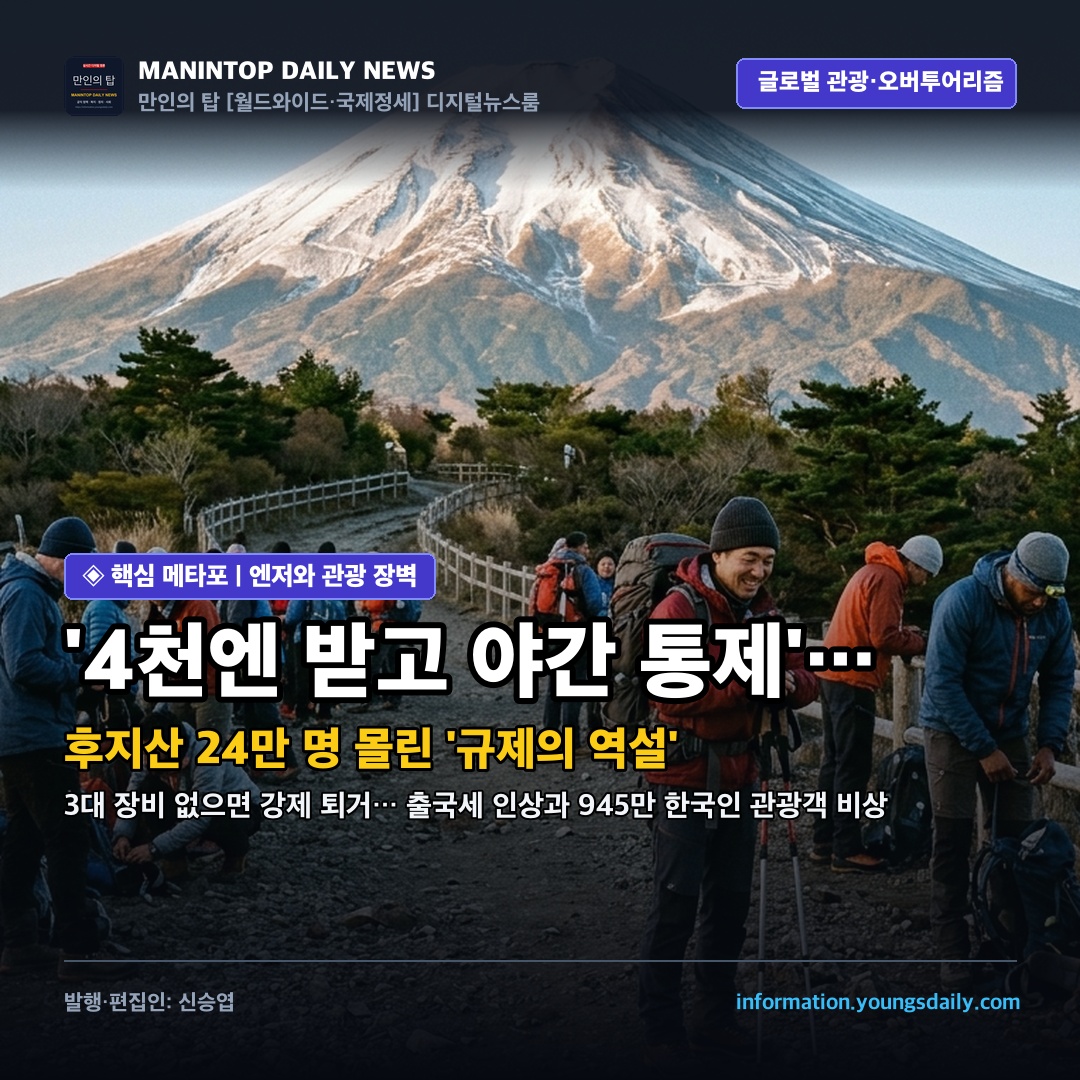
▲ 아침 햇살을 받아 붉게 물든 후지산 능선과 5합목 등산로로 향하는 등반 행렬. 수십 년간 이어진 무료 등반이 폐지되고 4,000엔의 입산료와 야간 통행 제한이 시작되었으나, 2026년 시즌 공식 등반객은 24만 5,000명으로 오히려 폭증했다. / 글로벌 관광 보도 자료 사진
세계문화유산이자 일본의 상징인 후지산(해발 3,776m)이 관광 공해(오버투어리즘)와 조난 사고 근절을 선언하며 사상 최초의 전면 유료화와 야간 입산 통제 체제에 돌입했습니다. 수십 년간 이어진 무료 등반 관행을 깨고 1인당 4,000엔의 입산료를 의무 징수하고 방한복·우의·등산화 등 3대 장비가 없으면 요금을 냈더라도 게이트 입장을 거부하는 초강경 조치를 시행했으나, 2026년 시즌 공식 등반객 수는 24만 5,000명으로 오히려 코로나 이전 수준을 뛰어넘는 기현상이 벌어졌습니다. 후지산에서 시작된 유료화의 파도는 히메지성의 외국인 2.5배 이중가격제, 교토 시내버스 요금 차등화, 출국세 3배 인상으로 번지며 연간 945만 명에 달하는 방일 1위 한국인 관광객들의 발목을 직격하고 있습니다.
수십 년 '무료 등반' 끝났다… 4천엔 의무화와 게이트 3대 장비 실물 검사
일본을 상징하는 세계문화유산 후지산(해발 3,776m)의 문턱이 사상 최고 수준으로 높아졌습니다. 후지산을 양분해 관할하는 야마나시현과 시즈오카현은 수십 년간 이어져 온 자유로운 무료 등반 시대를 공식 마감하고, 올여름부터 4대 등산로(요시다, 후지노미야, 고텐바, 스바시리) 전 구간에서 1인당 4,000엔(한화 약 3만 8,000원)의 입산료를 의무 징수하기 시작했습니다. 과거 자율적으로 내던 1,000엔의 협력금 제도는 완전히 폐지되었습니다.
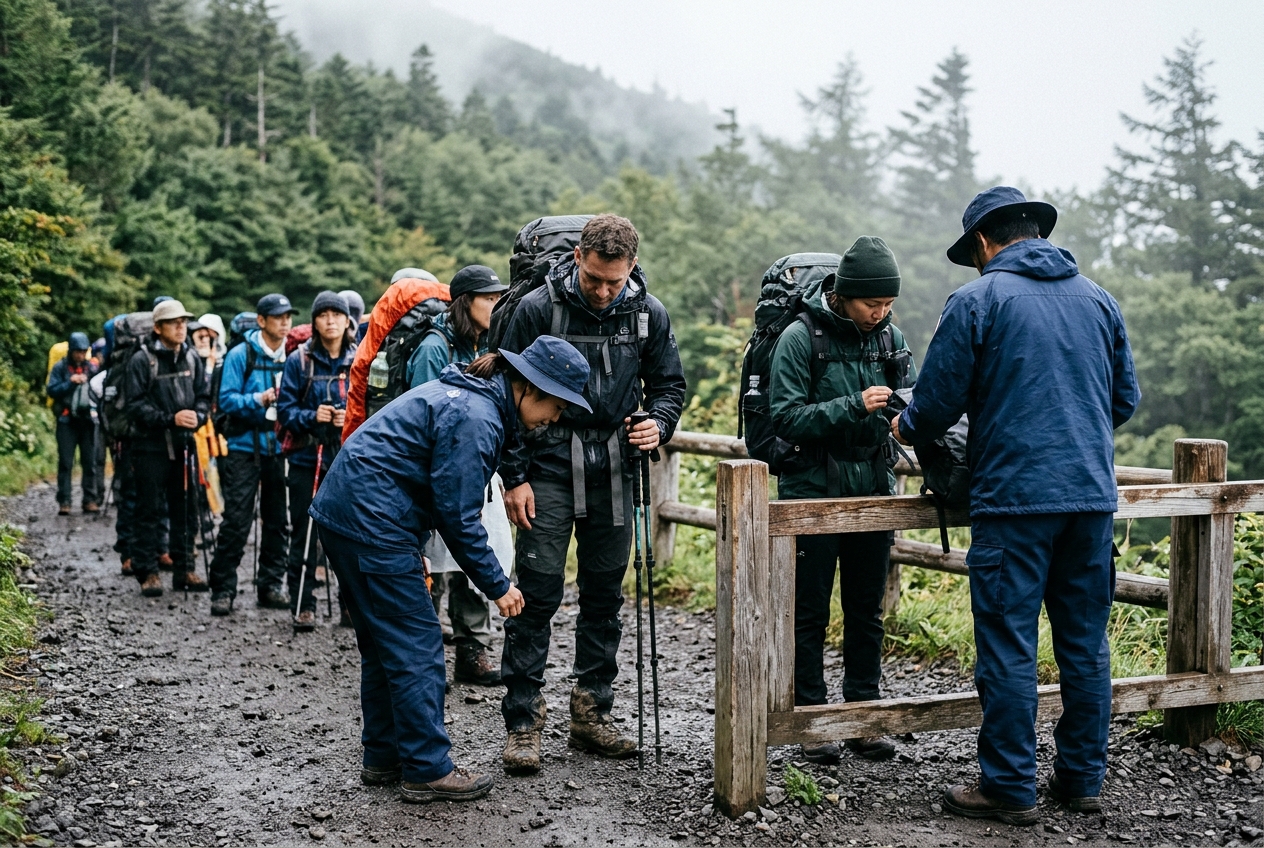
행정 조치의 핵심은 단순한 요금 징수에 그치지 않습니다. 5합목(五合目) 게이트 통과 시 현장 안전요원들이 등산객의 복장과 장비를 하나하나 육안으로 확인하는 '3대 필수 장비 실물 검사'가 전격 도입되었습니다. 해발 3,000m 이상의 혹한을 견딜 방한복, 돌풍과 폭우 시 체온 손실을 막아주는 상하 분리형 기능성 우의(일회용 비닐 우비 불인정), 화산 쇄설물 암릉에서 발목을 보호할 등산화 중 단 하나라도 갖추지 못하면, 사전에 4,000엔을 결제했더라도 게이트 통과가 현장에서 즉각 불허됩니다.
더욱이 오후 2시(14:00)부터 다음 날 새벽 3시(03:00)까지는 산장 숙박 예약 증명서가 없는 등산객의 진입이 완전히 차단됩니다. 9월 10일 폐산 이후 겨울철 통제선을 넘어 무단 입산할 경우 일본 도로법에 따라 6개월 이하의 구금형 또는 30만 엔 이하의 벌금형에 처해지며, 조난 시 출동하는 소방 헬기 비용 전액을 당사자에게 청구하는 구상권 조례까지 가동되었습니다.
'통제하니 더 몰렸다'… 24만 5천 명 운집한 '규제의 역설'과 폐산기 불법 등반
놀라운 점은 통제와 유료화의 벽을 높였음에도 불구하고, 실제 정상으로 향한 등반객 수는 오히려 역대 최고 수준으로 폭증했다는 사실입니다. 일본 환경성의 8부 능선 적외선 계측 데이터와 공식 집계에 따르면, 2026년 하계 개산 기간(7월 1일~9월 10일) 동안 후지산을 찾은 공식 등반객 수는 24만 5,000명에 달했습니다. 이는 규제 도입 직전인 2023년(22만 1,000명)은 물론, 코로나19 팬데믹 이전인 2019년(23만 5,000명)을 훌쩍 뛰어넘는 수치입니다.
산장 숙박비(1박당 1만~1만 5,000엔 이상)에 4,000엔의 통행료까지 더해져 1인당 수십만 원의 경비가 드는 데도 인파가 몰린 배경에는 이른바 '금지 심리'와 희소성 효과가 자리 잡고 있습니다. "앞으로 규제가 더 엄격해지거나 비용이 더 오르기 전에 평생 한 번은 다녀와야 한다"는 조바심이 등반 수요를 자극한 것입니다. 특히 전체 등반객 중 외국인 비중이 약 30%를 유지한 가운데, 일출(고라이코)을 감상하려는 일본 내국인들의 발길이 통계 상승을 주도했습니다.
하지만 이 같은 열풍의 이면에는 어두운 그림자가 짙게 깔렸습니다. 공식 폐산기인 가을과 겨울철에 울타리를 넘어 몰래 오르는 불법 등반객이 연간 1만 명 안팎에 이릅니다. 지난 4월에는 폐산 기간 중 후지산에 들어갔다가 조난되어 헬기로 구조된 외국인 유학생이, 불과 나흘 만에 분실한 스마트폰을 찾겠다며 재차 입산했다가 또다시 조난되어 경찰 산악구조대에 업혀 내려오는 어처구니없는 사건이 발생해 열도를 발칵 뒤집어 놓았습니다.
▲ 후지산 5합목 등산로 입구 게이트에서 안전 점검 요원들이 등산객의 필수 방한복과 등산화를 실물 확인하고 있다. 3대 필수 장비를 지참하지 않을 경우 사전 결제자라도 입산이 전면 거부된다. / 일본 산악 안전 인프라 공식 보도 사진
'0박 2일 탄환 등산'의 치명적 함정… 진통제로 못 막는 고산병과 즉각 하산 원칙
지자체가 오후 2시부터 게이트를 걸어 잠근 의학적 이유는 명확합니다. 산장에서의 숙박과 휴식 없이 야간에 0박 2일로 밤새 정상을 향해 질주하는 이른바 '탄환 등산(단간토잔)'이 수많은 조난과 사망 사고를 낳아왔기 때문입니다.
의학 전문가들은 희박한 산소에 인체가 순응할 시간도 없이 해발 3,000m 이상의 고도로 급상승할 경우, 뇌가 산소 공급을 늘리기 위해 혈관을 무리하게 확장시키면서 두개골 내 압력이 치솟아 급성 고산병(AMS)이 발생한다고 경고합니다. 어지럼증과 탈진으로 좁고 가파른 암릉 구간에서 한 사람이 쓰러지면, 뒤따르던 등반객들이 도미노처럼 함께 넘어지는 대형 압사 및 추락 사고로 이어질 위험이 매우 큽니다.
특히 현장에서 가장 위험한 오판은 타이레놀 같은 시판 진통제에 의존하는 행태입니다. 진통제는 저산소증 자체를 치료하지 못하며, 뇌가 보내는 위험 경고 신호인 두통을 억지로 감춰 치명적인 뇌부종(HACE)이나 폐수종(HAPE)으로 악화되는 골든타임을 놓치게 만듭니다. 의학계가 강조하는 고산병의 유일무이한 완치법은 '즉각 고도를 낮춰 하산하는 것'뿐입니다.
비교 분석 항목
후지산 (4대 등산로)
히메지성 (천수각)
교토 시내버스
요금 개편 및 인상 폭
입산료 4,000엔 의무화 (기존 1,000엔 자율협력금 폐지)
외국인 2,500엔으로 2.5배 인상 (내국인 1,000엔 유지)
균일 230엔 -> 주민 200엔 / 관광객 350~400엔 차등화
통제 및 자격 요건
14시~익일 03시 게이트 폐쇄, 3대 장비 미지참 시 퇴거
신분증 실물 확인을 통한 거주민과 외국인 차등 적용
주민 전용 IC카드 및 일반 관광권 구분 검표 체계
도입 목적과 명분
탄환 등산 방지, 환경 보전 및 조난 구조 재원 마련
목조 문화재 훼손 방지 및 성곽 보수 재정 확보
관광객 과밀로 마비된 시민 통근·통학 교통권 회복
시행 후 실질 결과
등반객 24.5만 명으로 증가 ('규제의 역설' 발생)
입장객 17% 감소했으나 입장 수입 2배 급증
혼잡 완화 기대 속 외지인 체감 교통비 약 1.7배 상승
히메지성 2.5배 이중가격과 출국세 3배… 일본 전역으로 번진 '관광 장벽' 도미노
후지산의 4,000엔 입산료는 일본 열도 전역을 뒤흔드는 거대한 관광 정책 전환의 신호탄에 불과합니다. 일본 정부는 2030년까지 외국인 관광객 6,000만 명을 유치하고 15조 엔의 관광 소비를 달성하겠다는 야심 찬 목표를 세웠지만, 정작 현장에서는 관광 공해(오버투어리즘)를 억제한다는 명분 아래 외국인에게 더 비싼 요금을 물리는 '가격 장벽 전략'이 전방위로 확산되고 있습니다.
유네스코 세계문화유산인 히메지성은 지난 3월부터 외국인 관광객에게 2.5배 비싼 2,500엔(약 2만 3,000원)을 받는 공식 '이중가격제'를 도입했습니다. 제도 도입 후 한 달간 입장객은 17% 줄었지만 수입은 2배로 폭증하자, 전국의 다른 지자체들이 앞다퉈 벤치마킹에 나섰습니다. 교토시는 시민 출퇴근 대중교통이 마비되자 숙박세를 올리고 시내버스 요금을 관광객에게만 최대 400엔으로 2배 가까이 올리는 방안을 추진하고 있습니다.
국가 차원의 부담도 커졌습니다. 일본 정부는 지난 7월부터 공항을 통해 일본을 떠나는 모든 승객에게 부과하는 국제관광여객세(출국세)를 기존 1,000엔에서 3,000엔(약 2만 8,000원)으로 3배 전격 인상했습니다. 여기에 11월부터는 매장에서 즉시 10%를 깎아주던 소비세 면세 할인이 폐지되고 공항에서 영수증을 확인받아야 세금을 돌려받는 '공항 사후 환급제'로 전환되어 출국장 대기 시간이 크게 늘어났으며, 2029년에는 유료 전자여행허가제(JESTA) 도입까지 예고되었습니다.
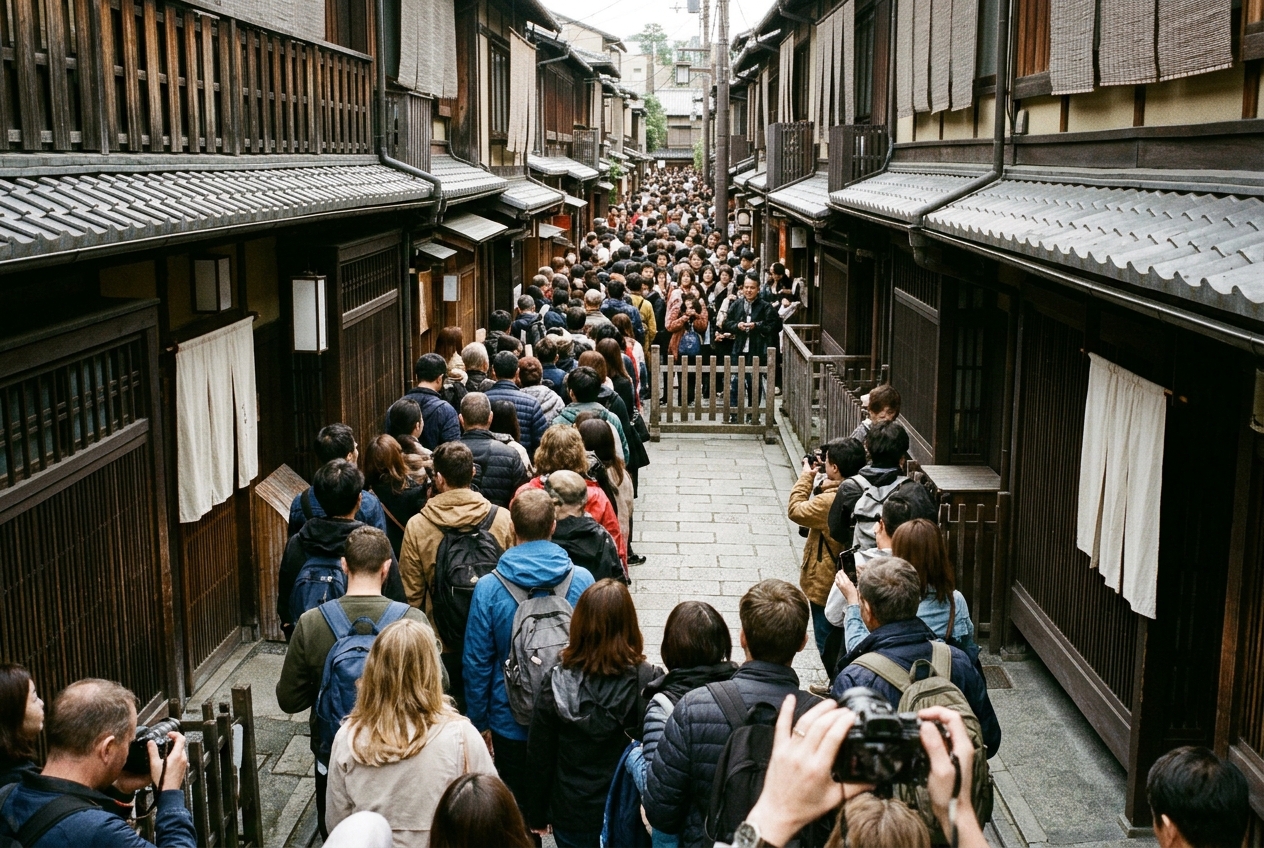
▲ 전통 목조 건축 거리에 운집한 관광객들이 매표 게이트로 줄지어 들어서고 있다. 히메지성의 외국인 이중가격제 도입과 출국세 3배 인상 등 일본 전역에서 관광객을 겨냥한 비용 인상 도미노가 이어지고 있다. / 일본 관광지 오버투어리즘 공식 보도 사진
'엔저 가성비' 신화의 붕괴와 945만 한국인 여행자… 기슭 분산 관광의 대안
이러한 가격 인상 조치의 최대 직격탄을 맞은 주인공은 다름 아닌 한국인 여행자들입니다. 일본 관광청 집계에 따르면 연간 방일 한국인 수는 945만 명으로 압도적 1위를 기록하고 있습니다. 과거 "엔저 덕분에 부담 없이 떠나는 가성비 여행지"라는 인식은 급격히 무너졌으며, 항공권이 저렴해도 현지 숙박세, 교통비, 입장료, 외식비가 눈덩이처럼 불어나 실질 여행 경비가 가파르게 상승하고 있습니다.
후지산이 올려다보이는 인근 도시 주민들의 피로감도 극에 달했습니다. 시즈오카현 후지시의 유명 사진 명소인 '꿈의 대교'는 보행로가 삼각대와 인파로 뒤덮여 통행이 마비되었고, 일부 지자체에서는 소음과 쓰레기를 견디다 못해 전통 벚꽃 축제를 취소하는 사태까지 벌어졌습니다.
이 때문에 일본 지자체는 험난하고 비용이 급증한 정상 등반 대신, 후지산 기슭의 풍부한 문화와 자연을 즐기는 '분산 관광'을 새로운 대안으로 제시하고 있습니다. 도쿠가와 이에야스가 1604년에 조영한 국가중요문화재 '후지산 혼구 센겐 다이샤'와 나선형 슬로프로 가상 등반을 체험할 수 있는 '시즈오카현 후지산 세계유산 센터', 광대한 녹차밭 너머로 후지산을 조망하는 '오부치 사사바' 등이 대표적입니다. 무리한 정상 정복 대신 지역 문화유산을 향유하는 성숙하고 안전한 여행 패러다임의 전환이 요구되는 시점입니다.
만인의 탑 정론 뉴스룸 | 월드와이드 특별취재팀
발행인 겸 편집인: 신승엽 (Seung Youb Ssin)
본 기사는 일본 환경성 하계 등반객 공식 계측 통계, 야마나시현·시즈오카현 후지산 조례 고시문, 일본 관광청 방일 외래객 통계, 히메지시 천수각 관리 공시 및 교토시 교통정책국 공식 행정 자료를 바탕으로 정밀 팩트체크를 거쳐 편찬되었습니다.
WORLDWIDE IN-DEPTH REPORT | Global Tourism & Overtourism Policy
MANINTOP DAILY NEWS GLOBAL DESK
[EXCLUSIVE] 4,000 Yen Fees and Night Curfews: Mount Fuji's 245,000-Climber 'Regulation Paradox'
▲ Mount Fuji volcanic slopes glowing under early morning sunlight as outdoor hikers gather along the 5th station trail entrance. Despite ending decades of free access and imposing 4,000 yen tolls and night curfews, the 2026 season attracted a record 245,000 climbers. / Global Tourism Press Archive
As a UNESCO World Cultural Heritage site and the enduring symbol of Japan, Mount Fuji (3,776 meters) has instituted an unprecedented mandatory admission regime and sweeping nocturnal trail closures to combat overtourism and mountain fatalities. Dismantling decades of unfettered free climbing, prefectural authorities enacted a mandatory 4,000 yen toll alongside rigorous gear checkpoints that bar climbers lacking proper thermal layers, rainwear, or footwear. Yet in a striking regulatory paradox, official summit-bound foot traffic surged to 245,000 climbers in the 2026 season, eclipsing pre-pandemic levels. The monetization wave pioneered at Mount Fuji is now rippling across Japan—from Himeji Castle’s 2.5-fold foreign visitor surcharge and Kyoto’s bus fare tiering to a tripling of the international departure tax—imposing steep financial friction on South Korean travelers, who constitute the nation’s largest inbound cohort at 9.45 million visitors annually.
The End of Free Ascents: Mandatory 4,000 Yen Tolls and Strict Three-Piece Gear Checkpoints
The threshold to ascend Mount Fuji (elevation 3,776 meters), Japan’s premier natural icon and a UNESCO World Cultural Heritage landmark, has reached an unprecedented height. Prefectural governments in Yamanashi and Shizuoka formally abolished decades of unrestricted free climbing, mandating a universal 4,000 yen (roughly 26 US dollars) entry toll across all four principal climbing corridors: Yoshida, Fujinomiya, Gotemba, and Subashiri. The legacy 1,000 yen voluntary conservation donation was permanently terminated.
The operational shift extends far beyond financial collection. At the 5th station trail gates, safety marshals conduct physical inspections enforcing a strict three-piece mandatory gear rule. Hikers must display adequate thermal layers capable of withstanding sub-zero summit wind chills, two-piece waterproof rainwear (disposable ponchos are strictly banned), and rigid ankle-support hiking boots. Any climber lacking even one item is denied entry at the gate, regardless of prior fee payment or digital registration.
Moreover, trail gates close firmly between 14:00 and 03:00 the following morning to all climbers without verifiable mountain hut reservations. Off-season incursions following the September 10 official closing now carry criminal penalties under the Japanese Road Act—up to six months' imprisonment or 300,000 yen in fines—alongside legal ordinances authorizing local authorities to demand full financial reimbursement for emergency helicopter rescue operations.
'Restrictions Spurred More Footsteps': The 245,000-Climber Paradox and Winter Infiltration
Paradoxically, erecting financial and logistical barricades failed to dampen summit ambitions; instead, it triggered an unexpected surge in foot traffic. Official infrared sensor tracking at the 8th station compiled by the Ministry of the Environment recorded 245,000 climbers during the summer 2026 window (July 1 to September 10). This figure surpassed both the 221,000 climbers of 2023 prior to fee enforcement and the pre-pandemic benchmark of 235,000 in 2019.
Despite combined costs for mandatory hut lodging (10,000 to 15,000 yen per night) and trail tolls elevating per-climber expenditure substantially, demand remained inelastic. Sociologists attribute this phenomenon to a psychological scarcity trigger: the apprehension that impending regulatory tightening would make future ascents impossible prompted an urgent bucket-list rush. While foreign tourists accounted for roughly 30 percent of total visitors, domestic Japanese climbers eager to witness the revered summit sunrise (Goraiko) drove the statistical increase under favorable summer weather.
This climbing frenzy produced severe off-season violations. An estimated 10,000 individuals trespass past barriers during the prohibited autumn and winter seasons annually. In a widely publicized incident in April, a foreign exchange student rescued by helicopter from frozen slopes illegally re-entered the restricted zone just four days later to retrieve a misplaced mobile phone, requiring another perilous extraction by police mountain rescue squads and intensifying public calls for strict cost indemnification.
▲ Safety staff at Mount Fuji's 5th station checkpoint inspect outdoor footwear and weather-resistant gear. Hikers failing to present mandatory cold-weather layers, two-piece rainwear, or hiking boots are systematically turned away at the gate. / Japan Mountain Safety Press Archive
The Deadly Trap of Bullet Climbing: Why Painkillers Cannot Mask Acute Mountain Sickness
The physiological rationale underpinning the 14:00 to 03:00 gate closure is grounded in high-altitude medicine. Eliminating hut rest stops to push overnight from base to peak—a hazardous practice known locally as bullet climbing (dangan tozan)—has historically served as the primary catalyst for severe hypothermia, physical collapse, and fatal trauma.
Medical authorities warn that rapid ascent above 3,000 meters without acclimatization triggers cerebral vasodilation as the body struggles to compensate for hypoxia. This rapid pressure change causes brain tissue swelling, inducing Acute Mountain Sickness (AMS). When exhausted climbers stumble on narrow volcanic ledges in the dark, single missteps frequently precipitate catastrophic domino falls, posing fatal crushing and slide risks for trailing groups.
Physicians specifically warn against the widespread reliance on over-the-counter analgesics such as acetaminophen. Painkillers do not treat underlying oxygen depletion; they merely mask cephalic warning signs, allowing mild distress to progress silently into life-threatening High Altitude Cerebral Edema (HACE) or High Altitude Pulmonary Edema (HAPE). Medical consensus emphasizes that the sole definitive intervention for high-altitude pathology is immediate descent to lower elevations.
Comparative Metrics
Mount Fuji Trails
Himeji Castle Keep
Kyoto City Buses
Pricing & Tariff Restructuring
Mandatory 4,000 yen toll (voluntary 1,000 yen abolished)
Foreign tourist fee raised 2.5x to 2,500 yen (domestic 1,000 yen)
Flat 230 yen split: residents 200 yen, tourists 350-400 yen
Himeji's 2.5x Surcharge and Tripled Exit Taxes: The Nationwide Spread of Tourism Price Barriers
The monetization of Mount Fuji is not an isolated initiative; it signals a fundamental nationwide pivot in Japanese tourism management. While Tokyo maintains ambitious macro targets aiming for 60 million annual international visitors and 15 trillion yen in tourism receipts by 2030, municipalities overwhelmed by congestion are aggressively deploying financial surcharges to erect price barriers.
In March, the historic keep of Himeji Castle instituted an official dual-pricing mechanism, raising admission for international visitors to 2,500 yen—a 2.5-fold markup over the domestic rate of 1,000 yen. Although visitation dipped by 17 percent during the initial month, municipal revenues doubled, prompting widespread benchmarking across regional governments. Concurrently, Kyoto enacted accommodation tax hikes while advancing bus fare tiering that charges non-residents up to 400 yen per ride.
National fiscal policies have reinforced these local measures. In July, Japan tripled its international tourist departure tax from 1,000 yen to 3,000 yen per passenger. Furthermore, the long-standing point-of-sale consumption tax exemption will transition in November to an airport post-refund inspection protocol, significantly extending departure wait times, while an electronic travel authorization system (JESTA) is scheduled for implementation by 2029.
▲ International tourists queueing along narrow historic pedestrian streets approaching entry ticket kiosks. Dual-pricing structures, transit surcharges, and tripled departure levies are proliferating across popular Japanese tourist hubs. / Japan Tourism Congestion Press Archive
The Collapse of the Cheap-Yen Tourism Myth: Impacts on 9.45M Koreans and Foothill Alternatives
The primary demographic bearing the financial brunt of this regulatory shift is South Korean travelers. According to Japan National Tourism Organization data, South Korea represents the single largest source market with 9.45 million annual visitors. The long-standing perception of Japan as an inexpensive destination buoyed by a weak yen is dissolving, as compounding hotel levies, transit surcharges, admission markups, and dining inflation sharply elevate real travel budgets.
Friction has mounted within communities surrounding Mount Fuji. In the city of Fuji, the scenic Yume no Ohashi bridge was overrun by crowds and photography tripods, obstructing local pedestrians and necessitating permanent security details. In several municipalities, chronic noise, littering, and private property intrusions prompted the outright cancellation of traditional community cherry blossom festivals.
Consequently, regional authorities are actively redirecting travelers toward foothill cultural assets as sustainable alternatives to grueling summit attempts. Highlights include Fujisan Hongu Sengen Taisha—an important cultural property constructed in 1604 by Tokugawa Ieyasu—the Mt. Fuji World Heritage Centre in Shizuoka offering simulated climbing ramps, and the panoramic tea plantations of Obuchi Sasaba. Transitioning toward decentralized cultural appreciation represents an essential evolution for both visitors and host communities navigating the overtourism era.
MANINTOP DAILY NEWS ROOM | Worldwide Special Investigation Team
Publisher & Editor-in-Chief: Seung Youb Ssin
This investigative report was compiled through rigorous documentary analysis of official summer climbing sensor metrics from Japan's Ministry of the Environment, administrative ordinances issued by Yamanashi and Shizuoka prefectures, Japan National Tourism Organization immigration data, and municipal policy registries from Himeji and Kyoto.
PRO SOURCING ENGINE만인의 탑 빅데이터 솔루션
★ 가입 시 600 크레딧(120회) 전원 무료
내가 찾는 상품 키워드, 지금 얼마나 검색될까?
네이버 월간 검색량 + 구글 볼륨 + 아이템스카우트 실시간 상품수와 경쟁강도 배지를 0.5초 만에 무료로 확인하세요.
MANINTOP NEWSLETTER
📬 만인의 탑 뉴스레터 무료 구독
오늘 보신 정책·시사 뉴스가 유익하셨나요? 매일 엄선되는 알짜 복지 혜택과 국회 실시간 속보를 이메일로 가장 먼저 받아보세요. (평생 무료)
1월이 시작되면 감기는 이미 우리 곁에 와 있습니다. 2월, 3월, 4월까지 이어지는 추위와 건조함은 코와 목을 가장 먼저 공격합니다. 아침에 일어나자마자 막혀 있는 코. 계속 흐르는 콧물. 괜히 칼칼해지는 목. 이 증상은 “시작”일 뿐입니다. 한 번 무너지면 일주일, 길면 한 달까지 끌고 갑니다. 약을 먹으면 잠깐 괜찮아집니다. 하지만 며칠 뒤 또 반복됩니다. 왜일까요? 감기는 ‘치료’의 문제가 아니라 ‘관리’의 문제이기 때문입니다. 대부분은 감기가 오고 나서 약을 찾습니다. 하지만 진짜 중요한 건 감기가 오기 전에 코와 목을 지키는 것입니다. 건조한 실내 공기, 차가운 바깥 공기, 눈에 보이지 않는 세균. 코와 목은 매일 공격받고 있습니다. 지긋지긋하죠! 그런데도 우리는 아무 준비 없이 버티고 있습니다. 이번 겨울도 그렇게 보낼 건가요? 사실 방법은 어렵지 않습니다. 코를 깨끗하게 관리하고, 목을 따뜻하게 보호하고, 점막을 촉촉하게 유지하고, 기관지를 미리 관리하고, 외부 공기를 차단하는 것. 이 다섯 가지만 꾸준히 해도 감기약 없이 겨울을 보내는 것이 충분히 가능합니다. 🔥 이제부터 그 방법을 하나씩 살펴보겠습니다. 🔥 1. 코와 목을 먼저 관리해야 하는 과학적 이유 감기의 대부분은 코 점막에서 시작됩니다. 국제 학술지 Nature Reviews Microbiology 와 Journal of Allergy and Clinical Immunology 에 실린 호흡기 감염 관련 연구들에서는, 감기 바이러스가 비강 상피세포에 먼저 부착해 증식한다는 점을 설명하고 ...
리모델링사업이 진행 중인 아파트를 매매할 때 “계약금 10%를 언제까지 내야 하느냐”는 질문이 특히 많이 나옵니다. 이주공고(이주 안내)가 7~11월쯤이라고 들으면, 그 시점에 맞춰 계약금도 움직일 것 같아서 더 헷갈리기 쉽습니다. 하지만 실제 납부기한은 ‘이주공고가 언제냐’만으로 자동 결정되지 않는 경우가 많습니다. 1) 계약금 10% 납부기한: 결국 ‘문서에 적힌 일정’이 기준 계약금 10%를 언제까지 납부해야 하는지는, 내가 서명하는 매매계약서(특약 포함) 와 사업주체/조합이 제시한 공고·안내문 에 적힌 납부 일정이 기준이 됩니다. 실제 공고문에서는 분양대금 납부의 큰 틀(계약금→중도금→잔금)을 먼저 안내하고, 상세 일정은 별도 표나 유의사항으로 제시하는 방식이 흔합니다. 또, 계약서 문구에 따라 지급 시점이 조건부로 설정될 수도 있습니다. 예를 들어 한 사례 소개 자료에서는 용역계약서에 잔금(10%) 지급시기가 “사업승인 후”로 기재되어 있었다는 점이 언급됩니다. 이런 식으로 ‘사업 단계’와 지급을 연동하는 문구가 들어가면, 질문의 답은 계약서 문구를 확인해야만 확정됩니다. 관련 내용은 링크 에서 문구 사례를 확인할 수 있습니다. 2) 입주자모집공고에서 확인되는 ‘납부 순서’와 잔금 마감 시점 공고문에 적힌 문구를 보면, 납부 순서와 잔금 마감에 대한 기준이 비교적 명확하게 제시되는 경우가 있습니다. 예를 들어 한 입주자모집공고에는 “분양금액(주택가격)은 계약금, 중도금, 잔금의 순서로 납부”하며 “잔금은 입주(열쇠 수령일) 전에 완납”해야 한다고 안내되어 있습니다. (문구 확인: 링크 ) 이 문구가 의미하는 바는 최소 2가지입니다. 분양/공급 형태의 문서에서는 ‘계약금→중도금→잔금’ 흐름이 공식적으로 안내될 수 있습니다. 잔금은 “입주(열쇠 수령)” 이전에 완납해야 한다는 마감 기준이 문서에 적혀 있을 수 있습니다. 다만, 위 공고문 문구는 잔금 마감에 대한 기준을 보여주지만, 계약금 10%의...
윤석열 전 대통령 탄핵 인용 소식을 접하면, 가장 궁금한 지점은 ‘헌재가 정확히 무엇을 위헌·위법으로 봤는가’입니다. 또한 탄핵과 별개로 진행되는 형사재판(내란 우두머리 혐의 등)이 어디까지 왔는지도 함께 정리할 필요가 있습니다. 아래 내용은 제공된 기사/게시물 스니펫과 링크에서 확인되는 범위만 모아, 일반인이 흐름을 이해하기 쉽게 정리한 것입니다. 1) 탄핵 인용 관련: 스니펫에서 확인되는 ‘판단의 골격’ 제공된 근거 중 조국혁신당 사이트에는 헌법재판소가 윤석열 탄핵 심판에서 “피청구인의 위헌·위법행위는 국민 신임 …”이라는 취지로 판단했다는 문장이 인용돼 있습니다( 링크 ). 이 인용문만 놓고 보면, ‘위헌·위법행위’가 있었는지와 그로 인해 ‘국민의 신임’이 어떻게 평가됐는지가 핵심 축으로 소개됩니다. 다만 질문에서 요청하신 세부 항목, 즉 비상계엄 선포 자체를 문제 삼은 구체적 이유, 계엄 이후 조치(포고령, 국회 통제 등)의 어떤 지점이 헌법 위반인지, 국회의 권한행사 방해 및 정치활동 제약을 어떤 논리로 판단했는지 등은, 이번에 제공된 근거의 제목/스니펫만으로는 조항·사실관계·판단 구조가 그대로 제시돼 있지 않습니다. 따라서 이 글에서는 ‘헌재가 무엇을 문제 삼았다’는 세부 리스트를 단정적으로 재구성하기보다, 현재 확인 가능한 문구 수준의 요약(위헌·위법행위 → 국민 신임의 문제로 평가)까지만 적습니다. 만약 헌재 결정문 전문(주문 및 이유)이 추가로 확인되면, 그때는 문장 단위로 ‘어떤 행위’와 ‘어떤 헌법 원리/조항’이 연결되는지(예: 권력분립, 국회의 권한, 정치적 기본권 등) 구조화해 정리하는 것이 가장 정확합니다. 2) 형사 절차(내란 혐의) 관련: 체포영장과 1심 선고 언급 탄핵 심판과 별도로, 12·3 비상계엄 사태로 내란 혐의를 받는 윤석열 대통령에 대해 2024년 12월 31일 체포 영장이 발부됐다는 BBC 보도가 있습니다( 링크 ). 해당 보도는 ‘현직 대통령’에 대한 체포영장 발부라는 점을 함께 언급합니다. 또...