“‘금치’ 걱정 덜었다”… 2026 김장철 640억 역대 최대 할인과 알뜰 장보기 꿀팁 총정리
가을배추 풍작에 생산량 18.5% 급증·포기당 3천 원대 안착… 정부 역대 최대 640억 할인 쿠폰·농할상품권·수산대전과 1인 가구 포장김치 트렌드까지 심층 분석
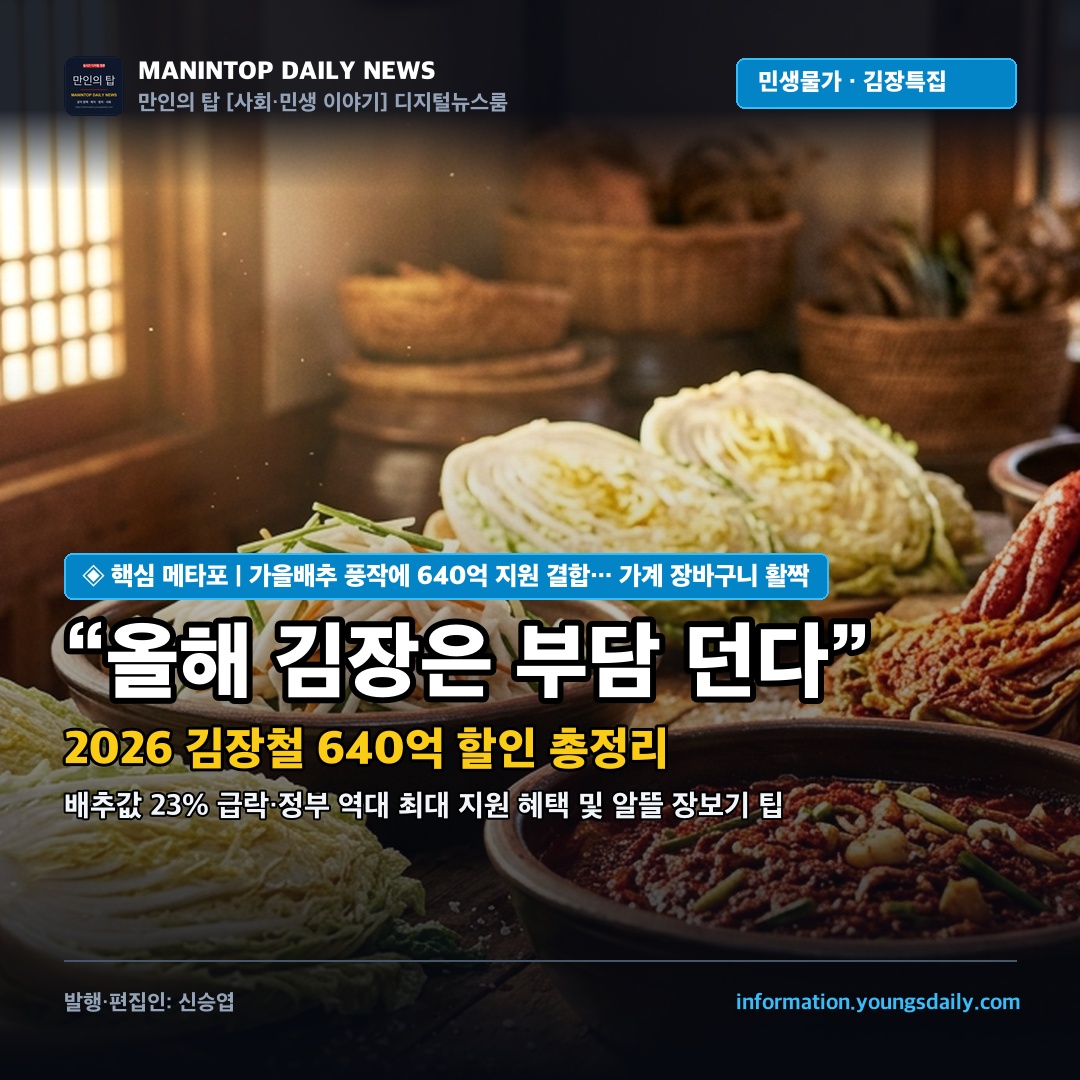
한국농수산식품유통공사(aT)와 한국농촌경제연구원(KREI)의 최근 관측에 따르면, 올해 김장 시장의 가장 큰 특징은 주요 채소류의 작황 호조로 인한 공급량 확대입니다. 가을배추 재배면적은 1만 2,955헥타르(ha)로 지난해보다 1.7% 소폭 줄었지만, 배추 모종을 심은 뒤 온화한 날씨와 충분한 강우량이 이어지면서 단위면적당 생산량이 무려 20.6% 급증했습니다. 이에 따라 전체 가을배추 생산량은 121만 4천 톤으로 전년 대비 18.5%, 평년 대비 2.5% 늘어났습니다.
가을무 역시 작황이 매우 좋습니다. 김장용 다발무 재배면적이 늘어난 데다 생육이 순조로워 생산량이 전년 대비 11.1% 증가한 37만 2천 톤에 이를 것으로 집계되었습니다. 이 같은 공급 확대에 힘입어 10월 하순 기준 배추 1포기 평균 소비자가격은 3,969원으로 지난해 같은 기간보다 23.5%나 떨어졌고, 무 역시 개당 2,038원으로 9.2% 하락했습니다. 대파(-30.0%)와 양파(-14.9%)도 안정적인 약세를 나타내고 있습니다.
| 품목 | 2026 예상 생산·재고량 | 전년 대비 증감 | 평년 대비 증감 | 수급 및 시세 주요 원인 |
|---|---|---|---|---|
| 가을배추 | 121만 4,000톤 | +18.5% | +2.5% | 생육기 기상 여건 호조로 10a당 단수 20.6% 급증 |
| 가을무 | 37만 2,000톤 | +11.1% | -2.6% | 김장용 다발무 재배면적 증가 및 생육 순조 |
| 건고추 | 6만 1,000톤 | +0.4% | -1.1% | 전년과 유사한 안정적 수준 유지 (단수 1.8% 증가) |
| 마늘 (재고) | 7만 2,000톤 | -8.3% | -6.4% | 생산량 감소 및 산지 입고량 축소로 강세 지속 |

배추와 무는 가격이 내려갔지만, 양념에 빠질 수 없는 부재료인 마늘(저장재고 -8.3%)과 새우젓(전년 대비 25.8%~32.5% 상승)은 오름세를 보이고 있습니다. 이에 정부는 농축산물 440억 원, 수산물 200억 원 등 총 640억 원의 예산을 투입해 역대 최대 규모의 할인 행사를 펼칩니다. 지난해 500억 원보다 28% 늘어난 규모입니다.
- 농축산물 최대 40% 할인 (440억 원 지원): 10월 29일부터 12월 2일까지 대형마트, 중소형마트, 온라인몰에서 배추(절임배추 포함), 무, 고춧가루, 대파, 양파, 수육용 돼지고기 등 10개 품목에 대해 정부 20%와 유통업체 자체 최대 20%를 합쳐 최대 40%를 깎아줍니다.
- 농할상품권 200억 발행: 국내산 농축산물 전용 모바일 상품권으로 20% 선할인 판매됩니다. 1인당 10만 원 한도(실구매가 8만 원)로 제로페이 앱 등에서 구매할 수 있습니다.
- 수산대전 최대 50% 할인 (200억 원 지원): 10월 28일부터 11월 29일까지 천일염, 새우젓, 멸치액젓, 굴 등에 대해 정부 지원 20%(1인 1만 원 한도)에 유통업체 할인을 더해 최대 반값에 구매할 수 있습니다.
- 서울시 하나로마트 6종 반값 특가: 서울시 지원과 연계하여 11월 5일부터 11일까지 서울 시내 18개 하나로마트에서 깐마늘(1kg 1만 3,900원 → 8,900원), 알타리무(1단 5,500원 → 2,800원), 대파(1단 2,800원 → 1,500원) 등을 최대 50% 특별 할인합니다.
- 전통시장 온누리상품권 최대 30% 환급: 전통시장에서 국산 신선 농축수산물을 3만 4천 원 이상 사면 1만 원, 6만 7천 원 이상 사면 2만 원의 온누리상품권을 현장에서 돌려받습니다.
1. 마감일 빠른 수산물 먼저: 가격이 오른 새우젓과 천일염은 11월 29일 행사가 끝나는 수산대전을 통해 1인 1만 원 할인 한도를 선제적으로 챙기세요.
2. 서울 거주자는 하나로마트 특가 공략: 깐마늘과 대파 등 비싼 부재료는 11월 11일까지 진행되는 서울시 하나로마트 반값 찬스를 이용하면 비용을 절반으로 아낄 수 있습니다.
3. 전통시장 페이백 극대화: 온누리상품권을 사전에 10% 할인 충전한 뒤 전통시장에서 6만 7천 원 이상 결제하고 2만 원 환급을 받으면 실질 체감 할인율이 40%를 훌쩍 넘어섭니다.
한국농촌경제연구원이 전국 20대 이상 1,000가구를 대상으로 진행한 설문조사에 따르면, 소비자들의 김장 문화에도 뚜렷한 구조적 변화가 감지되고 있습니다.
첫째, 김장 집중 시기의 분산입니다. 본격적인 김장은 11월 중순부터 12월 상순 사이에 69.3%가 몰릴 것으로 조사되었습니다. 세부적으로는 11월 하순(24.5%), 11월 중순(23.8%), 12월 상순(21.0%) 순입니다. 지역별로는 서울·경기·충청권이 11월 중순에 가장 많이 담그고, 영남권은 11월 하순, 호남과 제주권은 12월 상순에 집중되는 경향을 보입니다.
둘째, 포장김치(상품 김치) 수요의 꾸준한 성장입니다. 직접 김장을 하거나 부모·친지에게 얻어먹는 비중은 2020년 72.2%에서 올해 58.6%로 줄어든 반면, 시판 상품 김치를 사 먹겠다는 응답은 41.4%로 늘어났습니다. 1~2인 가구 증가와 번거로움을 피하려는 경향 때문입니다. 직접 김장을 하는 이유로는 '가족 입맛에 맞출 수 있어서(51.8%)'가 1위였고, 사 먹는 이유로는 '필요한 만큼만 구매 가능해서(43.9%)'가 꼽혔습니다.
셋째, 절임배추와 다진마늘 등 '손쉬운 재료'의 대세화입니다. 직접 김치를 담그는 가구 중에서도 절임배추를 이용하겠다는 응답이 46.6%로 신선배추(42.8%)를 제쳤습니다. 양념 부재료 역시 통마늘(48.2%)보다 깐마늘과 다진마늘을 합한 가공마늘(51.8%) 선호도가 사상 처음으로 과반을 넘어섰습니다. 또한 김장김치를 10개월 이상 장기 보관하며 먹겠다는 가구가 53.5%로 전년 대비 5.8%포인트 증가해, 한 번 담글 때 제대로 보관해 사계절 내내 먹는 경향이 짙어졌습니다.
정부는 배추와 무 공급 과잉으로 인한 농가의 가격 폭락 피해를 막기 위해 배추 1만 톤, 무 3천 톤 등 총 1만 3천 톤을 선제적으로 수매 비축합니다. 동시에 가격이 오른 마늘 515톤과 양파 1,500톤의 비축물량을 시장에 적기 방출하여 물가 균형을 맞춥니다. 수입 농산물의 원산지 거짓 표시 단속도 12월 5일까지 강도 높게 전개됩니다.
한편, 훈훈한 나눔 문화도 활기를 띠고 있습니다. 한돈자조금관리위원회는 전국 400여 개 사회복지시설 및 비영리단체에 김장 짝꿍인 수육용 국산 돼지고기(한돈) 5톤을 무상 지원합니다. 농림축산식품부 역시 농협과 함께 '더하고 나누는 김장, 한 포기 더의 행복' 캠페인을 펼치며, 가계마다 한두 포기씩 더 담가 이웃과 온정을 나누는 따뜻한 겨울나기를 장려하고 있습니다.
“Relief from Cabbage Price Spikes”… 2026 Gimjang Season Unveils Historic 64 Billion KRW Discount Package
Bumper Autumn Cabbage Crop Surges by 18.5% Dropping Prices to 3,000 KRW Range… Comprehensive Analysis of Government Subsidies, Voucher Benefits, and Evolving Consumer Trends
According to recent market observations by the Korea Rural Economic Institute (KREI) and the Korea Agro-Fisheries & Food Trade Corporation (aT), the primary driver behind stabilizing the 2026 Gimjang market is a major turnaround in vegetable harvests. Although the total cultivation area for autumn napa cabbage slightly shrank by 1.7% to 12,955 hectares, yield per unit area surged by 20.6% thanks to mild temperatures and optimal precipitation throughout October. Total autumn cabbage production is estimated at 1,214,000 metric tons, an 18.5% increase year-on-year and 2.5% above average years.
Autumn radishes have similarly enjoyed a stellar harvest, with production climbing 11.1% to 372,000 metric tons. Consequently, as of late October, the average retail price of a head of napa cabbage settled at 3,969 KRW, down 23.5% from the same period last year. Radish prices fell 9.2% to 2,038 KRW per piece, while scallions (-30.0%) and onions (-14.9%) also exhibited marked downward price stability.
| Item | 2026 Forecast Volume | YoY Change | vs Average | Market & Yield Drivers |
|---|---|---|---|---|
| Autumn Napa Cabbage | 1,214,000 MT | +18.5% | +2.5% | Yield per 10a rose 20.6% due to ideal post-planting weather |
| Autumn Radish | 372,000 MT | +11.1% | -2.6% | Expanded bundle radish acreage and robust crop development |
| Dried Red Pepper | 61,000 MT | +0.4% | -1.1% | Yield per unit area rose 1.8%, keeping overall supply steady |
| Garlic (Inventory) | 72,000 MT | -8.3% | -6.4% | Lower incoming storage volume pushed prices higher |
While cabbages and radishes have fallen in price, secondary ingredients such as garlic (inventories down 8.3%) and salted fermented shrimp (up 25.8% to 32.5% YoY) have shown upward pressure. In response, the Ministry of Agriculture, Food and Rural Affairs and the Ministry of Oceans and Fisheries allocated a combined 64 billion KRW (44 billion KRW for agricultural produce, 20 billion KRW for marine products)—a 28% increase over last year's 50 billion KRW.
- Up to 40% Off Agricultural Produce (44 Billion KRW): From October 29 to December 2, major hypermarkets, supermarkets, and online platforms offer up to 40% off (20% government subsidy + up to 20% retailer co-funding) on 10 essential items including salted cabbages, radishes, red pepper powder, and pork belly for boiled pork (suyuk).
- 20 Billion KRW in Agricultural Discount Vouchers: Mobile vouchers dedicated to domestic agricultural goods are offered at a 20% advance discount (individual purchase cap of 100,000 KRW, meaning 80,000 KRW out-of-pocket).
- Up to 50% Off Seafood (20 Billion KRW): Through the Korea Seafood Festival (running until November 29), consumers receive up to 50% off sea salt, salted shrimp, anchovy fish sauce, and fresh oysters (individual government cap of 10,000 KRW).
- Seoul Hanaro Mart Half-Price Specials: Across 18 Hanaro Mart branches in Seoul from November 5 to 11, six key ingredients including peeled garlic (1kg down to 8,900 KRW) and green onions (down to 1,500 KRW) are sold at up to 50% off.
- Traditional Market Onnuri Voucher Cashbacks: Shoppers spending over 34,000 KRW on fresh domestic produce receive 10,000 KRW in Onnuri vouchers, and those spending over 67,000 KRW receive 20,000 KRW (up to 30% payback).
1. Prioritize Seafood Discounts: Salted shrimp and sea salt programs conclude earlier on November 29; secure the 10,000 KRW seafood discount early.
2. Capitalize on Local Hanaro Mart Promos: Seoul residents should target the 50% off produce deals ending November 11 for expensive peeled garlic and scallions.
3. Maximize Traditional Market Cashbacks: Purchasing discounted Onnuri vouchers and claiming the 20,000 KRW cashback for purchases over 67,000 KRW brings the effective discount rate well past 40%.
A nationwide survey of 1,000 adult consumers conducted by KREI highlights several clear behavioral shifts shaping modern Korean households:
First, staggered timing: Peak kimchi-making intentions are concentrated between mid-November and early December (69.3%), led by late November (24.5%), mid-November (23.8%), and early December (21.0%). Central inland regions prepare kimchi in mid-November, whereas southern regions and Jeju peak in early December.
Second, the rise of commercial packaged kimchi: The share of households making kimchi at home or receiving it from relatives dropped from 72.2% in 2020 to 58.6% in 2026. Conversely, purchasing commercially manufactured packaged kimchi rose to 41.4%, driven by smaller single-person households seeking convenience. Those making kimchi cited tailored family taste (51.8%) and ingredient trust (32.1%), while packaged kimchi buyers favored buying only what is needed (43.9%).
Third, overwhelming preference for pre-salted cabbages and pre-minced ingredients: Among home-making households, pre-salted cabbage preference (46.6%) surpassed fresh cabbages (42.8%). For garlic, processed peeled and minced garlic (51.8%) eclipsed whole garlic (48.2%) for the first time. Furthermore, 53.5% of respondents indicated they plan to consume their Gimjang kimchi for 10 months or more, reaffirming its role as a year-round household staple.
To prevent severe market price crashes that damage farming livelihoods, the government is preemptively purchasing and storing 10,000 metric tons of napa cabbages and 3,000 metric tons of radishes. Simultaneously, 515 metric tons of reserve garlic and 1,500 metric tons of onions are being released into wholesale markets to curb secondary ingredient inflation.
Community initiatives are also gaining momentum. The HanDon Board is donating 5 metric tons of domestic pork belly to roughly 400 welfare facilities nationwide to pair with newly made kimchi. Additionally, the government's 'Add One More Cabbage for Your Neighbor' campaign encourages households to prepare an extra head or two of kimchi to share with vulnerable neighbors, keeping the UNESCO-recognized cultural spirit of communal warmth alive.
내가 찾는 상품 키워드, 지금 얼마나 검색될까?
네이버 월간 검색량 + 구글 볼륨 + 아이템스카우트 실시간 상품수와 경쟁강도 배지를 0.5초 만에 무료로 확인하세요.


