퇴근 후 김이 모락모락 피어오르는 뜨거운 물 아래 몸을 맡기는 순간은 지친 하루를 달래주는 최고의 휴식처럼 느껴집니다. 하지만 샤워를 마치고 물기를 닦자마자 종아리와 팔 안쪽이 하얗게 일어나며 따갑고 가렵다면, 이는 단순한 건조함이 아닙니다. 내 몸의 가장 바깥쪽에서 수분을 가두어주던 거대한 '피부 댐'이 무너져 내리고 있다는 강력한 신호입니다. 물 온도가 체온보다 높은 41도에 도달하는 순간 피부 장벽을 이루던 지질층이 씻겨 나가며 피부 속 수분 손실량이 평소보다 무려 127% 폭증한다는 사실이 임상 실험을 통해 밝혀졌습니다.
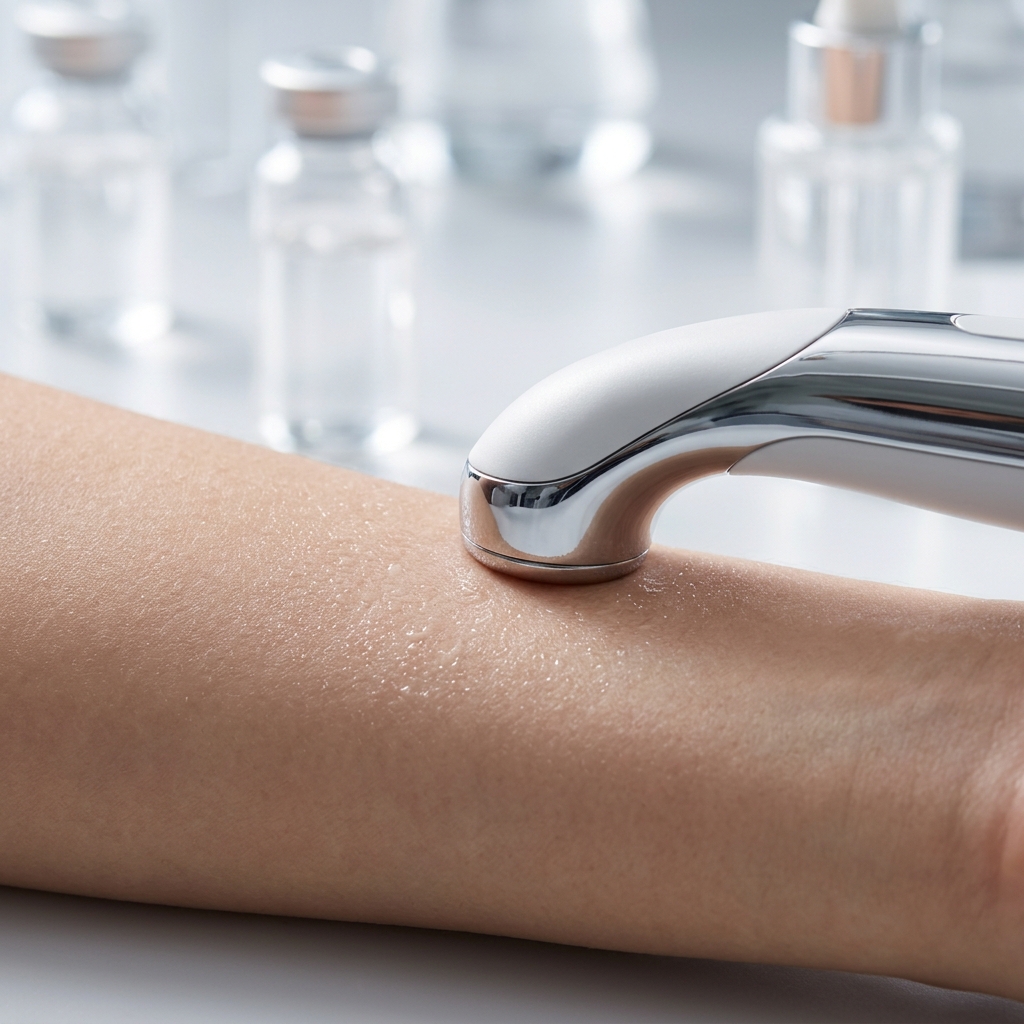
건강한 피부 표면의 수분막과 임상 연구진의 정밀 피부 장벽 측정 프로브. 각질 세포 사이를 촘촘히 메우는 지질층이 파괴되면 수분이 폭발적으로 공기 중에 증발하게 됩니다.
1. 10분 만에 터져버리는 피부 댐: 경피수분손실(TEWL)의 과학적 실체
건강한 성인의 피부 각질층은 약 30% 수준의 촉촉한 수분을 품고 있습니다. 피부 속 천연보습인자(NMF)인 아미노산, 요소, 젖산 등이 수분을 자석처럼 끌어당기고, 그 위를 세포 간 지질이 단단한 뚜껑처럼 덮어두기 때문입니다. 하지만 각질층 수분도가 10% 밑으로 곤두박질치는 순간, 피부는 비명을 지르며 극심한 가려움과 따가움을 유발합니다.
피부과학 임상 데이터는 우리가 무심코 즐기는 뜨거운 샤워가 피부에 얼마나 치명적인지 숫자로 명백히 보여줍니다. 피부 방어막의 건강도를 나타내는 국제 표준 지표인 '경피수분손실(TEWL)'을 측정한 결과, 상온에서 인체의 자연스러운 시간당 수분 손실량은 25.75 g/m² 수준입니다. 11도의 찬물에 닿았을 때는 34.96 g/m²으로 완만하게 상승하지만, 41도의 뜨거운 물에 단 10분간 노출되는 순간 수분 손실량은 58.58 g/m²까지 치솟습니다. 평상시보다 무려 127% 폭증하는 수치입니다.
임상 실험으로 확인된 수온별 피부 수분 손실량(TEWL) 변화
- 평상시 자연적 수분 손실량: 약 25.75 g/m²/h
- 11℃ 찬물 노출 시: 약 34.96 g/m²/h (소폭 증가)
- 41℃ 뜨거운 물 10분 노출 시: 약 58.58 g/m²/h (평소 대비 127% 폭증)
- 지질층을 인위적으로 완전 제거했을 때: 경피수분손실 최대 75배 급증
뜨거운 물은 마치 싱크대의 기름때를 닦아내듯, 각질 세포 사이를 메우고 있던 필수 지질을 순식간에 녹여 배수구로 흘려보냅니다. 지질이 씻겨 나가 수분을 잃은 각질층은 또 다른 악순환에 빠집니다. 정상 피부에서는 매일 약 40mg의 묵은 각질이 단백질 분해효소의 작용으로 눈에 보이지 않게 탈락합니다. 하지만 각질층에 물이 부족해지면 이 분해효소가 작동을 멈추고 맙니다. 그 결과 각질이 하얗게 엉겨 붙어 피부 표면을 거칠게 만들고 빛 반사를 흐트러뜨려 칙칙한 안색을 유발합니다.

피부과 진료실에서 전문의가 디지털 화면을 통해 각질층의 '벽돌과 회반죽' 라멜라 구조를 설명하는 모습. 세라마이드, 콜레스테롤, 지방산의 조화로운 결합이 장벽 재생의 핵심입니다.
2. 피부 장벽의 시멘트: 세라마이드·콜레스테롤·지방산 '3:1:1' 황금비율
피부과학에서 각질층은 유명한 '벽돌과 회반죽(Bricks and Mortar)' 모델로 설명됩니다. 튼튼한 각질세포가 단단한 벽돌이라면, 그 틈새를 빈틈없이 메워주는 시멘트가 바로 세포 간 지질입니다. 이 지질 성분들은 물과 기름이 층층이 교대로 쌓이는 정교한 '라멜라(Lamellar) 층상 구조'를 이뤄 외부 유해 자극을 막고 수분 증발을 철통 방어합니다.
여기서 가장 중요한 발견은 피부 지질의 구성 성분비입니다. 건강한 피부 지질의 절반인 약 50%는 세라마이드가 차지하고, 25%는 콜레스테롤, 나머지 10~15%는 자유 지방산으로 이루어져 있습니다. 이를 분자 몰 비율로 환산했을 때 가장 완벽한 방어력을 발휘하는 공식이 바로 '세라마이드 3, 콜레스테롤 1, 지방산 1'의 3:1:1 황금비율입니다.
| 지질 구성 성분 |
지질 내 비율 |
생리학적 핵심 기능 |
결핍 시 나타나는 임상 증상 |
| 세라마이드 (Ceramide) |
약 50% (3 몰비) |
라멜라 판상 구조의 중심축, 수분 분자 결합 및 증발 원천 차단 |
수분 유지력 상실, 각질층 들뜸, 건성 습진 발생 |
| 콜레스테롤 (Cholesterol) |
약 25% (1 몰비) |
지질층의 유동성 조절 및 온도 변화에 따른 층상 배열 물리적 안정화 |
지질막의 유연성 저하, 미세 균열 및 외부 자극 민감도 증가 |
| 자유 지방산 (Free Fatty Acid) |
약 10~15% (1 몰비) |
지질층 밀도 유지, 피부 표면 pH 5.5 약산성 방패 형성 및 합성효소 활성화 |
피부 알칼리화, 유해 세균 증식 및 염증 반응 유발 |
| 천연보습인자 (NMF) |
세포 내 수용성 분자 |
각질세포 내부 수분 포집 및 효소 활성화 환경 조성 |
각질 탈락 주기 정체, 피부 거칠어짐 및 칙칙함 |
많은 소비자들이 시중에서 '세라마이드 고함량' 문구만 보고 단일 성분 제품을 고르곤 합니다. 하지만 피부 생리학적으로 세라마이드만 단독으로 듬뿍 바르면 지질층의 물리적 배열이 어긋나 오히려 흡수되지 못하고 겉돌기 쉽습니다. 세라마이드 NP, 콜레스테롤, 스테아릭애씨드 등 3대 지질이 함께 어우러진 3:1:1 복합 포뮬러를 발라야만 무너진 지질 시멘트가 온전히 재건됩니다.
특히 나이가 들거나 찬 바람이 부는 겨울철에는 체내 지질 총량이 30% 이상 급격히 감소합니다. 네덜란드 울티 박사(Dr. Ultee) 연구팀의 임상 결과에 따르면, 노화와 한랭 노출은 지질막의 유연성을 담당하는 '세라마이드 1 리놀레산'을 급감시켜 지질 결합을 성글게 만듭니다. 중장년층이 겨울철 샤워 후 유독 정강이가 가려워 피가 날 때까지 긁게 되는 '건성 습진'이 바로 이 지질 붕괴에서 비롯됩니다.
3. 피부 모사체 기술의 진화: PC-104에서 차세대 UHD 캡슐까지
천연 세라마이드는 물에도 기름에도 잘 녹지 않고 상온에서 하얗게 굳어버리는 치명적인 결정화 특성을 가집니다. 이 때문에 화장품에 고함량으로 안정화하여 피부 깊숙이 전달하기가 극도로 까다로웠습니다. 이를 돌파하기 위해 바이오 연구진은 실제 피부 지질 구조를 공학적으로 복제한 '피부 모사체(Biomimetic Skin Model)' 기술을 발전시켜 왔습니다.
국내 R&D 연구진은 1997년 천연 세라마이드 특유의 양팔형 대칭 구조를 세계 최초로 모사한 유사세라마이드 'PC-104' 개발에 성공했습니다. 당시 미국 샌프란시스코 대학교(UCSF)의 피부과학 석학 피터 엘리야스 교수는 이 기술에 대해 "세라마이드 중의 세라마이드"라고 찬사를 보내며 피부 장벽 회복 효능을 공인했습니다. 이어 피부 지질을 층판소체 형태의 소프트 캡슐로 감싸 안은 '더마온(Derma-ON)' 기술이 도입되며, 도포 후 각질층 잔존율이 단독 성분 대비 128% 높아지고 세정 후에도 190% 높은 결합력을 입증했습니다.
최근에는 긴 사슬 구조의 세라마이드와 지질층 사이를 묶어주는 '링커 세라마이드'를 결합한 2세대 초고밀도 UHD 기술까지 도달했습니다. 수분 증발을 차단하는 고밀도 오르소롬빅 지질 구조를 15% 더 촘촘하게 메워줍니다. 영국 피부학회지(BJD)에 발표된 셰필드 대학교 임상 연구 역시, 아토피 성향 성인 58명에게 피부 동일 지질과 글리세린 유화제를 28일간 도포했을 때 장벽 손상 지표가 38.02에서 29.79 g/m²/h로 대폭 호전된 반면, 단순 글리세린만 바른 대조군은 장벽 회복 효과가 전혀 없었음을 보고하며 피부 동일 지질 보충의 절대적 필요성을 못 박았습니다.
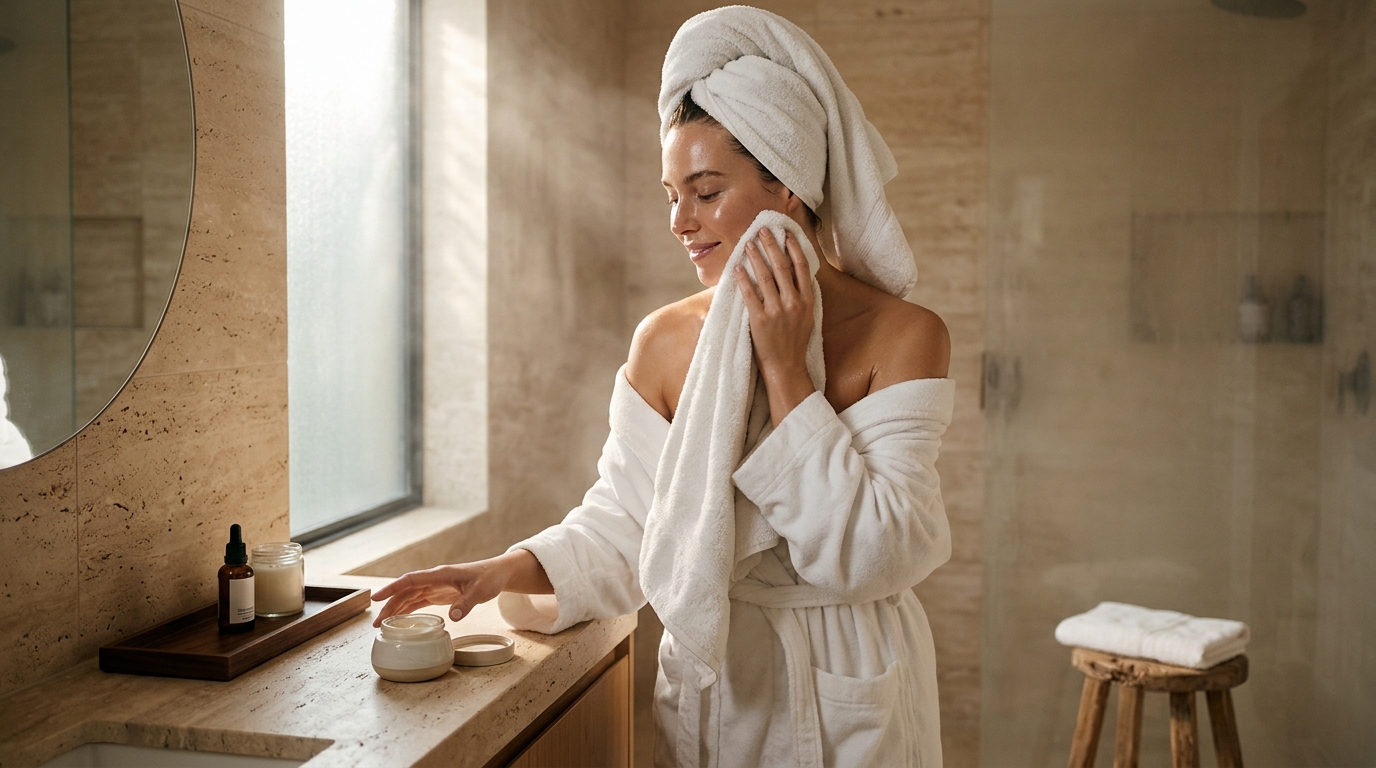
샤워 직후 수분이 남아있는 3분 이내에 부드러운 타월로 가볍게 눌러 닦고 3:1:1 보습 크림을 도포하는 모습. 피부 표면의 수분 증발을 완벽하게 잠그는 결정적 골든타임입니다.
4. 피부 수분을 사수하는 '3분 골든타임' 실전 관리 수칙 4단계
피부과 전문의들은 무너진 피부 장벽을 되살리기 위해 오늘 밤 샤워 습관부터 당장 바꿔야 한다고 한목소리로 강조합니다. 일상에서 누구나 실천할 수 있는 핵심 4단계 가이드라인은 다음과 같습니다.
1단계: 온도는 37~39도 미온수로, 시간은 10분 이내로 단축
김이 펄펄 나는 41도 이상의 온수는 피부 기름막을 녹이는 주범입니다. 체온과 비슷한 37~39도 미온수로 맞추고, 스마트폰 타이머를 5~10분으로 설정해 샤워 시간을 최소화하세요. 비누칠은 땀과 피지가 분비되는 겨드랑이와 사타구니 위주로 가볍게 끝내는 것이 좋습니다.
2단계: 때수건은 영구 퇴출, 면 수건으로 톡톡 누르듯 닦기
목욕탕에서 초록색 때수건으로 피부를 문지르는 행위는 피부 댐을 불도저로 밀어버리는 것과 같습니다. 피부 산도를 해치는 알칼리성 비누 대신 약산성(pH 5.5) 클렌저를 사용하고, 샤워 후 물기는 문지르지 말고 부드러운 면 타월로 가볍게 '톡톡' 눌러 남은 물기만 정돈합니다.
3단계: 욕실 문 열기 전 '3분 골든타임' 내에 보습제 밀폐
샤워실에서 나와 옷을 입고 방으로 이동하는 순간 피부 수분은 공기 중으로 가장 빠르게 날아갑니다. 피부에 촉촉한 수분감이 남아 있는 3분 이내에 세라마이드, 콜레스테롤, 지방산이 3:1:1로 함유된 보습제를 전신에 펴 바르세요. 몸통과 팔다리에는 크림이나 밤 제형을, 얼굴에는 로션을 선택하고, 건조함이 심한 정강이와 손등은 하루 2회 이상 덧발라 줍니다.
4단계: 진물과 붉은 발진 지속 시 2차 감염 주의 및 진료
보습제를 충분히 발랐는데도 가려움이 2주 이상 밤마다 계속되거나 피부가 붉게 부어오르고 진물이 난다면 단순 건조증을 넘어선 상태입니다. 긁어서 생긴 상처로 황색포도상구균이 침투하면 봉와직염 등 심각한 2차 감염으로 번질 수 있습니다. 손톱을 짧게 정돈하고 자극 없는 면 소재 옷을 입으며 지체 없이 피부과를 찾아 전문 처방을 받아야 합니다.
샤워를 끝마친 직후의 3분은 평생의 피부 나이와 촉촉함을 결정짓는 결정적 순간입니다. 오늘부터 뜨거운 물 샤워 습관을 미온수로 바꾸고, 욕실 안에 3:1:1 지질 보습제를 비치하여 피부 댐을 든든하게 지켜내시기 바랍니다.
만인의 탑 보건의료 전문 데스크 | 취재 및 집필: 신승엽 기자 (Seung Youb Ssin)
본 기사는 임상 피부과학 학술 저널(British Journal of Dermatology) 연구 데이터, 대학병원 피부과 임상 가이드라인, 국내외 바이오 지질 연구 성과를 바탕으로 교차 검증을 거쳐 작성되었습니다.
Stepping under a steaming hot shower after an exhausting workday feels like the ultimate sanctuary of relaxation. However, if your calves and inner forearms begin stinging and itching the moment you reach for your clothes, it is far from a harmless sensation. It is an urgent alarm signaling the catastrophic collapse of your skin moisture barrier. Clinical dermatology trials have revealed that exposing skin to 41°C water for just 10 minutes strips away essential intercellular lipids, causing Transepidermal Water Loss (TEWL) to surge by an astonishing 127%.
Scientific evaluation of the skin hydration barrier using a clinical diagnostic probe. When the delicate lipid bilayer sealing the stratum corneum is breached, moisture rapidly evaporates into ambient air.
1. The Moisture Dam Breach in 10 Minutes: The Physics of TEWL
In healthy adult skin, the outermost stratum corneum maintains an optimal hydration level of roughly 30%. Endogenous Natural Moisturizing Factors (NMF)—including amino acids, urea, and lactic acid—magnetically hold water molecules, while intercellular lipids form an impenetrable protective ceiling. However, once hydration dips below 10%, skin elasticity plummets, triggering intense tightness, pruritus, and stinging pain.
Controlled clinical trials show how swiftly high water temperatures compromise skin integrity. Under baseline room conditions, normal human TEWL averages 25.75 g/m²/h. Exposure to 11°C cool water produces a modest rise to 34.96 g/m²/h. Yet, immersion in 41°C hot water for just 10 minutes drives water loss to a staggering 58.58 g/m²/h—a 127% spike above baseline.
Clinical Data: Water Temperature and Transepidermal Water Loss (TEWL)
- Baseline physiological water loss: Approx. 25.75 g/m²/h
- Cold water immersion (11°C): Approx. 34.96 g/m²/h (modest elevation)
- Hot water immersion (41°C, 10 min): Approx. 58.58 g/m²/h (127% surge)
- Experimental complete lipid extraction: TEWL spikes up to 75-fold
Hot water functions much like an industrial degreaser, dissolving the vital lipid mortar binding corneocytes and flushing it down the drain. Deprived of water, the skin enters a pathological cycle. Normally, approximately 40mg of shed corneocytes are broken down imperceptibly each day by hydrolytic proteases. Dehydration deactivates these enzymes, leaving clumps of unseparated dead cells that appear as dry, flaky scales and disrupt light reflection, imparting a dull complexion.
In a clinical setting, a dermatologist explains the iconic 'bricks and mortar' lamellar structure using a digital interface. Combining ceramides, cholesterol, and fatty acids is essential to restore the physiological matrix.
2. The Intercellular Mortar: The 3:1:1 Golden Ratio of Lipids
Dermatological science universally frames the epidermis within the classic 'Bricks and Mortar' model. Keratinocytes serve as resilient structural bricks, while intercellular lipids represent the mortar sealing every microscopic gap. These lipids assemble into an ultra-organized lamellar bilayer—alternating sheets of water and lipid phases—that repels external pathogens and prevents water egress.
Crucially, this mortar is defined by a precise molecular stoichiometry. Healthy stratum corneum lipids consist of roughly 50% ceramides, 25% cholesterol, and 10 to 15% free fatty acids. Converted into molar ratios, this yields the famed 3:1:1 golden formula: 3 parts ceramides, 1 part cholesterol, and 1 part free fatty acids.
| Lipid Component |
Proportion in Matrix |
Primary Physiological Function |
Clinical Consequences of Deficiency |
| Ceramide (Ceramide NP, AP) |
Approx. 50% (3 Molar Ratio) |
Forms backbone of lamellar bilayers; traps water molecules; halts evaporation |
Loss of hydration capacity, corneocyte detachment, asteatotic eczema |
| Cholesterol |
Approx. 25% (1 Molar Ratio) |
Regulates bilayer fluidity; maintains physical stability across temperature shifts |
Rigid membrane breakdown, micro-fissuring, heightened environmental sensitivity |
| Free Fatty Acids |
Approx. 10-15% (1 Molar Ratio) |
Maintains lipid packing density; stabilizes weakly acidic pH 5.5; activates enzymes |
Alkalinization, bacterial colonization, dysregulated inflammatory cascades |
| Natural Moisturizing Factor |
Intracellular Solutes |
Absorbs ambient humidity; creates catalytic environment for desquamation |
Arrest of enzymatic peeling, hyperkeratosis, surface roughness and dullness |
Consumers frequently choose single-ingredient products boasting high ceramide percentages. Yet pharmacology reveals that applying isolated ceramides without counter-lipids disrupts physiological packaging, causing the formula to slide off without integrating into the stratum corneum. Rebuilding true barrier defense requires a coordinated 3:1:1 blend combining Ceramide NP, cholesterol, and stearic acid.
Aging and cold winter climates compound this vulnerability by slashing total cutaneous lipids by more than 30%. Published research by Dr. Ultee demonstrates that chronological aging sharply reduces flexible Ceramide 1 linoleate while oleic acid levels rise, loosening the molecular matrix. This explains why elderly individuals frequently suffer from painful winter eczema craquele and unyielding pruritus.
3. Evolution of Biomimetic Lipids: From PC-104 to UHD Technology
Natural ceramide is notoriously insoluble in both water and oil, readily precipitating into rigid crystals at room temperature. This physical trait long hindered cosmetic chemists from delivering bioavailable ceramides into deeper stratum corneum layers. To overcome this barrier, bioengineers created biomimetic lipid platforms that mirror endogenous human skin architecture.
In 1997, bio-researchers introduced PC-104 (Pseudo Ceramide 104), faithfully mimicking the symmetrical dual-arm structure of native ceramides. Renowned UCSF dermatologist Dr. Peter Elias lauded PC-104 as the benchmark of synthetic ceramides, confirming its accelerated barrier repair kinetics. Subsequent breakthroughs introduced Derma-ON soft lamellar capsules, demonstrating a 128% higher retention rate in the stratum corneum and 190% greater wash-off resistance compared to unencapsulated actives.
Today, second-generation Ultra High Density (UHD) delivery systems incorporate linker ceramides alongside long-chain Ceramide NP, reinforcing the moisture-retaining orthorhombic lipid phase by 15%. Clinical findings published by the University of Sheffield in the British Journal of Dermatology validated this approach: treating 58 atopic adults with multi-vesicular emulsions containing skin-identical lipids (Ceramide NP, AP) and glycerin for 28 days decreased barrier damage metrics from 38.02 to 29.79 g/m²/h. Conversely, simple oil-in-water emulsions with glycerin failed to demonstrate barrier restoration, underscoring the indispensability of physiological lipid complexes.
Executing the three-minute golden window routine post-shower: patting damp skin with a plush towel and sealing hydration with a 3:1:1 ceramide barrier balm to prevent rapid moisture evaporation.
4. The 3-Minute Golden Window Protocol: 4 Steps to Seal Moisture
Dermatologists agree that rehabilitating a depleted skin barrier requires immediate lifestyle adjustments in the bathroom. Adopting these four evidence-based rules will protect your skin moisture reservoir:
Step 1: Cap Water Temperature at 37-39°C and Limit Showers to 10 Minutes
Water hotter than 41°C strips natural oils and melts intercellular mortar. Keep water comfortably lukewarm (37-39°C) and set a timer for under 10 minutes (ideally 5 minutes). Confine foaming cleansers to sebum-prone areas such as underarms and groin.
Step 2: Retire Physical Scrubs and Pat Dry with Soft Cotton
Abrasive exfoliating towels tear through compromised stratum corneum layers. Replace alkaline bar soaps with pH 5.5 slightly acidic cleansers. After rinsing, never rub aggressively; gently pat the skin with a soft cotton towel to absorb standing droplets.
Step 3: Lock Moisture Within 3 Minutes on Damp Skin
Water evaporates exponentially in the first few minutes post-shower. Within 3 minutes—while residual moisture still clings to the skin—slather a 3:1:1 lipid-rich moisturizer over the entire body. Use rich balms or creams for limbs and shins, applying an extra coat to severely dry zones twice daily.
Step 4: Monitor Persistent Redness and Guard Against Secondary Infections
If severe pruritus, redness, oozing, or honey-colored crusts persist beyond two weeks despite dedicated moisturizing, seek clinical dermatology evaluation. Micro-abrasions from scratching invite opportunistic Staphylococcus aureus pathogens, risking cellulitis. Keep nails trimmed short and wear soft, breathable cotton clothing.
The brief three-minute window immediately following your shower determines the long-term vitality, smoothness, and resilience of your skin. By moderating shower temperatures and locking in moisture with balanced 3:1:1 lipid replenishment, you fortify your biological moisture fortress against winter dryness.
MANINTOP Medical & Healthcare Editorial Desk | Reporting & Writing: Seung Youb Ssin, Senior Reporter
This report was cross-verified using clinical research from the British Journal of Dermatology, dermatological clinical protocols from university hospitals, and international biomimetic lipid engineering data.