진료실과 가정혈압의 기준은 다르며 한 번의 측정으로 진단하거나 약을 바꾸지 않는다. 지정 GPTs로 제작한 인공지능 설명 이미지이며 실제 현장 사진이 아닙니다.
만인의 탑 편집국
병원에서는 혈압이 높게 나오는데 집에서는 낮다면 어느 쪽을 믿어야 할까. 반대로 검진 때는 괜찮았는데 집에서 반복해 높은 수치가 나온다면 이를 무시해도 될까. 대한고혈압학회의 2026년 제6판 진료지침은 진료실 측정과 함께 가정혈압·활동혈압을 활용해 상태를 판단하도록 권고한다.
핵심은 서로 다른 측정값을 하나의 기준에 넣지 않는 것이다. 진료실에서는 수축기 140 또는 이완기 90mmHg 이상, 가정혈압에서는 수축기 135 또는 이완기 85mmHg 이상이 고혈압 기준이다. 두 숫자가 모두 넘어야 한다는 뜻도, 한 번의 측정만으로 진단이나 약 변경을 결정한다는 뜻도 아니다. 대한고혈압학회 2026년 진료지침 수정본
위 숫자와 아래 숫자, 둘 다 봐야 한다
수축기혈압은 심장이 수축해 피를 내보낼 때의 압력으로 혈압계의 위쪽 숫자다. 이완기혈압은 심장이 이완할 때의 압력으로 아래쪽에 표시된다. 단위인 mmHg는 압력을 나타낸다. ‘140/90’처럼 줄여 쓰더라도 판정에서는 두 수치 사이의 ‘또는’이라는 조건이 중요하다.
2026년 지침은 수축기 140 미만이면서 이완기만 90 이상인 경우를 이완기단독고혈압으로 분류한다. 위 숫자가 높지 않다고 아래 숫자를 무시해서는 안 되는 이유다. 예를 들어 진료실에서 125/92가 나왔다면 이완기 수치가 기준을 넘은 것이다. 다만 이는 숫자의 해석을 설명하는 가정이며, 한 번의 측정만으로 독자의 질환이나 치료를 확정하는 사례가 아니다.
정상혈압은 수축기 120 미만이면서 이완기 80 미만인 범주다. 진단 기준에 못 미친다고 모두 같은 정상 범위인 것도 아니다. 지침의 고혈압 전단계는 수축기 130~139 또는 이완기 80~89다. 진료에서는 반복 측정과 함께 심혈관질환 위험, 동반 질환 등을 살펴 관리 방향을 정한다.
집·진료실·24시간 평균의 기준은 서로 다르다
측정 방법
수축기 기준
이완기 기준
읽는 방법
진료실 혈압
140 이상
90 이상
둘 중 하나가 기준 이상
가정혈압
135 이상
85 이상
표준 방법으로 반복 측정한 기록 평가
24시간 활동혈압 전체 평균
130 이상
80 이상
하루 동안 자동 측정한 평균
활동혈압 주간 평균
135 이상
85 이상
깨어 있는 시간대의 평균
활동혈압 야간 평균
120 이상
70 이상
잠자는 시간대의 평균
단위는 모두 mmHg다. 표는 고혈압을 평가하는 측정별 기준이며 개인의 치료 목표표가 아니다. 가정혈압 숫자에 5를 더해 진료실 수치로 바꾸는 식의 개인별 환산 공식으로 사용할 수도 없다.
진료실에서 높지만 밖에서는 높지 않은 경우를 백의고혈압이라고 한다. 의료진의 흰 가운을 뜻하는 이름처럼 진료 환경의 영향을 고려하는 개념이다. 반대로 진료실에서는 높지 않지만 밖에서 높은 경우가 가면고혈압이다. 어느 한쪽 기록이 무조건 틀렸다고 판단하기보다 두 환경에서 측정한 자료를 함께 봐야 한다.
24시간 활동혈압 검사는 일상생활과 수면 중 혈압 변화를 확인하는 데 도움이 된다. 가정혈압은 집에서 장기간 반복하기 편하지만, 보통 깨어 있을 때 스스로 재므로 수면 중 혈압을 평가하는 데 한계가 있다. 집에서 낮게 나오는 기록만으로 야간 혈압까지 잘 조절된다고 단정할 수 없는 이유다. 2026년 지침, 혈압 측정·진료실 밖 혈압 절
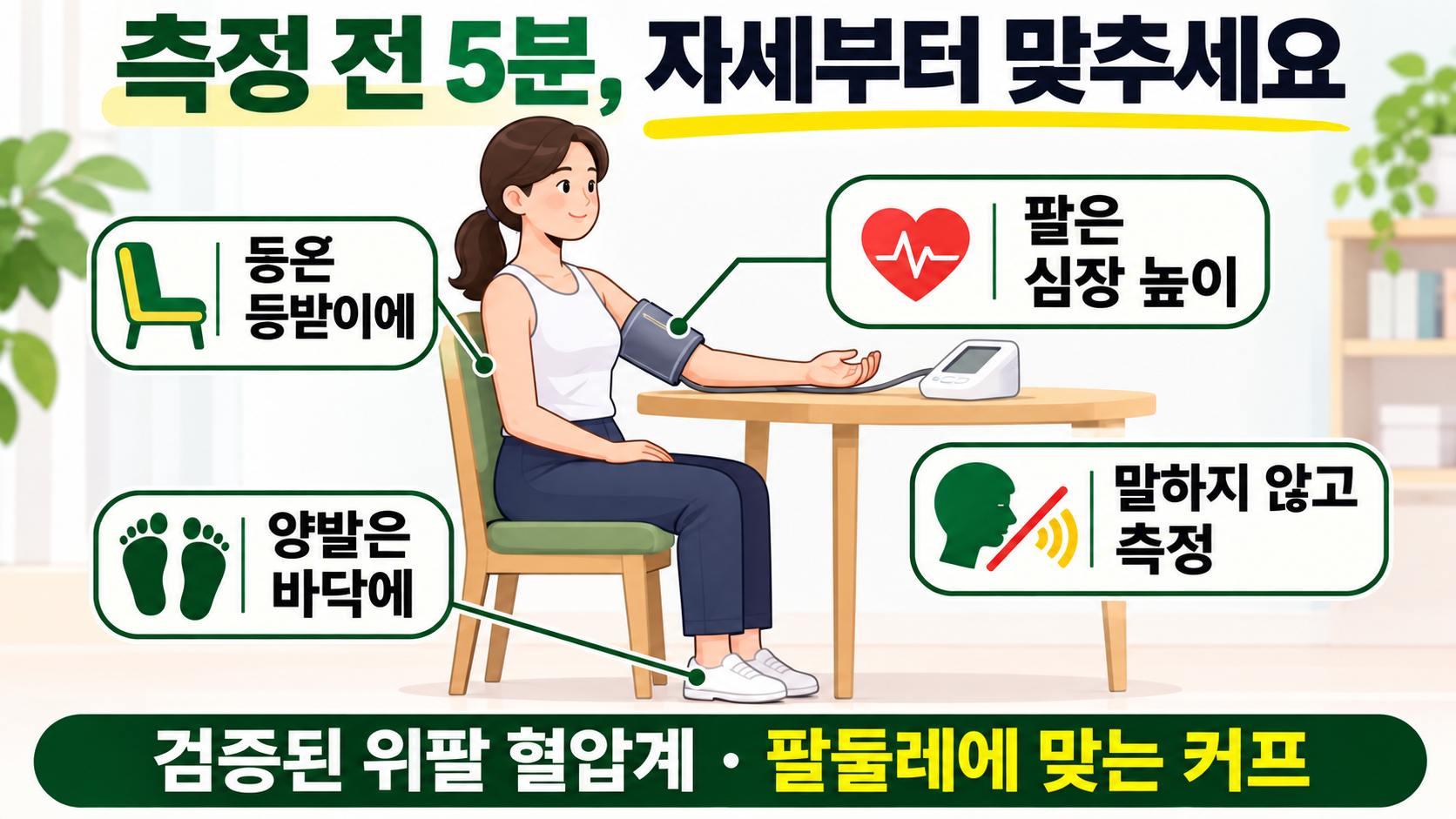
측정 전 안정과 위팔 혈압계의 자세를 확인한다. 지정 GPTs로 제작한 인공지능 설명 이미지이며 실제 현장 사진이 아닙니다.
정확히 재려면 혈압계와 팔 위치부터 맞춘다
가정에서는 정확도가 검증된 위팔 자동혈압계를 사용하는 것이 권고된다. 위팔은 어깨와 팔꿈치 사이 부위다. 커프는 팔에 감아 압력을 주는 띠를 말한다. 비싼 기기인지보다 해당 기기의 검증 여부와 팔둘레에 맞는 커프를 사용하는지가 중요하다.
자동혈압계의 커프 크기는 제조사 안내에 맞춘다. 너무 작은 커프를 쓰면 혈압이 실제보다 높게 측정될 수 있다. 모든 성인에게 동일한 커프 길이를 적용하지 말고 자신의 팔둘레가 제품이 정한 범위 안에 들어가는지 확인해야 한다. 사용 중인 혈압계와 커프를 진료 때 가져가 측정 방법을 보여주는 것도 오류를 찾는 데 도움이 된다.
측정할 때는 등받이가 있는 의자에 앉아 5분 동안 조용히 쉰다. 등을 기대고 다리를 꼬지 않으며 양발을 바닥에 놓는다. 팔을 편안하게 받치고 커프가 심장 높이에 오게 한다. 팔을 힘주어 들고 버티거나 측정 중 대화·움직임을 계속하면 같은 조건으로 잰 값이 되기 어렵다. 커프가 심장보다 아래에 있으면 높게 측정될 수 있다.
손목형은 높이를 맞추기 어려워 일반적으로 우선 권고되지 않는다. 다만 위팔둘레가 매우 큰 경우 등에는 검증된 손목형을 예외적으로 사용할 수 있다는 것이 지침 설명이다. ‘손목형은 어떤 경우에도 전부 쓸 수 없다’는 식으로 바꾸어 전달해서도 안 된다.
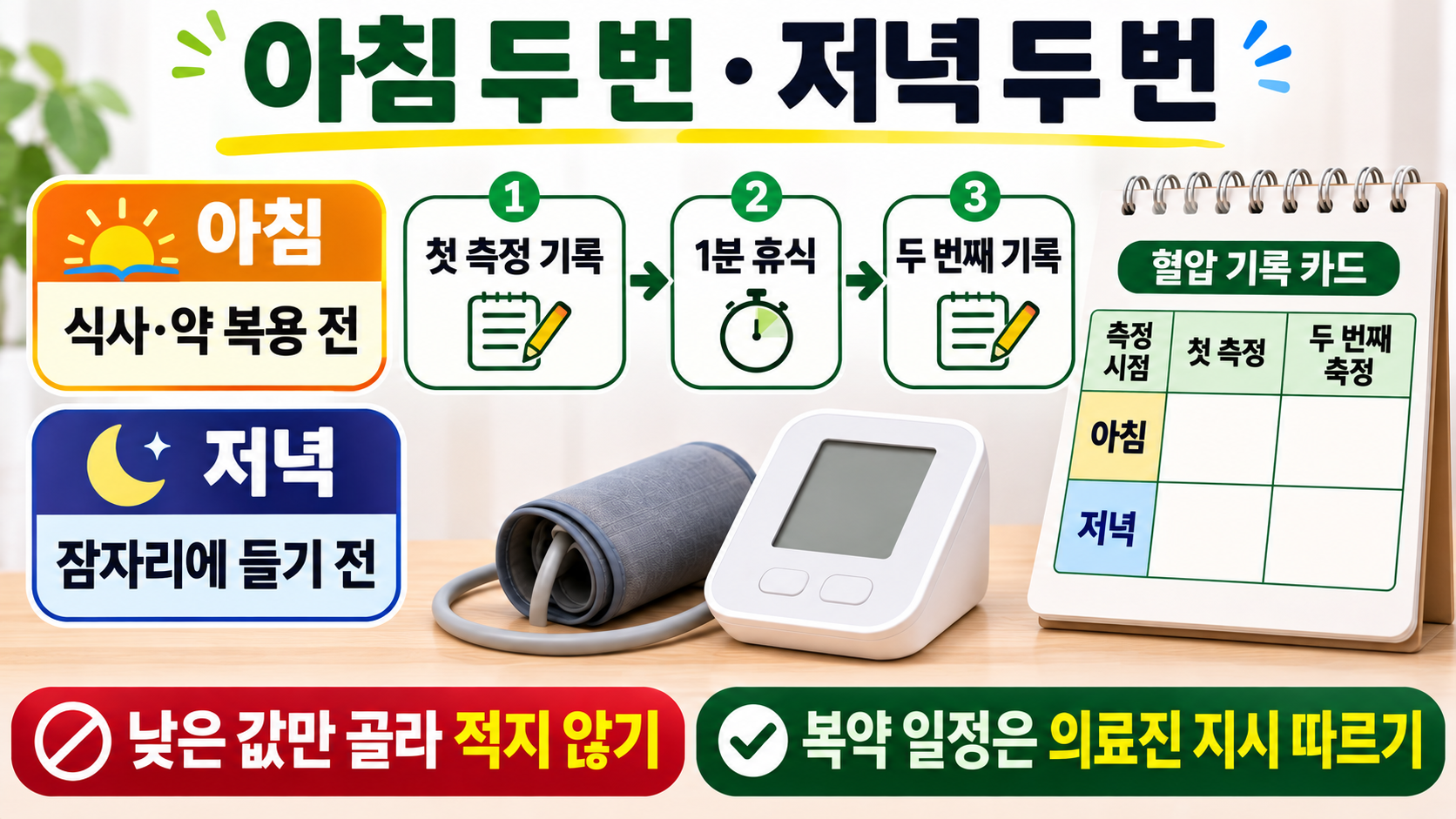
아침·저녁 각각 두 번 측정하고 모든 값을 기록한다. 지정 GPTs로 제작한 인공지능 설명 이미지이며 실제 현장 사진이 아닙니다.
아침·저녁 기록, 낮은 값만 골라 적지 않는다
학회의 가정혈압 교육자료는 측정 전 준비와 일정한 측정 습관을 강조한다. 식사·복약·활동 등 측정 전후 상황이 달라지면 숫자의 비교가 어려워진다. 의료진이 정해준 기록 방법이 있다면 그 방법을 우선 따르고, 약을 임의로 미루거나 건너뛰면서 수치를 비교하지 않는다. 대한고혈압학회 가정혈압 교육자료
학회 환자용 교육책자는 아침에는 식사와 약 복용 전, 저녁에는 잠자리에 들기 전에 측정하도록 안내한다. 화장실을 다녀온 뒤 5분 쉬고, 샤워나 목욕 전 측정한다. 2026년 지침은 측정 전 30분 동안 운동·목욕·흡연·음주·카페인 섭취를 피하도록 안내한다. 이는 일정한 측정 조건을 만들기 위한 안내이며, 처방된 복용 시간을 임의로 바꾸라는 뜻은 아니다.
한 번 측정해 기록한 뒤 1분 쉬고 다시 측정해 두 값을 남기도록 안내한다. 아침과 저녁에 각각 두 번 측정하는 방식이다. 한 번의 높은 값이나 낮은 값보다 같은 방법으로 쌓은 기록을 의료진과 함께 보는 것이 중요하다.
진단 초기에는 최소 3일 이상, 가능하면 7일 연속으로 측정하는 것이 지침의 안내다. 평가에서는 첫날 측정값을 제외한다. 원시 기록을 삭제하라는 의미는 아니므로 첫날을 포함한 전체 기록을 보존하고 의료진에게 보여준다. 장기 추적 관찰에서는 외래 방문 직전 5~7일 동안 측정하거나 주 또는 달에 1~2회 측정하는 방식이 제시돼 있다. 자신의 진료 목적에 맞는 기간은 의료진과 정한다.
기록표에는 날짜, 시각, 수축기·이완기혈압, 맥박과 특이사항을 나누어 적는다. 아침과 저녁, 첫 번째와 두 번째 값을 구분해 남기면 진료실에서 흐름을 읽기 쉽다. 높은 값이 마음에 들지 않는다고 낮게 나올 때까지 반복한 뒤 마지막 값만 적으면 실제 상태를 왜곡할 수 있다. 측정 오류가 의심되면 값을 지워버리기보다 무엇이 달랐는지 함께 적는다.
날짜·시각
첫 측정
두 번째 측정
맥박·특이사항
아침 기록칸
수축기 / 이완기
수축기 / 이완기
복약 전후·증상 등
저녁 기록칸
수축기 / 이완기
수축기 / 이완기
운동·음주·불편감 등
위 표는 빈 기록 형식이다. 임의의 정상 수치를 넣어 따라 맞추는 목표로 삼지 않는다. 기록을 제출할 때는 숫자뿐 아니라 복용 중인 처방약·일반약·영양제 목록과 최근 검진 결과도 함께 준비한다. 감기약이나 일부 소염진통제 등도 혈압 조절 평가에서 확인할 항목이 될 수 있다.
스마트워치 수치와 치료 목표를 혼동하지 않는다
커프 없이 측정하는 스마트워치나 반지형 기기는 센서와 계산 방식으로 혈압을 추정하는 기술을 사용한다. 2026년 지침은 이런 기기의 진료실 밖 활용 가능성을 다루면서도, 기기와 연구에 따라 정확도가 다르고 추가 검증과 해석 기준이 필요하다고 설명한다. 표준 측정에는 검증된 커프형 기기를 권고한다.
따라서 손목이나 반지에 숫자가 표시된다는 이유만으로 모든 제품을 동등한 진단 도구로 볼 수 없다. 제품별 허가 용도와 검증 상태, 의료진이 사용하는 방법을 구분해야 한다. 커프가 없다는 이유만으로 모든 기기의 승인 용도와 임상 활용을 동일하게 판단해서도 안 된다.
진단 기준과 치료 목표도 구분해야 한다. 기준은 질환을 분류할 때 쓰는 수치이고, 목표는 치료 중 어느 수준을 지향할지 정하는 값이다. 동반 질환, 심혈관 위험, 나이와 노쇠, 일어설 때 어지러운 증상 등이 목표를 정하는 데 영향을 줄 수 있다. 집에서 한 번 정상 범위가 나왔다고 약을 줄이거나 끊는 판단으로 이어져서는 안 된다. 약 복용 중의 기록을 의료진과 함께 검토해야 한다.
아주 높은 수치가 반복되면 며칠 기다리는 기록으로 대신하지 않는다
혈압이 매우 높을 때는 일반적인 며칠간의 기록 계획보다 즉시 평가가 필요한지 구분하는 것이 우선이다. 미국심장협회는 임신하지 않은 성인에서 수축기 180mmHg 초과 또는 이완기 120mmHg 초과의 수치가 나오면 적어도 1분 후 다시 측정하고, 여전히 높다면 증상을 확인하도록 안내한다. 흉통·호흡곤란·갑작스러운 마비나 쇠약·말하기 어려움·시야 변화 등이 함께 있으면 응급상황일 수 있다. 한국에서는 119에 도움을 요청하고 수치가 저절로 내려가기를 기다리지 않는다.
증상이 없더라도 반복해서 매우 높게 나오면 가능한 한 빨리 의료진에게 연락해야 한다. ‘증상이 없으니 며칠 기록한 뒤 가면 된다’고 일률적으로 안내할 수 없다. 임신 중에는 별도의 평가 기준과 치료가 필요하므로 이 일반 성인 안내를 그대로 적용하지 않는다. 미국심장협회 고혈압 응급 대응 안내
가정혈압의 가치는 숫자 하나를 얻는 데 있지 않다. 같은 조건으로 반복해 측정하고, 두 숫자와 측정 상황을 함께 남겨 진료에 활용하는 데 있다. 측정 환경에 맞는 기준, 정확한 자세, 빠짐없는 기록이 모여야 의료진도 치료가 필요한지와 현재 치료가 적절한지를 판단할 수 있다.
자료 확인: 2026년 11월 20일. 개인별 진단·복약 변경은 진료를 통해 결정해야 한다.
140/90 in the clinic, 135/85 at home: check how blood pressure was measured
Clinic and home thresholds differ; one reading is not a diagnosis or a reason to change medication. AI editorial illustration created with the designated GPT; not a photograph of an actual event.
MANINTOP Newsroom
Which reading matters when blood pressure is high in the clinic but lower at home? What if a checkup looks reassuring but repeated home measurements are high? The Korean Society of Hypertension's sixth-edition 2026 guideline recommends using home or ambulatory measurements alongside clinic measurements to assess blood pressure.
The first step is not to put every reading against the same threshold. The clinic threshold is systolic pressure of at least 140 or diastolic pressure of at least 90 mmHg; the home threshold is at least 135 or 85 respectively. Both numbers do not have to cross their thresholds. Nor does a single measurement decide a diagnosis or a medication change. Korean Society of Hypertension's revised 2026 guideline
Read both the upper and lower numbers
Systolic pressure, usually the upper number, is pressure when the heart contracts and pumps blood. Diastolic pressure, the lower number, is pressure while the heart relaxes. The unit mmHg measures pressure. Although readings are written in a compact form such as 140/90, the word “or” between the diagnostic thresholds matters.
The guideline classifies systolic pressure below 140 with diastolic pressure of 90 or higher as isolated diastolic hypertension. A relatively low upper number is therefore not a reason to ignore the lower one. For example, a clinic reading of 125/92 exceeds the diastolic threshold. This is an illustration of how to read the numbers, not a diagnosis or treatment decision for a reader based on one measurement.
Normal blood pressure means systolic pressure below 120 and diastolic pressure below 80. Being below the hypertension threshold does not put every reading in the same normal category. The guideline defines prehypertension as systolic pressure of 130–139 or diastolic pressure of 80–89. Clinicians consider repeated measurements, cardiovascular risk and accompanying conditions when planning management.
Home, clinic and 24-hour averages use different thresholds
Measurement
Systolic threshold
Diastolic threshold
How to interpret it
Clinic
140 or higher
90 or higher
Either number reaching its threshold matters
Home
135 or higher
85 or higher
Assess a record of repeated standardised measurements
24-hour ambulatory average
130 or higher
80 or higher
Average of automatic measurements over the day and night
Daytime ambulatory average
135 or higher
85 or higher
Average during waking hours
Night-time ambulatory average
120 or higher
70 or higher
Average during sleep
All values are in mmHg. These are measurement-specific assessment thresholds, not a personal treatment-target chart. They are also not an individual conversion formula: adding five points to a home reading does not establish what that person's clinic reading should be.
High clinic pressure without high out-of-clinic pressure is called white-coat hypertension, reflecting the possible influence of the clinical environment. The reverse—pressure that is not high in the clinic but is high outside it—is masked hypertension. Instead of assuming one record must be wrong, clinicians examine both environments.
Ambulatory monitoring helps show patterns during normal activities and sleep. Home monitoring is convenient for repeated measurements over a longer period, but people generally take those readings while awake. Low daytime home readings therefore do not establish that night-time pressure is adequately controlled. 2026 guideline sections on blood-pressure measurement
Rest before measuring and check posture when using an upper-arm monitor. AI editorial illustration created with the designated GPT; not a photograph of an actual event.
Start with a suitable device and correct arm position
A validated automatic upper-arm monitor is recommended for home measurements. The upper arm is the area between the shoulder and elbow; the cuff is the band that inflates around it. Device validation and a cuff that fits the arm matter more than assuming an expensive monitor must be appropriate.
Use the cuff size specified by the automatic monitor's manufacturer. An undersized cuff can overestimate pressure. Do not assume one adult cuff size fits everyone: check that your arm circumference falls within the stated range. Bringing the monitor and cuff to an appointment and demonstrating how you measure can help identify errors.
Sit in a chair with back support and rest quietly for five minutes. Support your back, leave your legs uncrossed and place both feet on the floor. Rest the arm comfortably with the cuff at heart level. Holding the arm up through muscular effort, talking or moving makes measurements less consistent. A cuff below heart level can produce an overestimate.
Wrist monitors are generally not preferred because positioning them correctly at heart level is difficult. The guideline nevertheless allows a validated wrist device in exceptional circumstances, such as a very large upper-arm circumference. That is different from saying every wrist monitor is unusable in all circumstances.
Take two readings each morning and evening and record both. AI editorial illustration created with the designated GPT; not a photograph of an actual event.
Keep morning and evening records—not just the lowest readings
The society's home-monitoring education material emphasises preparation and a consistent routine. Meals, medication and activity around the measurement affect comparability. Follow the recording plan supplied by your clinician, if there is one, and do not delay or skip medication on your own to compare readings. Korean Society of Hypertension home-monitoring education
The patient booklet recommends morning measurements before food and medication, and evening measurements before bed. Use the bathroom, rest for five minutes and measure before a shower or bath. The 2026 guideline advises avoiding exercise, bathing, smoking, alcohol and caffeine for 30 minutes beforehand. These instructions establish consistent measurement conditions; they do not authorise changing a prescribed medication schedule independently.
The booklet advises taking and recording a measurement, resting for one minute and then recording another. It describes two measurements in the morning and two in the evening. A consistent record reviewed with a clinician is more useful than concentrating on one high or low result.
For initial diagnosis, the guideline recommends measurements on at least three days, preferably seven consecutive days, excluding the first day from assessment. This does not mean deleting the raw records: retain all readings, including day one, for the clinician. For long-term follow-up, it describes measurements for five to seven days immediately before an outpatient visit, or once or twice per week or month. Agree the appropriate period for the purpose of your care with your clinician.
Record the date, time, systolic and diastolic pressures, pulse and relevant circumstances separately. Distinguishing morning from evening and first from second readings makes the pattern easier to assess. Repeating measurements until a lower result appears and recording only that final result can distort the picture. If you suspect a measurement error, note what was different rather than silently deleting the reading.
Date and time
First measurement
Second measurement
Pulse and notes
Morning entry
Systolic / diastolic
Systolic / diastolic
Medication timing, symptoms, etc.
Evening entry
Systolic / diastolic
Systolic / diastolic
Exercise, alcohol, discomfort, etc.
This is a blank recording format, not a set of target values to imitate. Bring your prescription medicines, over-the-counter medicines and supplements list, as well as recent checkup results, with the record. Cold medicines and some anti-inflammatory painkillers can be relevant when assessing blood-pressure control.
A wearable reading is not a treatment target
Cuffless watches and ring-type devices use sensors and computational methods to estimate pressure. The 2026 guideline discusses their potential out-of-clinic use while noting differences in accuracy between devices and studies, and the need for further validation and standards for interpretation. Validated cuff-based devices remain recommended for standard measurements.
The presence of a number on a watch or ring does not make every product an equivalent diagnostic instrument. Distinguish each product's authorised use, validation and the method used by the clinician. Equally, the absence of a cuff does not make every device's authorised use and clinical application identical.
Diagnostic thresholds and treatment targets are also different. The former help classify a condition; the latter describe the level to aim for during treatment. Accompanying disease, cardiovascular risk, age, frailty and dizziness on standing can affect target selection. One home reading in the normal range should not prompt a person to reduce or stop medication independently. Review readings taken during treatment with the clinician.
Repeated extremely high readings are not a reason simply to keep a diary for several days
With very high pressure, deciding whether immediate assessment is necessary takes priority over an ordinary multiday recording plan. For adults who are not pregnant, the American Heart Association advises repeating a reading with systolic pressure above 180 mmHg or diastolic pressure above 120 mmHg after at least one minute and assessing symptoms if it remains very high. Chest pain, breathlessness, sudden numbness or weakness, difficulty speaking or changes in vision may indicate an emergency. In Korea, call 119 rather than waiting for the pressure to fall by itself.
Even without symptoms, repeated readings that remain very high warrant contacting a healthcare professional as soon as possible. A blanket instruction to record for several days before seeking care would be inappropriate. Pregnancy requires separate assessment and treatment criteria, so this general adult advice should not be applied unchanged. American Heart Association guidance on severe blood pressure and emergencies
Home monitoring is valuable for more than producing a single number. Repeated measurements under consistent conditions, with both numbers and the circumstances recorded, give clinicians better information for deciding whether treatment is needed and whether current treatment is appropriate.
Sources checked November 20, 2026. Individual diagnosis and medication changes require clinical assessment.
PRO SOURCING ENGINE만인의 탑 빅데이터 솔루션
★ 가입 시 600 크레딧(120회) 전원 무료
내가 찾는 상품 키워드, 지금 얼마나 검색될까?
네이버 월간 검색량 + 구글 볼륨 + 아이템스카우트 실시간 상품수와 경쟁강도 배지를 0.5초 만에 무료로 확인하세요.
MANINTOP NEWSLETTER
📬 만인의 탑 뉴스레터 무료 구독
오늘 보신 정책·시사 뉴스가 유익하셨나요? 매일 엄선되는 알짜 복지 혜택과 국회 실시간 속보를 이메일로 가장 먼저 받아보세요. (평생 무료)
1월이 시작되면 감기는 이미 우리 곁에 와 있습니다. 2월, 3월, 4월까지 이어지는 추위와 건조함은 코와 목을 가장 먼저 공격합니다. 아침에 일어나자마자 막혀 있는 코. 계속 흐르는 콧물. 괜히 칼칼해지는 목. 이 증상은 “시작”일 뿐입니다. 한 번 무너지면 일주일, 길면 한 달까지 끌고 갑니다. 약을 먹으면 잠깐 괜찮아집니다. 하지만 며칠 뒤 또 반복됩니다. 왜일까요? 감기는 ‘치료’의 문제가 아니라 ‘관리’의 문제이기 때문입니다. 대부분은 감기가 오고 나서 약을 찾습니다. 하지만 진짜 중요한 건 감기가 오기 전에 코와 목을 지키는 것입니다. 건조한 실내 공기, 차가운 바깥 공기, 눈에 보이지 않는 세균. 코와 목은 매일 공격받고 있습니다. 지긋지긋하죠! 그런데도 우리는 아무 준비 없이 버티고 있습니다. 이번 겨울도 그렇게 보낼 건가요? 사실 방법은 어렵지 않습니다. 코를 깨끗하게 관리하고, 목을 따뜻하게 보호하고, 점막을 촉촉하게 유지하고, 기관지를 미리 관리하고, 외부 공기를 차단하는 것. 이 다섯 가지만 꾸준히 해도 감기약 없이 겨울을 보내는 것이 충분히 가능합니다. 🔥 이제부터 그 방법을 하나씩 살펴보겠습니다. 🔥 1. 코와 목을 먼저 관리해야 하는 과학적 이유 감기의 대부분은 코 점막에서 시작됩니다. 국제 학술지 Nature Reviews Microbiology 와 Journal of Allergy and Clinical Immunology 에 실린 호흡기 감염 관련 연구들에서는, 감기 바이러스가 비강 상피세포에 먼저 부착해 증식한다는 점을 설명하고 ...
리모델링사업이 진행 중인 아파트를 매매할 때 “계약금 10%를 언제까지 내야 하느냐”는 질문이 특히 많이 나옵니다. 이주공고(이주 안내)가 7~11월쯤이라고 들으면, 그 시점에 맞춰 계약금도 움직일 것 같아서 더 헷갈리기 쉽습니다. 하지만 실제 납부기한은 ‘이주공고가 언제냐’만으로 자동 결정되지 않는 경우가 많습니다. 1) 계약금 10% 납부기한: 결국 ‘문서에 적힌 일정’이 기준 계약금 10%를 언제까지 납부해야 하는지는, 내가 서명하는 매매계약서(특약 포함) 와 사업주체/조합이 제시한 공고·안내문 에 적힌 납부 일정이 기준이 됩니다. 실제 공고문에서는 분양대금 납부의 큰 틀(계약금→중도금→잔금)을 먼저 안내하고, 상세 일정은 별도 표나 유의사항으로 제시하는 방식이 흔합니다. 또, 계약서 문구에 따라 지급 시점이 조건부로 설정될 수도 있습니다. 예를 들어 한 사례 소개 자료에서는 용역계약서에 잔금(10%) 지급시기가 “사업승인 후”로 기재되어 있었다는 점이 언급됩니다. 이런 식으로 ‘사업 단계’와 지급을 연동하는 문구가 들어가면, 질문의 답은 계약서 문구를 확인해야만 확정됩니다. 관련 내용은 링크 에서 문구 사례를 확인할 수 있습니다. 2) 입주자모집공고에서 확인되는 ‘납부 순서’와 잔금 마감 시점 공고문에 적힌 문구를 보면, 납부 순서와 잔금 마감에 대한 기준이 비교적 명확하게 제시되는 경우가 있습니다. 예를 들어 한 입주자모집공고에는 “분양금액(주택가격)은 계약금, 중도금, 잔금의 순서로 납부”하며 “잔금은 입주(열쇠 수령일) 전에 완납”해야 한다고 안내되어 있습니다. (문구 확인: 링크 ) 이 문구가 의미하는 바는 최소 2가지입니다. 분양/공급 형태의 문서에서는 ‘계약금→중도금→잔금’ 흐름이 공식적으로 안내될 수 있습니다. 잔금은 “입주(열쇠 수령)” 이전에 완납해야 한다는 마감 기준이 문서에 적혀 있을 수 있습니다. 다만, 위 공고문 문구는 잔금 마감에 대한 기준을 보여주지만, 계약금 10%의...
윤석열 전 대통령 탄핵 인용 소식을 접하면, 가장 궁금한 지점은 ‘헌재가 정확히 무엇을 위헌·위법으로 봤는가’입니다. 또한 탄핵과 별개로 진행되는 형사재판(내란 우두머리 혐의 등)이 어디까지 왔는지도 함께 정리할 필요가 있습니다. 아래 내용은 제공된 기사/게시물 스니펫과 링크에서 확인되는 범위만 모아, 일반인이 흐름을 이해하기 쉽게 정리한 것입니다. 1) 탄핵 인용 관련: 스니펫에서 확인되는 ‘판단의 골격’ 제공된 근거 중 조국혁신당 사이트에는 헌법재판소가 윤석열 탄핵 심판에서 “피청구인의 위헌·위법행위는 국민 신임 …”이라는 취지로 판단했다는 문장이 인용돼 있습니다( 링크 ). 이 인용문만 놓고 보면, ‘위헌·위법행위’가 있었는지와 그로 인해 ‘국민의 신임’이 어떻게 평가됐는지가 핵심 축으로 소개됩니다. 다만 질문에서 요청하신 세부 항목, 즉 비상계엄 선포 자체를 문제 삼은 구체적 이유, 계엄 이후 조치(포고령, 국회 통제 등)의 어떤 지점이 헌법 위반인지, 국회의 권한행사 방해 및 정치활동 제약을 어떤 논리로 판단했는지 등은, 이번에 제공된 근거의 제목/스니펫만으로는 조항·사실관계·판단 구조가 그대로 제시돼 있지 않습니다. 따라서 이 글에서는 ‘헌재가 무엇을 문제 삼았다’는 세부 리스트를 단정적으로 재구성하기보다, 현재 확인 가능한 문구 수준의 요약(위헌·위법행위 → 국민 신임의 문제로 평가)까지만 적습니다. 만약 헌재 결정문 전문(주문 및 이유)이 추가로 확인되면, 그때는 문장 단위로 ‘어떤 행위’와 ‘어떤 헌법 원리/조항’이 연결되는지(예: 권력분립, 국회의 권한, 정치적 기본권 등) 구조화해 정리하는 것이 가장 정확합니다. 2) 형사 절차(내란 혐의) 관련: 체포영장과 1심 선고 언급 탄핵 심판과 별도로, 12·3 비상계엄 사태로 내란 혐의를 받는 윤석열 대통령에 대해 2024년 12월 31일 체포 영장이 발부됐다는 BBC 보도가 있습니다( 링크 ). 해당 보도는 ‘현직 대통령’에 대한 체포영장 발부라는 점을 함께 언급합니다. 또...