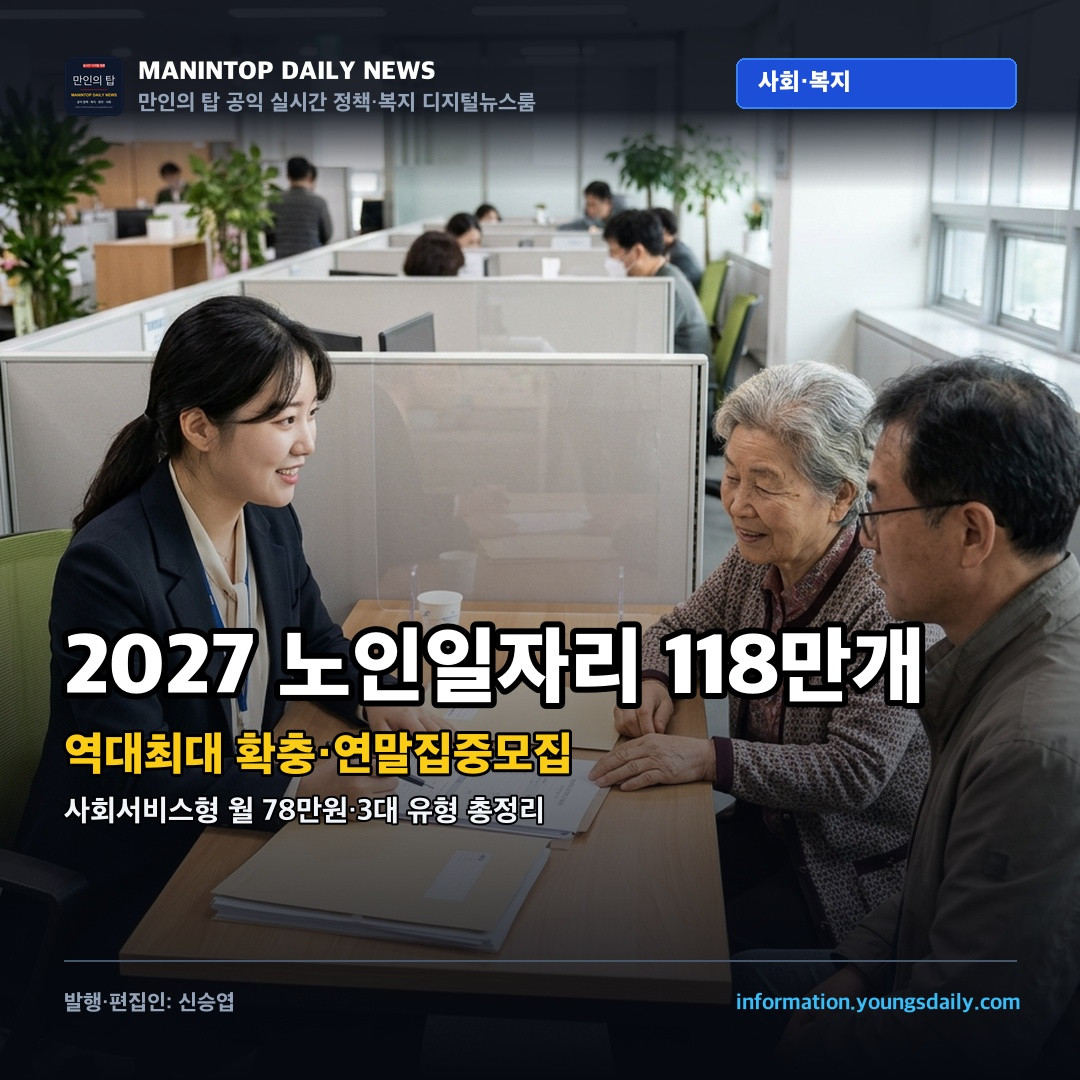
2027년 노인일자리 118만 개 역대 최대 확충… 연말 집중 모집 및 3대 유형별 신청 심층 가이드
만인의 탑 편집국11월 01, 2026
▲ 2027년 노인일자리 118만 개 역대 최대 확충… 연말 집중 모집 및 3대 유형별 신청 심층 가이드 (공식 보도 자료)
📌 핵심 브리핑 · 주요 쟁점 및 핵심 요약
2027년 노인일자리 공급 규모가 118만 개로 역대 최대 수준으로 확충되는 가운데, 대한민국이 초고령사회 진입을 목전에 두고 노인 일자리 사업은 단순한 복지 지원을 넘어 어르신의 노후 소득 보장, 건강 증진, 사회적 고립 예방, 지역사회 돌봄 사각지대 해소를 결합한 국가적 핵심 안전망으로 자리매김했다. 매년 11월 말에서 12월 초 사이 진행되는 노인일자리 전국 연말 집중 모집은 수백만 명의 어르신이 참여하는 대규모 행정 절차로, 정확한 자격 요건과 신청 일정 파악이 필수적이다.
SPONSORED · ADVERTISEMENT
1. 취재 프레임 및 연말 집중 모집 개요
매년 연말 진행되는 노인 일자리 집중 모집은 이듬해 1월부터 12월까지 운영될 전국 사업 참여자를 사전에 선발하는 정례 행정 절차다. 보건복지부 집계에 의하면 지난 모집 당시 97만 개 일자리에 총 122만 명의 신청자가 몰려 평균 1.24 대 1의 경쟁률을 기록했으며, 연초 대기자 수만 20만 명을 상회할 정도로 현장의 수요가 폭발적이다. 중도 포기자 발생 시 대기 순번대로 추가 선발이 이뤄지므로 4주간의 연말 집중 모집 기간 내 접수가 필수적이다.
특히 최근 베이비붐 세대(1955~1963년생)가 65세 이상 고령층으로 본격 편입되면서, 과거 단순 환경미화 중심의 봉사활동에서 벗어나 전문성과 경험을 활용할 수 있는 사회서비스형 및 민간형 일자리 선호도가 급증하고 있다. 전국 지자체 및 시니어클럽별로 11월 중순부터 사전 공고 및 개별 접수가 시작되므로 관할 수행기관의 일정을 선제적으로 확인해야 한다.
노인 일자리는 참여 어르신 개인에게는 월 소득 보조와 의료비 절감, 우울감 개선의 긍정적 효과를 창출하며, 지역사회 차원에서는 아동·노인 돌봄 공백 해소와 공공 서비스 보완이라는 정책적 선순환을 이끌어내고 있다.
▲ 노인 일자리 참여 어르신의 안정적 노후 소득 보장 및 기초연금 연계 지원 현장 / 보건복지부 공식 자료
2. 2026~2027년 사업 규모 및 연도별 예산안 정밀 비교
노인 일자리 사업 규모는 초고령사회 대응 목표에 따라 해마다 단계적으로 확대되고 있다. 보건복지부 종합계획 및 정부 예산안 데이터를 바탕으로 확정된 2025~2026년 실적과 2027년 정부 예산안 주요 수치를 비교·분석한 내역은 다음과 같다.
2027년 정부 예산안에 따르면 순증하는 2만 8,000개 일자리 중 약 64%인 1만 8,000개가 사회서비스형에 집중되어 있다. 이는 저소득 취약 어르신의 생계를 지원하는 공공형 일자리를 안정적으로 유지하면서, 활동 역량이 높은 신노년세대를 위한 사회서비스형 및 민간형 일자리를 전체의 40% 이상으로 견인하려는 전략이다.
구분 항목
2025년 사업 실적
2026년 사업 기준
2027년 정부 예산안
전체 일자리 수
109.8만 개
115.2만 개 (+5.4만)
118.0만 개 (+2.8만)
공공형 (공익활동형)
69.2만 개
70.9만 개
70.9만 개
사회서비스형 (역량활용형)
15.6만 개
19.7만 개
21.5만 개 (+1.8만)
민간형 (시니어인턴십 등)
25.0만 개
24.6만 개
25.6만 개 (+1.0만)
사회서비스형 월 활동비
월 76.1만 원
월 76.1만 원
월 78.1만 원 (+2.0만)
시니어인턴십 기업지원금
최대 240만 원
최대 240만 원
최대 270만 원 (+30만)
SPONSORED · ADVERTISEMENT
3. 3대 사업 유형별 상세 조건 및 2026년 신규 8대 직무 분석
노인 일자리 사업은 참여자의 연령, 기초연금 수급 여부, 직무 성격에 따라 공공형, 사회서비스형, 민간형의 3대 축으로 구분된다. 첫째, 공공형(노인공익활동사업)은 만 65세 이상 기초연금 수급자가 대상이다. 노노(老老)케어(취약노인 안부 확인), 스쿨존 교통지도, 급식 보조, 환경정화 등 봉사 성격의 직무를 수행하며, 하루 3시간씩 월 10일(월 30시간) 근무하고 11개월 동안 월 29만 원의 활동비가 지급된다.
둘째, 사회서비스형(노인역량활용사업)은 만 65세 이상(일부 60세 이상) 지원 가능하며 기초연금 수급 여부와 무관하게 신청할 수 있다. 보육시설 학습 보조, 공공기관 행정 지원, 금융 안전 도우미 등 전문성을 살리는 직무로, 하루 3시간씩 월 20일(월 60시간) 근무하고 10개월 동안 주휴수당 포함 월 76만 1,000원(2027년 78만 1,000원 추진)을 지급받는다.
셋째, 민간형(공동체사업단·시니어인턴십)은 만 60세 이상 구직자를 대상으로 하며, 실버카페·실버택배 운영이나 일반 민간 기업 채용 연계를 통해 근로계약에 따라 급여를 지급받는다. 보건복지부는 신노년층의 역량을 반영한 2026년 8대 신규 우수 직무를 전국으로 확산 적용한다. 주요 직무로는 소상공인 정책금융 안심동행단(금융 상담 및 온라인 신청 지원), 폐그림책 교구사업(친환경 교구 제작 및 돌봄시설 제공), 현충시설 시니어 레인저스, 로컬픽 다국어 제작단, 시니어 법무보호 사전상담단, 건강증진 금연지도원, 인생이야기 기록 작가단, 시니어 항공안전 감시단이 포함된다. 아울러 돌봄 특화 분야로 '유치원 시니어 돌봄사'(500명, 월 90만 원), '통합돌봄 도우미'(1,602명), '안심귀가 도우미'(951명), '푸드뱅크 관리자'(680명)를 우선 배치한다.
▲ 베이비붐 세대의 전문성과 직업 경험을 살리는 사회서비스형 노인 일자리 직무 컨설팅 / 한국노인인력개발원 자료
4. 신청 자격 결격 사유 체크리스트 및 연말 집중 모집 행정 절차
노인 일자리 사업은 정부 재정이 투입되는 직접일자리이므로 엄격한 결격 사유 검증이 진행된다. 국민기초생활보장법상 생계급여 수급자(의료·주거·교육급여 수급자는 신청 가능), 타 사업장 국민건강보험 직장가입자, 노인장기요양보험 1~5등급 판정자(인지지원등급은 일상활동 가능 진단서 제출 시 심사 참여 가능), 타 재정지원 직접일자리 중복 참여자, 실업급여 수급 후 90일 미경과자는 선발에서 제외된다.
신청 절차는 온·오프라인 채널을 통해 동시 진행된다. 온라인 신청은 온라인 '노인일자리 여기'(seniorro.or.kr), '복지로'(bokjiro.go.kr), '정부24'(gov.kr) 누리집 및 모바일 앱에 접속하여 거주지 시·군·구 공고를 확인한 뒤 본인 인증을 거쳐 간편 접수할 수 있다.
오프라인 방문 신청은 주소지 관할 읍·면·동 행정복지센터(주민센터), 지역 시니어클럽, 노인복지관, 대한노인회 지회를 직접 방문하면 되며, 대표 안내 전화 1544-3388을 통해 가장 가까운 수행기관으로 자동 연결된다.
최종 선발은 선착순이 아닌 소득 수준, 세대 구성(독거노인 가점), 건강 상태, 직무 관련 자격증(사회복지사, 조리사, 보육교사, 운전면허, 컴퓨터 자격증 등) 유무를 종합 심사하는 '고득점 배점표 순'으로 결정된다. 이번 사업은 보건복지부의 '제3차 노인 일자리 및 사회활동 지원 종합계획(2023~2027)'에 따라 전체 노인인구의 10% 수준까지 공공·민간 일자리를 확충하는 국가 핵심 복지 과제로 지속 추진된다.
In 2027, the number of senior job opportunities will be expanded to a record 1.18 million. A concentrated recruitment effort will take place at the end of the year, along with an in-depth guide for applications categorized into three main types.
In 2027, the supply of jobs for the elderly is set to reach a record high of 1.18 million, as South Korea stands on the brink of becoming a super-aged society. The elderly job program has evolved beyond mere welfare support to become a national safety net that ensures income security for seniors, promotes health, prevents social isolation, and addresses gaps in community care. The nationwide year-end recruitment drive for elderly jobs, held annually between late November and early December, is a large-scale administrative process involving millions of seniors, making it essential to understand the precise eligibility criteria and application schedule.
📌 Key Takeaways
An increase of 28,000 jobs compared to 2026, with a focus on 215,000 social service positions for the new elderly demographic.
709,000 public sector jobs; social service positions at 781,000 won per month; senior internships at 2.7 million won.
Financial support for small businesses, a project for repurposing discarded picture books, and the placement of 500 caregivers in kindergartens.
1. Overview of Year-End Intensive Recruitment for Senior Jobs
The year-end intensive recruitment for senior jobs, conducted annually, is a regular administrative procedure to select participants for nationwide programs that will operate from January to December of the following year. According to the Ministry of Health and Welfare, during the last recruitment, 1.22 million applicants vied for 970,000 job positions, resulting in an average competition ratio of 1.24 to 1. The demand on the ground is explosive, with the number of waiting applicants exceeding 200,000 at the beginning of the year. Additional selections will be made in the order of waiting lists if there are any dropouts, making it essential to apply during the four-week year-end intensive recruitment period.
Notably, as the baby boomer generation (born between 1955 and 1963) transitions into the 65 and older age group, there is a significant increase in the preference for jobs that utilize expertise and experience, moving away from past volunteer activities focused solely on environmental beautification. Local governments and senior clubs will begin pre-announcements and individual applications from mid-November, so it is crucial to check the schedules of the relevant executing agencies in advance.
Senior jobs provide individual seniors with positive effects such as monthly income support, reduced medical expenses, and improved mental health, while also creating a policy-driven virtuous cycle at the community level by addressing gaps in child and elder care and supplementing public services.
▲ On-site senior employment and basic pension coordination supporting stable retirement income / Ministry of Health and Welfare Archive
2. Detailed Comparison of Business Scale and Annual Budget for 2026-2027
The scale of the senior job program is being gradually expanded each year in response to the goals of an ultra-aged society. Based on the comprehensive plans and government budget data from the Ministry of Health and Welfare, a comparison and analysis of the confirmed results for 2025-2026 and the key figures in the 2027 government budget proposal are as follows.
According to the 2027 government budget proposal, approximately 64% of the net increase of 28,000 jobs will be concentrated in social service roles. This strategy aims to maintain public jobs that reliably support the livelihoods of low-income vulnerable seniors while driving social service and private sector jobs for the highly capable new elderly generation to make up more than 40% of the total.
Category
Target Scope
Standard / Benefit
Procedure / Action
Total Number of Jobs
1,098,000
1,152,000 (+54,000)
1,180,000 (+28,000)
Public Type (Public Activity Type)
692,000
709,000
709,000
Social Service Type (Capability Utilization Type)
156,000
197,000
215,000 (+18,000)
Private Type (Senior Internship, etc.)
250,000
246,000
256,000 (+10,000)
Monthly Activity Allowance for Social Service Type
760,000 KRW
760,000 KRW
781,000 KRW (+20,000)
Senior Internship Company Support Fund
Up to 2,400,000 KRW
Up to 2,400,000 KRW
Up to 2,700,000 KRW (+300,000)
3. Detailed Conditions by Three Major Types of Business and Analysis of Eight New Roles for 2026
The senior job program is categorized into three main types: public, social service, and private, based on the participant's age, basic pension eligibility, and job nature.
First, the public type (Senior Public Activity Program) targets individuals aged 65 and older who receive basic pensions. Participants perform volunteer roles such as checking on vulnerable seniors (elderly care), traffic guidance in school zones, meal assistance, and environmental cleanup, working three hours a day for ten days a month (30 hours per month) and receiving a monthly activity allowance of 290,000 won for 11 months.
Second, the social service type (Senior Capability Utilization Program) is available to those aged 65 and older (and some aged 60 and older) regardless of basic pension eligibility. This type includes specialized roles such as learning assistance in childcare facilities, administrative support for public institutions, and financial safety helpers, with participants working three hours a day for 20 days a month (60 hours per month) and receiving a monthly salary of 761,000 won (projected to be 781,000 won in 2027) for ten months, including weekly allowances.
Third, the private type (community project teams and senior internships) targets job seekers aged 60 and older, who receive salaries based on employment contracts through operations like silver cafes and silver delivery services or connections with general private companies.
The Ministry of Health and Welfare will apply eight new excellent roles reflecting the capabilities of the new elderly generation nationwide in 2026. Key roles include the Small Business Policy Financial Support Team (financial counseling and online application support), the Used Picture Book Educational Materials Project (eco-friendly material production and care facility provision), Senior Rangers for Memorial Facilities, Local Pick Multilingual Production Team, Senior Legal Protection Pre-Counseling Team, Health Promotion Smoking Cessation Guides, Life Story Recording Writers, and Senior Aviation Safety Monitors. Additionally, in specialized care fields, priority placements will be given to 'Kindergarten Senior Care Workers' (500 positions, 900,000 won per month), 'Integrated Care Helpers' (1,602 positions), 'Safe Return Helpers' (951 positions), and 'Food Bank Managers' (680 positions).
▲ Vocational consulting for social service senior employment utilizing baby boomer expertise / Korea Senior Support Archive
4. Eligibility Disqualification Checklist and Year-End Intensive Recruitment Administrative Procedures
As the senior job program is a direct job initiative funded by the government, strict verification of disqualification reasons is conducted. According to the National Basic Livelihood Security Act, recipients of livelihood benefits (those receiving medical, housing, or educational benefits may apply), individuals enrolled in the National Health Insurance as employees at other workplaces, those rated 1-5 in the Long-Term Care Insurance for Seniors (those with cognitive support ratings can participate in assessments with a diagnosis certificate indicating daily activity capability), participants in other financially supported direct job programs, and those who have received unemployment benefits within the last 90 days are excluded from selection.
The application process is conducted simultaneously through online and offline channels. Online applications can be submitted via the websites and mobile apps of 'Senior Jobs Here' (seniorro.or.kr), 'Welfare Road' (bokjiro.go.kr), and 'Government 24' (gov.kr) after checking the announcements for the respective city, county, or district, followed by identity verification for easy submission.
For offline applications, individuals can visit the administrative welfare centers (community centers) in their residential areas, local senior clubs, senior welfare centers, or branches of the Korean Senior Citizens Association. The representative information hotline 1544-3388 automatically connects callers to the nearest executing agency.
Final selections will not be made on a first-come, first-served basis but will be determined based on a comprehensive assessment of income level, household composition (with points for single elderly individuals), health status, and possession of job-related qualifications (such as social worker, cook, childcare teacher, driver's license, computer certification, etc.) using a high-score point system. This initiative is part of the Ministry of Health and Welfare's '3rd Comprehensive Plan for Senior Jobs and Social Activity Support (2023-2027)', which aims to expand public and private jobs to cover about 10% of the total elderly population as a key national welfare project.
Recommended Deep-Dive Investigations TOP 3
GLOBAL REPORT
1월이 시작되면 감기는 이미 우리 곁에 와 있습니다. 2월, 3월, 4월까지 이어지는 추위와 건조함은 코와 목을 가장 먼저 공격합니다. 아침에 일어나자마자 막혀 있는 코. 계속 흐르는 콧물. 괜히 칼칼해지는 목. 이 증상은 “시작”일 뿐입니다. 한 번 무너지면 일주일, 길면 한 달까지 끌고 갑니다. 약을 먹으면 잠깐 괜찮아집니다. 하지만 며칠 뒤 또 반복됩니다. 왜일까요? 감기는 ‘치료’의 문제가 아니라 ‘관리’의 문제이기 때문입니다. 대부분은 감기가 오고 나서 약을 찾습니다. 하지만 진짜 중요한 건 감기가 오기 전에 코와 목을 지키는 것입니다. 건조한 실내 공기, 차가운 바깥 공기, 눈에 보이지 않는 세균. 코와 목은 매일 공격받고 있습니다. 지긋지긋하죠! 그런데도 우리는 아무 준비 없이 버티고 있습니다. 이번 겨울도 그렇게 보낼 건가요? 사실 방법은 어렵지 않습니다. 코를 깨끗하게 관리하고, 목을 따뜻하게 보호하고, 점막을 촉촉하게 유지하고, 기관지를 미리 관리하고, 외부 공기를 차단하는 것. 이 다섯 가지만 꾸준히 해도 감기약 없이 겨울을 보내는 것이 충분히 가능합니다. 🔥 이제부터 그 방법을 하나씩 살펴보겠습니다. 🔥 1. 코와 목을 먼저 관리해야 하는 과학적 이유 감기의 대부분은 코 점막에서 시작됩니다. 국제 학술지 Nature Reviews Microbiology 와 Journal of Allergy and Clinical Immunology 에 실린 호흡기 감염 관련 연구들에서는, 감기 바이러스가 비강 상피세포에 먼저 부착해 증식한다는 점을 설명하고 ...
리모델링사업이 진행 중인 아파트를 매매할 때 “계약금 10%를 언제까지 내야 하느냐”는 질문이 특히 많이 나옵니다. 이주공고(이주 안내)가 7~11월쯤이라고 들으면, 그 시점에 맞춰 계약금도 움직일 것 같아서 더 헷갈리기 쉽습니다. 하지만 실제 납부기한은 ‘이주공고가 언제냐’만으로 자동 결정되지 않는 경우가 많습니다. 1) 계약금 10% 납부기한: 결국 ‘문서에 적힌 일정’이 기준 계약금 10%를 언제까지 납부해야 하는지는, 내가 서명하는 매매계약서(특약 포함) 와 사업주체/조합이 제시한 공고·안내문 에 적힌 납부 일정이 기준이 됩니다. 실제 공고문에서는 분양대금 납부의 큰 틀(계약금→중도금→잔금)을 먼저 안내하고, 상세 일정은 별도 표나 유의사항으로 제시하는 방식이 흔합니다. 또, 계약서 문구에 따라 지급 시점이 조건부로 설정될 수도 있습니다. 예를 들어 한 사례 소개 자료에서는 용역계약서에 잔금(10%) 지급시기가 “사업승인 후”로 기재되어 있었다는 점이 언급됩니다. 이런 식으로 ‘사업 단계’와 지급을 연동하는 문구가 들어가면, 질문의 답은 계약서 문구를 확인해야만 확정됩니다. 관련 내용은 링크 에서 문구 사례를 확인할 수 있습니다. 2) 입주자모집공고에서 확인되는 ‘납부 순서’와 잔금 마감 시점 공고문에 적힌 문구를 보면, 납부 순서와 잔금 마감에 대한 기준이 비교적 명확하게 제시되는 경우가 있습니다. 예를 들어 한 입주자모집공고에는 “분양금액(주택가격)은 계약금, 중도금, 잔금의 순서로 납부”하며 “잔금은 입주(열쇠 수령일) 전에 완납”해야 한다고 안내되어 있습니다. (문구 확인: 링크 ) 이 문구가 의미하는 바는 최소 2가지입니다. 분양/공급 형태의 문서에서는 ‘계약금→중도금→잔금’ 흐름이 공식적으로 안내될 수 있습니다. 잔금은 “입주(열쇠 수령)” 이전에 완납해야 한다는 마감 기준이 문서에 적혀 있을 수 있습니다. 다만, 위 공고문 문구는 잔금 마감에 대한 기준을 보여주지만, 계약금 10%의...
윤석열 전 대통령 탄핵 인용 소식을 접하면, 가장 궁금한 지점은 ‘헌재가 정확히 무엇을 위헌·위법으로 봤는가’입니다. 또한 탄핵과 별개로 진행되는 형사재판(내란 우두머리 혐의 등)이 어디까지 왔는지도 함께 정리할 필요가 있습니다. 아래 내용은 제공된 기사/게시물 스니펫과 링크에서 확인되는 범위만 모아, 일반인이 흐름을 이해하기 쉽게 정리한 것입니다. 1) 탄핵 인용 관련: 스니펫에서 확인되는 ‘판단의 골격’ 제공된 근거 중 조국혁신당 사이트에는 헌법재판소가 윤석열 탄핵 심판에서 “피청구인의 위헌·위법행위는 국민 신임 …”이라는 취지로 판단했다는 문장이 인용돼 있습니다( 링크 ). 이 인용문만 놓고 보면, ‘위헌·위법행위’가 있었는지와 그로 인해 ‘국민의 신임’이 어떻게 평가됐는지가 핵심 축으로 소개됩니다. 다만 질문에서 요청하신 세부 항목, 즉 비상계엄 선포 자체를 문제 삼은 구체적 이유, 계엄 이후 조치(포고령, 국회 통제 등)의 어떤 지점이 헌법 위반인지, 국회의 권한행사 방해 및 정치활동 제약을 어떤 논리로 판단했는지 등은, 이번에 제공된 근거의 제목/스니펫만으로는 조항·사실관계·판단 구조가 그대로 제시돼 있지 않습니다. 따라서 이 글에서는 ‘헌재가 무엇을 문제 삼았다’는 세부 리스트를 단정적으로 재구성하기보다, 현재 확인 가능한 문구 수준의 요약(위헌·위법행위 → 국민 신임의 문제로 평가)까지만 적습니다. 만약 헌재 결정문 전문(주문 및 이유)이 추가로 확인되면, 그때는 문장 단위로 ‘어떤 행위’와 ‘어떤 헌법 원리/조항’이 연결되는지(예: 권력분립, 국회의 권한, 정치적 기본권 등) 구조화해 정리하는 것이 가장 정확합니다. 2) 형사 절차(내란 혐의) 관련: 체포영장과 1심 선고 언급 탄핵 심판과 별도로, 12·3 비상계엄 사태로 내란 혐의를 받는 윤석열 대통령에 대해 2024년 12월 31일 체포 영장이 발부됐다는 BBC 보도가 있습니다( 링크 ). 해당 보도는 ‘현직 대통령’에 대한 체포영장 발부라는 점을 함께 언급합니다. 또...