2030 청년 87%가 비만 당뇨? 천만 당뇨 잡는 '채·단·탄' 거꾸로 식사법의 기적
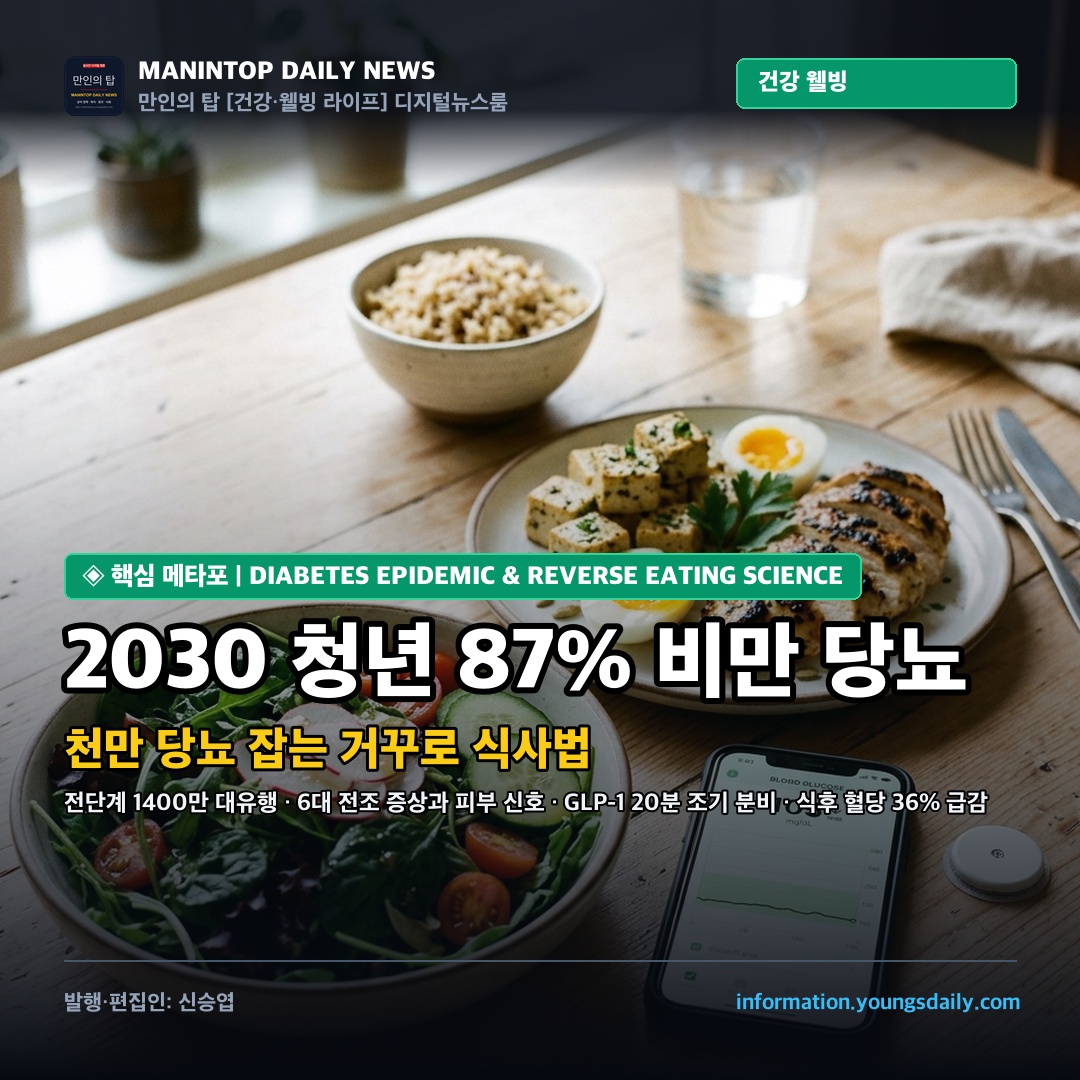
▲ 거꾸로 식사법(채소 ➔ 단백질 ➔ 탄수화물) 순서로 구성된 식탁과 안정적인 식후 혈당 반응 곡선. 식사 순서 변경만으로 위 배출 시간을 늦추고 인크레틴 호르몬 GLP-1 분비를 20분 앞당겨 혈당 스파이크를 효과적으로 억제한다. [사진=만인의 탑 보건의학DB]
1. 천만 당뇨 시대의 경고등: 성인 41%가 전단계, 2030 청년 87%는 비만
대한당뇨병학회가 발표한 2024 당뇨병 팩트시트에 따르면 국내 30세 이상 성인의 당뇨병 유병률은 14.8%(당화혈색소 기준 15.5%)로 환자 수만 533만 명에 이릅니다. 65세 이상 어르신 인구에서는 28%가 당뇨병을 앓고 있어 10명 중 3명꼴입니다.
더욱 심각한 복병은 공복혈당 100~125 mg/dL 또는 당화혈색소 5.7~6.4%에 해당하는 당뇨병 전단계 인구입니다. 30세 이상 성인의 41.1%인 약 1,400만 명이 전단계로 집계되었으며, 65세 이상에서는 47.7%(370만 명)에 달합니다. 이미 진단받은 환자와 전단계 위험군을 합치면 대한민국 성인의 절반 이상이 혈당 장애의 사정권에 들어서 있습니다.
특히 19세부터 39세 사이의 청년층 당뇨병은 침묵의 뇌관으로 부상했습니다. 청년 당뇨 환자는 약 30만 명, 전단계 청년은 300만 명으로 청년 5명 중 1명이 혈당 위험군입니다. 20대 유병자가 8만 명인 데 비해 30대는 23만 명으로 3배나 치솟으며, 특히 30대 남성의 37.2%가 당뇨병 전단계에 진입해 있습니다.
청년 당뇨의 핵심 원인은 서구화된 식단과 운동 부족으로 인한 비만입니다. 청년 당뇨 환자 중 정상 체중은 4.9%에 불과하며, 과체중을 포함해 무려 87%가 체질량지수 25 이상의 비만 상태입니다. 반면 청년 환자의 질환 인지율은 43.3%, 실제 치료율은 34.6%에 그쳐 10명 중 6명 이상이 자신이 당뇨병이라는 사실조차 모른 채 방치되고 있습니다.

▲ 내분비내과 전문의가 30대 직장인 환자에게 연속혈당 모니터링 데이터와 대사 증후군 지표를 설명하며 생활습관 교정을 지도하고 있다. 2030 청년 세대의 비만율 급증과 낮은 질환 인지율이 조기 합병증 발생의 주원인으로 지목된다. [사진=만인의 탑 보건의학DB]
2. 비만·고혈압·고지혈증 삼중고: 3대 지표 동시 달성률은 겨우 15.9%
당뇨병은 홀로 찾아오지 않고 치명적인 대사 이상 질환을 동반합니다. 30세 이상 당뇨 환자의 53.8%가 비만, 61.2%가 복부비만을 겪고 있습니다. 고혈압 동반율은 59.6%, 나쁜 콜레스테롤이 높은 고콜레스테롤혈증 동반율은 74.2%에 달하며, 두 질환을 동시에 앓는 환자도 44.5%에 이릅니다.
그러나 혈당(당화혈색소 6.5% 미만), 혈압(140/85 미만), 콜레스테롤(LDL 100 미만)이라는 3대 목표 수치를 모두 정상으로 관리하는 환자는 전체의 15.9%에 불과합니다. 환자 6명 중 5명 이상이 심근경색이나 뇌졸중 등 심뇌혈관 합병증 위험에 무방비로 노출되어 있는 셈입니다.
국민건강영양조사 분석 결과에서도 흥미로운 영양 섭취 역설이 확인되었습니다. 당뇨 환자는 비당뇨 성인보다 하루 총 섭취 칼로리와 단백질, 지방 섭취 비율은 낮았지만, 전체 칼로리 중 탄수화물이 차지하는 비중은 오히려 비당뇨인보다 높았습니다. 밥 위주의 탄수화물 과잉 식단이 혈당 조절 실패의 핵심 요인으로 작용하고 있음을 보여줍니다.
3. 내 몸이 보내는 조기 경고: 6대 전조 증상과 피부 SOS 신호
당뇨병은 초기 자각 증상이 거의 없어 침묵의 살인자로 불리지만, 혈당이 지속적으로 상승하면 우리 몸은 분명한 위험 신호를 보냅니다.
• 다뇨와 야간뇨: 혈당이 신장 배설 역치(약 180 mg/dL)를 넘으면 포도당이 소변으로 배출되면서 수분을 끌고 나갑니다. 하루 소변량이 정상(1.5L)을 넘어 3L 이상으로 급증하며 수면 중 소변 때문에 깨는 야간뇨가 잦아집니다.
• 극심한 갈증(다음): 수분 손실로 혈액이 끈적해지면서 뇌 갈증 중추가 자극받아 물을 연거푸 마셔도 목마름이 가시지 않습니다.
• 이유 없는 체중 감소: 인슐린 기능 저하로 세포가 포도당을 에너지로 쓰지 못하면 몸은 근육 단백질과 지방을 분해해 에너지로 씁니다. 잘 먹는데도 2~3개월 사이 4.5kg 이상 살이 빠진다면 즉각적인 검사가 필요합니다.
• 만성 피로와 식후 쏟아지는 졸음: 세포의 에너지 결핍으로 충분히 자도 무기력하며, 정제 탄수화물 식사 후 30분~2시간 사이 쏟아지는 극심한 식곤증은 혈당이 치솟았다가 급락하는 혈당 스파이크의 전형적 증상입니다.
• 손발 저림과 감각 이상: 고혈당이 말초 미세혈관과 신경을 손상시켜 손끝과 발끝이 장갑이나 양말을 신은 부위부터 찌릿찌릿 저리고 화끈거리게 됩니다.
• 피부 SOS 신호: 목 뒤나 겨드랑이 피부가 벨벳처럼 까맣고 두껍게 변하는 흑색가시세포증은 청년 비만형 당뇨의 대표 신호입니다. 정강이 앞쪽의 갈색 반점(당뇨병성 피부병증), 보습제를 발라도 낫지 않는 가려움증, 무좀이나 칸디다 등 곰팡이 감염이 반복되고 상처가 잘 아물지 않는다면 혈당을 의심해야 합니다.
4. 혈당 진단 지표의 비밀: 공복혈당 95인데 당화혈색소 6.1%인 이유
당뇨병 진단은 세 가지 기준으로 이뤄집니다. 8시간 금식 후 공복혈당(정상 100 미만, 전단계 100~125, 당뇨 126 이상), 75g 포도당 섭취 2시간 후 혈당(정상 140 미만, 전단계 140~199, 당뇨 200 이상), 그리고 최근 2~3개월간의 평균 혈당을 보여주는 당화혈색소(정상 5.7% 미만, 전단계 5.7~6.4%, 당뇨 6.5% 이상)입니다.
많은 건강검진 수검자가 공복혈당 95 mg/dL로 정상 판정을 받고 안심하지만, 당화혈색소를 측정해보면 6.1%로 전단계에 해당하는 경우가 많습니다. 이는 아침 공복 혈당만 정상일 뿐, 점심과 저녁 식사 후 혈당이 180~200 mg/dL 이상 급상승하는 식후 고혈당 환자임을 뜻합니다. 일반 건강검진의 공복혈당 단독 검사로는 수많은 숨은 당뇨 환자를 놓칠 수 있어 당화혈색소 정밀 검사가 필수적입니다.
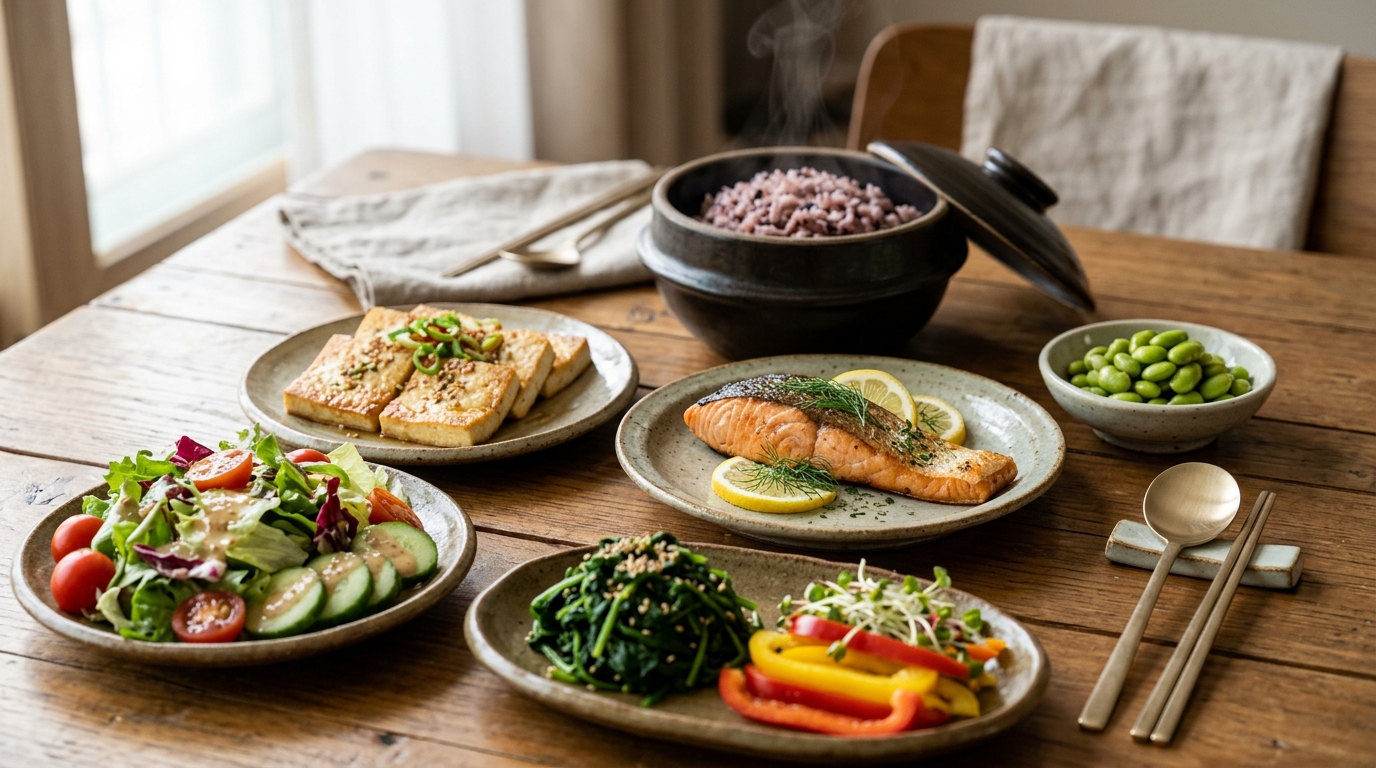
▲ 한국인 식탁에 맞춘 3단계 거꾸로 식사법. 1단계 아삭한 채소 샐러드와 나물 반찬, 2단계 기름기를 뺀 연어구이와 두부 단백질, 3단계 뚜껑을 덮어두었던 잡곡밥을 순차적으로 섭취함으로써 혈당 곡선을 완만하게 유지한다. [사진=만인의 탑 보건의학DB]
5. 밥상 위의 과학 혁신: 거꾸로 식사법(채·단·탄)의 3대 생리 메커니즘
같은 양의 음식을 먹더라도 먹는 순서만 바꾸면 혈당이 치솟는 것을 막을 수 있습니다. 거꾸로 식사법의 핵심 원리는 채소(식이섬유), 단백질 및 지방, 탄수화물(밥·빵·면) 순서로 음식을 섭취하는 것입니다. 인체 생리학적으로 세 가지 강력한 방어 기전이 작동합니다.
첫째, 위 배출 속도(Gastric Emptying)의 획기적 지연입니다. 탄수화물은 위에 들어가면 순식간에 소화되어 십이지장으로 빠르게 넘어가 혈당을 급격히 끌어올립니다. 반면 채소의 식이섬유와 단백질, 지방은 위장 내 체류 시간이 깁니다. 채소와 단백질이 위를 먼저 채우면 뒤이어 들어오는 밥이 위장에 머무는 시간이 2~3배 늘어나 포도당이 소장으로 천천히 이동하면서 혈당 스파이크가 발생하지 않습니다.
둘째, 기적의 비만·혈당 조절 호르몬인 GLP-1의 조기 분비입니다. 소장 하부의 L세포는 단백질의 아미노산과 불포화 지방산을 감지하면 GLP-1(글루카곤 유사 펩타이드-1)을 강력하게 분비합니다. 단백질을 탄수화물보다 먼저 먹으면 GLP-1 분비 시점이 약 15~20분 앞당겨집니다. 이로 인해 췌장은 밥이 들어오기 전부터 인슐린을 분비할 만반의 준비를 마치며, 뇌 시상하부 포만 중추가 자극되어 식사 후반부에 탄수화물을 과식하는 일을 사전에 막아줍니다.
셋째, 수용성 식이섬유의 물리적 젤 흡수 장벽 형성입니다. 채소 속의 펙틴과 알긴산 같은 수용성 섬유질은 수분을 머금어 끈적끈적한 젤 형태로 장벽을 코팅합니다. 이 물리적 완충벽이 소화효소와 탄수화물의 접촉을 늦추고 당 분자가 모세혈관으로 흡수되는 속도를 완만하게 조절합니다. 또한 대장 미생물이 섬유질을 발효시켜 만드는 부티르산 등 단쇄지방산은 간의 당 생성을 억제하고 근육 세포의 인슐린 감수성을 높여줍니다.
6. 글로벌 의학계가 입증한 임상 데이터 대조표
거꾸로 식사법의 효과는 미국 코넬 의과대학, 일본 오사카대학, 국내 유수 대학병원 내분비내과 연구팀의 엄격한 크로스오버 임상시험을 통해 정량적으로 검증되었습니다.
| 식사 단계 및 식품군 | 주요 생리 작용 및 호르몬 기전 | 임상 시험 혈당·인슐린 개선 데이터 | 한국인 실생활 밥상 실천 수칙 |
|---|---|---|---|
| 1단계: 채소류 (식사 시작 ~ 5분) |
수용성 식이섬유 장벽 형성 위장 통과 지연 및 탄수화물 흡수 완충 |
식후 30분 혈당 상승 폭 28.6% 감소 오사카대: 밥 배출 시간 30분➔83분 연장 |
밥뚜껑 열지 말고 시금치·콩나물·샐러드 주먹 한 개 분량 먼저 섭취 |
| 2단계: 단백질·지방 (식사 중반 5~10분) |
소장 L세포 자극➔GLP-1 조기 분비 췌장 인슐린 예비 가동 및 포만감 촉진 |
식후 60분 혈당 정점 36.7% 급감 췌장 총 인슐린 소모량 23% 절감 달성 |
기름진 튀김 대신 생선구이, 수육, 두부조림, 계란찜 위주 섭취 |
| 3단계: 탄수화물 (식사 후반 10분 이후) |
선행 음식 혼합물로 완만한 포도당 방출 혈당 스파이크 원천 차단 |
2년 추적 연구 시 당화혈색소 0.9% 추가 강하 (경구 혈당강하제 단독 처방 효과) |
식사 시작 10분 후 잡곡밥 평소의 3분의 2 섭취, 국물에 말아먹기 금지 |
| 식사 속도 변수 (빠른 식사 vs 느린 식사) |
순서 원칙이 속도보다 우위 빨리 먹어도 호르몬 분비 경로 유지 |
10분 빠른 식사군에서도 식후 혈당 및 인슐린 강하 효과 유의미 유지 | 직장인 바쁜 점심에도 반찬 채소 먼저 집어먹는 습관만 들이면 효과 발휘 |
미국 코넬 의과대학 알파나 슈클라(Alpana Shukla) 교수 연구팀의 연구에 따르면 빵과 주스, 닭가슴살과 샐러드로 구성된 동일한 식사를 순서만 바꿔 섭취하게 한 결과, 식후 60분 혈당 정점이 36.7% 낮아졌고 인슐린 분비량은 23% 줄어들었습니다. 또한 일본 오사카대학 이마이 교수팀의 2년 추적 조사에서는 거꾸로 식사법을 실천한 환자들의 당화혈색소가 평균 0.9% 감소해 경구 혈당약 단독 투약에 버금가는 혈당 강하 성과를 입증했습니다. 국내 유수 대학병원 내분비내과 연구팀(배재현·조영민 연구팀, 2018) 역시 초기 인슐린 분비능이 취약한 한국인 제2형 당뇨 환자에게서 거꾸로 식사법이 GLP-1 분비를 촉진하고 식후 혈당 변동성을 대폭 개선함을 공식 규명했습니다.
7. 오늘부터 바로 쓰는 실전 외식·한식 밥상 가이드
한국 식탁은 밥, 국, 반찬이 한상에 올라와 첫 숟가락부터 밥을 뜨는 문화입니다. 일상에서 거꾸로 식사법을 성공시키는 실천 수칙은 매우 간단합니다.
• 찌개 및 백반집: 밥그릇 뚜껑을 바로 열지 마십시오. 찌개 속의 두부, 버섯, 김치 건더기와 계란말이, 나물 반찬을 먼저 젓가락으로 5분간 천천히 건져 먹은 뒤 밥을 먹습니다. 국물에 밥을 말아 먹으면 탄수화물이 국물과 함께 소장으로 직행해 혈당 폭탄이 되므로 반드시 건더기 위주로 먹어야 합니다.
• 고깃집 회식: 고기와 공기밥, 된장찌개, 냉면을 한꺼번에 시키지 마십시오. 상추와 깻잎 등 쌈채소를 고기와 함께 충분히 먹어 배를 채운 뒤, 식사가 끝날 무렵 밥 반 공기만 시켜 가볍게 마무리합니다.
• 비빔밥: 밥을 고추장에 바로 비비지 마십시오. 밥 위에 얹힌 시금치, 콩나물, 당근, 도라지와 계란 프라이를 젓가락으로 먼저 절반 이상 집어먹고, 남은 나물에 밥을 비비되 당분이 높은 고추장 양념은 절반으로 줄입니다.
• 라면 및 분식: 라면을 끓일 때 계란, 콩나물, 버섯, 대파를 듬뿍 넣고 채소와 계란을 먼저 건져 먹은 후 면을 먹습니다. 컵라면이나 일반 라면이라면 편의점에서 샐러드나 구운 계란을 먼저 사서 먹고 라면을 취식하는 것이 안전합니다.
• 명절 음식 주의사항: 명절 음식 중 칼로리와 당분이 높은 약과(100g당 420 kcal), 떡갈비(350 kcal), 소갈비찜(340 kcal)을 조심해야 합니다. 고사리, 도라지, 시금치 등 삼색 나물을 개인 접시에 덜어 먼저 식사를 시작하고, 식사 후 30분 뒤에는 바로 눕지 말고 15분간 가벼운 산책을 실천해야 합니다.
• 복약자 필수 수칙: 인슐린 주사제나 설포닐유레아 계열 약물을 복용 중인 환자는 식사 순서를 바꿨을 때 위 배출 지연으로 저혈당이 올 수 있으므로 반드시 주치의와 상의해야 합니다. 전체 식사 시간은 20~25분 내외로 유지하는 것이 좋습니다.
87% of Young Diabetics Battle Obesity: The Miracle of 3-Step Reverse Eating in the 10-Million Diabetes Crisis
▲ A dining table arranged according to the Reverse Eating method (vegetables first, proteins next, carbohydrates last) alongside a stabilized postprandial glucose curve. Altering the food intake sequence delays gastric emptying and triggers early GLP-1 incretin secretion by 20 minutes, mitigating dangerous glucose spikes. [Photo: MANINTOP Health DB]
1. The 10-Million Diabetes Crisis: 41% in Prediabetes, 87% of Young Diabetics Obese
According to the Diabetes Fact Sheet in Korea 2024 released by the Korean Diabetes Association, the diabetes prevalence rate among adults aged 30 and older stands at 14.8% (15.5% when accounting for HbA1c criteria), encompassing approximately 5.33 million individuals. Among seniors aged 65 and older, the prevalence surges to 28.0%, meaning nearly three out of every ten seniors are diabetic.
The greater hidden hazard lies within the prediabetes population (fasting plasma glucose 100 to 125 mg/dL or HbA1c 5.7 to 6.4%). Approximately 14 million adults aged 30 and older (41.1%) are estimated to have prediabetes, rising to 47.7% (3.7 million individuals) among those 65 and older. Combining diagnosed patients with prediabetic cohorts reveals that over half of Korean adults are exposed to metabolic dysfunction.
In particular, diabetes among young adults aged 19 to 39 has become a silent time bomb. Around 300,000 young adults have diabetes, while 3 million suffer from prediabetes, placing one out of every five young people at risk. While 80,000 individuals in their twenties have diabetes, the number triples to 230,000 in their thirties. Shockingly, 37.2% of men in their thirties are already in the prediabetes stage.
Obesity driven by Westernized fast foods and sedentary lifestyles is the primary engine behind young-onset diabetes. Only 4.9% of young diabetic patients maintain normal body weight, whereas 87% are classified as clinically obese (BMI 25 kg/m2 or higher). However, awareness stands at just 43.3% and treatment rate at 34.6%, meaning over six out of ten young patients live completely unaware of their life-threatening condition.
▲ An endocrinologist analyzes continuous glucose monitoring curves and metabolic syndrome markers during a clinical consultation with a young adult patient. Soaring obesity rates combined with critically low disease awareness present a major health hazard. [Photo: MANINTOP Health DB]
2. Quadruple Comorbidities: Triple Target Achievement Reaches Merely 15.9%
Diabetes rarely travels alone; it is accompanied by severe cardiovascular risk factors. Among diabetic adults aged 30 and older, 53.8% suffer from obesity and 61.2% from abdominal obesity. Hypertension is present in 59.6% of patients, and hypercholesterolemia (LDL cholesterol 100 mg/dL or higher) affects 74.2%. Furthermore, 44.5% of diabetic patients battle both hypertension and hyperlipidemia simultaneously.
Despite these dangers, the comprehensive management rate—simultaneously reaching all three clinical targets of blood glucose (HbA1c below 6.5%), blood pressure (below 140/85 mmHg), and lipid profile (LDL below 100 mg/dL)—is a dismal 15.9%. More than five out of six patients remain vulnerable to fatal macrovascular complications such as myocardial infarction and stroke.
National health surveys also highlight a striking nutritional paradox: while diabetic patients consume fewer total daily calories and lower proportions of protein and fat compared to non-diabetic peers, their carbohydrate caloric intake ratio is significantly higher. Heavy carbohydrate reliance remains a primary barrier to successful glycemic control.
3. Subtle Physical Warnings: 6 Early Symptoms and Dermatological SOS Signals
Although often labeled an asymptomatic silent killer in its nascent stages, persistent hyperglycemia triggers distinct warning signals across the body:
• Polyuria and Nocturia: When plasma glucose exceeds the renal threshold (approx. 180 mg/dL), kidneys excrete excess glucose alongside copious amounts of water. Daily urine output can exceed 3 liters (normal 1.5L), with frequent nighttime awakenings.
• Polydipsia (Intense Thirst): Severe dehydration increases blood osmolality, firing hypothalamic thirst centers so that even substantial fluid intake fails to quench thirst.
• Unexplained Weight Loss: When insulin deficiency prevents cells from absorbing glucose for fuel, the body catabolizes skeletal muscle proteins and adipose tissue. Losing over 4.5 kg in 2 to 3 months despite steady caloric intake demands immediate medical evaluation.
• Chronic Fatigue and Postprandial Stupor: Chronic cellular energy starvation produces relentless exhaustion. Uncontrollable sleepiness 30 to 120 minutes following carbohydrate meals indicates dramatic glucose spikes followed by reactive hypoglycemia.
• Peripheral Neuropathy: Microvascular damage and sustained hyperglycemia injure peripheral nerves, producing tingling, burning, or pins-and-needles sensations starting in the toes and fingers.
• Dermatological SOS Indicators: Acanthosis nigricans, characterized by hyperpigmented, velvety thickening on the neck folds and armpits, serves as a cardinal physical sign of insulin resistance. Diabetic dermopathy (shin spots), intractable pruritus unresponsive to moisturizers, and recurring fungal infections (athlete's foot or candidiasis) strongly point toward uncontrolled blood glucose.
4. Demystifying Diagnostic Metrics: Normal Fasting Glucose with Elevated HbA1c
Clinical diabetes diagnosis relies on three cardinal benchmarks: fasting plasma glucose after an 8-hour fast (normal under 100 mg/dL, prediabetes 100-125, diabetes 126 and above), 2-hour oral glucose tolerance test (normal under 140 mg/dL, prediabetes 140-199, diabetes 200 and above), and glycated hemoglobin HbA1c reflecting 2 to 3 months of glycemic history (normal under 5.7%, prediabetes 5.7-6.4%, diabetes 6.5% and above).
Many patients receive a normal fasting glucose report of 95 mg/dL during regular checkups, yet their HbA1c tests at 6.1%. This divergence unmasks hidden postprandial glucose spikes where blood sugar surges past 180 to 200 mg/dL following daytime meals. Relying solely on fasting glucose tests misses a massive cohort of hidden diabetics.
▲ A three-step Reverse Eating sequence tailored for Korean cuisine. Stage 1: crisp greens and namul; Stage 2: lean grilled fish and tofu; Stage 3: steaming multigrain rice. This order flattens the glycemic response curve and sustains satiety. [Photo: MANINTOP Health DB]
5. The Physiological Science: 3 Master Mechanisms of the Reverse Eating Protocol
Consuming the exact same meal in a different order dramatically alters metabolic outcomes. The Reverse Eating protocol mandates eating vegetables (fiber) first, proteins and healthy fats second, and carbohydrates (rice, bread, noodles) last. This sequence unlocks three potent biological mechanisms:
First, significant delay in gastric emptying. Refined carbohydrates transit rapidly into the duodenum, triggering rapid glucose spikes. In contrast, dietary fiber, proteins, and fats possess extended gastric residence times. Pre-loading the stomach with vegetables and protein forces subsequent carbohydrates to remain in the stomach two to three times longer, preventing rapid glucose flooding into the bloodstream.
Second, early release of GLP-1 (glucagon-like peptide-1). When enteroendocrine L-cells in the ileum sense amino acids and free fatty acids, they rapidly secrete GLP-1. Ingesting protein ahead of carbohydrates advances GLP-1 secretion by 15 to 20 minutes. This primes pancreatic beta cells to produce insulin proactively, suppresses hepatic glucagon secretion, and triggers hypothalamic satiety centers to curb carbohydrate cravings.
Third, creation of a viscous physical fiber mesh. Soluble fiber compounds such as pectin and alginate absorb water to create a gel-like lining across intestinal mucosa. This barrier impedes carbohydrate digestive enzymes and slows glucose absorption into capillaries. Furthermore, microbial fermentation in the colon produces short-chain fatty acids like butyrate, which suppress hepatic gluconeogenesis and elevate peripheral insulin sensitivity.
6. Global Clinical Trial Evidence Matrix
Rigorous randomized crossover clinical trials across the United States, Japan, and leading Korean academic medical centers demonstrate the undeniable power of meal sequencing.
| Meal Phase & Food Category | Physiological & Hormonal Mechanism | Clinical Blood Glucose & Insulin Impact | Real-World Korean Dining Guidelines |
|---|---|---|---|
| Stage 1: Vegetables & Fiber (First 5 minutes) |
Forms viscous mucosal gel barrier Delays transit & buffers glucose absorption |
30-min postprandial glucose drop of 28.6% Osaka Univ: gastric transit extended 30➔83 min |
Keep rice bowl closed; consume seasoned greens, salads, or seaweed first |
| Stage 2: Proteins & Fats (Minutes 5 to 10) |
Stimulates ileal L-cells➔Early GLP-1 surge Prepares pancreatic insulin & triggers satiety |
60-min glucose peak plunged by 36.7% Total pancreatic insulin demand lowered by 23% |
Choose grilled fish, steamed pork, stewed tofu, or eggs over fried meats |
| Stage 3: Carbohydrates (After 10 minutes) |
Blended with digestive chyme for slow release Completely prevents sharp glucose spikes |
2-year follow-up: HbA1c reduced by 0.9% (Matches single oral hypoglycemic drug efficacy) |
Eat two-thirds of normal rice portion; choose whole grains and avoid broth soaking |
| Eating Speed Factor (Fast Eating vs Slow Eating) |
Meal sequencing trumps ingestion speed Hormone cascades trigger even with faster meals |
Statistically significant glucose and insulin reductions maintained even in 10-min meals | Busy office workers achieve clear benefits simply by prioritizing side dish vegetables |
A landmark crossover study by Dr. Alpana Shukla at Weill Cornell Medical College (Diabetes Care, 2015) evaluated identical 628-calorie meals. Simply sequencing vegetables and chicken breast ahead of bread and orange juice suppressed the 60-minute postprandial glucose peak by 36.7% and lowered total insulin expenditure by 23%. In Japan, a 2-year trial led by Osaka University (Imai et al., 2014) demonstrated an average 0.9% drop in HbA1c among patients practicing vegetable-first eating, rivaling standard oral medication. Research from premier Korean university medical centers (Bae & Cho research team, 2018) confirmed that early fiber and protein intake enhances GLP-1 secretion and stabilizes glycemic variability among Korean type 2 diabetics who typically exhibit vulnerable early-phase insulin secretion.
7. Actionable Dining Guide: Everyday Korean Meals and Festive Dining
Adapting traditional Korean dining to the Reverse Eating protocol is remarkably straightforward:
• Korean Stews and Bapsang: Never open the rice lid immediately. Use chopsticks to pick out tofu, mushrooms, kimchi solids, rolled omelets, and seasoned greens for the first 5 minutes. Never mix rice into stew broth, as liquid carbohydrates rush directly into the small intestine, causing rapid glycemic spikes.
• Korean BBQ Dining: Do not order grilled meat, rice, and cold noodles simultaneously. Fill up on lettuce, perilla leaves, and fresh vegetables alongside grilled meat first, and conclude with half a bowl of rice at the end of the meal.
• Bibimbap: Do not immediately mix rice with red pepper paste. First eat half of the vegetable toppings (spinach, bean sprouts, carrots) and fried egg using chopsticks, then mix the remaining vegetables with rice while cutting red pepper paste in half.
• Ramen and Noodles: Generously add eggs, bean sprouts, mushrooms, and scallions. Eat the toppings and broth solids first before taking the noodles. When consuming convenience store noodles, pre-load with a packaged fresh salad or boiled eggs.
• Festive Foods: Exercise caution around calorie-heavy holiday snacks like yakgwa (420 kcal per 100g), tteokgalbi (350 kcal), and braised short ribs (340 kcal). Start holiday meals with tri-color namul on a personal plate, limit fruit to one or two slices, and take a 15-minute walk 30 minutes after dining.
• Medication Safety: Patients on insulin injections or sulfonylureas must consult their physicians before drastically altering meal order, as delayed gastric emptying may precipitate hypoglycemia. Aim for an overall meal duration of 20 to 25 minutes.
내가 찾는 상품 키워드, 지금 얼마나 검색될까?
네이버 월간 검색량 + 구글 볼륨 + 아이템스카우트 실시간 상품수와 경쟁강도 배지를 0.5초 만에 무료로 확인하세요.