[심층기획] '조건 충족' vs '필수 과목 미이수 졸업' 전작권 전환 정면 충돌… 한미 핵·재래식 통합(CNI) 지휘권 딜레마와 트럼프 2기 안보 파고
만인의 탑 편집국11월 15, 2026
[심층기획] '조건 충족' vs '필수 과목 미이수 졸업' 전작권 전환 정면 충돌… 한미 핵·재래식 통합(CNI) 지휘권 딜레마와 트럼프 2기 안보 파고
정치·안보 심층취재팀 | 한미 군사동맹 및 전시작전통제권 구조 분석2026. 11. 15 08:45 KST
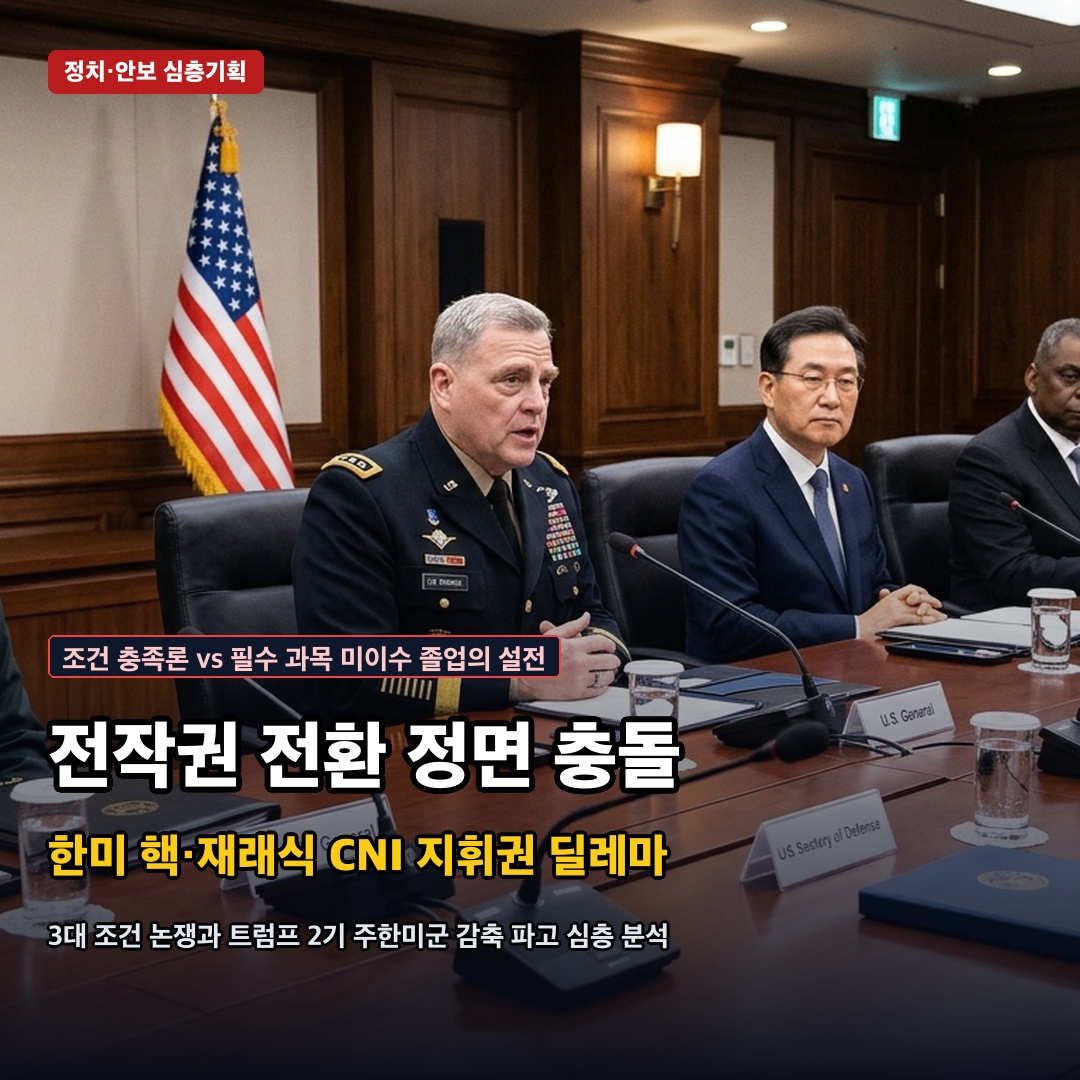
▲ 한미 고위급 국방 전략 회의에서 한국군과 미군 4성 장군들이 전시작전통제권 전환 3대 조건 평가와 연합방위체제 지휘구조를 둘러싸고 치열한 협상을 벌이고 있다. [사진: 미 국방부·합참 프레스 풀]
2026년 대한민국 안보의 중추인 한미동맹이 전시작전통제권(전작권) 조기 전환 문제를 둘러싸고 건국 이래 가장 격렬한 정면충돌의 소용돌이에 휩싸였습니다. 한국 국방부 장관이 국회에서 '전작권 전환 3대 조건이 모두 충족되었으며 지금 당장이라도 전환이 가능하다'고 공식 선언하자, 전·현직 주한미군사령관들이 '필수 과목도 안 듣고 시험도 안 치른 채 졸업하겠다는 처사'라며 거칠게 반박하는 유례없는 설전이 터져 나왔습니다. 여기에 백악관에 재입성한 도널드 트럼프 2기 행정부의 보호무역 관세 압박과 주한미군 감축·철수 구실 찾기가 맞물리면서 전작권은 단순한 군사 지휘권 이양을 넘어 동맹의 명운을 건 정치·경제적 빅딜 카드로 비화하고 있습니다. 더욱 심각한 문제는 북한의 전술핵 실전 배치에 맞설 핵심 억제력인 한미 '핵-재래식 통합(CNI)' 지휘체계가 전작권 전환 시 둘로 쪼개지는 치명적인 안보 공백에 직면해 있다는 사실입니다. 화려한 '자주국방' 구호 뒤에 가려진 한미 지휘체계의 분절과 안보 딜레마를 심층 취재했습니다.
1. 한미 군 수뇌부 정면 충돌과 당국 간 엇박자의 전말
논란의 방아쇠는 국회 예산결산특별위원회와 법제사법위원회에서 당겨졌습니다. 강신철 국방부 장관은 국회에 출석해 '전작권 전환을 위한 조건이 다 충족됐느냐'는 여야 의원들의 질의에 '그렇다'고 거침없이 답변하며 당장 지휘권을 환수해도 유사시 전쟁 승리에 아무런 문제가 없다고 공언했습니다. 한반도 전장 환경을 가장 잘 아는 한국군 4성 장군이 연합군을 주도하고 막강한 미군이 이를 지원하는 구조가 작전상 훨씬 효율적이라는 주장입니다. 그러나 정부 내부에서는 엇박자가 적나라하게 노출되었습니다. 대통령실 강건작 국가안보실 1차장은 방송에 출연해 '미국과 정무적 평가를 나누면 군사적 조건을 넘어서는 합의가 될 수 있다'고 발언해 군사 기술적 조건이 여전히 미충족 상태임을 자인했습니다. 국방부는 조건이 다 끝났다고 단언하고 청와대는 정무적 타결로 조건을 우회하려 하는 기이한 불협화음이 노출된 셈입니다.
미군 지휘부의 반발은 외교적 수사를 벗어던질 만큼 거칠고 직설적이었습니다. 빈센트 브룩스 전 주한미군사령관은 미 전략국제문제연구소(CSIS) 대담에서 강 장관의 발언을 두고 '매우 실망스럽다(deeply disappointing)'고 직격했습니다. 브룩스 전 사령관은 '대학생이 필수 학점도 이수하지 않고 기말고사도 통과하지 않았으면서 오늘 당장 학사모를 쓰겠다고 떼를 쓰는 격'이라고 질타했습니다. 그러면서 '전쟁에서는 주권이라는 명분을 내세워 군대를 짜는 것이 아니라 오직 승리를 위해 조직을 구성해야 한다'며 섣부른 지휘구조 개편이 재앙적인 혼란과 위험을 초래할 것이라고 강력히 경고했습니다. 폴 라캐머라 전 주한미군사령관 역시 '정치적으로 타협해 만들어낸 어설픈 지휘체계는 전투가 시작되는 순간 결코 작동하지 않을 것'이라고 가세했습니다.
현직인 제이비어 브런슨 주한미군사령관 또한 단호한 태도를 취했습니다. 브런슨 사령관은 북한의 지속적인 극초음속 미사일 발사와 러시아와의 군사동맹 복원 등 급변한 안보 환경을 지목하며 '우리가 계획을 바꿨기 때문에 지켜야 할 새로운 기준이 생겼다'고 못 박았습니다. 특히 브런슨 사령관은 미 하원 군사위원회에 전작권 전환 목표 시점을 '2029회계연도 2분기(한국 기준 2029년 1분기)'로 명시한 로드맵을 공식 보고했습니다. 이는 임기 내인 2028년까지 전작권 환수를 매듭짓겠다는 이재명 정부의 국정 목표에 대해 미군 수뇌부가 2029년 이후로 못 박으며 공개적인 제동을 건 것입니다.
구분
전작권 전환 이전 (현 체제)
전작권 전환 이후 (미래연합사)
안보 영향 및 작전적 쟁점
연합사령관 및 지휘권
미군 4성 장군 (주한미군·유엔사 겸직)
한국군 4성 장군 (미군 대장은 부사령관)
한국군 주도 연합방위체제 전환 (자주국방 명분)
재래식 작전통제권
미군 사령관이 한미 연합전력 통합 지휘
한국군 사령관이 한미 연합전력 통합 지휘
전평시 지휘권 일원화 및 한국군 작전 주도권
핵전력 통제권 및 CNI
인적 결합: 사령관 1인이 재래식·핵 연결 장악
인적 결합 해체: 한국군 사령관 핵 지휘 배제
권한과 책임의 불일치 발생 (유사시 지휘 마비)
주한미군 J10 위상
미 전략사-주한미군 연결 미군 단독 부서
연합사 외부 미군 단독 부서 유지 (지휘권 밖)
한국군과 핵 공동 지휘 불가, 업무 협력에 국한
위기 시 의사결정 속도
단일 사령관 중심의 일원화된 즉각 판단
양국 지휘부 간 다단계 대면 협의 및 결심 필요
북한 전술핵 기습 시 골든타임 지연 위험 노출
2. 트럼프 2기 출범과 전작권의 '동상이몽'… 주한미군 감축 구실 논란
전작권 논쟁을 더욱 복잡하게 얽어매는 변수는 트럼프 2기 백악관의 출범입니다. 이재명 정부는 대선 10대 공약에 전작권 조기 환수를 명시하고 2028년을 마지노선으로 설정해 군사주권 확립 드라이브를 걸고 있습니다. 세계 5위의 군사력과 북한 국내총생산(GDP)의 1.4배에 달하는 연간 국방비를 지출하는 대한민국이 전평시 지휘권을 일원화하는 것은 당연한 헌법적 책무라는 논리입니다. 일각에서는 트럼프 행정부의 25% 상호관세 위협과 무역 압박에 맞서, 한국이 대미 국방 투자를 대폭 늘려 전작권을 넘겨받는 대신 관세 인하를 이끌어내자는 위험천만한 '통상·안보 빅딜론'까지 고개를 들고 있습니다.
그러나 워싱턴 조야가 계산하는 셈법은 전혀 다릅니다. 미 국방부의 '잠정 국가방위전략지침(INDSG)'은 미군의 전략적 최우선 순위를 중국의 대만 침공 저지와 미 본토 방어로 규정하고, 북한의 위협은 동맹국인 한국에 전적으로 넘기겠다고 명시했습니다. 트럼프 1기 국방장관 대행을 지내고 차기 국방 청사진을 주도한 크리스토퍼 밀러와 엘브리지 콜비 국방 정책차관 등 핵심 브레인들은 한국을 '모범 동맹'이라 치켜세우며 전작권 조기 전환을 적극 지지하고 있습니다. 이는 한국의 자주국방을 존중해서가 아니라, 미군이 한반도라는 지상전 족쇄에서 벗어나 대중국 견제에 집중하기 위해 북한 억제 임무를 한국군에 '하청(subcontract)' 주려는 포석입니다.
미국의 한반도 전문가들은 트럼프 대통령이 전작권 전환을 주한미군 감축과 철수의 결정적 명분으로 악용할 것이라고 강력히 경고합니다. 빅터 차 CSIS 한국석좌는 '트럼프가 전작권을 미군 철수의 수단으로 보고 있다는 판단은 대단히 신빙성이 높다'고 분석했으며, 랜들 슈라이버 전 국방부 인도·태평양 차관보 역시 '트럼프 대통령은 한국이 지휘권을 가져갔으니 미군이 주둔할 이유가 없다고 판단할 것이 100% 확실하다'고 진단했습니다. 이미 한국은 제12차 방위비분담특별협정(SMA)을 통해 2026년 분담금을 1조 5,192억 원으로 타결했으나, 의회 비준을 거치지 않는 행정협정의 특성상 트럼프 대통령이 협정을 파기하고 수십억 달러의 분담금 증액을 요구하거나 주한미군 철수 카드로 한국을 압박할 위험이 상존합니다.
3. 멈춰 선 SCM과 합참 검증TF 5배 증편의 속도전
군사 실무 차원의 검증 작업 역시 심각한 파열음을 내며 멈춰 섰습니다. 한미 양국은 2014년 합의한 '조건에 기초한 전작권 전환계획(COTP)'에 따라 1단계 최초작전운용능력(IOC, 2019년 완료), 2단계 완전운용능력(FOC, 2022년 평가 완료), 3단계 완전임무수행능력(FMC)을 차례로 밟도록 규정해 두었습니다. 그러나 2단계 FOC 검증은 평가만 끝났을 뿐, 핵심 조건 충족 여부에 대한 한미 간 이견으로 최종 승인 합의가 수년째 보류되어 있습니다. 이로 인해 통상 매년 10월 말에서 11월 초에 열리던 한미 최고위 국방 의사결정 회의인 제56차 한미안보협의회의(SCM)가 전격 취소되고 12월 장관급 양자회담을 거쳐 2027년 초로 연기되는 초유의 사태가 발생했습니다.
사태가 급박해지자 합동참모본부는 전작권전환추진단 산하 '연합검증평가TF' 인력을 기존 9명에서 50명으로 무려 5배 이상 급증시키는 속도전에 돌입했습니다. 50명 규모는 2022년 FOC 평가 당시의 대규모 인력 수준으로, 내년도 예산안에 운영비 5,100만 원 증액까지 긴급 편성했습니다. 군 당국은 2단계 FOC의 미승인 상태를 정면 돌파하고 3단계 FMC 평가에 선제적으로 대비하겠다는 복안입니다. 하지만 실제 미래연합사에 대한 FMC 평가는 한미 양국 군이 공동검증단을 구성해야만 가동될 수 있습니다. 미군이 '필수 과목 미이수'를 외치며 동의하지 않는 상황에서 한국군 단독으로 인력을 늘려봐야 실질적인 검증 진도를 낼 수 없는 자가당착에 빠져 있습니다.
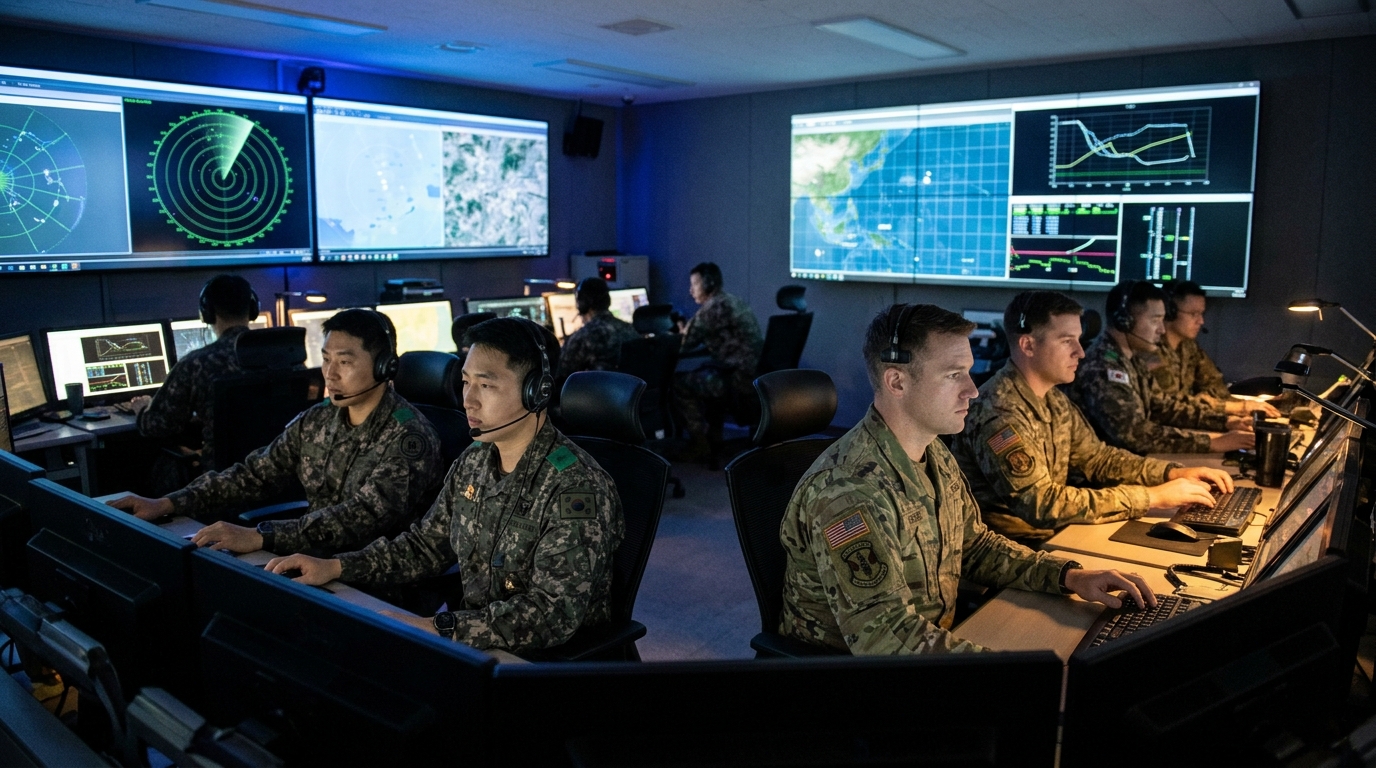
▲ 지하 연합지휘통제센터 벙커에서 한국군과 미군 장교들이 대형 전술 C4I 모니터를 응시하며 연합 공중 및 미사일 방어 상황을 실시간 모니터링하고 있다. 전작권 전환 시 미국의 핵 지휘라인과 재래식 지휘권이 분리되는 구조적 딜레마가 상존한다. [사진: 로이터·성조지 프레스 풀]
4. 가려진 핵 딜레마… '인적 결합' 해체와 주한미군 J10의 실체
그러나 정치적 공방보다 훨씬 치명적인 안보의 뇌관은 지휘체계 개편에 따른 한미 '핵-재래식 통합(CNI)'의 붕괴 위험입니다. 현재 한미연합사 체제에서는 주한미군사령관(미군 대장) 1인이 연합사령관과 유엔사령관을 겸직합니다. 미군 사령관은 한 몸 안에서 한반도 재래식 전력을 총괄 지휘하는 동시에, 미 인도태평양사령부와 전략사령부(STRATCOM)로 직통 연결되는 미국의 핵 지휘망을 장악하고 있습니다. 즉, 한 인물 안에서 재래식 작전과 미국의 핵우산 전개가 유기적으로 조율되는 완벽한 '인적 결합(Personal Union)' 구조였습니다. 그러나 전작권이 전환되면 연합사령관은 한국군 대장이 맡고 미군 대장은 부사령관으로 내려앉습니다. 미국 헌법과 군법상 핵무기 통제권은 오직 미국 대통령과 미군에게만 귀속되므로, 한국군 사령관은 전구의 전쟁 수행을 책임지면서도 정작 전쟁의 승패를 가를 핵 기획과 통제에서는 철저히 배제되는 '권한과 책임의 불일치'가 발생합니다.
주한미군이 운영 중인 핵 관련 전담 조직의 실체도 이러한 한계를 명백히 입증합니다. 주한미군은 2025년 6월 기획참모부 산하 조직을 미 육군 대령이 지휘하는 독립 부서인 'J10 전략통합요소(Strategic Integration Element)'로 확대 격상했습니다. 대외적으로는 한미 CNI의 핵심 기구로 포장되었지만, 실상은 한미연합사 내부 조직이 아니라 '연합사 바깥에 놓인 미군 단독 부서'입니다. J10의 본질적 임무는 한국군과의 공동 지휘가 아니라, 미국 본토 전략사령부의 글로벌 핵 기획과 주한미군의 극동 재래식 작전을 연결하는 미군 내부의 조정 축에 불과합니다. 미국은 어떤 동맹국과도 핵무기 지휘통제권을 공유하지 않는다는 철칙을 조직 설계로 확고히 못 박아둔 것입니다.
한국군의 독자적 작전 수행 역량 역시 냉혹한 현실에 부딪혀 있습니다. 핵-재래식 통합 작전에서 한국군의 핵심 역할은 미국의 전략폭격기 등 핵 자산이 전개될 때 적의 방공망을 제압(SEAD)하고 호위하며 정밀 표적 정보를 제공하는 것입니다. 그러나 한국군은 북한 전역의 이동식 미사일 발사대(TEL)와 지하 핵시설을 실시간 감시하고 타격할 수 있는 군사정찰위성, 고고도 무인정찰기(ISR) 등 정찰 자산과 전구급 지휘통제체계(C4I)가 턱없이 부족합니다. 한국군 4성 장군이 연합사령관 완장을 차더라도, 눈과 귀에 해당하는 조기경보와 핵심 표적 정보를 미군에 100% 구걸해야 하는 구조적 한계 속에서는 독자적 작전 주도권 행사가 불가능에 가깝습니다.
평가 영역
한미 합의 기준 (COTP)
한국 국방부 공식 입장
미군 지휘부 및 전문가 검증 결과
조건 1: 연합방위 핵심능력
한국군 주도의 핵심 군사 작전 능력 구비
'충족 완료' (한국군 역량 충분, 즉시 가능)
미흡 (감시정찰 ISR 자산 및 대화력전 미군 100% 의존)
조건 2: 북핵·미사일 대응
초기 필수 대응능력 및 3축 체계 완성
'충족 완료' (전략사 창설 및 킬체인 고도화)
미흡 (북한 전술핵 실전 배치로 확장억제 자립 불가능)
조건 3: 역내 안보환경
한반도 및 주변 안보환경의 안정성 유지
'충족 완료' (동맹 신뢰 기반 관리 가능)
역대 최악 악화 (적대적 두 국가론·러북 동맹·엄격 기준 요구)
검증 단계 및 전환 연도
1단계 IOC -> 2단계 FOC -> 3단계 FMC
2028년(임기 내) 최종 전환 강력 추진
미군 하원 보고: 2029회계연도 2분기(2029년) 이후 목표
5. 도상훈련 '가디언 타이거 III'의 경고와 한미 CNI 3대 구조적 해법
전작권 전환 이후 CNI의 균열이 실전에서 어떠한 참사로 이어지는지는 객관적 군사 시뮬레이션을 통해 여실히 입증되었습니다. 미국 애틀랜틱 카운슬이 국방위협감소국(DTRA)의 지원을 받아 실시한 도상훈련 '가디언 타이거 III(Guardian Tiger III)' 결과는 충격적이었습니다. 북한이 무인잠수정(UUV)으로 한국 해군 함정을 기습 어뢰 공격하자, 한국군 사령관이 이끄는 미래연합사는 원산 인근 북한 수뇌부 지휘소를 정밀 보복 타격했습니다. 궁지에 몰린 북한은 곧바로 오산 공군기지에 저위력 전술핵 미사일을 투하했습니다. 이 절체절명의 순간, 한미 동맹의 의사결정 체계는 완전히 마비되었습니다. 미국은 북한의 대미 대륙간탄도미사일(ICBM) 보복을 우려해 핵 보복을 주저했고, 한국군 사령관은 핵 통제권이 없어 응징할 수단이 없었습니다. 한국군 사령관과 미군 부사령관, J10, 미 인도태평양사, 전략사, 백악관으로 이어지는 다단계 소통 과정에서 치명적인 시간이 허비되며 한반도는 전면 핵전쟁의 나락으로 떨어졌습니다.
결국 전작권 전환이 국가적 과제라 할지라도, 동맹의 핵 억제력 분절을 막을 정교한 안전장치가 선행되지 않는다면 그것은 안보 자살골이 될 수밖에 없습니다. 안보 전문가들은 3대 긴급 처방을 제시합니다. 첫째, 미국의 전략폭격기나 저위력 핵탄두 탑재 잠수함(SSBN) 등 특정 핵 자산을 한반도 작전용으로 사전에 못 박는 '전구 지정(Theater Earmarking)'을 관철해야 합니다. 둘째, 나토(NATO)의 핵기획그룹(NPG)을 능가하는 상설 한미 핵-재래식 통합 기구를 미래연합사 내에 제도화하여 위기 시 즉각 결심할 수 있는 표준 교리를 구축해야 합니다. 셋째, 정례 연합훈련 시 북한의 전술핵 도발을 가정한 실전 CNI 훈련을 정례화하고 감시정찰 자산의 상호운용성을 조기에 확보해야 합니다. 자주국방의 낭만적 감상주의를 걷어내고, 동맹의 생존을 담보할 냉혹한 군사적 실체 위에 전작권 문제를 다시 세워야 할 때입니다.
[In-Depth Analysis] 'Conditions Met' vs. 'Graduating Without Prerequisites': Clashing Over OPCON Transfer, the Nuclear-Conventional Integration (CNI) Dilemma, and Trump 2.0 Security Waves
Politics & National Security Desk | ROK-US Alliance and OPCON Transition Analysis2026. 11. 15 08:45 KST
▲ South Korean and American four-star generals and senior defense officials engage in high-stakes negotiations over the three conditions for Wartime Operational Control (OPCON) transfer and combined defense command structures. [Photo: US DoD/JCS Press Pool]
In 2026, the cornerstone of South Korea's national defense—the ROK-US alliance—is engulfed in the fiercest direct confrontation since its inception over the expedited transition of Wartime Operational Control (OPCON). When South Korea's Minister of National Defense declared before the National Assembly that all three foundational conditions for OPCON transfer had been met and that operational authority could be reclaimed immediately, former and active US Forces Korea (USFK) commanders delivered an unprecedented public rebuke, comparing Seoul's push to a university student demanding a diploma without completing prerequisite coursework or passing final examinations. Compounding this friction, the return of Donald Trump to the White House has weaponized the OPCON issue into a geopolitical bargaining chip, with Washington exploring trade tariffs and potential USFK troop reductions. Most critically, beneath the surface debate over sovereign command lies a grave operational fissure: the fracturing of the bilateral Nuclear-Conventional Integration (CNI) command structure, designed to neutralize North Korea's advanced tactical nuclear arsenal. This investigative analysis dissects the command decoupling and structural dilemmas hidden behind patriotic self-reliant defense rhetoric.
1. Clash of Military Leadership and Emerging Inter-Agency Friction
The clash erupted inside the National Assembly's Budget and Accounts and Legislation-Judiciary Committees. Defense Minister Kang Shin-chul unequivocally answered 'Yes' when lawmakers asked whether all three conditions for OPCON transfer were fulfilled, asserting that transitioning command immediately would not compromise allied victory in wartime. He argued that having a South Korean four-star general lead the combined force while backed by the unmatched capabilities of the US military represents a far more operationally efficient posture for the Korean theater. However, acute dissonance surfaced between the military and the executive branch. First Deputy National Security Adviser Kang Geon-jak stated on national television that strategic and political negotiations with Washington could forge an agreement 'transcending technical conditions,' openly signaling that military criteria remain unfulfilled. While the Defense Ministry claimed all conditions were completed, the presidential office sought to bypass technical deficits through political bargaining.
The response from US military commanders was unsparingly direct, dispensing with diplomatic niceties. In a Center for Strategic and International Studies (CSIS) briefing, General Vincent Brooks, former commander of USFK and the ROK-US Combined Forces Command (CFC), characterized the defense minister's declarations as 'deeply disappointing.' Brooks remarked that claiming readiness today is akin to a college student insisting on immediate graduation despite failing to take required classes or pass exams. He emphasized that wartime command architectures must never be organized around sovereignty, but strictly configured for operational victory, warning that superficial restructuring would invite catastrophic instability and tactical risk. General Paul LaCamera, who recently relinquished command of USFK, concurred, cautioning that a command structure born of political compromise would inevitably fail under combat conditions.
General Xavier Brunson, the incumbent USFK commander, adopted an equally unyielding stance. Highlighting North Korea's persistent hypersonic missile tests and the formal restoration of its mutual defense treaty with Russia, Brunson stated that the evolving threat landscape mandates rigorous new compliance benchmarks. Crucially, Brunson submitted an official roadmap to the US House Armed Services Committee targeting the second quarter of fiscal year 2029 (the first calendar quarter of 2029 in Seoul) as the realistic window for OPCON transition. This congressional filing served as an explicit rejection of the Lee Jae-myung administration's declared objective to finalize the transfer within its presidential term by 2028.
Category
Current Pre-Transition Structure
Post-Transition Future CFC Structure
Operational & Strategic Impact
CFC Commander
US 4-star General (Triple-hatted: USFK/UNC)
ROK 4-star General (US General as Deputy)
ROK-led defense framework; sovereign pride mandate
Conventional OPCON
US Commander exercises combined theater command
ROK Commander exercises combined theater command
Integration of peacetime and wartime command structures
Nuclear Command & CNI
Personal Union: Single commander links conventional & nuclear
Decoupling: ROK General excluded from nuclear line
Mismatch of authority and responsibility; command paralysis
USFK J10 Status
US-only directorate linking STRATCOM and USFK
Maintained as US-only cell outside CFC lines
Zero nuclear power sharing; limited to staff coordination
Decision Velocity
Unified, instantaneous single-commander calculus
Multi-layered inter-governmental bilateral review
Severe escalation response lag during tactical nuclear strike
2. Trump 2.0 and the OPCON Calculus: The Risk of USFK Troop Reductions
The advent of the second Trump administration injects volatile political variables into the OPCON timetable. President Lee Jae-myung made reclaiming wartime command a centerpiece of his national agenda, establishing 2028 as the definitive target year. The administration argues that as the world's fifth-ranked military power spending annual defense budgets 1.4 times larger than North Korea's entire gross domestic product, unifying peacetime and wartime command represents a fundamental constitutional imperative. Concurrently, facing Trump's threats of 25 percent reciprocal tariffs and trade penalties, certain political factions in Seoul have proposed a high-stakes trade-security compromise: significantly escalating domestic defense procurement to expedite OPCON transfer in exchange for American tariff exemptions.
However, strategic calculations within Washington diverge sharply from Seoul's assumptions. The Pentagon's Interim National Defense Strategic Guidance explicitly reprioritizes American military posture around deterring a Chinese invasion of Taiwan and defending the homeland, formally shifting primary responsibility for containing North Korea to South Korea. Key national security architects of the Trump 2.0 coalition, including Christopher Miller and Under Secretary of Defense for Policy Elbridge Colby, have publicly lauded South Korea as a model ally while championing an expedited OPCON transfer. This stance does not stem from deference to Korean sovereignty, but from an operational desire to unshackle US forces from the Korean ground theater and subcontract conventional deterrence to Seoul.
Prominent Washington security strategists caution that President Trump views OPCON transfer as the ultimate justification for downsizing or withdrawing USFK. Dr. Victor Cha, Korea Chair at CSIS, observed that assertions suggesting Trump sees OPCON transfer as a mechanism to pull American troops from the peninsula carry immense credibility. Randall Schriver, former Assistant Secretary of Defense for Indo-Pacific Security Affairs, corroborated this assessment, noting that Trump instinctively concludes American troops have no purpose in Korea once Seoul assumes operational command. While South Korea finalized the 12th Special Measures Agreement (SMA) establishing its 2026 defense contribution at 1.52 trillion won, its status as an executive agreement leaves it vulnerable to unilateral abrogation and aggressive renegotiation demands under Trump.
3. SCM Delays and the Fivefold Surge of the Joint Verification Task Force
On the military verification front, procedural friction has stalled allied progress. Under the bilaterally agreed 2014 Conditions-based Operational Control Transition Plan (COTP), the alliance established a three-stage evaluation framework: Initial Operational Capability (IOC, certified in 2019), Full Operational Capability (FOC, evaluated in 2022 but lacking final bilateral endorsement), and Full Mission Capability (FMC, the final certification tier). Disagreements over whether core capabilities have truly matured have prevented Washington from certifying Stage 2 FOC. Consequently, the 56th Security Consultative Meeting (SCM)—the premier annual bilateral defense ministerial usually convened in late autumn—was abruptly postponed until early 2027, preceded by an interim bilateral session in Washington.
In response to this stalemate, South Korea's Joint Chiefs of Staff initiated an aggressive internal mobilization, expanding its Combined Evaluation Task Force from 9 officers to 50 personnel—a more than fivefold surge. This 50-officer complement mirrors the staffing levels deployed during the intensive 2022 FOC assessment, backed by emergency operational funding requests. Military authorities intend to force momentum through the uncertified FOC phase and prepare preemptively for the final FMC evaluation. Nevertheless, because FMC assessments require joint allied certification, expanding unilateral South Korean staff without American concurrence creates an operational paradox that cannot accelerate the actual transition timeline.
▲ South Korean and US military staff officers monitor combined air defense and ballistic missile tracking data on high-definition tactical C4I consoles inside an underground command bunker. OPCON transition creates an acute operational dilemma by decoupling conventional defense command from US nuclear command lines. [Photo: Reuters/Stars and Stripes Press Pool]
4. The Unseen Nuclear Dilemma: Dissolution of the 'Personal Union' and USFK J10
Far transcending political posturing is the critical danger of decoupling the ROK-US Nuclear-Conventional Integration (CNI) framework. Under the current CFC structure, a single US four-star general concurrently commands USFK, the UN Command, and CFC. This commander embodies an operational 'personal union,' exercising direct command over theater conventional forces while plugged directly into US nuclear command channels via Indo-Pacific Command and US Strategic Command (STRATCOM). Under the proposed Future CFC, a South Korean four-star general assumes supreme command, while the US commander is relegated to deputy commander. Because American statutory law strictly restricts nuclear weapons release authority to the US President, the South Korean commander would bear full theater operational responsibility while remaining completely excluded from nuclear planning and execution—instigating a lethal mismatch between operational responsibility and strategic authority.
The organizational reality of USFK's nuclear planning apparatus underscores this structural barrier. In June 2025, USFK elevated its internal nuclear-conventional staff into an independent directorate designated as the 'J10 Strategic Integration Element,' commanded by a US Army colonel. While framed publicly as a vehicle for allied CNI synchronization, J10 operates strictly as an autonomous American entity outside CFC command lines. Its primary function is to bridge global nuclear planning at STRATCOM with regional USFK conventional operations. By deliberately placing J10 outside the combined command structure, Washington reaffirmed its non-negotiable doctrine that sovereign nuclear command authority cannot be shared with foreign flag officers.
Furthermore, severe deficiencies in South Korea's independent intelligence and surveillance architecture undermine claims of operational autonomy. In a functional CNI operation, South Korean forces must suppress enemy air defenses (SEAD) and provide real-time targeting coordinates to escort American strategic bombers. However, Seoul continues to suffer from acute shortages of military reconnaissance satellites, high-altitude unmanned aerial vehicles (ISR), and theater-level command-and-control (C4I) networks capable of tracking North Korean mobile missile launchers and buried command bunkers. Even with a South Korean general serving as CFC commander, complete reliance on US early warning and targeting intelligence fundamentally compromises tactical operational independence.
Evaluation Dimension
Bilateral COTP Baseline
ROK Defense Ministry Claim
US Military & Expert Audit Assessment
Condition 1: Core Military Power
Independent ROK capacity to lead combined defense
'Fully Met' (ROK forces ready for immediate transfer)
Deficient (Critical dependence on US ISR and counter-fire)
5. Warnings from 'Guardian Tiger III' and Three Structural Prescriptions for CNI
The catastrophic consequences of command decoupling were empirically demonstrated in the 'Guardian Tiger III' wargame, conducted in May 2026 by the Atlantic Council with support from the US Defense Threat Reduction Agency (DTRA). In the simulation, North Korea launched an uncrewed underwater vehicle (UUV) torpedo attack sinking a South Korean naval combatant. The South Korean-led Future CFC executed a precision conventional strike against leadership facilities near Wonsan. Pushed into a corner, Pyongyang retaliated by detonating a low-yield tactical nuclear weapon over Osan Air Base. At this critical juncture, allied decision-making collapsed into paralysis. Fearing North Korean intercontinental ballistic missile retaliation against the American homeland, Washington hesitated to execute nuclear retaliation, while the South Korean commander possessed no nuclear assets. Multi-layered deliberations across disparate command nodes consumed precious hours, plunging the peninsula into catastrophic escalation.
If OPCON transition is to proceed without triggering allied strategic self-destruction, three structural safeguards must be established immediately. First, the alliance must secure formal 'Theater Earmarking,' pre-assigning specific American strategic bombers, ballistic missile submarines (SSBNs), or low-yield warheads exclusively for the Korean theater. Second, the alliance must institutionalize a permanent bilateral CNI planning body within the Future CFC modeled after NATO's Nuclear Planning Group (NPG), establishing standardized doctrine and immediate crisis execution protocols. Third, the allies must regularize full-scale CNI simulations during the annual Ulchi Freedom Shield exercises and establish seamless technical interoperability between Korean sensors and US strike networks. Stripping away political romanticism and anchoring command architecture in rigorous strategic reality represents the only path to safeguarding national survival.
1월이 시작되면 감기는 이미 우리 곁에 와 있습니다. 2월, 3월, 4월까지 이어지는 추위와 건조함은 코와 목을 가장 먼저 공격합니다. 아침에 일어나자마자 막혀 있는 코. 계속 흐르는 콧물. 괜히 칼칼해지는 목. 이 증상은 “시작”일 뿐입니다. 한 번 무너지면 일주일, 길면 한 달까지 끌고 갑니다. 약을 먹으면 잠깐 괜찮아집니다. 하지만 며칠 뒤 또 반복됩니다. 왜일까요? 감기는 ‘치료’의 문제가 아니라 ‘관리’의 문제이기 때문입니다. 대부분은 감기가 오고 나서 약을 찾습니다. 하지만 진짜 중요한 건 감기가 오기 전에 코와 목을 지키는 것입니다. 건조한 실내 공기, 차가운 바깥 공기, 눈에 보이지 않는 세균. 코와 목은 매일 공격받고 있습니다. 지긋지긋하죠! 그런데도 우리는 아무 준비 없이 버티고 있습니다. 이번 겨울도 그렇게 보낼 건가요? 사실 방법은 어렵지 않습니다. 코를 깨끗하게 관리하고, 목을 따뜻하게 보호하고, 점막을 촉촉하게 유지하고, 기관지를 미리 관리하고, 외부 공기를 차단하는 것. 이 다섯 가지만 꾸준히 해도 감기약 없이 겨울을 보내는 것이 충분히 가능합니다. 🔥 이제부터 그 방법을 하나씩 살펴보겠습니다. 🔥 1. 코와 목을 먼저 관리해야 하는 과학적 이유 감기의 대부분은 코 점막에서 시작됩니다. 국제 학술지 Nature Reviews Microbiology 와 Journal of Allergy and Clinical Immunology 에 실린 호흡기 감염 관련 연구들에서는, 감기 바이러스가 비강 상피세포에 먼저 부착해 증식한다는 점을 설명하고 ...
리모델링사업이 진행 중인 아파트를 매매할 때 “계약금 10%를 언제까지 내야 하느냐”는 질문이 특히 많이 나옵니다. 이주공고(이주 안내)가 7~11월쯤이라고 들으면, 그 시점에 맞춰 계약금도 움직일 것 같아서 더 헷갈리기 쉽습니다. 하지만 실제 납부기한은 ‘이주공고가 언제냐’만으로 자동 결정되지 않는 경우가 많습니다. 1) 계약금 10% 납부기한: 결국 ‘문서에 적힌 일정’이 기준 계약금 10%를 언제까지 납부해야 하는지는, 내가 서명하는 매매계약서(특약 포함) 와 사업주체/조합이 제시한 공고·안내문 에 적힌 납부 일정이 기준이 됩니다. 실제 공고문에서는 분양대금 납부의 큰 틀(계약금→중도금→잔금)을 먼저 안내하고, 상세 일정은 별도 표나 유의사항으로 제시하는 방식이 흔합니다. 또, 계약서 문구에 따라 지급 시점이 조건부로 설정될 수도 있습니다. 예를 들어 한 사례 소개 자료에서는 용역계약서에 잔금(10%) 지급시기가 “사업승인 후”로 기재되어 있었다는 점이 언급됩니다. 이런 식으로 ‘사업 단계’와 지급을 연동하는 문구가 들어가면, 질문의 답은 계약서 문구를 확인해야만 확정됩니다. 관련 내용은 링크 에서 문구 사례를 확인할 수 있습니다. 2) 입주자모집공고에서 확인되는 ‘납부 순서’와 잔금 마감 시점 공고문에 적힌 문구를 보면, 납부 순서와 잔금 마감에 대한 기준이 비교적 명확하게 제시되는 경우가 있습니다. 예를 들어 한 입주자모집공고에는 “분양금액(주택가격)은 계약금, 중도금, 잔금의 순서로 납부”하며 “잔금은 입주(열쇠 수령일) 전에 완납”해야 한다고 안내되어 있습니다. (문구 확인: 링크 ) 이 문구가 의미하는 바는 최소 2가지입니다. 분양/공급 형태의 문서에서는 ‘계약금→중도금→잔금’ 흐름이 공식적으로 안내될 수 있습니다. 잔금은 “입주(열쇠 수령)” 이전에 완납해야 한다는 마감 기준이 문서에 적혀 있을 수 있습니다. 다만, 위 공고문 문구는 잔금 마감에 대한 기준을 보여주지만, 계약금 10%의...
윤석열 전 대통령 탄핵 인용 소식을 접하면, 가장 궁금한 지점은 ‘헌재가 정확히 무엇을 위헌·위법으로 봤는가’입니다. 또한 탄핵과 별개로 진행되는 형사재판(내란 우두머리 혐의 등)이 어디까지 왔는지도 함께 정리할 필요가 있습니다. 아래 내용은 제공된 기사/게시물 스니펫과 링크에서 확인되는 범위만 모아, 일반인이 흐름을 이해하기 쉽게 정리한 것입니다. 1) 탄핵 인용 관련: 스니펫에서 확인되는 ‘판단의 골격’ 제공된 근거 중 조국혁신당 사이트에는 헌법재판소가 윤석열 탄핵 심판에서 “피청구인의 위헌·위법행위는 국민 신임 …”이라는 취지로 판단했다는 문장이 인용돼 있습니다( 링크 ). 이 인용문만 놓고 보면, ‘위헌·위법행위’가 있었는지와 그로 인해 ‘국민의 신임’이 어떻게 평가됐는지가 핵심 축으로 소개됩니다. 다만 질문에서 요청하신 세부 항목, 즉 비상계엄 선포 자체를 문제 삼은 구체적 이유, 계엄 이후 조치(포고령, 국회 통제 등)의 어떤 지점이 헌법 위반인지, 국회의 권한행사 방해 및 정치활동 제약을 어떤 논리로 판단했는지 등은, 이번에 제공된 근거의 제목/스니펫만으로는 조항·사실관계·판단 구조가 그대로 제시돼 있지 않습니다. 따라서 이 글에서는 ‘헌재가 무엇을 문제 삼았다’는 세부 리스트를 단정적으로 재구성하기보다, 현재 확인 가능한 문구 수준의 요약(위헌·위법행위 → 국민 신임의 문제로 평가)까지만 적습니다. 만약 헌재 결정문 전문(주문 및 이유)이 추가로 확인되면, 그때는 문장 단위로 ‘어떤 행위’와 ‘어떤 헌법 원리/조항’이 연결되는지(예: 권력분립, 국회의 권한, 정치적 기본권 등) 구조화해 정리하는 것이 가장 정확합니다. 2) 형사 절차(내란 혐의) 관련: 체포영장과 1심 선고 언급 탄핵 심판과 별도로, 12·3 비상계엄 사태로 내란 혐의를 받는 윤석열 대통령에 대해 2024년 12월 31일 체포 영장이 발부됐다는 BBC 보도가 있습니다( 링크 ). 해당 보도는 ‘현직 대통령’에 대한 체포영장 발부라는 점을 함께 언급합니다. 또...