| 대한민국판 서울 16.5℃ 맑음
🔍 기사 검색 🔑 로그인 · 구독 신문사 소개 기사 제보
/
LIFE & INFO 삶의 지혜
MANINTOP DAILY NEWS 우리들의 삶을 윤택하게 하는 정보를 담은 뉴스
DAILY NEWS 유익한 정보
만 인 의 탑
우리들의 삶을 윤택하게 하는 정보를 담은 뉴스
MANINTOP DAILY NEWS
인터넷신문 | https://information.youngsdaily.com

[기획] 분양가 25%만 내고 내 집 마련… 수원 광교·고양창릉 '지분적립형 분양주택' 청약 자격과 20년 분할 매입 실익 총정리
정론 심층기획 경제·부동산

[기획] 분양가 25%만 내고 내 집 마련… 수원 광교·고양창릉 '지분적립형 분양주택' 청약 자격과 20년 분할 매입 실익 총정리

"집값 폭등과 대출 규제 속에서 청년과 신혼부부의 내 집 마련 꿈을 현실로 바꿀 새로운 주거 사다리가 열렸습니다. 초기 목돈 부담을 4분의 1로 낮추고 20년에 걸쳐 차곡차곡 내 집을 완성해가는 지분적립형 분양주택의 모든 것을 쉽고 명쾌하게 해부합니다."
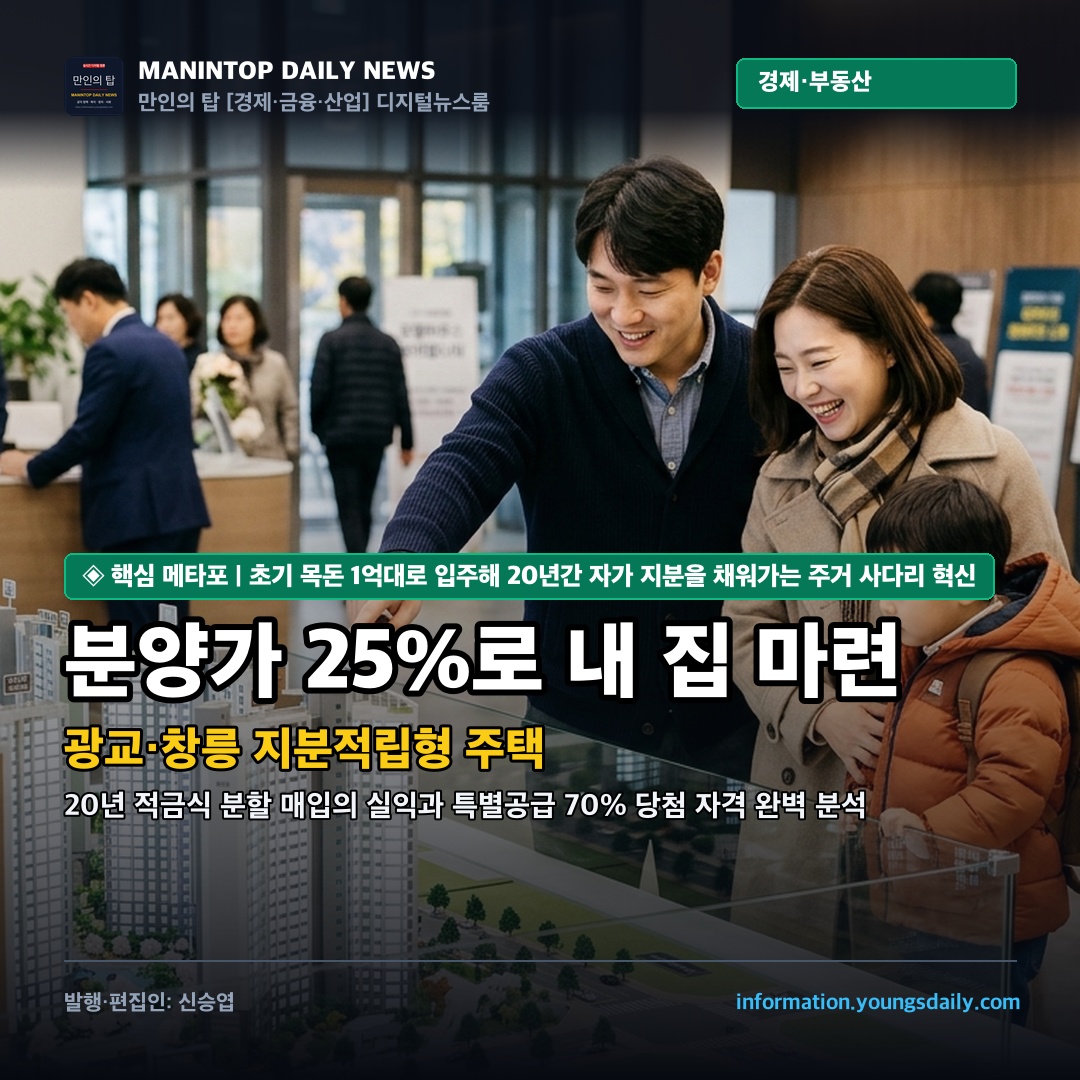
공공주택 홍보관에서 지분적립형 분양주택 단지 모형을 살펴보는 젊은 부부와 아이
▲ 공식 보도사진 — 경기도 주택 홍보관에서 한 젊은 부부가 아이와 함께 지분적립형 분양주택 단지 축소 모형을 살펴보며 상담을 받고 있다. 초기 분양가의 25%만 내고 입주해 20년간 자가 지분을 늘려가는 새로운 주거 방식이 무주택 서민들의 큰 관심을 모으고 있다.

초기 분양가 25%만 내고 내 집을 마련할 수 있는 수원 광교와 고양창릉 지분적립형 분양주택 공급이 본격화되면서 무주택 서민과 청년층의 청약 자격 요건과 실질 당첨 가능성에 대한 관심이 뜨겁게 달아오르고 있습니다.

그동안 치솟는 수도권 아파트 분양가와 강화된 대출 규제 때문에 목돈이 부족한 청년이나 신혼부부는 청약 당첨의 기쁨을 누리기도 전에 수억 원에 달하는 잔금 조달 장벽에 부딪히기 일쑤였습니다. 하지만 이번에 첫선을 보이는 지분적립형 주택은 당장 집값 전액을 마련하지 않아도 일단 4분의 1만 내고 입주한 뒤, 남은 20년 동안 적금을 붓듯이 차근차근 내 집 지분을 사들여 온전한 100% 자가를 완성할 수 있는 획기적인 공공분양 제도입니다.

경기도 수원 광교호수공원 인근의 알짜 입지에 들어서는 광교 A17 블록과 서울 접근성이 뛰어난 3기 신도시 고양창릉 S-2 블록이 그 첫 무대입니다. 지분적립형 주택이 과연 어떤 원리로 움직이고, 실제로 매달 들어가는 주거비와 20년 뒤 손익 계산서는 어떻게 나오는지 알기 쉽게 하나씩 짚어보겠습니다.

1. 분양가 25%로 입주하는 지분적립형 주택의 기본 원리

지분적립형 분양주택은 영국의 유명한 주거 복지 모델인 공유소유 제도를 한국 실정에 맞게 도입한 공공분양 아파트입니다. 일반 공공분양은 입주할 때 분양가 100%를 한 번에 정산해야 하지만, 지분적립형은 입주 시점에 분양가의 25% 수준만 초기 자본금으로 내고 열쇠를 받습니다.

입주 후에는 한국토지주택공사(LH)나 경기주택도시공사(GH) 같은 공공기관과 집의 소유권을 공동으로 나누어 갖게 됩니다. 수분양자는 본인이 취득한 25% 지분에 대해서는 완전한 주인 행세를 하며 살아가고, 아직 사지 못한 공공의 나머지 75% 지분에 대해서는 주변 시세보다 저렴한 임대료를 매달 내면서 거주하는 방식입니다.

가장 매력적인 점은 거주하면서 4년 또는 5년 주기마다 15~20%씩 지분을 추가로 매입할 수 있다는 사실입니다. 지분을 추가로 사들일 때마다 공공이 가진 지분은 줄어들기 때문에, 매달 나가는 월세 부담도 비례해서 뚝뚝 떨어집니다. 그렇게 20년이 지나면 마침내 100% 온전한 내 명의의 아파트가 탄생합니다.

쾌적한 호수공원과 대규모 주거 타운이 조화를 이루는 수도권 신도시 아파트 전경
▲ 현장 취재사진 — 쾌적한 호수와 녹지 환경을 갖춘 수도권 신도시 주거 단지 전경. 수원 광교 A17 블록과 고양창릉 3기 신도시 등 핵심 입지에 지분적립형 분양주택이 잇따라 공급되면서 무주택 실수요자들의 청약 열기가 고조되고 있다.

2. 수원 광교 vs 고양창릉: 지분 적립 스케줄과 실제 자금 계산

수분양자가 체감할 수 있는 가장 중요한 핵심은 실제 내 주머니에서 얼마가 나가느냐입니다. 현재 확정된 대표 사업지인 GH의 수원 광교 A17형과 LH의 고양창릉 S-2형은 지분을 매입하는 주기와 방식에서 약간의 차이가 있습니다.

전국 1호로 공급되는 수원 광교 A17 블록(전용 59㎡)의 분양가는 약 6억 3,450만 원에서 6억 8,590만 원 선으로 책정되었습니다. 인근 동일 평형 아파트 실거래가가 12억 7,000만 원 안팎인 점을 감안하면 거의 반값 수준입니다. 입주 시점에 필요한 25% 초기 자금은 약 1억 5,750만 원에 불과합니다. 광교형은 5년 주기로 4회에 걸쳐 지분을 매입하며, 추가 지분 가격은 최초 분양가에 1년 만기 정기예금 이자율(복리)을 더해 합리적으로 계산됩니다.

3기 신도시인 고양창릉 S-2 블록(전용 55㎡)은 예상 분양가가 약 5억 1,000만 원 수준입니다. 초기 25% 금액인 약 1억 2,800만 원만 있으면 입주가 가능합니다. 창릉형은 4년 주기로 15%씩 총 5회에 걸쳐 지분을 매입하게 됩니다. 특히 창릉형에서 전액 월세 방식을 선택할 경우 초기 1억 2,800만 원을 낸 뒤 월 약 79만 원 수준의 임대료를 부담하게 되는데, 이는 일반 전월세 시장(보증금 1억 3천만 원에 월 124만 원 선) 대비 매달 45만 원, 무려 36% 이상의 주거비를 절약하는 효과를 낳습니다.

구분 항목 GH 수원 광교 A17 블록 (경기도형 1호) LH 고양창릉 S-2 블록 (3기 신도시 1호)
공급 규모 및 전용면적 총 600가구 중 지분적립형 240가구 (전용 59㎡) 총 1,057가구 중 지분적립형 284가구 (전용 55㎡)
예상 분양가 (기준) 약 6억 3,000만 원대 (인근 시세 약 12.7억 원의 50%) 약 5억 1,000만 원대 (수도권 공공분양 표준선)
입주 시 초기 자본 (25%) 약 1억 5,750만 원 약 1억 2,800만 원
지분 취득 주기 및 비율 5년마다 매입 (5년차 20%, 10년차 20%, 15년차 20%, 20년차 15%) 4년마다 매입 (4·8·12·16·20년차 각 15%씩 5회 매입)
추가 지분 가격 산정 기준 최초 분양가 + 1년 만기 정기예금 이자율(복리 적용) 최초 분양가 + 추가 취득 시점 공인 정산가
미취득 공공지분 월세 부담 인근 전세 시세의 90% 수준 연동 (지분 증가 시 감액) 전액 월세 선택 시 약 79만 원 (일반 전월세 대비 36% 절감)

3. 20년 동안 9억 원 넘게 쓰는데 정말 이득일까? 손익의 진실

광교 A17 블록을 기준으로 20년 동안 들어가는 총비용을 꼼꼼하게 따져보면 의문이 생길 수 있습니다. 6억 3,000만 원짜리 아파트를 사는데 20년 동안 지분 매입비용 7억 9,882만 원(정기예금 복리 이자 약 1억 6,880만 원 포함)에 공공지분 임대료 누적액 약 1억 4,200만 원을 더하면 총 9억 4,000만 원가량이 들어가기 때문입니다.

최초 분양가보다 3억 원 이상 더 드는데 왜 유리할까요? 그 비밀은 바로 소멸성 주거비와 자산 형성의 차이에 있습니다. 만약 무주택자가 20년 동안 일반 민간 전세나 월세에 거주한다면, 매달 낸 월세나 전세대출 이자는 단 1원도 남지 않고 허공으로 완전히 사라집니다.

반면 지분적립형은 매달 내는 돈의 대부분이 온전히 내 집 지분을 사 모으는 강제 저축 역할을 합니다. 20년 뒤에는 그동안 낸 돈이 사라지는 것이 아니라 시세 10억~15억 원을 훌쩍 넘는 온전한 아파트 한 채로 남아 가족의 평생 자산이 됩니다. 게다가 혹시 중간에 실직이나 사업 부진으로 돈이 부족해지면 최대 1년 동안 지분 매입을 미룰 수 있는 취득 유예 안전장치까지 마련되어 있어 하우스푸어로 전락할 위험을 원천 차단해 줍니다.

햇살이 비치는 아늑한 거실에서 태블릿으로 주거 계획을 세우며 미소 짓는 30대 부부와 아이
▲ 생활 밀착 취재사진 — 햇살이 따스하게 들어오는 아파트 거실에서 한 젊은 부부가 아이를 돌보며 향후 20년 자금 계획을 세우고 있다. 초기 목돈 걱정 없이 안정적으로 거주하며 내 집을 늘려갈 수 있다는 점이 신혼부부들에게 가장 큰 안도감을 주고 있다.

4. 나눔형·토지임대부와 무엇이 다를까? 공공분양 5대 모델 비교

정부가 무주택 서민을 위해 내놓은 공공분양 주택에는 지분적립형 외에도 여러 유형이 있어 청약 대기자들을 헷갈리게 만듭니다. 가장 널리 알려진 나눔형(이익공유형) 주택, 토지임대부 주택, 그리고 일반 공공분양과의 차이점을 명확히 알아야 본인의 자금 사정에 딱 맞는 선택을 할 수 있습니다.

기존의 나눔형 주택은 시세의 70% 수준으로 저렴하게 분양받는 대신 집을 팔 때 반드시 LH에 되팔아야 하고 시세차익의 30%를 공공에 반납해야 합니다. 반면 토지임대부 주택은 건물만 내 것이고 땅은 공공 소유여서 평생 매달 토지 임대료를 내야 하는 구조적 한계가 있습니다.

이에 비해 지분적립형 주택은 20년 동안 차근차근 지분을 모으면 건물뿐만 아니라 대지 지분까지 100% 온전한 내 명의가 되며, 의무 거주와 전매 제한 기간이 지난 뒤에는 일반 아파트처럼 자유롭게 거래할 수 있다는 결정적인 장점을 지니고 있습니다.

비교 항목 지분적립형 분양주택 이익공유형 (나눔형) 토지임대부 분양주택 일반 공공분양주택
초기 필요 자본 분양가의 10% ~ 25% (가장 저렴) 분양가의 15% ~ 30% 수준 건물 분양가의 100% (초기 목돈 필요) 분양가의 100% (대출 동원 필수)
소유권 형태 20~30년에 걸쳐 토지·건물 100% 단독 소유 입주 즉시 소유 (대출 담보 설정) 건물만 영구 소유 (토지는 공공 소유) 입주 즉시 토지·건물 100% 소유
매월 나가는 추가 비용 미취득 지분 사용료 (지분 매입 시 계속 감소) 저리 모기지 대출 이자만 납부 매월 토지 임대료를 영구 납부 시중 주택담보대출 원리금 상환
집을 팔 때 처분 방식 10년 전매제한 후 매각 시 지분율대로 배분 반드시 LH에만 환매 (수익 70%만 인정) LH 또는 법 개정에 따른 환매 방식 민간 부동산 시장에서 자유 매각
가장 적합한 실수요층 당장 목돈은 적지만 소득 흐름이 안정적인 청년·신혼 저리 대출을 길게 활용하고 싶은 초기 자본 보유자 토지 소유욕보다는 저렴한 주거 안정 희망자 분양 대금을 감당할 목돈과 대출 여력이 있는 가구

5. 특별공급 70% 쏟아진다… 청약 자격과 당첨 가점표 공략법

지분적립형 주택은 자산 형성 기회가 절실한 젊은 층을 위한 제도인 만큼, 공급 물량의 70%를 특별공급으로 쏟아붓습니다. 일반공급 30% 중에서도 상당수가 자녀가 있는 가구에 우선 배정되므로 청약 전 본인이 어느 유형에 가장 유리한지 꼼꼼하게 따져보아야 합니다.

특별공급 70%는 신생아 가구 20%, 청년 15%, 신혼부부 15%, 다자녀 10%, 생애최초 7%, 노부모 부양 3%로 구성됩니다. 신혼부부의 경우 혼인 기간 7년 이내이거나 6세 이하 자녀가 있어야 하며, 도시근로자 월평균 소득 130%(맞벌이는 200%) 이하 기준을 충족해야 합니다.

특히 19세에서 39세 미혼 청년을 위한 청년 특별공급(15%)은 과거 주택을 소유한 적이 없고 5년 이상 꾸준히 소득세를 납부한 성실한 직장인에게 물량의 30%를 우선 배정합니다. 소득 수준(3점), 거주 기간(3점), 청약통장 납입 횟수(3점), 소득세 납부 기간(3점) 등 총 12점 만점의 가점표에서 만점에 가까울수록 당첨 확률이 비약적으로 높아집니다.

공급 유형 배정 비율 필수 소득 및 기본 자격 요건 입주자 선정 방식 및 핵심 가점 기준
신생아 특별공급 20% 입주자 모집일 기준 2세 미만 자녀(태아 포함), 소득 140%(맞벌이 200%) 이하 물량의 70%를 소득 100%(맞벌이 120%) 이하 가구에 자녀 수와 거주 기간 가점순 배정
청년 특별공급 15% 19세~39세 미혼 무주택자, 본인 소득 140% 이하, 생애 주택 미소유자 물량의 30%는 5년 이상 소득세 납부자 우선 배정. 소득·거주·청약납입·세금 납부 4대 가점순
신혼부부 특별공급 15% 혼인 7년 이내 또는 6세 이하 자녀, 소득 130%(맞벌이 200%) 이하, 청약 6회 이상 혼인 2년 이내 또는 2세 이하 자녀 세대에 30% 우선 배정, 가구 소득 및 자녀 수 가점제
다자녀 특별공급 10% 미성년 자녀 2명 이상 무주택세대구성원, 소득 120%(맞벌이 200%) 이하 물량의 90%를 소득 120% 이하 가구에 우선 배정하며 미성년 자녀 수 순으로 선정
생애최초 특별공급 7% 세대원 전원 주택 소유 이력 없음, 5년 이상 소득세 납부, 소득 130% 이하 소득 기준 충족자 중 100% 추첨제로 투명하게 당첨자를 가려냄
일반공급 30% 무주택세대구성원, 청약저축 가입 1순위, 소득 100%(맞벌이 200%) 이하 일반공급의 50%는 2세 미만 자녀 세대 우선, 30%는 1순위 납입 인정액 순, 20%는 무작위 추첨

6. 10년 전매제한·세제 혜택 총정리와 전문가 제언

지분적립형 주택에 청약할 때 반드시 숙지해야 할 법적 규제와 세금 혜택도 명확합니다. 공공주택 특별법에 따라 당첨자는 최초 입주 가능일로부터 무려 10년 동안 집을 마음대로 팔 수 없는 전매제한에 묶입니다. 아울러 최초 입주 후 최소 5년 동안은 실제로 거주해야 하는 의무가 따릅니다. 만약 정당한 사유 없이 거주 의무를 어기면 공공기관이 은행 예금 이자만 얹어주고 집을 강제로 사들이게 됩니다.

반면 파격적인 세금 혜택도 주어집니다. 2026년 지방세제 개편에 따라 40세 미만 청년이 지분적립형 아파트를 생애최초로 취득할 경우 취득세 감면 한도가 기존 200만 원에서 300만 원으로 대폭 상향되었습니다. 사업을 맡은 LH와 GH의 공공 지분 재산세 25% 감면 혜택도 2029년 말까지 연장되어 공공기관의 공급 확대 유인도 든든하게 확보되었습니다.

부동산 학술 전문가들의 AHP(계층분석법) 분석 결과에 따르면, 지분적립형 주택이 시장에 확고하게 뿌리내리기 위해 가장 시급한 과제로 '미취득 지분 임대료 산정 기준의 명확화(가중치 0.1504)'와 '취득 지분 비율 선택권 확대(0.1347)'가 꼽혔습니다. 무주택 청년들이 20년 동안 불안함 없이 집을 키워갈 수 있도록 투명한 임대료 예측 시스템을 구축하고 초기 지분 비율을 10%, 20%, 30% 등 가구 형편에 맞게 고를 수 있도록 제도를 다듬어야 한다는 목소리가 높습니다.

결국 지분적립형 분양주택은 목돈이 없어 내 집 마련을 포기했던 2030 세대에게 가장 든든한 주거 사다리가 되어줄 것입니다. 오는 11월 9일 특별공급을 시작하는 수원 광교 A17 블록을 필두로 고양창릉과 남양주왕숙 등 수도권 핵심지 청약 일정을 꼼꼼히 챙겨 나만의 맞춤형 청약 전략을 세워야 할 때입니다.

지분적립형 분양주택 핵심 FAQ

Q1. 지분적립형 분양주택은 입주할 때 얼마의 초기 목돈이 필요한가요?

최초 입주 시에는 분양가의 25%만 납부하면 됩니다. 예를 들어 수원 광교 전용 59㎡(분양가 약 6억 3,000만 원)는 약 1억 5,750만 원, 고양창릉 전용 55㎡(분양가 약 5억 1,000만 원)는 약 1억 2,800만 원의 초기 자본으로 입주가 가능합니다.

Q2. 아직 사지 않은 나머지 75% 지분에 대해서는 매달 얼마의 비용을 내야 하나요?

공공이 보유한 미취득 지분에 대해서는 주변 시세 전세가의 약 90%를 기준으로 산정된 임대료를 지불합니다. 4년이나 5년마다 지분을 추가로 사들일 때마다 공공 지분이 줄어들기 때문에 매달 내는 임대료 부담도 점차 줄어듭니다.

Q3. 청약에 당첨되면 의무적으로 거주해야 하거나 전매가 제한되는 기간이 있나요?

공공주택 특별법에 따라 최초 입주 가능일로부터 10년 동안 전매가 제한되며, 5년 동안은 실제 의무적으로 계속 거주해야 합니다. 중간에 불가피하게 처분할 경우 공공주택사업자에게 환매해야 합니다.

In-Depth Analysis Economy & Real Estate

[In-Depth Analysis] Own a Home by Paying 25% Upfront: Eligibility and 20-Year Equity Accumulation in Gwanggyo and Changneung

"Amid soaring housing prices and strict lending barriers, a groundbreaking public housing model is offering young families and first-time buyers a realistic ladder to homeownership. By lowering initial upfront costs to just 25% and allowing residents to purchase the remaining equity in increments over 20 years, South Korea launches its shared-equity housing initiative in Gwanggyo and Changneung."
Young Korean couple and child examining scale model in public housing gallery
▲ Official Press Photo — A young couple with their child examining a scale model of an equity-accumulation public housing development at an exhibition gallery. The program lowers the initial barrier to 25% down payment with remaining shares acquired over two decades. (Press Archive)

South Korea is officially rolling out its innovative equity-accumulation public housing program in prime metropolitan locations, beginning with Suwon Gwanggyo Block A17 and Goyang Changneung Block S-2, opening up a direct path to homeownership for young adults and first-time buyers with just 25 percent down payment.

For years, skyrocketing apartment prices and stringent debt-service ratio limits have locked young couples and moderate-income households out of the housing market. Even winning a public housing subscription often turned into a financial crisis when buyers faced immediate demands for hundreds of millions of won in balance payments. The newly inaugurated shared-equity housing model fundamentally transforms this landscape by allowing buyers to move in with only one-quarter of the purchase price, gradually acquiring the remaining 75 percent equity like an installment savings plan over 20 to 30 years.

With Suwon Gwanggyo, adjacent to Lake Park, and Goyang Changneung 3rd New Town leading the rollout, prospective homebuyers are closely evaluating the financial mechanics, monthly rent obligations, and subscription qualifications of this new system.

1. Core Principles of Equity-Accumulation Housing

Modeled after the United Kingdom shared ownership program, South Korea shared-equity public housing system allows eligible residents to acquire homes that would otherwise be out of financial reach. Unlike conventional public housing that demands 100 percent payment upon occupancy, this model requires an initial down payment of just 10 to 25 percent.

Upon move-in, the homebuyer shares legal ownership with a public housing corporation such as Korea Land and Housing Corporation (LH) or Gyeonggi Housing and Urban Corporation (GH). The buyer enjoys complete residential rights while paying a modest monthly usage fee on the unacquired public share, set at approximately 90 percent of prevailing neighborhood Jeonse rental rates.

Every four or five years, residents purchase an additional 15 to 20 percent equity tranche. As their private ownership stake increases, the monthly rental fee owed to the public sector decreases proportionally. After two decades, the buyer completes all installments and achieves 100 percent sole ownership of both the building and the underlying land.

Panoramic view of modern metropolitan new town development and lake park
▲ Editorial Documentary Photo — Panoramic view of a modern metropolitan new town residential development district featuring landscaped lake parks and upcoming public residential blocks. The shared-equity model expands across Gwanggyo and Changneung. (Press Archive)

2. Gwanggyo vs Changneung: Equity Tranches and Capital Simulations

The financial feasibility of the program depends heavily on initial capital requirements and ongoing installment schedules. While GH operates on a 5-year cycle, LH follows a 4-year equity purchase framework.

At Suwon Gwanggyo Block A17, 240 units of 59-square-meter apartments are being offered at an estimated sale price between 634.5 million and 685.9 million won. This represents roughly half the market price of comparable private units in the area, which currently trade near 1.27 billion won. Buyers need only 157.5 million won upfront to move in. Additional tranches are priced based on the initial sale price compounded by 1-year time deposit interest rates.

At Goyang Changneung Block S-2 in the 3rd New Town, 284 units of 55-square-meter apartments carry an estimated price tag of 510 million won. Occupants enter with an initial 128 million won. Choosing a full monthly rent option on the unacquired share results in approximately 790,000 won per month, saving over 36 percent compared to general market rental costs of 1.24 million won for equivalent properties.

Comparison Item GH Suwon Gwanggyo Block A17 (Provincial Model 1) LH Goyang Changneung Block S-2 (3rd New Town Model 1)
Total Units & Floor Area 240 shared-equity units out of 600 total (59 square meters) 284 shared-equity units out of 1,057 total (55 square meters)
Estimated Sale Price Approx. 630 million won (50% of market rate of 1.27 billion won) Approx. 510 million won (Standard metropolitan benchmark)
Initial Capital Needed (25%) Approx. 157.5 million won Approx. 128.0 million won
Equity Acquisition Cycle 5-year intervals (+20% at yr 5, 10, 15; +15% at yr 20) 4-year intervals (+15% at yr 4, 8, 12, 16, 20; 5 total tranches)
Tranche Price Calculation Initial price plus compound 1-year deposit interest Initial price plus official valuation adjustment
Monthly Rent on Public Share Indexed to 90% Jeonse market rate (decreases as equity rises) Approx. 790,000 won monthly (36% cheaper than market rent)

3. Long-Term Financial Economics: Asset Accumulation vs Vanishing Rent

A comprehensive examination of the 20-year cash outflow for Gwanggyo Block A17 reveals a total expenditure of approximately 940 million won, comprising 798.8 million won in cumulative equity purchases and 142 million won in public share rental payments.

While this total exceeds the initial 630 million won sticker price, it represents a far superior wealth-building mechanism than private tenancy. In conventional renting, all monthly payments are permanently lost. Under the shared-equity framework, the vast majority of expenditures directly convert into real estate equity.

After 20 years, residents own an unencumbered asset valued well over 1 billion won. Furthermore, the policy includes a deferred payment safety net that allows households facing unexpected job losses or financial distress to postpone their scheduled tranche purchase for up to one year, eliminating the threat of premature contract forfeiture.

Young family enjoying their bright living room in a modern apartment
▲ Domestic Documentary Photo — A young couple planning their long-term housing finances while looking at a tablet in a sunlit modern apartment living room as their toddler plays safely nearby. (Press Archive)

4. Comparative Analysis Across Five Public Housing Frameworks

To choose the most suitable path, prospective applicants must distinguish shared-equity housing from other public schemes, including Profit-Sharing (Nanum), Land-Leasehold, and standard public presales.

Profit-sharing models offer discounted entry but mandate that owners sell back exclusively to LH, forfeiting 30 percent of capital appreciation. Land-leasehold housing separates land from structure, leaving buyers with permanent monthly land rental obligations.

Shared-equity housing, conversely, culminates in full ownership of both structural units and underlying land shares. Once mandatory holding periods expire, owners enjoy unrestricted rights to sell on the open private market, retaining their proportionate gains.

Evaluation Metric Shared-Equity Housing Profit-Sharing (Nanum) Land-Leasehold Housing Standard Public Presale
Initial Capital Down 10% to 25% of sale price (Lowest) 15% to 30% of sale price 100% of building price (Moderate) 100% of full sale price (High)
Ownership Structure Phased progression to 100% sole ownership Immediate ownership with public mortgage lien Building ownership only (Land remains public) Immediate 100% private ownership
Ongoing Monthly Cost Rent on unacquired share (decreases over time) Subsidized mortgage interest only Permanent monthly land lease fee Commercial mortgage principal and interest
Exit & Resale Structure Open market resale after 10-year lockup Mandatory buyback by LH (70% profit kept) LH repurchase or restricted market trade Unrestricted open market sale
Target Audience Young households with steady income but low savings Buyers seeking long-term subsidized financing Buyers prioritizing low-cost secure tenure Buyers with sufficient upfront liquid capital

5. Subscription Qualifications: 70% Allocated to Special Categories

Because the initiative focuses on asset building for emerging generations, 70 percent of total housing supply is strictly designated for special supply quotas, with the remaining 30 percent allocated to general supply.

The 70 percent special quota is distributed among newborn households (20%), young single adults (15%), newlyweds (15%), multi-child families (10%), first-time buyers (7%), and elderly dependent caretakers (3%). Newlywed eligibility requires a marriage within seven years or dependent children aged six or younger, with household income capped at 130 percent of urban averages (200 percent for dual-income couples).

For young singles aged 19 to 39, 30 percent of their quota is prioritized for those who have paid income taxes for five or more consecutive years. Evaluation utilizes a rigorous 12-point rubric evaluating income levels, local residency duration, subscription deposit history, and employment tax records.

Supply Category Quota Share Eligibility & Income Requirements Allocation Mechanism & Key Scoring Criteria
Newborn Quota 20% Children under 2 years; Income under 140% (Dual 200%) 70% prioritized for lower income (under 100%) via merit points
Youth Single Quota 15% Ages 19-39, unmarried, never owned home, income under 140% 30% reserved for 5-year tax payers; 12-point rubric on residency and savings
Newlywed Quota 15% Married under 7 years or child under 6, income under 130% (Dual 200%) 30% prioritized for marriages under 2 years; points for children and residence
Multi-Child Quota 10% Two or more minor children, income under 120% (Dual 200%) 90% prioritized for income under 120%; ranked by minor child count
First-Time Buyer Quota 7% Household members never owned home, 5-year tax record, income under 130% 100% transparent public lottery among qualified applicants
General Supply 30% Homeless household, 1st tier subscription, income under 100% (Dual 200%) 50% reserved for toddlers under 2; 30% by deposit total; 20% random draw

6. Regulatory Restrictions, Tax Relief, and Expert Policy Assessment

Prospective applicants must carefully weigh statutory obligations alongside financial incentives. Under the Special Act on Public Housing, shared-equity homeowners face a 10-year resale restriction preventing private transfers. Furthermore, mandatory residency requires continuous occupation for at least five years from move-in. Failure to maintain residency results in compulsory public repurchase at original cost plus statutory savings interest.

Substantial fiscal relief offsets these constraints. Under recent local tax revisions, young buyers under age 40 acquiring their first home receive an expanded acquisition tax exemption capped at 3 million won, up from 2 million won. Additionally, the 25 percent property tax reduction on public housing corporation shares has been extended through December 2029, preserving institutional developer viability.

Academic research utilizing the Analytic Hierarchy Process (AHP) indicates that establishing transparent rental calculation benchmarks on unacquired shares (weight 0.1504) and providing flexible equity down payment ratios (weight 0.1347) represent the most critical policy prerequisites for long-term program stability. With Gwanggyo Block A17 opening special supply subscriptions on November 9, shared-equity housing provides a practical, low-barrier pathway to homeownership across the Seoul capital region.

Shared-Equity Housing FAQ

Q1. How much initial capital is required upon move-in?

Buyers need only pay 25 percent of the purchase price upfront. For example, Suwon Gwanggyo 59-square-meter units require approximately KRW 157.5 million, while Goyang Changneung 55-square-meter units require about KRW 128 million.

Q2. What are the ongoing monthly costs for unacquired shares?

Residents pay a monthly fee on the remaining public share equivalent to roughly 90 percent of neighborhood Jeonse rental rates, which systematically declines every four or five years as additional equity tranches are acquired.

Q3. What are the statutory restrictions on resale and residency?

Under the Special Act on Public Housing, owners face a 10-year transfer prohibition and a mandatory five-year continuous residency requirement. Early disposals must be repurchased by public corporations at original cost plus statutory interest.

PRO SOURCING ENGINE 만인의 탑 빅데이터 솔루션
★ 가입 시 600 크레딧(120회) 전원 무료

내가 찾는 상품 키워드, 지금 얼마나 검색될까?

네이버 월간 검색량 + 구글 볼륨 + 아이템스카우트 실시간 상품수와 경쟁강도 배지를 0.5초 만에 무료로 확인하세요.

신고하기

이 블로그 검색

환절기 감기 예방법 찐실천 후기와 전문가 조언으로 완성한 코와 목 관리 99% 방어 루틴

리모델링 아파트 계약금 10%는 언제 내나요? 계약서·공고문으로 확인하는 납부 시점

윤석열 탄핵·12·3 비상계엄·내란 혐의 재판까지: 근거로 확인되는 범위만 한 번에 정리
