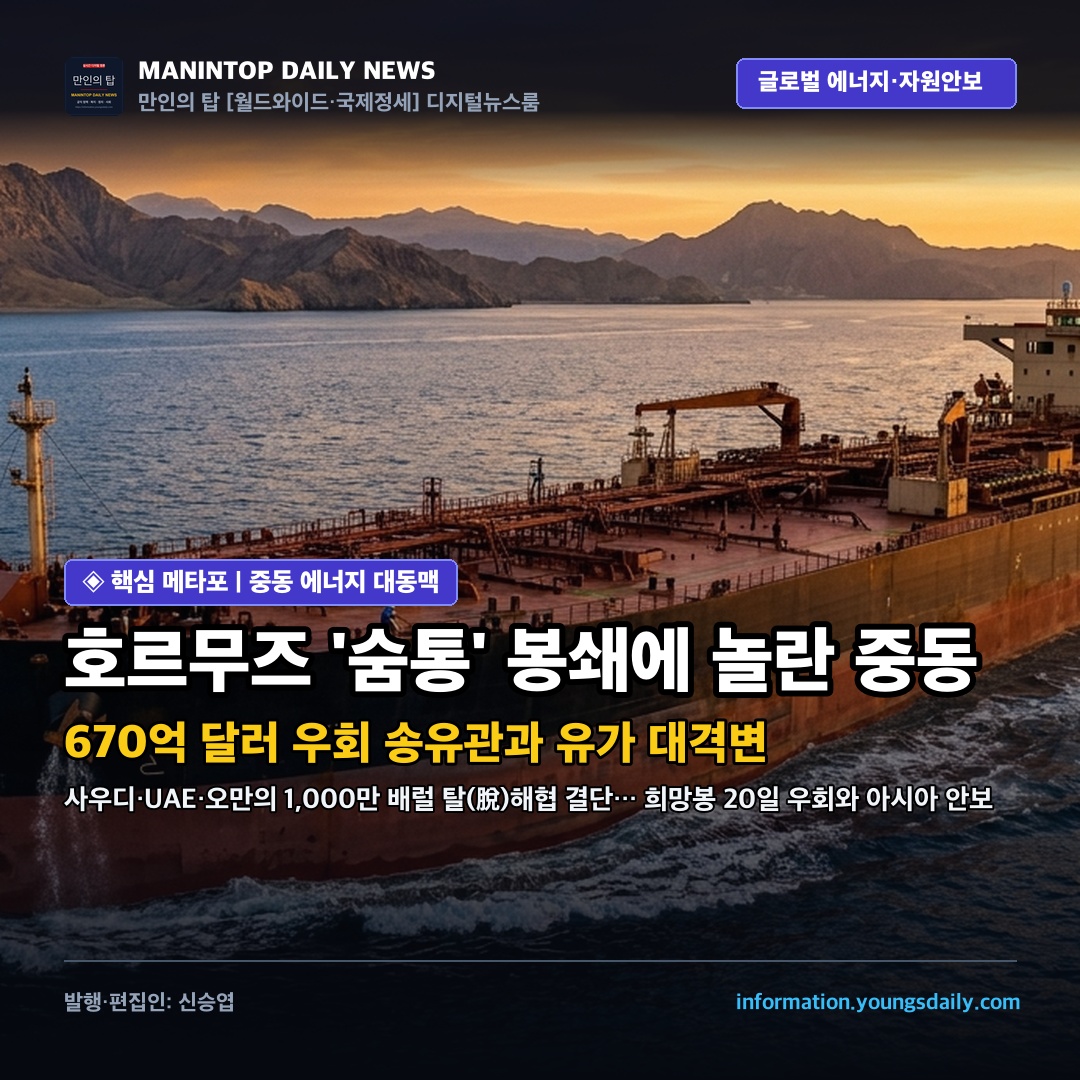
▲ 전 세계 해상 원유 수송량의 27%가 오가는 호르무즈 해협에서 200만 배럴의 원유를 실은 초대형 원유운반선(VLCC)이 험준한 사막 해안선을 배경으로 항해하고 있다. / 공식 해운 보도 사진
호르무즈 '숨통' 봉쇄에 놀란 중동… 670억 달러 우회 송유관과 유가 대격변
전 세계 바다를 오가는 원유의 4분의 1 이상이 통과하는 중동의 핵심 수송로 호르무즈 해협이 군사적 충돌과 봉쇄 위기에 직면하면서, 글로벌 에너지 시장의 판도가 근본적인 대격변을 맞이하고 있다. 2026년 봄 한때 배럴당 150달러 선까지 치솟았던 국제 유가는 미국 중간선거 이후 협상 기대감이 피어오르며 90달러대로 급격히 숨을 죽였지만, 중동의 주요 산유국들은 이미 뼈아픈 교훈을 얻었다. 폭이 수십 킬로미터에 불과한 좁은 바닷길 하나에 국가의 명운을 온전히 맡길 수는 없다는 절박함이다. 사우디아라비아와 아랍에미리트(UAE), 오만 등 중동 맹주들은 호르무즈 해협을 아예 거치지 않고 홍해와 아라비아해로 원유를 곧장 빼내는 1,000만 배럴급 육상 '사막 송유관' 인프라 확충에 사활을 걸고 있으며, 아부다비에서는 단일 행사 사상 최대 규모인 670억 달러(약 92조 원)의 초대형 에너지 투자 협정이 쏟아졌다. 유조선 한 척당 200만 배럴의 기름을 싣고 아프리카 희망봉을 20일 넘게 돌아가야 했던 글로벌 해운 대란의 막전막후와, 지구촌 에너지 안보 지도를 송두리째 다시 그리고 있는 '호르무즈 탈출 작전'의 생생한 현장을 심층 취재했다.
일일 2,000만 배럴의 바닷길이 막혔다… 배럴당 150달러 치솟았던 호르무즈의 악몽
호르무즈 해협은 지구상에서 대체할 수 없는 가장 거대한 에너지 동맥이다. 평상시 이곳을 드나드는 원유와 석유제품은 하루 평균 2,000만 배럴에 달해 전 세계 해상 원유 교역량의 27%를 차지하며, 카타르와 아랍에미리트에서 생산되는 액화천연가스(LNG) 역시 전 세계 공급량의 19%가 이 좁은 수로를 통과한다. 그러나 2026년 군사 작전이 본격화되자마자 이 황금 통로는 순식간에 마비되었다. 분기당 2,070만 배럴이던 일일 통과량이 1,460만 배럴로 30% 급감하더니, 위기가 정점에 달했던 4월 초에는 평소의 5분의 1 수준인 일일 380만 배럴까지 곤두박질쳤다. 수출길이 막힌 페르시아만 유전들은 하루 1,070만 배럴이라는 사상 초유의 강제 감산(Shut-in)에 내몰렸고, 사우디 320만 배럴, 이라크 270만 배럴의 생산 설비가 멈춰 섰다.
물리적 공급망 차단은 곧장 전 세계적인 유가 발작으로 이어졌다. 연초 배럴당 60~70달러 선에서 안정세를 보이던 브렌트유는 선물 시장에서 118달러를 뚫고 올라갔고, 일부 현물 시장에서는 배럴당 132달러에서 최고 150달러를 넘나드는 공포 매수세가 붙었다. 유럽의 디젤과 항공유 정제 마진(크랙 스프레드)이 배럴당 70~80달러를 돌파하며 물류 대란이 현실화되었다. 비록 11월 미국 중간선거에서 민주당이 의회를 탈환하며 평화 협상 기대감 속에 브렌트유가 주간 16% 급락한 98.60달러로 내려앉았지만, 에너지 분석 기관들은 해협 안팎의 군사적 긴장이 잔존하는 한 본질적인 공급망 불안은 언제든 다시 폭발할 수 있다고 입을 모은다.
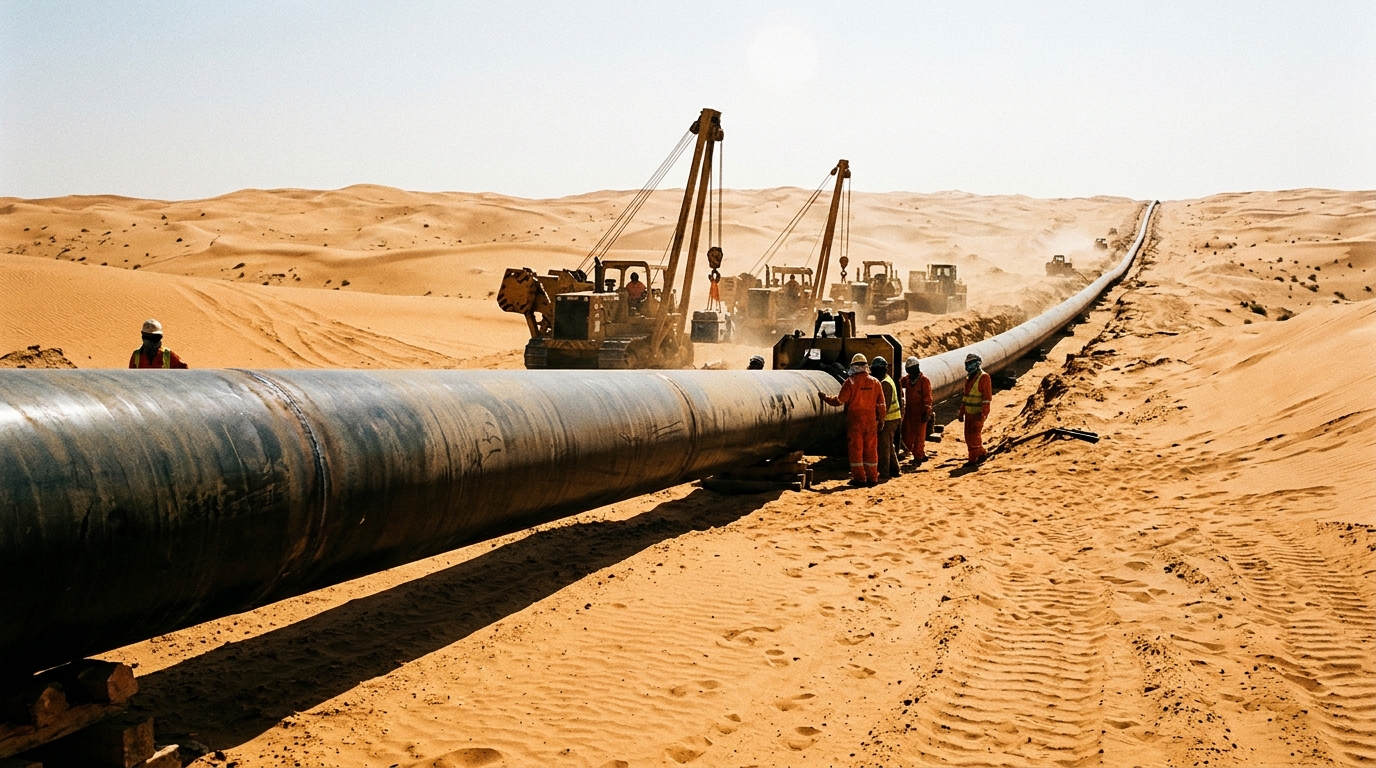
▲ 호르무즈 해협을 통과하지 않고 홍해와 인도양으로 원유를 직결 수송하기 위해 사막 모래 언덕을 가로질러 건설 중인 56인치 초대형 우회 송유관 현장. / 공식 산업 자료 사진
해협 봉쇄라는 뼈아픈 충격을 겪은 중동 국가들은 바닷길 대신 광활한 아라비아 사막을 관통하는 대규모 육상 파이프라인으로 눈을 돌렸다. 사우디아라비아는 동부 유전에서 서부 홍해 얀부(Yanbu) 항구까지 아라비아반도를 가로지르는 1,190km(740마일) 길이의 '동서 파이프라인(Petroline)' 수송 용량을 기존 700만 배럴에서 1,000만 배럴까지 끌어올리는 대규모 증설 공사에 속도를 내고 있다. 그러나 얀부 항구의 원유 선적 능력이 하루 400만~500만 배럴 수준에 머무는 데다, 얀부를 빠져나간 유조선들이 홍해 하단 바브엘만데브 해협에서 예멘 후티 반군의 공격 위험에 다시 노출된다는 구조적 한계는 여전히 남아 있다.
이에 따라 가장 안전하고 혁신적인 대안으로 떠오른 곳이 바로 UAE 푸자이라와 오만의 아라비아해 연안이다. 아랍에미리트는 호르무즈 해협 바깥인 오만만에 위치한 푸자이라 항구까지 연결된 ADCOP 파이프라인에 150만 배럴 규모의 신규 관로를 추가해 총 330만~400만 배럴의 수송망을 2027년까지 완성하기로 했다. 여기에 더해 글로벌 컨설팅 그룹 EY가 제시한 '오만 아라비아해 에너지 회랑' 프로젝트는 이라크 남부와 쿠웨이트, 사우디를 거쳐 오만 둠크(Duqm)와 라스 마르카즈 터미널까지 1,800km를 잇는 56인치 쌍둥이 강철 송유관을 깔아 하루 1,000만 배럴을 바브엘만데브와 호르무즈 모두를 피해 직접 인도양으로 뽑아내는 구상이다. 약 500억 달러(약 69조 원)의 사업비가 투입되지만, 해협이 석 달만 막혀도 산유국과 소비국이 입는 피해가 800억 달러를 훌쩍 넘는다는 점에서 경제적 타당성이 충분한 '에너지 방파제'로 평가받는다.
아부다비에 쏟아진 670억 달러… 전통 석유와 첨단 AI가 손잡은 에너지 대전환
위기 속에서도 중동은 새로운 미래를 향한 투자를 멈추지 않았다. 2026년 11월 초 아랍에미리트 아부다비에서 열린 세계 최대 에너지 전시회 'ADIPEC 2026'에는 전 세계 170개국에서 24만 명의 에너지 리더와 40여 명의 장관급 인사가 집결했다. 현장에서 타결된 상업 인프라 및 자원 개발 계약 규모만 전년 대비 26.4% 급증한 총 670억 달러(약 92조 원)에 달해 역대 최고 기록을 갈아치웠다. UAE 국영 투자사 XRG가 글로벌 석유 메이저 셸(Shell)이 보유한 호주 가스전 지분을 15억 달러에 인수하고, 루와이스의 대규모 화학·터미널 프로젝트가 51억 디르함의 금융 조달을 성공적으로 매듭짓는 등 초대형 자본의 이동이 잇따랐다.
특히 이번 행사의 백미는 전통 석유 산업과 최첨단 인공지능(AI) 기술의 결합이었다. 아부다비 국영석유회사(ADNOC)는 샘 올트먼의 OpenAI, 그리고 기술 대기업 G42와 삼각 전략 동맹을 맺고 에너지 공급망 전체의 자율 운영 시스템을 구축하기로 선언했다. 게코 로보틱스(Gecko Robotics)의 자율 검사 로봇이 파이프라인의 미세 균열을 스스로 탐지하고, 허니웰의 AI 플랫폼이 유전 설비의 정밀 가동을 돕는 등 사막의 파이프라인은 이제 물리적 강철관을 넘어 디지털 인텔리전스로 무장하고 있다. 술탄 알 자베르 ADNOC CEO는 '공급 능력을 키우고, 수송로를 다변화하며, AI 기술을 통해 시스템의 복원력을 높이는 국가만이 미래 에너지 안보를 주도할 것'이라고 강조했다.
[심층 비교 분석] 중동 3대 우회 인프라 프로젝트 및 글로벌 해운 물류 충격 대조
중동 주요국들이 추진 중인 초대형 우회 송유관 프로젝트의 세부 규격과 지정학적 전략 가치를 비교하고, 호르무즈 봉쇄 위기가 글로벌 해운 물류망과 아시아 수입국 경제에 미친 정량적 충격을 입체적으로 대조 분석한다.
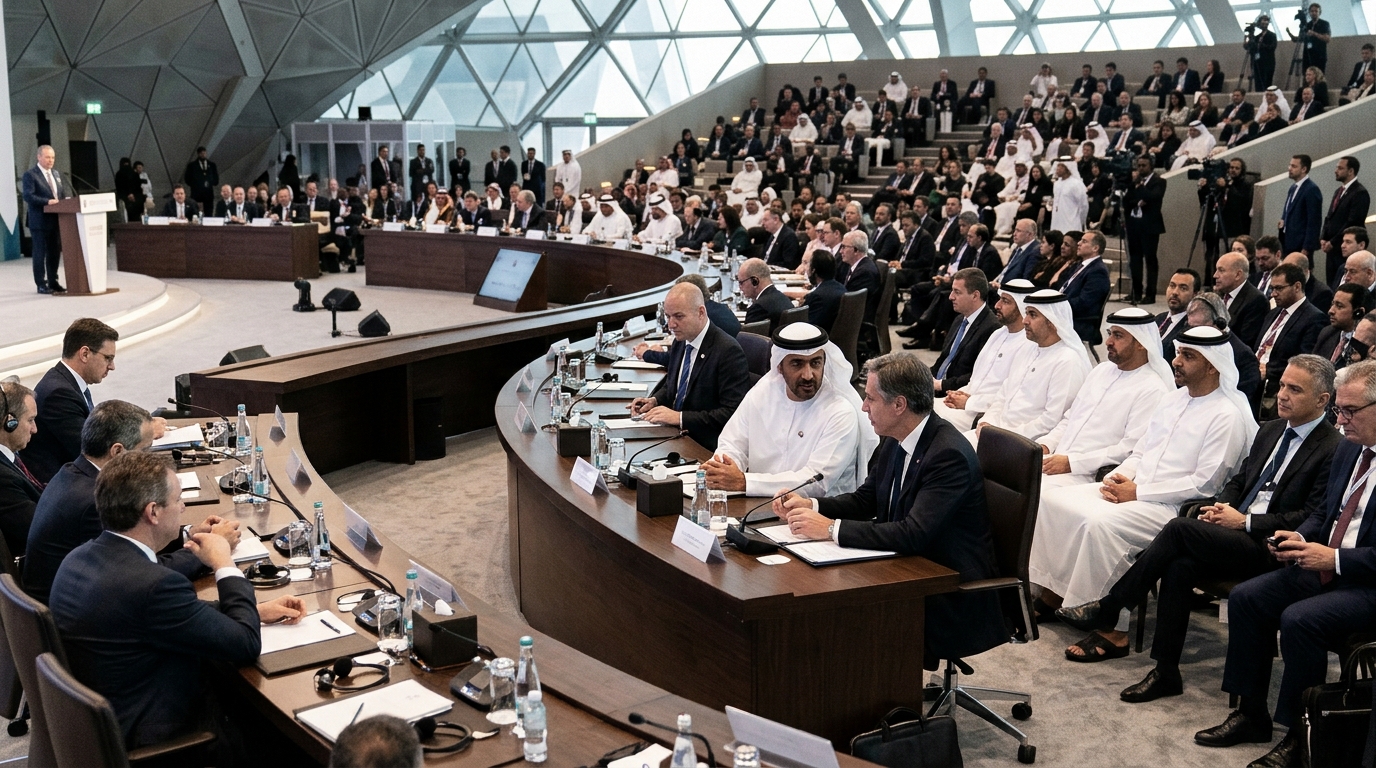
▲ 역대 최대인 670억 달러(약 92조 원) 규모의 계약을 체결한 ADIPEC 2026 아부다비 총회장에서 중동 산유국 장관들과 글로벌 에너지 기업 대표들이 미래 공급망 협력을 논의하고 있다. / 현장 공식 사진
희망봉 20일 우회와 치솟는 보험료… 한국·인도 등 아시아 공급망의 생존 전략
바닷길이 좁아지자 해운 물류 시장은 극심한 병목과 비용 폭탄에 직면했다. 호르무즈 해협을 드나드는 유조선의 전쟁위험 보험료율은 평시 선박 가액의 0.125%에서 단숨에 0.4%로 4배 가까이 폭등했다. 1억 달러짜리 초대형 원유운반선(VLCC) 한 척이 해협을 한번 통과할 때마다 무려 40만 달러가 넘는 웃돈을 보험료로 내야 했다. 결국 선사들은 지중해와 홍해를 피해 아프리카 대륙 남단 희망봉(Cape of Good Hope)을 삥 돌아가는 우회 항로를 선택했다. 항해 거리가 8,000해리나 늘어나고 운항 기간이 15~20일 더 걸리면서, 배 한 척당 벙커유 연료비만 최대 250만 달러가 추가되는 천문학적 물류비가 발생했다.
호르무즈를 지나는 원유의 80%를 소비하는 아시아 국가들은 국가적 총력 대응에 돌입했다. 원유 수요의 85%를 수입하는 인도는 외교적 채널을 총동원해 인도적 통항 우대 조치를 이끌어내고, 자국 해군의 호위 작전(작전 산칼프)을 가동해 가스선을 무사히 탈출시켰다. 또한 지하 암반 동굴에 비축한 533만 톤의 전략석유비축유(SPR)와 정유소 재고를 결합해 총 70일분의 버퍼를 지켜냈다. 한국과 일본 역시 에너지 절약 조치와 비축유 방출 태세를 점검하며 공급망 안보의 중요성을 절감했다. 호르무즈 사태는 값싼 화석연료의 시대가 저물고, '안전한 수송로를 확보한 에너지'만이 글로벌 경쟁력을 보장하는 새로운 자원 안보의 시대가 열렸음을 웅변하고 있다.
월드와이드 중동에너지·자원안보 전문 취재팀발행인 겸 편집인: 신승엽 (Seung Youb Ssin)
▲ A fully laden Very Large Crude Carrier (VLCC) carrying two million barrels transits near the Strait of Hormuz during sunset against arid coastal mountain terrain. / Official Maritime Press Archive
Bypassing the Chokepoint: Middle East Races for $67B Pipelines as Oil Trembles Beyond Hormuz
The Strait of Hormuz—the indispensable maritime gateway through which more than a quarter of the world's seaborne petroleum flows—has plunged the international energy architecture into an unprecedented structural reckoning following severe military closures and transit crises. While crude oil benchmarks that touched $150 per barrel earlier in 2026 have retreated toward the $90 threshold following the US midterm elections, Persian Gulf hydrocarbon powerhouses have absorbed an irreversible strategic lesson: sovereign survival can no longer hinge upon a vulnerable naval chokepoint. Saudi Arabia, the United Arab Emirates, and Oman are aggressively mobilizing to construct massive 10-million-barrel-per-day overland bypass corridors directly linking inland oilfields to the Red Sea and Arabian Sea. Concurrently, the historic ADIPEC 2026 gathering in Abu Dhabi catalyzed $67 billion in landmark commercial agreements combining frontier artificial intelligence with traditional infrastructure resilience. This extensive dispatch investigates the operational realities of supertankers forced onto three-week detours around Africa's Cape of Good Hope, the geopolitical race for overland energy corridors, and the resilient survival playbooks deployed across Asian economies.
When a 20-Million-Barrel Artery Froze: The $150 Oil Shock and the Vulnerability of Hormuz
The Strait of Hormuz represents an irreplaceable maritime juggernaut in the global economy. Under standard operating conditions, approximately 20 million barrels of crude and refined petroleum transit its narrow lanes every day, accounting for 27% of global seaborne crude trade alongside 19% of global liquefied natural gas (LNG). However, when regional hostilities intensified in 2026, this maritime choke point suffered a paralyzing collapse. Quarterly transit volumes plunged 30% from 20.7 million bpd down to 14.6 million bpd, eventually hitting an abyssal low of 3.8 million bpd during the height of the crisis. Trapped without export outlets, Persian Gulf producers were forced into unprecedented shut-ins totaling 10.7 million bpd, idling 3.2 million bpd in Saudi Arabia and 2.7 million bpd in Iraq.
This physical paralysis triggered a violent pricing explosion across international commodity exchanges. Brent crude benchmarks that hovered between $60 and $72 at the start of the year breached $118 in futures markets, with physical spot parcels trading between $132 and $150 per barrel. Downstream refining margins detached from reality, with European diesel crack spreads topping $74.7 and jet fuel spreads crossing $80. Although the Democratic victory in the November US midterms prompted diplomatic optimism that sent Brent plunging 16% to $98.60, market analysts uniformly warn that structural vulnerabilities will persist so long as Persian Gulf energy relies upon a single aquatic gateway.
▲ Heavy pipelaying machinery deploying a 56-inch overland crude bypass conduit across Arabian desert dunes to circumvent maritime choke points. / Official Industrial Archive
1,800-Kilometer Steel Veins Across the Dunes: Saudi, UAE, and Oman Bet on Bypass Routes
Reeling from the naval shutdown, Gulf monarchies mobilized massive sovereign capital to engineer overland pipeline corridors across the Arabian sands. Saudi Aramco accelerated plans to scale its 1,190-kilometer (740-mile) East-West Petroline—connecting eastern oilfields to the Red Sea port of Yanbu—from 7 million bpd to a definitive 10-million-barrel capacity. However, Yanbu's operational tanker berth constraints (limiting sustained loadings to 4-5 million bpd) and persistent maritime threats near the southern Red Sea bottleneck of Bab el-Mandeb revealed that single-axis bypass lines remain vulnerable.
In response, the commercial frontier pivoted toward the Gulf of Oman and the open Arabian Sea. The UAE advanced a dedicated 1.5-million bpd expansion of its ADCOP pipeline to Fujairah, targeting a resilient 3.3-to-4.0 million bpd export corridor by 2027. Concurrently, the landmark Oman Energy Corridor proposal gained multilateral momentum: an 1,800-kilometer twin 56-inch pipeline linking southern Iraq and Kuwait directly to Oman's deepwater ports at Duqm and Ras Markaz. While carrying a $50 billion capital requirement, economic modeling indicates that bypassing both Hormuz and Bab el-Mandeb provides an indispensable insurance buffer against potential regional supply disruptions exceeding $80 billion.
A $67 Billion Torrent in Abu Dhabi: Where Hydrocarbon Power Merges with Industrial AI
Amid geopolitical tension, the pace of commercial transformation in the Gulf reached record velocity. The ADIPEC 2026 conference in Abu Dhabi convened 240,000 delegates and more than 40 government ministers from 170 nations, concluding with an unprecedented $67 billion (92 trillion KRW) in signed commercial and infrastructure agreements. Transactions included UAE investment entity XRG acquiring Shell's equity stake in Australia's North West Shelf LNG facility for $1.5 billion, alongside the financial closing of Ruwais's 5.1-billion AED TA'ZIZ industrial terminal complex.
The defining thematic convergence was the strategic union of traditional hydrocarbons with generative AI and automated robotics. ADNOC forged a high-profile tripartite alliance with OpenAI and G42 to pioneer fully automated operational intelligence across upstream fields and pipeline networks. Autonomous pipeline inspection crawlers from Gecko Robotics and predictive maintenance platforms from Honeywell demonstrated how artificial intelligence is hardening energy arteries. Dr. Sultan Al Jaber, CEO of ADNOC, emphasized that expanding accessible supply, securing resilient export corridors, and deploying operational AI represent the three pillars of 21st-century energy sovereignty.
Comprehensive Comparative Analysis: Middle East Bypass Infrastructure and Global Maritime Logistics Shock
The comparative matrix below details the engineering specifications and strategic trade-offs of the three primary Gulf bypass corridors, contrasting logistical baseline parameters against the physical shockwaves generated by the 2026 maritime blockade.
Domain / Corridor
Saudi Petroline (Red Sea / Yanbu)
UAE ADCOP Expansion (Fujairah)
Oman Energy Corridor (Duqm / Ras Markaz)
Routing & Terminus
Eastern Fields to Yanbu Port on the Red Sea (1,190 km)
Habshan Fields to Fujairah Port on Gulf of Oman (406 km)
Southern Iraq/Kuwait to Duqm on the Arabian Sea (1,800 km)
Target Nameplate Capacity
Expanding baseline 7.0M bpd toward 10.0M bpd
Current 1.8M bpd + 1.5M bpd loop = 3.3M to 4.0M bpd total
Completely bypasses Persian Gulf littoral interception
Direct deepwater access outside the Hormuz strait neck
Simultaneously bypasses both Hormuz and Bab el-Mandeb chokepoints
Operational Limitations
Yanbu loading bottlenecks (4-5M bpd sustained), Red Sea naval risk
Proximity risks near Gulf of Oman entry; limited volume share
Massive $50B capital cost requiring multinational consortium financing
▲ Energy ministers and international energy corporate executives convene at ADIPEC in Abu Dhabi, where $67 billion in infrastructure contracts were executed. / Official Summit Press
The 20-Day Cape Detour and Skyrocketing Premiums: How Asian Economies Safeguarded Crude Supplies
Maritime logistics bore the immediate brunt of the chokepoint crisis as war-risk insurance premiums surged four-fold from 0.125% to 0.4% of hull value, imposing punitive surcharges exceeding $400,000 per voyage on modern VLCCs. To protect high-value cargoes, global tanker operators rerouted traffic around the Cape of Good Hope, extending voyages by 8,000 nautical miles and adding 15 to 20 sailing days. The extended transit absorbed global fleet tonnage, driving spot charter rates past $150,000 per day and saddling each cargo with up to $2.5 million in additional bunker fuel consumption.
Asian economies—which absorb over 80% of Hormuz petroleum flows—mounted intensive national contingency programs. India leveraged bilateral diplomatic agility to secure humanitarian safe-passage windows from regional actors while deploying naval escorts under Operation Sankalp. Supported by 5.33 million metric tons in strategic underground petroleum reserves (SPR) across Visakhapatnam and Mangalore, New Delhi maintained a robust 70-day operational buffer. Similarly, South Korea and Japan deployed strategic stockpiles and initiated temporary industrial conservation measures. The Hormuz disruption has permanently established that securing resilient, sovereign transport corridors is now co-equal with securing physical reserves.
Worldwide Middle East Energy & Resource Security Reporting TeamPublisher & Editor-in-Chief: Seung Youb Ssin
PRO SOURCING ENGINE만인의 탑 빅데이터 솔루션
★ 가입 시 600 크레딧(120회) 전원 무료
내가 찾는 상품 키워드, 지금 얼마나 검색될까?
네이버 월간 검색량 + 구글 볼륨 + 아이템스카우트 실시간 상품수와 경쟁강도 배지를 0.5초 만에 무료로 확인하세요.
MANINTOP NEWSLETTER
📬 만인의 탑 뉴스레터 무료 구독
오늘 보신 정책·시사 뉴스가 유익하셨나요? 매일 엄선되는 알짜 복지 혜택과 국회 실시간 속보를 이메일로 가장 먼저 받아보세요. (평생 무료)
1월이 시작되면 감기는 이미 우리 곁에 와 있습니다. 2월, 3월, 4월까지 이어지는 추위와 건조함은 코와 목을 가장 먼저 공격합니다. 아침에 일어나자마자 막혀 있는 코. 계속 흐르는 콧물. 괜히 칼칼해지는 목. 이 증상은 “시작”일 뿐입니다. 한 번 무너지면 일주일, 길면 한 달까지 끌고 갑니다. 약을 먹으면 잠깐 괜찮아집니다. 하지만 며칠 뒤 또 반복됩니다. 왜일까요? 감기는 ‘치료’의 문제가 아니라 ‘관리’의 문제이기 때문입니다. 대부분은 감기가 오고 나서 약을 찾습니다. 하지만 진짜 중요한 건 감기가 오기 전에 코와 목을 지키는 것입니다. 건조한 실내 공기, 차가운 바깥 공기, 눈에 보이지 않는 세균. 코와 목은 매일 공격받고 있습니다. 지긋지긋하죠! 그런데도 우리는 아무 준비 없이 버티고 있습니다. 이번 겨울도 그렇게 보낼 건가요? 사실 방법은 어렵지 않습니다. 코를 깨끗하게 관리하고, 목을 따뜻하게 보호하고, 점막을 촉촉하게 유지하고, 기관지를 미리 관리하고, 외부 공기를 차단하는 것. 이 다섯 가지만 꾸준히 해도 감기약 없이 겨울을 보내는 것이 충분히 가능합니다. 🔥 이제부터 그 방법을 하나씩 살펴보겠습니다. 🔥 1. 코와 목을 먼저 관리해야 하는 과학적 이유 감기의 대부분은 코 점막에서 시작됩니다. 국제 학술지 Nature Reviews Microbiology 와 Journal of Allergy and Clinical Immunology 에 실린 호흡기 감염 관련 연구들에서는, 감기 바이러스가 비강 상피세포에 먼저 부착해 증식한다는 점을 설명하고 ...
리모델링사업이 진행 중인 아파트를 매매할 때 “계약금 10%를 언제까지 내야 하느냐”는 질문이 특히 많이 나옵니다. 이주공고(이주 안내)가 7~11월쯤이라고 들으면, 그 시점에 맞춰 계약금도 움직일 것 같아서 더 헷갈리기 쉽습니다. 하지만 실제 납부기한은 ‘이주공고가 언제냐’만으로 자동 결정되지 않는 경우가 많습니다. 1) 계약금 10% 납부기한: 결국 ‘문서에 적힌 일정’이 기준 계약금 10%를 언제까지 납부해야 하는지는, 내가 서명하는 매매계약서(특약 포함) 와 사업주체/조합이 제시한 공고·안내문 에 적힌 납부 일정이 기준이 됩니다. 실제 공고문에서는 분양대금 납부의 큰 틀(계약금→중도금→잔금)을 먼저 안내하고, 상세 일정은 별도 표나 유의사항으로 제시하는 방식이 흔합니다. 또, 계약서 문구에 따라 지급 시점이 조건부로 설정될 수도 있습니다. 예를 들어 한 사례 소개 자료에서는 용역계약서에 잔금(10%) 지급시기가 “사업승인 후”로 기재되어 있었다는 점이 언급됩니다. 이런 식으로 ‘사업 단계’와 지급을 연동하는 문구가 들어가면, 질문의 답은 계약서 문구를 확인해야만 확정됩니다. 관련 내용은 링크 에서 문구 사례를 확인할 수 있습니다. 2) 입주자모집공고에서 확인되는 ‘납부 순서’와 잔금 마감 시점 공고문에 적힌 문구를 보면, 납부 순서와 잔금 마감에 대한 기준이 비교적 명확하게 제시되는 경우가 있습니다. 예를 들어 한 입주자모집공고에는 “분양금액(주택가격)은 계약금, 중도금, 잔금의 순서로 납부”하며 “잔금은 입주(열쇠 수령일) 전에 완납”해야 한다고 안내되어 있습니다. (문구 확인: 링크 ) 이 문구가 의미하는 바는 최소 2가지입니다. 분양/공급 형태의 문서에서는 ‘계약금→중도금→잔금’ 흐름이 공식적으로 안내될 수 있습니다. 잔금은 “입주(열쇠 수령)” 이전에 완납해야 한다는 마감 기준이 문서에 적혀 있을 수 있습니다. 다만, 위 공고문 문구는 잔금 마감에 대한 기준을 보여주지만, 계약금 10%의...
윤석열 전 대통령 탄핵 인용 소식을 접하면, 가장 궁금한 지점은 ‘헌재가 정확히 무엇을 위헌·위법으로 봤는가’입니다. 또한 탄핵과 별개로 진행되는 형사재판(내란 우두머리 혐의 등)이 어디까지 왔는지도 함께 정리할 필요가 있습니다. 아래 내용은 제공된 기사/게시물 스니펫과 링크에서 확인되는 범위만 모아, 일반인이 흐름을 이해하기 쉽게 정리한 것입니다. 1) 탄핵 인용 관련: 스니펫에서 확인되는 ‘판단의 골격’ 제공된 근거 중 조국혁신당 사이트에는 헌법재판소가 윤석열 탄핵 심판에서 “피청구인의 위헌·위법행위는 국민 신임 …”이라는 취지로 판단했다는 문장이 인용돼 있습니다( 링크 ). 이 인용문만 놓고 보면, ‘위헌·위법행위’가 있었는지와 그로 인해 ‘국민의 신임’이 어떻게 평가됐는지가 핵심 축으로 소개됩니다. 다만 질문에서 요청하신 세부 항목, 즉 비상계엄 선포 자체를 문제 삼은 구체적 이유, 계엄 이후 조치(포고령, 국회 통제 등)의 어떤 지점이 헌법 위반인지, 국회의 권한행사 방해 및 정치활동 제약을 어떤 논리로 판단했는지 등은, 이번에 제공된 근거의 제목/스니펫만으로는 조항·사실관계·판단 구조가 그대로 제시돼 있지 않습니다. 따라서 이 글에서는 ‘헌재가 무엇을 문제 삼았다’는 세부 리스트를 단정적으로 재구성하기보다, 현재 확인 가능한 문구 수준의 요약(위헌·위법행위 → 국민 신임의 문제로 평가)까지만 적습니다. 만약 헌재 결정문 전문(주문 및 이유)이 추가로 확인되면, 그때는 문장 단위로 ‘어떤 행위’와 ‘어떤 헌법 원리/조항’이 연결되는지(예: 권력분립, 국회의 권한, 정치적 기본권 등) 구조화해 정리하는 것이 가장 정확합니다. 2) 형사 절차(내란 혐의) 관련: 체포영장과 1심 선고 언급 탄핵 심판과 별도로, 12·3 비상계엄 사태로 내란 혐의를 받는 윤석열 대통령에 대해 2024년 12월 31일 체포 영장이 발부됐다는 BBC 보도가 있습니다( 링크 ). 해당 보도는 ‘현직 대통령’에 대한 체포영장 발부라는 점을 함께 언급합니다. 또...