[심층기획] '트럼프 2기 관세 충격과 적대적 두 국가론' 글로벌 경제안보 격변… 반도체·배터리 공급망과 한반도 평화공존 전략
만인의 탑 편집국11월 15, 2026
[심층기획] '트럼프 2기 관세 충격과 적대적 두 국가론' 글로벌 경제안보 격변… 반도체·배터리 공급망과 한반도 평화공존 전략
월드와이드·통상외교 심층취재팀 | 글로벌 경제안보 및 대외 전략 심층 분석2026. 11. 15 08:30 KST
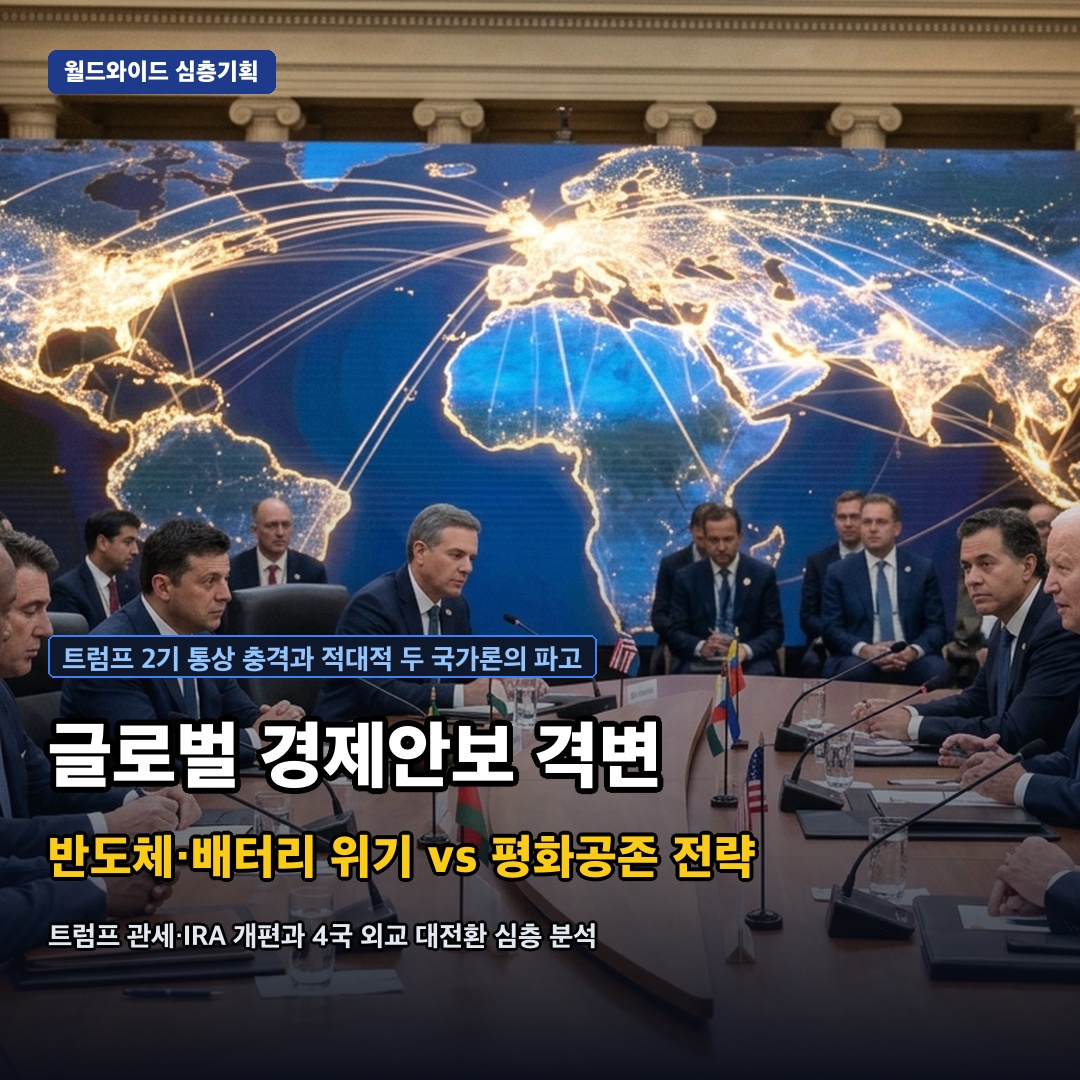
▲ 워싱턴 D.C.에서 열린 고위급 다자 경제안보 회담에서 주요국 통상·외교 장관들이 글로벌 무역로와 첨단 기술 공급망 재편을 둘러싸고 치열한 협상을 벌이고 있다. [사진: AP·로이터 프레스 풀]
2026년 글로벌 국제 정세와 한반도를 둘러싼 대외 환경이 전례 없는 거대한 복합 위기의 소용돌이 속으로 진입하고 있습니다. 미국 제47대 대통령 선거에서 도널드 트럼프 후보가 선거인단 312석을 획득하며 백악관에 재입성함에 따라, '미국 우선주의 2.0'에 기반한 가혹한 보편 관세와 첨단 산업 통상 압박이 세계 경제의 근간을 뒤흔들고 있습니다. 조세감면법(OBBBA)을 통한 인플레이션 감축법(IRA)의 전기차 세액공제 조기 폐지와 반도체 지원법(CHIPS Act)의 전면 재검토는 수십조 원의 대미 투자를 단행한 한국 반도체와 배터리 제조업에 전방위적 충격을 가하고 있습니다. 설상가상으로 북한은 남북관계를 '동족 관계'가 아닌 '적대적인 두 국가 관계, 교전국 관계'로 공식 규정하고 헌법을 개정해 조국평화통일위원회 등 대남 기구를 전면 폐지하며 80년간 이어져 온 평화통일 담론의 틀을 일거에 허물어뜨렸습니다. 통상 안보와 군사 안보가 결합된 글로벌 복합 위기 속에서 한국 외교와 첨단 산업 생태계가 맞닥뜨린 구조적 실태를 심층 취재했습니다.
1. 트럼프 2기 집권과 미국 우선주의 경제안보 질서의 전면 재편
트럼프 전 대통령의 재집권은 2024년 11월 대선에서 흑인 남성(12.4%p 상승)과 청년 유색인종(10.6%p 상승), 히스패닉(7.6%p 상승) 유권자들의 전폭적인 지지를 이끌어내며 230만 표 차이로 대승을 거둔 결과였습니다. 공화당은 상원 53석을 장악하며 확실한 다수당 지위를 확보했으나, 하원에서는 220석 대 215석으로 100년 만에 가장 얇은 격차의 박빙 우위를 점하는 '신(新) 분점의회' 지형을 형성했습니다. 이에 따라 트럼프 2기 행정부는 의회 입법보다는 행정명령과 관세 행정 권한을 최대한 동원하여 속도전 방식의 통상 정책을 밀어붙이고 있습니다.
트럼프 2기 백악관과 내각은 1기 시절의 온건파 관료들을 배제하고 강력한 충성파 실세들로 채워졌습니다. 재무부 장관으로 지명된 스콧 베센트는 2028년까지 재정적자를 국내총생산(GDP) 대비 3%로 축소하고 3% 경제성장률을 달성하며 일일 원유 생산량을 300만 배럴 증산하겠다는 '3-3-3 정책'을 내걸었습니다. 상무부 장관 하워드 러트닉은 모든 수입품에 10~20%의 보편적 기본 관세를 부과하고 대중국 수입품에는 최대 60% 이상의 고율 징벌 관세를 매기는 극단적 보호무역주의를 주도하고 있습니다. 여기에 국가안보보좌관 마이크 왈츠의 대중국 매파 전략과 국경 통제를 총괄하는 톰 호먼의 불법 이민자 대량 추방 정책이 맞물려 글로벌 공급망의 불확실성을 최고조로 끌어올리고 있습니다.
트럼프 행정부 통상 전략의 핵심 타깃은 대미 무역흑자 상위국들입니다. 한국은 대미 무역수지 흑자가 2024년 기준 500억 달러를 돌파하며 8대 무역적자 유발국 명단에 이름을 올렸습니다. 트럼프 2기 정부는 한미 자유무역협정(FTA) 개정 압박과 환율 관찰 대상국 지정을 무기로 한국산 자동차, 철강, 배터리 등에 대한 징벌적 품목별 관세 부과를 현실화하고 있습니다. 이는 단순한 무역 불균형 해소를 넘어 미국의 제조업 일자리를 강제 복원하고 동맹국의 첨단 공급망을 미국 본토에 묶어두려는 전략적 강압책으로 풀이됩니다.
산업 분야
트럼프 2기 주요 법안 및 통상 정책
대미 투자 및 대중 의존 리스크
한국 제조업 전략적 대응 과제
반도체 산업
반도체법 직접 보조금 집행 및 투자세액공제 35%로 상향
대중 수출 비중 58.9%, 시안·우시 팹 등 중국 거점 리스크
테일러 팹 연계 수율 확보 및 첨단 패키징 초격차 사수
이차전지·전기차
OBBBA 통과로 IRA 7,500달러 세액공제 2025년 9월 조기 폐지
북미 증설 기가팩토리 가동률 저하 및 전기차 캐즘 장기화
ESS용 배터리 전환 가속화 및 LFP 포트폴리오 다각화
핵심 광물 공급망
해외우려기관(FEOC) 전면 배제 및 중국산 징벌 관세
전구체 88.4%, 흑연 100%, 리튬 70% 대중국 의존
호주·남미·동남아 공급망 직구매 및 정련 내재화
대미 통상 협상
보편 관세 10~20% 및 대미 무역흑자국 품목별 관세 위협
2024년 대미 무역흑자 500억 달러 돌파에 따른 표적화
미국산 LNG·원유 수입 확대 및 한미 공급망 파트너십 레버리지
2. 반도체·배터리 공급망 충격과 한국 첨단제조업의 3대 리스크
이러한 통상 충격의 파편은 한국 첨단 제조업의 핵심 기둥인 이차전지와 전기차 산업에 직접 떨어졌습니다. 트럼프 행정부가 밀어붙인 조세감면법(OBBBA)은 당초 2032년까지 유지될 예정이었던 인플레이션 감축법(IRA)의 대당 최대 7,500달러 전기차 구매 세액공제를 2025년 9월 30일부로 조기 종료시켰습니다. 청정 전력 발전 및 수소 관련 세액공제(45Y, 48E)마저 단계적으로 폐지되면서 북미 현지에 대규모 배터리 기가팩토리를 증설해 온 LG에너지솔루션, SK온, 삼성SDI 등 K-배터리 3사는 막대한 보조금 중단과 공장 가동률 저하라는 '전기차 캐즘(대중화 전 일시적 수요 둔화)'의 벼랑 끝으로 내몰렸습니다.
더욱 심각한 문제는 배터리 원자재의 중국 공급망 종속입니다. 한국무역협회 통계에 따르면 K-배터리는 양극재 핵심 원료인 전구체의 대중 수입 의존도가 88.4%에 달하며, 음극재는 71~78%, 전해액 74%, 분리막 66%를 중국산에 기대고 있습니다. 특히 음극재에 쓰이는 천연 흑연은 사실상 100%를 중국에서 들여오고 있으며, 수산화리튬(70%), 황산망간(90%), 황산코발트(64%) 등 핵심 가공 광물 역시 중국이 독점하고 있습니다. 트럼프 정부가 해외우려기관(FEOC) 규정을 엄격히 적용해 중국산 광물이 포함된 배터리를 전면 퇴출하기로 함에 따라 한국 배터리 기업들은 천문학적인 원자재 다변화 비용을 치러야 할 처지입니다.
반도체 산업 역시 양날의 칼 위에 서 있습니다. 미국 반도체 지원법(CHIPS Act)은 전체 527억 달러의 보조금 예산 중 85.4%의 직접 보조금 집행이 확정되었으며, 투자세액공제(ITC) 비율을 기존 25%에서 35%로 10%포인트 상향 조정했습니다. 이에 따라 삼성전자는 텍사스 테일러 파운드리 팹에 64억 달러의 연방 보조금과 10억 달러 이상의 지방 세제 혜택을 확보했고, SK하이닉스는 인디애나 첨단 패키징 팹에 4억 5,000만 달러의 보조금을 따냈습니다. 그러나 막대한 인센티브의 대가는 가혹합니다. 한국 반도체 수출의 58.9%가 여전히 대중국 수출에 편중되어 있고, 삼성전자 시안 낸드 플래시 팹과 SK하이닉스 우시 D램 팹 등 국내 기업의 핵심 생산 거점이 중국에 위치해 있어 미·중 기술 패권 전쟁의 최전선에서 고래 싸움에 등 터지는 위험을 고스란히 떠안고 있습니다.
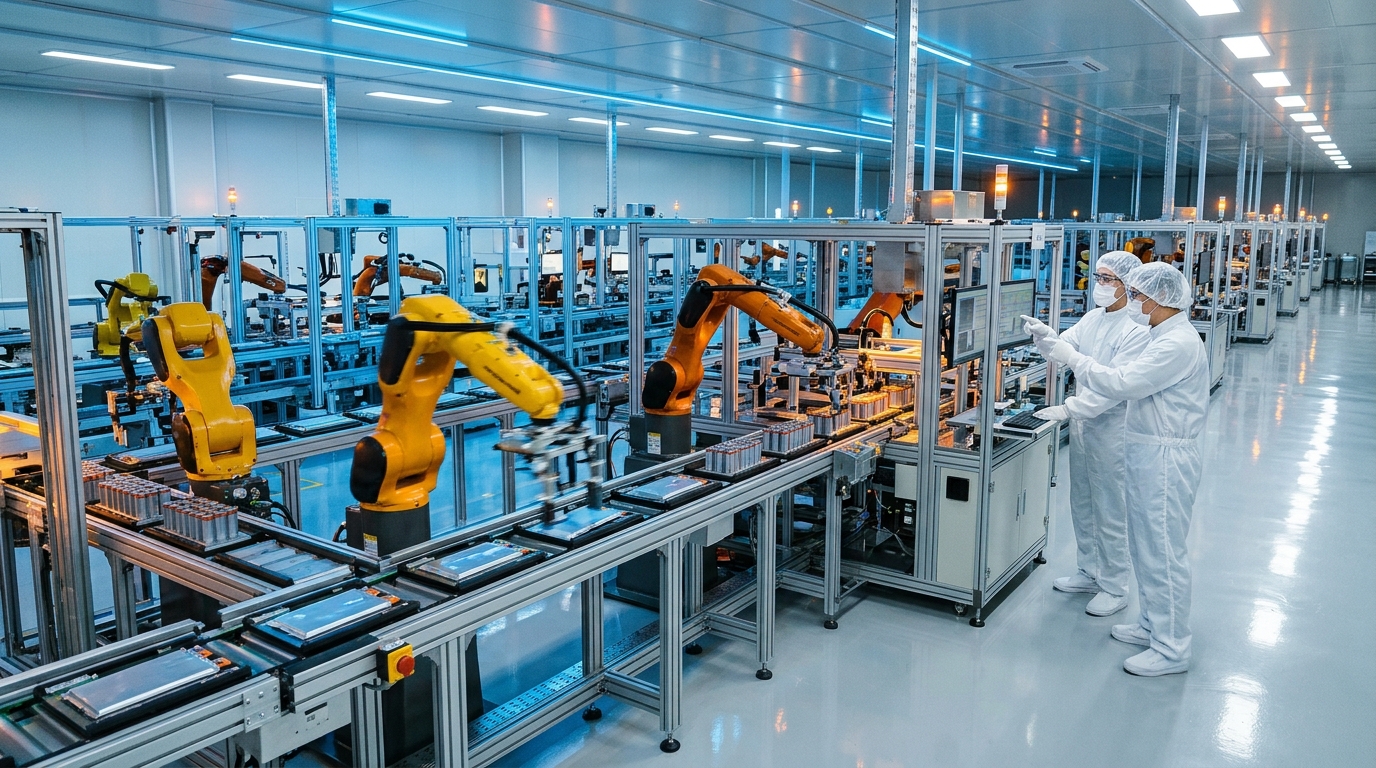
▲ 첨단 전기차 배터리 기가팩토리 클린룸에서 방진복을 착용한 엔지니어들이 로봇 자동화 셀 조립 라인을 정밀 점검하고 있다. 미국의 IRA 보조금 조기 폐지와 광물 FEOC 규제 강화는 K-배터리에 혹독한 구조조정을 요구하고 있다. [사진: 블룸버그 프레스 풀]
3. 북한의 '적대적 두 국가론' 선언과 남북관계의 구조적 단절
통상 전선의 격랑 속에서 한반도 안보 지형 역시 1953년 휴전 이후 가장 중대한 단절의 시대를 맞이했습니다. 북한 김정은 국무위원장은 2023년 12월 노동당 전원회의와 2024년 1월 최고인민회의를 통해 대한민국을 더 이상 '화해와 통일의 상대'가 아닌 '제1의 적대국이자 불변의 주적'으로 공식 천명했습니다. 북한은 '적대적인 두 국가 관계, 교전국 관계'를 새로운 국가 노선으로 채택하고, 남북 대화와 교류를 전담하던 조국평화통일위원회와 민족경제협력국을 전격 폐지했습니다. 나아가 평양의 조국통일3대헌장기념탑을 철거하고 경의선·동해선 남북 연결 도로와 철길을 물리적으로 완전히 폭파 단절했습니다.
북한은 2024년 10월 최고인민회의를 거쳐 사회주의 헌법을 개정함으로써 대한민국을 영토 조항에 명시적 교전 상대로 반영했습니다. 특히 평양 무인기 침투 사건을 계기로 전시 전환 태세를 최고조로 격상시키고, 한국을 향해 '주권 침해 재발 시 물리적 타격'을 공언하며 체제 결속의 구실로 삼고 있습니다. 이는 과거 남북 간에 체결된 1991년 남북기본합의서(통일을 지향하는 잠정적 특수관계)를 북한 스스로 전면 백지화한 것이며, 핵무력 완성을 바탕으로 대남 흡수통일 담론을 거부하고 두 개의 독립된 적대 국가로서의 공존 혹은 무력 병합을 도모하겠다는 위험천만한 전략적 선언입니다.
4. 평화공존 패러다임 전환과 인도주의 대북 지원의 딜레마
북한의 적대적 두 국가론에 맞서 한국 정부 역시 통일 정책의 패러다임 전환을 불가피하게 마주하고 있습니다. 2026년 통일백서가 공식 표방하듯, 당장의 통일 추진보다는 우발적 군사 충돌을 방지하고 한반도의 정세를 안정적으로 관리하는 '평화적 공존과 상생'이 최우선 국가 전략으로 부상했습니다. 적대감이 극에 달한 상황에서 흡수통일 담론을 고수하는 것은 오히려 안보 위기를 가중시킬 뿐이라는 현실주의적 인식이 확산된 결과입니다.
그러나 평화공존을 위한 최소한의 인도주의적 협력마저 냉혹한 벽에 부딪히고 있습니다. 대표적 사례가 통일부가 추진해 온 '평양 강동군 병원 건립 및 의료장비 지원 사업'입니다. 정부는 100억 원 규모의 남북협력기금을 투입해 166종 1,400여 점의 필수 의료기기를 북한 취약계층에 지원하기로 하고, 2026년 5월 유엔 대북제재위원회(1718 위원회)로부터 제재 면제 승인까지 어렵게 받아냈습니다. 하지만 북한이 일체의 인도적 지원 제의를 '불순한 체제 침투 책동'이라며 전면 거부하고 있어 장비 반출이 전면 중단된 상태입니다. 더욱이 미국의 전략물자 반출 통제와 해외금융자산통제국(OFAC)의 세컨더리 보이콧 위험까지 얽혀 있어 인도주의 지원조차 외교적 딜레마에 갇혀 있습니다.
국가
통일 공공외교 호응도
핵심 장애 요인 및 우려 사항
전략적 우선순위 자산
미국 (US)
부정적 59% (비판적 시각 우세)
북한 핵·미사일 위협 및 동맹 억제선 이완 우려
한국 정부 공식 통일 방안 및 CVID 공조
중국 (China)
긍정적 63% (원칙적 지지 표명)
한국 정부 정책의 일관성 결여(73%) 및 완충지대 상실
남북 경제협력 및 동북아 다자평화 체제
일본 (Japan)
부정적 65% (주변국 중 최저)
북한 군사 도발 지속 및 통일 한국의 지정학적 마찰
민간 교류 및 비핵화 선결 인도적 해법
러시아 (Russia)
긍정적 60% (실리적 접근)
남북 상호 불신 및 북·러 포괄적 전략동반자 조약 충돌
남·북·러 삼각 물류(철도·가스) 및 경협 복원
5. 한반도 통일 공공외교의 한계와 미·중·일·러 4국 외교 대전환
남북관계의 구조적 단절은 한반도 통일을 위한 한국의 공공외교 전략에도 근본적인 수정을 요구하고 있습니다. 통일연구원이 미국, 중국, 일본, 러시아 등 주변 4개국 외교·안보 전문가 70명을 대상으로 실시한 심층 설문조사 결과, 한국 정부의 통일 공공외교에 대한 호응도는 국가별로 극명하게 엇갈렸습니다. 중국(63% 긍정)과 러시아(60% 긍정)는 비교적 우호적인 반응을 보인 반면, 전통 우방인 미국은 59%, 일본은 65%가 한국의 통일 공공외교에 대해 부정적인 평가를 내렸습니다.
통일 공공외교의 최대 장애 요인에 대해서도 4대국의 시각은 첨예하게 갈렸습니다. 미국과 일본은 '북한의 핵·미사일 위협과 지속적인 군사 도발'을 1순위 장애물로 지목하며 한국의 대화 제의가 안보 전선을 이완시킬 수 있다고 우려했습니다. 반면 중국과 러시아는 '한국 정부의 일관성 없는 대북 정책(중국 73% 응답)'과 '남북 간 상호 신뢰 결여'를 가장 큰 걸림돌로 꼽았습니다. 아울러 공공외교에서 가장 유용한 자산으로 미국은 '한국 정부의 공식 통일 방안'을 선택한 반면, 중국·일본·러시아는 남북 경제협력과 민간 교류의 실천적 성과를 압도적인 1순위 자산으로 지목했습니다.
2026년 대한민국이 직면한 현실은 냉혹합니다. 트럼프 2기의 자국 우선주의 무역 공세에 맞서 반도체와 배터리 등 첨단 제조업의 기술 초격차를 유지하고 공급망을 다변화하는 '경제안보 자주화'가 시급합니다. 동시에 북한의 적대적 두 국가론과 미·중 전략경쟁의 틈바구니에서 감정적 통일론을 넘어 '평화적 관리와 단계적 공존'이라는 현실주의 외교 안보 노선을 정립해야 합니다. 통상 파고를 넘어서는 정밀한 대미 경제 통상 외교와 한반도 긴장을 제어하는 4강 복합 외교가 맞물릴 때만이 대한민국은 복합 안보 격변기의 생존과 번영을 담보할 수 있을 것입니다.
[In-Depth Analysis] Trump 2.0 Tariff Shock and the Hostile Two-State Doctrine: Global Economic Security Realignments, Semiconductor-Battery Supply Chains, and Peaceful Coexistence
▲ Trade ministers and senior diplomats negotiate global trade corridors and strategic tech supply chain realignments during a multilateral summit in Washington, D.C. [Photo: AP/Reuters Press Pool]
In 2026, the global geopolitical landscape and the strategic environment surrounding the Korean Peninsula are plunging into an unprecedented polycrisis. With Donald Trump securing 312 electoral votes to reclaim the White House as the 47th President of the United States, an aggressive America-First 2.0 agenda anchored in universal baseline tariffs and industrial nationalism is shaking global trade. The Omnibus Budget and Border Act (OBBBA), which unilaterally terminates the Inflation Reduction Act's (IRA) electric vehicle tax credits ahead of schedule and initiates a structural audit of the CHIPS and Science Act, has dealt a severe blow to South Korean semiconductor and battery conglomerates that deployed tens of billions of dollars in North American manufacturing assets. Compounding these trade shocks, North Korea formally redesignated inter-Korean ties not as a transitional relationship seeking reunification, but as a permanent state between two hostile and belligerent foreign nations. By amending its socialist constitution and abolishing institutions like the Committee for the Peaceful Reunification of the Country, Pyongyang dismantled an eight-decade framework of national reconciliation. This investigative report examines the structural realities confronting South Korea's high-tech manufacturing base and foreign policy architecture amid converging trade weaponization and military confrontation.
1. The Advent of Trump 2.0 and the Sweeping Overhaul of America-First Economic Security
Trump's presidential triumph in November 2024 was powered by significant demographic shifts, marked by surging support among Black male voters (+12.4 percentage points), young minority cohorts aged 18 to 44 (+10.6 percentage points), and Hispanic voters (+7.6 percentage points), yielding a popular vote margin exceeding 2.3 million. While Republicans secured a decisive 53-seat majority in the Senate, their control of the House of Representatives remains exceptionally precarious at 220 seats to 215—the narrowest legislative majority in a century. Operating within this fragmented legislative landscape, the Trump 2.0 administration is aggressively utilizing executive orders, unilateral trade authorities, and administrative tariff mechanisms to accelerate protectionist mandates without relying on comprehensive congressional legislation.
The executive leadership of the second Trump administration has been thoroughly consolidated with ideologically aligned loyalists, systematically displacing moderate establishment figures. Treasury Secretary Scott Bessent has instituted the signature 3-3-3 fiscal mandate, pledging to compress the federal budget deficit to 3 percent of gross domestic product by 2028, generate 3 percent annual economic growth, and increase domestic petroleum output by 3 million barrels per day. Commerce Secretary Howard Lutnick oversees an aggressive tariff regime proposing a universal baseline levy of 10 to 20 percent on all global imports alongside punitive duties exceeding 60 percent on Chinese goods. Synchronized with National Security Advisor Mike Waltz's hawkish stance on strategic decoupling and Border Czar Tom Homan's expansive deportation program, the global supply chain landscape is experiencing historic friction.
At the operational center of this protectionist offensive are sovereign trading partners generating persistent trade surpluses with the United States. Having crossed the 50 billion dollar bilateral merchandise surplus milestone in 2024, South Korea was formally targeted among the top eight deficit-inducing economies. The Trump administration is leveraging free trade agreement renegotiations and currency monitoring lists to impose selective punitive duties across South Korean automotive exports, steel shipments, and energy storage systems. This calculated economic coercion extends beyond balance-of-payments balancing, deliberately designed to force high-tech manufacturing capacity and critical sovereign supply chains into continental American industrial hubs.
Industry Sector
Trump 2.0 Policies & Legislation
US Investment & China Dependence Risk
Strategic Countermeasures for Korea
Semiconductors
CHIPS direct grants and 35% Investment Tax Credit
China export share 58.9%; Xi'an and Wuxi fab risks
Secure Taylor yields and maintain packaging leadership
EV Batteries
OBBBA terminates IRA $7,500 tax credit by Sept 2025
Cratering North American gigafactory utilization
Pivot to ESS batteries and diversify LFP portfolios
Critical Minerals
Strict FEOC exclusion and punitive China tariffs
Precursors 88.4%, graphite 100%, lithium 70% China dependent
Direct offtakes in Australia/Americas; onshore refining
Trade Negotiations
10-20% universal tariffs and surplus-targeted duties
Targeted over $50 billion bilateral surplus in 2024
Expand US energy imports; leverage supply chain assets
2. Semiconductor and Battery Supply Chain Shocks: Three Major Risks for Korean High-Tech
The fallout from this trade realignment directly impacts South Korea's secondary battery and advanced automotive sectors. Under the OBBBA, the federal clean vehicle consumer tax credit of up to 7,500 dollars authorized under IRA Section 30D—originally scheduled to persist through 2032—was abruptly terminated effective September 30, 2025. Coupled with the phased elimination of production and investment tax credits for clean power and hydrogen (Sections 45Y and 48E), South Korea's leading battery producers, including LG Energy Solution, SK On, and Samsung SDI, face severe fiscal headwinds. Having committed immense capital outlays to construct gigafactories across North America, these manufacturers now confront cancelled subsidy streams, cratering utilization rates, and an intensifying electric vehicle market chasm.
Compounding this market contraction is the structural bottleneck of upstream critical mineral reliance on China. Data compiled by the Korea International Trade Association indicates that domestic cathode manufacturing relies on Chinese precursors for 88.4 percent of aggregate volume, while anode material reliance ranges between 71 and 78 percent, electrolyte supplies stand at 74 percent, and separator membranes reach 66 percent. Natural graphite utilized in battery anodes exhibits near 100 percent dependence on Chinese processing, accompanied by overwhelming import ratios for refined battery minerals such as lithium hydroxide (70 percent), manganese sulfate (90 percent), and cobalt sulfate (64 percent). As Washington enforces stringent Foreign Entity of Concern (FEOC) disqualifications that bar Chinese-sourced minerals, South Korean producers face staggering supply chain reorganization expenditures.
The semiconductor sector navigates an equally precarious strategic landscape. While the federal CHIPS and Science Act committed 85.4 percent of its 52.7 billion dollar direct subsidy allocation and elevated the Advanced Manufacturing Investment Tax Credit from 25 percent to 35 percent, the regulatory trade-offs remain daunting. Samsung Electronics secured 6.4 billion dollars in direct federal grants alongside more than 1 billion dollars in municipal tax abatements for its Taylor, Texas foundry, while SK Hynix obtained 450 million dollars in federal support for its advanced packaging facility in Indiana. However, with South Korea directing 58.9 percent of its chip exports to mainland China and operating major fabrication facilities in Xi'an and Wuxi, domestic tech giants remain caught in the crosshairs of retaliatory export controls, ASML lithography restrictions, and critical mineral licensing disputes.
▲ Cleanroom engineers supervise automated robotic cell manufacturing in an advanced electric vehicle battery gigafactory. The early termination of IRA incentives and stringent mineral FEOC rules impose severe restructuring challenges on Korean battery makers. [Photo: Bloomberg Press Pool]
3. North Korea's 'Hostile Two-State Doctrine' and the Structural Severance of Inter-Korean Relations
Simultaneously, the geopolitical architecture governing the Korean Peninsula has suffered its most severe rupture since the 1953 armistice. During the Workers' Party of Korea Central Committee Plenum in December 2023 and the subsequent Supreme People's Assembly in January 2024, Kim Jong Un formally defined South Korea not as a compatriot entity for national reconciliation, but as the primary foreign adversary and immutable principal enemy. Formally codifying the hostile two-state doctrine, Pyongyang dissolved long-standing inter-Korean dialogue mechanisms, including the Committee for the Peaceful Reunification of the Country and the National Economic Cooperation Bureau. The regime systematically demolished the Monument to the Three Charters for National Reunification and physically detonated road and rail links along the Gyeongui and Donghae transit corridors.
Pyongyang reinforced this doctrinal break during the October 2024 Supreme People's Assembly by amending its socialist constitution to designate South Korea as a hostile belligerent state within its territorial articles. Utilizing alleged drone incursions over Pyongyang to mobilize domestic military readiness, the regime threatened immediate kinetic retaliation against future sovereign border infringements. This structural shift effectively abrogates the foundational 1991 Inter-Korean Basic Agreement, which established relations as a temporary special relationship moving toward reunification. Backed by an operational nuclear arsenal, North Korea has abandoned conventional reunification rhetoric, pursuing an adversarial posture rooted in permanent separation and deterrence.
4. Paradigm Shift Toward Peaceful Coexistence and the Dilemma of Humanitarian Aid
Confronting Pyongyang's hostile two-state doctrine, Seoul has undertaken a structural reorientation of its reunification doctrine. As reflected in the 2026 Unification White Paper, the immediate strategic focus has shifted from expedited political integration toward crisis stabilization, accidental escalation prevention, and sustainable peaceful coexistence. Security analysts recognize that rigid adherence to absorption-style unification frameworks amid unprecedented diplomatic hostility exacerbates military instability rather than mitigating strategic risk.
Nevertheless, even fundamental humanitarian cooperation faces insurmountable diplomatic deadlocks. A prime example is the Ministry of Unification's flagship medical infrastructure initiative for the Gangdong County Hospital in Pyongyang. Allocating 10.00 billion won through the Inter-Korean Cooperation Fund to supply 1,400 units across 166 categories of essential medical apparatus, Seoul successfully navigated the United Nations Sanctions Committee (1718 Committee) to obtain formal sanctions exemptions in May 2026. However, North Korea categorically rejected the deliveries, characterizing all humanitarian overtures as subversive systemic interference. Furthermore, stringent US strategic export controls and potential secondary boycott liabilities enforced by the Treasury's Office of Foreign Assets Control leave humanitarian channels completely paralyzed.
Country
Unification Diplomacy Stance
Primary Obstacles & Concerns
Strategic Priority Assets
United States
59% Negative (Critical skepticism)
North Korean nuclear threat; deterrence dilution
Official unification policies and CVID alignment
China
63% Positive (Principle-based support)
Policy inconsistency in Seoul (73%); buffer erosion
Cross-border economic projects and regional accords
Japan
65% Negative (Lowest among regional powers)
Persistent military provocations; geopolitical friction
Private exchanges and denuclearization prerequisites
Russia
60% Positive (Pragmatic economic focus)
Inter-Korean mutual distrust; treaty conflicts
Tripartite rail/gas connectivity and joint initiatives
5. Limits of Unification Public Diplomacy and Strategic Realignment Across the Four Major Powers
The structural severance of inter-Korean engagement necessitates an exhaustive reassessment of South Korea's unification public diplomacy. An empirical survey conducted by the Korea Institute for National Unification across 70 prominent diplomatic and security scholars in the United States, China, Japan, and Russia revealed stark divergence in regional support for Seoul's public diplomacy initiatives. While positive evaluations reached 63 percent among Chinese respondents and 60 percent among Russian experts, key allied counterparts expressed deep skepticism, with 59 percent of US scholars and 65 percent of Japanese analysts rendering unfavorable assessments.
Perceptions regarding the primary obstacles to peaceful unification diplomacy reflect fundamental strategic divides. Scholars in Washington and Tokyo identified North Korea's advanced nuclear-missile capabilities and offensive military posturing as the predominant impediment, cautioning that premature dialogue could weaken deterrence cohesion. Conversely, experts in Beijing and Moscow attributed operational failure to chronic inconsistencies in South Korea's presidential administrations (cited by 73 percent of Chinese scholars) and systemic mutual distrust. Regarding high-value diplomatic assets, American analysts prioritized formal inter-Korean policy declarations, whereas scholars across China, Japan, and Russia overwhelmingly designated economic integration and private sector civil exchanges as paramount.
South Korea confronts an unforgiving dual-front geopolitical challenge in 2026. Navigating the protectionist crosswinds of Trump 2.0 requires robust economic statecraft, technical super-gaps in semiconductors and battery manufacturing, and aggressive supply chain diversification to safeguard industrial autonomy. Concurrently, managing North Korea's hostile state paradigm and intensifying great power rivalries demands a pragmatic foreign policy prioritized on risk mitigation and stable coexistence over abstract political reunification. Only through synchronized trade diplomacy in Washington and strategic multilateral equilibrium across regional powers can South Korea ensure sovereign resilience and sustainable economic security.
1월이 시작되면 감기는 이미 우리 곁에 와 있습니다. 2월, 3월, 4월까지 이어지는 추위와 건조함은 코와 목을 가장 먼저 공격합니다. 아침에 일어나자마자 막혀 있는 코. 계속 흐르는 콧물. 괜히 칼칼해지는 목. 이 증상은 “시작”일 뿐입니다. 한 번 무너지면 일주일, 길면 한 달까지 끌고 갑니다. 약을 먹으면 잠깐 괜찮아집니다. 하지만 며칠 뒤 또 반복됩니다. 왜일까요? 감기는 ‘치료’의 문제가 아니라 ‘관리’의 문제이기 때문입니다. 대부분은 감기가 오고 나서 약을 찾습니다. 하지만 진짜 중요한 건 감기가 오기 전에 코와 목을 지키는 것입니다. 건조한 실내 공기, 차가운 바깥 공기, 눈에 보이지 않는 세균. 코와 목은 매일 공격받고 있습니다. 지긋지긋하죠! 그런데도 우리는 아무 준비 없이 버티고 있습니다. 이번 겨울도 그렇게 보낼 건가요? 사실 방법은 어렵지 않습니다. 코를 깨끗하게 관리하고, 목을 따뜻하게 보호하고, 점막을 촉촉하게 유지하고, 기관지를 미리 관리하고, 외부 공기를 차단하는 것. 이 다섯 가지만 꾸준히 해도 감기약 없이 겨울을 보내는 것이 충분히 가능합니다. 🔥 이제부터 그 방법을 하나씩 살펴보겠습니다. 🔥 1. 코와 목을 먼저 관리해야 하는 과학적 이유 감기의 대부분은 코 점막에서 시작됩니다. 국제 학술지 Nature Reviews Microbiology 와 Journal of Allergy and Clinical Immunology 에 실린 호흡기 감염 관련 연구들에서는, 감기 바이러스가 비강 상피세포에 먼저 부착해 증식한다는 점을 설명하고 ...
리모델링사업이 진행 중인 아파트를 매매할 때 “계약금 10%를 언제까지 내야 하느냐”는 질문이 특히 많이 나옵니다. 이주공고(이주 안내)가 7~11월쯤이라고 들으면, 그 시점에 맞춰 계약금도 움직일 것 같아서 더 헷갈리기 쉽습니다. 하지만 실제 납부기한은 ‘이주공고가 언제냐’만으로 자동 결정되지 않는 경우가 많습니다. 1) 계약금 10% 납부기한: 결국 ‘문서에 적힌 일정’이 기준 계약금 10%를 언제까지 납부해야 하는지는, 내가 서명하는 매매계약서(특약 포함) 와 사업주체/조합이 제시한 공고·안내문 에 적힌 납부 일정이 기준이 됩니다. 실제 공고문에서는 분양대금 납부의 큰 틀(계약금→중도금→잔금)을 먼저 안내하고, 상세 일정은 별도 표나 유의사항으로 제시하는 방식이 흔합니다. 또, 계약서 문구에 따라 지급 시점이 조건부로 설정될 수도 있습니다. 예를 들어 한 사례 소개 자료에서는 용역계약서에 잔금(10%) 지급시기가 “사업승인 후”로 기재되어 있었다는 점이 언급됩니다. 이런 식으로 ‘사업 단계’와 지급을 연동하는 문구가 들어가면, 질문의 답은 계약서 문구를 확인해야만 확정됩니다. 관련 내용은 링크 에서 문구 사례를 확인할 수 있습니다. 2) 입주자모집공고에서 확인되는 ‘납부 순서’와 잔금 마감 시점 공고문에 적힌 문구를 보면, 납부 순서와 잔금 마감에 대한 기준이 비교적 명확하게 제시되는 경우가 있습니다. 예를 들어 한 입주자모집공고에는 “분양금액(주택가격)은 계약금, 중도금, 잔금의 순서로 납부”하며 “잔금은 입주(열쇠 수령일) 전에 완납”해야 한다고 안내되어 있습니다. (문구 확인: 링크 ) 이 문구가 의미하는 바는 최소 2가지입니다. 분양/공급 형태의 문서에서는 ‘계약금→중도금→잔금’ 흐름이 공식적으로 안내될 수 있습니다. 잔금은 “입주(열쇠 수령)” 이전에 완납해야 한다는 마감 기준이 문서에 적혀 있을 수 있습니다. 다만, 위 공고문 문구는 잔금 마감에 대한 기준을 보여주지만, 계약금 10%의...
윤석열 전 대통령 탄핵 인용 소식을 접하면, 가장 궁금한 지점은 ‘헌재가 정확히 무엇을 위헌·위법으로 봤는가’입니다. 또한 탄핵과 별개로 진행되는 형사재판(내란 우두머리 혐의 등)이 어디까지 왔는지도 함께 정리할 필요가 있습니다. 아래 내용은 제공된 기사/게시물 스니펫과 링크에서 확인되는 범위만 모아, 일반인이 흐름을 이해하기 쉽게 정리한 것입니다. 1) 탄핵 인용 관련: 스니펫에서 확인되는 ‘판단의 골격’ 제공된 근거 중 조국혁신당 사이트에는 헌법재판소가 윤석열 탄핵 심판에서 “피청구인의 위헌·위법행위는 국민 신임 …”이라는 취지로 판단했다는 문장이 인용돼 있습니다( 링크 ). 이 인용문만 놓고 보면, ‘위헌·위법행위’가 있었는지와 그로 인해 ‘국민의 신임’이 어떻게 평가됐는지가 핵심 축으로 소개됩니다. 다만 질문에서 요청하신 세부 항목, 즉 비상계엄 선포 자체를 문제 삼은 구체적 이유, 계엄 이후 조치(포고령, 국회 통제 등)의 어떤 지점이 헌법 위반인지, 국회의 권한행사 방해 및 정치활동 제약을 어떤 논리로 판단했는지 등은, 이번에 제공된 근거의 제목/스니펫만으로는 조항·사실관계·판단 구조가 그대로 제시돼 있지 않습니다. 따라서 이 글에서는 ‘헌재가 무엇을 문제 삼았다’는 세부 리스트를 단정적으로 재구성하기보다, 현재 확인 가능한 문구 수준의 요약(위헌·위법행위 → 국민 신임의 문제로 평가)까지만 적습니다. 만약 헌재 결정문 전문(주문 및 이유)이 추가로 확인되면, 그때는 문장 단위로 ‘어떤 행위’와 ‘어떤 헌법 원리/조항’이 연결되는지(예: 권력분립, 국회의 권한, 정치적 기본권 등) 구조화해 정리하는 것이 가장 정확합니다. 2) 형사 절차(내란 혐의) 관련: 체포영장과 1심 선고 언급 탄핵 심판과 별도로, 12·3 비상계엄 사태로 내란 혐의를 받는 윤석열 대통령에 대해 2024년 12월 31일 체포 영장이 발부됐다는 BBC 보도가 있습니다( 링크 ). 해당 보도는 ‘현직 대통령’에 대한 체포영장 발부라는 점을 함께 언급합니다. 또...