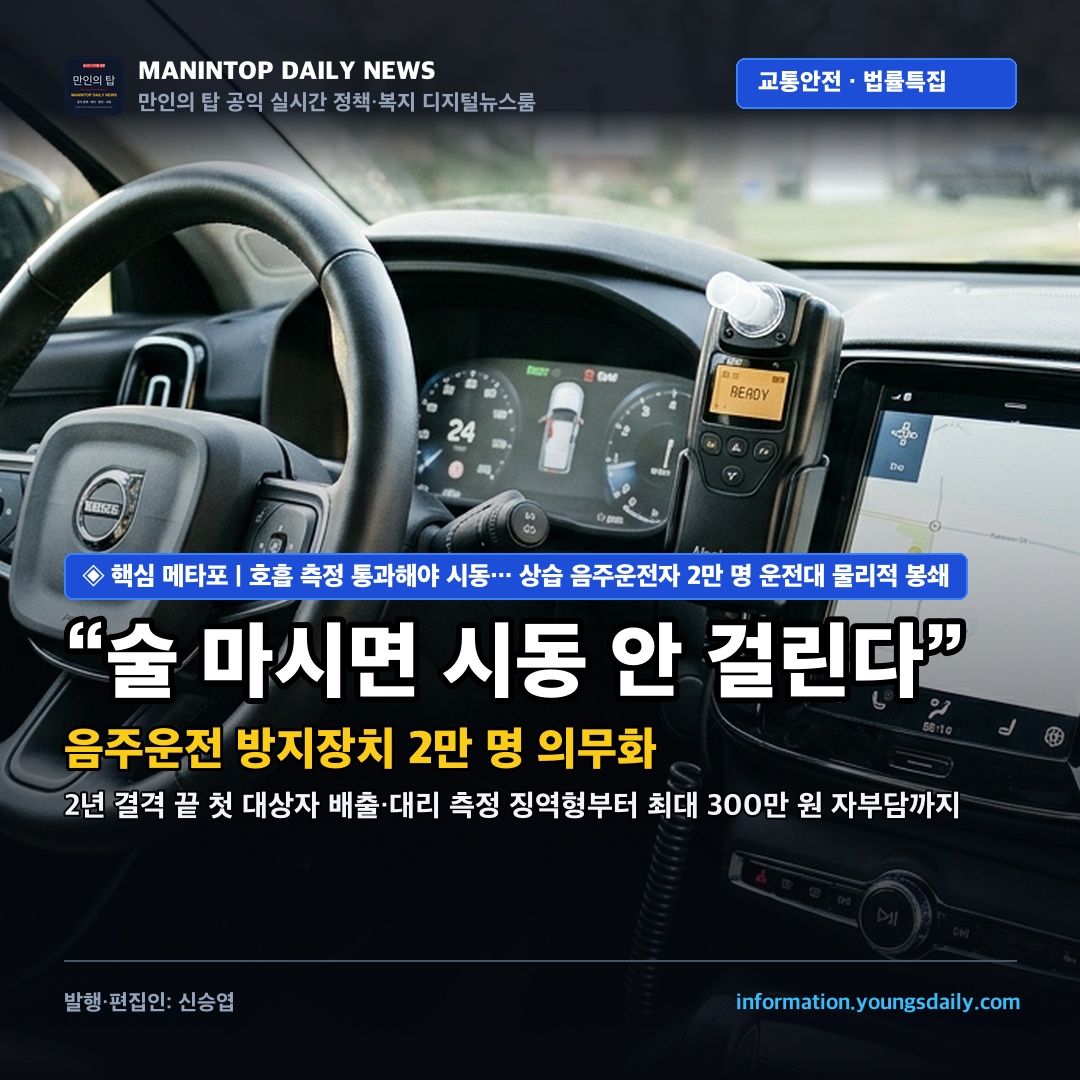
“술 마시면 시동 안 걸린다”… 2년 만에 첫 대상자 배출된 ‘음주운전 방지장치 의무화’ 총정리
2024년 법 시행 후 2년 결격 기간 종료 시점 도래… 연간 2만 명 상습 음주운전자 물리적 차단·대신 불어주면 징역형 및 최대 300만 원 자부담 쟁점 심층 해부
많은 시민들이 "법이 통과된 지가 언제인데 왜 이제야 도로에 장치가 보이기 시작하느냐"고 묻습니다. 그 이유는 도로교통법상 구조적인 시차 때문입니다. 도로교통법상 음주운전으로 2회 이상 적발되면 운전면허가 취소되고 최소 2년 동안은 면허를 다시 딸 수 없는 '결격 기간'을 보내야 합니다.
따라서 2024년 10월 법 시행 이후 적발된 운전자들이 2년의 면허 취소 결격 기간을 모두 채우고, 다시 운전면허를 취득하러 나오는 시점이 바로 2026년 가을입니다. 이 제도는 지난 2023년 4월 대전 어린이보호구역에서 발생한 배승아(당시 9세) 양 참사를 계기로 국민적 공분이 일면서 급물살을 탔습니다. 아울러 2026년 10월 법 개정을 통해 무면허 상태에서 재범한 운전자까지 적용 대상을 촘촘히 묶었습니다.
| 위반 유형 | 적발 세부 요건 | 면허 결격 기간 | 방지장치 의무 부착 기간 |
|---|---|---|---|
| 단순 음주 재범 | 5년 이내 2회 이상 음주운전 적발 | 취소 후 2년 | 결격 종료 후 2년간 부착 |
| 음주사고 재범 | 5년 이내 음주사고 2회 이상 발생 | 취소 후 3년 | 결격 종료 후 3년간 부착 |
| 음주 사망사고 | 음주운전으로 사람을 사망케 한 경우 | 취소 후 5년 | 결격 종료 후 5년간 부착 |
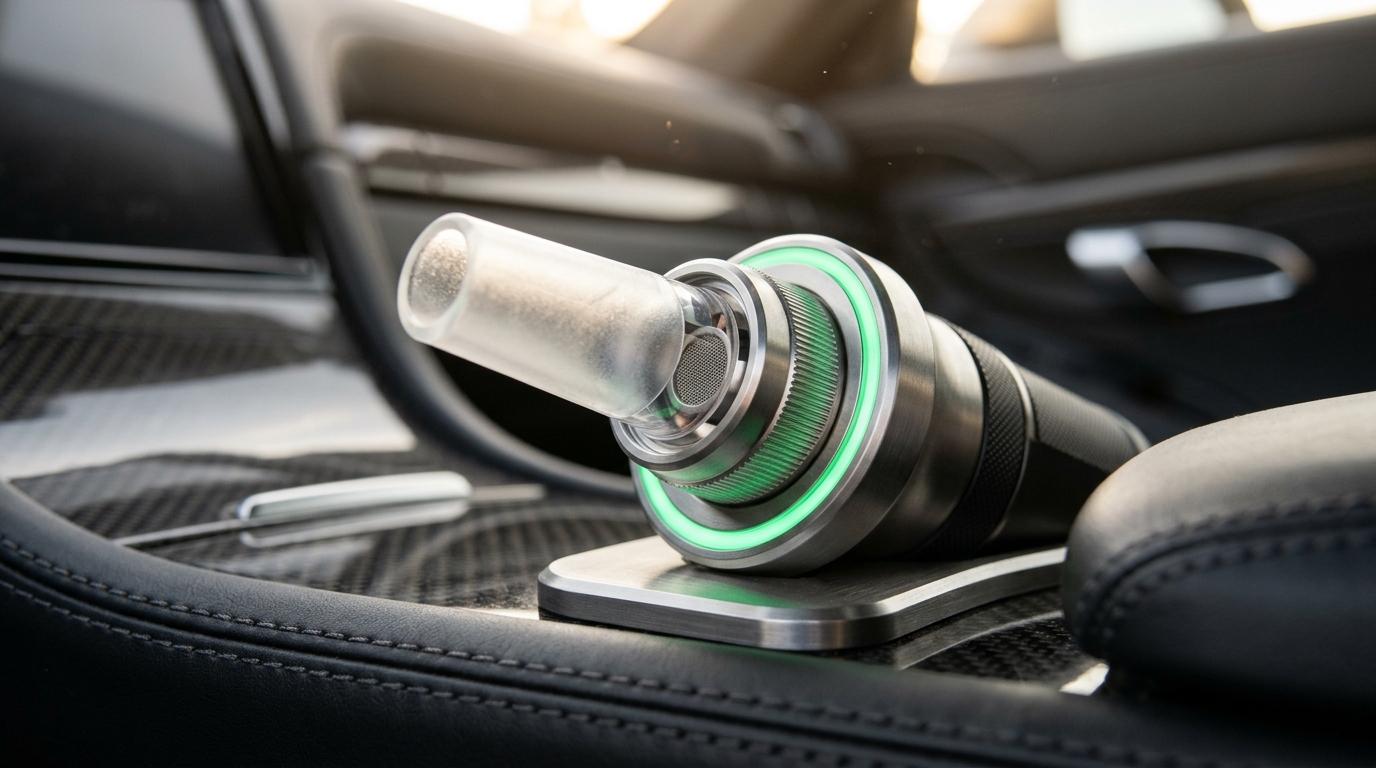
음주운전 방지장치는 시중에서 판매하는 단순 휴대용 측정기와 완전히 다릅니다. 차량 스타트 모터와 점화 계통의 전원을 직접 통제하는 일체형 정밀 컴퓨터 장치입니다. 도로교통법 시행규칙에 따라 반드시 다음 4가지 장치를 한 세트로 갖추어야 합법적인 등록이 가능합니다.
- 음주호흡 분석기: 날숨 속 에탄올 분자를 0.00mg/L 수준까지 정밀 감지하는 전기화학 센서.
- 엔진 제어장치: 센서 분석 결과에 따라 차량 시동 모터 전원을 인가하거나 즉시 차단하는 유닛.
- 운행기록 저장부: 시동 시도 일시, 측정 수치, 통과·실패 이력, 오류 코드를 암호화하여 저장.
- 안면 인증 카메라: 숨을 불어넣는 순간 운전자의 얼굴을 실시간 촬영해 본인 여부를 대조.
“다른 사람에게 대신 불어달라고 하면 그만 아니냐”는 꼼수도 원천 차단됩니다. 내장 카메라가 측정 순간의 얼굴을 사전 등록된 면허권자와 실시간 대조하며, 시동을 켠 뒤 이동 중 술을 마시는 행위를 막기 위해 주행 중 무작위 간격으로 경고음을 울리며 재측정(롤링 리테스트)을 요구합니다. 재측정에 불응하거나 알코올이 감지되면 비상등과 경적을 울리며 운행을 강제 중단시킵니다.
대중이 가장 주의해야 할 대목은 대리 측정에 대한 무거운 형사처벌입니다. 가족이나 동료가 단순한 호의로 대신 숨을 불어넣어 주는 순간 부탁한 사람과 대신 불어준 사람 모두 1년 이하의 징역 또는 300만 원 이하의 벌금에 처해져 전과자가 됩니다.
1. 대리 측정 행위: 대신 불어준 사람과 부탁한 운전자 모두 1년 이하 징역 또는 300만 원 이하 벌금.
2. 장치 무단 해제 및 조작: 센서나 배선을 조작해 무력화하면 3년 이하 징역 또는 3,000만 원 이하 벌금.
3. 미부착 차량 운전: 장치가 없는 가족차, 렌터카, 법인차를 몰래 운전하면 무면허 운전으로 간주되어 즉시 1년 이하 징역 또는 300만 원 이하 벌금 및 면허 재취소.
4. 정기검사 미이행: 6개월 주기 점검 및 데이터 제출을 거부하면 최대 500만 원 이하의 과태료 부과.
장치 설치와 유지비는 전액 운전자 본인 부담입니다. 기기 구입 및 설치 공임비로 약 200만~300만 원이 일시불로 소요되며, 렌털 이용 시에도 매달 10만~15만 원 안팎의 대여료와 6개월 주기 점검비 3만~5만 원이 추가됩니다. 경제적 여유가 있는 사람은 비용을 내고 즉시 생업에 복귀하지만, 저소득층은 이동권이 제한된다는 '경제적 형평성' 논란이 제기되는 배경입니다.
그러나 제도의 예방 효과는 이미 해외에서 명백히 입증되었습니다. 미국 질병통제예방센터(CDC)에 따르면 방지장치 도입 후 음주운전 재범률이 무려 67% 감소했고, 스웨덴 역시 재범률을 5% 미만으로 통제하고 있습니다. 40%에 육박하는 한국의 고질적인 상습 음주운전을 획기적으로 낮출 안전판으로 기대되는 이유입니다.
“Engine Refuses to Start After Alcohol Consumption”… 2026 Marks First Graduates Subject to Mandatory Ignition Interlock Devices
Two-Year License Disqualification Window Concludes… 20,000 Habitual Offenders Blocked Annually, Prison Sentences for Proxy Breath Tests, and 3-Million KRW Self-Funding Controversies
Citizens frequently wonder why interlocks are only now appearing on vehicles despite the law being passed years ago. The answer lies in statutory timing. Under the Road Traffic Act, anyone caught driving under the influence twice or more within five years faces mandatory license revocation accompanied by a minimum two-year disqualification period during which they cannot hold any license whatsoever.
Consequently, repeat offenders apprehended after October 2024 were legally prohibited from driving entirely for two full years. Only as their disqualification periods expire in autumn 2026 do they qualify for conditional re-licensing contingent upon installing an interlock. The legislative momentum was galvanized by the tragic April 2023 death of 9-year-old Bae Seung-ah in a Daejeon school zone. Subsequent October 2026 statutory refinements expanded coverage to unlicensed repeat offenders.
| Offense Category | Violation Criteria | License Ban Period | Mandatory Interlock Term |
|---|---|---|---|
| Simple Repeat DUI | 2+ violations within 5 years | 2-Year Revocation | 2 Years Post-Reissuance |
| DUI Accident Recidivism | 2+ DUI accidents within 5 years | 3-Year Revocation | 3 Years Post-Reissuance |
| Fatal DUI Accident | Causing death while driving intoxicated | 5-Year Revocation | 5 Years Post-Reissuance |
Unlike off-the-shelf portable breathalyzers, an ignition interlock is an integrated vehicular computer system directly wired to the starter motor and ignition circuits. Under enforcement regulations, four certified modules must operate synchronously:
- Electrochemical Breath Analyzer: Precision sensor detecting ethanol molecules down to 0.00mg/L.
- Electronic Ignition Controller: Physically connects or cuts electrical power to the vehicle starter motor based on sensor results.
- Encrypted Operational Log Storage: Securely logs timestamps, blood alcohol measurements, test outcomes, and diagnostic error codes.
- Biometric Facial Recognition Camera: Captures high-resolution images during each breath sample to match against registered license holders.
Attempts to bypass the device are aggressively countered. The integrated camera cross-references the breathing driver against biometric records in real time. To prevent post-start drinking or driver swapping, the system executes randomized 'rolling retests' while the vehicle is in motion. Failing or ignoring a rolling retest triggers automated emergency flashers and continuous horn honking, forcing the vehicle to pull over safely.
The most critical legal warning for the public is the severe criminal liability for proxy testing. Well-meaning family members or friends who blow into the tube on behalf of an intoxicated driver commit an intentional crime: both the requesting driver and the proxy tester face up to 1 year in prison or up to 3 million KRW in criminal fines.
1. Proxy Breath Testing: Both the driver and the individual providing the breath sample face up to 1 year imprisonment or 3 million KRW in fines.
2. Unauthorized Tampering or Removal: Modifying circuitry or removing the device incurs up to 3 years imprisonment or 30 million KRW in fines.
3. Operating Non-Interlock Vehicles: Driving a family car, corporate car, or rental car lacking an interlock constitutes unlicensed driving, triggering immediate license cancellation and up to 1 year imprisonment.
4. Failure to Comply with Biannual Inspections: Neglecting 6-month calibration and data audits carries administrative fines up to 5 million KRW.
The financial burden rests entirely upon the offender. Equipment purchase and installation cost between 2 million and 3 million KRW, while rental alternatives require monthly fees of 100,000 to 150,000 KRW plus biannual calibration fees of 30,000 to 50,000 KRW. Critics argue this imposes unequal mobility restrictions on low-income drivers compared to wealthy offenders.
Nonetheless, global precedent highlights undeniable public safety dividends. According to the US Centers for Disease Control and Prevention (CDC), mandatory interlocks slash recidivism by 67%, while Sweden maintains repeat rates below 5%. In South Korea, where chronic recidivism hovers near 40%, interlocks promise to erect an unyielding technological barrier safeguarding innocent lives.
내가 찾는 상품 키워드, 지금 얼마나 검색될까?
네이버 월간 검색량 + 구글 볼륨 + 아이템스카우트 실시간 상품수와 경쟁강도 배지를 0.5초 만에 무료로 확인하세요.