“평균 30점에 홀로 100점 만점”… AI 안경 부정행위 의혹과 시험 공정성의 위기
세무사 수석 초유 성적표 파문·국가자격시험 잇단 적발부터 20세기 지필 감독 붕괴까지
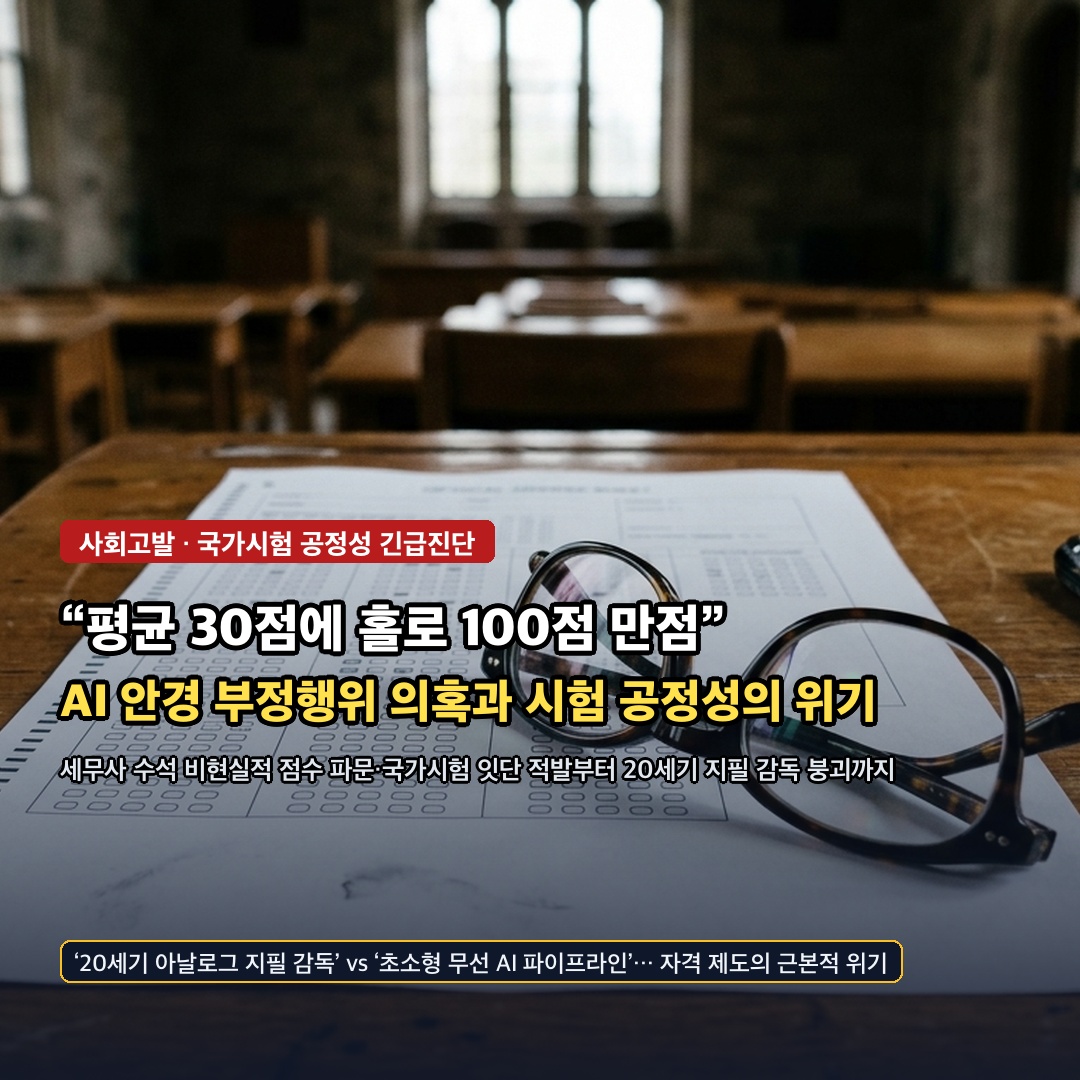
적막이 감도는 고사장 책상 위, 객관식 답안지 옆에 놓인 세련된 검은색 뿔테 안경과 펜. 겉보기엔 평범한 일상 안경이지만 렌즈 모서리에 초소형 광학 디스플레이 프리즘이 숨겨져 있을 수 있는 첨단 웨어러블 시대, 100년 전통의 아날로그 지필 시험 감독 체계가 마주한 거대한 위기를 상징한다.
1. 인간의 한계를 뛰어넘은 성적표: 160문제 중 159개 정답
논란의 도화선은 지난 10월 28일 한국산업인력공단이 발표한 제63회 세무사 자격시험 최종 합격자 발표였습니다. 수석 합격자 한모(34) 씨는 2년간 전업으로 공부해 첫 응시에서 1차와 2차 시험을 한 번에 동차 합격했습니다. 그러나 수험생들과 현직 전문가들이 경악한 것은 단순한 동차 합격이 아니라, 시험의 물리적 한계를 완전히 벗어난 득점 기록이었습니다.
공단 통계에 따르면 한 씨는 1차 시험 4개 과목 160문항 중 재정학에서 단 한 문제만 틀려 400점 만점에 397.5점, 평균 99.375점을 기록했습니다. 최근 치러진 61회 수석(85.6점)이나 62회 수석(81.9점)보다 무려 15점 이상 높은 역대 최고 점수입니다.
| 시험 구분 | 과목명 | 한모 씨 득점 | 전체 응시자 통계 및 특이사항 |
|---|---|---|---|
| 1차 시험 | 재정학 | 97.5점 | 40문제 중 단 1문제만 오답 |
| 1차 시험 | 세법학개론 | 100점 (만점) | 전체 평균 30.18점, 과락률 74.21%, 90점대 전무, 2등 80점대 1명 |
| 1차 시험 | 회계학개론 | 100점 (만점) | 방대한 계산 문항 포함, 시간 내 완제 불가 과목 |
| 1차 시험 | 상법 | 100점 (만점) | 복합 법 조문 및 최신 판례 출제 |
| 1차 종합 | 총점 및 평균 | 397.5점 (99.38점) | 160문항 중 159문항 정답 (정답률 99.38%), 합격선 60점 |
| 2차 시험 | 회계학 1부 | 96점 | 원가·재무회계 계산 위주 초고득점 |
| 2차 시험 | 회계학 2부 | 95점 | 세무회계 계산 위주 초고득점 |
| 2차 시험 | 세법학 1부 | 57점 | 논술·서술형 과목, 1차 세법학 대비 무려 43점 급락 |
| 2차 시험 | 세법학 2부 | 83.5점 | 논술·서술형 과목 |
| 2차 종합 | 총점 및 평균 | 663점 (82.88점) | 합격선(49.75점) 대비 33점 초과 압도적 수석 |
특히 의혹이 집중된 과목은 세법학개론입니다. 올해 세법학개론 응시자 1만 6,856명의 평균 점수는 30.18점에 불과했고, 응시자의 74.21%에 달하는 1만 2,509명이 40점을 넘지 못해 과락했습니다. 1차 합격자 3,050명 중에서도 90점대 득점자는 단 한 명도 없었으며, 80점대 1명, 70점대 32명에 그쳤습니다. 전국 2등과의 격차가 최소 10점 이상 벌어진 가운데 한 씨 홀로 100점 만점을 받았습니다.
현직 세무사이자 유명 강사인 김문철 회계사는 “세무사 1차는 80분 동안 80문제를 풀어야 해 어떤 고수가 와도 만점을 받을 수 없도록 설계된 시험”이라며 물리적 불가능성을 지적했습니다. 국세청 출신 김재환 세무사 역시 지문 독해와 복잡한 계산 시간 압박을 고려할 때 인간의 한계를 벗어났다고 평가했습니다. 더욱이 2차 시험에서 계산 중심인 회계학 1·2부는 90점대 중후반을 받은 반면, 서술형 논술인 세법학 1부는 57점으로 43점이나 급락한 득점 패턴이 드러나면서 기기를 활용한 객관식 연산 의혹은 걷잡을 수 없이 증폭되었습니다.
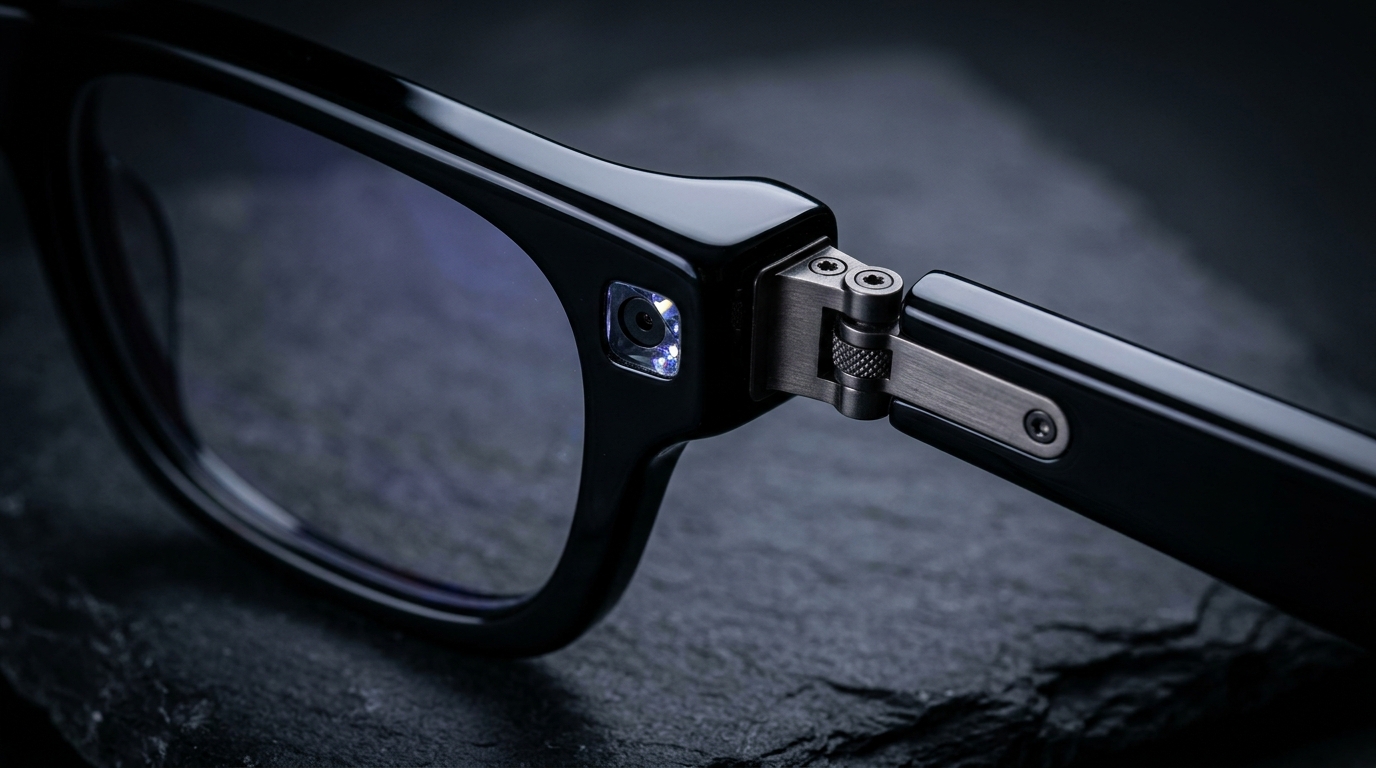
티타늄 힌지와 검은색 아세테이트 프레임 모서리에 정밀 결합된 초소형 광학 센서와 프리즘 모듈. 외부에서는 일반 안경테로 보이지만 내부 마이크로 디스플레이를 통해 실시간 데이터와 시험 정답이 투영되는 최첨단 웨어러블 하드웨어의 단면을 보여준다.
2. 당사자의 억울함 호소와 진상 조사의 구조적 한계
부정행위 의혹이 눈덩이처럼 커지자 수석 합격자 한 씨는 변호인을 선임하고 강력한 법적 대응을 예고했습니다. 한 씨의 법률대리인인 이돈호 변호사는 언론을 통해 “의뢰인은 악의적인 허위사실 유포로 인해 극심한 고통과 억울함을 호소하고 있다”며 “향후 사실관계 확인을 위한 당국의 조사와 필요한 법적 절차에 성실히 임하겠다”고 밝혔습니다. 단지 시험을 잘 보았다는 이유만으로 객관적 물증 없이 부정행위자로 매도하는 것은 중대한 명예훼손이라는 입장입니다.
한국세무사회(김선명 부회장)는 국가 공인 자격 제도의 신뢰를 지키기 위해 관계 당국의 철저한 진상 조사를 촉구하면서도, 무분별한 마녀사냥으로 무고한 피해자가 발생해서는 안 된다는 신중한 입장을 표명했습니다. 국무총리실(한성숙 국무총리) 또한 국가시험의 공정성을 해치는 행위에는 무관용 원칙으로 엄정 대응할 것이며 수사의뢰를 포함해 진상을 철저히 밝히겠다고 발표했습니다.
그러나 현행 관리 시스템으로는 진실을 가려내기가 쉽지 않습니다. 1차 시험(4월)과 2차 시험(7월)이 치러진 지 이미 수개월이 지나 고사장 내부 폐쇄회로(CCTV) 영상 보관 기한이 지났거나 확인이 어렵기 때문입니다. 당시 감독관들 역시 “시험 중 특이 징후는 보고되지 않았다”고 진술하고 있어, 통신 내역 추적이나 강제 수사 없이는 단순한 성적 이상치만으로 합격 취소 처분을 내리기 어려운 것이 법조계의 냉정한 진단입니다.
3. 빙산의 일각: 국내 최초 형사처벌과 잇단 현장 적발
이번 사태가 일회성 소동으로 치부될 수 없는 이유는, 이미 국가자격시험 현장에서 스마트 안경을 동원한 부정행위가 잇따라 적발되어 사법처리로 이어졌기 때문입니다.
광주지방검찰청은 지난 5월 15일 광주의 한 소방설비기사 시험장에서 특수 안경을 착용하고 시험을 치른 40대 남성을 국가기술자격법 위반 혐의로 약식기소했습니다. 이는 국내에서 스마트 안경 부정행위로 형사처벌된 최초의 사례입니다. 당시 이 남성은 렌즈 안쪽에 비친 수상한 불빛을 수상히 여긴 감독관의 육안 관찰에 덜미가 잡혔습니다.
국회 기후에너지환경노동위원회 김위상 의원실이 한국산업인력공단으로부터 제출받은 자료에 따르면, 올해 국가기술자격시험에서 적발된 스마트 안경 부정행위는 5건에 달했습니다:
1. 5월 광주 소방설비기사: 렌즈 안쪽 비정상적 불빛 포착 → 광주지검 약식기소 (국내 첫 사법처리)
2. 5월 서울 정보처리기사: 안경테 카메라 렌즈 및 LED 표시등 육안 식별 → 경찰 불구속 송치 (업무방해 혐의)
3. 5월 목포 전기산업기사: 안경테 버튼 조작 시 렌즈에 청색 화면 표출 → 경찰 수사의뢰
4. 6월 대구 가스기능사: 시험 중 안경 본체에서 비정상 전자음 송출 → 2명 현장 적발 및 수사의뢰
5. 5~6월 어학시험(TOEIC): 통신 장비 연동 의심 안경 착용자 3명 적발
6. 7월 법학적성시험(LEET): 고사장 내 스마트 안경 착용자 적발 및 조사
충격적인 사실은 이들 적발 사례가 첨단 탐지 장비에 의해 걸러진 것이 아니라, 조작 미숙으로 렌즈에 불빛이 번쩍이거나 스마트폰 연결음이 흘러나오는 등 우연한 실수에 의해 드러났다는 점입니다. 만약 기기를 능숙하게 다루고 저조도 화면을 유지했다면 현재의 육안 감시망으로는 적발이 사실상 불가능했을 것입니다.
4. 구멍 뚫린 고사장: 금속탐지기 발표와 현장의 민낯
주관 부처와 공단은 “금속탐지기를 동원해 전자기기를 철저히 통제하고 있다”고 해명해 왔습니다. 그러나 현장 취재 결과는 참담했습니다. 실제 고사장 감독관들은 “금속탐지기는 구경조차 못 했고 수험생 몸수색도 없었다”고 증언했습니다. 심지어 전자기기를 수거하지도 않고 “전원을 끄고 가방에 넣어두라”는 안내 방송만 내보냈습니다. 수험생이 가방 속에 스마트폰을 켜둔 채 테더링(핫스팟)을 켜두어도 감독관이 전혀 알 수 없는 무방비 상태였습니다.
더욱이 학계 연구에 따르면 현재 시중에는 네 가지 첨단 부정행위 파이프라인이 존재합니다. 펜 카메라나 단추 카메라를 이용한 무선 전송 방식뿐만 아니라, 가장 치명적인 것은 ‘오프라인 단독 스마트 안경’입니다. 안경 내부 메모리에 방대한 요약 노트와 법 조문, 계산 공식을 사전에 넣어두고 헤드업 디스플레이(HUD)로 확인하는 방식입니다. 이 방식은 무선 전파(RF)를 일체 방출하지 않기 때문에 주파수 탐지기나 무선 통신 차단기로도 절대 잡아낼 수 없습니다. 신체 수색이나 안경 탈의 검사를 강제하지 않는 한 현행 체계로는 기술적 탐지가 원천적으로 불가능합니다.
5. 대책의 딜레마와 ‘역량 보증’의 근본적 붕괴
사태가 걷잡을 수 없이 번지자 국회와 정부는 대책 마련에 나섰습니다. 국회 김위상 의원실은 내년도 국가기술자격검정 예산에 휴대용 전파탐지기 7,200대 도입(36억 원)과 전담 감시 요원 2만 3,559명 배치(29억 7,300만 원) 등 총 65억 7,300만 원의 보안 예산을 긴급 증액하기로 했습니다. 교육 당국 역시 오는 11월 19일 2027학년도 대학수학능력시험을 앞두고 안경 판별 전담 요원을 배치하고 적발 시 3년간 응시자격 박탈 등 최고 수위 처벌을 예고했습니다.
그러나 시험장 전체의 전파를 먹통으로 만드는 ‘전파 방해(재밍)’는 현행 전파법상 불법이며 인근 시민들의 119 긴급 신고망까지 마비시킬 위험이 있어 도입이 불가능합니다.
학계에서는 이번 사태가 단순한 부정행위를 넘어 국가 자격 제도의 근간인 ‘역량 보증(Warrant of Competence)’의 붕괴를 알리는 경고음이라고 진단합니다. 자격증과 학위는 사회가 해당 인물의 능력을 믿고 의뢰할 수 있도록 보증하는 신호입니다. 그러나 고사장에서 수험생의 머릿속 지식과 첨단 기기의 연산을 분리해 낼 수 없게 된 순간, 시험은 자격의 신뢰도를 보증할 능력을 영구히 상실합니다. 특히 세무, 회계뿐 아니라 의사, 약사, 변호사, 항공 조종사 등 국민의 생명과 재산을 다루는 전문직에서 이러한 무자격자가 배출된다면 국가적 재앙으로 이어질 수 있습니다.
전문가들은 고사장을 감옥처럼 감시하는 식의 대응은 기술 진화 속도를 따라잡을 수 없다고 입을 모읍니다. 20세기식 단순 암기와 계산 문제 위주의 지필시험을 폐지하고, 현장 구술시험, 오픈북 심층 문제 해결, 실기 시뮬레이션 등 기계로 외주화할 수 없는 ‘진짜 역량 중심 평가’로 시험 패러다임을 전면 재설계해야만 무너진 공정성을 회복할 수 있을 것입니다.
“Alone with 100 When Average Was 30”: AI Smart Glasses Cheating Scandal and the Crisis of Exam Integrity
From Historic Certified Tax Accountant Scores to Repeated National Test Scandals and the Collapse of 20th-Century Pen-and-Paper Proctoring
A tense, quiet examination hall desk with an unmarked optical answer sheet and designer dark spectacles under morning sunlight. An emblem of the profound crisis confronting a century-old pen-and-paper invigilation system as invisible micro-optical displays enter the testing arena.
1. Beyond Human Limits: 159 Correct Out of 160 Questions
The controversy ignited on October 28 when the Human Resources Development Service of Korea (HRDK) released final results for the 63rd CTA examination. The top-scoring applicant, a 34-year-old identified as Mr. Han, achieved simultaneous completion of both primary and secondary exams after two years of full-time preparation. What stunned examiners and veteran practitioners was not merely the simultaneous pass, but a score distribution that shattered physical exam limits.
Official records show Han missed only a single problem across four primary subjects totaling 160 questions, registering 397.5 out of 400 points—an average of 99.375 percent. This surpassed previous top scores (85.6 in the 61st and 81.9 in the 62nd) by more than 15 full points, establishing an all-time record.
| Exam Stage | Subject | Han's Score | National Statistics & Discrepancies |
|---|---|---|---|
| Primary Exam | Public Finance | 97.5 pts | Only 1 incorrect answer out of 40 questions |
| Primary Exam | Tax Law Introduction | 100 pts (Perfect) | National average 30.18 pts; 74.21% failure rate; zero 90s; one 80 |
| Primary Exam | Accounting Introduction | 100 pts (Perfect) | Dense computational formulas; impossible to complete in time |
| Primary Exam | Commercial Law | 100 pts (Perfect) | Complex statutory interpretation and judicial precedents |
| Primary Total | Total / Average | 397.5 pts (99.38%) | 159 out of 160 correct (Passing bar: 60 pts) |
| Secondary Exam | Accounting Part 1 | 96 pts | Formula and calculation-heavy high score |
| Secondary Exam | Accounting Part 2 | 95 pts | Tax accounting computational high score |
| Secondary Exam | Tax Law Part 1 | 57 pts | Subjective essay format; 43-point collapse from primary exam |
| Secondary Exam | Tax Law Part 2 | 83.5 pts | Subjective essay format |
| Secondary Total | Total / Average | 663 pts (82.88 pts) | Passing threshold: 49.75 pts (Top honors by 33+ points) |
Tax Law Introduction emerged as the epicenter of suspicion. Among 16,856 test-takers, the national average was 30.18 points, and 12,509 candidates (74.21%) were eliminated by failing to score 40. Out of 3,050 successful first-round candidates, no one scored in the 90s, only one reached the 80s, and 32 achieved the 70s. Han stood alone at 100, leaving a minimum 10-point void to second place nationwide.
Prominent tax instructors and former National Tax Service officials highlighted the physical impossibility. The primary exam requires completing 80 complex problems across two subjects in 80 minutes, deliberately engineered with time-draining calculations so that even veteran accountants cannot finish. Suspicion deepened when secondary exam marks revealed that while Han dominated calculation-heavy accounting sections with 96 and 95 points, his score plummeted by 43 points to 57 in Tax Law Part 1, an essay-based written exam—a divergence characteristic of automated optical input pipelines.
A detailed macro inspection of titanium hinges and micro-optical sensors seamlessly integrated into an acetate eyeglass temple. Looking like ordinary eyewear to casual observers, these devices can project high-resolution data directly into the wearer's line of sight.
2. Accused Denies Allegations as Authorities Face Evidentiary Walls
Confronting escalating allegations, Han retained legal defense and mounted formal refutations. Attorney Lee Don-ho stated that his client is experiencing extreme emotional distress due to malicious rumors and affirmed that Han will cooperate fully with official investigations. The defense underscored that leveling cheating accusations based solely on anomalous test scores without physical evidence constitutes grave defamation.
The Korean Association of Certified Tax Accountants urged thorough inquiries to defend qualification credibility while cautioning against ungrounded witch-hunts. Prime Minister Han Sung-sook and the Prime Minister's Office announced zero-tolerance policies and promised comprehensive investigations, including police referrals.
Nevertheless, structural hurdles obstruct post-hoc verification. Months have passed since the April and July exams, rendering surveillance footage expired or inaccessible. On-site invigilators reported noticing no suspicious behavior during testing, meaning that absent forensic communication records, regulatory bodies face substantial legal barriers in revoking qualifications based solely on statistical outliers.
3. The Tip of the Iceberg: First Criminal Conviction and Serial Detections
The controversy is far from speculative fantasy. In 2026, multiple cases of smart glasses cheating were caught inside South Korean testing halls, culminating in criminal prosecution.
The Gwangju District Prosecutors' Office summarily indicted a man in his 40s under the National Technical Qualifications Act for wearing optical smart glasses during a Fire Protection Engineer test on May 15—the nation's first criminal sanction of its kind. The suspect was detected when an alert proctor noticed an unusual luminescent reflection shimmering within the eyeglass lens.
Records submitted by HRDK to Representative Kim Wi-sang's office reveal five separate smart glasses violations during national qualification tests this year alone:
1. May 15: Fire Protection Engineer (Gwangju) — Lens glow spotted by invigilator → Summarily indicted by Gwangju Prosecutors
2. May: Information Processing Engineer (Seoul) — Camera lens and LED identified on frame → Referred to police for obstruction of business
3. May: Electrical Industry Engineer (Mokpo) — Blue screen revealed upon button tap → Under police investigation
4. June 29: Gas Technician (Daegu) — Audible electronic tones emitted during test → Two individuals caught on-site and referred
5. May-June: TOEIC English Tests — Three individuals intercepted wearing suspicious linked smart glasses
6. July: Legal Education Eligibility Test (LEET) — Smart glasses wearer detected in examination hall
Critically, every single capture was triggered not by technical scanning, but by operator missteps—such as accidental display flashes, audible pairing sounds, or conspicuous hardware bulk. Flawlessly configured devices operating with dim displays remain completely undetectable under current visual invigilation protocols.
4. Collapsed Invigilation Defenses and Undetectable Offline Hardware
While testing authorities routinely tout strict controls including metal detectors, field reporting revealed a starkly different reality. Proctors confirmed that metal detector screenings were never conducted, and personal mobile phones were not collected but merely left inside candidates' backpacks. Examinees were easily able to leave wireless hot-spots active inside bags without detection.
Worse, academic analyses identify four distinct cheating architectures, the most formidable being 'Offline Standalone Smart Glasses'. By pre-loading statutes, summarized outlines, and accounting formulas directly onto internal flash storage, wearers can consult head-up displays (HUD) using subtle eye movements. Because these devices emit zero radio-frequency (RF) signals, frequency scanners and wireless signal jammers are completely powerless. Without intrusive physical searches or forced glasses removal, detection is impossible.
5. Countermeasure Dilemmas and the Demise of 'Warrant of Competence'
In response to national alarm, the National Assembly and government mobilized emergency resources. Lawmaker Kim Wi-sang secured an emergency allocation of 6.573 billion KRW for next year's qualification testing budget, funding 7,200 portable RF detectors (3.6 billion KRW) and 23,559 dedicated device surveillance personnel (2.973 billion KRW). Education authorities preparing for the upcoming College Scholastic Ability Test (CSAT) also instituted stringent inspections and zero-tolerance exclusions.
However, total wireless jamming remains legally prohibited under the Radio Waves Act due to severe risks of severing 119 emergency rescue communications and infringing public telecom rights.
Scholars warn that this crisis signals the collapse of the 'Warrant of Competence'—the social compact wherein diplomas and licenses guarantee an individual's independent mastery. When invigilators can no longer separate a candidate's biological intellect from covert artificial processing, testing instruments lose their warranting legitimacy. If unverified holders infiltrate life-critical vocations such as medicine, engineering, aviation, and law, catastrophic public safety threats become inevitable.
Security experts urge that transforming examination rooms into hyper-policed prisons is a losing battle against miniaturized technology. Preserving testing integrity demands a fundamental paradigm shift away from 20th-century rote memorization tests toward oral defenses, open-book problem solving, hands-on simulations, and dynamic competence evaluations that cannot be covertly outsourced to machines.
내가 찾는 상품 키워드, 지금 얼마나 검색될까?
네이버 월간 검색량 + 구글 볼륨 + 아이템스카우트 실시간 상품수와 경쟁강도 배지를 0.5초 만에 무료로 확인하세요.


