정치·국방 심층취재팀 | 대한민국 안보 거버넌스 및 군 개혁 심층 분석2026. 11. 16 08:30 KST
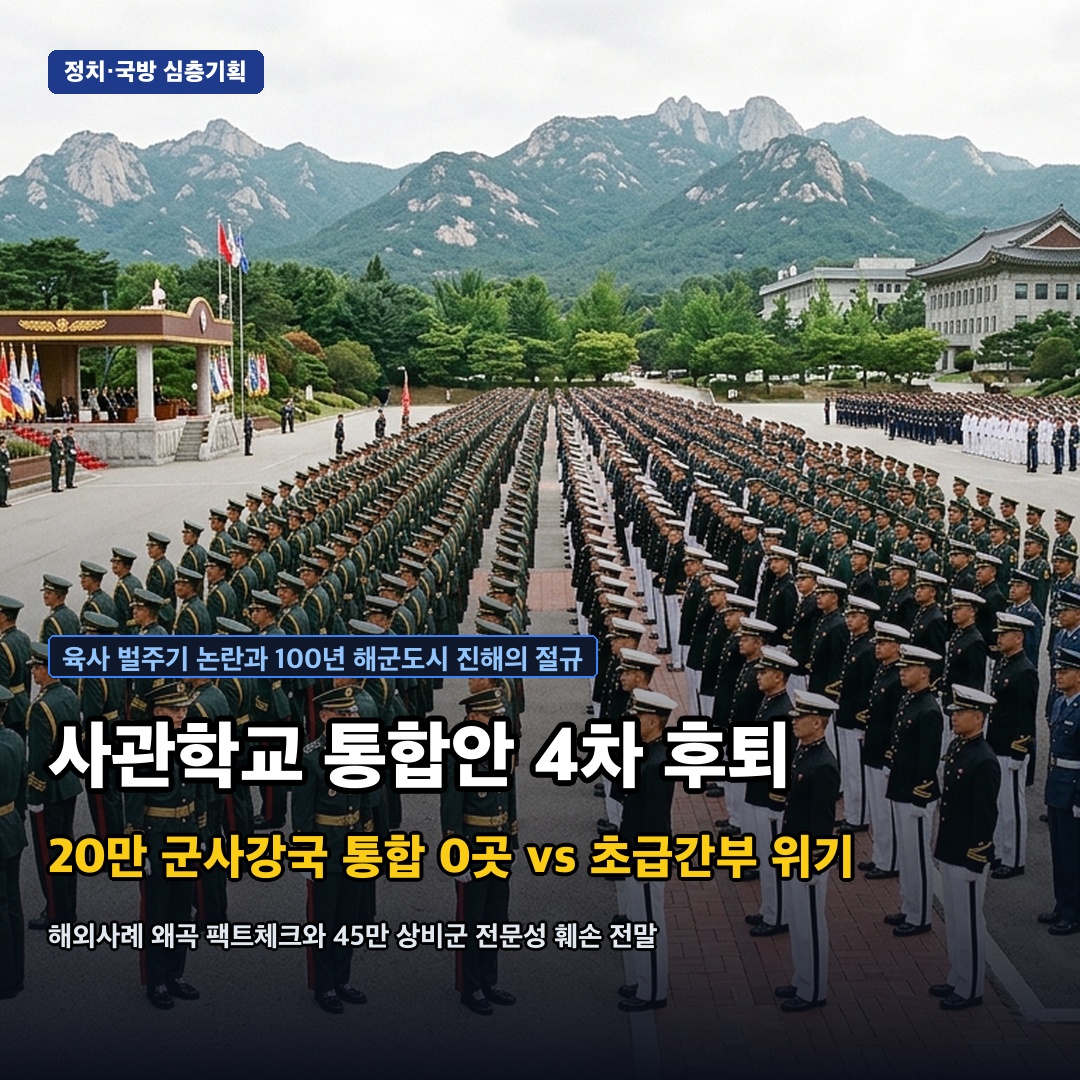
▲ 육·해·공군 3군 사관학교 합동 졸업 및 임관 행사에서 생도들이 절도 있는 대열로 사열을 준비하고 있다. [사진: 국방안보 프레스 풀]
핵심 쟁점 3줄 요약
4년제 자운대 단일 통합에서 2+2 모델, 육사 지방 이전안으로 후퇴하며 이번 정부 들어 4번째 정책 수정 파행
국회 입법조사처 전수조사 결과 상비군 20만 이상 10개 군사강국 중 통합 사관학교를 운영하는 국가는 0곳으로 확인
100년 해군도시 진해의 강력한 생존권 저항과 육군 ROTC 22% 미달 사태 속 기형적 통폐합 추진 논란 가열
2026년 국방부가 야심 차게 추진해 온 육·해·공군 사관학교 통합안이 군사적 타당성 결여와 해외 사례 왜곡 논란, 정치적 보복 의혹, 그리고 해군 모항인 진해를 비롯한 지역사회의 거센 반발에 부딪히며 출범 초기 구상에서 사실상 퇴각하는 국면을 맞고 있습니다. 당초 대전 유성구 자운대에 4년제 단일 '국군사관학교'를 신설해 3군 사관학교를 일괄 통폐합하겠다던 정부 계획은 현장의 강력한 저항에 밀려 각 군 사관학교 본교 명칭과 시설을 유지하는 이른바 '네트워크형 2+2 절충안'으로 급격히 후퇴했습니다. 하지만 군 안팎에서는 전임 장관의 해외 사례 왜곡 홍보와 대통령의 과거 쿠데타 책임론 발언, 서울 태릉 육사 부지 주택 개발설 등이 겹치며 순수한 군 개혁이 아닌 '육사 길들이기'로 변질되었다는 비판이 팽배합니다. 더욱이 상비군 20만 명 이상의 군사강국 가운데 통합 사관학교를 운영하는 국가가 단 한 곳도 없다는 사실이 국회 조사를 통해 확인된 데다, 야전의 핵심 공급원인 육군 학군장교(ROTC) 임관 충족률이 78%로 곤두박질치며 초급간부 수급 생태계가 붕괴되는 와중에 옥상옥 구조의 통합에만 매달렸다는 지적이 쏟아지고 있습니다.
1. 4년제 자운대 신설에서 부분 존치까지… 사관학교 통합안 '누더기 4차 후퇴'
정부와 국방부의 사관학교 통합 구상은 불과 수개월 사이에 전면 통합에서 부분 절충안으로, 다시 명칭 존속과 분산 교육안으로 표류하며 정책적 일관성을 상실했습니다. 국방부는 2026년 7월 16일 국회에서 열린 여당과의 당정협의회 직후, 육·해·공군 사관학교를 일괄 통합하여 대전 자운대에 4년제 단일 사관학교인 '국군사관학교'를 창설하겠다는 기본계획을 전격 발표했습니다. 당시 안규백 국방부 장관은 현대전의 핵심 역량인 군 합동성 제고와 학령인구 감소에 따른 사관학교 입학 경쟁률 하락을 명분으로 내세우며, 교육 체계를 근원적으로 개혁해 미래 전장 환경에 맞춤형 장교를 양성하겠다고 천명했습니다. 국방부는 의견 수렴과 공청회를 거쳐 같은 해 10월 세부 실행계획을 확정·공개하겠다는 로드맵을 제시했습니다.
사관학교 통합 논의는 과거 이명박 정부 시절에도 미래 국방 개혁의 일환으로 추진된 바 있으나, 군종별 고유 전문성과 교육 현실을 고려할 때 단기간에 졸속으로 해결할 수 없다는 비판 끝에 수년간의 숙의를 거쳐 철회된 역사적 선례가 있습니다. 그러나 현 정부는 과거의 뼈아픈 정책적 교훈을 간과한 채 속도전을 밀어붙이다가 군 안팎의 거센 역풍을 자초했습니다. 군 원로와 3군 사관학교 총동창회, 야당, 그리고 해군사관학교가 자리 잡은 경남 창원시 진해구 주민들의 격렬한 반발이 들불처럼 번지면서 정부 구상은 근본부터 흔들리기 시작했습니다.
국방부는 2026년 9월 강신철 장관 취임 이후 군 내부 의견 수렴이라는 명목을 내세워 정책을 전면 재검토하기 시작했습니다. 이어 11월 9일 강 장관은 각 군 사관학교 총동창회장단과의 간담회 및 국회 국방위원회 회의에서 폐교 철회와 수정안 검토를 공식화했습니다. 대전 자운대 4년제 통합안에서 저학년 공통교육과 고학년 전문교육을 나누는 2+2 모델로 후퇴했다가, 마침내 해사와 공사의 기존 본교 및 시설을 유지하고 육사만 서울 태릉에서 지방으로 이전하는 방안을 검토하면서 이번 정부 들어서만 정책이 네 번째 수정되는 파행을 빚었습니다. 강 장관이 '통합군 체제가 아닌 이상 각 군 교육 존속은 필수이며 해군은 바다가 필요하다'며 물러섰지만, 국군사관학교 신설 기조를 완전히 백지화하지 않아 갈등의 불씨는 여전히 타오르고 있습니다.
추진 단계
주요 개편 내용
정부가 내세운 명분
군 안팎 및 지역사회 반발 사유
초기 기본계획 (2026년 7월 당정)
3군 사관학교 완전 폐교 및 대전 자운대 4년제 단일 '국군사관학교' 신설
현대전 필수 군 합동성 강화 및 학령인구 감소 대응
군종별 특수 전문성 말살, 해양·항공 인프라 단절, '육사 벌주기' 의혹
1차 절충안 (2026년 여름~가을)
1·2학년 자운대 공통 기초교육, 3·4학년 각 군 본교 전문교육 ('2+2 모델')
합동 교육과 군종별 심화 교육의 현실적 절충안
군별 전문 교육 2년으로 반토막, 첨단 기술전 대비 전문성 결여 초래
최근 수정안 (2026년 11월 보고)
각 군 사관학교 폐교 철회, 해사(진해)·공사(청주) 유지, 육사만 지방 이전 검토
각 군 고유 교육 존속 인정 및 진해 해양 훈련 특수성 수용
육사만 표적 이전하는 차별 논란, 태릉 부지 주택 개발용 졸속 이전 의혹
군사·지역 종합 평가
4차례 정책 후퇴 끝에 누더기화, 옥상옥 국군사관학교 추진 표류
국군사관학교에 대학원 기능 부여 등 네트워크형 절충 모색
3군 총동창회 결사 저지 및 진해 범대위 총궐기 등 전면 백지화 촉구
2. '육사 벌주기'인가 개혁인가… 3대 쿠데타 책임론과 태릉 부지 개발 의혹
사관학교 통합안이 안보적 숙의 없이 일방통행식으로 밀어붙여지다가 누더기가 된 근본적 배경에는 군 개혁이라는 외피 속에 감춰진 정치적 동기가 자리 잡고 있다는 비판이 지배적입니다. 이재명 대통령은 사관학교 통합 논란이 거세지던 2026년 8월, '그동안 쿠데타를 세 번이나 한 중심이 육사인데 한 번도 책임을 묻지 않았다'고 직접 언급했습니다. 이는 군 통수권자가 사관학교 통합 추진의 실질적 목적이 과거 군사정변과 12·3 비상계엄 사태를 주도한 육군사관학교에 대한 문책 및 인적 청산에 있음을 시사한 발언으로 해석되며 거센 정치적 후폭풍을 불렀습니다.
군 안팎에서는 5·16 군사정변과 12·12 군사반란이 육사 출신 사조직에 의해 주도된 역사적 과오와 달리, 12·3 비상계엄의 경우 군 전체를 도매금으로 매도해서는 안 된다는 반론이 팽배합니다. 12·3 계엄 당시 윤석열 전 대통령과 김용현 전 국방부 장관 등 극소수를 제외하고는 다수의 육사 출신 영관급 장교들이 당일까지 계엄 선포 사실조차 인지하지 못했습니다. 오히려 육사 출신 국가안보실장이 대통령 면전에서 계엄 선포를 정면 반대했고, 비상계엄령 집행 과정에서도 위법한 부대 출동 지시에 실질적으로 저항한 육사 출신 장교들이 다수 확인되었습니다. 그럼에도 현 정권이 육사 전체를 반헌법적 집단으로 낙인찍고 징벌적 차원에서 학교 해체와 통합을 추진했다는 비판이 쏟아지고 있습니다.
정치권과 군 일각에서는 또 다른 현실적 의혹으로 서울 노원구 태릉 육사 부지 개발설을 지목하고 있습니다. 정부가 육사를 충청권이나 전남 장성 등 지방으로 강제 이전시키고, 서울 동북부의 핵심 노른자위 땅인 태릉 골프장과 육사 부지에 대규모 공공주택을 공급하려는 부동산 정책의 일환이 아니냐는 의구심입니다. 언론과 전문가들은 국민의 생명과 재산을 지키는 국가 안보의 근간인 정예 장교 양성 체계를 주택 공급 정책의 하위 수단으로 삼아 초가삼간을 태우는 격이라고 강하게 질타했습니다. 결국 육사의 힘을 빼고 수도권 알짜 부지를 확보하려는 정략적 의도가 군 합동성 강화라는 명분으로 포장되었다는 의혹이 해소되지 않고 있습니다.
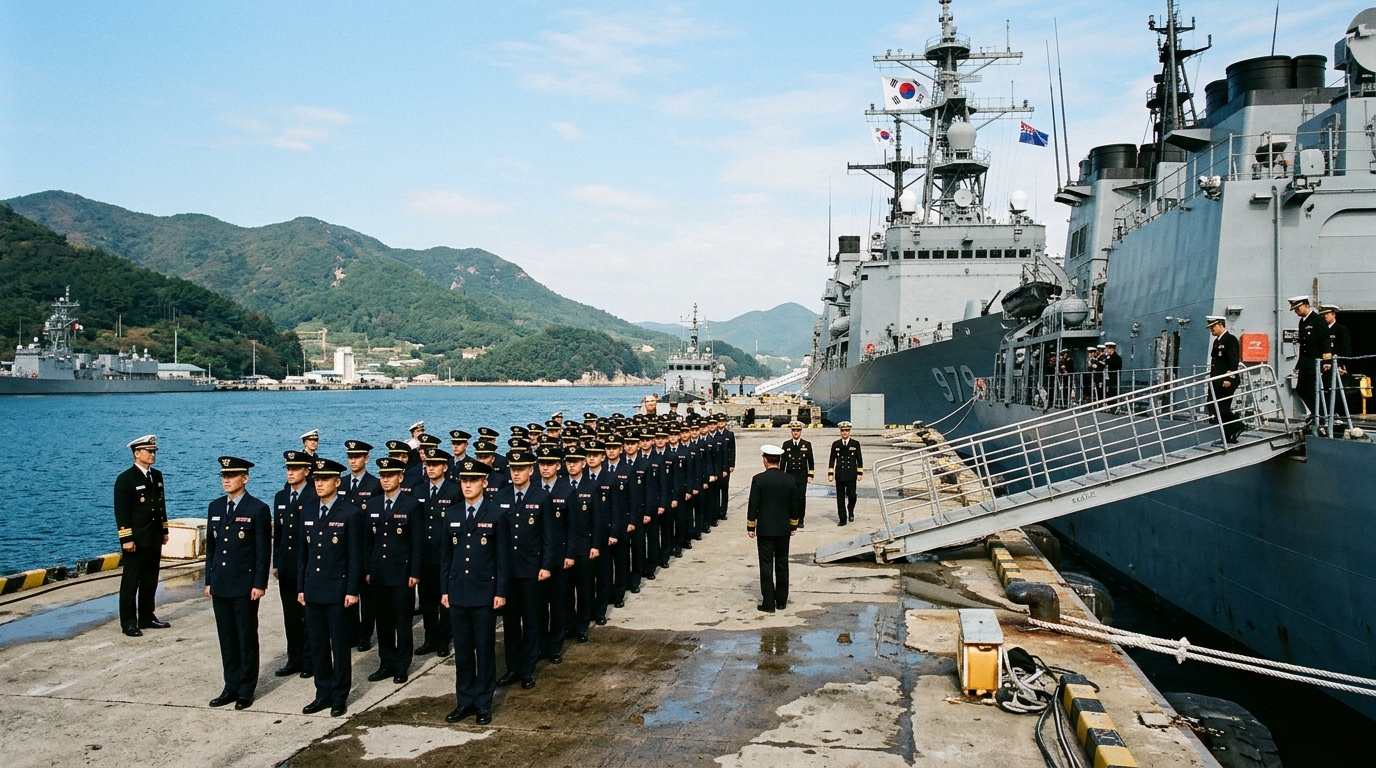
▲ 해군사관학교가 위치한 경남 창원시 진해 군항 부두에서 해군 장교와 사관생도들이 실습 훈련함에 승선하며 출항 준비를 하고 있다. [사진: 국방안보 프레스 풀]
3. [팩트체크] '해외선 다 통합'?… 20만 군사강국 중 통합 사관학교 '0곳'의 진실
국방부는 사관학교 통합을 밀어붙이는 과정에서 선진국 군대들이 이미 통합 사관학교를 대세로 채택하고 있는 것처럼 홍보했으나, 국회 조사 결과 이는 사실관계를 심각하게 왜곡한 여론 호도였음이 백일하에 드러났습니다. 안규백 전 국방부 장관은 2026년 8월 대통령 업무보고에서 '사관학교 제도를 가진 나라가 많지 않으며 주요 몇 나라만 분리 운영되고 통합 운영하는 나라가 굉장히 많다'고 주장했습니다. 그러나 국회 입법조사처가 경제협력개발기구(OECD) 38개국과 러시아, 중국을 포함한 40개국의 장교 양성 체계를 전수 조사해 국민의힘 김상훈 의원실에 제출한 공식 보고서의 실측 데이터는 정반대였습니다.
국회 입법조사처 분석에 따르면 사관학교를 운영 중인 35개국 가운데 분리형은 12개국, 통합형은 13개국, 혼합형은 10개국으로 대등했습니다. 특히 상비군 20만 명 이상의 군사강국 10개국(대한민국, 미국, 중국, 러시아, 인도 등) 가운데 통합 사관학교를 운영하는 나라는 단 한 곳도 없었습니다. 미국, 영국, 프랑스 등 서방 주요 군사대국은 예외 없이 각 군 사관학교를 독립 운영하고 있습니다. 통합형을 채택한 국가는 상비군 7만 7,000명의 캐나다를 제외하면 발트 3국, 벨기에, 슬로바키아 등 상비군 수천에서 2만~3만 명 수준의 유럽 소규모 국가에 불과했습니다. 상비군 45만 명을 유지하며 북한의 핵·미사일 위협과 주변 강국의 안보 압박에 직면한 대한민국이 소규모 군대 모델을 모방해 통합을 추진한다는 것은 전략적 난센스라는 지적입니다. 특히 드론과 인공지능이 결합된 기술 집약형 현대전에서 군종별 전문 교육 기간을 반토막 내는 2+2 통합안은 장교단의 전투 지휘 능력을 치명적으로 약화시키는 자해 행위라는 비판을 피할 수 없습니다.
4. '바다 없는 대전서 해군 장교 양성?'… 100년 '해군도시' 진해 상인과 시민의 절규
사관학교 통합안 발표 이후 가장 격렬한 사회적 저항이 폭발한 곳은 대한민국 해군의 요람이자 해군사관학교가 자리 잡은 경남 창원시 진해구입니다. 진해 주민들과 소상공인, 지역 정치권은 이번 통합안을 100년 역사를 지닌 해군도시 진해에 대한 사형 선고로 받아들이고 있습니다. 진해는 1910년대 일제강점기 군항 도시로 조성된 이래 광복 후 대한민국 해군의 창설과 성장을 함께해 온 상징적인 도시입니다. 하지만 국방 행정 편의에 따라 과거 진해에 있던 해군본부가 충남 계룡대로, 해군작전사령부가 부산으로 연이어 이전하면서 지역사회가 겪어온 상실감과 박탈감은 이미 임계점에 도달해 있었습니다. 2027학년도 모집인원 170명을 포함해 전체 600여 명 규모의 사관생도와 교직원이 상주하는 해사마저 대전으로 이전할 경우 침체된 원도심 골목상권의 붕괴는 돌이킬 수 없다는 것이 지역사회의 절규입니다.
진해 현장에서 만난 상인들의 목소리는 절박했습니다. 장순자 진해구소상공인연합회 회장 직무대행은 생도들의 외출과 군항제는 침체된 상권의 생명선인데 학교가 떠나면 원도심은 고사한다며 정부의 일방통행을 성토했습니다. 택시기사 백영식 씨는 손님의 절반이 군인인데 해사가 빠지면 택시업계가 직격탄을 맞는다고 호소했고, 해사 정문 앞 슈퍼마켓을 운영하는 안영아 씨는 골목상권 매출의 최소 30%가 증발할 것이라며 울분을 토했습니다. 국민의힘 이종욱 국회의원(경남 창원시 진해구)은 국회 예결위에서 강신철 국방부 장관을 상대로 바다, 함정, 충무공 이순신 정신, 진해시민이라는 '4대 가치 불가론'을 천명하며 이전 계획의 완전 백지화를 요구했습니다. 진해 남원로터리에서는 범시민대책위원회 주최로 제3차 총궐기대회가 열려 시민과 동문들이 거리 투쟁을 전개하며 한국국방연구원(KIDA) 연구 용역 결과와 총사업비의 투명한 공개를 촉구했습니다.
군 규모 및 국가 구분
조사 대상 국가 현황
사관학교 운영 형태
한국군 시사점 및 군사적 타당성
상비군 20만 이상 (글로벌 군사강국 10개국)
미국, 중국, 러시아, 영국, 프랑스, 대한민국, 인도 등
분리형 7개국, 혼합형 3개국 통합 사관학교 운영국: 0곳
대규모 상비군 운용 국가 중 통합 사관학교는 전무하며, 고유 군종별 전문 교육 체계 유지
상비군 10만 미만 (유럽 중소국 18개국)
캐나다(7.7만), 벨기에, 슬로바키아, 발트 3국 등
통합형 12개국 다수 차지 (비용 절감 목적 소규모 통합)
병력 수천~수만 명 수준의 행정 통합 모델로 전면전 위협에 직면한 한국군에 부적합
대한민국 상비군 (45만 정예 상비군)
OECD 40개국 중 4위 규모 (프랑스의 2배, 영국의 4배)
육·해·공 분리형 운영 중 (현행 4년제 정예 사관학교)
북한 전면 위협 대비 독자적 지휘 역량 및 육·해·공 영역별 고도 전문 교육 필수
초급장교 수급 생태계 (육군 ROTC 임관 실태)
2022년 임관목표 3,300명 → 2026년 2,800명 축소
충족률 96%(2022) → 78%(2026) 목표 축소에도 22% 미달
소·중위 결원율 5.5% 폭등, 기형적 사관학교 통합 대신 초급장교 처우 개선 시급
5. ROTC 22% 미달과 초급장교 붕괴… 안보 근간 흔들리는데 '옥상옥 기형 개편'
국방부의 통합안은 군 내부의 결속을 다지기는커녕, 창군 이래 유례없이 육·해·공군 3군 사관학교 총동창회 전체의 전면적 결집과 집단 반발을 촉발하는 자충수가 되었습니다. 육사 총동창회는 정부가 육사를 계엄의 주범으로 몰아 상징적 요람인 태릉에서 강제 축출하려 한다며, 정책 강행 시 감사원 감사청구와 직권남용에 따른 민·형사상 법적 소송을 단행하겠다고 경고했습니다. 해사 총동창회는 바다와 함정, 군항 부두가 없는 내륙 대전 자운대에서 해군 장교를 양성하겠다는 발상은 해양 안보에 대한 무지의 극치라고 비판했습니다. 공사 총동창회 역시 충북 청주 본교에 수십 년간 막대한 예산을 들여 구축한 활주로와 비행 훈련 시뮬레이터 인프라를 방치한 채 생도들을 분산 수용하는 것은 천문학적인 혈세 낭비이자 조종사 양성 공백을 부르는 재앙이라고 목소리를 높였습니다.
정부가 사관학교 통합이라는 파괴적 조직 개편에 행정력을 낭비하는 사이, 군의 실질적 근간인 초급장교 수급 생태계는 궤멸적 위기로 치닫고 있습니다. 국회 국방위원회 민홍철 의원이 각 군으로부터 제출받은 국정감사 자료에 따르면, 대한민국 육군 초급장교의 최대 공급원인 학군장교(ROTC)의 임관 충족률은 참담한 수준으로 폭락했습니다. 육군 ROTC 임관 충족률은 2022년 96%에서 2023년 94%, 2024년 86%, 2025년 84%로 떨어지더니 2026년에는 역대 최악인 78%까지 주저앉았습니다. 특히 육군이 지원자 급감을 감안해 임관 목표 자체를 2022년 3,300여 명에서 2026년 2,800여 명으로 500명이나 줄였음에도 불구하고, 목표 인원의 22%를 채우지 못하는 초유의 미달 사태가 발생했습니다.
이러한 초급장교 충원 실패는 야전 전투 부대의 기능 마비로 직결되고 있습니다. 육군 소위와 중위의 실제 복무 현원은 2024년 1만 3,300여 명에서 2025년 1만 2,900여 명으로 급감하며 결원율이 2.7%에서 5.5%로 1년 만에 두 배 이상 치솟았습니다. 병사 복무기간 단축과 급여 인상에 반해 초급장교의 열악한 처우와 복무 메리트 상실이 인재 이탈을 부추기고 있는데도, 군 수뇌부는 옥상옥 구조의 통합사관학교라는 엉뚱한 처방에 매달려 왔습니다. 방위사업청이 첨단 방산 인력 양성에 막대한 예산을 쏟아붓는 동안 최전선 야전 부대를 지휘할 소대장 수급은 벼랑 끝에 섰습니다. 안보의 주체인 군심과 지역사회의 동의를 얻지 못한 채 해외 통계 왜곡과 정치적 보복 논란만 남긴 사관학교 통합안은 전면 철회되어야 하며, 장교단 복무 여건 개선과 군종별 첨단 전문성 강화라는 본질적 국방 혁신으로 정책의 중심축을 시급히 되돌려야 합니다.
[In-Depth Analysis] 'Punishing KMA vs. Jinhae's Outrage': Military Academies Merger Retreats for the 4th Time, Zero Unified Academies Among Major Armies, and Junior Officer Shortages
Politics & Defense Desk | National Defense Governance & Military Reform In-Depth Analysis2026. 11. 16 08:30 KST
▲ Cadets from the ROK Military, Naval, and Air Force Academies stand in formation during a joint ceremonial review. [Photo: Defense Press Pool]
Key Takeaways
The military academies consolidation plan retreated four times from a four-year unified campus to selective relocation of the Army academy
A comprehensive parliamentary audit verified that zero nations with standing armies over 200,000 operate unified academies
Intense civic resistance in Jinhae and a record 22 percent commissioning deficit in Army ROTC expose severe contradictions in defense policy
In 2026, the ambitious initiative pushed by the Ministry of National Defense to consolidate the ROK Army, Naval, and Air Force Academies is in full retreat. Confronted by glaring military flaws, distorted overseas precedents, lingering suspicions of political retribution, and fierce resistance from local naval hubs like Jinhae, the administration's initial blueprint has effectively collapsed. The original proposal to construct a unified four-year ROK Military Academy in Jaundae, Daejeon, and shut down the individual service academies has rapidly downgraded to a fractured network model preserving existing campuses. However, military circles and civic leaders argue that the initiative has devolved into a politically driven effort to discipline the Korea Military Academy (KMA), exacerbated by the defense minister's selective data citations, presidential rhetoric targeting historic coups, and persistent rumors of residential redevelopments at the prime Taereung military campus. Furthermore, an exhaustive parliamentary audit revealed that not a single military powerhouse maintaining an active standing army of 200,000 troops operates a unified academy. Amid an alarming collapse in junior officer commissioning rates—exemplified by Army Reserve Officers' Training Corps (ROTC) fulfillment dropping to 78 percent—critics condemn the government for chasing a bureaucratic restructuring while front-line officer supply lines disintegrate.
1. From Four-Year Jaundae Merger to Partial Retention: The Fourth Retreat of the Consolidation Plan
The defense establishment's consolidation agenda lost strategic continuity within months, careening from full integration to partial compromises, and ultimately toward nominal campus preservation. On July 16, 2026, following a high-level consultation with the ruling party at the National Assembly, the defense ministry abruptly unveiled its primary blueprint to disband individual service academies and establish a single four-year National Armed Forces Academy in Jaundae, Daejeon. Then-Defense Minister Ahn Gyu-back championed military jointness and declining candidate applicant pools driven by demographic shifts, claiming an overhaul was essential to train officers adapted to multidomain warfare. The ministry promised a finalized operational roadmap by October following public hearings and expert panels.
Proposals to integrate the military academies had been explored under the Lee Myung-bak administration but were discarded after comprehensive studies concluded that erasing service-specific warfighting doctrines produced grave operational deficiencies. Disregarding these established lessons, the current government prioritized speed over institutional consensus, triggering intense backlash across the defense ecosystem. Military veterans, alumni associations across all three branches, opposition lawmakers, and the residents of Jinhae—the historic home of the ROK Naval Academy—mounted unified resistance that dismantled the ministry's unilateral timeline.
Following the appointment of Defense Minister Kang Shin-chul in September 2026, the ministry initiated a formal policy review under the guise of internal consultations. On November 9, Minister Kang met with alumni leadership and addressed the parliamentary defense committee, officially retracting academy closures. The plan retreated from the four-year unified model to a 'two-plus-two' split curriculum, and finally to retaining the naval and air force academy campuses in Jinhae and Cheongju while selectively relocating the Army academy out of Seoul. This marks the fourth major retreat under the current administration. While Kang conceded that separate service academies remain vital and acknowledged that naval education requires direct maritime access, the ministry has refused to fully cancel the umbrella academy charter, keeping institutional friction alive.
Phase
Key Reform Provisions
Official Government Stance
Military and Civic Criticisms
Initial Proposal (July 2026)
Complete dissolution of 3 academies; single 4-year unified academy in Daejeon
Enhancing inter-service jointness and responding to demographic contractions
Erosion of branch-specific doctrine; severed maritime assets; political retribution
1st Compromise (Fall 2026)
2-year basic common training at Jaundae; 2-year branch education ('2+2 model')
Pragmatic compromise between joint education and specialized training
Specialized branch schooling halved; tactical deficiencies in high-tech warfare
Current Revision (Nov 2026)
Retract closures; keep Naval (Jinhae) and Air Force (Cheongju); relocate Army academy
Preserving branch identities; recognizing vital maritime training needs
Targeted eviction of KMA; allegations of metropolitan housing redevelopment
Overall Assessment
Fragmented after 4 reversals; umbrella academy role reduced to graduate studies
Attempting network-based institutional compromise across campuses
Unified alumni resistance and civic rallies demand complete cancellation
2. 'Disciplining KMA' or Legitimate Reform: Coup Responsibility and Taereung Development Suspicions
The fundamental catalyst behind the chaotic erosion of the consolidation initiative lies in widespread suspicions of partisan political motivation cloaked in defense reform. In August 2026, as nationwide debates escalated, President Lee Jae-myung pointedly remarked that the Korea Military Academy served as the epicenter of three historic military coups without ever facing formal institutional accountability. This direct intervention by the commander-in-chief was widely interpreted as confirmation that the restructuring was designed to penalize the Army academy for historic coups and the December 3 martial law episode, sparking explosive political blowback.
Defense experts strongly counter that while past juntas like Hanahoe spearheaded historic coups, the military officer corps as a collective institution must not be scapegoated for the December 3 martial law declaration. Aside from former President Yoon Suk-yeol and former Defense Minister Kim Yong-hyun, the vast majority of active KMA officers had no prior knowledge of the decree until it was broadcast. In fact, a KMA-educated national security adviser directly opposed the declaration in the president's presence, and several field-grade commanders refused unlawful deployment orders. Despite this evidence, critics argue that the administration framed the entire Army academy as an unconstitutional faction to justify punitive structural dismantling.
Concurrently, political and military observers point to suspicions surrounding the commercial and residential redevelopment of the Taereung campus in northern Seoul. Skeptics allege that relocating the Army academy to provincial sites like Jangseong or Chungcheong serves a hidden real estate agenda: securing prime metropolitan land for high-density public housing. Editorial commentary from major economic dailies condemned the strategy as sacrificing core national security assets for short-term housing targets. Consequently, suspicions persist that weakening the academy's traditional stature and capturing its metropolitan real estate were disguised under the banner of military jointness.
▲ Naval cadets and officers assemble along the dock beside a training warship at Jinhae Naval Base in Changwon. [Photo: Defense Press Pool]
3. [Fact Check] 'Consolidation Is the Global Trend'? Zero Unified Academies Among Major Armies
Throughout its public campaigns, the defense ministry insisted that advanced global militaries had already embraced unified academies as an international standard. However, an exhaustive parliamentary inquiry exposed this narrative as a distortion of empirical facts. Former Minister Ahn claimed before the president that few countries maintain separate academies and that unified institutions represent the overwhelming norm. In response, the National Assembly Research Service surveyed 40 nations, including 38 OECD member states alongside China and Russia, presenting definitive findings to the office of Representative Kim Sang-hoon.
The parliamentary research revealed that among 35 nations operating military academies, 12 maintain separated academies, 13 utilize unified models, and 10 adopt hybrid systems. Crucially, among the 10 nations maintaining standing armies exceeding 200,000 personnel—including South Korea, the United States, China, Russia, and India—exactly zero operate unified academies. Global military powers without exception preserve independent single-service institutions. Unified models were confined to Canada (standing military of 77,000) and small European nations like Belgium, Slovakia, and the Baltic states with standing forces of a few thousand to 30,000 troops. For South Korea, with 450,000 active troops confronting North Korean nuclear forces, adopting a mini-military European framework is strategic nonsense. In an era of AI and drone-centric warfare, cutting branch-specific specialized instruction in half through a two-plus-two model severely impairs tactical command competency.
4. 'Training Navies Without the Sea?' The Century-Old Naval Hub of Jinhae Mounts Resistance
The fiercest social opposition erupted in Jinhae, Changwon, the historic naval cradle hosting the ROK Naval Academy. Residents, small business owners, and regional leaders viewed the proposed transfer as an existential blow to a city defined by a century of naval heritage. Established as a naval port in the 1910s, Jinhae has anchored South Korea's maritime defense since national independence. However, after the prior transfers of Navy Headquarters to Gyeryongdae and the Naval Operations Command to Busan, local sense of economic deprivation reached an apex. With roughly 600 cadets and faculty members—including an intake of 170 cadets for the 2027 academic year—relocating the academy to landlocked Daejeon threatens the total collapse of the historic commercial district.
Interviews across Jinhae captured profound distress. Acting President Jang Soon-ja of the Jinhae Small Merchants Federation emphasized that cadet weekend leaves and the annual naval festival represent the financial lifeline of the old downtown, warning that an academy departure would paralyze small commerce. Veteran taxi driver Baek Young-sik noted that service members generate half of local transit demand, while grocer Ahn Young-ah projected a minimum 30 percent plunge in retail revenue. At the National Assembly, Representative Lee Jong-wook articulated four non-negotiable values—the sea, warships, Admiral Yi Sun-sin's legacy, and Jinhae citizens—demanding the total termination of the transfer scheme. At Namwon Rotary, a civic alliance held its third mass rally, demanding the immediate release of Korea Institute for Defense Analyses feasibility studies and total project cost breakdowns.
Military Scale & Category
Surveyed Nations Sample
Institutional Academy Model
Strategic Viability for ROK Forces
Over 200,000 Troops (10 Major Global Militaries)
United States, China, Russia, UK, France, South Korea, India
Separated: 7, Hybrid: 3 Unified Academies: ZERO (0)
Major powers exclusively maintain independent academies to ensure specialized branch doctrine
Under 100,000 Troops (18 Small European Nations)
Canada (77k), Belgium, Slovakia, Baltic States
Unified: 12 nations (Cost-saving small force models)
Designed for forces of a few thousand to tens of thousands; wholly inapplicable to large-scale warfare
Republic of Korea Armed Forces (450,000 Standing Force)
4th largest among 40 nations (2x France, 4x United Kingdom)
Rather than fostering inter-service cohesion, the consolidation agenda triggered unprecedented joint resistance from the alumni associations of the Army, Naval, and Air Force academies. The KMA Alumni Association warned that if authorities forcibly evict the academy from Taereung to serve political objectives, alumni leadership will initiate audits by the Board of Audit and Inspection alongside criminal and civil litigation against responsible officials. The Naval Academy Alumni Association denounced the premise of educating naval officers in landlocked Daejeon without deep-water access, docks, or warships as maritime illiteracy. Similarly, Air Force Academy alumni argued that abandoning multimillion-dollar runways and flight simulators in Cheongju would squander immense public capital and jeopardize pilot training pipelines.
While policymakers squandered resources on structural realignments, the frontline officer supply system entered an unprecedented crisis. According to parliamentary audit records released by Representative Min Hong-chul of the National Assembly Defense Committee, commissioning fulfillment for Army ROTC—the military's primary source of lieutenants—suffered a catastrophic drop. Army ROTC fulfillment fell from 96 percent in 2022 to 94 percent in 2023, 86 percent in 2024, 84 percent in 2025, and plunged to an all-time low of 78 percent in 2026. Despite the Army scaling down annual commissioning targets from 3,300 to 2,800 to mask declining interest, it still suffered an unprecedented 22 percent shortfall.
This commissioning deficit has severely undermined frontline readiness. Active platoon commanders and company-grade officers dropped from 13,300 in 2024 to 12,900 in 2025, pushing junior officer vacancy rates from 2.7 percent to 5.5 percent within a single year. While conscript service terms shortened and enlisted stipends rose significantly, junior officer compensation and benefits remained stagnant, accelerating talent flight. Yet the defense leadership remained fixated on an unnecessary bureaucratic consolidation rather than addressing junior officer retention. The consolidation plan, marked by data distortions and perceived political retribution, must be decisively discarded. National defense priorities must return to their true foundation: restoring junior officer morale, upgrading branch-specific warfighting excellence, and safeguarding tactical readiness across all domains.
PRO SOURCING ENGINE만인의 탑 빅데이터 솔루션
★ 가입 시 600 크레딧(120회) 전원 무료
내가 찾는 상품 키워드, 지금 얼마나 검색될까?
네이버 월간 검색량 + 구글 볼륨 + 아이템스카우트 실시간 상품수와 경쟁강도 배지를 0.5초 만에 무료로 확인하세요.
MANINTOP NEWSLETTER
📬 만인의 탑 뉴스레터 무료 구독
오늘 보신 정책·시사 뉴스가 유익하셨나요? 매일 엄선되는 알짜 복지 혜택과 국회 실시간 속보를 이메일로 가장 먼저 받아보세요. (평생 무료)
1월이 시작되면 감기는 이미 우리 곁에 와 있습니다. 2월, 3월, 4월까지 이어지는 추위와 건조함은 코와 목을 가장 먼저 공격합니다. 아침에 일어나자마자 막혀 있는 코. 계속 흐르는 콧물. 괜히 칼칼해지는 목. 이 증상은 “시작”일 뿐입니다. 한 번 무너지면 일주일, 길면 한 달까지 끌고 갑니다. 약을 먹으면 잠깐 괜찮아집니다. 하지만 며칠 뒤 또 반복됩니다. 왜일까요? 감기는 ‘치료’의 문제가 아니라 ‘관리’의 문제이기 때문입니다. 대부분은 감기가 오고 나서 약을 찾습니다. 하지만 진짜 중요한 건 감기가 오기 전에 코와 목을 지키는 것입니다. 건조한 실내 공기, 차가운 바깥 공기, 눈에 보이지 않는 세균. 코와 목은 매일 공격받고 있습니다. 지긋지긋하죠! 그런데도 우리는 아무 준비 없이 버티고 있습니다. 이번 겨울도 그렇게 보낼 건가요? 사실 방법은 어렵지 않습니다. 코를 깨끗하게 관리하고, 목을 따뜻하게 보호하고, 점막을 촉촉하게 유지하고, 기관지를 미리 관리하고, 외부 공기를 차단하는 것. 이 다섯 가지만 꾸준히 해도 감기약 없이 겨울을 보내는 것이 충분히 가능합니다. 🔥 이제부터 그 방법을 하나씩 살펴보겠습니다. 🔥 1. 코와 목을 먼저 관리해야 하는 과학적 이유 감기의 대부분은 코 점막에서 시작됩니다. 국제 학술지 Nature Reviews Microbiology 와 Journal of Allergy and Clinical Immunology 에 실린 호흡기 감염 관련 연구들에서는, 감기 바이러스가 비강 상피세포에 먼저 부착해 증식한다는 점을 설명하고 ...
리모델링사업이 진행 중인 아파트를 매매할 때 “계약금 10%를 언제까지 내야 하느냐”는 질문이 특히 많이 나옵니다. 이주공고(이주 안내)가 7~11월쯤이라고 들으면, 그 시점에 맞춰 계약금도 움직일 것 같아서 더 헷갈리기 쉽습니다. 하지만 실제 납부기한은 ‘이주공고가 언제냐’만으로 자동 결정되지 않는 경우가 많습니다. 1) 계약금 10% 납부기한: 결국 ‘문서에 적힌 일정’이 기준 계약금 10%를 언제까지 납부해야 하는지는, 내가 서명하는 매매계약서(특약 포함) 와 사업주체/조합이 제시한 공고·안내문 에 적힌 납부 일정이 기준이 됩니다. 실제 공고문에서는 분양대금 납부의 큰 틀(계약금→중도금→잔금)을 먼저 안내하고, 상세 일정은 별도 표나 유의사항으로 제시하는 방식이 흔합니다. 또, 계약서 문구에 따라 지급 시점이 조건부로 설정될 수도 있습니다. 예를 들어 한 사례 소개 자료에서는 용역계약서에 잔금(10%) 지급시기가 “사업승인 후”로 기재되어 있었다는 점이 언급됩니다. 이런 식으로 ‘사업 단계’와 지급을 연동하는 문구가 들어가면, 질문의 답은 계약서 문구를 확인해야만 확정됩니다. 관련 내용은 링크 에서 문구 사례를 확인할 수 있습니다. 2) 입주자모집공고에서 확인되는 ‘납부 순서’와 잔금 마감 시점 공고문에 적힌 문구를 보면, 납부 순서와 잔금 마감에 대한 기준이 비교적 명확하게 제시되는 경우가 있습니다. 예를 들어 한 입주자모집공고에는 “분양금액(주택가격)은 계약금, 중도금, 잔금의 순서로 납부”하며 “잔금은 입주(열쇠 수령일) 전에 완납”해야 한다고 안내되어 있습니다. (문구 확인: 링크 ) 이 문구가 의미하는 바는 최소 2가지입니다. 분양/공급 형태의 문서에서는 ‘계약금→중도금→잔금’ 흐름이 공식적으로 안내될 수 있습니다. 잔금은 “입주(열쇠 수령)” 이전에 완납해야 한다는 마감 기준이 문서에 적혀 있을 수 있습니다. 다만, 위 공고문 문구는 잔금 마감에 대한 기준을 보여주지만, 계약금 10%의...
윤석열 전 대통령 탄핵 인용 소식을 접하면, 가장 궁금한 지점은 ‘헌재가 정확히 무엇을 위헌·위법으로 봤는가’입니다. 또한 탄핵과 별개로 진행되는 형사재판(내란 우두머리 혐의 등)이 어디까지 왔는지도 함께 정리할 필요가 있습니다. 아래 내용은 제공된 기사/게시물 스니펫과 링크에서 확인되는 범위만 모아, 일반인이 흐름을 이해하기 쉽게 정리한 것입니다. 1) 탄핵 인용 관련: 스니펫에서 확인되는 ‘판단의 골격’ 제공된 근거 중 조국혁신당 사이트에는 헌법재판소가 윤석열 탄핵 심판에서 “피청구인의 위헌·위법행위는 국민 신임 …”이라는 취지로 판단했다는 문장이 인용돼 있습니다( 링크 ). 이 인용문만 놓고 보면, ‘위헌·위법행위’가 있었는지와 그로 인해 ‘국민의 신임’이 어떻게 평가됐는지가 핵심 축으로 소개됩니다. 다만 질문에서 요청하신 세부 항목, 즉 비상계엄 선포 자체를 문제 삼은 구체적 이유, 계엄 이후 조치(포고령, 국회 통제 등)의 어떤 지점이 헌법 위반인지, 국회의 권한행사 방해 및 정치활동 제약을 어떤 논리로 판단했는지 등은, 이번에 제공된 근거의 제목/스니펫만으로는 조항·사실관계·판단 구조가 그대로 제시돼 있지 않습니다. 따라서 이 글에서는 ‘헌재가 무엇을 문제 삼았다’는 세부 리스트를 단정적으로 재구성하기보다, 현재 확인 가능한 문구 수준의 요약(위헌·위법행위 → 국민 신임의 문제로 평가)까지만 적습니다. 만약 헌재 결정문 전문(주문 및 이유)이 추가로 확인되면, 그때는 문장 단위로 ‘어떤 행위’와 ‘어떤 헌법 원리/조항’이 연결되는지(예: 권력분립, 국회의 권한, 정치적 기본권 등) 구조화해 정리하는 것이 가장 정확합니다. 2) 형사 절차(내란 혐의) 관련: 체포영장과 1심 선고 언급 탄핵 심판과 별도로, 12·3 비상계엄 사태로 내란 혐의를 받는 윤석열 대통령에 대해 2024년 12월 31일 체포 영장이 발부됐다는 BBC 보도가 있습니다( 링크 ). 해당 보도는 ‘현직 대통령’에 대한 체포영장 발부라는 점을 함께 언급합니다. 또...