[심층기획] '수도권 코앞 전술핵과 호르무즈 급감' 복합 위기… 정부, '안전디딤돌' 43종 대피 지도·22개국어 디지털 방패 전면 가동
만인의 탑 편집국11월 16, 2026
[심층기획] '수도권 코앞 전술핵과 호르무즈 급감' 복합 위기… 정부, '안전디딤돌' 43종 대피 지도·22개국어 디지털 방패 전면 가동
사회안전·국가안보 심층취재팀 | 북한 CNI 전략 및 디지털 재난망 전면 개편 심층 분석2026. 11. 16 09:30 KST
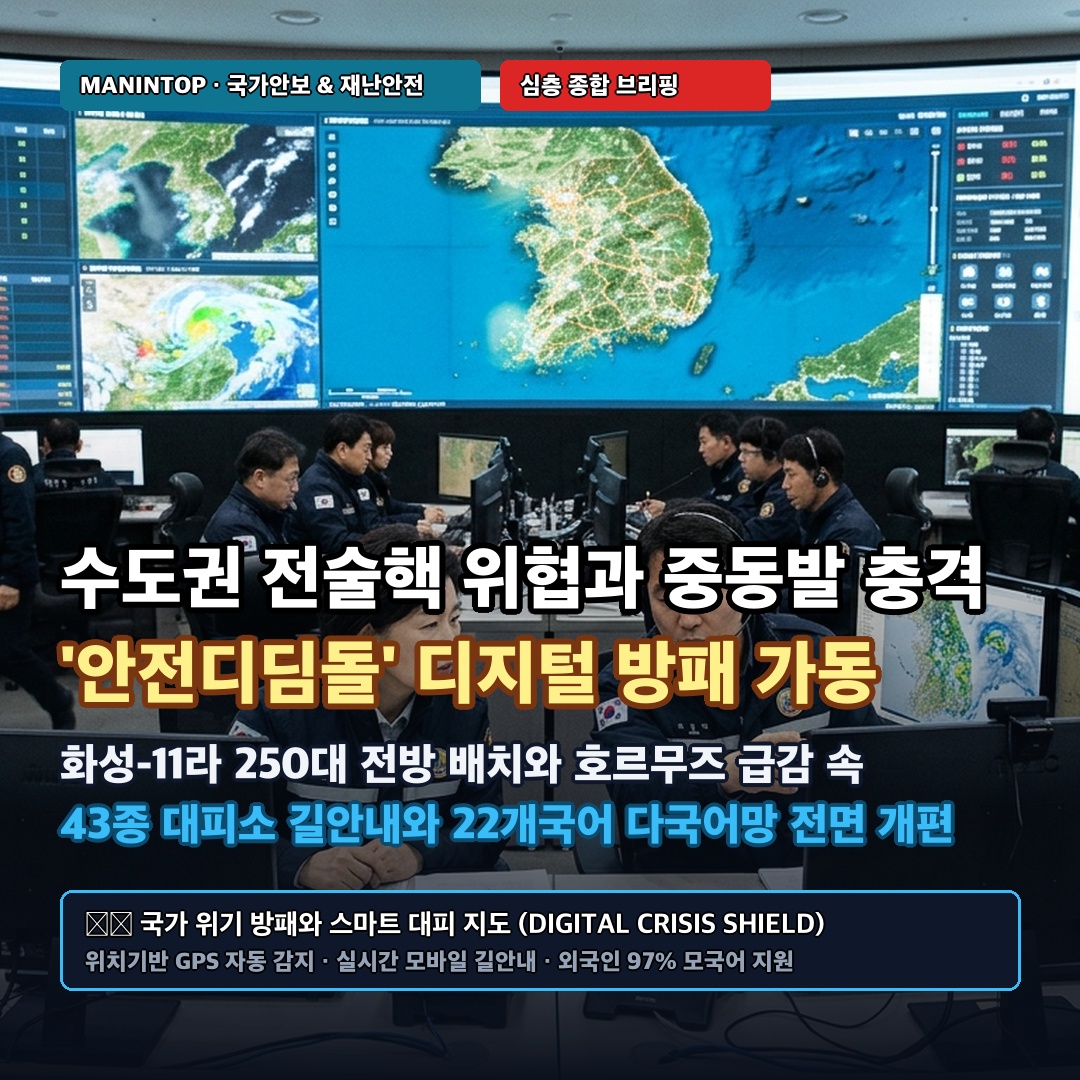
▲ 정부합동 재난안전종합상황실에서 관계관들이 전국 재난 감시 지도와 실시간 기상 레이더 화면을 점검하고 있다. 행정안전부는 2026년 6월 15일부터 실시간 GPS 기반 위치 인식과 43종 대피 시설 네비게이션 길안내를 제공하는 '안전디딤돌' 전면 개편 서비스를 개시했다. [사진: 행정안전부 재난안전종합상황실 보도자료]
핵심 쟁점 3줄 요약
북한 화성-11라 250대 전방 배치로 서울·평택 136km 타격권 노출 및 DMZ 5~82m 초근접 요새화
미·이란 충돌 속 호르무즈 물동량 70% 급감과 1,450원 고환율로 한국 실물 경제 4대 공급망 충격
행정안전부 6월 15일 '안전디딤돌' GPS 위치인식, 43종 대피소 길안내, 22개국어 다국어망 전면 가동
2026년 한반도를 둘러싼 군사적 안보 환경과 대외 실물 경제, 그리고 국민 일상의 재난 대비 체계가 동시에 유례없는 중대한 전환기를 맞이하고 있습니다. 북한은 전술핵과 재래식 무기를 전장에서 일체형으로 사용하는 '재래식-핵 통합(CNI)' 군사전략을 공식화하고 사거리 136km의 신형 전술탄도미사일 '화성-11라' 250대를 최전방 국경 부대에 전격 배치하여 서울과 수원, 평택 캠프 험프리스를 포함한 수도권 전역을 직접적인 타격권에 두었습니다. 이와 동시에 비무장지대(DMZ) 일대에서는 군사분계선에 불과 5~82m까지 근접한 대규모 방벽 축조와 지뢰 매설을 강행하며 '적대적 두 국가'의 국경을 일방적으로 영구 고착화하고 있습니다. 대외적으로도 2026년 2월 말 발발한 미국과 이란 간의 직접 군사 충돌로 세계 해상 원유 수송로인 호르무즈 해협의 물동량이 70% 급감하면서 1,450원대 고환율과 원자재 가격 폭등이라는 복합 경제 충격이 한국 산업계를 정면으로 강타했습니다. 이러한 복합 위기 속에서 국내 독자 핵무장 지지 여론이 74%에 달하는 등 안보 패러다임이 격변하자, 정부는 2026년 6월 15일을 기점으로 '안전디딤돌' 앱을 전면 개편하여 실시간 GPS 기반 위치 인식과 43종 대피 시설 네비게이션 길안내, 22개국어 다국어 지원망을 전격 가동하며 국민의 생명과 안전을 지키는 디지털 방패 구축에 총력을 기울이고 있습니다.
1. 전방 군단의 미사일화: '화성-11라' 250대와 수도권-평택 회랑 136km 타격권
북한의 군사전략 진화에서 가장 주목해야 할 대목은 전방 군단 화력의 전면적인 미사일화와 전술핵 실전 배치입니다. 과거 김정일 정권 당시의 핵 개발이 체제 생존과 외교적 협상 카드로 쓰이던 '정치적 상징 억제'에 머물렀다면, 김정은 정권은 이를 실제 전장에서 군사적 승리를 거두기 위한 '작전적 운용 수단'으로 완전히 재정의했습니다. KDI 한국개발연구원의 분석에 따르면 북한은 2022년 9월 '핵무력 정책 법령' 제정을 통해 지휘부 무력화와 전장 통제를 위한 선제적 핵 사용을 법제화한 데 이어, 전방 부대에 전술핵탄두 '화산-31'을 장착할 수 있는 신형 유도무기를 집중 배치하고 있습니다. 이는 한반도 전역을 대상으로 제한핵전을 실제 작전 옵션으로 내재화했음을 의미합니다.
특히 2024년 8월 국경 제1선 전방 부대에 발사대 250대가 인도된 '화성-11라'는 과거 노후한 KN-02 독사 미사일을 완전히 대체하며 전방 포병의 판도를 바꿨습니다. 2026년 4월 20일 실시된 최종 시험발사에서 136km 비행을 성공적으로 검증한 이 미사일은 서부전선 4군단에 배치될 경우 서울과 인천은 물론, 주한미군 핵심 기지인 평택 캠프 험프리스(100~110km)와 오산 공군기지(90km), 천안과 아산까지 완벽히 사정권에 집어넣습니다. 더욱이 수십~수백 발의 자탄을 공중 살포해 축구장 18개 넓이에 달하는 12.5~13헥타르(ha)를 초토화하는 '산포전투부(집속탄)'와 지면에 깔려 기동로를 차단하는 '파편지뢰전투부'까지 다종화 시험을 마침으로써, 수도권-평택 한미 핵심 축선을 정밀 타격과 면적 제압이라는 이중 위험에 동시에 노출시켰습니다.
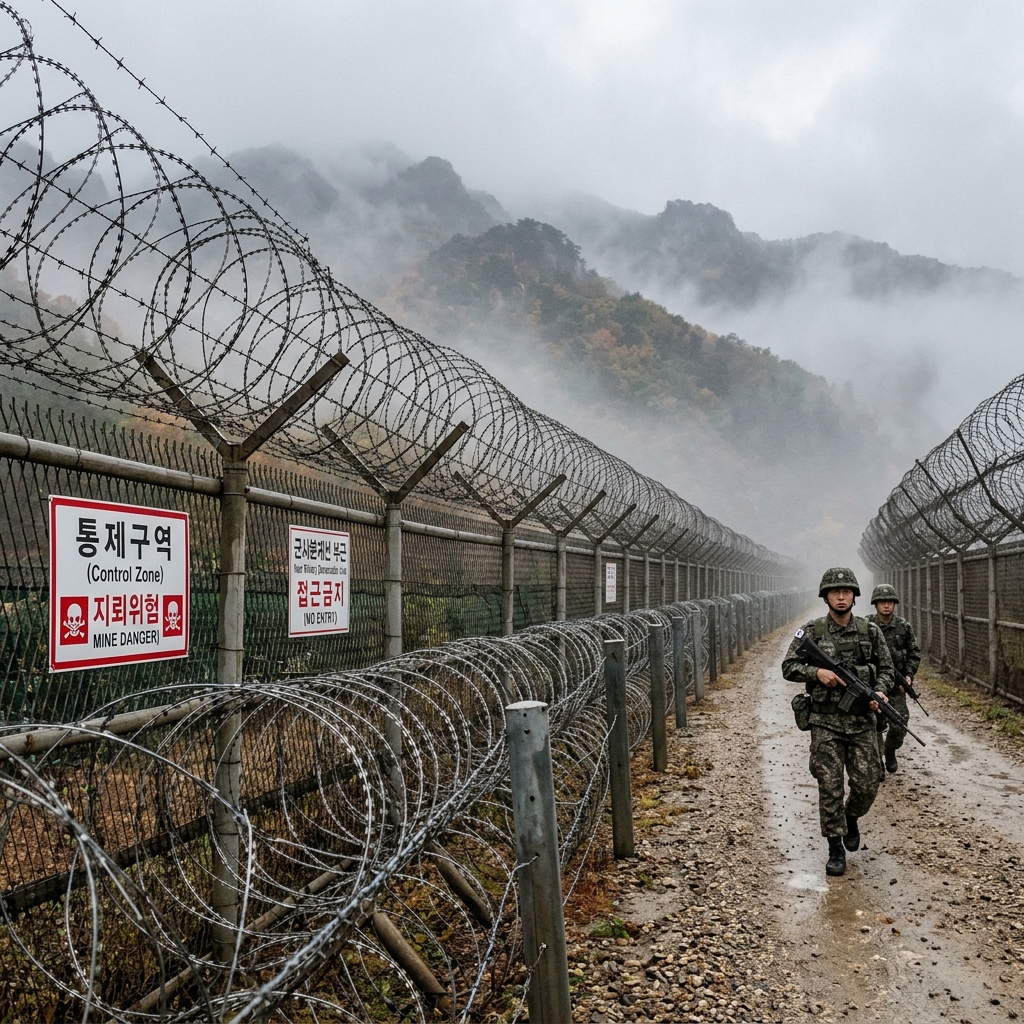
▲ 비무장지대(DMZ) 최전방 철책 너머로 북한군이 군사분계선(MDL) 인근에 축조 중인 대전차 방벽과 전술도로 공사 현장이 식별되고 있다. 북한은 2024년 4월부터 전 전선에 걸쳐 5~82m 초근접 요새화 작업을 강행하며 남북 완충지대를 해체하고 있다. [사진: 국방안보 프레스 풀]
2. DMZ의 국경화와 5~82m 초근접 요새화… 완충지대 사라진 접경지의 일촉즉발 위기
지상 접경지대에서는 반세기 넘게 평화를 지탱해 온 비무장지대(DMZ)의 완충 기능이 급격히 해체되고 있습니다. 북한은 2023년 말 '적대적 두 국가론'을 선언하고 남북을 잇던 경의선·동해선 철도와 도로를 폭파한 데 이어, 2024년 4월부터 전 전선에 걸쳐 2028년 완공을 목표로 대대적인 '남부국경 요새화' 공사를 밀어붙이고 있습니다. 일평균 최대 7,000여 명의 병력과 주민을 강제 동원한 이 공사는 전방 시야 확보를 위한 수목 벌채(불모지화), 신속 이동을 위한 전술도로 개설, 보병과 전차 침투를 막는 고밀도 지뢰 매설, 그리고 대전차 방벽과 영구 철책 설치라는 4단계 공정으로 일사불란하게 진행되고 있습니다.
가장 심각한 군사적 뇌관은 북한의 구조물들이 군사분계선(MDL)에 극도로 근접해 축조되고 있다는 사실입니다. 신설 철책이 군사분계선에서 불과 82m 거리까지 남하했고, 경계선 북쪽 불과 5~10m 지점에서도 지뢰 매설 작업이 포착되었습니다. 정전협정 체결 당시 설치된 1,292개의 군사분계선 표지판 중 현재 식별 가능한 것이 200여 개에 불과하여 남북 간 인식 오차가 존재하는 상황에서, 북한은 방벽을 앞세워 경계선을 자의적으로 기정사실화하려 하고 있습니다. 더욱이 MDL 코앞까지 연결된 전술도로는 유사시 병력과 특수부대를 기습 투입했다가 신속히 빠지는 치고 빠지기식 작전을 가능하게 하여, 접경지에서의 우발적 충돌이 전면전으로 번질 위험성을 어느 때보다 고조시키고 있습니다.
3. 미국의 '이중억제' 딜레마와 독자 핵무장 74% 찬성… 요동치는 안보 여론
북한의 핵·미사일 위협이 눈앞의 현실로 다가오면서 한미동맹 내부의 구조적 딜레마도 깊어지고 있습니다. 세종연구소의 학술 분석에 따르면 미국의 확장억제는 단순히 동맹을 지켜주는 방패에 그치지 않고, 적대국의 도발을 막는 동시에 한국의 독자 핵개발과 군사적 자율성을 제어하는 '이중억제(Dual Deterrence)' 구조로 작동해 왔습니다. 1978년 한미안보협의회의(SCM)에서 '핵우산'이 명문화된 것이나 2006년 1차 북핵 실험 후 '확장억제'가 공식 채택된 역사적 배경에는 한국의 독자적 핵무장을 차단하려는 미국의 의도가 깔려 있었습니다.
그러나 북한이 미국 본토를 겨냥한 ICBM 능력을 고도화하면서 '과연 미국이 뉴욕이나 LA를 위험에 빠뜨리면서까지 서울을 지키기 위해 핵 보복에 나설 것인가'라는 국민적 의구심은 역대 최고조에 달했습니다. 여론조사 통계는 이러한 인식 변화를 명확히 보여줍니다. 2025년 1월 KBS 조사에서 국민의 74%가 독자 핵무장에 찬성했으며, 최종현학술원(72.8%)과 아산정책연구원(70.9%) 조사에서도 일관되게 70%를 상회했습니다. 특히 한국국방연구원(KIDA) 조사에서는 핵무장을 지지한 응답자의 53.3%가 미국의 핵 보복 공약을 확신하지 못한다고 답했고, 통일연구원 조사에서는 사상 처음으로 '주한미군 주둔'(40.1%)보다 '독자 핵보유'(44.6%)를 우선 선택하는 골든크로스가 나타났습니다. 안보의 자율성을 확보하려는 국민적 열망이 동맹의 전통적 틀을 흔들고 있는 것입니다.
핵심 영역
위기 요인 및 발발 트리거
파급 메커니즘 및 국민 위험
정책 및 전주기 대응 체계
군사 안보
북한 CNI(재래식-핵 통합) 전략 공식화, 화성-11라 250대 전방 배치, DMZ 5~82m 초근접 요새화
수도권-평택 136km 타격권 노출, 12.5~13ha 면적제압, 완충지대 해체로 접경지 우발 충돌 위험 급증
4. 호르무즈 물동량 70% 급감과 1,450원 환율… 한국 실물 경제를 덮친 4대 공급망 충격
안보 위기의 먹구름은 대외 경제 전선에서도 짙게 드리우고 있습니다. 2026년 2월 28일 단행된 미국과 이스라엘의 이란 본토 타격은 수십 년간 이어져 온 중동의 대리전을 끝내고 직접적인 정면 군사 충돌을 촉발했습니다. 이란의 즉각적인 반격과 해상 봉쇄 위협으로 인해 전 세계 해상 원유 수송량의 26.9%를 담당하는 핵심 요충지 호르무즈 해협의 물동량은 평시 대비 무려 70% 급감했습니다. 원유의 70.7%, LNG의 20.4%를 중동에 의존하는 대한민국 경제의 숨통이 순식간에 조여든 것입니다.
삼일PwC경영연구원의 분석에 따르면 이번 중동 사태는 한국 경제에 가격, 물류, 금융, 무역이라는 4대 경로를 통해 파괴적인 충격을 가하고 있습니다. 1달러당 1,450원에 달하는 고환율 환경은 달러로 결제되는 국제유가와 해상 운임 상승분을 원화 기준 원가로 기하급수적으로 증폭시키는 기폭제가 되었습니다. 아프리카 희망봉으로 우회하는 3,800해리의 항로는 운송 기간을 10일 이상 지연시키며 기업들의 재고를 바다 위에 묶어두고 현금 흐름을 극도로 악화시키고 있습니다. 정유와 석유화학은 원가 급등과 마진 축소로 신음하고 있으며, 부품 하나만 부족해도 라인이 멈추는 자동차와 정밀 소재 공급이 생명인 반도체 산업 역시 비상 물류 체제로 전환했습니다.
이에 따라 국내 주요 대기업들은 비상 자금 계획을 수립하고, 필요한 물품을 바로 들여오는 적기 공급 방식(JIT)에서 위기에 대비해 충분한 물량을 미리 비축하는 안심 비축 방식(JIC)으로 재고 정책을 전면 수정하고 있습니다. 전문가들은 향후 72시간 이내에 전사적인 '비상 재무 워룸(Financial War Room)'을 가동하여 외화 유동성을 확보하고 납기 지연에 따른 계약 리스크를 선제적으로 방어해야 한다고 경고하고 있습니다.
이처럼 복합적인 안보 위기와 대외 충격이 중첩되자, 대한민국 정부는 비상사태와 재난 상황에서 국민 한 사람 한 사람의 생명을 지키기 위한 디지털 인프라를 대대적으로 혁신했습니다. 과거 북한 미사일 도발 시 일본 NHK의 즉각적인 대피 방송과 비교해 국내 정보 전달이 다소 미흡했다는 지적을 겸허히 수용하여, 행정안전부는 2026년 6월 15일을 기점으로 국가 대표 재난안전 앱 '안전디딤돌'과 외국인을 위한 '이머전시레디앱'의 전면 개편 서비스를 개시했습니다.
가장 눈에 띄는 혁신은 '안전디딤돌' 앱의 위치 기반 자동화와 네비게이션 연동입니다. 스마트폰의 GPS 위치 정보를 실시간으로 인식하여 앱을 켜자마자 현재 머물고 있는 지역의 긴급재난문자와 안전안내문자가 첫 화면에 가장 먼저 뜹니다. 낯선 출장지나 여행길에서도 즉각 위험을 인지할 수 있게 된 것입니다. 또한 제공되는 대피 시설 정보가 기존 16종에서 민방위 대피소, 지진 옥외대피장소, 무더위 쉼터, 응급의료기관 등 43종으로 2.7배 대폭 확대되었습니다. 무엇보다 모바일 지도 상에서 현재 내 위치로부터 가장 가깝고 안전한 대피소까지 걸어가거나 차로 이동하는 최적의 경로를 스마트폰 네비게이션처럼 생생하게 안내해 주는 '길안내 기능'이 탑재되어, 긴박한 공습경보나 지진 발생 시 골든타임을 확보할 수 있게 되었습니다.
국내 체류 외국인 287만 시대를 맞아 외국인 전용 '이머전시레디앱'도 혁명적인 변신을 마쳤습니다. 기존에는 영어, 중국어, 일본어 3개 언어만 지원되어 동남아 출신 근로자나 다문화 가정 주민들이 위기 상황에서 소외된다는 비판이 있었습니다. 이번 개편을 통해 베트남어, 태국어, 러시아어 등을 포함한 총 22개 언어로 번역 지원이 전면 확대되었습니다. 이로써 국내 체류 외국인의 97%가 모국어로 실시간 재난문자를 수신하고 행동요령을 확인하며 가까운 대피소로 안내받을 수 있는 포용적 안전망이 구축되었습니다.
구분 및 플랫폼
기존 운영 체계
2026 전면 개편 혁신
국민 체감 효과 및 활용성
안전디딤돌 위치 인식
광역 지자체 일괄 발송 및 이용자 거주지 수동 설정 방식
스마트폰 실시간 GPS 자동 인식, 현 위치 재난문자 첫 화면 최우선 노출
출장·여행 등 낯선 지역 방문 중에도 현 위치 위험 상황 즉시 인지 가능
대피 시설 정보 범위
민방위 대피소 등 16종 제한적 시설 정보만 단순 나열 제공
지진 옥외대피, 무더위 쉼터, 임시주거, 응급의료 등 43종으로 2.7배 확대
공습경보·지진·기상이변 등 재난 유형별 최적의 전문 시설 신속 선별
길안내 및 대피 경로
주소 텍스트 및 단순 정적 지도 핀 표시에 그쳐 이동 경로 파악 난항
모바일 지도 네비게이션 연동, 최단 도보 및 차량 대피 경로 실시간 안내
통신 혼잡 및 긴급 대피 상황에서 대피소를 찾지 못해 생기는 인명 피해 방지
이머전시레디앱 다국어
영어, 중국어, 일본어 3개 언어 한정 지원 (동남아 외국인 사각지대)
베트남, 태국, 러시아어 등 22개 언어 실시간 번역 지원으로 대폭 확대
체류 외국인 287만 명 중 97%가 모국어로 공습경보·재난문자 및 대피 안내 수신
전방에 배치된 전술핵 미사일의 가시적 위협과 호르무즈 해협에서 불어닥친 경제 한파는 대한민국 안보가 군사와 외교, 경제와 국민 일상을 아우르는 총력전의 단계에 진입했음을 웅변합니다. 강력한 군사적 방위 태세와 치밀한 대외 공급망 수호는 물론, 스마트폰 하나로 가장 가까운 대피 시설을 찾아 생명을 지킬 수 있는 촘촘한 디지털 재난 인프라가 유기적으로 맞물릴 때 비로소 대한민국의 안보 방패는 완성될 것입니다. 거센 지정학적 격랑 속에서 정부와 기업, 그리고 국민 모두가 비상한 경각심을 공유하며 탄탄한 위기 대응 역량을 갖춰나가야 할 시점입니다.
[In-Depth Analysis] Frontline Tactical Nuclear Threat and Hormuz Crisis: South Korea Deploys 43 Shelter Navigation and 22-Language Civil Defense Network
▲ Emergency management coordinators monitor interactive disaster GIS maps and satellite meteorological radar inside the National Disaster and Safety Operations Command Center. Effective June 15, 2026, the ministry initiated a major modernization of the Safety Stepping Stone app, offering GPS-driven alerts and 43 shelter navigation routes. [Photo: Ministry of the Interior and Safety Press Pool]
Key Takeaways: 3 Core Dimensions
250 Hwasong-11Ra frontline launchers expose Seoul and Pyeongtaek to a 136km strike radius alongside 5-82m DMZ fortifications
Strait of Hormuz maritime volume drops 70% amid US-Iran strikes, creating supply-chain headwinds under a 1,450 KRW exchange rate
Ministry of the Interior and Safety deploys GPS alerts, 43 shelter navigation routes, and 22 languages on June 15, 2026
In 2026, the national security landscape surrounding the Korean Peninsula, external economic stability, and citizen disaster preparedness systems are simultaneously undergoing an unprecedented structural transition. North Korea has formally codified its 'Conventional-Nuclear Integration (CNI)' military doctrine, which seamlessly integrates tactical nuclear weapons with conventional artillery on the operational battlefield. By deploying 250 newly manufactured Hwasong-11Ra tactical ballistic missile launchers along frontline border units, Pyongyang has placed the entire Seoul metropolitan area, Suwon, and the vital US military hub at Camp Humphreys in Pyeongtaek within an immediate 136-kilometer strike radius. Simultaneously, North Korea is accelerating extensive fortification construction within 5 to 82 meters of the Military Demarcation Line (MDL) in the Demilitarized Zone (DMZ), attempting to unilaterally solidify an international border under its 'hostile two states' paradigm. Abroad, direct military strikes between the United States and Iran in late February 2026 caused a severe 70% collapse in shipping traffic through the Strait of Hormuz, unleashing dual economic shocks of a 1,450 KRW high exchange rate and soaring raw material prices across South Korean industry. With public support for sovereign nuclear armament reaching 74% amid shifting alliance dynamics, the South Korean government launched a comprehensive digital defense overhaul on June 15, 2026. Upgrading the 'Safety Stepping Stone' and 'Emergency Ready' mobile applications with real-time GPS positioning, 43 disaster shelter navigation routes, and 22-language emergency networks, state authorities are mobilizing an all-encompassing digital shield to protect public safety.
1. Frontline Missile Transformation: 250 Hwasong-11Ra Launchers and the 136km Capital-Pyeongtaek Corridor
The most critical dimension of North Korea's evolving military posture lies in the comprehensive missile transition of its frontline army corps and the operational fielding of tactical nuclear warheads. While nuclear development during the Kim Jong-il era served primarily as political leverage and symbolic deterrence for regime survival, the Kim Jong-un leadership has redefined nuclear assets as operational weapons designed to secure direct battlefield victory. According to comprehensive strategic assessments by the Korea Development Institute (KDI), North Korea institutionalized preemptive nuclear strikes to neutralize allied command nodes and dominate battlefield escalation through its September 2022 nuclear policy legislation. This doctrinal shift has been reinforced by the rapid deployment of tactical strike units equipped with the Hwasan-31 miniaturized tactical nuclear warhead, embedding limited nuclear warfare as an active operational option across the Korean Peninsula.
In particular, the Hwasong-11Ra tactical ballistic missile, delivered to first-line border units with 250 mobile launchers in August 2024, has fundamentally transformed frontline artillery by completely replacing obsolete KN-02 Toksa missiles. Following finalized multi-warhead flight tests on April 20, 2026, verifying an operational range of 136 kilometers, this system deployed under the 4th Army Corps covers Seoul and Incheon, as well as Camp Humphreys in Pyeongtaek (100-110 km), Osan Air Base (90 km), and industrial clusters in Cheonan and Asan. Furthermore, the completed flight tests validated two distinct warheads: a submunition cluster warhead capable of carpet-bombing 12.5 to 13 hectares (the equivalent of 18 soccer fields) for wide-area neutralization, and a fragmentation mine warhead designed to disperse anti-vehicle and anti-personnel mines along allied mobilization routes, exposing the strategic Capital-Pyeongtaek corridor to simultaneous precision strike and area-denial risks.
▲ North Korean military construction of anti-tank concrete walls and tactical roads is visible near the Military Demarcation Line (MDL) from a frontline guard post. Since April 2024, North Korea has conducted ultra-close fortification between 5 and 82 meters from the border, dismantling the traditional DMZ buffer zone. [Photo: Defense Security Press Pool]
2. Border Hardening in the DMZ: 5-82m Ultra-Close Fortification and Dissolving Buffer Zones
Along the ground frontier, the historic buffering function of the Demilitarized Zone (DMZ), maintained for more than half a century under the 1953 Armistice Agreement, is rapidly disintegrating. Following the formal proclamation of the 'hostile two states' doctrine and the explosive destruction of inter-Korean railway and road corridors, North Korea launched a massive 'southern border fortification' offensive across the entire frontline in April 2024, aiming for complete structural hardening by 2028. Mobilizing up to 7,000 military and civilian personnel daily, the construction proceeds through a disciplined four-stage engineering sequence: clear-cutting trees and vegetation to establish unobstructed observation lines, constructing tactical logistics roads, laying dense minefields to block ground maneuvers, and erecting massive anti-tank concrete walls and permanent security fencing.
The primary operational flashpoint stems from North Korean barrier structures encroaching dangerously close to the Military Demarcation Line (MDL). Newly constructed border fences have advanced to within 82 meters of the MDL, while mine clearance and ground grading have been documented just 5 to 10 meters north of the border. With only approximately 200 of the original 1,292 armistice markers remaining identifiable due to weathering, North Korea is actively exploiting border ambiguities to establish unilateral territorial control. Crucially, tactical roads constructed directly up to the MDL allow North Korean assault units and special forces to execute rapid cross-border hit-and-run strikes before withdrawing behind minefields, elevating the structural risk of accidental border skirmishes escalating into wider military conflicts.
3. The US Dual Deterrence Dilemma and 74% Nuclear Support: Shifting Public Security Perceptions
As tactical nuclear threats become tangible realities, structural dilemmas within the ROK-US alliance have deepened significantly. Academic research from the Sejong Institute demonstrates that American extended deterrence historically operated under a 'Dual Deterrence' architecture, functioning not only as a protective shield against adversary aggression but also as an internal control mechanism to constrain South Korean autonomous nuclearization and military unilateralism. Landmark security milestones, including the codification of the 'nuclear umbrella' at the 1978 Security Consultative Meeting (SCM) and 'extended deterrence' following North Korea's 2006 nuclear test, were fundamentally engineered to restrain Seoul's independent weapons programs.
However, as North Korean intercontinental ballistic missiles (ICBMs) demonstrate credible capability to strike the continental United States, public skepticism over whether Washington would trade New York or Los Angeles to defend Seoul with nuclear retaliation has surged to historic highs. Empirical polling confirms this profound perceptual shift. In a January 2025 KBS national survey, 74% of South Korean citizens supported sovereign nuclear armament, a finding mirrored by the Chey Institute (72.8%) and the Asan Institute (70.9%). Notably, a Korea Institute for Defense Analyses (KIDA) poll revealed that 53.3% of pro-nuclear respondents doubt US nuclear retaliatory commitments during a full-scale crisis. Furthermore, the Korea Institute for National Unification (KINU) documented a historic golden cross where preference for independent nuclear weapons (44.6%) surpassed US troop presence (40.1%) for the first time, reflecting a growing societal demand for sovereign strategic autonomy.
Strategic Domain
Crisis Trigger
Transmission & Public Risk
Policy & Defense Architecture
Military Security
North Korean CNI doctrine institutionalized; 250 Hwasong-11Ra launchers deployed; DMZ 5-82m fortification
Capital-Pyeongtaek 136km strike radius; 12.5-13ha area denial; elevated risk of accidental border clash
Direct US-Iran confrontation; 70% shipping drop in Hormuz (chokepoint for 26.9% of global seaborne oil)
1,450 KRW high exchange rate multiplies costs; Cape routing adds 10 days; working capital tied in cargo
Activate 72-hour Financial War Rooms; diversify crude/LNG contracts; pivot from JIT to JIC stockpiling
Civil Disaster Safety
Demand for real-time digital alert modernization against compound crises (MOIS June 15 overhaul)
Alert delays during air raid crises; difficulty finding shelters in unfamiliar areas; foreign resident blind spots
Deploy GPS auto-detection, 43 shelter navigation in Safety Stepping Stone, and 22 languages in Emergency Ready App
4. 70% Plunge in Hormuz Traffic and 1,450 KRW Exchange Rate: Four Supply-Chain Shocks Hitting Industry
Security challenges are simultaneously compounding along South Korea's external economic perimeter. Direct military strikes conducted by the United States and Israel against Iranian territory on February 28, 2026, dismantled decades of shadow proxy conflict, triggering open interstate confrontation. In response to Iranian retaliatory strikes and maritime closure threats, shipping volume through the Strait of Hormuz—conduit for 26.9% of global seaborne petroleum—collapsed by 70%. With South Korea reliant on the Middle East for 70.7% of its crude oil imports and 20.4% of liquefied natural gas (LNG), vital domestic energy lifelines were immediately constrained.
An emergency assessment by Samil PwC Management Research Institute highlights four distinct transmission channels through which the Middle East crisis impacts South Korean industry: price, logistics, financial, and trade mechanisms. An elevated exchange rate of approximately 1,450 KRW per dollar has acted as a cost multiplier, exponentially amplifying international energy and freight costs in domestic currency terms. Rerouting maritime traffic around Africa's Cape of Good Hope adds 3,800 nautical miles and delays cargo lead times by over ten days, trapping corporate cash flow in floating maritime inventories. Petrochemical and refining producers face severe margin compression, while automotive and semiconductor manufacturers, highly sensitive to component shortages and precision chemical inputs, have initiated emergency air cargo diversions.
In response, leading Korean industrial conglomerates are restructuring corporate inventory management, abandoning Just-in-Time (JIT) lean logistics in favor of resilient Just-in-Case (JIC) strategic stockpiling. Corporate strategists strongly urge businesses to activate dedicated 'Financial War Rooms' within 72 hours to audit foreign currency liquidity, manage derivative margin calls, and mitigate contractual liabilities arising from international shipping disruptions.
5. Digital Lifeline on Smartphones: MOIS Overhauls Safety Stepping Stone with 43 Shelter Navigation and 22 Languages
Confronting this dual matrix of frontline military tension and macroeconomic volatility, the South Korean government has implemented a comprehensive technological overhaul of its civilian disaster communication network. Addressing long-standing public concerns regarding the speed and granularity of domestic alerts compared to Japanese systems during regional missile launches, the Ministry of the Interior and Safety (MOIS) launched fully modernized versions of its primary 'Safety Stepping Stone' portal and the foreign resident 'Emergency Ready App' on June 15, 2026.
The central breakthrough in the upgraded Safety Stepping Stone app is the integration of real-time GPS location tracking with automated navigation routing. By automatically detecting user coordinates upon launch, the application immediately displays localized emergency alerts and civil protection notices for the exact municipality where the user is physically located, ensuring instantaneous situational awareness during travel or transit. Furthermore, documented disaster shelter facilities have expanded 2.7-fold from 16 to 43 distinct categories, encompassing civil defense bunkers, outdoor earthquake assembly sites, climate shelters, and emergency medical centers. Crucially, the app now provides turn-by-turn mobile navigation, calculating the safest pedestrian and vehicular routes to the nearest verified shelter to preserve life-saving golden time during air raid warnings or seismic events.
Recognizing South Korea's growing foreign resident population of 2.87 million, the dedicated 'Emergency Ready App' underwent a linguistic transformation. Previously restricted to English, Chinese, and Japanese, which left many Southeast Asian workers and multicultural families vulnerable, the application now supports 22 global languages, including Vietnamese, Thai, Russian, and Filipino. This expansion guarantees that 97% of foreign nationals residing in South Korea receive real-time translated civil protection alerts, official behavioral guidelines, and localized evacuation routes in their native languages, establishing an inclusive and equitable national safety net.
Platform & Category
Legacy System
2026 Modernized Architecture
Public Benefit & Operational Impact
Location Recognition
Broad municipal broadcast with manual residential settings
Real-time smartphone GPS detection; instant localized alert prioritization on home screen
Immediate hazard awareness when traveling or transiting through unfamiliar municipalities
Shelter Information
Limited list of 16 civil defense shelters with basic text descriptions
Expanded 2.7-fold to 43 categories including seismic, climate, and medical emergency hubs
Rapid matching of optimized shelter facilities based on specific crisis type (air raid, quake, flood)
Navigation & Routing
Static map pin placement without active turn-by-turn guidance
Integrated mobile turn-by-turn navigation displaying optimal pedestrian and vehicle routes
Prevents casualties caused by lost evacuation time during network congestion and air alerts
Multilingual Access
Restricted to English, Chinese, and Japanese (excluding Southeast Asian residents)
Expanded to 22 global languages including Vietnamese, Thai, Russian, and Filipino
Ensures 97% of 2.87 million foreign residents receive real-time native language safety alerts
The tangible frontline deployment of tactical ballistic missiles combined with maritime supply-chain turbulence in the Middle East proves that South Korea's national security has evolved into a total state endeavor encompassing military vigilance, diplomatic resilience, economic security, and civilian protection. A formidable deterrence posture and strategic supply-chain alliances must be matched by robust civil defense digital infrastructure that empowers everyday citizens to locate immediate sanctuary via their smartphones. Navigating complex geopolitical crosscurrents demands synchronized crisis readiness across government, industry, and the public to ensure sovereign safety and enduring peace.
PRO SOURCING ENGINE만인의 탑 빅데이터 솔루션
★ 가입 시 600 크레딧(120회) 전원 무료
내가 찾는 상품 키워드, 지금 얼마나 검색될까?
네이버 월간 검색량 + 구글 볼륨 + 아이템스카우트 실시간 상품수와 경쟁강도 배지를 0.5초 만에 무료로 확인하세요.
MANINTOP NEWSLETTER
📬 만인의 탑 뉴스레터 무료 구독
오늘 보신 정책·시사 뉴스가 유익하셨나요? 매일 엄선되는 알짜 복지 혜택과 국회 실시간 속보를 이메일로 가장 먼저 받아보세요. (평생 무료)
1월이 시작되면 감기는 이미 우리 곁에 와 있습니다. 2월, 3월, 4월까지 이어지는 추위와 건조함은 코와 목을 가장 먼저 공격합니다. 아침에 일어나자마자 막혀 있는 코. 계속 흐르는 콧물. 괜히 칼칼해지는 목. 이 증상은 “시작”일 뿐입니다. 한 번 무너지면 일주일, 길면 한 달까지 끌고 갑니다. 약을 먹으면 잠깐 괜찮아집니다. 하지만 며칠 뒤 또 반복됩니다. 왜일까요? 감기는 ‘치료’의 문제가 아니라 ‘관리’의 문제이기 때문입니다. 대부분은 감기가 오고 나서 약을 찾습니다. 하지만 진짜 중요한 건 감기가 오기 전에 코와 목을 지키는 것입니다. 건조한 실내 공기, 차가운 바깥 공기, 눈에 보이지 않는 세균. 코와 목은 매일 공격받고 있습니다. 지긋지긋하죠! 그런데도 우리는 아무 준비 없이 버티고 있습니다. 이번 겨울도 그렇게 보낼 건가요? 사실 방법은 어렵지 않습니다. 코를 깨끗하게 관리하고, 목을 따뜻하게 보호하고, 점막을 촉촉하게 유지하고, 기관지를 미리 관리하고, 외부 공기를 차단하는 것. 이 다섯 가지만 꾸준히 해도 감기약 없이 겨울을 보내는 것이 충분히 가능합니다. 🔥 이제부터 그 방법을 하나씩 살펴보겠습니다. 🔥 1. 코와 목을 먼저 관리해야 하는 과학적 이유 감기의 대부분은 코 점막에서 시작됩니다. 국제 학술지 Nature Reviews Microbiology 와 Journal of Allergy and Clinical Immunology 에 실린 호흡기 감염 관련 연구들에서는, 감기 바이러스가 비강 상피세포에 먼저 부착해 증식한다는 점을 설명하고 ...
리모델링사업이 진행 중인 아파트를 매매할 때 “계약금 10%를 언제까지 내야 하느냐”는 질문이 특히 많이 나옵니다. 이주공고(이주 안내)가 7~11월쯤이라고 들으면, 그 시점에 맞춰 계약금도 움직일 것 같아서 더 헷갈리기 쉽습니다. 하지만 실제 납부기한은 ‘이주공고가 언제냐’만으로 자동 결정되지 않는 경우가 많습니다. 1) 계약금 10% 납부기한: 결국 ‘문서에 적힌 일정’이 기준 계약금 10%를 언제까지 납부해야 하는지는, 내가 서명하는 매매계약서(특약 포함) 와 사업주체/조합이 제시한 공고·안내문 에 적힌 납부 일정이 기준이 됩니다. 실제 공고문에서는 분양대금 납부의 큰 틀(계약금→중도금→잔금)을 먼저 안내하고, 상세 일정은 별도 표나 유의사항으로 제시하는 방식이 흔합니다. 또, 계약서 문구에 따라 지급 시점이 조건부로 설정될 수도 있습니다. 예를 들어 한 사례 소개 자료에서는 용역계약서에 잔금(10%) 지급시기가 “사업승인 후”로 기재되어 있었다는 점이 언급됩니다. 이런 식으로 ‘사업 단계’와 지급을 연동하는 문구가 들어가면, 질문의 답은 계약서 문구를 확인해야만 확정됩니다. 관련 내용은 링크 에서 문구 사례를 확인할 수 있습니다. 2) 입주자모집공고에서 확인되는 ‘납부 순서’와 잔금 마감 시점 공고문에 적힌 문구를 보면, 납부 순서와 잔금 마감에 대한 기준이 비교적 명확하게 제시되는 경우가 있습니다. 예를 들어 한 입주자모집공고에는 “분양금액(주택가격)은 계약금, 중도금, 잔금의 순서로 납부”하며 “잔금은 입주(열쇠 수령일) 전에 완납”해야 한다고 안내되어 있습니다. (문구 확인: 링크 ) 이 문구가 의미하는 바는 최소 2가지입니다. 분양/공급 형태의 문서에서는 ‘계약금→중도금→잔금’ 흐름이 공식적으로 안내될 수 있습니다. 잔금은 “입주(열쇠 수령)” 이전에 완납해야 한다는 마감 기준이 문서에 적혀 있을 수 있습니다. 다만, 위 공고문 문구는 잔금 마감에 대한 기준을 보여주지만, 계약금 10%의...
윤석열 전 대통령 탄핵 인용 소식을 접하면, 가장 궁금한 지점은 ‘헌재가 정확히 무엇을 위헌·위법으로 봤는가’입니다. 또한 탄핵과 별개로 진행되는 형사재판(내란 우두머리 혐의 등)이 어디까지 왔는지도 함께 정리할 필요가 있습니다. 아래 내용은 제공된 기사/게시물 스니펫과 링크에서 확인되는 범위만 모아, 일반인이 흐름을 이해하기 쉽게 정리한 것입니다. 1) 탄핵 인용 관련: 스니펫에서 확인되는 ‘판단의 골격’ 제공된 근거 중 조국혁신당 사이트에는 헌법재판소가 윤석열 탄핵 심판에서 “피청구인의 위헌·위법행위는 국민 신임 …”이라는 취지로 판단했다는 문장이 인용돼 있습니다( 링크 ). 이 인용문만 놓고 보면, ‘위헌·위법행위’가 있었는지와 그로 인해 ‘국민의 신임’이 어떻게 평가됐는지가 핵심 축으로 소개됩니다. 다만 질문에서 요청하신 세부 항목, 즉 비상계엄 선포 자체를 문제 삼은 구체적 이유, 계엄 이후 조치(포고령, 국회 통제 등)의 어떤 지점이 헌법 위반인지, 국회의 권한행사 방해 및 정치활동 제약을 어떤 논리로 판단했는지 등은, 이번에 제공된 근거의 제목/스니펫만으로는 조항·사실관계·판단 구조가 그대로 제시돼 있지 않습니다. 따라서 이 글에서는 ‘헌재가 무엇을 문제 삼았다’는 세부 리스트를 단정적으로 재구성하기보다, 현재 확인 가능한 문구 수준의 요약(위헌·위법행위 → 국민 신임의 문제로 평가)까지만 적습니다. 만약 헌재 결정문 전문(주문 및 이유)이 추가로 확인되면, 그때는 문장 단위로 ‘어떤 행위’와 ‘어떤 헌법 원리/조항’이 연결되는지(예: 권력분립, 국회의 권한, 정치적 기본권 등) 구조화해 정리하는 것이 가장 정확합니다. 2) 형사 절차(내란 혐의) 관련: 체포영장과 1심 선고 언급 탄핵 심판과 별도로, 12·3 비상계엄 사태로 내란 혐의를 받는 윤석열 대통령에 대해 2024년 12월 31일 체포 영장이 발부됐다는 BBC 보도가 있습니다( 링크 ). 해당 보도는 ‘현직 대통령’에 대한 체포영장 발부라는 점을 함께 언급합니다. 또...