"혈압약 한 알보다 세다?"… 고혈압 44% 낮추는 DASH 식단과 '유·무산소 복합 운동'의 기적
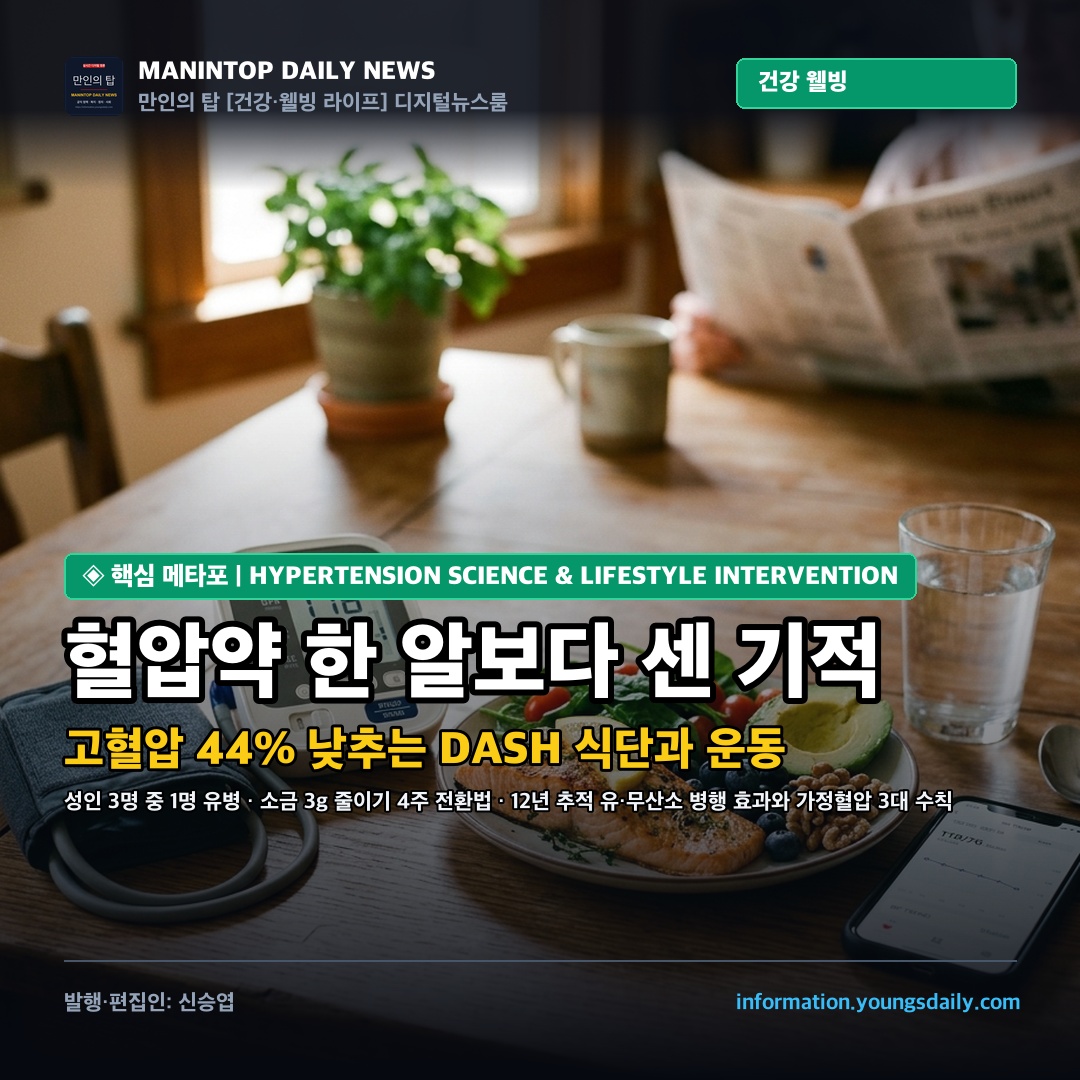
▲ 햇살이 비치는 아침 식탁 위에 놓인 전자 혈압계와 칼륨·식이섬유가 풍부한 DASH 식단. 식단 조절과 운동 중재를 병행하면 혈압약 한 알 이상의 강력한 혈압 강하 효과를 거둘 수 있다. [사진=만인의 탑 보건의학DB]
1. 침묵의 살인자 고혈압: 성인 3명 중 1명의 위기와 2026 진단 기준
고혈압은 뚜렷한 증상이 없으면서도 혈관을 서서히 망가뜨려 뇌졸중과 심근경색, 만성 신부전 등 치명적인 심뇌혈관 질환을 일으키는 대표적인 질환입니다. 세계보건기구(WHO)에 따르면 전 세계 12억 8천만 명이 고혈압을 앓고 있으며, 심장질환 사망의 45%, 뇌졸중 사망의 51%가 고혈압에서 비롯됩니다.
질병관리청과 국민건강영양조사 분석에 따르면 국내 30세 이상 성인의 고혈압 유병률은 약 29.1%에서 34.16%에 달합니다. 성인 3명 중 1명이 고혈압 환자인 셈입니다. 남성 유병률은 35%이며, 여성은 22.9% 수준이지만 폐경 이후 에스트로겐 분비가 줄어들면서 혈관 탄성이 급격히 떨어져 노년층 여성의 유병률이 가파르게 상승합니다. 55세에 정상 혈압을 유지하더라도 평생 살아가는 동안 고혈압이 발생할 확률은 90%에 육박합니다.
대한고혈압학회의 2026 고혈압 진료지침에 따른 기준은 명확합니다. 수축기 혈압 120 미만이면서 이완기 혈압 80 미만이어야 정상입니다. 수축기 120~139 또는 이완기 80~89는 고혈압 전단계로 즉각적인 식단과 운동 관리가 요구되며, 140 이상 또는 90 이상은 약물과 생활요법을 병행해야 하는 고혈압으로 확진됩니다.

▲ 가을 아침 공원에서 빠르게 걷기와 가벼운 근력운동을 병행하는 모습. 국립보건연구원 12년 추적 조사 결과 유산소 운동에 주 1회 근력운동을 병행할 때 고혈압 위험이 최대 44% 감소했다. [사진=만인의 탑 보건의학DB]
2. 약물급 강하 효과 DASH 식단과 한국형 저염 조리 비결
현재 전 세계 순환기 의학계가 가장 공인하는 식단은 미국 국립보건원(NIH)이 개발한 DASH(Dietary Approaches to Stop Hypertension) 식단입니다. DASH 식단은 단순히 싱겁게 먹는 것을 넘어, 혈관을 이완시키고 나트륨 배출을 촉진하는 칼륨, 칼슘, 마그네슘, 식이섬유를 전략적으로 공급하는 식사법입니다.
성인 412명을 대상으로 한 무작위 대조 임상시험에서 저나트륨 DASH 식단은 일반 고나트륨 식단에 비해 수축기 혈압을 8.9mmHg, 이완기 혈압을 4.5mmHg 더 떨어뜨렸습니다. 이는 통상적인 혈압약 한 알의 약효와 맞먹는 수준입니다. 2025년 발표된 DASH4D 임상시험에서도 여러 혈압약을 복용 중인 당뇨 환자에게 DASH 식단을 적용했을 때 4.6/2.3mmHg의 추가 혈압 강하가 나타났으며, 식단 전환 후 불과 2주 만에 혈압이 내려가기 시작했습니다.
한국인의 하루 평균 나트륨 섭취량은 3,136mg으로 세계보건기구 권고치(2,000mg)의 1.6배에 달합니다. 소금 섭취량을 하루 3g만 줄여도 혈압이 4~6/2~3mmHg 감소합니다. 식단을 바꿀 때는 4주 단계적 전환법을 추천합니다. 1주차에는 매끼 채소와 과일을 한 접시 추가하고, 2주차에는 흰쌀밥을 현미·귀리 등 통곡물로 바꿉니다. 3주차에는 저지방 유제품을 챙기고 육류를 줄이며, 4주차에는 가공식품을 끊고 나트륨을 1,500mg 이하로 조입니다.
한국 식탁 맞춤형 저염 비결도 간단합니다. 시판 쌈장에 으깬 두부를 1:1로 섞은 두부 저염 쌈장은 짠맛을 절반으로 낮추면서 단백질을 보강합니다. 양념간장에 발사믹 드레싱을 5:5로 섞으면 산뜻한 저염 소스가 완성됩니다. 두부는 양념에 조리지 말고 찜기에 쪄서 양념장을 살짝 찍어 먹고, 캔 참치나 콩 통조림은 요리 전 흐르는 물에 헹구면 나트륨을 대폭 씻어낼 수 있습니다.
3. 고혈압 위험 44% 낮추는 유·무산소 복합 운동의 과학
운동은 부작용 없이 혈관 탄성을 회복시키는 천연 치료제입니다. 질병관리청 국립보건연구원이 한국인유전체역학조사사업(KoGES)을 통해 5,075명을 12년간 추적 분석한 결과는 운동 처방의 새로운 이정표를 제시합니다.
주당 150분 이상 빠르게 걷기 등 중강도 유산소 운동만 실천해도 고혈압 위험이 남성 31%, 여성 35% 감소했습니다. 여기에 주 1회 이상의 근력운동을 병행하자 고혈압 발생 위험이 남성은 34%, 여성은 무려 44%까지 대폭 줄어들었습니다. 특히 여성은 유산소 단독 그룹에 비해 근력운동을 병행했을 때 고혈압 위험이 35% 추가 감소했습니다. 반면 근력운동만 단독으로 했을 때는 유의미한 예방 효과가 나타나지 않았습니다.
운동을 하면 혈관 내피세포에서 산화질소(NO)가 분비되어 좁아진 혈관이 시원하게 확장됩니다. 하루 30분 빠르게 걷기를 12주간 실천한 환자는 수축기 혈압이 10.7mmHg, 이완기 혈압이 5.7mmHg 낮아졌습니다. 최근 주목받는 벽에 등 대고 버티는 월 싯(Wall-sit)이나 플랭크 같은 아이소메트릭(등척성) 운동 역시 안정 시 혈압 강하에 탁월합니다. 존스홉킨스 의대의 PREMIER 임상에 따르면 DASH 식단과 주당 150분 운동을 결합했을 때 수축기 16mmHg, 이완기 10mmHg라는 파격적인 강하 효과를 거두었습니다.
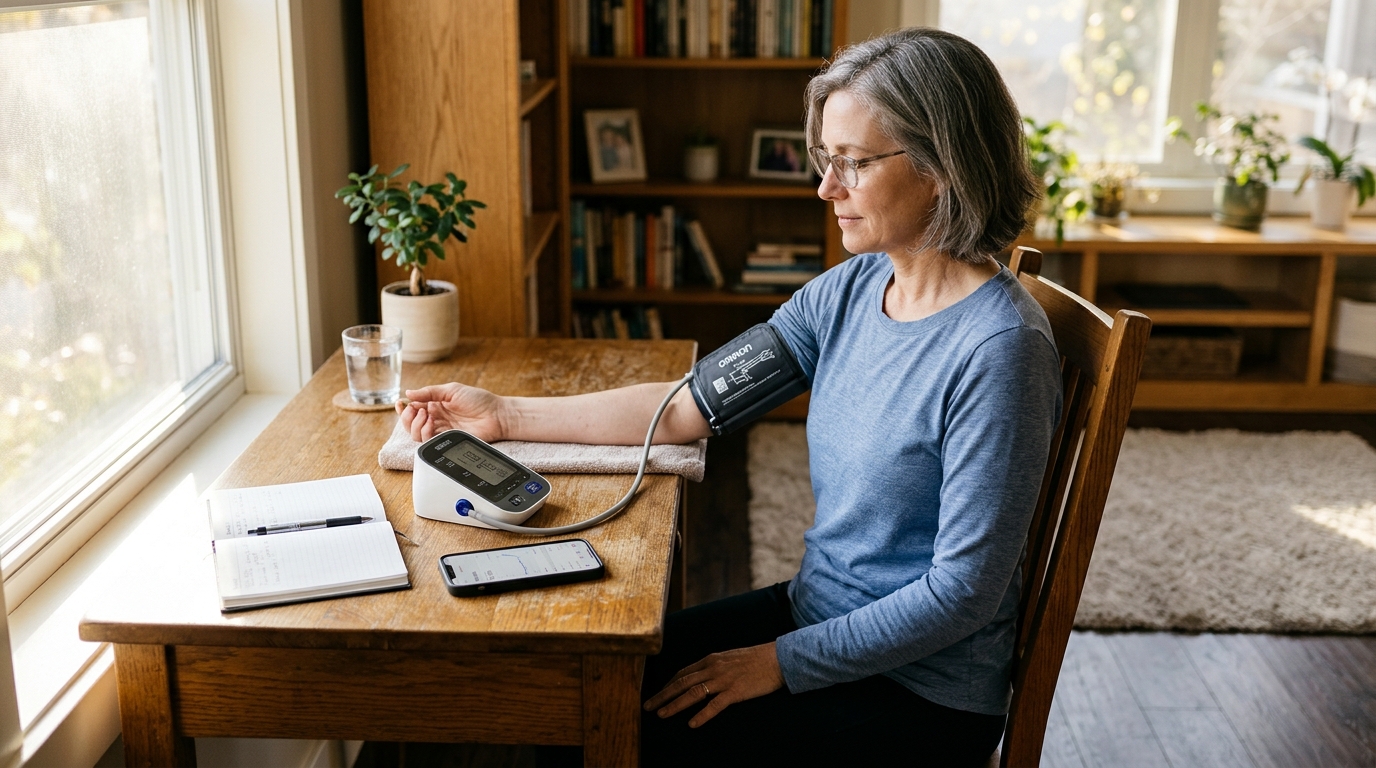
▲ 조용한 방에서 등을 기대고 심장 높이로 위팔 커프를 맞춘 채 가정 혈압을 측정하는 모습. 5분간 안정 후 아침·저녁 2회 측정 루틴을 지켜야 백의 고혈압과 조조고혈압을 정확히 감별할 수 있다. [사진=만인의 탑 보건의학DB]
4. 고혈압 생활습관 중재 4대 영역 핵심 대조표
식단, 운동, 이완 요법, 정밀 모니터링에 이르는 4대 핵심 비약물 중재 요법의 메커니즘과 임상 효과를 정밀 대조표로 집약했습니다.
| 생활습관 중재 영역 | 과학적 메커니즘 및 실천 수칙 | 임상시험 혈압 강하 및 위험 감소 수치 | 한국인 실생활 적용 꿀팁 |
|---|---|---|---|
| DASH 식단 및 저염식 | 칼륨·칼슘·마그네슘 공급으로 나트륨 배출 혈관 평활근 이완 및 혈관벽 탄성 회복 |
수축기 8.9mmHg, 이완기 4.5mmHg 강하 (소금 3g 감량 시 4~6/2~3mmHg 추가 강하) |
두부 으깬 저염 쌈장(1:1), 발사믹 간장 드레싱, 통조림 물 세척, 4주 단계적 전환 |
| 유산소 + 근력 복합 운동 | 산화질소(NO) 분비로 혈관 확장 촉진 자율신경 균형 및 운동 후 지속 저혈압 유도 |
유·무산소 병행 시 고혈압 위험 44% 급감 (질병관리청 12년 추적 KoGES 코호트) |
주 150분 빠르게 걷기 + 주 2~3회 스쿼트·플랭크, 숨참는 발살바 호흡 절대 금지 |
| 분당 10회 느린 심호흡 | 내쉬는 숨 연장으로 화학수용체 자극 연수 부교감신경 활성 및 말초혈관저항 감소 |
7일간 아침 15분 실시 후 11.0/8.44mmHg 강하 (두통 및 목덜미 뻐근함 완화율 90%) |
기상 후 편안한 의자에서 4초 들이마시고 6초 천천히 내쉬는 복식 호흡 15분 실천 |
| 가정 혈압 정밀 모니터링 | 진료실 백의 고혈압 및 일상 가면 고혈압 방지 위팔 커프 심장 높이 일치 측정 |
아침 일주일 평균 134/84 이상 시 조조고혈압 경보 (뇌졸중 및 심근경색 조기 차단) |
'5분의 약속'(대화·스마트폰 금지), 아침 기상 1시간 내 복약 전 2회 측정 평균 기록 |
5. 하루 15분 느린 심호흡과 혈관 청소부 오메가3의 힘
약물 없이 자율신경계를 안정시켜 혈압을 즉각 떨어뜨리는 자연 요법으로 '느린 심호흡(Slow Deep Breathing)'이 주목받고 있습니다.
국제 임상 연구에 따르면 고혈압 환자에게 아침마다 15분간 분당 10회 이하로 천천히 복식 호흡을 하게 한 결과, 불과 7일 만에 수축기 혈압이 151.8mmHg에서 140.8mmHg로 11.0mmHg 감소했고, 이완기 혈압도 8.44mmHg 떨어졌습니다. 두통과 목덜미 통증 완화율은 90%에 달했습니다. 숨을 길게 내쉬면 체내 화학수용체가 자극되어 연수의 부교감신경이 활성화되고 교감신경의 긴장이 풀리면서 전신 말초 혈관 저항이 즉각 낮아지기 때문입니다.
이와 함께 고등어, 삼치, 연어 등 등푸른생선에 풍부한 불포화지방산 오메가3를 주 2~3회 꾸준히 섭취하면 혈중 중성지방을 낮추고 혈관 내피세포의 염증을 가라앉혀 혈압을 안정적으로 유지하는 데 큰 도움을 줍니다.
6. 가정 혈압 측정 3대 골든룰과 응급실 직행 신호
병원에만 가면 긴장해 혈압이 오르는 백의 고혈압이나, 병원에서는 정상인데 일상에서 치솟는 가면 고혈압을 잡으려면 올바른 가정 혈압 측정이 필수입니다. 순환기내과 전문의들이 권고하는 3대 골든룰은 다음과 같습니다.
• 5분의 약속: 등받이 의자에 등을 편안히 기대고 다리를 꼬지 않은 채 5분간 안정을 취합니다. 측정 중 스마트폰을 보거나 대화를 하면 혈압이 순간적으로 10~15mmHg 치솟으므로 대화를 완전히 멈춰야 합니다. 측정 30분 전 커피, 담배, 운동을 피하고 미리 소변을 봅니다.
• 심장 높이 일치: 커프 중심부가 반드시 심장 높이와 일치해야 합니다. 팔꿈치 접히는 선 위로 1~2cm 띄워 손가락 하나가 들어갈 정도로 감으며, 손목형보다는 위팔 커프형 혈압계를 사용하는 것이 표준입니다.
• 양팔 측정 및 조조고혈압 경보: 처음 잴 때는 양팔을 모두 재보고 더 높은 수치가 나오는 팔을 기준 팔로 삼습니다. 양팔 차이가 20mmHg 이상 벌어지면 혈관 협착을 의심해야 합니다. 아침 기상 후 1시간 이내 복약 전 측정한 일주일 평균 혈압이 134/84mmHg 이상이면 뇌졸중 위험이 높은 조조고혈압이므로 진료 시 의료진에게 앱 기록을 보여주어야 합니다.
• 약물 임의 중단 금지 및 119 응급 신호: 혈압이 안정되었다고 약을 갑자기 끊으면 원래보다 더 치솟는 반동성 고혈압으로 뇌졸중이 올 수 있습니다. 만약 혈압이 180/120mmHg 이상으로 치솟으면서 쥐어짜는 가슴 통증, 극심한 두통, 호흡 곤란, 언어 장애, 마비 감각이 나타나면 급성 뇌출혈이나 심근경색을 의미하므로 즉시 119를 부르고 응급실로 가야 합니다.
"More Potent Than a Daily Pill": The Clinical Miracle of the DASH Diet and Combined Exercise Slashing Hypertension Risk by 44%
▲ A digital upper-arm blood pressure monitor displaying optimal readings alongside a colorful DASH diet meal rich in potassium and fiber. Combining evidence-based nutrition with exercise yields therapeutic effects rivaling pharmaceutical medication. [Photo: MANINTOP Health DB]
1. The Silent Killer: 1 in 3 Adults Affected and 2026 Diagnostic Benchmarks
Hypertension progresses largely without overt warning signs while steadily damaging vascular networks, driving catastrophic complications including stroke, myocardial infarction, and end-stage renal failure. According to the World Health Organization (WHO), approximately 1.28 billion adults aged 30 to 79 live with hypertension globally, accounting for 45 percent of all cardiovascular deaths and 51 percent of fatal strokes.
In South Korea, Korea National Health and Nutrition Examination Survey data indicates an adult prevalence rate of 29.1 to 34.16 percent among those aged 30 and older. Male prevalence stands at 35.0 percent, while female prevalence reaches 22.9 percent. However, following menopause, diminished estrogen leads to arterial stiffening, causing female hypertension rates to surge sharply in later years. Even individuals maintaining normal blood pressure at age 55 face a lifetime hypertension risk of 90 percent.
The 2026 Clinical Practice Guidelines from the Korean Society of Hypertension establish strict parameters: systolic below 120 mmHg and diastolic below 80 mmHg constitutes normal blood pressure. Readings between 120 to 139 mmHg systolic or 80 to 89 mmHg diastolic denote prehypertension, demanding immediate dietary and fitness interventions, while readings reaching 140/90 mmHg or higher confirm clinical hypertension requiring comprehensive medical management.
▲ A middle-aged adult performing brisk power walking combined with resistance training in an autumn morning park. A 12-year KoGES cohort study revealed that pairing aerobic activity with resistance training lowers hypertension risk by 44 percent. [Photo: MANINTOP Health DB]
2. DASH Nutrition Science and Actionable Low-Sodium Culinary Strategies
Developed by the U.S. National Institutes of Health (NIH), the DASH eating pattern represents the most rigorously validated nutritional intervention in cardiology. Rather than mere salt avoidance, DASH strategically enriches diets with potassium, calcium, magnesium, and dietary fiber to induce vascular smooth muscle relaxation and accelerate renal sodium excretion.
In a randomized trial involving 412 adults, the low-sodium DASH diet lowered systolic blood pressure by 8.9 mmHg and diastolic pressure by 4.5 mmHg compared to standard high-sodium diets, mirroring single-drug pharmaceutical efficacy. In the 2025 DASH4D clinical trial evaluating diabetic patients on multiple antihypertensives, DASH achieved an additional 4.6/2.3 mmHg reduction, with benefits manifesting within just two weeks.
The average daily sodium intake among Koreans reaches 3,136 mg—1.6 times the WHO 2,000 mg limit—rising to 3,389 mg among adults in their thirties and forties. Reducing daily salt intake by just 3 grams lowers systolic and diastolic blood pressure by 4 to 6 and 2 to 3 mmHg, respectively. Experts advocate a 4-week progressive transition: adding fruits and vegetables in week one, replacing refined grains with oats and brown rice in week two, incorporating low-fat dairy while reducing meat in week three, and curbing processed foods to achieve a 1,500 mg sodium ceiling in week four.
Clinical dietitians suggest practical adaptations for traditional Korean cuisine: blending crushed tofu with commercial ssamjang at a 1:1 ratio halves sodium while boosting plant protein; mixing soy sauce with balsamic dressing at 5:5 creates a tangy low-sodium dip; steaming tofu instead of braising preserves clean flavors; and rinsing canned tuna or beans under running water washes away sodium-laden preservatives.
3. Exercise Physiology: Slashing Hypertension Risk by 44% with Combined Training
Physical activity functions as a natural vascular restorative without drug side effects. A landmark 12-year prospective study of 5,075 participants from the Korean Genome and Epidemiology Study (KoGES), published in Frontiers in Cardiovascular Medicine by the National Institute of Health, established definitive exercise benchmarks.
Performing at least 150 minutes of moderate-intensity aerobic exercise weekly reduced hypertension risk by 31 percent in men and 35 percent in women. When participants combined aerobic exercise with at least one weekly resistance training session, hypertension risk plummeted by 34 percent in men and an extraordinary 44 percent in women. Women combining modalities experienced an additional 35 percent risk drop compared to aerobic training alone, whereas resistance training alone yielded no statistically significant preventative benefit.
Exercise stimulates endothelial nitric oxide (NO) synthesis, expanding arterial diameters and curbing autonomic sympathetic overactivity. Walking briskly for 30 minutes daily over 12 weeks drops systolic and diastolic blood pressure by 10.7 and 5.7 mmHg. Isometric exercises, such as wall sits and planks, exhibit superior resting blood pressure reduction across meta-analyses. The PREMIER clinical trial led by Johns Hopkins Medicine demonstrated that combining the DASH diet with 150 minutes of weekly exercise slashes systolic blood pressure by 16 mmHg and diastolic pressure by 10 mmHg.
▲ Measuring home blood pressure in a calm study room with back supported and upper-arm cuff aligned with heart level. Adhering to the 5-minute stabilization rule and logging morning-evening readings detects white-coat and morning hypertension. [Photo: MANINTOP Health DB]
4. Comprehensive Lifestyle Intervention Matrix
The scientific mechanisms, clinical outcomes, and real-world implementation rules across the four core non-pharmacological pillars are summarized below:
| Lifestyle Intervention Dimension | Scientific Mechanism & Dosing Protocol | Clinical Blood Pressure & Risk Reduction | Real-World Korean Lifestyle Tips |
|---|---|---|---|
| DASH Diet & Low Sodium | Enhances potassium/magnesium/calcium to excrete sodium Relaxes vascular smooth muscles and restores elasticity |
8.9/4.5 mmHg drop in DASH-Sodium trial (3g salt reduction yields additional 4-6/2-3 mmHg drop) |
Tofu-ssamjang 1:1 blend, balsamic-soy sauce 5:5 dressing, canned food rinsing, 4-week progressive switch |
| Combined Aerobic & Resistance | Stimulates endothelial nitric oxide (NO) vasodilation Balances autonomic tone and induces post-exercise hypotension |
Slashes hypertension risk by 44% in women, 34% in men (KoGES 12-year prospective cohort study) |
150 min/week brisk walking + 2-3 weekly squat/plank sets; strictly avoid breath-holding Valsalva maneuver |
| 10 Breaths/Min Slow Breathing | Lengthened exhalation stimulates baroreceptors Activates vagal parasympathetic tone & lowers peripheral resistance |
11.0/8.44 mmHg drop after 7 days of 15-min sessions (90% relief in tension headaches and neck stiffness) |
Practice 15 minutes of 4-second inhalation and 6-second slow abdominal exhalation upon waking |
| Home Blood Pressure Protocol | Eliminates white-coat and masked hypertension errors Aligns upper-arm cuff precisely with cardiac level |
Detects morning hypertension (weekly average >=134/84) (Prevents early-morning stroke and acute coronary events) |
Observe '5-minute silence rule' (no talking/phones); record duplicate readings morning and evening |
5. 15-Minute Slow Deep Breathing and the Vascular Benefits of Omega-3
Slow Deep Breathing (SDB) at rates under 10 breaths per minute has emerged as a validated non-pharmacological tool to rebalance autonomic function.
In clinical trials evaluating hypertensive patients practicing 15 minutes of slow diaphragmatic breathing every morning for seven days, systolic blood pressure dropped from 151.8 to 140.8 mmHg (an 11.0 mmHg decrease) and diastolic pressure fell by 8.44 mmHg, with 90 percent of patients reporting relief from occipital headaches. Prolonged exhalation stimulates pulmonary and arterial baroreceptors, triggering central parasympathetic activation, blunting sympathetic vascular tone, and lowering total peripheral resistance.
Concurrently, consuming omega-3 polyunsaturated fatty acids from mackerel, Spanish mackerel, or salmon 2 to 3 times weekly reduces serum triglycerides, suppresses platelet aggregation, and soothes endothelial inflammation, fostering an optimal vascular environment for sustained blood pressure regulation.
6. Home Blood Pressure Golden Rules and Emergency Red Flags
Differentiating white-coat hypertension (clinic-induced anxiety spikes) from masked hypertension requires standardized home blood pressure logging based on three cardinal rules:
• The 5-Minute Stabilization Rule: Sit quietly on a chair with back supported and feet flat on the floor for 5 full minutes before pressing start. Completely cease conversation and smartphone viewing, as cognitive or verbal stimulation spikes readings by 10 to 15 mmHg. Avoid coffee, smoking, and exercise for 30 minutes prior, and empty your bladder.
• Cardiac Level Alignment: Position the cuff center precisely at heart level on the bare upper arm, 1 to 2 cm above the elbow crease, snug enough for one or two fingers to slip inside. Upper-arm cuffs remain the clinical gold standard over wrist monitors.
• Dual-Arm Baseline and Morning Warning: Check both arms initially and designate the arm with the higher reading as your standard measurement arm. Differences exceeding 20 mmHg warrant vascular evaluation. If average morning blood pressure across one week exceeds 134/84 mmHg, it signals dangerous morning hypertension requiring medication reassessment.
• Strict Warning on Self-Discontinuation and ER Red Flags: Never abruptly stop prescribed blood pressure medication without medical supervision; rebound hypertension can trigger sudden cerebral hemorrhage. If blood pressure spikes past 180/120 mmHg accompanied by crushing chest pain, severe explosive headache, vision loss, or limb numbness, call 119 immediately for emergency hospital care.
내가 찾는 상품 키워드, 지금 얼마나 검색될까?
네이버 월간 검색량 + 구글 볼륨 + 아이템스카우트 실시간 상품수와 경쟁강도 배지를 0.5초 만에 무료로 확인하세요.


