[게임 기획특보] 페이커의 손목과 130ms의 생체 한계: 60세 뇌 불변설과 240Hz 모니터가 증명한 e스포츠 의과학 리포트
수근관 증후군 자가진단법과 하버드 임상 침술 침술 치료, 보호대 3종 분석부터 118만 명 빅데이터가 입증한 인지 속도 불변의 법칙까지
1. e스포츠 프로게이머들의 손목 부상 위기와 임상 실태
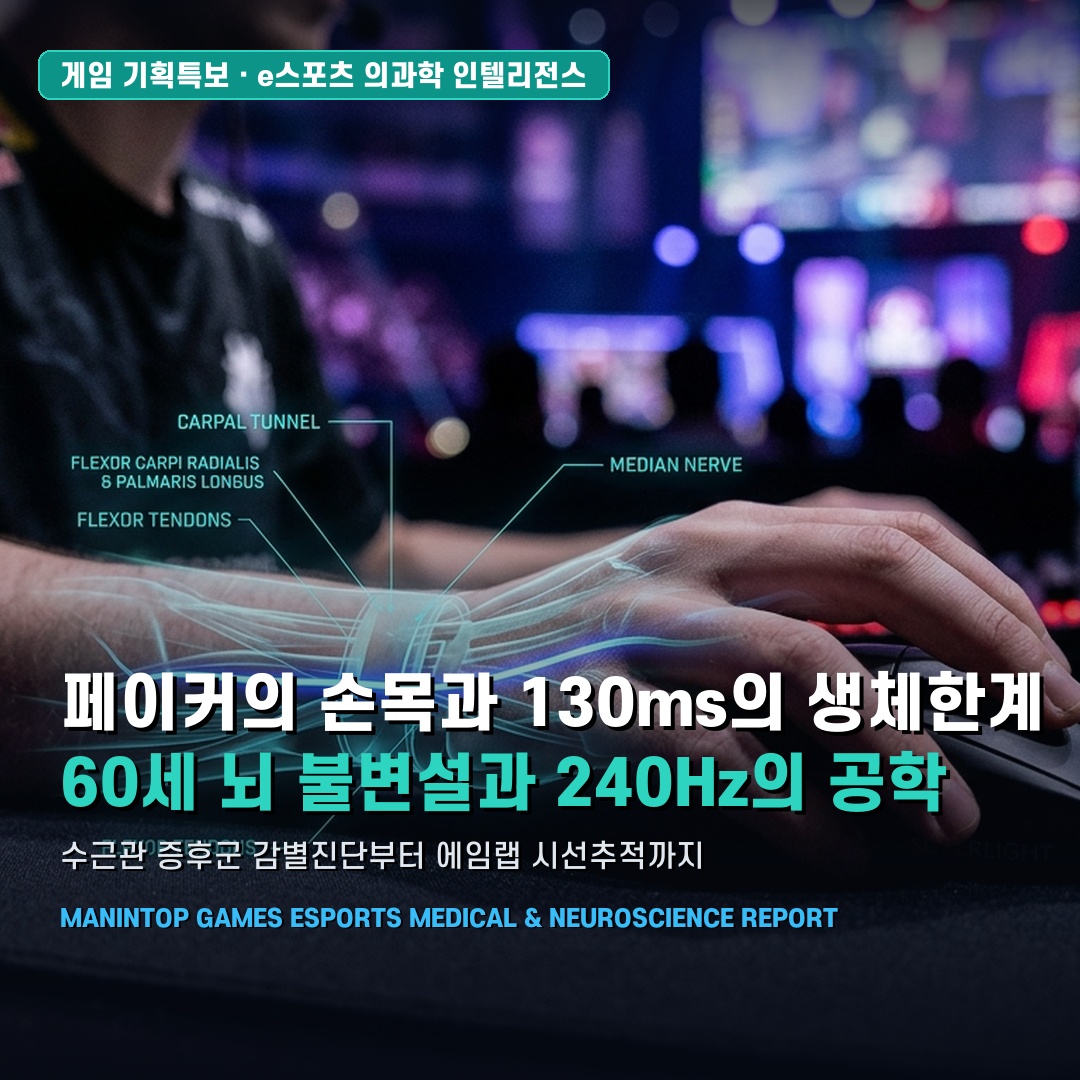
2023년 여름, 전 세계 리그 오브 레전드 e스포츠 팬들을 큰 충격에 빠뜨린 사건이 일어났습니다. T1의 주장 페이커(Faker, 이상혁) 선수가 심각한 오른손 손목 통증으로 인해 약 1개월간 공식 경기 출전을 전면 중단한 것입니다. 페이커가 자리를 비운 사이 T1은 정규 시즌에서 충격적인 1승 7패를 기록하며 급격한 전력 누수를 겪었습니다. 정밀 진단과 집중적인 휴식, 체계적인 비수술 재활 치료를 거친 뒤 복귀한 페이커는 팀을 재정비하여 그해 월드 챔피언십(롤드컵) 트로피를 들어 올렸지만, 이 사건은 e스포츠 무대에서 손목 부상이 선수 개인의 커리어는 물론 팀의 존폐를 뒤흔드는 가장 위협적인 변수임을 전 세계에 각인시켰습니다.
유럽 LEC의 명문팀 G2 Esports의 베테랑 서포터 미키엑스(Mikyx, 미하엘 메흘레)의 사례 역시 드라마틱한 임상 기록으로 꼽힙니다. 2019 스프링 시즌 도중 심각한 손목 통증으로 마우스를 쥐기조차 어려웠던 그는 팀의 핵심 전지훈련지였던 한국 부트캠프에도 참가하지 못했습니다. 하지만 미키엑스는 섣부른 수술 대신 전담 물리치료와 한의학적 침술 치료를 병행하는 보존적 요법을 선택했고, 극적으로 회복하여 복귀하자마자 2019 MSI 우승과 롤드컵 준우승이라는 대기록을 견인했습니다.
2. 게이머의 적: 수근관 증후군과 주관 증후군의 신경학적 해부
게이머들이 가장 흔하게 호소하는 손목 질환은 수근관 증후군(Carpal Tunnel Syndrome, CTS)입니다. 손목 안쪽에는 뼈와 인대로 둘러싸인 작은 통로인 수근관(손목터널)이 존재하며, 이곳으로 손가락을 굽히는 9개의 굴근 건과 정중신경(Median Nerve)이 통과합니다. 마우스를 책상 모서리에 장시간 올려놓고 손목을 뒤로 젖힌 채(배굴) 과도하게 클릭을 반복하면, 건초에 염증이 생기고 부어올라 정중신경을 강하게 압박하게 됩니다.
정중신경이 압박을 받으면 엄지손가락, 검지, 중지, 그리고 넷째 손가락(약지)의 안쪽 절반에 찌릿찌릿한 저림과 화끈거림, 감각 저하가 발생합니다. 특히 밤중에 손목 혈류가 정체되면서 통증이 극심해져 잠에서 깨는 야간 통증이 대표적 징후입니다. 주의할 점은 넷째 손가락 바깥쪽 절반과 다섯째 손가락(새끼손가락)이 저린 증상은 수근관 증후군이 아니라, 팔꿈치 관절 안쪽의 척골신경(Ulnar Nerve)이 눌려 발생하는 '주관 증후군(Cubital Tunnel Syndrome)'이라는 사실입니다. 책상에 팔꿈치를 대고 턱을 괴거나 팔을 과도하게 구부리고 게임을 할 때 발생하므로 정밀한 감별 진단이 필수적입니다.
| 질환명 | 압박 신경 | 주요 저림 및 감각 이상 부위 | 임상 특징 및 자가진단법 |
|---|---|---|---|
| 수근관 증후군 (CTS) | 정중신경 (Median) | 엄지, 검지, 중지, 약지 안쪽(1~3.5지) | 팔렌 검사(손등 맞대기 60초) 양성, 야간 통증 심화, 엄지두덩 위축 위험 |
| 주관 증후군 (CuTS) | 척골신경 (Ulnar) | 약지 바깥쪽, 새끼손가락(4.5~5지) | 팔꿈치를 구부렸을 때 저림 악화, 틴넬 징후(팔꿈치 내측 타진 시 찌릿함) |
| 드퀘르벵 건초염 | 건초 건염 (단무지신근) | 엄지손가락 뿌리 및 손목 바깥쪽 통증 | 핑켈스타인 검사(엄지 감싸쥐고 새끼 방향으로 꺾기) 시 극심한 통증 |
| 경추 신경근병증 | 경추 6·7·8번 신경근 | 목, 어깨에서 시작해 팔 전체로 방사 | 거북목 및 라운드숄더 환자 호발, 고개를 뒤로 젖히고 돌릴 때 저림 유발 |
수근관 증후군을 방치할 경우 가장 위험한 결과는 엄지손가락 뿌리 부분의 도톰한 근육인 '무지구근(Thenar Muscle, 엄지두덩)'이 위축되어 납작해지는 것입니다. 무지구근이 소실되면 엄지와 다른 손가락을 맞닿는 대립 운동(Pincer Grasp)이 불가능해져 마우스 휠을 굴리거나 단추를 채우는 일상 기능이 영구 마비됩니다. 역사적으로도 영국의 필립 왕자(에든버러 공작)가 이 질환으로 수술을 받았으며, 전설적인 펑크 록 밴드 그린데이의 베이시스트 마이크 던트(Mike Dirnt) 역시 손목터널 증후군 수술을 거친 바 있습니다.
하버드 의대·KIOM 공동 임상: 세계적 신경과학 학술지 'Brain'에 발표된 하버드 의대와 한국한의학연구원(KIOM)의 공동 임상 연구에 따르면, 수근관 증후군 환자에게 열결(LU7), 경거(LU8), 내관(PC6) 혈자리에 전침 치료를 시행한 결과 손목 기능 평가 점수(BCTQ)가 25.1% 호전되었으며, 뇌 시각피질 및 체성감각피질의 신경 가소성 회복 효과가 치료 종료 후 3개월 이상 지속되는 것으로 입증되었습니다.
3. 인체공학적 예방법과 장비 솔루션: 스트레칭, 보호대, 버티컬 마우스
많은 게이머들이 손목이 뻐근할 때 손목 관절을 비틀어 '우두둑' 소리를 내며 시원함을 느끼곤 합니다. 하지만 정형외과 전문의들은 이러한 '손목 꺾기' 습관이 관절포를 파열시키고 인대를 비가역적으로 이완시켜 만성 관절 불안정증과 퇴행성 관절염을 초래하는 최악의 행동이라고 경고합니다. 손목 통증의 원인은 손목 자체뿐만 아니라 거북목과 굽은 등(라운드숄더)으로 인해 목에서 나오는 상완신경총이 압박받는 것과 직결되어 있으므로, 1시간 게임 후 반드시 5분간 어깨와 흉추를 펴는 전신 리셋 스트레칭이 동반되어야 합니다.
손목을 보호하기 위한 장비 선택에서도 용도에 따른 정밀한 선별이 요구됩니다. 게이밍 및 오피스 환경에서 널리 활용되는 대표적인 손목 보호대 3종의 특성을 분석해 보면 다음과 같습니다.
| 분류 | 제품명 및 정가 | 핵심 특징 및 지지 구조 | 장점 및 게이머 권장 대상 |
|---|---|---|---|
| 에디터 베스트 | 잠스트(Zamst) 리스트랩 (약 24,000원 / 1개입) |
일체형 벨크로 랩 방식, 초박형 고탄성 네오프렌 소재, 일본 스포츠 메디컬 공학 설계 | 마우스 이동 및 키보드 타건 간섭 제로. 얇은 두께로 게이밍 패드 마찰이 적고 탄성 유지력이 6개월 이상 지속됨. 현역 프로게이머 최선호. |
| 최고의 가성비 | 아나파(Anapa) 이중 압박 밴드 (약 15,900원 / 1개입) |
듀얼 크로스 스트랩, 미세 압박 조절 가능, 통기성 에어 메시 안감 | 저렴한 가격 대비 강력한 손목 고정력 제공. 초기 통증 예방에 적합하나 내구성이 3~4개월 수준으로 잦은 세탁 시 탄성 저하. |
| 프리미엄 의료기 | 서포트온 메디컬 손목보호대 2P (약 43,000원 / 2개입) |
식약처 1등급 의료기기 신고 품목, 탈부착형 고탄성 알루미늄 지지대, 양손 세트 | 손목 배굴을 완벽 차단하여 야간 수면 중 통증 완화에 탁월. 지지력이 강해 FPS 에이밍에는 다소 둔탁하므로 게임 후 휴식 및 재활용으로 최적. |
최근 사무직과 일반 게이머들 사이에서 급부상한 버티컬 마우스(Vertical Mouse)는 인체공학적 관점에서 뚜렷한 장단점을 지닙니다. 일반 마우스는 손바닥이 바닥을 향하면서 전완부의 요골과 척골이 꼬이는 회내(Pronation) 상태를 유발하여 수근관 내 압력을 크게 높입니다. 반면 57도 안팎으로 기울어진 버티컬 마우스는 악수를 하듯 중립적인 해부학적 자세를 취하게 함으로써 손목 터널 내압을 즉각 낮춰줍니다. 그러나 마우스를 넓게 움직여야 하는 전술 FPS 게임에서는 손목 스냅 대신 어깨와 팔꿈치 관절로 부하가 전이되며, 정밀한 마이크로 플릭 에임이 흔들릴 수 있다는 단점이 있으므로 웹서핑과 사무 작업 시 교대 사용하는 것이 권장됩니다.
4. 반응 속도의 과학: 휴먼 벤치마크, 130ms 한계, 60세 뇌 불변설
많은 게이머들이 자신의 동체시력과 반응 속도를 가늠하기 위해 웹 기반의 '휴먼 벤치마크(Human Benchmark)' 시각 반응 테스트를 이용합니다. 화면이 붉은색에서 초록색으로 바뀌는 순간 마우스를 클릭하는 이 테스트는 수천만 건의 데이터를 통해 명확한 엑스-가우시안(ex-Gaussian) 정규 분포를 형성합니다.
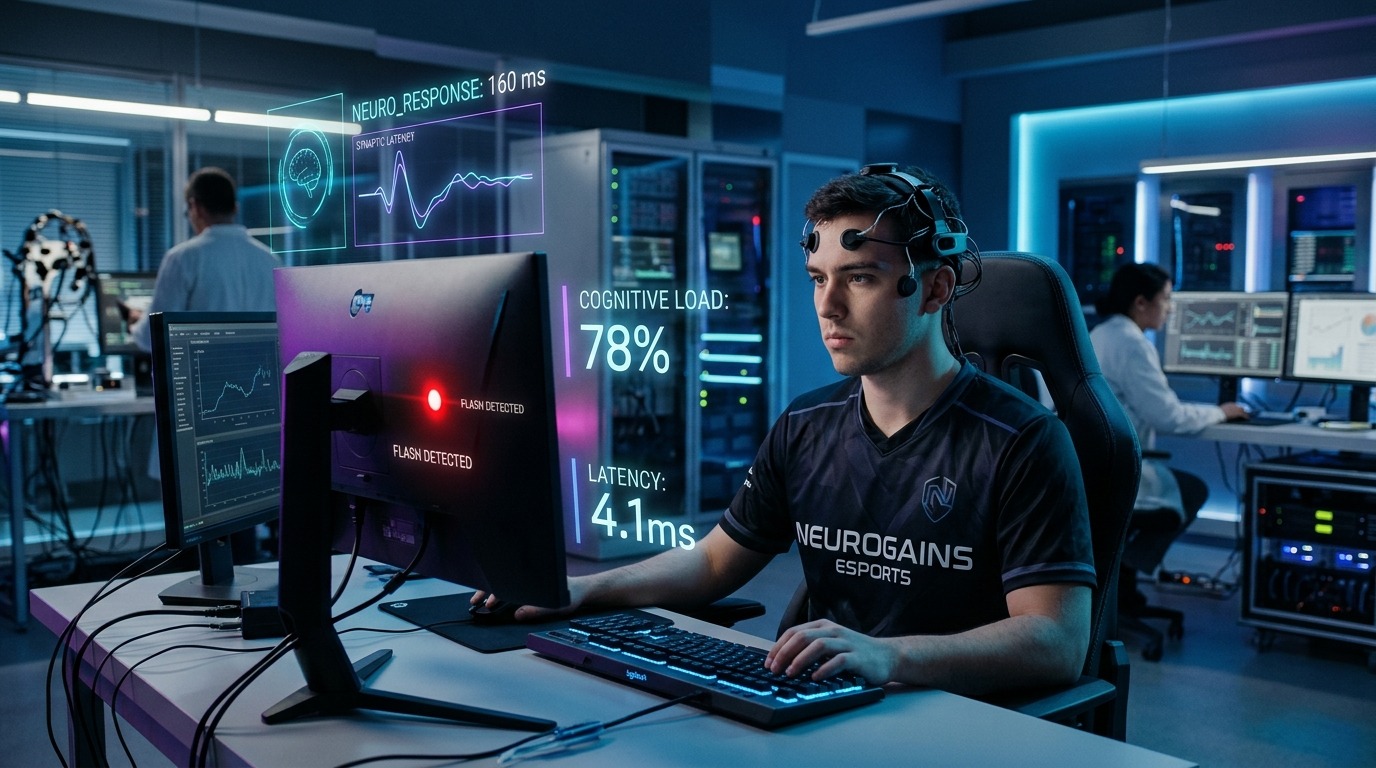
신경생리학적으로 인간의 시각 반응 속도에는 넘을 수 없는 절대적인 생체 물리적 한계가 존재합니다. 망막의 광수용체가 빛을 인지하고(약 20~40ms), 시신경을 거쳐 뇌 뒤쪽 시각피질(V1)로 도달하며(약 30ms), 전두엽 운동피질(M1)에서 의사결정을 내린 후(약 30~50ms), 척수 운동신경을 통해 손가락 굴근이 수축하는(약 30~40ms) 일련의 경로를 거치면 아무리 뛰어난 인간이라도 최소 130~150밀리초(ms)가 소요됩니다. 따라서 상대의 움직임을 사전에 예측하고 발사하는 '프리파이어(Pre-fire)'가 아닌 순수 반응으로 130ms 미만의 기록이 나오는 것은 생체 물리 법칙상 불가능하며 입력 장치의 오류이거나 단순한 우연의 일치입니다.
| 백분위 티어 | 반응 시간 (ms) | 신경생리학적 분류 | 대표 집단 및 게이밍 하드웨어 환경 |
|---|---|---|---|
| 상위 0.1% | < 160 ms | 초인적 생체 반응 (Superhuman) | 1티어 발로란트·카스 2 전술 FPS 프로, 전투기 조종사, 240Hz+ OLED 게이머 |
| 상위 1.0% | 160 ~ 185 ms | 최상위 엘리트 (Elite Athlete) | F1 레이싱 드라이버, 올림픽 100m 단거리 육상 선수, 최상위 프로 지망생 |
| 상위 5.0% | 185 ~ 210 ms | 상위 랭커 게이머 (Advanced) | 고티어 랭크 게임 유저, 빠른 순발력을 유지하는 20대 숙련 게이머 |
| 상위 20.0% | 210 ~ 240 ms | 우수 일반인 (Above Average) | 144Hz 게이밍 모니터를 사용하는 건강한 20~30대 일반 게이머 |
| 중앙값 50.0% | 240 ~ 275 ms | 일반 성인 평균 (Median) | 60Hz 표준 사무용 모니터를 사용하는 대한민국 일반 성인 평균치 |
| 하위 25.0% | 275 ~ 325 ms | 반응 저하군 (Below Average) | 수면 부족, 만성 피로 상태이거나 입력 지연이 심한 무선 사무용 기기 사용 |
| 하위 10.0% | > 325 ms | 현저한 지연 (Slow) | 고령층, 심한 수면 박탈 및 신경학적 반응 피로 누적 상태 |
분석 결과, 시각 정보를 인지하고 뇌에서 결정을 내리는 순수한 '인지 정보 처리 속도(Mental Processing Speed)'는 약 30세 전후에 최고조에 달한 뒤 60세가 될 때까지 거의 퇴화하지 않고 유지되는 것으로 밝혀졌습니다. 20대 초반이 반응 속도 테스트에서 10~20ms 더 빠르게 측정되는 이유는 뇌의 인지 속도가 빨라서가 아니라, 말초 신경근의 반사 속도가 미세하게 빠른 상태에서 '정확도보다 속도를 맹목적으로 우선시하는 충동성' 때문이었습니다. 반면 40~50대는 결정을 내리기 전에 더 신중하게 증거를 수집하므로 클릭 자체는 약간 늦어지지만 오판율이 압도적으로 낮았습니다. 즉, 경험 많은 베테랑 게이머의 뇌는 결코 느려지지 않는다는 것이 현대 신경과학의 결론입니다.
5. 하드웨어 레이턴시의 비밀: 240Hz 주사율과 CRT 모니터의 유산
많은 유저들이 60Hz 모니터에서 144Hz, 혹은 240Hz 모니터로 교체했을 때 반응 속도가 급상승하는 경험을 합니다. 이는 게이머의 생체 신경 전달 속도가 빨라진 것이 아니라, 화면이 갱신되는 하드웨어 표시 간격(Frame Display Interval)이 대폭 단축되면서 시각 정보가 망막에 도달하는 물리적 대기 시간이 줄어들었기 때문입니다.
| 주사율 규격 | 프레임 갱신 간격 | 지연 단축 비율 | 체감 특징 및 권장 그래픽카드 사양 |
|---|---|---|---|
| 60 Hz | 16.66 ms | 기준치 (0%) | 사무용 표준. 화면 전환 시 모션 블러와 찢어짐 발생, 긴 프레임 대기열 |
| 144 Hz | 6.94 ms | 58.3% 단축 | 게이밍 모니터 대중화 표준. 마우스 커서 궤적이 부드러워지며 즉각적인 체감 |
| 240 Hz | 4.16 ms | 75.0% 단축 | 60Hz 대비 4분의 1 단축, 144Hz 대비 70% 빠름. 역체감이 극심한 프로 표준. FHD: RTX 3060 / QHD: RTX 3070 권장 |
| 360 ~ 540 Hz | 2.77 ~ 1.85 ms | 83~89% 단축 | 한계 돌파용 초고주사율. 가격 대비 성능 향상 폭이 미세하며 최상위 CPU(9800X3D 등) 필수 |
여기서 흥미로운 하드웨어 역사의 사실은 2000년대 초반 배관통 같은 브라운관(CRT) 모니터의 반응 속도가 현대 최신 LCD 게이밍 모니터보다 빨랐다는 점입니다. CRT는 전자총이 형광체를 직접 타격하는 아날로그 방식으로 동작했기 때문에 액정 분자가 물리적으로 회전할 필요가 없어 잔상이 0ms였고 프레임 버퍼링 지연이 존재하지 않았습니다. 당시 CRT 환경에서 측정된 휴먼 벤치마크 평균 반응 시간은 210~220ms에 달했으나, 현대의 LCD 모니터와 윈도우 DWM(데스크톱 창 관리자) 시스템은 15~25ms의 액정 응답 및 버퍼 지연을 기본적으로 발생시킵니다. 결국 오늘날 240Hz 초고주사율 모니터와 1000Hz 이상의 폴링레이트 게이밍 마우스를 장착하는 것은 20년 전 브라운관이 지녔던 무지연의 순수성을 디지털 환경에서 되찾기 위한 공학적 투쟁인 셈입니다.
6. 트레이닝 및 피지컬 관리: 에임랩, 토비 시선추적, 그리고 컨디셔닝
단순히 게임을 많이 플레이하는 것만으로는 프로급 반응 속도와 에임을 습득할 수 없습니다. 현대 e스포츠 구단들은 과학적인 훈련 소프트웨어와 시선 추적 센서를 결합하여 선수들의 신경망을 체계적으로 훈련시킵니다.
무료 에임 훈련 도구인 에임랩(Aim Lab)과 코박스(KovaaK's)는 선수의 조준 행동을 플릭(Flick Aim, 순간 조준), 트래킹(Tracking Aim, 연속 추적), 프리시전(Precision Aim, 미세 조준) 3대 영역으로 분해하여 훈련시킵니다. 이러한 반복적인 표적 클릭 훈련은 대뇌 피질의 의식적 사고를 거치지 않고 소뇌(Cerebellum)에 운동 기억(Muscle Memory)을 각인시켜 반응 시간을 30~50ms 이상 극적으로 단축시킵니다. 또한 아페루AI(AperuAI)와 같은 데이터 분석 도구를 통해 자신이 어떤 각도에서 표적을 지나치거나(Over-aim) 덜 조준하는지(Under-aim) 오차 패턴을 시각화합니다.
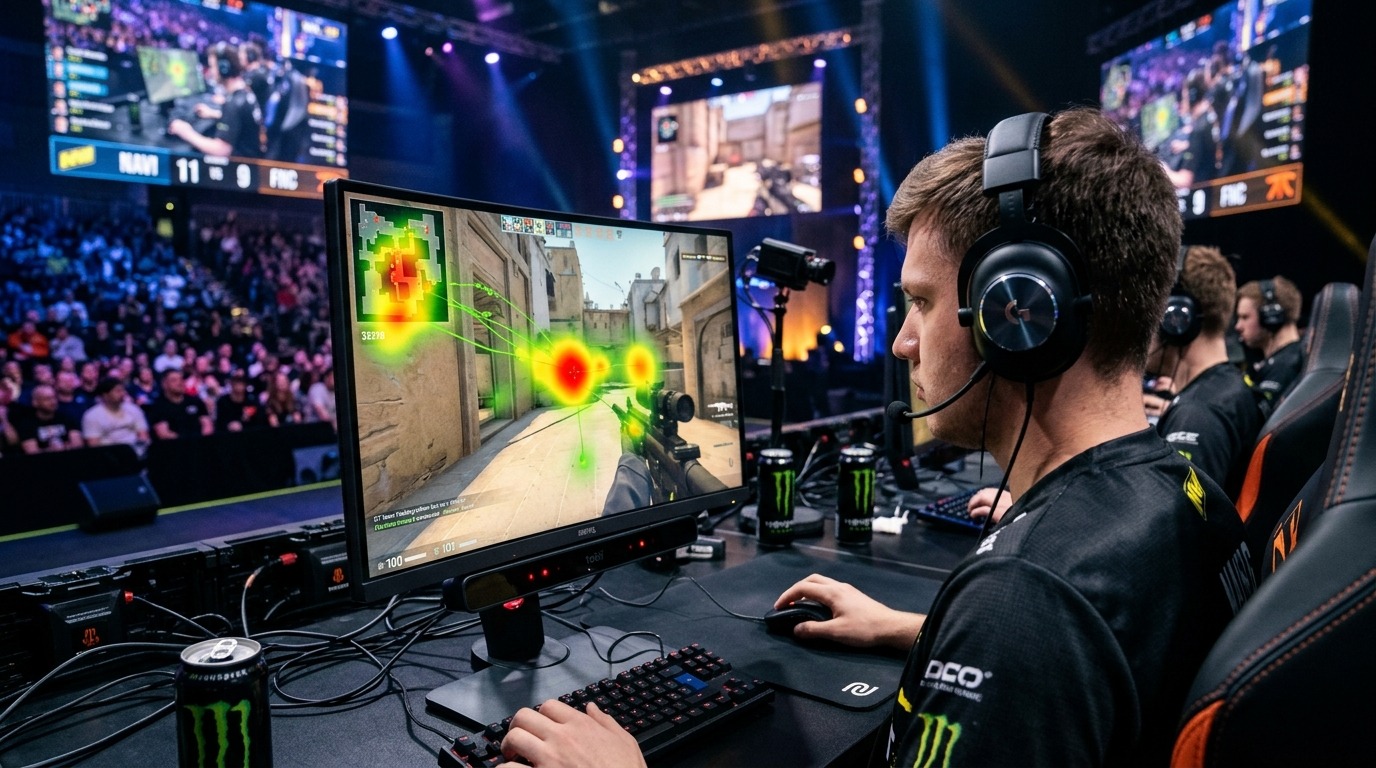
에일리언웨어 노트북 등에 내장된 '토비 아이 트래커 5(Tobii Eye Tracker 5)'는 프로와 아마추어의 결정적인 차이를 시선 주사 패턴(Gaze Heatmap)으로 증명해 냈습니다. 일반 게이머는 교전 중 시선이 한곳에 1초 이상 고정되는 터널 비전(Tunnel Vision)에 빠지는 반면, 최상위 프로게이머들은 0.2~0.3초마다 미니맵과 탄약 게이지, 화면 외곽을 훑고 0.1초 만에 중앙 크로스헤어로 시선을 복귀시키는 경이로운 시선 분산 능력을 보여주었습니다.
2. 에너지 드링크 급격한 당분 주의: 고카페인·고당류 에너지 음료는 일시적인 각성을 주지만 1시간 후 인슐린 급증으로 인한 '혈당 스파이크(Sugar Crash)'를 일으켜 뇌 반응 속도를 급격히 떨어뜨립니다. 무가당 전해질 음료나 순수한 물을 섭취하는 것이 좋습니다.
3. 매일 30분 유산소 운동: 가벼운 조깅이나 사이클은 뇌 혈류량을 20% 이상 증가시켜 전두엽 산소 공급을 원활하게 만들며, 신경 성장 인자(BDNF) 분비를 촉진하여 손목 신경 재생과 반사 신경 유지를 돕습니다.
[Special Report] Faker's Wrist and the 130ms Biological Barrier: The Age 60 Brain Invariance Rule and 240Hz Display Science
From Carpal Tunnel Differential Diagnosis and Harvard Clinical Acupuncture to Big Data Insights from 1.18 Million Participants Proving Mental Speed Stability
1. Pro Gamer Wrist Injury Crisis and Clinical Epidemiology
In the summer of 2023, the global League of Legends community faced unprecedented shock. T1's legendary mid laner Faker (Lee Sang-hyeok) was forced to step down from active competition for approximately one month due to severe right wrist and arm pain. During his absence, T1 suffered a devastating 1-7 losing streak in the regular season. Following structured rest, specialized clinical diagnostics, and conservative non-surgical therapy, Faker returned to lead T1 to victory at the 2023 World Championship. However, this crisis illuminated how repetitive strain injuries threaten not only individual careers but the competitive stability of entire esports organizations.
The clinical journey of European veteran support Mihael 'Mikyx' Mehle of G2 Esports presents another significant milestone. Struggling with crippling wrist pain during the 2019 Spring Split that rendered mouse control agonising, Mikyx was unable to attend the team's vital Korean bootcamp. Rather than opting for invasive surgery, Mikyx engaged in structured physical therapy and acupuncture, staging a dramatic recovery to secure the 2019 Mid-Season Invitational title and reach the Worlds grand finals.
2. The Gamer's Nemesis: Carpal Tunnel vs. Cubital Tunnel Neuropathy
Carpal Tunnel Syndrome (CTS) is the most prevalent peripheral neuropathy affecting hardcore gamers. The carpal tunnel is a rigid osteofibrous canal at the base of the wrist containing nine flexor tendons and the vital Median Nerve. Continuous mouse friction against the desk edge combined with prolonged wrist extension (dorsiflexion) and hyper-clicking induces tenosynovial inflammation, severely compressing the median nerve.
Median nerve impingement produces numbness, tingling paresthesia, and burning pain across the thumb, index, middle, and radial half of the ring finger. Nocturnal pain that awakens the patient due to venous stasis is a classic diagnostic marker. Crucially, numbness isolated to the fifth digit (little finger) and ulnar half of the ring finger points not to CTS, but to Cubital Tunnel Syndrome, where the Ulnar Nerve is compressed at the medial elbow. Differentiating between these conditions is essential for correct clinical intervention.
| Condition | Compressed Nerve | Primary Sensory Distribution | Clinical Features & Self-Test |
|---|---|---|---|
| Carpal Tunnel Syndrome (CTS) | Median Nerve | Thumb, index, middle, radial half of ring (Digits 1–3.5) | Phalen's maneuver (60s wrist flexion) positive, nocturnal pain, risk of thenar atrophy |
| Cubital Tunnel Syndrome (CuTS) | Ulnar Nerve | Little finger, ulnar half of ring (Digits 4.5–5) | Aggravated by sustained elbow flexion, positive Tinel sign at medial epicondyle |
| De Quervain's Tenosynovitis | EPB & APL Tendon Sheaths | Radial styloid process and base of thumb | Severe localized pain during Finkelstein's test (fist with thumb tucked inside) |
| Cervical Radiculopathy | C6, C7, C8 Nerve Roots | Radiating pain from neck/shoulder down arm | Associated with forward head posture, aggravated by Spurling's neck extension test |
The most dangerous consequence of untreated chronic CTS is irreversible muscular atrophy of the Thenar Eminence at the base of the thumb. Loss of thenar musculature impairs thumb opposition (pincer grasp), permanently disabling precise mouse grip and fine motor tasks. Historically, Prince Philip (Duke of Edinburgh) underwent surgical carpal release, as did Green Day bassist Mike Dirnt following years of touring strain.
Harvard Medical School & KIOM Clinical Trial: Published in the prestigious neurological journal 'Brain', a collaborative clinical trial by Harvard Medical School and the Korea Institute of Oriental Medicine (KIOM) demonstrated that electroacupuncture at acupoints Lieque (LU7), Jingqu (LU8), and Neiguan (PC6) achieved a 25.1% improvement in Boston Carpal Tunnel Questionnaire (BCTQ) scores, producing neuroplastic remeidation in cortical somatosensory mapping that persisted beyond three months.
3. Ergonomic Solutions: Stretching, Wrist Braces, and Vertical Mice
Many gamers habitually pop their wrist joints to relieve fatigue. Orthopedic surgeons caution that forceful joint cracking stretches synovial capsules and ligaments past elasticity limits, precipitating chronic joint instability and premature osteoarthritis. Because wrist nerve entrapment is heavily exacerbated by thoracic kyphosis and forward head posture, a 5-minute full-body posture reset every 60 minutes of play is biologically mandatory.
| Category | Product & Price | Support Architecture | Key Advantages & Gamer Suitability |
|---|---|---|---|
| Editor's Choice | Zamst Wrist Wrap (~$18 / Single Unit) |
Integrated velcro wrap, ultra-thin high-elastic neoprene, Japanese sports medical engineering | Zero interference with mouse movement or keyboard typing. Low friction against desk pads with durability exceeding 6 months. Top choice among pro players. |
| Best Value | Anapa Dual Compression Band (~$12 / Single Unit) |
Dual criss-cross straps, customizable tension, breathable air-mesh lining | Affordable wrist stabilization for early symptom prevention. Moderate breathability and shorter lifespan (3–4 months) under daily intensive gaming. |
| Medical Grade | SupportOn Medical Wrist Splint 2P (~$32 / Pair) |
Class 1 registered medical device, removable high-rigidity aluminum stay, bilateral set | Rigidly restricts wrist extension, ideal for nocturnal recovery and acute rehabilitation. Too bulky for high-speed FPS aiming; optimal for post-match rest. |
Vertical mice offering a 57-degree handshake grip successfully eliminate forearm pronation and lower carpal tunnel pressure. However, for competitive FPS players, vertical orientations shift movement mechanics from wrist flicks to large shoulder sweeps, destabilizing micro-aim precision. Consequently, hybrid workflows—utilizing vertical mice for administrative work and ergonomic low-profile mice for competitive sessions—remain the gold standard.
4. Reaction Time Science: The 130ms Limit and Age 60 Brain Stability
On web-based visual latency tests like Human Benchmark (red-to-green click), human response times conform to an ex-Gaussian distribution with a central median of 240–275ms on standard 60Hz displays.
Physiologically, an absolute biological barrier governs human reaction. Retinal phototransduction (20–40ms), optic nerve transit to visual cortex V1 (~30ms), frontal motor cortex decision processing (30–50ms), and spinal motor neuron firing to muscle contraction (30–40ms) require a cumulative minimum of 130 to 150 milliseconds. Pure unpredicted visual reactions under 130ms are physiologically impossible; recorded figures below this threshold invariably reflect anticipatory pre-firing or input hardware artifacts.
| Percentile Tier | Reaction Time (ms) | Neurophysiological Classification | Representative Cohort & Display Environment |
|---|---|---|---|
| Top 0.1% | < 160 ms | Superhuman Response | Tier 1 Tactical FPS Pros, Aerobatic Aviators, 240Hz+ OLED Displays |
| Top 1.0% | 160 ~ 185 ms | Elite Athletic Tier | Formula 1 Drivers, Olympic 100m Sprinters, Elite Esports Prospects |
| Top 5.0% | 185 ~ 210 ms | Advanced Competitive | High-tier competitive ranked players with optimized low-latency peripherals |
| Top 20.0% | 210 ~ 240 ms | Above Average | Healthy active gamers on 144Hz displays with disciplined sleep hygiene |
| Median 50.0% | 240 ~ 275 ms | General Population Median | Standard healthy adult average measured on conventional 60Hz displays |
| Bottom 25.0% | 275 ~ 325 ms | Impaired / Delayed | Sleep-deprived, fatigued individuals or high input-lag office wireless gear |
| Bottom 10.0% | > 325 ms | Severe Latency | Elderly cohorts, acute sleep deprivation, neuromuscular exhaustion |
The research proved that pure mental processing speed peaks around age 30 and remains virtually unchanged until age 60. Slightly faster reaction times in 20-year-olds are driven not by superior cerebral speed, but by peripheral neuromuscular reflex velocity combined with an impulsive bias prioritizing speed over accuracy. In contrast, older adults accumulate sensory evidence more cautiously before executing decisions, yielding dramatically fewer erroneous inputs.
5. Display Engineering: The 240Hz Advantage and CRT Heritage
Upgrading from 60Hz to 144Hz or 240Hz accelerates player reaction not by quickening biological nerves, but by drastically compressing hardware frame intervals.
| Refresh Rate | Frame Interval | Latency Reduction | Perceptual Impact & Recommended GPU Hardware |
|---|---|---|---|
| 60 Hz | 16.66 ms | Baseline (0%) | Standard office spec. Motion blur, tearing, extended input queues |
| 144 Hz | 6.94 ms | 58.3% Reduced | Standard competitive baseline. Immediate fluidity in cursor trajectory |
| 240 Hz | 4.16 ms | 75.0% Reduced | 4x faster than 60Hz; 70% reduction over 144Hz. Severe reverse adaptation. Recommended: RTX 3060 (1080p) / RTX 3070 (1440p) |
| 360 ~ 540 Hz | 2.77 ~ 1.85 ms | 83~89% Reduced | Extreme competitive tier. Diminishing returns; demands top-tier CPUs like Ryzen 7 9800X3D |
Historically, early 2000s Cathode Ray Tube (CRT) monitors possessed zero pixel persistence and zero frame buffering, enabling measured response averages of 210–220ms. Modern LCDs and Windows Desktop Window Manager (DWM) introduce 15–25ms of hardware buffer lag. Adopting 240Hz displays and 1000Hz+ mouse polling rates effectively recovers the instantaneous physical clarity of analog cathode tubes in digital form.
6. Professional Training Regimens: Aim Lab, Tobii Gaze Tracking, and Conditioning
Specialized suites like Aim Lab and KovaaK's isolate flick, tracking, and precision aiming. Structured drills bypass deliberate cortical thought, embedding motor programs within the cerebellum to trim 30–50ms from tactical responses. AperuAI telemetry visually maps micro-aiming overshoots and undershoots for data-driven calibration.
Eye-tracking systems like Tobii Eye Tracker 5 reveal that elite competitors do not succumb to tunnel vision; they scan minimaps and HUD elements in 200ms bursts before snapping their gaze back to center-screen crosshairs, maintaining panoramic spatial awareness.
2. Avoiding Energy Drink Sugar Crashes: High-sugar stimulant beverages trigger acute hyperglycemia followed by rapid crashes, degrading cognitive reaction. Unsweetened electrolyte hydration is optimal.
3. Daily 30-Minute Aerobic Exercise: Light jogging or cycling boosts cerebral blood flow by 20%, stimulating Brain-Derived Neurotrophic Factor (BDNF) for peripheral nerve regeneration.
내가 찾는 상품 키워드, 지금 얼마나 검색될까?
네이버 월간 검색량 + 구글 볼륨 + 아이템스카우트 실시간 상품수와 경쟁강도 배지를 0.5초 만에 무료로 확인하세요.


