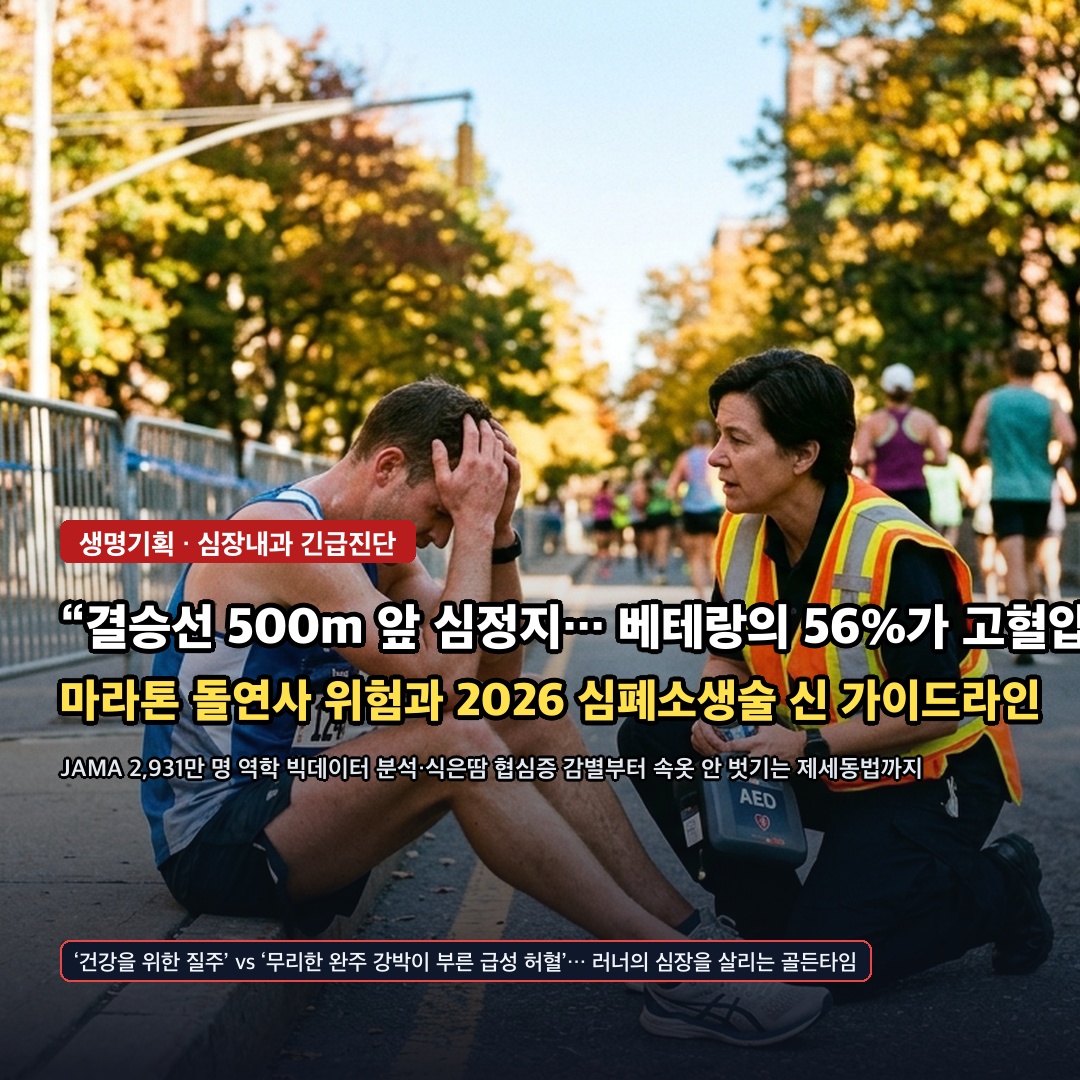
“결승선 500m 앞 심정지… 베테랑의 56%가 고혈압”… 마라톤 돌연사 위험과 2026 심폐소생술 신 가이드라인
JAMA 2,931만 명 역학 빅데이터 분석·식은땀 협심증 감별부터 속옷 안 벗기는 제세동법까지 입체 추적
1. 결승선 500m 앞의 비극: 왜 마지막 구간에서 심장이 멎는가
주말마다 도심과 하천변을 가득 채우는 마라톤 축제. 최근 10월 한 달에만 전국에서 23개 이상의 대회가 열릴 정도로 러닝 크루 열풍이 거세지만, 주로 위에서는 목숨을 잃는 안타까운 사고가 끊이지 않고 있습니다. 서울레이스 하프마라톤 결승선을 불과 500m 앞두고 쓰러진 20대 여성, 경주 마라톤에서 의식을 잃은 청년, 춘천 산악마라톤에서 숨진 40대 러너 등 고령자뿐 아니라 젊은 층에서도 급성 심정지가 발생하고 있습니다.
순환기내과 전문의들은 결승선을 목전에 둔 마지막 구간이 심장에 가장 잔인한 시간대라고 설명합니다. 완주를 앞두고 쏟아지는 관중의 환호와 기록 단축을 위한 마지막 전력 질주(라스트 스퍼트)는 교감신경계를 극한으로 흥분시킵니다. 심장 근육의 산소 요구량이 물리적 한계치에 다다를 때, 잠복해 있던 혈관 이상이나 심근 비대가 심실세동이라는 치명적인 부정맥을 폭발시키는 것입니다.
2. JAMA 2,931만 명 빅데이터: 제세동기 보급이 바꾼 생존율의 기적
마라톤 도중 심정지가 얼마나 자주 발생하고 얼마나 살아남을 수 있을까요. 미국의사협회지(JAMA)에 실린 에모리대학교 연구팀의 2,931만 명 완주자 전수 추적 데이터(RACER 레지스트리)는 명확한 해답을 제시합니다.
| 분석 지표 항목 | 과거 추세 (2000~2009년) | 최근 추세 (2010~2023년) | 변화 추이 및 핵심 의학적 의미 |
|---|---|---|---|
| 10만 명당 심정지 발생률 | 0.54건 | 0.60건 | 발생 빈도는 통계적으로 큰 변동 없이 유지 |
| 심정지 환자 사망 치명률 | 71% | 34% | 사망 비율이 절반 이하로 급감 |
| 10만 명당 최종 사망률 | 0.39건 | 0.20건 | 49% 대폭 감소 (인명 피해 절반 축소) |
| 목격자 심폐소생술(CPR) 비율 | 58% | 100% | 현장 즉각 흉부압박 조치 완벽 정착 |
| 자동심장충격기(AED) 사용률 | 48% | 거의 전원 적용 | 신속한 제세동 접근성 극대화 |
| 최종 현장 생존율 | 29% | 66% | 생존율 2.3배 수직 상승 (기적적 회복) |
연구에 따르면 완주자 10만 명당 심정지 발생률은 약 0.6건(16만 7천 명 중 1명)으로 예나 지금이나 비슷합니다. 하지만 환자의 생존율은 29%에서 66%로 2.3배나 뛰어올랐습니다. 그 비결은 단 하나, 현장에서 즉시 심폐소생술을 시작하고 자동심장충격기(AED)를 신속하게 부착한 덕분이었습니다. 남성 러너는 여성보다 심정지 위험이 6배 높았고, 풀코스는 하프보다 2배 이상 위험했습니다. 원인의 40%는 심장 혈관이 막히는 관상동맥 질환이었습니다.
3. '베테랑의 역설': 마라톤 마니아 중년 남성 56%가 운동 중 고혈압
"나는 10년 넘게 풀코스를 뛰었으니 혈관도 심장도 누구보다 깨끗하다"는 자부는 가장 위험한 착각입니다. 삼성서울병원 박경민 교수와 성신여대 김영주 교수 연구팀이 발표한 연구 결과는 충격적입니다.
마라톤을 즐기는 중년 남성의 무려 56%가 운동 중 수축기 혈압이 210㎜Hg 이상으로 치솟는 ‘운동 유발성 고혈압(EIH)’을 앓고 있는 것으로 나타났습니다. 평소 진료실에서 재는 안정 시 혈압이 정상이라도, 장거리를 달릴 때 혈압이 비정상적으로 급등하며 혈관 내벽을 손상시키는 것입니다. 이로 인해 지속적 고강도 러닝을 하는 중년층의 동맥경화 유병률은 44.3%로 일반인(22.2%)의 2배에 달했습니다.
더 무서운 것은 ‘무증상 혈관 협착’입니다. 오래 훈련한 베테랑 러너는 심장 주변의 미세 모세혈관(측부 순환)이 잘 발달해 혈관이 75% 이상 좁아져 있어도 일상생활에서 아무런 통증을 느끼지 못합니다. 그러다 대회 당일 극한의 탈수와 탈진이 겹치면 혈전이 좁아진 혈관을 완전히 틀어막아 돌연사로 이어집니다. 40세가 넘은 마라토너라면 단순 러닝머신 검사를 넘어 심장 CT 검사를 통해 혈관 석회화를 반드시 확인해야 합니다.
4. 러너의 발목을 잡는 3대 뇌 착각과 협심증 감별 팩트체크
임상 데이터에 따르면 마라톤 중 쓰러진 러너의 82%는 쓰러지기 10~30분 전부터 흉부 압박감과 식은땀 등 뚜렷한 위험 신호를 겪었습니다. 그런데 왜 멈추지 않았을까요. 스포츠 심리학이 밝혀낸 세 가지 인지적 함정 때문입니다.
첫째는 엔도르핀 역설입니다. 달릴 때 분비되는 베타 엔도르핀이 극심한 통증을 마비시켜 심장이 쥐어짜는 고통을 "호흡이 트이는 상쾌한 피로감"으로 왜곡합니다. 둘째는 페이스 매몰 비용 오류입니다. "지난 몇 달간 새벽마다 훈련한 노력이 아깝다", "여기서 서면 서브3 목표가 날아간다"는 집착이 이성을 마비시킵니다. 셋째는 회피성 합리화로, "술·담배도 안 하니 심장병일 리 없다"며 식은땀을 단순 탈수로 넘겨버리는 것입니다.
| 구분 항목 | 단순 숨참 (호흡근 피로) | 급성 심근허혈 (협심증·심근경색) | 갈비뼈 근육통 / 신경통 |
|---|---|---|---|
| 가슴 통증 양상 | 가슴 조임 없이 숨만 턱 끝까지 참 | 가슴 중앙을 바위로 짓누르듯 쥐어짬 | 숨 들이쉴 때 바늘로 콕콕 찌름 |
| 통증 방사 부위 | 방사통 전혀 없음 | 턱, 목, 왼쪽 어깨, 등, 팔 안쪽 확산 | 상체 비틀 때 통증 위치 이동 |
| 결정적 동반 증상 | 심호흡하면 서서히 호전 | 차가운 식은땀, 메스꺼움, 숨 막히는 공포 | 손가락으로 뼈를 누르면 아픔(압통) |
| 속도 늦출 때 반응 | 1~2분 천천히 걸으면 호흡 정상화 | 완전히 멈춰 서도 3~5분 이상 지속 | 심박수와 무관하게 간헐적 바늘 통증 |
| 현장 필수 조치 | 보폭 줄이고 복식호흡 | 즉시 주로 밖 착석, 119 및 AED 긴급 요청 | 러닝 폼 수정 및 상체 스트레칭 |
5. 골든타임 4분: 주로에서 이상을 느꼈을 때 즉각 행동 4원칙
심장이 멎은 뒤 1분 안에 심폐소생술과 제세동을 받으면 90% 이상 살아나지만, 4분이 넘어가면 뇌세포 괴사가 시작되고 8분이 지나면 생존율은 9% 아래로 곤두박질칩니다. 주로에서 이상을 느꼈을 때 생명을 건지는 4가지 철칙입니다.
1. 절대로 걸어서 이동하려 하지 말고 즉시 주저앉으라: 통증이 올 때 서서 걸으면 중력 때문에 뇌와 심장 혈관으로 가는 피가 급격히 줄어들어 그대로 의식을 잃고 아스팔트에 머리를 부딪칩니다. 즉시 주로 갓길에 앉아야 합니다.
2. 상체를 30~45도 세운 ‘반좌위’ 자세 유지: 바닥에 완전히 평평하게 누우면 다리에 몰려 있던 피가 심장으로 한꺼번에 밀려들어 허혈 상태의 심장이 감당하지 못합니다. 동료의 무릎이나 가방에 등을 기대어 상체를 비스듬히 세워야 심장 부담이 줄어듭니다.
3. 특정인을 정확히 지목하여 119와 AED 호출: 손을 번쩍 들고 주변 사람의 인상착의를 콕 집어("파란 모자 쓰신 분!") "가슴 통증 심장 환자입니다! 119와 제세동기를 불러주세요!"라고 외쳐야 방관자 효과를 깰 수 있습니다.
4. 의식과 호흡이 없으면 지체 없이 흉부압박 개시: 환자가 대답이 없고 숨을 헐떡이거나 쉬지 않는다면 망설이지 말고 가슴 정중앙을 분당 100~120회, 깊이 5cm로 강하고 빠르게 눌러야 합니다.
6. 2026 심폐소생술 신 가이드라인: 여성 환자 속옷 벗기지 않고 제세동
질병관리청이 최신 의학적 근거를 바탕으로 개정한 2025~2026 한국 심폐소생술 가이드라인은 현장 구조율을 획기적으로 높이기 위한 실전 지침들을 담고 있습니다.
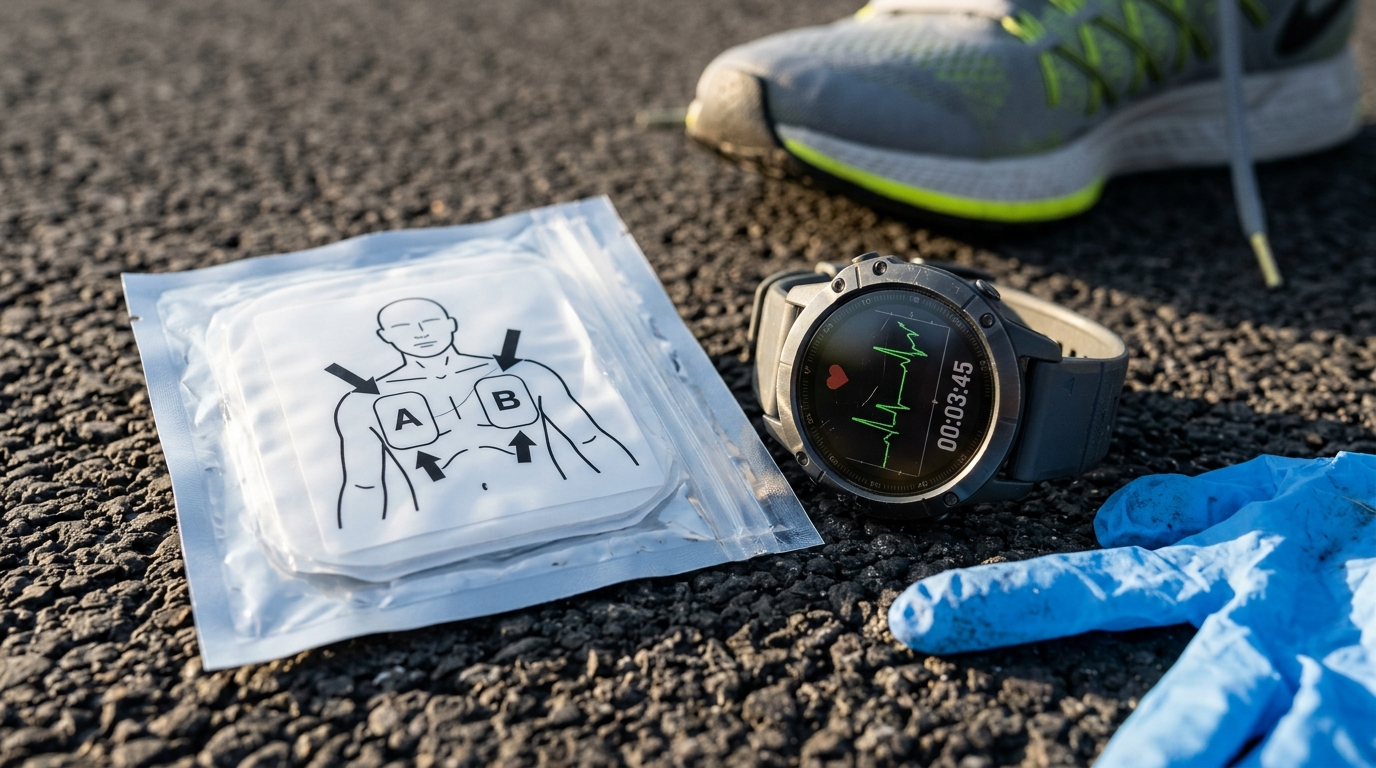
가장 획기적인 변화는 여성 심정지 환자에 대한 제세동 지침입니다. 그동안 여성 환자의 신체 노출에 대한 심리적 부담감 때문에 제세동 패드 부착이 늦어지던 문제를 해결하기 위해, 속옷(브래지어)을 완전히 벗기거나 풀지 않고 위치만 살짝 조정해 패드를 붙이도록 공식 권고했습니다. 오른쪽 쇄골 아래와 왼쪽 옆구리에 속옷을 살짝 젖히며 부착하면 되며, 속옷 안의 와이어는 전류 흐름에 전혀 방해가 되지 않는다는 사실이 정밀 실험을 통해 입증되었습니다.
또한 성인 심폐소생술 시 구조자가 가장 편하게 힘을 쓸 수 있는 ‘주된 손(오른손잡이는 오른손)’을 환자 가슴뼈 중앙에 먼저 올리고 다른 손을 깍지 끼도록 권고를 통일하여 신용카드 세로 높이인 5cm 압박 깊이를 유지하도록 했습니다. 아울러 자동심장충격기 사용 권고 대상을 만 1세 이상의 모든 소아로 확대했고, 영아(돌 이전 아기)의 경우 양손으로 가슴을 감싸 쥐고 두 엄지손가락으로 누르는 방식으로 일원화했습니다.
7. 심장을 지키는 안전 러닝 5계명: Zone 2 트레이닝과 10% 룰
건강을 위해 시작한 달리기가 심장을 위협하는 비극이 되지 않으려면 훈련 방식부터 과학적으로 바꿔야 합니다.
첫째, 평소 훈련의 80%는 달리는 도중 옆 사람과 숨이 차지 않고 편안하게 대화를 나눌 수 있는 ‘Zone 2(최대심박수의 60~70%)’ 저강도 심박수 구간에서 이루어져야 합니다. 심박수가 최대치의 90%를 넘어서는 Zone 5 구간에 진입하면 심장 혈관 저항이 평소의 4.2배로 폭증해 심근경색 위험이 급상승합니다.
둘째, ‘10% 규칙’을 사수해야 합니다. 훈련 거리를 늘릴 때는 지난주 달린 총거리의 10% 이상을 절대 한 번에 늘려서는 안 됩니다. 셋째, 대회 당일에는 초반 1km를 천천히 달리고 후반부로 갈수록 페이스를 유지하는 ‘네거티브 스플릿(Negative Split)’ 전략으로 심장의 워밍업 시간을 벌어주어야 합니다.
Cardiac Arrest 500 Meters from the Finish Line: Marathon Sudden Death Risks and the 2026 CPR Guidelines
From JAMA's 29.31-million runner epidemiological dataset to identifying cold-sweat angina and non-removal AED protocols
1. Tragedy 500 Meters from the Finish Line: Why Hearts Fail in the Final Stretch
Urban marathon races have surged in popularity, with over 23 major events held nationwide in a single autumn month. However, fatal medical emergencies continue to occur on the asphalt. Recent tragedies include a woman in her 20s collapsing 500 meters before the Seoul Half-Marathon finish line, another runner losing consciousness in Gyeongju, and a 40-something male dying during a trail marathon in Chuncheon. Sudden cardiac arrest is no longer confined to elderly demographics.
Cardiologists emphasize that the final stretch before the finish line represents the most biologically precarious segment of any race. Spectator cheers and personal pace ambitions trigger an intense sympathetic nervous system surge. As runners initiate their final sprint, myocardial oxygen demand reaches physical ceilings. If subclinical coronary stenosis or undetected hypertrophic cardiomyopathy exists, this sudden stress detonates lethal ventricular fibrillation.
2. JAMA 29.31 Million Big Data: How Rapid Defibrillation Cut Fatalities in Half
How frequently does cardiac arrest occur during endurance marathons, and what determines survival? An exhaustive epidemiological investigation published in JAMA by Emory University researchers tracking 29.31 million marathon and half-marathon finishers (the RACER registry) provides conclusive insights.
| Epidemiological Metric | Historic Baseline (2000-2009) | Modern Era (2010-2023) | Statistical Shift & Clinical Significance |
|---|---|---|---|
| Arrest Incidence per 100,000 | 0.54 events | 0.60 events | Underlying occurrence rate remained steady |
| Patient Case Fatality Rate | 71% | 34% | Fatality proportion dropped by more than half |
| Overall Mortality per 100,000 | 0.39 deaths | 0.20 deaths | 49% reduction in overall runner deaths |
| Bystander CPR Delivery Rate | 58% | 100% | Immediate on-site chest compressions universally delivered |
| On-Scene AED Deployment | 48% | Nearly Universal | Rapid defibrillation access comprehensively established |
| Final Discharge Survival Rate | 29% | 66% | Survival jumped 2.3-fold (29% to 66%) |
The data demonstrates that while cardiac arrest occurrence remained steady at approximately 0.6 per 100,000 finishers (1 in 167,000 runners), patient survival surged from 29% to 66%. This remarkable achievement stems directly from widespread bystander CPR and rapid automated external defibrillator (AED) intervention. Male participants faced six times higher arrest rates than females, full marathons carried double the risk of half-marathons, and acute coronary artery disease accounted for 40% of confirmed cases.
3. The Veteran's Paradox: 56% of Avid Middle-Aged Runners Exhibit Exertional Hypertension
Believing that years of completing marathons renders one's coronary arteries immune to disease is a hazardous misconception. Clinical research led by Samsung Medical Center cardiologist Dr. Kyoung-Min Park and Sungshin Women's University Professor Young-Joo Kim revealed startling findings regarding veteran runners.
Among middle-aged men regularly competing in marathons, 56% suffered from Exercise-Induced Hypertension (EIH), characterized by systolic blood pressure skyrocketing past 210 mmHg during peak exertion. Even when resting blood pressure reads completely normal in a clinic, intense running induces massive vascular shear stress. Consequently, atherosclerosis prevalence among chronic endurance athletes reached 44.3%, double that of sedentary peers (22.2%).
Even more dangerous is asymptomatic coronary artery stenosis. Decades of aerobic training develop extensive collateral microcirculation around main coronary branches. Runners may feel zero angina even with 75% arterial blockage. On race day, severe dehydration and electrolyte shifts provoke acute plaque rupture and thrombosis. Runners aged 40 and older must undergo coronary CT scans rather than relying solely on treadmill stress tests.
4. Three Cognitive Traps and Differentiating True Angina from Breathlessness
Clinical data reveals that 82% of runners who collapsed from cardiac arrest exhibited overt warning signs—such as severe chest tightness and cold sweats—for 10 to 30 minutes beforehand. Why did they refuse to stop? Sports psychology identifies three cognitive pitfalls:
First, the Endorphin Paradox: heavy beta-endorphin release blunts visceral pain, causing runners to mistake coronary ischemia for pleasant breathing transitions. Second, the Sunk-Cost Fallacy: obsession with hitting a target pace or finishing a race after months of early-morning training overrides rational self-preservation. Third, Cognitive Denial: overconfidence in clean lifestyle habits leads athletes to dismiss cold sweats and nausea as harmless dehydration.
| Diagnostic Metric | Respiratory Fatigue (Normal) | Acute Myocardial Ischemia (Angina/Infarction) | Intercostal Muscular Strain |
|---|---|---|---|
| Pain Sensation | No chest crushing; only heavy breathing | Crushing, vise-like weight on center of chest | Localized, sharp needle-like pricking on inhalation |
| Radiation of Pain | Zero radiation | Radiates to jaw, neck, left shoulder, back, arms | Shifts location when twisting torso or arms |
| Associated Symptoms | Gradually eases with deep diaphragm breaths | Clammy cold sweat, nausea, dread of impending doom | Distinct focal tenderness upon palpation |
| Response to Rest | Normalizes within 1-2 minutes of walking | Persists 3-5+ minutes even after full stop | Intermittent discomfort regardless of pulse rate |
| Action Required | Slow stride and perform belly breathing | Immediately sit down off course; shout for 119 & AED | Correct posture and stretch chest wall muscles |
5. The Golden Four-Minute Protocol: Four Immediate Actions When Chest Pain Strikes
Delivering CPR and defibrillation within one minute maintains survival rates above 90%. After four minutes, irreversible brain damage ensues, and past eight minutes, survival drops below 9%. When experiencing cardiac symptoms or witnessing a runner falter, apply these four essential principles:
1. Do Not Attempt to Walk; Sit Down Immediately: Continuing to walk upright drastically diminishes cerebral and coronary perfusion due to gravity, inducing sudden syncope and head trauma against asphalt.
2. Maintain a 30 to 45-Degree Semi-Fowler's Seated Posture: Lying completely flat forces venous blood from lower extremities back into an ischemic heart, causing severe preload overload. Lean backward against a race barrier or a partner's knee.
3. Point and Designate a Specific Bystander for 119 and AED: Wave both arms and point directly at an individual's clothing ("You in the blue hat!") shouting: "Cardiac emergency! Call 119 and bring an AED immediately!" to pierce bystander apathy.
4. Initiate Immediate Compressions if Unresponsive: If the runner is unresponsive with absent or abnormal gasping breaths, instantly compress the center of the chest at 100 to 120 beats per minute to a depth of 5 cm.
6. 2026 CPR Guidelines: Attaching AEDs Without Removing Undergarments
The updated 2025-2026 Korean Cardiopulmonary Resuscitation Guidelines released by the Korea Disease Control and Prevention Agency (KDCA) introduce vital revisions to eliminate delays in public defibrillation.
Most notably, the guidelines mandate that rescuers should position AED pads on female patients without unclasping or removing undergarments (bras). Reluctance over public exposure previously caused fatal defibrillation delays. Rescuers simply slide the upper pad below the right collarbone and gently slip the lateral pad along the left rib cage beneath the undergarment strap. Controlled testing confirms that underwire brassieres do not impede defibrillator current pathways.
Additionally, rescuers are instructed to place their dominant hand directly onto the sternum first, interlocking fingers with the other hand to maintain a consistent 5 cm compression depth (equivalent to the width of a credit card). Public AED deployment recommendations now encompass all children aged 1 year and older, while infant chest compressions have been standardized to the two-thumb technique encircling the thorax.
7. Five Commandments for Safe Running: Zone 2 Heart Rates and the 10% Mileage Rule
Transforming running into a lifetime shield for cardiovascular vitality requires disciplined, heart-rate-guided training methodologies.
Eighty percent of weekly running should take place within Zone 2 (60% to 70% of maximum heart rate), where a runner can converse easily in full sentences without gasping. Surpassing 90% of maximum heart rate (Zone 5) spikes coronary vascular resistance 4.2-fold, drastically escalating acute ischemic hazards.
Furthermore, respect the 10% Rule: never increase weekly running volume by more than 10% over the previous week. On race day, execute a disciplined Negative Split—starting the first kilometer conservatively to allow the coronary microvasculature adequate warm-up before settling into race rhythm.
내가 찾는 상품 키워드, 지금 얼마나 검색될까?
네이버 월간 검색량 + 구글 볼륨 + 아이템스카우트 실시간 상품수와 경쟁강도 배지를 0.5초 만에 무료로 확인하세요.


