의학·바이오 기획취재팀 | 신승엽 전문기자 (Seung Youb Ssin)
분과: 건강 웰빙 라이프 | 승인: 2026.11.08

▲ [만인의 탑 단독 기획] 1080x1080 울트라 볼드 썸네일: 손목 위 스마트워치가 보내는 심장 이상 신호의 과학적 진실과 뇌졸중 5배 위험을 막는 실전 대처법.
출근길 만원 지하철 안이나 조용한 침실에서 갑자기 손목 시계가 '징-' 하고 길게 진동할 때가 있습니다. 화면을 켜자 나타난 낯선 문구: "불규칙한 심장 박동이 감지되었습니다. 심방세동의 징후일 수 있습니다."
가슴이 철렁 내려앉고 '내가 혹시 큰 병에 걸린 건 아닐까' 덜컥 겁부터 납니다. 국내 환자만 100만 명에 육박하고 뇌졸중 위험을 무려 5배나 끌어올리는 침묵의 부정맥 '심방세동(AFib)'. 과연 내 손목 위 스마트워치의 경고는 얼마나 정확한 것일까요? 당장 큰 병원으로 뛰어가야 할 신호와 가볍게 넘겨도 될 착시 신호를 가려내는 명쾌한 기준을 취재했습니다.
1. 지휘자를 잃어버린 오케스트라: 심방세동은 도대체 왜 생길까?
우리 심장은 원래 세계 최고 오케스트라처럼 한 치의 오차도 없이 박자를 맞춥니다. 심장의 윗집인 '심방'이 먼저 피를 모아 쿵 하고 짜주면, 아랫집인 '심실'이 쾅 하고 온몸으로 피를 뿜어냅니다. 이 질서정연한 리듬을 유지해주는 총지휘자가 바로 심장 안의 미세한 전기 신호 발전소(동결절)입니다.
그런데 이 지휘 체계가 무너지면 심방 상부가 마치 감전된 것처럼 분당 300회에서 600회까지 제멋대로 파르르 떨리게 됩니다. 심장이 온전히 수축하지 못하고 덜덜 떨기만 하니, 피가 시원하게 나가지 못하고 심장 구석(좌심방이)에 고이게 됩니다.
물이 고이면 썩듯이, 심장 안에 고인 피는 엉겨 붙어 끈적한 피떡, 즉 혈전(Thrombus)을 만듭니다. 이 피떡이 혈류를 타고 뇌로 솟구쳐 올라가 굵은 뇌혈관을 콱 틀어막는 순간, 아무런 예고도 없이 치명적인 급성 뇌경색(뇌졸중)이 터집니다.

▲ 반대편 손가락을 스마트워치 용두에 대고 30초간 단일유도 심전도(ECG) 파형을 침착하게 기록하는 모습.
숫자로 보는 심방세동의 위험도
• 뇌졸중 위험 5배: 일반인보다 뇌혈관이 막힐 위험이 정확히 5배 높습니다.
• 환자 10명 중 3명은 무증상: 가슴 두근거림이나 어지럼증을 전혀 느끼지 못해 '침묵의 살인자'로 불립니다. 뇌경색으로 쓰러진 뒤에야 심방세동이었다는 사실을 알게 되는 환자가 매년 수만 명에 달합니다.
• 환절기 일교차 주의보: 기온이 1도 떨어질 때마다 혈관이 수축하며 혈압이 1.3mmHg 상승합니다. 하루 일교차가 10도 안팎으로 벌어지는 늦가을과 초겨울에는 급성 뇌졸중 위험이 25%까지 치솟습니다.
2. 손목 위 파수꾼의 두 가지 눈: 빛(PPG)과 전기(ECG)의 원리
최신 애플워치나 갤럭시워치는 도대체 손목에 차고만 있는데 어떻게 심장의 이상을 알아채는 걸까요? 시계 뒷면에는 두 가지 첨단 센서가 숨어 있습니다.
첫째는 빛으로 맥박을 보는 센서(광전용적맥파, PPG)입니다. 시계 뒷면에서 번쩍이는 초록색 LED 불빛이 피부 속 모세혈관을 비춥니다. 심장이 뛸 때마다 혈관 속 피의 양이 달라지면서 빛이 흡수되는 양이 변하는데, 이를 통해 평상시 쉬고 있거나 잠을 자는 동안 맥박이 고르게 뛰는지 밤낮으로 감시합니다.
둘째는 전기를 직접 재는 센서(단일유도 심전도, ECG)입니다. 시계 옆면의 둥근 용두(버튼)나 테두리에 반대쪽 손가락을 가만히 대면, 양팔과 심장을 잇는 미세한 전기 회로가 완성됩니다. 30초 동안 심장이 박동하며 만들어내는 전기 파형을 직접 그려내는 원리입니다.
글로벌 카디올로지(Global Cardiology)와 미국심장학회지(JACC)에 발표된 3만 3천 명 규모의 최신 임상 메타분석에 따르면, 스마트워치의 심방세동 감지 정확도는 민감도 94~97%, 특이도 93~96%로 대단히 뛰어납니다. 적어도 심장이 제멋대로 뛰고 있다는 신호 자체는 기가 막히게 잘 잡아낸다는 뜻입니다.
3. 왜 "확진"이 아니라 "선별"일까? 단일유도와 위양성의 함정
하지만 순환기내과 전문의들은 입을 모아 경고합니다. "스마트워치 알림은 병을 확정하는 진단서가 아니라, 병원에 가보라는 신호등일 뿐입니다." 여기에는 두 가지 중요한 과학적 이유가 있습니다.
첫째, 관찰하는 각도의 차이입니다. 대학병원 심전도실에 가면 간호사가 가슴 둘레와 양팔, 양다리에 총 12개의 전극 스티커를 붙입니다. 이를 '12유도 심전도'라고 부릅니다. 심장을 앞, 옆, 아래 등 12개 방향에서 입체적으로 촬영하는 고화질 3D 방송 카메라인 셈입니다. 반면 스마트워치는 양손을 잇는 단 1개 선(단일유도)에서만 심장을 엿보는 흑백 스냅사진에 가깝습니다. 심방세동을 확진하는 데 필수적인 미세한 'P파'가 잡음에 묻혀 보이지 않을 때가 많습니다.
둘째, 일상생활 속 헛경보(위양성)입니다. 겨울철 손목 피부가 건조하거나, 시계를 헐렁하게 찼거나, 측정 도중 몸을 뒤척이거나 말을 하면 기계는 센서에 튄 노이즈를 부정맥으로 착각합니다. 또한 건강한 사람에게도 흔히 나타나는 무해한 '조기수축(심장이 한 박자 일찍 쿵 뛰는 현상)'을 심각한 심방세동으로 오독하기도 합니다. 북유럽 임상 저널에 따르면 스마트워치 장기 모니터링으로 발견된 불규칙 신호 중 실제로 치료가 필요 없는 과잉 진단 비율이 적지 않은 것으로 보고되었습니다.

▲ 대학병원 순환기내과 외래에서 스마트워치로 기록된 PDF 심전도 기록을 바탕으로 12유도 정밀 심전도 검사를 상담하는 진료 현장.
4. 시계가 울렸을 때 당황하지 않는 '실전 4단계 행동 요령'
스마트워치 알림을 보고 사시나무 떨듯 놀라면, 교감신경이 흥분해 맥박이 더 가빠지고 혈압이 치솟습니다. 알림이 떴다면 다음 4단계를 차분하게 따라 하시면 됩니다.
1의자에 편안히 앉아 1분간 심호흡하기
알림에 놀란 가슴을 먼저 진정시키세요. 어지럽거나 숨이 찬 느낌, 가슴이 쿵쾅거리는 자각 증상이 있는지 스스로 점검합니다.
2움직이지 말고 즉시 30초 수동 심전도(ECG) 재측정하기
심방세동은 잠깐 나타났다 번개처럼 사라지는 경우가 많습니다. 말을 하거나 움직이지 말고, 팔을 책상에 편안히 올린 뒤 손가락을 버튼에 대고 30초 동안 심전도를 다시 측정합니다.
3스마트폰 앱에서 심전도 그래프를 'PDF 파일'로 저장하기
스마트폰 건강 앱(애플 건강 또는 삼성 헬스 모니터)에 들어가면 30초간 기록된 심전도 파형을 PDF로 내보낼 수 있습니다. 당시 스트레스를 받았는지, 커피를 마셨는지 메모를 곁들이면 최고의 진료 자료가 됩니다.
4저장한 PDF를 들고 순환기내과 전문의 찾아가기
알림이 한 번이라도 떴거나 반복된다면 병원을 찾아가 의사에게 PDF를 보여주세요. 병원 표준 12유도 심전도, 24시간 패치형 홀터 검사, 심장 초음파를 통해 확실하게 흑백을 가려줍니다.
※ 이럴 때는 지체 없이 119를 부르셔야 합니다 (응급실 골든타임)
단순한 알림을 넘어 아래 증상이 함께 나타난다면 심근경색이나 뇌졸중 등 치명적인 심혈관 응급 상황입니다. 외래 예약을 기다리지 말고 즉시 119에 전화하십시오.
• 가슴 한가운데를 무거운 바위로 짓누르거나 쥐어짜는 듯한 통증이 5분 이상 멈추지 않을 때
• 숨이 턱 끝까지 차올라 말을 제대로 잇지 못할 때
• 가슴 통증이 왼쪽 어깨, 목덜미, 턱 끝이나 등 뒤로 뻗쳐나갈 때
• 눈앞이 캄캄해지며 주저앉거나 의식을 잃었을 때
5. 치료의 핵심: 피떡 막는 항응고제와 차세대 펄스장 절제술(PFA)
만약 병원에서 심방세동으로 최종 진단을 받더라도 너무 낙담할 필요는 없습니다. 최근 의학 기술의 눈부신 발전 덕분에 안전하고 효과적인 치료법이 확립되어 있습니다.
가장 중요한 첫 단추는 뇌졸중을 막는 항응고제 복용입니다. 과거에는 '와파린'이라는 약을 쓰며 청국장이나 시금치 같은 비타민 K 음식을 철저히 피해야 했고 수시로 피 검사를 받아야 했습니다. 그러나 최근에는 음식 제한이 없고 출혈 위험을 대폭 낮춘 차세대 경구 항응고제(DOAC: 아픽사반, 리바록사반, 에독사반, 다비가트란)가 널리 쓰입니다. 전문의 처방에 따라 약을 꼬박꼬박 챙겨 먹는 것만으로도 뇌경색 위험을 66% 이상 막아낼 수 있습니다.
| 치료제 구분 |
전통의 와파린 (Warfarin) |
차세대 DOAC (직접 작용 항응고제) |
| 주요 처방 대상 |
금속 인공판막 수술을 받은 환자 (판막성) |
일반 대다수 심방세동 환자 (비판막성) |
| 정기 혈액 검사 |
매달 피를 뽑아 수치(INR 2~3) 확인 필수 |
정기적인 응고 수치 검사 불필요 |
| 음식과의 상호작용 |
비타민 K 음식(녹색 채소, 콩류) 엄격 제한 |
음식에 구애받지 않고 편안하게 식사 가능 |
| 뇌출혈 안전성 |
상대적으로 뇌출혈 등 대출혈 위험이 높음 |
와파린 대비 뇌출혈 위험이 절반 수준으로 안전 |
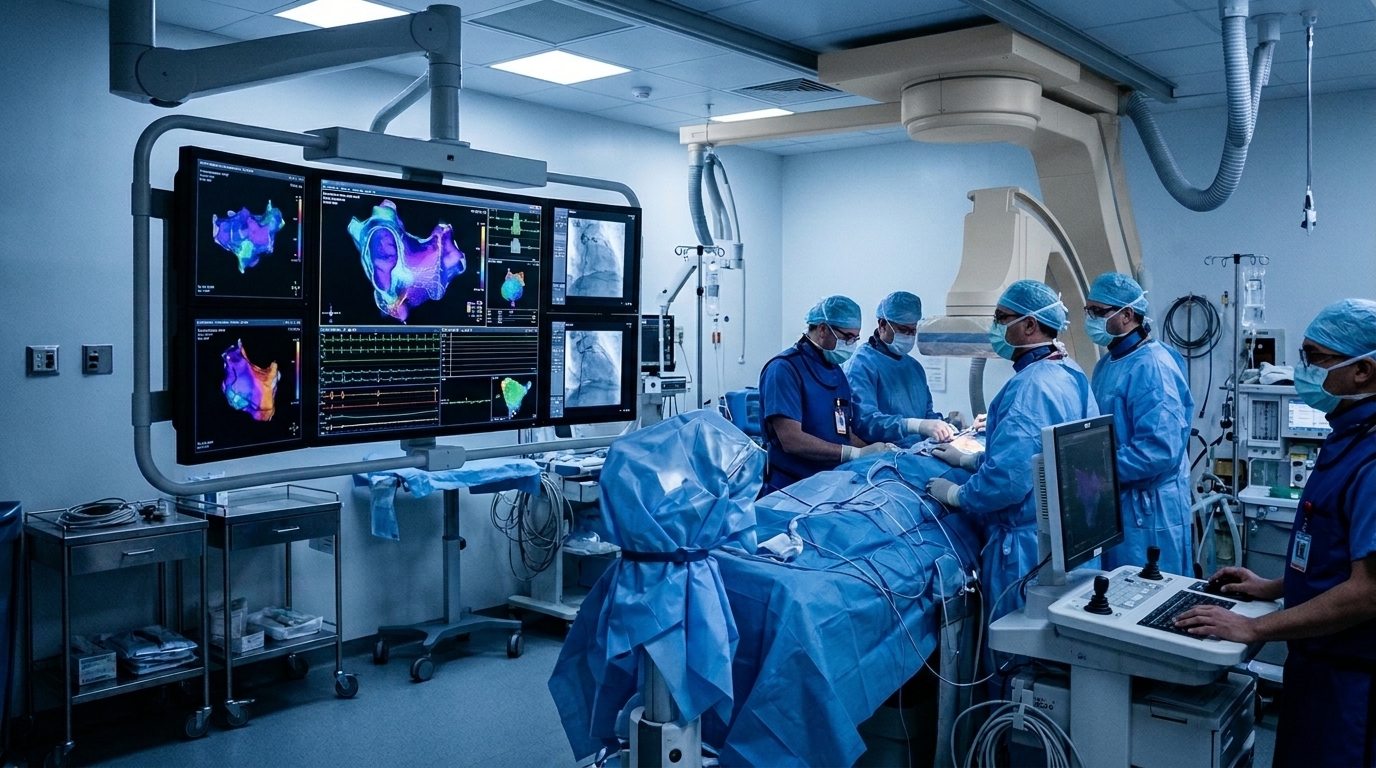
▲ 열이나 냉기 대신 순간적인 고전압 전기 펄스로 주변 정상 조직 손상 없이 부정맥 원인 부위만 안전하게 제거하는 차세대 펄스장 절제술(PFA) 치료 장비.
약물로 조절되지 않는 환자들을 위한 시술 기술도 획기적으로 진화했습니다. 2026년 글로벌 심장학계에서 가장 뜨거운 관심을 받는 기술은 펄스장 절제술(Pulse Field Ablation, PFA)입니다. 과거에는 고주파 열로 지지거나 영하 80도 냉각 풍선으로 얼려서 나쁜 전기 길목을 차단하다 보니, 심장 뒤편에 붙어 있는 식도나 신경이 화상을 입는 합병증 위험이 있었습니다.
반면 PFA는 열을 전혀 쓰지 않고, 100만 분의 1초 단위의 초미세 고전압 전기 펄스를 쏘아 심장 부정맥 세포막에만 미세한 구멍을 뚫어 사멸시킵니다. 주변 혈관이나 식도는 건드리지 않고 병든 조직만 골라 없애기 때문에 시술 시간이 절반 이하로 줄고 안전성이 비약적으로 향상되었습니다.
6. 손목 위 기술을 지혜롭게 누리는 법
스마트워치는 더 이상 단순한 전자시계나 패션 아이템이 아닙니다. 내 몸의 가장 은밀한 생체 신호를 24시간 들여다보는 손목 위의 든든한 파수꾼입니다.
그러나 시계의 진동에 일희일비하며 매 순간 불안에 떨 필요는 전혀 없습니다. 헛경보의 가능성을 차분히 인지하되, 시계가 보내오는 경고 신호를 계기 삼아 내 심장 건강을 정밀하게 점검하는 현명한 징검다리로 삼는 것. 그것이 바로 인류가 첨단 웨어러블 헬스케어 기술과 가장 지혜롭게 동행하는 방법입니다.
[공인 의학 문헌 및 데이터 출처]
• 대한부정맥학회(KHRS) 심방세동 팩트시트 및 임상 가이드라인
• 건강보험심사평가원 부정맥 다빈도 진료 통계 (2024)
• Global Cardiology Meta-Analysis (2026): Diagnostic accuracy of wearables in atrial fibrillation (33,374 patients)
• Journal of the American College of Cardiology (JACC: Advances, 2025): Wearable device validation studies
• Scandinavian Journal of Primary Health Care (2026): Overdiagnosis risk analysis in population screening
• Canadian Cardiovascular Society (CCS) Guidelines on Anticoagulation (CHADS-65 Algorithm)
Investigative Medical Desk | Seung Youb Ssin, Senior Medical and Biotechnology Correspondent
Section: Health & Wellness | Approved: 2026.11.08
MANINTOP Daily Exclusive: Ultra-Bold 1080x1080 Editorial Thumbnail examining the clinical reality behind smartwatch heart warnings and life-saving triage protocols for silent atrial fibrillation.
It often happens unexpectedly during a crowded morning subway commute or in the quiet stillness of your bedroom. A sudden, persistent vibration buzzes against your wrist, followed by an ominous notification: "Irregular Heart Rhythm Detected. This may indicate Atrial Fibrillation."
Your chest tightens with anxiety. Am I experiencing a sudden cardiac event? Should I sprint to the emergency department? Atrial fibrillation (AFib) affects over 59 million people globally, elevating the risk of ischemic stroke by a staggering fivefold. But just how reliable are these wrist-worn health alerts? Here is the definitive, clinically grounded breakdown of what your smartwatch can truly see, what it frequently misinterprets, and the four calm steps you must take when the alarm sounds.
1. The Orchestra Without a Conductor: What Happens in Atrial Fibrillation?
Under normal physiological conditions, the human heart functions like a world-class symphony orchestra. The natural internal pacemaker, known as the sinoatrial node, sends an orderly electrical pulse down the cardiac chambers. The upper chambers (atria) gently squeeze blood into the lower chambers (ventricles), which then powerfully pump it throughout the body.
In atrial fibrillation, this master conductor vanishes. The atria become electrically chaotic, quivering at chaotic rates between 300 and 600 beats per minute. Because the upper chambers cannot contract fully, blood flow becomes sluggish, pooling in a small muscular pouch called the left atrial appendage.
Just as stagnant water breeds rot, pooled blood quickly begins to coagulate, forming dangerous blood clots known as thrombi. If one of these clots breaks free, it shoots up the carotid artery and plugs a major vessel in the brain, triggering a devastating acute ischemic stroke without a moment of warning.
A person resting their arm on a wooden table, calmly touching the digital crown to record a single-lead ECG tracing following a wrist notification.
Key Epidemiological Realities of Atrial Fibrillation
• Fivefold Stroke Risk: Individuals with AFib face a 500% higher likelihood of suffering an ischemic stroke compared to the general population.
• One in Three Suffer Silently: Approximately 30% of AFib patients experience zero symptoms no racing pulse, no dizziness. Tens of thousands discover their condition only after suffering a catastrophic stroke.
• Seasonal Thermal Stress: With every 1-degree Celsius drop in ambient temperature, peripheral vascular resistance elevates systolic blood pressure by 1.3 mmHg. Large seasonal temperature swings expand acute stroke risk by up to 25%.
2. How the Watch Watches: Light (PPG) vs. Electricity (ECG)
How does a lightweight wrist device peer inside your circulatory system? Modern devices like the Apple Watch and Samsung Galaxy Watch rely on two complementary sensor systems:
First is Photoplethysmography (PPG). Flashing green LED lights on the underside of the watch illuminate the microvascular bed of the dermis. As blood volume fluctuates with each pulse, the amount of absorbed light changes. This optical sensor passively monitors pulse rate variability 24 hours a day, including during deep sleep.
Second is the Single-Lead Electrocardiogram (ECG). When you rest your opposite index finger on the watch crown or bezel electrode, you close an electrical circuit across both arms and the chest. Over 30 seconds, it directly records the electrical vector of your cardiac muscle depolarization.
According to a comprehensive 2026 meta-analysis published in Global Cardiology (examining 51 clinical trials encompassing 33,374 patients) and data from the Journal of the American College of Cardiology (JACC), modern wearable algorithms achieve impressive diagnostic benchmarks: sensitivity rates between 94% and 97%, and specificity rates between 93% and 96%. When a heart beats irregularly, the device captures the signal with remarkable fidelity.
3. Why It Is a 'Screen' Not a 'Diagnosis': The Artifact Trap
Despite impressive numbers, cardiologists emphasize an essential clinical boundary: A smartwatch notification is not a final medical diagnosis; it is an invitation to seek medical confirmation.
The primary constraint lies in perspective. In a hospital, clinicians attach 10 electrodes across your chest and limbs to generate a '12-lead ECG'. This acts like an array of twelve high-definition studio cameras inspecting the heart from every spatial angle. A smartwatch, by contrast, is a single-lead recording equivalent to Lead I a one-dimensional snapshot. Subtle electrical features, such as low-amplitude P-waves crucial for proving atrial rhythm, are frequently obscured by background noise.
The second challenge is everyday artifacts. Dry winter skin, a loose strap, shivering, speaking, or muscular twitching can mimic the irregular tracings of AFib, causing false-positive alerts. Furthermore, common and harmless premature contractions (PACs or PVCs) are often misinterpreted by algorithms. Recent clinical reviews in the Scandinavian Journal of Primary Health Care warn that indiscriminate screening among young, healthy populations can generate substantial overdiagnosis, driving unnecessary panic without improving clinical outcomes.
A reassuring clinical consultation where a cardiologist reviews PDF waveform records provided by a patient alongside formal 12-lead diagnostic tracings.
4. Four Calm Steps When Your Watch Sounds the Alarm
Panicking when an alert sounds spikes adrenaline, raising your heart rate and compounding confusion. Instead, follow these four pragmatic clinical steps:
1Sit Down and Breathe Deeply for One Minute
Allow your nervous system to calm down. Check whether you genuinely feel lightheaded, short of breath, or experience flutterings in your chest.
2Record an Immediate 30-Second Manual ECG
Paroxysmal AFib can vanish within minutes. Rest your forearm flat on a stable table, stay completely silent, and hold your finger steadily on the crown to capture clean electrical data.
3Export the Waveform as a PDF Document
Open the health app on your connected smartphone and save the 30-second rhythm strip as a PDF report. Note the time and surrounding circumstances (e.g., following high espresso intake or work exhaustion).
4Present the PDF to a Board-Certified Cardiologist
Schedule an outpatient consultation. Your physician can quickly review the rhythm strip and order definitive hospital testing, such as a 12-lead ECG, 24-hour Holter patch, or echocardiogram.
Emergency Red Flags Requiring Immediate Emergency Care
If the notification is accompanied by any of the following acute symptoms, do not wait for an outpatient appointment call emergency services immediately:
• Severe crushing or burning chest pressure persisting beyond 5 minutes
• Acute shortness of breath rendering speech difficult
• Radiating chest pain extending toward the left shoulder, neck, jaw, or upper back
• Sudden syncopal collapse, blackout, or profound loss of balance
5. Clinical Solutions: Anticoagulants and Pulsed Field Ablation (PFA)
If clinical testing confirms atrial fibrillation, modern therapeutics provide highly effective protection.
The foundation of treatment is anticoagulation to eliminate blood clot formation. While older therapies like Warfarin required strict dietary restrictions (avoiding green vegetables rich in vitamin K) and frequent blood draws, modern Direct Oral Anticoagulants (DOACs: apixaban, rivaroxaban, edoxaban, dabigatran) require no routine coagulation monitoring, carry no food restrictions, and cut the risk of brain hemorrhage in half while preventing roughly two-thirds of ischemic strokes.
| Medication Class |
Traditional Warfarin |
Next-Gen DOACs |
| Primary Clinical Indication |
Valvular AFib (mechanical heart valves) |
Non-valvular AFib (majority of cases) |
| Routine Blood Monitoring |
Mandatory monthly INR coagulation checks |
Fixed-dose regimen, no routine blood tests needed |
| Dietary Interactions |
Strict restriction on vitamin K foods (spinach, beans) |
Zero significant dietary interactions |
| Intracranial Hemorrhage Risk |
Higher baseline hemorrhagic risk |
Significantly lower risk of fatal intracranial bleeding |
An advanced cardiac electrophysiology catheterization laboratory equipped with non-thermal Pulsed Field Ablation (PFA) technology for safe, targeted arrhythmia treatment.
For patients requiring rhythm control, catheter intervention has entered a revolutionary era with Pulsed Field Ablation (PFA). Conventional ablation used extreme heat (radiofrequency) or extreme cold (cryoballoon) to scar abnormal electrical pathways, posing rare risks of thermal injury to the adjacent esophagus or phrenic nerve.
PFA introduces non-thermal electroporation delivering microsecond bursts of high-voltage electrical fields that selectively disrupt the cell membranes of arrhythmogenic myocardial tissue. Because cardiac myocytes are uniquely sensitive to these specific electrical thresholds, neighboring vascular and esophageal structures remain untouched, slashing procedure times and dramatically improving patient safety.
6. Embracing Wearable Technology with Wisdom
Your smartwatch is no longer a simple timepiece; it has become an around-the-clock biological guardian.
The key is perspective. Rather than allowing an algorithm's alert to dictate panic, regard it as a valuable early-warning beacon. When wielded thoughtfully, consumer wearable technology bridges the vital gap between silent physiological shifts and timely clinical care, transforming how we safeguard our cardiovascular health.
[References and Academic Data Sources]
• Korean Heart Rhythm Society (KHRS) Clinical Practice Guidelines and Atrial Fibrillation Factsheet
• Health Insurance Review and Assessment Service (HIRA) Arrhythmia Frequency Metrics
• Global Cardiology Meta-Analysis (2026): Diagnostic accuracy of wearables in atrial fibrillation (33,374 patients)
• Journal of the American College of Cardiology (JACC: Advances, 2025): Wearable device validation studies
• Scandinavian Journal of Primary Health Care (2026): Overdiagnosis risk analysis in population screening
• Canadian Cardiovascular Society (CCS) Guidelines on Anticoagulation (CHADS-65 Algorithm)


