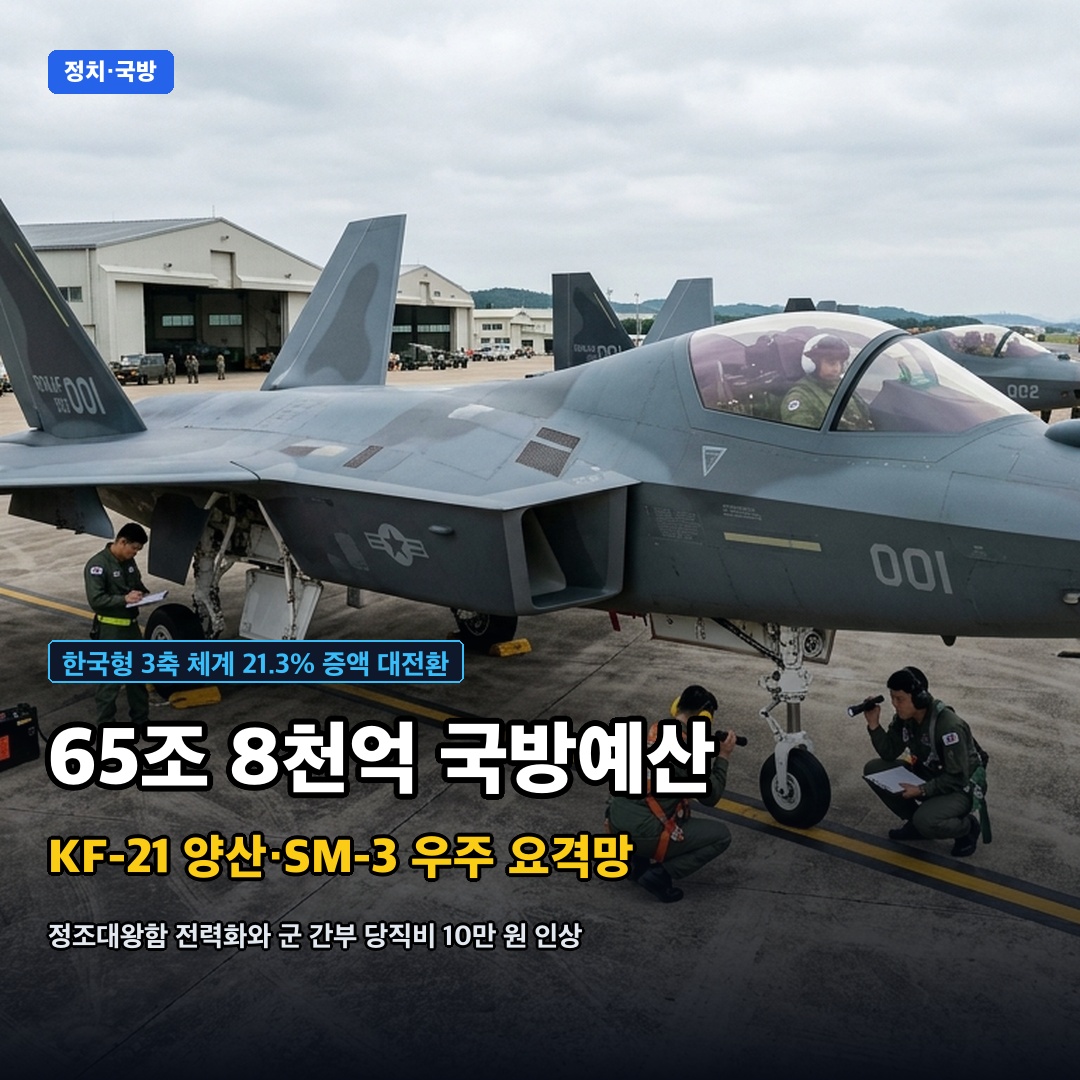
▲ 공군 비행기지 활주로에서 정비 요원들이 최초 양산에 돌입한 KF-21 보라매 전투기의 동체와 항공전자 센서를 꼼꼼히 점검하고 있다. 올해부터 40대가 순차 인도되어 영공 방위의 주력으로 활약한다. / 공식보도자료
대한민국의 안보 지형과 미래 군사력의 판도를 바꿀 2026년도 국방예산이 2020년 이후 6년 만에 최대 증액폭인 7.5% 늘어난 총 65조 8,642억 원으로 최종 확정되었습니다. 특히 첨단 첨병 무기를 도입하고 연구개발을 주도하는 방위력개선비 내에서 한국형 3축 체계 고도화 예산이 전년 대비 21.3% 폭증한 8조 8,387억 원으로 편성되며 독자적 대북 억제력의 비약적인 도약을 예고했습니다. 독자 개발 초음속 전투기인 KF-21 보라매가 마침내 최초 양산 궤도에 올라 공군 40대 순차 인도에 돌입하고, 해상 탄도탄 요격미사일 SM-3 탑재로 우주 영역까지 뻗어나가는 다층 방어망이 구축되면서 우리 군의 전력 구조가 질적인 대전환기를 맞이하고 있습니다.
6년 만의 최대 증액(+7.5%)과 3축 체계 21.3% 폭증… 균형 잡힌 국방 재정
이번 국방 예산의 재정 배분은 군사력 첨단화와 부대 운용 안정성이라는 두 마리 토끼를 잡기 위해 정밀하게 설계되었습니다. 전체 65조 8,642억 원 중 무기 체계 획득과 성능 개량을 담당하는 방위력개선비는 전년 대비 11.9% 급증한 19조 9,653억 원이 배정되었으며, 장병 인건비와 급식, 교육 훈련 등 부대 운용을 책임지는 전력운영비는 5.8% 증가한 45조 8,989억 원으로 균형을 맞췄습니다. 국회 예결위 심사 과정에서 사업 일정이 늦춰질 우려가 있는 4,305억 원을 꼼꼼히 삭감해 불필요한 재정 낭비를 줄인 대신, 여야 합의로 최전방 초급 간부들의 처우 개선과 핵심 무기 연구개발 예산을 증액해 살림살이의 내실을 꽉 채웠습니다.
가장 눈부신 변화는 공군의 차세대 주력 전투기인 KF-21 보라매의 본격적인 양산 개시입니다. 국산 능동위상배열(AESA) 레이더와 독자 항전 장비로 무장한 보라매 전투기 40대가 올해부터 순차적으로 일선 비행단에 인도되어 영공 방위의 최전선에 투입됩니다. 휴전선 이남 우리 공역에서 출격해 북한 전역의 주요 지휘소와 미사일 기지를 3미터 이내의 정밀도로 타격할 수 있는 장거리 공대지 유도탄이 함께 탑재되면서, 북한의 도발 징후를 사전에 포착해 원점을 무력화하는 킬체인(Kill Chain)의 타격 반경이 비약적으로 넓어지게 되었습니다.
예산 구분
2025년 본예산
2026년 확정예산
전년 대비 증감률
총 국방예산
61조 2,000억 원
65조 8,642억 원
+7.5% (4조 6,642억 증액)
방위력개선비 (무기·R&D)
17조 8,462억 원
19조 9,653억 원
+11.9% (역대급 증액폭)
한국형 3축 체계
7조 2,838억 원
8조 8,387억 원
+21.3% (방위력의 44.3%)
전력운영비 (인건비·복지)
43조 3,538억 원
45조 8,989억 원
+5.8% (처우 대폭 개선)
우레-II 갱도 격멸과 SM-3 우주 요격망… 입체적 3축 체계의 완성
지상 타격 체계에서는 지하 갱도에 숨은 적의 포병과 방사포 진지를 일거에 제압하는 전술지대지유도무기(KTSSM) '우레'가 전력화 판정을 마치고 야전 배치에 들어갑니다. 나아가 기존 고정식 발사대의 취약점을 극복하기 위해 바퀴 달린 차량에서 즉각 발사할 수 있고 사거리를 30% 이상 늘린 차세대 '우레-II' 개발 사업(총사업비 약 5,360억 원)도 본궤도에 올랐습니다. 갱도 출입문과 콘크리트 엄체를 뚫고 들어가 내부를 초토화하는 관통력이 기존보다 두 배 이상 강화되어 북한 장사정포 위협을 원천 봉쇄할 핵심 무기로 기대를 모으고 있습니다.
해상 방어망에서는 대기권 밖 우주 영역에서 적 미사일을 요격하는 신기원이 열립니다. 차세대 이지스 구축함인 정조대왕함이 본격 전력화되고, 수백 킬로미터 상공에서 적 탄도미사일을 직접 타격하는 SM-3 요격미사일 탑재가 공식 확정되었습니다. 그동안 패트리어트(PAC-3)와 사드(THAAD), 천궁-II, L-SAM이 책임지던 고도 40~150km의 종말단계 하층 방어선에 더해, 적 미사일이 우주 공간을 날아가는 중간단계(Midcourse)에서부터 먼저 걷어내는 촘촘한 다층 미사일 방어망(KAMD)이 마침내 완성되는 것입니다.
특수작전 C-130H 침투력 강화와 조기경보통제기 8대 체제 구축
특수작전 부대의 적진 침투 능력도 한 차원 업그레이드됩니다. 유사시 북한 지휘부를 타격하는 특임여단의 발이 되어줄 C-130H 수송기 성능개량 사업에 속도가 붙었습니다. 적의 레이더망을 피해 야간이나 험한 악천후 속에서도 산골짜기를 스치듯 초저고도로 침투할 수 있는 전방적외선감시(FLIR) 장비와 정밀 항법 장치가 장착됩니다. 여기에 적의 대공 미사일 공격을 레이저로 교란해 무력화하는 지향성적외선방해장비(DIRCM)가 더해져 우리 특수부대원들의 생존성과 작전 성공률을 극대화합니다.
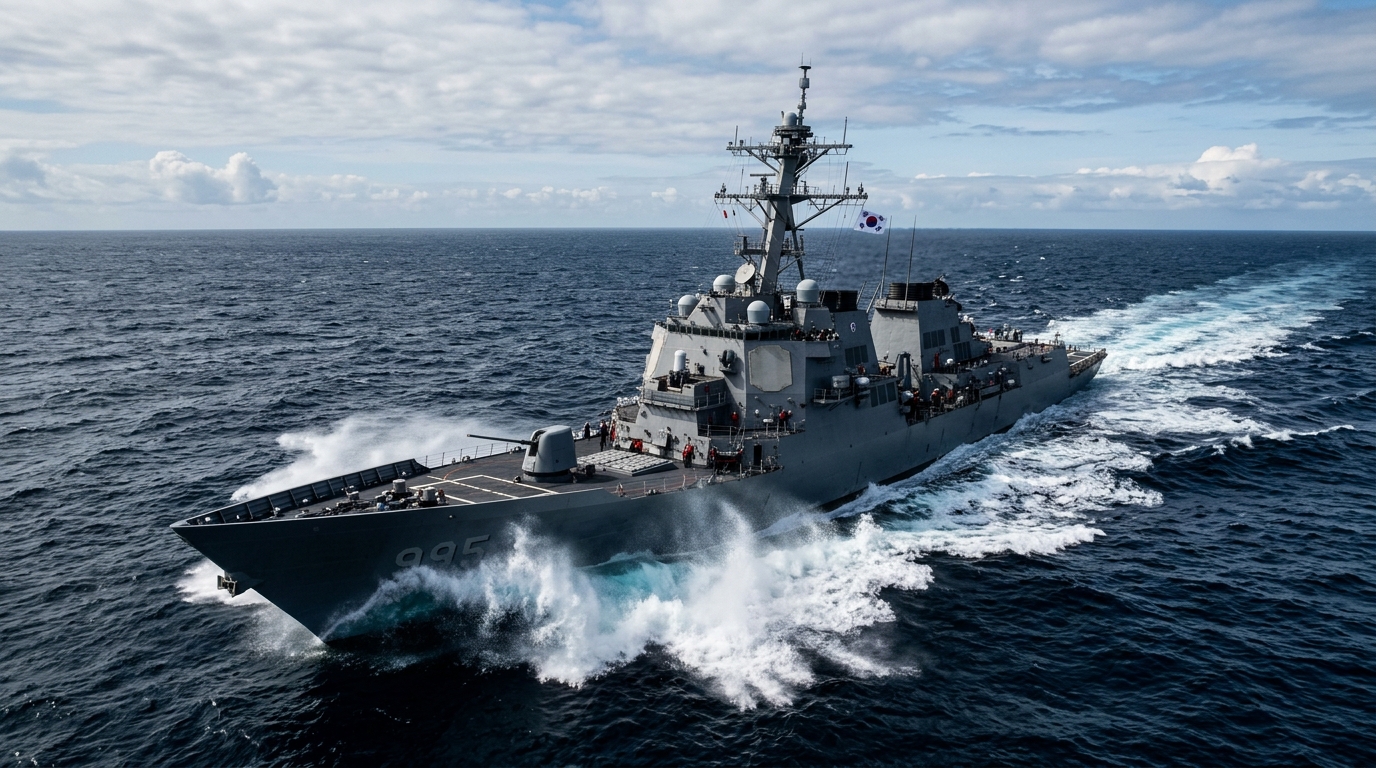
▲ 차세대 이지스 구축함 정조대왕함이 해상 작전 기동 훈련을 펼치고 있다. 수백 킬로미터 상공의 탄도미사일을 요격하는 SM-3 미사일이 탑재되어 대기권 밖 우주 영역까지 아우르는 해상 요격망이 가동된다. / 공식보도자료
눈과 귀 역할을 하는 감시정찰 인프라도 대폭 보강됩니다. 현재 공군이 운용 중인 4대의 E-737 피스아이 조기경보통제기 외에 최신형 항공통제기 4대를 추가 도입하는 2차 사업이 순조롭게 추진되고 있습니다. 2032년까지 총 8대 체제가 완성되면 정비나 작전 피로에 따른 공백 없이 한반도 전역을 24시간 내내 360도로 감시할 수 있게 됩니다. 아울러 적의 전자기펄스(EMP) 공격에도 끄떡없는 차세대 군위성통신체계-III 사업과 국방우주인증센터 구축 예산도 새롭게 반영되어 우주 방위의 주춧돌을 놓았습니다.
네이비 씨 고스트와 함정 발주 혁신… 무인화의 법적·전략적 딜레마
인구 절벽으로 인한 병력 감소에 맞서기 위해 해군이 주도하는 유·무인 복합전투체계 '네이비 씨 고스트(Navy Sea GHOST)'도 힘찬 닻을 올렸습니다. 수상과 수중, 공중의 드론과 무인 로봇을 유인 함정과 하나로 묶어 작전을 펼치는 이 미래형 체계는 방위사업청의 획득 절차 혁신과 맞물려 급물살을 타고 있습니다. 함정 건조 역사상 처음으로 기본설계와 상세설계, 건조를 한 번에 묶어 발주하는 방식으로 항만경비정-II 사업을 추진해 건조 기간과 예산을 획기적으로 줄였으며, 적 기뢰를 목숨 걸고 치우던 위험 임무를 무인 함정이 대신하는 기뢰전 무인수상정(USV) 사업도 공식 승인되었습니다.
하지만 바다 위 무인화가 장밋빛 미래만 담고 있는 것은 아닙니다. 전략 학계에서는 무인 함정이 가져올 뜻밖의 안보 딜레마를 경고하고 있습니다. 국제해양법상 군함은 국적을 표시하고 장교의 지휘하에 승무원이 탄 배로 정의됩니다. 사람이 타지 않은 무인정은 군함의 특권인 주권면제나 무해통항권을 온전히 보장받기 어렵습니다. 더욱이 적국 입장에서는 무인정을 공격하더라도 한국군 인명 피해가 발생하지 않기 때문에 군사적 타격의 부담을 덜 느끼게 되고, 이는 평시 억제력을 약화시켜 우발적인 국지 충돌을 쉽게 부를 수 있다는 깊은 고민거리를 던져주고 있습니다.
지상 전장에서도 사람 대신 위험을 도맡아줄 '피지컬 AI' 로봇들이 본격 활약합니다. 산악과 도시, 복잡한 지하 갱도가 뒤섞인 한반도 전장 환경을 극복하기 위해 전방 부대에 '폭발물 탐지 및 지뢰제거 로봇'이 양산 배치됩니다. 병사들이 목숨을 걸고 탐지기를 휘두르던 지뢰 매설 지역에 첨단 로봇이 먼저 투입되어 길을 열어줌으로써 우리 장병들의 소중한 생명을 지키고 기동부대의 진격 속도를 획기적으로 높여줄 전망입니다.
군 간부 당직비 10만 원 인상과 50만 드론전사… 체감형 복지 혁신
이번 국방 예산의 또 다른 주인공은 묵묵히 헌신해 온 군 간부들입니다. 열악한 복무 환경으로 군을 떠나던 초급·중견 간부들의 발길을 잡기 위해 피부에 와닿는 처우 개선이 대거 단행되었습니다. 그동안 일반 공무원에 비해 턱없이 적었던 당직근무비가 평일 2만 원에서 3만 원으로, 휴일 4만 원에서 10만 원으로 2.5배 껑충 뛰었습니다. 밤샘 당직을 서고도 몇 푼 안 되는 수당에 한숨짓던 군인들의 오랜 설움이 마침내 해소된 것입니다.
소외되었던 중견 간부들을 위한 세심한 배려도 예산안 곳곳에 담겼습니다. 시간외수당도 받지 못하고 지휘 부담만 짊어졌던 소령 계급과 4급 군무원을 위한 직책수행경비가 신설되었고, 잦은 이사로 고통받던 군인 가족을 위해 아파트 사다리차 이용료를 전액 국비로 지원하기로 했습니다. 부사관단을 이끄는 주임원사의 월 활동비도 35만 원으로 올랐으며, 장기 복무를 선택한 간부들이 목돈을 모을 수 있도록 정부가 저축액을 매칭해 주는 '장기간부 도약적금'도 첫선을 보였습니다.
청년 장병들의 전역 후 미래를 준비해 주는 교육 투자와 예비군 보상도 알차게 챙겼습니다. 복무 기간 중 드론 조종 기술을 배우고 국가 자격증까지 딸 수 있도록 205억 원을 투입해 '50만 드론전사 양성 사업'을 가동합니다. 여기에 생업을 멈추고 훈련장으로 달려오는 청년 예비군들을 위해 2,600억 원의 훈련보상비를 배정해 실질적인 경제적 보상을 강화했습니다. 튼튼한 무기와 따뜻한 복지가 어우러진 2026 국방 예산은 안보의 방패를 단단히 벼리는 동시에, 우리 청년들이 자긍심을 품고 복무할 수 있는 선진 강군의 든든한 토대가 될 것으로 기대됩니다.
복지 및 전력 사업
기존 지원 기준
2026년 개선 내용
현장 체감 효과
군 간부 당직근무비
평일 2만 원 / 휴일 4만 원
평일 3만 원 / 휴일 10만 원
휴일 당직비 2.5배 파격 인상
소령·4급 군무원 처우
시간외수당·경비 제외 역차별
직책수행경비 신규 신설
중견 간부 지휘 책임 정당 보상
50만 드론전사 양성
부대별 자체 조종 연습 위주
205억 원 투입 공인 자격 취득
장병 복무 중 미래 기술 습득
예비군 훈련보상비
실비 보상 미흡
총 2,600억 원 예산 확충
참가비·중식비 현실화로 사기 진작
[In-Depth Analysis] 65.8 Trillion Won 2026 Defense Budget Upheaval: KF-21 40-Jet Production and SM-3 Midcourse Interception Unveiled
Defense and Strategic Technology Desk | 2026 National Defense Budget Special2026. 11. 13 21:35 KST
▲ On an active Air Force flight line, maintenance technicians inspect the airframe and sensor array of the KF-21 Boramae as mass production begins. Forty aircraft will be sequentially delivered to frontline air wings to safeguard sovereign airspace. / Press Coverage Photo
Reshaping South Korea's national security landscape and future military readiness, the approved 2026 defense budget expanded by 7.5 percent—the steepest leap in six years since 2020—reaching an aggregate 65.8642 trillion won. Driving this historic transformation, outlays dedicated to the Korea Triad System within the defense capability improvement account surged 21.3 percent to 8.8387 trillion won, demonstrating an uncompromising commitment to sovereign deterrence. With the indigenous supersonic fighter jet KF-21 Boramae officially entering serial production for the phased delivery of 40 jets to the Air Force, and shipboard SM-3 interceptors inaugurating space-tier midcourse ballistic defenses, South Korea's military capabilities have entered a transformative era.
Steepest Surge in Six Years (+7.5%) and 21.3 Percent Jump in Triad Deterrence
Strategic fiscal allocation was meticulously calibrated to simultaneously achieve technological superiority and robust operational stability. Out of the 65.8642 trillion won total, the defense capability improvement account—tasked with advanced weapon acquisition and defense research—surged 11.9 percent to 19.9653 trillion won, while force operations expenditure funding personnel compensation, logistical readiness, and live-fire training rose 5.8 percent to 45.8989 trillion won. During parliamentary deliberations, lawmakers audited 430.5 billion won in delayed appropriations, reallocating these freed funds by bipartisan consensus into essential frontline officer allowances and sovereign defense technology initiatives.
Leading this generational modernization is the domestic mass production of the KF-21 Boramae 4.5-generation fighter jet. Outfitted with an indigenous active electronically scanned array radar and advanced avionics, 40 operational Boramae jets will be sequentially delivered to frontline air wings, establishing an elite aerial strike vanguard. Integrated with long-range air-to-ground precision guided cruise missiles capable of striking high-value bunker command complexes across North Korea within a three-meter circular error probable from sovereign airspace, the qualitative reach of the pre-emptive Kill Chain architecture expands exponentially.
Appropriation Category
FY 2025 Baseline
FY 2026 Enacted
Year-over-Year Growth
Total Defense Budget
61.2000 Trillion Won
65.8642 Trillion Won
+7.5% (+4.6642T Won)
Defense Capability Improvement
17.8462 Trillion Won
19.9653 Trillion Won
+11.9% (Decade High)
Korea Triad System
7.2838 Trillion Won
8.8387 Trillion Won
+21.3% (44.3% of Procurement)
Force Operations & Welfare
43.3538 Trillion Won
45.8989 Trillion Won
+5.8% (frontline welfare boost)
Ure-II Subterranean Strike and SM-3 Exo-Atmospheric Interception Architecture
On the terrestrial battlefield, the tactical surface-to-surface guided missile KTSSM-I Ure, designed to neutralize hostile underground artillery caves and multiple rocket launch batteries in rapid succession, has completed official operational testing and entered frontline deployment. Simultaneously, engineering development for the vehicle-mounted KTSSM-I Block-II Ure-II—a 536 billion won initiative running through 2036—is proceeding rapidly. Featuring high-mobility wheeled chassis, a 30 percent range extension, and twice the reinforced concrete penetration power of its predecessor, Ure-II constitutes an impregnable shield against subterranean artillery emplacements.
At sea, the Republic of Korea Navy is inaugurating an exo-atmospheric ballistic missile defense umbrella. The commissioning of the next-generation Aegis destroyer ROKS Jeongjo the Great, paired with the official procurement of shipboard SM-3 interceptors, expands national missile interception into space-tier midcourse trajectory altitudes exceeding hundreds of kilometers. Complementing terminal-phase lower-tier assets such as Patriot PAC-3, THAAD, Cheongung-II, and L-SAM operating between 40 and 150 kilometers, the integration of SM-3 achieves a true multi-layered ballistic missile defense shield across the entire Korean Peninsula.
C-130H Commando Infiltration Upgrades and Eight Airborne Control Aircraft Fleet
Special reconnaissance and unconventional warfare capabilities are experiencing a synchronized technological overhaul. Upgrades for the Air Force's C-130H tactical transport fleet will ensure specialized commandos can penetrate deep into hostile territory under extreme weather and zero-visibility darkness. Installing forward-looking infrared cameras, satellite datalinks, and specialized terrain-following avionics enables ultra-low-altitude contour flight, while directional infrared countermeasures and missile approach warning sensors defeat heat-seeking anti-aircraft missile threats with targeted laser jamming.
▲ The next-generation Aegis destroyer ROKS Jeongjo the Great executes operational maneuvers at sea. Equipped with SM-3 interceptors capable of neutralizing ballistic missiles hundreds of kilometers into space, South Korea's sea-based missile defense expands into the exo-atmosphere. / Press Coverage Photo
Surveillance and airborne command networks are expanding aggressively to eliminate operational blind spots. Alongside four existing E-737 Peace Eye aircraft, the Defense Acquisition Program Administration is procuring four Bombardier Global 6500-based airborne early warning and control aircraft under the Airborne Early Warning second batch program. Establishing an eight-aircraft fleet by 2032 guarantees continuous 24-hour 360-degree radar surveillance across the peninsula. Concurrently, kickoff funding for the military satellite communication system MilSatCom-III ensures secure orbital frequencies and electromagnetic pulse hardening against hostile jamming.
Navy Sea GHOST and Procurement Innovation Amid Unmanned Warship Dilemmas
Addressing demographic shifts and personnel constraints, the Navy has officially launched Navy Sea GHOST, a visionary multidomain manned-unmanned teaming architecture. Integrating uncrewed surface, subsurface, and aerial combat vehicles with crewed destroyers, the program is catalyzed by bold procedural reforms from the Defense Acquisition Program Administration. Pioneering an integrated procurement framework bundling basic design, detailed design, and lead ship construction into a single contract for the Harbor Patrol Boat-II project, authorities slashed multi-year acquisition cycles while formally commissioning autonomous mine countermeasures surface vessels.
Yet strategic maritime uncrewed operations introduce nuanced legal and tactical paradoxes that defense planners must navigate. Under Article 29 of the United Nations Convention on the Law of the Sea, a warship is strictly defined as an armed vessel belonging to the armed forces of a state, commanded by an officer and manned by a crew subject to regular military discipline. Lacking human personnel, autonomous vessels inhabit an ambiguous legal twilight regarding sovereign immunity and innocent passage, inadvertently lowering an adversary's threshold for kinetic interception since human casualties are eliminated.
Terrestrial land forces are deploying physical robotics systems to shoulder hazardous frontier duties. To clear dense legacy minefields across mountainous frontier corridors and urban terrain, the military will commence mass production and deployment of explosive ordnance disposal and mine-clearing robotic systems in 2026. Deploying autonomous mechanical platforms ahead of combat formations protects soldiers from catastrophic blast injuries while sustaining the tactical tempo of armored mechanized brigades.
Duty Allowances Reaching 100,000 Won and 500,000 Certified Drone Combat Specialists
Human capital resilience represents the foundational pillar of the 2026 defense appropriations. To arrest retention attrition among junior and mid-career officers, the government executed overdue compensation corrections. Long-stagnant officer duty watch stipends jumped from 20,000 won to 30,000 won for weekday shifts, and surged 2.5-fold from 40,000 won to 100,000 won for weekend and holiday duty, achieving parity with civil service benchmarks and resolving deep morale grievances among frontline commanders.
Mid-career personnel and military households also received targeted institutional backing across the legislative budget. Major rank officers and fourth-grade civilian defense officials, traditionally excluded from overtime compensation while bearing heavy command responsibilities, will receive dedicated leadership duty allowances. Furthermore, frequent relocation burdens will be softened through comprehensive coverage of high-rise ladder truck moving expenses, command sergeant major stipends will rise to 350,000 won monthly, and the newly launched Junior Officer Asset Building Savings Plan will provide government matching contributions for career officers.
Investing in conscripted youth, the military allocated 20.5 billion won to qualify 500,000 drone combat operators, providing technical certification and practical piloting skills during active service. Additionally, 260 billion won was appropriated to raise daily compensation allowances for reserve forces fulfilling mobilization duties. Uniting cutting-edge aerospace and naval platforms with dignified human welfare, the 2026 defense budget constructs a formidable deterrence shield while cementing the foundation of an advanced, respected national military.
Welfare & Force Initiative
Prior Compensation Standard
FY 2026 Enhanced Policy
Frontline Operational Impact
Officer Duty Watch Stipends
20,000 KRW Weekday / 40,000 Weekend
30,000 KRW Weekday / 100,000 Weekend
2.5-Fold jump for weekend duty
Major & 4th Grade Defense Staff
Overtime and expense gaps
Newly established leadership allowance
Equitable command remuneration
500,000 Drone Combat Pipeline
Fragmented unit-level practice
20.5 Billion Won for official licenses
Future technical career integration
Reserve Mobilization Stipends
Nominal expense reimbursements
Total 260 Billion Won allocated
Economic parity for civic defense
PRO SOURCING ENGINE만인의 탑 빅데이터 솔루션
★ 가입 시 600 크레딧(120회) 전원 무료
내가 찾는 상품 키워드, 지금 얼마나 검색될까?
네이버 월간 검색량 + 구글 볼륨 + 아이템스카우트 실시간 상품수와 경쟁강도 배지를 0.5초 만에 무료로 확인하세요.
MANINTOP NEWSLETTER
📬 만인의 탑 뉴스레터 무료 구독
오늘 보신 정책·시사 뉴스가 유익하셨나요? 매일 엄선되는 알짜 복지 혜택과 국회 실시간 속보를 이메일로 가장 먼저 받아보세요. (평생 무료)
1월이 시작되면 감기는 이미 우리 곁에 와 있습니다. 2월, 3월, 4월까지 이어지는 추위와 건조함은 코와 목을 가장 먼저 공격합니다. 아침에 일어나자마자 막혀 있는 코. 계속 흐르는 콧물. 괜히 칼칼해지는 목. 이 증상은 “시작”일 뿐입니다. 한 번 무너지면 일주일, 길면 한 달까지 끌고 갑니다. 약을 먹으면 잠깐 괜찮아집니다. 하지만 며칠 뒤 또 반복됩니다. 왜일까요? 감기는 ‘치료’의 문제가 아니라 ‘관리’의 문제이기 때문입니다. 대부분은 감기가 오고 나서 약을 찾습니다. 하지만 진짜 중요한 건 감기가 오기 전에 코와 목을 지키는 것입니다. 건조한 실내 공기, 차가운 바깥 공기, 눈에 보이지 않는 세균. 코와 목은 매일 공격받고 있습니다. 지긋지긋하죠! 그런데도 우리는 아무 준비 없이 버티고 있습니다. 이번 겨울도 그렇게 보낼 건가요? 사실 방법은 어렵지 않습니다. 코를 깨끗하게 관리하고, 목을 따뜻하게 보호하고, 점막을 촉촉하게 유지하고, 기관지를 미리 관리하고, 외부 공기를 차단하는 것. 이 다섯 가지만 꾸준히 해도 감기약 없이 겨울을 보내는 것이 충분히 가능합니다. 🔥 이제부터 그 방법을 하나씩 살펴보겠습니다. 🔥 1. 코와 목을 먼저 관리해야 하는 과학적 이유 감기의 대부분은 코 점막에서 시작됩니다. 국제 학술지 Nature Reviews Microbiology 와 Journal of Allergy and Clinical Immunology 에 실린 호흡기 감염 관련 연구들에서는, 감기 바이러스가 비강 상피세포에 먼저 부착해 증식한다는 점을 설명하고 ...
리모델링사업이 진행 중인 아파트를 매매할 때 “계약금 10%를 언제까지 내야 하느냐”는 질문이 특히 많이 나옵니다. 이주공고(이주 안내)가 7~11월쯤이라고 들으면, 그 시점에 맞춰 계약금도 움직일 것 같아서 더 헷갈리기 쉽습니다. 하지만 실제 납부기한은 ‘이주공고가 언제냐’만으로 자동 결정되지 않는 경우가 많습니다. 1) 계약금 10% 납부기한: 결국 ‘문서에 적힌 일정’이 기준 계약금 10%를 언제까지 납부해야 하는지는, 내가 서명하는 매매계약서(특약 포함) 와 사업주체/조합이 제시한 공고·안내문 에 적힌 납부 일정이 기준이 됩니다. 실제 공고문에서는 분양대금 납부의 큰 틀(계약금→중도금→잔금)을 먼저 안내하고, 상세 일정은 별도 표나 유의사항으로 제시하는 방식이 흔합니다. 또, 계약서 문구에 따라 지급 시점이 조건부로 설정될 수도 있습니다. 예를 들어 한 사례 소개 자료에서는 용역계약서에 잔금(10%) 지급시기가 “사업승인 후”로 기재되어 있었다는 점이 언급됩니다. 이런 식으로 ‘사업 단계’와 지급을 연동하는 문구가 들어가면, 질문의 답은 계약서 문구를 확인해야만 확정됩니다. 관련 내용은 링크 에서 문구 사례를 확인할 수 있습니다. 2) 입주자모집공고에서 확인되는 ‘납부 순서’와 잔금 마감 시점 공고문에 적힌 문구를 보면, 납부 순서와 잔금 마감에 대한 기준이 비교적 명확하게 제시되는 경우가 있습니다. 예를 들어 한 입주자모집공고에는 “분양금액(주택가격)은 계약금, 중도금, 잔금의 순서로 납부”하며 “잔금은 입주(열쇠 수령일) 전에 완납”해야 한다고 안내되어 있습니다. (문구 확인: 링크 ) 이 문구가 의미하는 바는 최소 2가지입니다. 분양/공급 형태의 문서에서는 ‘계약금→중도금→잔금’ 흐름이 공식적으로 안내될 수 있습니다. 잔금은 “입주(열쇠 수령)” 이전에 완납해야 한다는 마감 기준이 문서에 적혀 있을 수 있습니다. 다만, 위 공고문 문구는 잔금 마감에 대한 기준을 보여주지만, 계약금 10%의...
윤석열 전 대통령 탄핵 인용 소식을 접하면, 가장 궁금한 지점은 ‘헌재가 정확히 무엇을 위헌·위법으로 봤는가’입니다. 또한 탄핵과 별개로 진행되는 형사재판(내란 우두머리 혐의 등)이 어디까지 왔는지도 함께 정리할 필요가 있습니다. 아래 내용은 제공된 기사/게시물 스니펫과 링크에서 확인되는 범위만 모아, 일반인이 흐름을 이해하기 쉽게 정리한 것입니다. 1) 탄핵 인용 관련: 스니펫에서 확인되는 ‘판단의 골격’ 제공된 근거 중 조국혁신당 사이트에는 헌법재판소가 윤석열 탄핵 심판에서 “피청구인의 위헌·위법행위는 국민 신임 …”이라는 취지로 판단했다는 문장이 인용돼 있습니다( 링크 ). 이 인용문만 놓고 보면, ‘위헌·위법행위’가 있었는지와 그로 인해 ‘국민의 신임’이 어떻게 평가됐는지가 핵심 축으로 소개됩니다. 다만 질문에서 요청하신 세부 항목, 즉 비상계엄 선포 자체를 문제 삼은 구체적 이유, 계엄 이후 조치(포고령, 국회 통제 등)의 어떤 지점이 헌법 위반인지, 국회의 권한행사 방해 및 정치활동 제약을 어떤 논리로 판단했는지 등은, 이번에 제공된 근거의 제목/스니펫만으로는 조항·사실관계·판단 구조가 그대로 제시돼 있지 않습니다. 따라서 이 글에서는 ‘헌재가 무엇을 문제 삼았다’는 세부 리스트를 단정적으로 재구성하기보다, 현재 확인 가능한 문구 수준의 요약(위헌·위법행위 → 국민 신임의 문제로 평가)까지만 적습니다. 만약 헌재 결정문 전문(주문 및 이유)이 추가로 확인되면, 그때는 문장 단위로 ‘어떤 행위’와 ‘어떤 헌법 원리/조항’이 연결되는지(예: 권력분립, 국회의 권한, 정치적 기본권 등) 구조화해 정리하는 것이 가장 정확합니다. 2) 형사 절차(내란 혐의) 관련: 체포영장과 1심 선고 언급 탄핵 심판과 별도로, 12·3 비상계엄 사태로 내란 혐의를 받는 윤석열 대통령에 대해 2024년 12월 31일 체포 영장이 발부됐다는 BBC 보도가 있습니다( 링크 ). 해당 보도는 ‘현직 대통령’에 대한 체포영장 발부라는 점을 함께 언급합니다. 또...