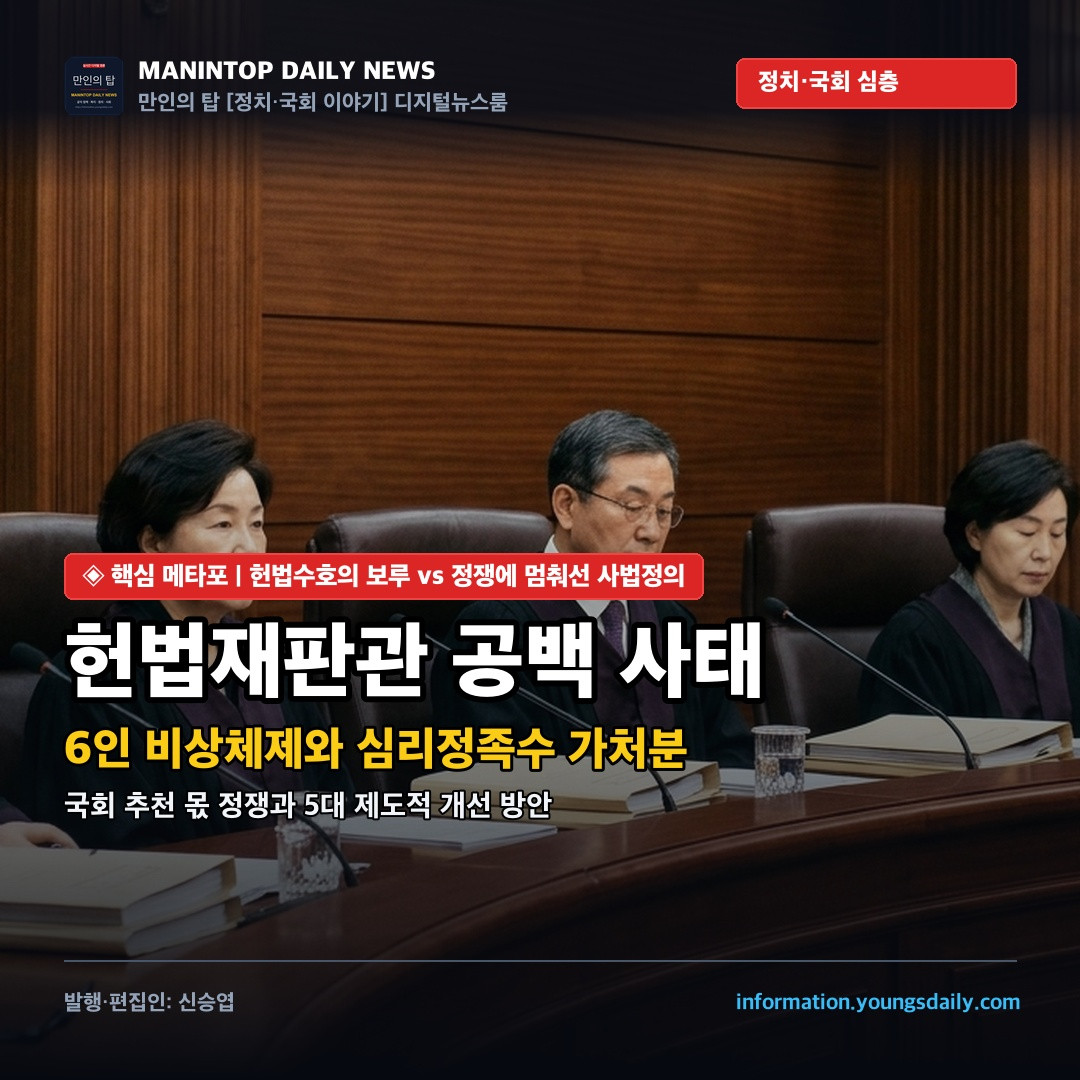
국회 몫 3인 선출 규정 부재: 법적 기준 없이 정권별 의석 구도와 정쟁에 기댄 고무줄 배분 관행이 파행 초래.
해외 헌법재판소의 안전장치: 독일의 계속근무제(BVerfGG 4조 4항) 및 헌재 자체 추천권, 오스트리아의 예비재판관 모델.
사법 공백 근절 5대 입법 과제: 단기 임기연장제 및 가중정족수 도입, 중장기 예비재판관 신설과 9년·12년 단임제 개헌.
국회 추천 몫 재판관의 후임 인선 결렬로 인한 헌법재판관 공백 사태가 반복되면서 대한민국 최고 헌법보장기관인 헌법재판소가 또다시 '6인 비상체제'로 축소 운영되는 사법 위기에 직면했습니다. 심리정족수(7인) 미달로 인한 헌재 기능 마비를 막기 위해 헌재 전원재판부가 사상 초유의 효력정지 가처분(2024헌사1250)을 인용하며 응급처방을 내렸으나, 심리는 가능하되 위헌 결정을 내릴 수 없는 의결정족수(6인)의 한계와 맞물려 판결의 정당성 시비가 거세게 일고 있습니다.
1. 반복되는 헌재 마비 잔혹사… 14개월 공석부터 2024년 6인 비상체제까지
헌법재판관 공백으로 인한 심판 기능의 마비는 단발성 사건이 아닌 헌정사에 뿌리 깊은 구조적 질환으로 꼽힙니다. 지난 2011년 조대현 재판관 퇴임 당시 여야 대립으로 무려 14개월간 후임 인선이 표류했던 사례가 대표적이며, 2018년 9월에도 재판관 5인이 동시 퇴임했으나 국회 인사청문 경과보고서 채택이 파행을 빚으면서 두 달간 헌재의 변론과 선고가 전면 중단되는 사태가 발생했습니다.
당시 2018년 국정감사에서 헌법재판소 사무처장은 6인의 재판관으로는 심판정족수가 충족되지 않아 평의와 변론, 선고가 전면 마비되고 있다며 국회의 조속한 추천을 공식 호소하기도 했습니다. 이어 2024년 10월 17일 이종석 헌법재판소장과 이영진·김기영 재판관이 임기 만료로 퇴임하면서 헌재는 또다시 6인 체제로 재편되었고, 3개 지정재판부 사전심사를 위해 타 재판부 재판관이 임시 대직하는 파행이 불가피했습니다.
2. 국회 추천 몫 3인의 배분 갈등… 관행에 기댄 인선과 정쟁의 악순환
사태가 만성화된 근본 원인은 헌법 제111조와 헌법재판소법이 '재판관 9명 중 국회에서 3명을 선출한다'고만 명시했을 뿐, 교섭단체 간 의석 비율이나 구체적인 추천 절차를 전혀 규정하지 않은 입법적 맹점에 있습니다. 대법원장 지명 몫 3인과 대통령 지명 몫 3인이 비교적 순조롭게 임명되는 것과 달리, 국회 선출 몫 3인은 역대 정치 구도와 여야 협상력에 따라 관행이 고무줄처럼 변해왔습니다.
실제로 1988년 제1기 헌재 출범 당시에는 4당 체제 하에서 상위 3개 정당이 1인씩 균등 추천했으나, 1994년 제2기에는 과반 여당이 2명, 야당이 1명을 가져갔고, 1999년 이후에는 여당 1명, 야당 1명, 여야 합의 1명이라는 양당 관행이 정착되었습니다. 그러나 2018년 3개 교섭단체 시절에는 각 당이 1명씩 배분받았고, 최근에는 여야 간 추천 지분(여1:야2 대 여1:야1:합의1)을 둘러싼 정략적 줄다리기가 탄핵심판 등 정치적 셈법과 얽히면서 공백이 무기한 장기화되었습니다.
국회 시기
원내 정당 구도
추천 배분 방식 및 관행
주요 추천 인사 및 특징
제1기 (1988년 체제)
4당 체제 (여소야대)
상위 3개 교섭단체 각 1명씩 추천
민정당(한병채), 평민당(변정수), 민주당(김진우) 균등 선출
제2기 (1994년)
여당 압도적 과반 의석
여당 2명, 야당 1명 의석 비례 배분
민자당 2명(김문희·신창언), 민주당 1명(조승형) 선출
제3기~5기 (1999~2012년)
여야 양당 체제 고착화
여당 1명, 야당 1명, 여야 합의 1명 정착
2012년 여야 합의 강일원 재판관 선출 등 안정적 안착
제6기 이후 (2018년~현재)
다당제 및 양대 교섭단체 극단 대치
배분 비율(여1:야2 vs 여1:야1:합의1) 대립
탄핵 심판 셈법과 맞물려 후임 인선 장기 표류 및 사법 마비
[자료: 국회 의안정보시스템 및 헌법재판소 30년사 역대 인선 기록 종합]
3. 2024헌사1250 가처분의 명암… 심리정족수 정지와 6인 만장일치 의결의 덫
이러한 헌재 마비의 뇌관이었던 헌법재판소법 제23조 제1항의 '재판관 7인 이상 출석' 심리정족수 규정에 대해, 헌재 전원재판부는 2024년 10월 14일 사상 초유의 효력정지 가처분(2024헌사1250)을 전원일치로 인용했습니다. 탄핵소추로 직무가 정지된 공직자가 국회의 추천 지연이라는 외적 사유로 신속한 재판을 받을 권리를 침해당하는 회복할 수 없는 손해를 방지하기 위해, 재판관 임기만료 공석 시에 한해 심리정족수 효력을 잠정 정지한 것입니다.
그러나 법조계와 헌법학계에서는 가처분 인용으로 6인 체제 심리가 가능해졌음에도 의결정족수와의 불일치로 인한 결정의 정당성 왜곡을 강력히 경고하고 있습니다. 헌법 제113조 제1항에 따라 위헌·탄핵·권한쟁의 인용 결정을 내리려면 재판관 6인 이상의 찬성이 필수적이므로, 6인 체제에서는 단 1명의 재판관만 반대해도 5대 1의 압도적 다수가 위헌 의견을 내더라도 사건이 기각되는 기형적 결과가 초래되기 때문입니다.
이와 함께 대통령 직무정지 또는 궐위 시 '대통령 권한대행'이 헌법재판관을 지명할 수 있는지에 대한 법적 공백도 정국의 뇌관으로 부상했습니다. 2017년 박근혜 전 대통령 탄핵 당시 황교안 권한대행은 재판관 지명을 자제했으나, 2025년 4월 한덕수 권한대행이 퇴임을 앞둔 재판관의 후임 지명을 강행하려 하자 대선을 앞둔 권한대행의 월권이자 위헌적 인사권 행사라는 거센 정치적 반발과 법적 분쟁이 촉발된 바 있습니다.
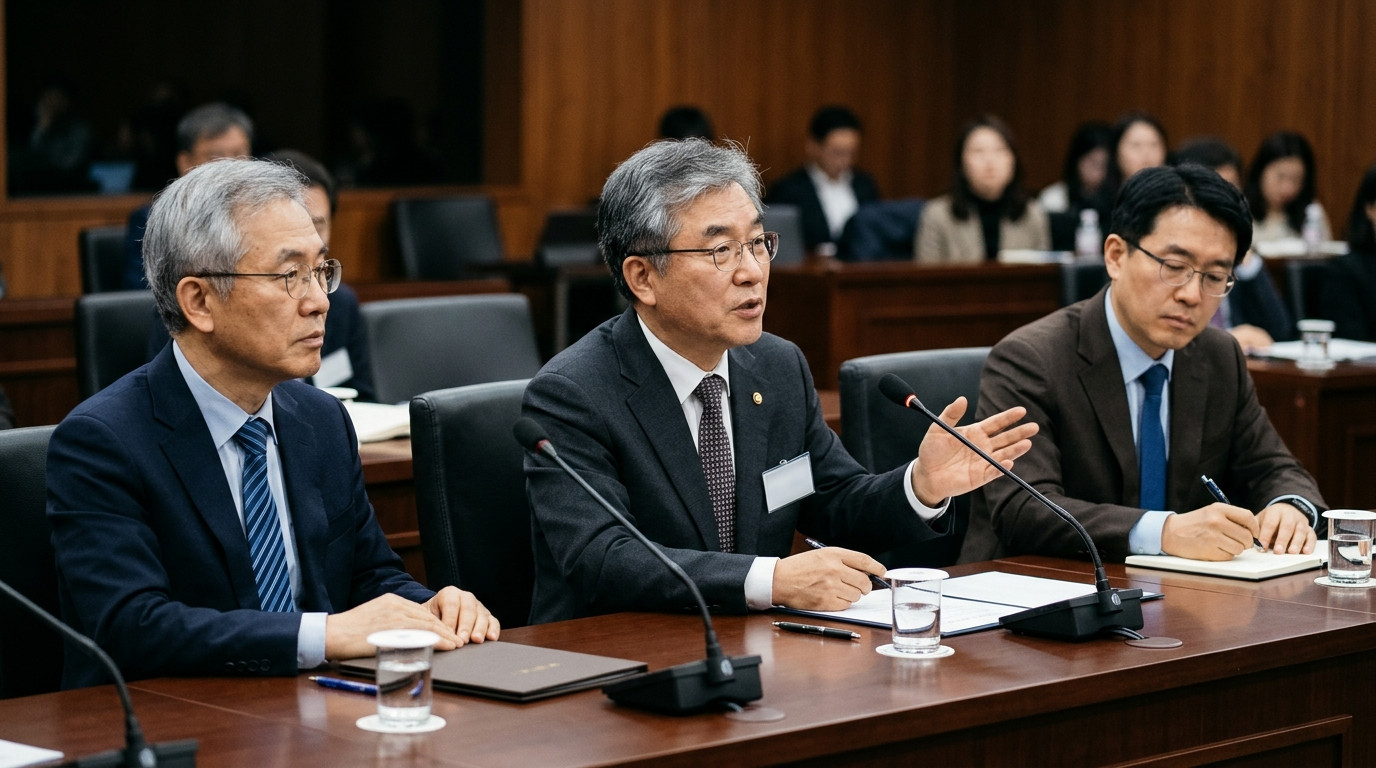
▲ 헌법학계 및 사법제도 전문가들이 헌법재판관 공석 사태 예방과 계속근무제 도입 방안을 토론하고 있다. / 학술회의보도자료
4. 독일 계속근무제와 오스트리아 예비재판관… 해외 헌법재판소의 공백 방지책
해외 주요 헌법재판국가들은 이러한 정치적 사법 공백을 제도적으로 원천 차단하고 있습니다. 독일 연방헌법재판소법(BVerfGG) 제4조 제4항은 재판관의 12년 임기가 종료되더라도 후임자가 선임되어 취임할 때까지 기존 재판관이 직무를 계속 수행하는 '계속근무제(임기연장제)'를 명문화하여 단 하루의 공석도 허용하지 않고 있습니다.
특히 독일은 의회가 정치적 갈등으로 2개월 내에 후임자를 선출하지 못할 경우 연방헌법재판소 자체가 후임 후보를 직접 추천하도록 규정함으로써, 다수당이 특정 재판관의 임기를 자의적으로 늘리기 위해 인선을 고의 지연시키는 사태를 방지합니다. 오스트리아 역시 질병이나 결원 발생 시 즉각 투입되어 심리와 의결에 참여하는 '예비재판관(Ersatzmitglieder)' 제도를 운용하여 헌법재판의 연속성을 완벽히 보장하고 있습니다.
5. 헌정 사법 정상화를 위한 5대 입법 대안… 단기 개정안부터 원포인트 개헌까지
국내 전문가들은 헌재 공백을 근절하기 위한 5대 입법 대안으로 계속근무제 도입, 국회 추천 몫 배분 기준 법제화 및 재적 3분의 2 가중정족수 도입, 오스트리아식 예비재판관 신설, 재판관 9인에서 12인 증원 및 2부제 운영, 대통령 권한대행의 지명권 한계 명문화를 제시합니다. 특히 후임자 선출 시까지 전임자가 최장 6개월간 직무를 수행하게 하되 헌재의 자체 추천권을 결합하는 방안이 유력한 단기 법 개정 대안으로 꼽힙니다.
개선 방안
핵심 내용 및 법적 기제
기대 효과 및 장점
주요 쟁점 및 해결 과제
계속근무제 (임기연장)
후임 취임 시까지 전임자 직무 계속 수행 (최장 6개월 안)
사법 공백 전면 차단 및 재판 연속성 보장
헌법상 6년 임기 조항 합치성 및 인선 고의 지연 방지책 필요
국회 배분 명문화 & 가중정족수
국회 몫 선출 기준 법문화 및 재적 2/3 찬성 요구
다수당 독식 차단 및 다원적 정당성 확보
극단 대치 시 인선 지연 심화 위험 (후보추천위 결합 필수)
예비재판관 제도
오스트리아식 사전 예비인력풀 구축 및 결원 시 즉시 투입
결원 없는 9인 전원재판부 완제 심리 유지
예비재판관 헌법적 지위 신설을 위한 개헌 필수
재판관 증원 및 2부제
정원을 9인에서 12인으로 증원하고 2개 부제 분할 운영
사건 처리 속도 향상 및 일부 공석 시 완충력 확보
사법 기구 비대화에 따른 예산 증액 및 헌법 개정 검토
권한대행 지명권 한계 법제화
대통령 권한대행의 재판관 지명·임명 권한 범위 법문화
정치적 상황에 따른 유권해석 혼란 및 월권 차단
권한대행의 헌법적 권능 한계에 대한 학설 및 판례 정립
[자료: 한국헌법학회 학술대회 발표 자료 및 헌법재판제도 개선 심포지엄 종합]
결국 헌법재판소가 정치권의 정쟁에 휘둘려 문을 닫는 사법 후진성을 탈피하기 위해서는 단기적인 헌법재판소법 개정과 함께 중장기적인 개헌 결단이 병행되어야 합니다. 재판관 임기를 6년 연임제에서 9년 또는 12년 단임제로 전환하여 재임 의식에 따른 정치적 종속을 차단하고, 헌법에 결원 보충 기제를 명시해야만 국민의 신속한 재판을 받을 권리와 사법정의가 온전히 지켜질 수 있습니다.
Published: 2026-11-06 |
Desk: Manintop Politics & Policy Bureau |
Author: Dr. Seung Youb Ssin (Seung Youb Ssin, Ph.D.)
▲ Constitutional Court justices deliberate upon high-stakes constitutional cases and quorum dispute issues. / Press Documentation
◈ Executive Briefing & Strategic Insights
Chronic High Court Gridlock: Following a 14-month vacancy in 2011 and paralysis in 2018, the court returned to an emergency six-justice bench in late 2024.
Historic 2024HeonSa1250 Injunction: Suspending statutory seven-justice hearing quorums enabled proceedings but left decisive six-vote requirements vulnerable.
Absence of Parliamentary Nomination Rules: Lack of clear statutory formulas leaves three parliamentary seats subject to volatile partisan disputes.
Global Institutional Safeguards: Germany holds over sitting justices with court nomination backup, while Austria employs substitute judges.
Five Comprehensive Reform Paradigms: Combining statutory holdover provisions and supermajority thresholds with targeted amendments for non-renewable long tenures.
With the recurring paralysis of judicial appointments for National Assembly nominees, the Constitutional Court of Korea, the nation's supreme guardian of constitutional order, has once again been forced into an emergency Six-Justice Regime amidst a deepening institutional crisis. Although the full bench of the Constitutional Court granted an unprecedented provisional injunction (2024HeonSa1250) suspending the statutory hearing quorum requirement of seven justices to prevent complete operational shutdown, acute controversies over judicial legitimacy have erupted because the statutory decision quorum of six affirmative votes remains unchanged, effectively preventing rulings on unconstitutionality or impeachment whenever a single justice dissents.
1. The Chronic History of Constitutional Court Paralysis: From 14-Month Vacancies to the 2024 Six-Justice Gridlock
The paralysis of constitutional adjudication resulting from unfilled judicial vacancies is widely recognized as a chronic structural affliction deeply embedded in modern constitutional history rather than an isolated phenomenon. A notable precedent occurred following the retirement of Justice Cho Dae-hyun in 2011, when partisan deadlock left the seat vacant for fourteen consecutive months, and again in September 2018, when five of nine justices completed their terms simultaneously, bringing hearings and rulings to a complete halt for two months due to legislative delays in adopting parliamentary confirmation reports.
During the 2018 parliamentary audit, the Secretary General of the Constitutional Court made an official plea to the National Assembly, warning that operating with only six justices fell short of the statutory hearing quorum, completely freezing deliberations, oral pleadings, and formal rulings. The crisis resurfaced on October 17, 2024, when Chief Justice Lee Jong-seok and Justices Lee Young-jin and Kim Ki-young completed their terms without successors, forcing the remaining bench to rotate emergency acting roles across three designated panels to handle basic pre-trial screenings.
2. The Partisan Clash Over Three Parliamentary Nominees: Reliance on Fluid Conventions and Political Deadlocks
The chronic vulnerability stems fundamentally from an institutional omission within Article 111 of the Constitution and the Constitutional Court Act, which mandate that three of the nine justices be elected by the National Assembly without providing any statutory formula for seat distribution or nomination timelines. While the three justices nominated by the Chief Justice of the Supreme Court and three chosen by the President proceed through established internal vetting, parliamentary selections have repeatedly fluctuated based on shifting party alignments and political leverage.
When the first Constitutional Court bench was inaugurated in 1988 under a four-party system, each of the top three parties nominated one justice, whereas in 1994 the ruling majority claimed two slots, leaving one to the opposition. After 1999, a bipartisan norm of one ruling, one opposition, and one consensus nominee took root, but the three-caucus parliament of 2018 reverted to one nominee per caucus, and recent factional disputes over allocation ratios have paralyzed appointments as nominees became bargaining chips in high-stakes impeachment and oversight battles.
Legislative Era
Parliamentary Configuration
Allocation Convention
Key Nominees & Characteristics
Inaugural Bench (1988)
Four-party legislative balance
One nominee per top three parties
Equal allocation among three major caucuses
Second Bench (1994)
Overwhelming ruling majority
Two ruling seats and one opposition seat
Proportional seat share allocation
Third to Fifth Benches (1999-2012)
Consolidated two-party system
One ruling, one opposition, one consensus
Institutional stability via bipartisan consensus
Sixth Bench and Beyond (2018-Present)
Multi-caucus friction and polarized deadlock
Disputes over nomination ratios
Prolonged vacancies tied to political battles
[Source: Republic of Korea National Assembly Legislative Records and Constitutional Court History Archives]
3. Double-Edged Injunction 2024HeonSa1250: Halting Hearing Quorums vs the Trap of Unanimous Six-Vote Rulings
Addressing the core statutory obstacle under Article 23, Paragraph 1 of the Constitutional Court Act, which mandates attendance of at least seven justices to hear cases, the full bench issued an extraordinary unanimous injunction (2024HeonSa1250) on October 14, 2024. The court ruled that suspending the hearing quorum in cases of post-expiration vacancies was essential to prevent irreparable harm to public officials whose duties were suspended following impeachment, protecting their fundamental right to a prompt trial against external legislative deadlock.
Despite the injunction permitting proceedings under a six-justice bench, constitutional jurists and legal scholars caution that the decoupling of hearing quorums from decision quorums fundamentally distorts judicial legitimacy. Under Article 113, Paragraph 1 of the Constitution, six affirmative votes are strictly required to declare laws unconstitutional, uphold impeachments, or grant jurisdictional disputes, meaning that even if five justices find a statute unconstitutional, a single dissent mandates dismissal, creating a structural paradox that undermines public confidence.
Simultaneously, the absence of statutory guidelines governing whether an acting president can nominate or appoint Constitutional Court justices during presidential suspensions or vacancies has become a potent flashpoint. While Acting President Hwang Kyo-ahn refrained from nominating replacements during the 2017 impeachment proceedings, Acting President Han Duck-soo's attempt to appoint successors for retiring justices in April 2025 provoked intense political conflict over whether an unelected interim authority possesses constitutional legitimacy to reshape the high court.
▲ Constitutional jurists and legal scholars debate structural reforms and incumbent holdover mechanisms during an academic conference. / Press Documentation
4. Germany's Incumbent Holdover and Austria's Substitute Judges: Global Models for Preventing Vacancies
Major foreign constitutional tribunals have instituted robust statutory safeguards to insulate judicial benches from legislative paralysis. Under Section 4, Paragraph 4 of the Federal Constitutional Court Act (BVerfGG), Germany enforces an incumbent holdover rule stipulating that sitting justices continue discharging judicial duties beyond their twelve-year mandates until their successors are officially elected and inaugurated, preventing even a single day of judicial vacancy.
Furthermore, to deter legislative majorities from deliberately stalling confirmation to prolong a favored justice's tenure, German law empowers the Federal Constitutional Court itself to submit binding candidate lists if parliament fails to confirm a nominee within two months. Austria similarly maintains an active roster of substitute judges (Ersatzmitglieder) who step in immediately during vacancies, illness, or disqualification, preserving full nine-member deliberations without interruption.
5. Five Legislative Paradigms to Restore Constitutional Justice: From Statutory Reforms to Targeted Amendments
South Korean legal scholars have formulated five structural legislative proposals to resolve the vacancy crisis: instituting an incumbent holdover mechanism, establishing statutory allocation formulas with a two-thirds supermajority confirmation threshold, adopting an Austrian-style substitute justice system, expanding the bench to twelve justices with a two-chamber panel system, and codifying strict limits on acting presidential appointment prerogatives. A short-term statutory revision permitting up to six months of holdover duty paired with court nomination backup is considered the most viable initial reform.
Reform Proposal
Core Mechanism
Expected Benefits
Key Controversies & Challenges
Incumbent Holdover System
Sitting justice serves until successor arrives (Up to 6 months)
Eliminates vacancies and preserves operational continuity
Ensuring compliance with constitutional term limits
Prevents partisan dominance and ensures legitimacy
Risk of prolonged deadlock without nomination committees
Substitute Justice Mechanism
Austrian-style pre-selected roster deployed during vacancies
Guarantees full nine-member bench participation
Requires formal constitutional amendment
Bench Expansion & Dual Panels
Expanding from 9 to 12 justices across two operational divisions
Accelerates case clearance and absorbs vacancies
Fiscal overhead and constitutional restructuring required
Acting Presidential Limits
Codifying statutory bounds for interim appointment powers
Prevents interpretive confusion and executive overreach
Harmonizing doctrine on interim executive powers
[Source: Korean Constitutional Law Association Symposium Proceedings]
Ultimately, rescuing the Constitutional Court from political subjugation requires harmonizing statutory revisions with targeted constitutional amendments. Transitioning judicial tenure from a renewable six-year term to a non-renewable nine or twelve-year term would eliminate political subservience tied to reappointment aspirations, while enshrining permanent succession mechanisms in the supreme charter ensures that the public's right to prompt justice and constitutional protection remains inviolable.
Dr. Seung Youb Ssin (Seung Youb Ssin, Ph.D.) Senior Political & Policy Correspondent This dispatch was formulated in strict accordance with statutory legislative records and administrative jurisprudence. All rights reserved.
1월이 시작되면 감기는 이미 우리 곁에 와 있습니다. 2월, 3월, 4월까지 이어지는 추위와 건조함은 코와 목을 가장 먼저 공격합니다. 아침에 일어나자마자 막혀 있는 코. 계속 흐르는 콧물. 괜히 칼칼해지는 목. 이 증상은 “시작”일 뿐입니다. 한 번 무너지면 일주일, 길면 한 달까지 끌고 갑니다. 약을 먹으면 잠깐 괜찮아집니다. 하지만 며칠 뒤 또 반복됩니다. 왜일까요? 감기는 ‘치료’의 문제가 아니라 ‘관리’의 문제이기 때문입니다. 대부분은 감기가 오고 나서 약을 찾습니다. 하지만 진짜 중요한 건 감기가 오기 전에 코와 목을 지키는 것입니다. 건조한 실내 공기, 차가운 바깥 공기, 눈에 보이지 않는 세균. 코와 목은 매일 공격받고 있습니다. 지긋지긋하죠! 그런데도 우리는 아무 준비 없이 버티고 있습니다. 이번 겨울도 그렇게 보낼 건가요? 사실 방법은 어렵지 않습니다. 코를 깨끗하게 관리하고, 목을 따뜻하게 보호하고, 점막을 촉촉하게 유지하고, 기관지를 미리 관리하고, 외부 공기를 차단하는 것. 이 다섯 가지만 꾸준히 해도 감기약 없이 겨울을 보내는 것이 충분히 가능합니다. 🔥 이제부터 그 방법을 하나씩 살펴보겠습니다. 🔥 1. 코와 목을 먼저 관리해야 하는 과학적 이유 감기의 대부분은 코 점막에서 시작됩니다. 국제 학술지 Nature Reviews Microbiology 와 Journal of Allergy and Clinical Immunology 에 실린 호흡기 감염 관련 연구들에서는, 감기 바이러스가 비강 상피세포에 먼저 부착해 증식한다는 점을 설명하고 ...
리모델링사업이 진행 중인 아파트를 매매할 때 “계약금 10%를 언제까지 내야 하느냐”는 질문이 특히 많이 나옵니다. 이주공고(이주 안내)가 7~11월쯤이라고 들으면, 그 시점에 맞춰 계약금도 움직일 것 같아서 더 헷갈리기 쉽습니다. 하지만 실제 납부기한은 ‘이주공고가 언제냐’만으로 자동 결정되지 않는 경우가 많습니다. 1) 계약금 10% 납부기한: 결국 ‘문서에 적힌 일정’이 기준 계약금 10%를 언제까지 납부해야 하는지는, 내가 서명하는 매매계약서(특약 포함) 와 사업주체/조합이 제시한 공고·안내문 에 적힌 납부 일정이 기준이 됩니다. 실제 공고문에서는 분양대금 납부의 큰 틀(계약금→중도금→잔금)을 먼저 안내하고, 상세 일정은 별도 표나 유의사항으로 제시하는 방식이 흔합니다. 또, 계약서 문구에 따라 지급 시점이 조건부로 설정될 수도 있습니다. 예를 들어 한 사례 소개 자료에서는 용역계약서에 잔금(10%) 지급시기가 “사업승인 후”로 기재되어 있었다는 점이 언급됩니다. 이런 식으로 ‘사업 단계’와 지급을 연동하는 문구가 들어가면, 질문의 답은 계약서 문구를 확인해야만 확정됩니다. 관련 내용은 링크 에서 문구 사례를 확인할 수 있습니다. 2) 입주자모집공고에서 확인되는 ‘납부 순서’와 잔금 마감 시점 공고문에 적힌 문구를 보면, 납부 순서와 잔금 마감에 대한 기준이 비교적 명확하게 제시되는 경우가 있습니다. 예를 들어 한 입주자모집공고에는 “분양금액(주택가격)은 계약금, 중도금, 잔금의 순서로 납부”하며 “잔금은 입주(열쇠 수령일) 전에 완납”해야 한다고 안내되어 있습니다. (문구 확인: 링크 ) 이 문구가 의미하는 바는 최소 2가지입니다. 분양/공급 형태의 문서에서는 ‘계약금→중도금→잔금’ 흐름이 공식적으로 안내될 수 있습니다. 잔금은 “입주(열쇠 수령)” 이전에 완납해야 한다는 마감 기준이 문서에 적혀 있을 수 있습니다. 다만, 위 공고문 문구는 잔금 마감에 대한 기준을 보여주지만, 계약금 10%의...
윤석열 전 대통령 탄핵 인용 소식을 접하면, 가장 궁금한 지점은 ‘헌재가 정확히 무엇을 위헌·위법으로 봤는가’입니다. 또한 탄핵과 별개로 진행되는 형사재판(내란 우두머리 혐의 등)이 어디까지 왔는지도 함께 정리할 필요가 있습니다. 아래 내용은 제공된 기사/게시물 스니펫과 링크에서 확인되는 범위만 모아, 일반인이 흐름을 이해하기 쉽게 정리한 것입니다. 1) 탄핵 인용 관련: 스니펫에서 확인되는 ‘판단의 골격’ 제공된 근거 중 조국혁신당 사이트에는 헌법재판소가 윤석열 탄핵 심판에서 “피청구인의 위헌·위법행위는 국민 신임 …”이라는 취지로 판단했다는 문장이 인용돼 있습니다( 링크 ). 이 인용문만 놓고 보면, ‘위헌·위법행위’가 있었는지와 그로 인해 ‘국민의 신임’이 어떻게 평가됐는지가 핵심 축으로 소개됩니다. 다만 질문에서 요청하신 세부 항목, 즉 비상계엄 선포 자체를 문제 삼은 구체적 이유, 계엄 이후 조치(포고령, 국회 통제 등)의 어떤 지점이 헌법 위반인지, 국회의 권한행사 방해 및 정치활동 제약을 어떤 논리로 판단했는지 등은, 이번에 제공된 근거의 제목/스니펫만으로는 조항·사실관계·판단 구조가 그대로 제시돼 있지 않습니다. 따라서 이 글에서는 ‘헌재가 무엇을 문제 삼았다’는 세부 리스트를 단정적으로 재구성하기보다, 현재 확인 가능한 문구 수준의 요약(위헌·위법행위 → 국민 신임의 문제로 평가)까지만 적습니다. 만약 헌재 결정문 전문(주문 및 이유)이 추가로 확인되면, 그때는 문장 단위로 ‘어떤 행위’와 ‘어떤 헌법 원리/조항’이 연결되는지(예: 권력분립, 국회의 권한, 정치적 기본권 등) 구조화해 정리하는 것이 가장 정확합니다. 2) 형사 절차(내란 혐의) 관련: 체포영장과 1심 선고 언급 탄핵 심판과 별도로, 12·3 비상계엄 사태로 내란 혐의를 받는 윤석열 대통령에 대해 2024년 12월 31일 체포 영장이 발부됐다는 BBC 보도가 있습니다( 링크 ). 해당 보도는 ‘현직 대통령’에 대한 체포영장 발부라는 점을 함께 언급합니다. 또...