만인의 탑 정치·예산 정책탐사보도팀 | 국회 심의·국가재정 심층기획2026년 11월 12일
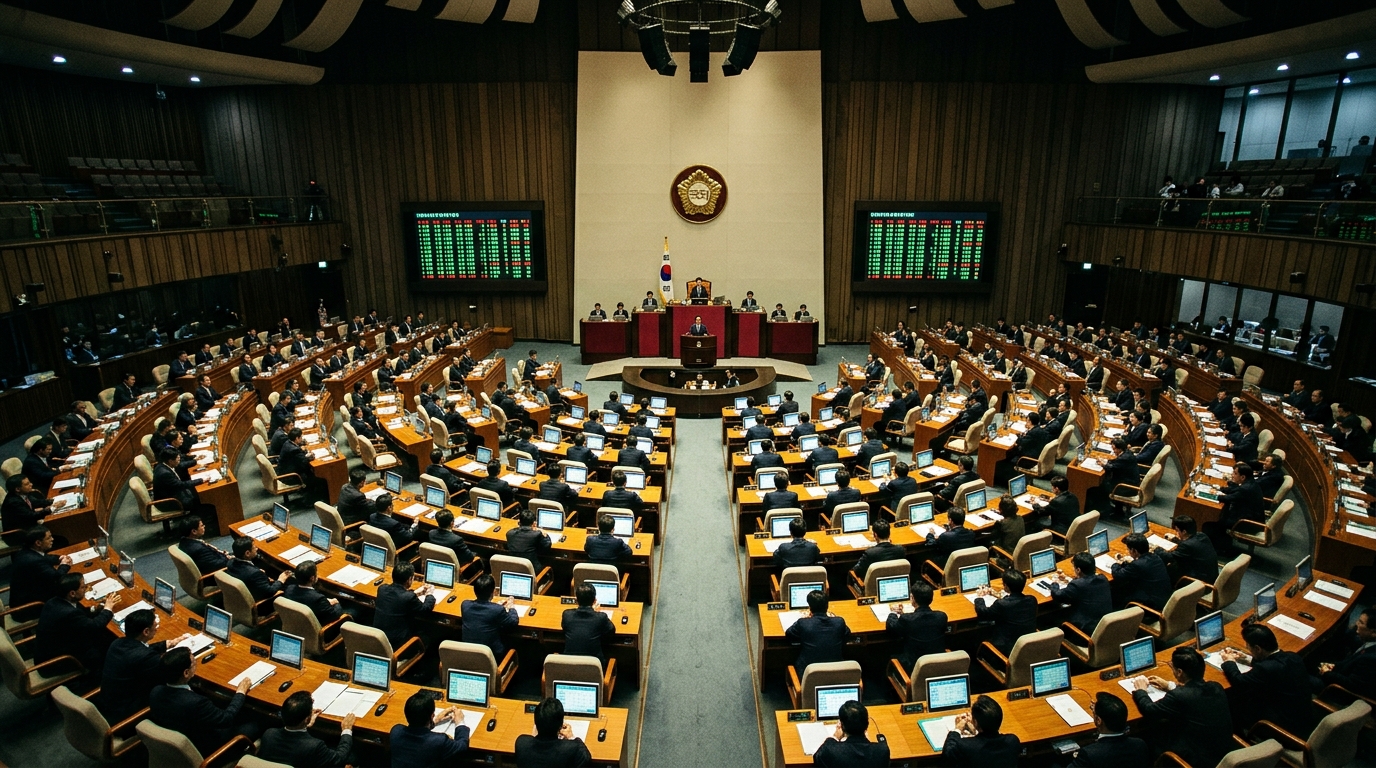
▲ 서울 여의도 국회 예산결산특별위원회 회의실에서 여야 의원들과 국무위원들이 정부 예산안을 놓고 치열한 정책 질의를 벌이고 있다. / 공식보도자료
한 해 동안 국가가 거두어들일 세금과 국민을 위해 집행할 재정의 종합 설계도인 정부 예산안이 국회에 제출되면, 여야 정치권은 막대한 혈세를 둘러싸고 치열한 명분 싸움과 실리 쟁탈전을 벌인다. 700조 원을 훌쩍 넘어선 슈퍼 예산 시대를 맞아 국회 심의 과정은 단순한 여야의 정쟁을 넘어 86조 원에 달하는 세수 결손 위기 극복, 미래 신산업 연구개발(R&D)과 골목상권 민생 지원의 우선순위, 그리고 헌법상 법정 시한 준수 여부를 가늠하는 대한민국 경제의 가장 중대한 분수령이다.
정부 예산안 편성 6단계와 11월 30일 본회의 자동부의 규정
국가재정법과 헌법에 따른 정부의 예산안 편성은 회계연도 개시 1년 전부터 시작되는 치밀한 6단계 통제 절차를 거친다. 전년도 12월 31일까지 기획재정부장관이 중기 재정 전망을 담은 수립지침을 시달하면, 각 부처는 1월 31일까지 5년 단위 중기사업계획서를 제출하고, 3월 31일 국무회의 승인을 거친 예산안 편성지침이 국회 예결위에 보고된다. 이후 5월 31일까지 각 부처가 예산요구서를 제출하면 6월부터 8월까지 기획재정부의 집중적인 타당성 심사와 조정을 거쳐, 8월 말 국무회의 의결 및 대통령 승인을 거쳐 9월 3일까지 국회에 최종 제출된다.
국회로 넘어온 예산안은 상임위원회의 예비심사를 거쳐 예산결산특별위원회(예결위)의 종합심사로 이어진다. 국회법 제85조의3에 따르면 예결위가 11월 30일까지 심사를 마치지 못할 경우 12월 1일 본회의에 정부 원안이 자동으로 부의되도록 규정되어 있으며, 헌법 제54조 제2항에 따라 회계연도 개시 30일 전인 12월 2일까지 본회의에서 최종 의결되어야 한다. 그러나 여야 간 극한 대치가 이어지면 공식 회의록조차 남지 않는 비공개 밀실 협의체인 '소소위'가 가동되며 실세 의원들의 지역구 쪽지 예산이 끼어드는 구태가 반복되어 왔다.
구분
2025년도 정부안
2026년도 정부안
2026년도 국회 확정
총수입
651조 8,000억 원
674조 2,000억 원
675조 2,000억 원 (+1.0조)
총지출
677조 4,000억 원
728조 원
727조 9,000억 원 (△1,269억)
관리재정수지
△77조 7,000억 원 (△2.9%)
△109조 원
△107조 8,000억 원 (△3.9%)
국가채무
1,277조 원 (48.3%)
1,415조 2,000억 원
1,413조 8,000억 원 (51.6%)
2025·2026 정부 재정총량 추이와 국가채무 1400조 원 돌파
헌법 제57조는 국회가 정부의 동의 없이 지출예산 각 항의 금액을 늘리거나 새로운 비목을 설치할 수 없도록 규정하고 있어, 감액은 국회가 독자적으로 주도할 수 있지만 증액은 기획재정부의 명시적 동의가 필수적이다. 만약 12월 31일 자정까지도 예산안이 처리되지 못하면 헌정사상 초유의 준예산 사태가 발생하게 된다. 준예산은 전년도 예산에 준해 공무원 인건비와 법률상 의무지출 등 필수 경비만 집행할 수 있는 비상 체제로, 신규 복지 사업이나 국책 인프라 투자가 전면 중단되어 국가 기능이 일대 마비에 빠질 위험을 안고 있다.
국회예산정책처 분석에 따르면 2026년도 정부 재정총량은 총지출 728조 원, 총수입 674조 2,000억 원 규모로 팽창했다. 국회 심의를 거치며 총수입은 1조 원 순증된 675조 2,000억 원, 총지출은 1,269억 원 순감된 727조 9,000억 원으로 최종 확정되었다. 그러나 실질적인 나라살림의 건전성을 보여주는 관리재정수지 적자는 107조 8,000억 원으로 국내총생산(GDP) 대비 마이너스 3.9%를 기록하여 정부가 제시한 재정준칙 목표선인 마이너스 3.0%를 크게 초과했으며, 국가채무는 1,413조 8,000억 원으로 GDP 대비 51.6%를 기록해 1,400조 원을 돌파했다.
매년 예결위 심사장에서 불을 뿜는 여야 5대 폭풍 쟁점의 첫머리는 R&D 예산이다. 정부와 여당은 과거 급격한 예산 팽창 과정에서 발생한 나눠먹기식 관행을 혁신하고 저비용 고성과 체제로 개편해야 한다고 맞섰고, 야당은 기초과학 연구 현장을 붕괴시키고 청년 연구원의 미래를 꺾는 처사라며 전면 복원을 요구했다. 지역사랑상품권(지역화폐) 발행지원 예산 역시 여당이 선심성 포퓰리즘이자 지자체 고유 사무라며 전액 삭감을 주장한 반면, 야당은 고물가·고금리로 신음하는 골목상권을 살릴 민생 마중물이라며 수천억 원 증액으로 팽팽히 맞섰다.
▲ 국회 본회의장에서 여야 의원들이 심야 본회의를 열고 차년도 정부 예산안 수정안을 전자투표로 표결하고 있다. / 국회공식보도사진
여야 5대 폭풍 쟁점… R&D·지역화폐·특활비 정면충돌
검찰청과 감사원 등 권력·사정기관의 특수활동비와 정부 일반 예비비를 둘러싼 공방도 정국의 핵심 뇌관이었다. 야당은 증빙 영수증이 없는 특활비와 쌈짓돈 예비비를 원칙에 따라 삭감하겠다며 대대적인 칼질을 단행했고, 정부와 여당은 국가 안보 및 기밀 수사와 재난 대응에 필수적인 예산이라며 맞섰다. 여기에 정부 주도 국민성장펀드 및 AI혁신펀드의 실효성 논란, 그리고 쟁점 법안 필리버스터와 맞물린 정국 급랭이 예산안 처리를 매년 벼랑 끝으로 몰고 갔다.
재정 파탄을 가속화한 가장 결정적인 요인은 2023년 56조 4,000억 원, 2024년 29조 6,000억 원으로 2년간 누적 86조 원에 달한 역대급 세수 결손이다. 정부는 추가경정예산 편성이나 적자국채 발행 대신 외국환평형기금(외평기금)이 공공자금관리기금(공자기금)에 빌린 원금을 조기 상환하게 하고 이를 일반회계로 끌어다 쓰는 우회 돌려막기를 단행했다. 이로 인해 외화자산으로 상환 가능한 금융성 채무가 국민 세금으로 갚아야 할 적자성 채무로 변질되었으며, 지방교부세와 교육재정교부금이 대폭 줄어들어 지방자치단체의 사업이 연쇄 중단되는 재정 경색이 벌어졌다.
세수 결손 86조 원과 기금 돌려막기… 지방재정 연쇄 경색
재정 지출 구조의 고착화와 이자 부담 급증도 심각한 경고음을 울리고 있다. 법령에 따라 지급 의무가 발생하는 의무지출은 2025년 365조 6,000억 원으로 전체 지출의 54.0%를 차지했으며, 2028년에는 57.3%인 433조 1,000억 원까지 급증할 전망이다. 반면 정부가 재량껏 조절할 수 있는 재량지출 증가율은 0.8%로 묶여 국가의 미래 투자 여력이 고갈되고 있다. 국가채무 누적에 따른 국채 이자 지출은 2024년 27조 원에서 2028년 36조 7,000억 원으로 연평균 8.0% 급증하고 있어 재정의 지속가능성을 위협하고 있다.
국회 예결위 심의 결과는 정밀한 삭감과 전략적 증액의 명암을 뚜렷하게 보여주었다. 국회는 10개 부처에 유사·중복으로 편성되었던 AI응용제품 신속상용화(AX-Sprint 300) 사업에서 2,785억 원을 깎아내고, 과기정통부 AI혁신펀드 1,000억 원을 전액 감액했으며, 중기부 모태조합출자도 2,800억 원을 삭감했다. 또한 기재부 일반 예비비 2,000억 원과 국방부 군사시설개선(1,106억 원), 부사관 인건비(650억 원), 복지부 기초연금(2,249억 원) 등 집행 부진 및 불용 가능성이 높은 사업들을 과감히 덜어냈다.
사업 구분
핵심 사업명
국회 심의 조정 내역
정책적 사유 및 함의
R&D·신산업 감액
AI응용 AX-Sprint 300 및 AI혁신펀드
△3,785억 원 (AX △2,785억 / 펀드 △1,000억)
10개 부처 중복 난립 억제 및 유사 모태펀드 통합
예비비·인건비 감액
일반 예비비 및 군 시설·기초연금
△5,203억 원 (예비비 △2,000억 등)
불용 위험 사전 차단 및 수급 추계 정밀화 반영
글로벌 통상 증액
대미투자 지원 프로그램 신설
+1조 1,000억 원 (기재부 소관 신설)
산은·수은 분산 예산 통폐합 및 관세협상 대응 창구 일원화
민생·에너지 증액
전산망 재난방지·도시가스 배관·K-패스
+4,861억 원 (전산망 +3,461억 등)
행정망 먹통 방지 및 에너지 취약지역 인프라 확충
국회 예결위 최종 칼질 내역… AI 삭감과 대미투자 1조 증액
이렇게 확보된 감액 재원은 통상 위기 대응과 생활 밀착형 인프라에 재배치되었다. 한미 관세 협상에 선제적으로 대응하기 위해 기획재정부 소관으로 1조 1,000억 원 규모의 대미투자 지원 프로그램이 전격 신설되었고, 국가 전산망 재난과 먹통 사태를 방지하기 위한 중앙행정기관 노후장비 교체 및 백업체계 구축 예산이 3,461억 원 증액되었다. 아울러 도시가스 미공급 소외지역 배관 건설(1,400억 원), 농어촌 기본소득 시범사업(637억 원), 분산전력망 ESS 구축(975억 원), K-패스 비수도권 우대(305억 원) 등 국민 체감도가 높은 민생 예산이 두텁게 보강되었다.
나아가 당해연도 재정 통계에는 당장 잡히지 않지만 미래 세대에 27조 8,000억 원의 정부지급금 부담을 넘기는 임대형 민자사업(BTL)과 14개 재무위험 공공기관의 533조 원 부채는 또 다른 숨은 뇌관이다. 정량적 적격성(VfM) 분석에서 민간 추진보다 국가 직접 추진이 더 유리하다고 판정된 사업들까지 국회에 무리하게 제출되는 관행은 반드시 근절되어야 할 대목이다. 국가 예산은 단순한 숫자의 나열이 아니라 주권자인 국민의 삶과 미래 세대의 운명을 결정짓는 나침반인 만큼, 국회와 정부는 밀실 야합과 시한 위반의 악순환을 끊고 투명하고 책임 있는 재정 개혁에 나서야 한다.
[In-Depth Analysis] National Budget Deliberation and Parliamentary Deadlines: South Korea's 728 Trillion Won Showdown
MANINTOP Political and Fiscal Investigation Desk | National Assembly and State Budget In-Depth AnalysisNovember 12, 2026
▲ Lawmakers and government cabinet ministers engage in sharp questioning over state spending during a National Assembly Budget Committee hearing in Yeouido, Seoul. / Press Coverage Photo
As the South Korean government's National Budget blueprint—delineating the total projected revenues and expenditures for the fiscal year—is submitted to parliament, rival political parties engage in fierce confrontations over the allocation of taxpayer funds. In an era of super budgets exceeding 700 trillion won, the National Assembly deliberation serves as a vital economic crossroads that transcends partisan friction, addressing an 86 trillion won cumulative tax shortfall, balancing cutting-edge R&D investments with grassroots commercial welfare, and testing constitutional statutory deadlines.
Six Stages of Government Budget Formulation and November 30 Automatic Referral Rule
Under the National Finance Act and the Constitution, government budget formulation follows an exacting six-stage mechanism commencing a full year prior to the fiscal year. By December 31 of the preceding year, the Minister of Economy and Finance transmits mid-term fiscal guidelines to all central government ministries. Each agency then submits a five-year mid-term plan by January 31, followed by Cabinet-approved formulation guidelines reported to parliamentary committees by March 31. Ministries formalize departmental budget requests by May 31, prompting rigorous line-item reviews by the finance ministry throughout the summer before presidential approval and statutory submission to parliament by September 3.
Upon transmission to parliament, the budget bill undergoes preliminary scrutiny across standing committees before advancing to comprehensive policy questioning in the Special Committee on Budget and Accounts. Under Article 85-3 of the National Assembly Act, if the budget committee fails to conclude its review by November 30, the government's original proposal is automatically referred to the plenary session on December 1. Under Article 54, Paragraph 2 of the Constitution, parliament must enact the bill by December 2, exactly thirty days before the new fiscal year. When bipartisan negotiations dead-end, unrecorded informal sub-subcommittees routinely convene behind closed doors, becoming notorious vehicles for senior lawmakers to insert pet constituency projects.
Category
2025 Government Proposal
2026 Government Proposal
2026 Enacted by Assembly
Total Revenue
651.8 Trillion Won
674.2 Trillion Won
675.2 Trillion Won (+1.0T)
Total Expenditure
677.4 Trillion Won
728.0 Trillion Won
727.9 Trillion Won (-126.9B)
Managed Fiscal Balance
-77.7 Trillion Won (-2.9%)
-109.0 Trillion Won
-107.8 Trillion Won (-3.9%)
National Debt
1,277.0 Trillion Won (48.3%)
1,415.2 Trillion Won
1,413.8 Trillion Won (51.6%)
Fiscal Trajectory of 2025-2026 and National Debt Surpassing 1400 Trillion Won
Article 57 of the Constitution establishes an institutional asymmetry, stipulating that the legislature cannot increase line items or create new budget heads without the explicit consent of the government. While parliament holds autonomous authority to cut appropriations, spending increases require executive concurrence from the Ministry of Economy and Finance. Should lawmakers fail to pass the budget by midnight on December 31, the nation faces an unprecedented provisional budget crisis. Restricting outlays exclusively to mandatory statutory duties and administrative maintenance, a provisional budget completely halts new welfare programs and infrastructure projects, crippling public governance.
Analytical reports from the National Assembly Budget Office indicate that total expenditures expanded to 728.0 trillion won alongside 674.2 trillion won in revenues for 2026. Parliamentary deliberations increased revenues by 1.0 trillion won to 675.2 trillion won while cutting expenditures by 126.9 billion won to 727.9 trillion won. Nonetheless, the managed fiscal deficit reached 107.8 trillion won, or minus 3.9 percent of GDP, substantially breaching the government's proposed fiscal rule threshold of minus 3.0 percent. Furthermore, total national debt climbed to 1,413.8 trillion won, surpassing 51.6 percent of GDP and breaking the 1,400 trillion won psychological benchmark.
Five tempestuous battlegrounds dominate budget deliberations every autumn, spearheaded by intense disputes over state research and development outlays. The Yoon administration and the ruling People Power Party argued that bloated R&D budgets required restructuring to dismantle inefficient scientific cartels and build a high-efficiency research ecosystem. Conversely, the opposition Democratic Party condemned the reductions as a reckless blow that disrupted ongoing laboratory research and alienated young scientists. Similarly, local currency vouchers triggered bitter ideological clashes, with the ruling bloc branding state subsidies as populist handouts while the opposition defended them as indispensable lifelines for neighborhood merchants.
▲ Lawmakers cast electronic ballots on the revised annual national budget during a midnight plenary session inside the National Assembly chamber. / Press Photo Coverage
Five Fiery Parliamentary Flashpoints: R&D, Local Currency, and Special Funds
Clashes over non-receipted special activity funds across law enforcement bodies, alongside the general contingency reserve, formed another combustible parliamentary friction point. The opposition pledged to slash special investigation budgets for prosecutors, the Board of Audit and Inspection, and the presidential office unless detailed receipts were furnished. In response, government officials insisted that confidential investigative funds and contingency reserves were indispensable safeguards for national security and climate disasters. Contentious policy fund subsidies and plenary filibusters over investigative special counsel bills compounded parliamentary gridlock.
The most critical headwind buffeting state finances was a historic two-year cumulative tax deficit totaling 86 trillion won, consisting of 56.4 trillion won in 2023 and 29.6 trillion won in 2024. Rather than issuing deficit-financing sovereign bonds or formulating a supplementary budget, the administration orchestrated an unorthodox financial detour. It directed the Foreign Exchange Equalization Fund to prepay loans to the Public Capital Management Fund, which subsequently deposited surplus liquidity into the general budget account. This accounting maneuver converted foreign-currency-backed financial debt into deficit debt funded by taxes, while drastically starving regional governments of local transfer taxes.
Cumulative 86 Trillion Won Tax Shortfall and Fund Diversion Crisis
Structural spending rigidity and soaring interest costs present alarming institutional vulnerabilities for the republic. Statutory mandatory expenditures, which cannot be modified without formal legal revisions, rose to 365.6 trillion won in 2025, capturing 54.0 percent of total outlays, and are projected to reach 433.1 trillion won or 57.3 percent by 2028. Conversely, discretionary spending growth was restricted to a meager 0.8 percent, suffocating the state's capacity to seed new economic initiatives. Compounding these strains, annual sovereign interest payments are projected to surge from 27.0 trillion won in 2024 to 36.7 trillion won in 2028, growing at an annual rate of 8.0 percent.
Final deliberations by the parliamentary budget committee highlighted a disciplined approach to budgetary pruning and strategic reallocation. Lawmakers excised 278.5 billion won from the multi-ministry AX-Sprint 300 AI application project, completely eliminated the 100 billion won AI Innovation Fund, and reduced SME fund-of-funds venture funding by 280 billion won to eliminate duplicative programs. Scrutiny also excised 200 billion won from government contingency reserves, while trimming 231 billion won across military facilities and defense personnel outlays alongside 224.9 billion won in basic pension estimates to curb structural under-execution.
Classification
Key Program Name
Parliamentary Adjustment
Fiscal Rationale and Impact
R&D and AI Cuts
AX-Sprint 300 and AI Innovation Fund
-378.5 Billion Won (AX -278.5B / Fund -100B)
Curbs multi-ministry overlap and merges fund-of-funds
Reserve and Personnel Cuts
General Reserve and Military Base Projects
-520.3 Billion Won (Reserve -200B etc.)
Prevents under-execution and refines demographic forecasts
Trade Support Addition
US Investment Support Program
+1.1 Trillion Won (Finance Ministry Initiative)
Consolidates policy banks and unifies tariff defense lines
Welfare and Energy Addition
IT Network Backup, Gas Pipelines, K-Pass
+486.1 Billion Won (IT Backup +346.1B etc.)
Prevents administrative blackouts and bolsters rural energy
Parliamentary Cuts and Increases: AI Program Reductions and US Investment Fund
Reclaimed resources were channeled toward mitigating trade exposure and upgrading critical domestic public infrastructure. Confronting bilateral trade friction and tariff negotiations, the finance ministry established a dedicated 1.1 trillion won US investment support program, consolidating disparate export credit agency lines into a unified government facility. Concurrently, parliament injected 346.1 billion won to replace aging administrative computer networks and construct real-time redundant backup systems. Lawmakers also augmented municipal gas pipeline construction by 140 billion won, rural basic income trials by 63.7 billion won, distributed grid energy storage by 97.5 billion won, and K-Pass transit subsidies by 30.5 billion won.
Looming beyond annual fiscal ledgers are significant off-balance-sheet liabilities, including 27.8 trillion won in long-term lease-transfer public-private partnership (BTL) obligations and 533 trillion won in liabilities across fourteen financially distressed state-owned enterprises. Troublingly, executive agencies repeatedly pushed forward projects that failed quantitative Value for Money (VfM) evaluations over direct state financing. National budgets are not abstract accounting exercises; they are the ultimate compass shaping sovereign competitiveness and public livelihoods. Ending the cycle of clandestine backroom negotiations and chronic deadline breaches is an urgent imperative for genuine fiscal transparency.
PRO SOURCING ENGINE만인의 탑 빅데이터 솔루션
★ 가입 시 600 크레딧(120회) 전원 무료
내가 찾는 상품 키워드, 지금 얼마나 검색될까?
네이버 월간 검색량 + 구글 볼륨 + 아이템스카우트 실시간 상품수와 경쟁강도 배지를 0.5초 만에 무료로 확인하세요.
MANINTOP NEWSLETTER
📬 만인의 탑 뉴스레터 무료 구독
오늘 보신 정책·시사 뉴스가 유익하셨나요? 매일 엄선되는 알짜 복지 혜택과 국회 실시간 속보를 이메일로 가장 먼저 받아보세요. (평생 무료)
1월이 시작되면 감기는 이미 우리 곁에 와 있습니다. 2월, 3월, 4월까지 이어지는 추위와 건조함은 코와 목을 가장 먼저 공격합니다. 아침에 일어나자마자 막혀 있는 코. 계속 흐르는 콧물. 괜히 칼칼해지는 목. 이 증상은 “시작”일 뿐입니다. 한 번 무너지면 일주일, 길면 한 달까지 끌고 갑니다. 약을 먹으면 잠깐 괜찮아집니다. 하지만 며칠 뒤 또 반복됩니다. 왜일까요? 감기는 ‘치료’의 문제가 아니라 ‘관리’의 문제이기 때문입니다. 대부분은 감기가 오고 나서 약을 찾습니다. 하지만 진짜 중요한 건 감기가 오기 전에 코와 목을 지키는 것입니다. 건조한 실내 공기, 차가운 바깥 공기, 눈에 보이지 않는 세균. 코와 목은 매일 공격받고 있습니다. 지긋지긋하죠! 그런데도 우리는 아무 준비 없이 버티고 있습니다. 이번 겨울도 그렇게 보낼 건가요? 사실 방법은 어렵지 않습니다. 코를 깨끗하게 관리하고, 목을 따뜻하게 보호하고, 점막을 촉촉하게 유지하고, 기관지를 미리 관리하고, 외부 공기를 차단하는 것. 이 다섯 가지만 꾸준히 해도 감기약 없이 겨울을 보내는 것이 충분히 가능합니다. 🔥 이제부터 그 방법을 하나씩 살펴보겠습니다. 🔥 1. 코와 목을 먼저 관리해야 하는 과학적 이유 감기의 대부분은 코 점막에서 시작됩니다. 국제 학술지 Nature Reviews Microbiology 와 Journal of Allergy and Clinical Immunology 에 실린 호흡기 감염 관련 연구들에서는, 감기 바이러스가 비강 상피세포에 먼저 부착해 증식한다는 점을 설명하고 ...
리모델링사업이 진행 중인 아파트를 매매할 때 “계약금 10%를 언제까지 내야 하느냐”는 질문이 특히 많이 나옵니다. 이주공고(이주 안내)가 7~11월쯤이라고 들으면, 그 시점에 맞춰 계약금도 움직일 것 같아서 더 헷갈리기 쉽습니다. 하지만 실제 납부기한은 ‘이주공고가 언제냐’만으로 자동 결정되지 않는 경우가 많습니다. 1) 계약금 10% 납부기한: 결국 ‘문서에 적힌 일정’이 기준 계약금 10%를 언제까지 납부해야 하는지는, 내가 서명하는 매매계약서(특약 포함) 와 사업주체/조합이 제시한 공고·안내문 에 적힌 납부 일정이 기준이 됩니다. 실제 공고문에서는 분양대금 납부의 큰 틀(계약금→중도금→잔금)을 먼저 안내하고, 상세 일정은 별도 표나 유의사항으로 제시하는 방식이 흔합니다. 또, 계약서 문구에 따라 지급 시점이 조건부로 설정될 수도 있습니다. 예를 들어 한 사례 소개 자료에서는 용역계약서에 잔금(10%) 지급시기가 “사업승인 후”로 기재되어 있었다는 점이 언급됩니다. 이런 식으로 ‘사업 단계’와 지급을 연동하는 문구가 들어가면, 질문의 답은 계약서 문구를 확인해야만 확정됩니다. 관련 내용은 링크 에서 문구 사례를 확인할 수 있습니다. 2) 입주자모집공고에서 확인되는 ‘납부 순서’와 잔금 마감 시점 공고문에 적힌 문구를 보면, 납부 순서와 잔금 마감에 대한 기준이 비교적 명확하게 제시되는 경우가 있습니다. 예를 들어 한 입주자모집공고에는 “분양금액(주택가격)은 계약금, 중도금, 잔금의 순서로 납부”하며 “잔금은 입주(열쇠 수령일) 전에 완납”해야 한다고 안내되어 있습니다. (문구 확인: 링크 ) 이 문구가 의미하는 바는 최소 2가지입니다. 분양/공급 형태의 문서에서는 ‘계약금→중도금→잔금’ 흐름이 공식적으로 안내될 수 있습니다. 잔금은 “입주(열쇠 수령)” 이전에 완납해야 한다는 마감 기준이 문서에 적혀 있을 수 있습니다. 다만, 위 공고문 문구는 잔금 마감에 대한 기준을 보여주지만, 계약금 10%의...
윤석열 전 대통령 탄핵 인용 소식을 접하면, 가장 궁금한 지점은 ‘헌재가 정확히 무엇을 위헌·위법으로 봤는가’입니다. 또한 탄핵과 별개로 진행되는 형사재판(내란 우두머리 혐의 등)이 어디까지 왔는지도 함께 정리할 필요가 있습니다. 아래 내용은 제공된 기사/게시물 스니펫과 링크에서 확인되는 범위만 모아, 일반인이 흐름을 이해하기 쉽게 정리한 것입니다. 1) 탄핵 인용 관련: 스니펫에서 확인되는 ‘판단의 골격’ 제공된 근거 중 조국혁신당 사이트에는 헌법재판소가 윤석열 탄핵 심판에서 “피청구인의 위헌·위법행위는 국민 신임 …”이라는 취지로 판단했다는 문장이 인용돼 있습니다( 링크 ). 이 인용문만 놓고 보면, ‘위헌·위법행위’가 있었는지와 그로 인해 ‘국민의 신임’이 어떻게 평가됐는지가 핵심 축으로 소개됩니다. 다만 질문에서 요청하신 세부 항목, 즉 비상계엄 선포 자체를 문제 삼은 구체적 이유, 계엄 이후 조치(포고령, 국회 통제 등)의 어떤 지점이 헌법 위반인지, 국회의 권한행사 방해 및 정치활동 제약을 어떤 논리로 판단했는지 등은, 이번에 제공된 근거의 제목/스니펫만으로는 조항·사실관계·판단 구조가 그대로 제시돼 있지 않습니다. 따라서 이 글에서는 ‘헌재가 무엇을 문제 삼았다’는 세부 리스트를 단정적으로 재구성하기보다, 현재 확인 가능한 문구 수준의 요약(위헌·위법행위 → 국민 신임의 문제로 평가)까지만 적습니다. 만약 헌재 결정문 전문(주문 및 이유)이 추가로 확인되면, 그때는 문장 단위로 ‘어떤 행위’와 ‘어떤 헌법 원리/조항’이 연결되는지(예: 권력분립, 국회의 권한, 정치적 기본권 등) 구조화해 정리하는 것이 가장 정확합니다. 2) 형사 절차(내란 혐의) 관련: 체포영장과 1심 선고 언급 탄핵 심판과 별도로, 12·3 비상계엄 사태로 내란 혐의를 받는 윤석열 대통령에 대해 2024년 12월 31일 체포 영장이 발부됐다는 BBC 보도가 있습니다( 링크 ). 해당 보도는 ‘현직 대통령’에 대한 체포영장 발부라는 점을 함께 언급합니다. 또...