[심층기획] '특검 일상화와 거부권의 충돌' 78년 검찰청 해체 속 8석의 딜레마… 헌정사 87건 거부권과 재의결 2.7%의 벽
만인의 탑 편집국11월 17, 2026
[심층기획] '특검 일상화와 거부권의 충돌' 78년 검찰청 해체 속 8석의 딜레마… 헌정사 87건 거부권과 재의결 2.7%의 벽
정치·헌정사법 심층취재팀 | 특검제도 구조적 쟁점 및 헌정사 거부권 정치 심층 분석2026. 11. 17 08:30 KST
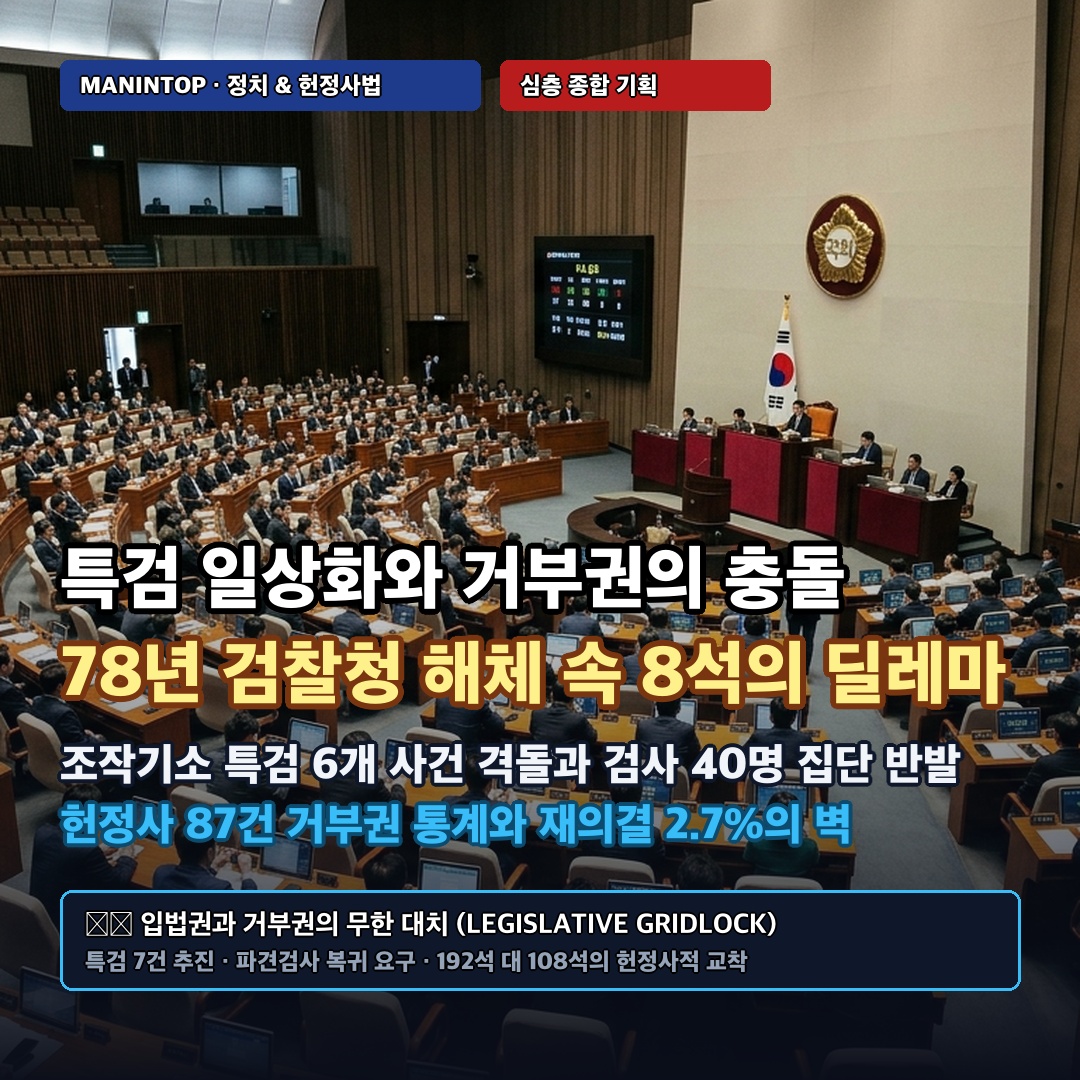
▲ 대한민국 국회 본회의장에서 여야 의원들이 특검법안 표결을 둘러싸고 엄숙한 대치 속에 회의를 진행하고 있다. 제22대 국회는 192석 범야권과 108석 집권 여당 사이에서 특검과 거부권의 소모적 충돌을 거듭하고 있다. [사진: 국회 프레스 풀 보도자료]
핵심 쟁점 3줄 요약
이재명 정부 7개 특검 가동 속 단순 기소 숫자와 대법원 최종 유죄 확정 판결 간의 사법적 괴리 부각
조작기소 특검법 수사 대상 12개 중 6개가 대통령 직결… 78년 만의 검찰청 해체 속 파견검사 40명 집단 반발
헌정사 거부권 87건 중 윤석열 대통령 21건 연평균 최고치 기록 속 1987년 민주화 이후 재의결 통과율 2.7% 불과
2026년 대한민국 정치는 특별검사(특검)의 상시적 가동과 대통령의 법률안 재의요구권(거부권) 행사가 정면으로 부딪치며 헌정사상 유례없는 극한의 대치 국면을 이어가고 있습니다. 과거 특검은 통상적인 검찰과 경찰의 수사 역량으로는 도저히 실체적 진실을 밝히기 어렵거나 최고 권력형 비리 의혹이 터져 나왔을 때 극히 예외적으로 도입되던 비상 사법 장치였습니다. 그러나 2025년 6월 이재명 정부 출범 이후 특검은 여야 간 정치적 쟁점을 돌파하는 일상적인 승부수로 자리 잡았습니다. 동시에 국회 다수 의석을 확보한 야당의 법안 단독 처리와 행정부 수반의 연속적인 거부권 행사가 톱니바퀴처럼 맞물리면서 법안 발의, 본회의 통과, 거부권 행사, 재의결 부결 폐기라는 소모적 악순환이 굳어졌습니다. 이재명 정부 출범 이후 추진된 총 7건의 특검 수사 실적과 사법적 유죄 판결의 괴리, 수사 대상 12개 중 절반이 현직 대통령과 직결된 조작기소 특검법의 쟁점, 78년 만의 검찰청 해체를 앞두고 터져 나온 특검 파견 검사 40명의 집단 반발, 그리고 헌정사 거부권 87건의 역사적 데이터와 제22대 국회 8석의 딜레마를 심층 분석했습니다.
1. 비상 사법에서 일상 정치로… 7개 특검 가동과 기소·유죄 판결의 사법적 괴리
이재명 정부 출범 이후 추진된 특검은 종료된 사건과 진행 중인 사안, 그리고 법안 통과 후 공포를 앞둔 사건을 모두 합쳐 총 7건에 달합니다. 2025년 말 동시 수사를 마친 3대 특검(내란·김건희·순직해병)은 피의자 중복을 제외하고 총 121명을 기소하고 24명을 구속했습니다. 이어 출범한 2차 종합특검 역시 2026년 8월 수사를 종료하며 7명 구속을 포함해 58명을 재판에 넘겼고, 남은 의혹은 경찰청 국가수사본부로 넘겼습니다. 여기에 상설특검법에 따라 수사를 마친 쿠팡 퇴직금 불기소 외압 의혹 특검과 현재 현장 수사가 한창인 중앙선거관리위원회 특검, 그리고 11월 6일 국회 본회의를 통과한 조작기소 특검까지 쉼 없이 이어지고 있습니다.
하지만 정치권과 언론이 가장 경계해야 할 대목은 수사팀의 단순 기소 인원을 곧바로 법원의 최종 유죄 판결로 동일시하는 착시입니다. 3대 특검의 121명 기소와 2차 종합특검의 58명 기소는 수사 대상자가 중복되어 있어 단순 합산이 불가능할뿐더러, 법원의 엄격한 법리 검증을 거쳐야만 진정한 사법적 성과로 인정받을 수 있습니다. 실제로 과거 고 이예람 중사 특검의 경우 8명을 재판에 넘겼으나 대법원에서 6명 유죄, 2명 무죄가 확정되며 정작 핵심 피고인이 법망을 벗어났다는 유족들의 깊은 탄식을 낳았습니다. 과거 드루킹 댓글조작 특검에서 김경수 전 경남지사가 대법원에서 징역 2년의 실형을 확정받았던 것처럼, 특검의 역사적 가치는 떠들썩한 수사 발표 때의 구속 숫자나 기소 숫자가 아니라 대법원 최종 판결문에서 어떤 법리가 살아남았는가에 달려 있습니다.
특검 명칭
추진 배경 및 현황
수사 및 사법 처리 결과
법적 쟁점 및 향후 절차
3대 특검 (내란·김건희·순직해병)
2025년 말 동시 수사 종료 (야당 주도 단독 법안 통과)
중복 제외 총 121명 기소, 24명 구속 (고위직 다수 포함)
1심 재판 진행 중, 핵심 혐의별 대법원 최종 법리 확정 검증 필요
2차 종합특검
2026년 8월 수사 공식 종료 (후속 의혹 전방위 규명)
구속 7명 포함 총 58명 기소, 미완 사건 경찰 국수본 이첩
3대 특검 기소 인원과의 중복 배제 및 국수본 이첩 사건 후속 수사 진행
쿠팡 퇴직금 의혹 특검
상설특검법 제정 기반 가동 (불기소 외압 의혹 규명)
사건 관계자 전원 조사 후 수사 완료 및 공식 종료
상설특검 제도의 실효성 및 개별 특검과의 입법적 효용성 비교 검증
중앙선관위 특검
2026년 9월 공식 수사 착수 (채용 비리 및 전산 시스템)
현장 압수수색 및 관계자 소환 (현재 활발한 수사진행 중)
선관위 헌법기관 독립성 침해 논란과 사법적 실체 규명 간의 법리 공방
조작기소 특검
2026년 11월 6일 본회의 통과 (11월 17일 국무회의 심의 예정)
수사 착수 전 미착수 상태 (특검 임명 절차 대기)
수사 대상 12개 중 대통령 관련 6개 사건 포함, 이해충돌 및 공포 여부 촉각
▲ 법원의 정의의 여신상이 저울과 검을 든 채 헌법과 법치주의의 무게를 증언하고 있다. 대형 특검 수사의 진정한 사법적 가치는 수사 단계의 구속자가 아니라 대법원 최종 확정판결의 내용과 절차적 정당성으로 평가받는다. [사진: 사법부 프레스 풀 보도자료]
2. 정면 충돌하는 '조작기소 특검법'… 수사 대상 12개 중 대통령 직결 6개 사건의 뇌관
현재 여야 대치의 최정점에는 2026년 11월 6일 국회 본회의를 통과해 11월 17일 국무회의 심의를 앞둔 이른바 '조작기소 특검법'이 자리 잡고 있습니다. 더불어민주당은 윤석열 정부 당시 검찰이 자행한 편파 기소와 조작 수사의 진상을 밝혀 무너진 사법 정의를 바로 세워야 한다고 역설하지만, 국민의힘과 개혁신당 등 야당 진영은 현직 대통령의 사법 리스크를 지우기 위한 노골적인 권력 방어용 방탄 특검이라며 정면으로 맞서고 있습니다.
개혁신당 이동훈 수석대변인의 논평처럼 정치권 공방의 핵심은 법안이 명시한 12개 수사 대상 중 정확히 절반인 6개가 이재명 대통령 본인과 직결된 사건이라는 점입니다. 특히 대장동 의혹은 민간업자 특혜와 시 재정 손실을 따지는 '개발사업 배임 및 뇌물 의혹'과 선거 국면의 발언 진위를 가리는 '공직선거법상 허위사실 공표 사건'이 법리적으로 엄격히 분리된 별개의 혐의입니다. 여기에 성남FC 제3자 뇌물 의혹, 쌍방울 대북송금 의혹, 김진성 씨 위증교사 의혹, 경기도 법인카드 사적 유용 의혹까지 대통령의 핵심 재판들이 수사 목록에 올라 있습니다. 여당이 추천권을 주도하여 현직 대통령 사건을 조사하는 구조적 이해충돌 문제와 공소취소 조항을 둘러싼 논란은 헌정사적으로도 유례를 찾기 힘든 뜨거운 쟁점입니다.
3. 검찰청 78년 만의 해체와 특검 파견 검사 40명의 반발… '수사와 기소 분리'의 모순
특검 정국의 파도가 거세지는 와중에 사법 현장에서는 더욱 근본적인 제도적 지각변동이 발생하고 있습니다. 정부조직법 개정안이 공포되면서 1948년 정부 수립 이후 78년간 형사사법의 중추를 맡아왔던 대한민국 검찰청이 내년 10월을 기점으로 공식 해체되고 중대범죄수사청과 공소청으로 분리되기 때문입니다. 수사권과 기소권의 완전 분리라는 명분 아래 추진된 이 개혁은, 역설적으로 현재 가장 뜨겁게 가동 중인 김건희 특검팀 내부에서 심각한 균열을 일으켰습니다.
김건희 특검에 파견되어 수사를 이끌던 현직 검사 40명 전원은 최근 민중기 특별검사에게 검찰청 복귀를 요구하는 공식 입장문을 전격 제출했습니다. 특검 수사에 열정을 바쳤지만 정작 자신들이 돌아갈 친정인 검찰청 조직 자체가 사라지는 현실 앞에서 미래에 대한 극심한 직업적 불안감이 터져 나온 것입니다. 민중기 특검이 우려했듯이, 대형 비리 사건은 수사를 담당한 검사가 사건의 맥락을 가장 꿰뚫고 있어 재판에 직접 참여해야만 치밀한 공소 유지가 가능합니다. 그러나 수사와 기소를 인위적으로 단절한 채 파견 검사들이 대거 복귀할 경우, 사설 변호사 인력만으로는 천문학적인 재판 기록을 감당하지 못해 법원에서 무더기 무죄가 쏟아질 수 있다는 경고가 법조계 안팎에서 터져 나오고 있습니다.
4. 헌정사 87건 거부권 통계의 재발견… 연 9.3건 최고치와 '재의결 2.7%'의 콘크리트 벽
입법부가 특검 드라이브를 걸 때마다 행정부 수반이 맞서는 헌법적 방패는 바로 헌법 제53조의 법률안 재의요구권, 즉 거부권입니다. 1948년 제헌 이후 대한민국 헌정사에서 행사된 거부권은 총 87건에 달합니다. 이 중 1987년 6월 항쟁 이전 민주화 이전 시기에 50건이 행사되었고, 1987년 민주화 이후 현재까지 37건이 행사되었습니다.
역대 대통령별 통계를 살펴보면 거부권의 성격이 과거의 예외적 정치에서 일상적 정치로 급변했음을 한눈에 알 수 있습니다. 건국 초기 이승만 대통령이 12년 재임 동안 45건(연 3.8건)을 행사한 이후 박정희 5건, 노태우 7건, 노무현 6건, 이명박 1건, 박근혜 2건에 그쳤습니다. 그러나 윤석열 대통령은 취임 2년 3개월 만에 무려 21번째 거부권을 행사하며, 민주화 이후 다른 모든 전직 대통령들이 행사한 거부권 총합(16건)을 단숨에 넘어섰습니다. 연평균으로 환산하면 연 9.3건으로 헌정사 압도적 1위입니다.
더욱 결정적인 사실은 거부권이 행사된 법안이 국회 본회의에서 다시 살아날 확률이 사실상 제로에 가깝다는 점입니다. 헌법 제53조 제4항에 따른 국회 재의결은 재적의원 과반수 출석과 출석의원 3분의 2 이상이라는 엄격한 가중정족수를 요구합니다. 민주화 이전에는 수정통과 등을 포함해 60%가 의회에서 관철되었지만, 1987년 민주화 이후 국회에서 재의결에 성공한 법안은 2003년 11월 노무현 대통령 측근 비리 특검법 단 1건(2.7%)에 불과합니다. 나머지 96.8%는 본회의 재표결에서 부결되거나 임기 만료로 폐기되었습니다. 여당이 국회 300석 중 100석(3분의 1)만 결집해 방어하면 대통령의 거부권을 절대 뚫을 수 없는 구조적 방파제가 세워져 있는 셈입니다.
대통령 및 재임 시기
거부권 행사 건수
연평균 행사 빈도
국회 재의결 결과 및 통과율
이승만 (1948~1960)
45건
약 3.8건
19건 가결 (38.0%), 수정통과 포함 실질 관철율 60% 상회
박정희 (1963~1979)
5건
약 0.3건
거부권 1건 철회, 4건 의회 처리 완료 (여대야소 구도)
노태우 (1988~1993)
7건
약 1.4건
민주화 직후 여소야대 국면서 7건 전량 행사 (3당 합당 전)
노무현 (2003~2008)
6건
약 1.2건
측근비리 특검법 1건 재의결 통과 (민주화 이후 유일 2.7%)
이명박·박근혜 (2008~2017)
3건 (이명박 1, 박근혜 2)
연 0.2~0.5건
택시법 및 국회법 개정안 거부, 임기 만료 자동 폐기
윤석열 (2022~재임 중)
21건
연 약 9.3건
민주화 이후 최다 및 연평균 1위, 재의결 전량 부결 폐기
헌정사 총계 및 분석
총 87건
시대별 편차 극심
민주화 이후 37건 중 1건 통과(2.7%), 나머지 96.8% 폐기
5. 제22대 국회 192석 대 108석의 대치… 패스트트랙과 필리버스터가 낳은 8석의 소용돌이
이러한 헌법적 콘크리트 벽은 2024년 4월 치러진 제22대 총선의 의석 지형과 맞물리며 여야 모두를 출구 없는 대치로 몰아넣었습니다. 총선 투표율 67.0%라는 뜨거운 참여 속에 유권자들은 범야권에 192석(더불어민주당 175석, 조국혁신당 12석 등)을 몰아주었고, 집권 여당인 국민의힘은 108석을 얻는 데 그쳤습니다.
여기서 한국 정치의 최대 딜레마인 '8석의 격차'가 탄생했습니다. 범야권은 국회 과반을 훌쩍 넘어 단독으로 패스트트랙(신속처리안건, 180석)을 지정할 수 있는 막강한 힘을 가졌지만, 대통령의 거부권을 무력화하거나 탄핵소추를 의결하는 데 필요한 '재적의원 3분의 2(200석)'에는 정확히 8석이 모자랍니다. 반면 여당은 108석으로 최소한의 거부권 저지선(100석)을 지켜냈습니다. 특히 전국 총득표율 격차는 민주당 50.5% 대 국민의힘 45.1%로 불과 5.4%포인트 차이였음에도, 소선거구제의 승자독식 구조로 인해 지역구 의석수 차이가 71석으로 벌어지면서 의회 내 진영 대결은 타협 없는 극한 투쟁으로 치달았습니다.
결국 여야는 국회법상 합법적인 의사진행 수단을 총동원해 소모전을 거듭하고 있습니다. 다수 야당은 상임위원회 심사 180일, 법사위 90일, 본회의 60일 등 최장 330일이 걸리는 패스트트랙 제도를 우회로 삼아 특검법안을 단독 상정하고, 소수 여당은 재적의원 3분의 1 요구로 시작되는 무제한 토론(필리버스터)을 신청해 24시간 동안 밤샘 연설을 이어가며 결사 저지에 나섭니다. 그러나 야당이 180석 찬성으로 토론을 강제 종결시키고 법안을 단독 처리하면 대통령이 거부권을 행사하고, 다시 국회로 돌아온 법안은 200석을 넘지 못해 폐기되는 도돌이표가 무한 반복되고 있습니다.
사법적 정의를 세우겠다는 특검의 명분과 입법부의 권한 남용을 막겠다는 거부권의 논리가 팽팽히 맞서는 사이, 대화와 타협이라는 의회 민주주의의 본령은 심각하게 질식하고 있습니다. 수사 결과가 최종 유죄 판결로 입증되지 못하는 특검의 남발은 사법의 정치화를 부르고, 국회의 입법권을 원천 무력화하는 잦은 거부권 행사는 통치의 정당성을 갉아먹습니다. 78년 만의 형사사법 개편이라는 거대한 문명사적 전환기 속에서, 여야가 진영의 방탄과 정략적 힘겨루기를 내려놓고 헌법적 견제와 균형의 황금률을 복원하지 않는다면 그 피해는 고스란히 국가의 법치와 주권자인 국민에게 돌아갈 것입니다.
[In-Depth Analysis] Normalization of Special Counsels vs. Presidential Vetoes: The 8-Seat Dilemma, Prosecution Dissolution, and the 2.7% Re-vote Barrier
MANINTOP Parliamentary & Judicial Affairs Desk | Strategic Analysis of Special Probes & Veto Dynamics2026. 11. 17 08:30 KST
▲ Lawmakers inside the Grand National Assembly Plenary Hall conduct high-stakes voting amid deep partisan confrontation over special counsel legislation. The 22nd Assembly remains locked in an adversarial cycle between a 192-seat opposition bloc and a 108-seat ruling party. [Photo: National Assembly Press Pool Coverage]
Key Takeaways: 3 Core Dimensions
Seven special counsel investigations initiated under the current administration reveal wide gaps between raw indictments and final judicial convictions
Fabricated Indictment Bill targets twelve allegations, with six directly involving the president, as 40 prosecutors revolt amid prosecutorial dissolution
87 historical vetoes peaked under Yoon Suk Yeol at 9.3 annually, while post-1987 parliamentary override success remains frozen at just 2.7%
In 2026, South Korean national politics faces an unprecedented constitutional confrontation as the institutional normalization of Special Prosecutors clashes directly with the President's constitutional veto power. Historically, a special counsel served as an extraordinary legal remedy reserved strictly for severe power-based corruption scandals where conventional prosecutorial agencies were structurally compromised. However, following the inauguration of the Lee Jae-myung administration in June 2025, special counsels have evolved into routine legislative mechanisms to bypass partisan gridlock. Simultaneously, a structural impasse has hardened where unilateral legislative passage by the parliamentary majority triggers presidential vetoes, followed by failed parliamentary re-votes and automatic legislative termination. This comprehensive investigative report analyzes the operational record of seven special counsels launched under the current administration, the legal flashpoints of the Fabricated Indictment Special Counsel Bill where half of the twelve targets directly involve the incumbent president, the institutional revolt of 40 prosecutors demanding reassignment amid the impending dissolution of the 78-year-old prosecution service, and the constitutional anatomy of 87 historical vetoes under the 8-seat legislative dilemma.
1. From Emergency Remedy to Routine Politics: Seven Special Counsels and the Verdict Gap
The volume of special investigations initiated under the Lee Jae-myung administration has reached seven distinct probes, spanning concluded investigations, active operational inquiries, and newly passed legislation awaiting cabinet deliberation. The tri-counsel investigations into insurrection allegations, former First Lady Kim Keon-hee, and the Marine corporal death concluded in late 2025, indicting 121 individuals and detaining 24 without duplication. Subsequently, the Second Comprehensive Special Counsel concluded its inquiry in August 2026, indicting 58 individuals with seven detained before transferring unresolved allegations to the National Investigation Headquarters. Complementing these are the completed statutory probe into Coupang severance pay non-indictment pressures, the ongoing on-site investigation into the National Election Commission, and the pending Fabricated Indictment probe passed on November 6.
Crucially, legal analysis cautions against conflating raw indictment numbers with finalized judicial guilt. The 121 indictments from the tri-counsel probe and the 58 indictments from the Second Comprehensive probe involve overlapping defendants and require rigorous evidentiary verification before the Supreme Court. In the landmark special investigation into Air Force Master Sergeant Lee Ye-ram, the prosecution indicted eight military officials, but the Supreme Court ultimately convicted six while acquitting two key commanders in July 2025, underscoring the procedural gaps between investigative fanfare and legal finality. Just as former Governor Kim Kyoung-soo received a finalized two-year prison sentence in the historic Druking special investigation, the enduring value of a special counsel is measured not by initial arrest numbers but by the constitutional integrity of finalized judicial precedent.
Special Counsel Probe
Legislative Background & Status
Indictments and Arrest Outcomes
Legal Controversies & Next Steps
Tri-Counsel Probes (Insurrection, Kim, Marine)
Concluded in late 2025 (Unilateral parliamentary passage)
121 individuals indicted, 24 detained without duplication
Assessing the institutional efficacy of standing special counsel vs ad-hoc appointments
Election Commission Probe
Launched in September 2026 (Hiring practices and IT systems)
On-site raids executed; active interrogation phase
Balancing constitutional independence of the election body against criminal scrutiny
Fabricated Indictment Probe
Passed plenary on Nov 6, 2026 (Awaiting cabinet review Nov 17)
Pre-operational stage; awaiting appointment process
Six of twelve targets involve the incumbent president, raising severe conflict-of-interest concerns
▲ Lady Justice balances scales of equity and the sword of law, reflecting the foundational demands of constitutional justice. The enduring validity of special counsel inquiries depends not upon initial arrest totals, but upon finalized legal reasoning confirmed by the Supreme Court. [Photo: Judiciary Press Pool Coverage]
2. Flashpoint of the Fabricated Indictment Bill: Six Direct Presidential Cases Among Twelve Targets
At the apex of legislative confrontation stands the Fabricated Indictment Special Counsel Bill, passed on November 6 and scheduled for State Council deliberation on November 17. The Democratic Party argues that a dedicated independent prosecutor is vital to expose politically biased indictments and manufactured evidence allegedly perpetrated by the prosecution under the previous administration. Conversely, the People Power Party and Reform Party fiercely condemn the bill as a direct legislative shield designed to neutralize the active criminal trials of the incumbent head of state.
As articulated by Reform Party Chief Spokesperson Lee Dong-hoon, the central constitutional controversy stems from the fact that six of the twelve mandated investigative targets directly involve President Lee Jae-myung. Critical distinctions must be drawn between the Daejang-dong development project breach of trust allegations and the separate public election law false statement trials, which involve entirely different legal standards. Together with third-party bribery charges regarding Seongnam FC sponsorships, the Ssangbangwool unauthorized North Korean remittance allegations, the Kim Jin-sung perjury subornation case, and corporate card misappropriation inquiries, the bill places the head of state's principal defense cases under a prosecutor selected under ruling party influence, sparking intense debate over structural conflicts of interest.
3. Dissolution of the 78-Year Prosecution Service and the Revolt of 40 Dispatched Prosecutors
Beneath the legislative battleground lies a systemic transformation of South Korea's criminal justice system. Following the enactment of the Government Organization Act, the Supreme Prosecutors' Office and its nationwide network—an institutional anchor for 78 years since 1948—will be officially dismantled next October, bifurcated into a Major Crimes Investigation Agency and a Public Prosecution Office. Engineered to achieve the complete separation of investigation and indictment, this radical reform has paradoxically ignited an institutional crisis within active special counsel operations.
All 40 prosecutors dispatched to the Kim Keon-hee Special Counsel recently submitted a formal joint petition to Special Prosecutor Min Joong-ki requesting immediate reassignment back to their home offices. Having spearheaded complex investigations, these frontline prosecutors face an existential professional vacuum as their institutional foundation vanishes. As Special Prosecutor Min publicly emphasized, complex financial and political cases require the investigating attorneys to maintain prosecution throughout the trial to secure convictions. If dispatched prosecutors exit en masse, private defense attorneys cannot replicate institutional familiarity, raising severe legal concerns that complex cases may collapse into widespread judicial acquittals.
4. Constitutional Anatomy of 87 Vetoes: Peak Frequency of 9.3 Annually and the 2.7% Override Wall
Against aggressive legislative initiatives, the primary constitutional defense available to the executive branch is the presidential power to demand legislative reconsideration under Article 53 of the Constitution. Since the founding of the republic in 1948, South Korean presidents have exercised the veto power a total of 87 times, divided into 50 vetoes prior to the 1987 June Democratic Uprising and 37 vetoes during the post-democratization era.
Historical metrics illustrate how executive vetoes have shifted from an extraordinary safeguard into routine political maneuvering. Founding President Rhee Syngman exercised 45 vetoes across twelve years (3.8 annually), followed by Park Chung-hee (5), Roh Tae-woo (7), Roh Moo-hyun (6), Lee Myung-bak (1), and Park Geun-hye (2). However, President Yoon Suk Yeol exercised his 21st veto in just two years and three months, eclipsing the combined total of all post-1987 democratic presidents (16) and setting an all-time constitutional peak with an annual average of 9.3 vetoes.
Furthermore, the probability of a vetoed bill overcoming reconsideration in the National Assembly is virtually zero. Under Article 53, Paragraph 4, overriding a presidential veto requires a strict supermajority of two-thirds of present lawmakers with a majority of total members attending. While pre-1987 parliaments salvaged approximately 60% of vetoed measures through legislative amendments, post-1987 assemblies have succeeded in overriding a presidential veto exactly once—the November 2003 Special Counsel Bill targeting aides to President Roh Moo-hyun (2.7%). The remaining 96.8% were decisively defeated or expired upon term completion, demonstrating that a disciplined ruling party holding just one-third of the legislature (100 seats) can permanently sustain an executive veto.
President & Tenure
Total Vetoes Exercised
Annual Frequency
Parliamentary Override & Final Status
Rhee Syngman (1948-1960)
45 Vetoes
Approx. 3.8 / year
19 overridden (38.0%); legislative success exceeded 60% with amendments
Park Chung-hee (1963-1979)
5 Vetoes
Approx. 0.3 / year
1 withdrawn, 4 processed under strong ruling party majorities
Roh Tae-woo (1988-1993)
7 Vetoes
Approx. 1.4 / year
Exercised during initial post-1987 divided government prior to the three-party merger
Roh Moo-hyun (2003-2008)
6 Vetoes
Approx. 1.2 / year
1 presidential aide special counsel bill overridden (sole post-1987 success at 2.7%)
Lee Myung-bak / Park (2008-2017)
3 Vetoes (Lee 1, Park 2)
0.2 - 0.5 / year
Vetoed Taxi Act and Assembly Rules Act; expired without re-passage
Yoon Suk Yeol (2022-Incumbent)
21 Vetoes
Approx. 9.3 / year
Highest post-democratization total and annual frequency; 100% sustained/defeated
Constitutional Totals
87 Total Vetoes
Extreme eras variation
Only 1 overridden out of 37 post-1987 vetoes (2.7%); 96.8% failed or expired
5. The 22nd Assembly Gridlock: 192 Opposition vs. 108 Ruling and the 8-Seat Legislative Vortex
This constitutional barrier intersected with the electoral geometry of the 22nd General Election in April 2024, locking Korean politics into systemic paralysis. With an elevated voter turnout of 67.0%, the electorate awarded the broader opposition coalition 192 seats (Democratic Party 175, Rebuilding Korea Party 12), while the ruling People Power Party secured 108 seats.
This allocation produced South Korea's decisive '8-seat dilemma.' While the unified opposition commands the three-fifths majority (180 seats) required to independently invoke the fast-track mechanism, it remains precisely eight votes shy of the two-thirds threshold (200 seats) necessary to override presidential vetoes or initiate presidential impeachment. Conversely, the ruling party's 108 seats securely anchor the 100-seat constitutional defense barrier. Despite a narrow national vote differential of just 5.4 percentage points (50.5% vs. 45.1%), single-member district dynamics expanded the constituency seat margin to 71, intensifying zero-sum partisan warfare.
Consequently, both camps have exhausted procedural parliamentary mechanisms. The opposition deploys the 330-day fast-track procedure to bypass committee deliberation, while the minority ruling party counters by launching 24-hour continuous filibusters. However, once the opposition terminates debate with 180 votes and passes the contested legislation, the executive exercises a predictable veto, returning the bill to the assembly floor where it inevitably falls short of 200 votes and dies, trapping governance in an endless legislative cycle.
As arguments for judicial accountability clash with justifications against legislative overreach, the foundational principles of deliberative democracy are rapidly eroding. The overuse of special counsels without sustained judicial convictions risks politicizing the judiciary, while routine presidential vetoes hollow out the constitutional authority of the legislature. In an era marked by the unprecedented restructuring of the criminal justice system, restoring institutional equilibrium and bipartisan compromise is imperative to safeguard the rule of law and preserve the democratic mandate of sovereign citizens.
PRO SOURCING ENGINE만인의 탑 빅데이터 솔루션
★ 가입 시 600 크레딧(120회) 전원 무료
내가 찾는 상품 키워드, 지금 얼마나 검색될까?
네이버 월간 검색량 + 구글 볼륨 + 아이템스카우트 실시간 상품수와 경쟁강도 배지를 0.5초 만에 무료로 확인하세요.
MANINTOP NEWSLETTER
📬 만인의 탑 뉴스레터 무료 구독
오늘 보신 정책·시사 뉴스가 유익하셨나요? 매일 엄선되는 알짜 복지 혜택과 국회 실시간 속보를 이메일로 가장 먼저 받아보세요. (평생 무료)
1월이 시작되면 감기는 이미 우리 곁에 와 있습니다. 2월, 3월, 4월까지 이어지는 추위와 건조함은 코와 목을 가장 먼저 공격합니다. 아침에 일어나자마자 막혀 있는 코. 계속 흐르는 콧물. 괜히 칼칼해지는 목. 이 증상은 “시작”일 뿐입니다. 한 번 무너지면 일주일, 길면 한 달까지 끌고 갑니다. 약을 먹으면 잠깐 괜찮아집니다. 하지만 며칠 뒤 또 반복됩니다. 왜일까요? 감기는 ‘치료’의 문제가 아니라 ‘관리’의 문제이기 때문입니다. 대부분은 감기가 오고 나서 약을 찾습니다. 하지만 진짜 중요한 건 감기가 오기 전에 코와 목을 지키는 것입니다. 건조한 실내 공기, 차가운 바깥 공기, 눈에 보이지 않는 세균. 코와 목은 매일 공격받고 있습니다. 지긋지긋하죠! 그런데도 우리는 아무 준비 없이 버티고 있습니다. 이번 겨울도 그렇게 보낼 건가요? 사실 방법은 어렵지 않습니다. 코를 깨끗하게 관리하고, 목을 따뜻하게 보호하고, 점막을 촉촉하게 유지하고, 기관지를 미리 관리하고, 외부 공기를 차단하는 것. 이 다섯 가지만 꾸준히 해도 감기약 없이 겨울을 보내는 것이 충분히 가능합니다. 🔥 이제부터 그 방법을 하나씩 살펴보겠습니다. 🔥 1. 코와 목을 먼저 관리해야 하는 과학적 이유 감기의 대부분은 코 점막에서 시작됩니다. 국제 학술지 Nature Reviews Microbiology 와 Journal of Allergy and Clinical Immunology 에 실린 호흡기 감염 관련 연구들에서는, 감기 바이러스가 비강 상피세포에 먼저 부착해 증식한다는 점을 설명하고 ...
리모델링사업이 진행 중인 아파트를 매매할 때 “계약금 10%를 언제까지 내야 하느냐”는 질문이 특히 많이 나옵니다. 이주공고(이주 안내)가 7~11월쯤이라고 들으면, 그 시점에 맞춰 계약금도 움직일 것 같아서 더 헷갈리기 쉽습니다. 하지만 실제 납부기한은 ‘이주공고가 언제냐’만으로 자동 결정되지 않는 경우가 많습니다. 1) 계약금 10% 납부기한: 결국 ‘문서에 적힌 일정’이 기준 계약금 10%를 언제까지 납부해야 하는지는, 내가 서명하는 매매계약서(특약 포함) 와 사업주체/조합이 제시한 공고·안내문 에 적힌 납부 일정이 기준이 됩니다. 실제 공고문에서는 분양대금 납부의 큰 틀(계약금→중도금→잔금)을 먼저 안내하고, 상세 일정은 별도 표나 유의사항으로 제시하는 방식이 흔합니다. 또, 계약서 문구에 따라 지급 시점이 조건부로 설정될 수도 있습니다. 예를 들어 한 사례 소개 자료에서는 용역계약서에 잔금(10%) 지급시기가 “사업승인 후”로 기재되어 있었다는 점이 언급됩니다. 이런 식으로 ‘사업 단계’와 지급을 연동하는 문구가 들어가면, 질문의 답은 계약서 문구를 확인해야만 확정됩니다. 관련 내용은 링크 에서 문구 사례를 확인할 수 있습니다. 2) 입주자모집공고에서 확인되는 ‘납부 순서’와 잔금 마감 시점 공고문에 적힌 문구를 보면, 납부 순서와 잔금 마감에 대한 기준이 비교적 명확하게 제시되는 경우가 있습니다. 예를 들어 한 입주자모집공고에는 “분양금액(주택가격)은 계약금, 중도금, 잔금의 순서로 납부”하며 “잔금은 입주(열쇠 수령일) 전에 완납”해야 한다고 안내되어 있습니다. (문구 확인: 링크 ) 이 문구가 의미하는 바는 최소 2가지입니다. 분양/공급 형태의 문서에서는 ‘계약금→중도금→잔금’ 흐름이 공식적으로 안내될 수 있습니다. 잔금은 “입주(열쇠 수령)” 이전에 완납해야 한다는 마감 기준이 문서에 적혀 있을 수 있습니다. 다만, 위 공고문 문구는 잔금 마감에 대한 기준을 보여주지만, 계약금 10%의...
윤석열 전 대통령 탄핵 인용 소식을 접하면, 가장 궁금한 지점은 ‘헌재가 정확히 무엇을 위헌·위법으로 봤는가’입니다. 또한 탄핵과 별개로 진행되는 형사재판(내란 우두머리 혐의 등)이 어디까지 왔는지도 함께 정리할 필요가 있습니다. 아래 내용은 제공된 기사/게시물 스니펫과 링크에서 확인되는 범위만 모아, 일반인이 흐름을 이해하기 쉽게 정리한 것입니다. 1) 탄핵 인용 관련: 스니펫에서 확인되는 ‘판단의 골격’ 제공된 근거 중 조국혁신당 사이트에는 헌법재판소가 윤석열 탄핵 심판에서 “피청구인의 위헌·위법행위는 국민 신임 …”이라는 취지로 판단했다는 문장이 인용돼 있습니다( 링크 ). 이 인용문만 놓고 보면, ‘위헌·위법행위’가 있었는지와 그로 인해 ‘국민의 신임’이 어떻게 평가됐는지가 핵심 축으로 소개됩니다. 다만 질문에서 요청하신 세부 항목, 즉 비상계엄 선포 자체를 문제 삼은 구체적 이유, 계엄 이후 조치(포고령, 국회 통제 등)의 어떤 지점이 헌법 위반인지, 국회의 권한행사 방해 및 정치활동 제약을 어떤 논리로 판단했는지 등은, 이번에 제공된 근거의 제목/스니펫만으로는 조항·사실관계·판단 구조가 그대로 제시돼 있지 않습니다. 따라서 이 글에서는 ‘헌재가 무엇을 문제 삼았다’는 세부 리스트를 단정적으로 재구성하기보다, 현재 확인 가능한 문구 수준의 요약(위헌·위법행위 → 국민 신임의 문제로 평가)까지만 적습니다. 만약 헌재 결정문 전문(주문 및 이유)이 추가로 확인되면, 그때는 문장 단위로 ‘어떤 행위’와 ‘어떤 헌법 원리/조항’이 연결되는지(예: 권력분립, 국회의 권한, 정치적 기본권 등) 구조화해 정리하는 것이 가장 정확합니다. 2) 형사 절차(내란 혐의) 관련: 체포영장과 1심 선고 언급 탄핵 심판과 별도로, 12·3 비상계엄 사태로 내란 혐의를 받는 윤석열 대통령에 대해 2024년 12월 31일 체포 영장이 발부됐다는 BBC 보도가 있습니다( 링크 ). 해당 보도는 ‘현직 대통령’에 대한 체포영장 발부라는 점을 함께 언급합니다. 또...