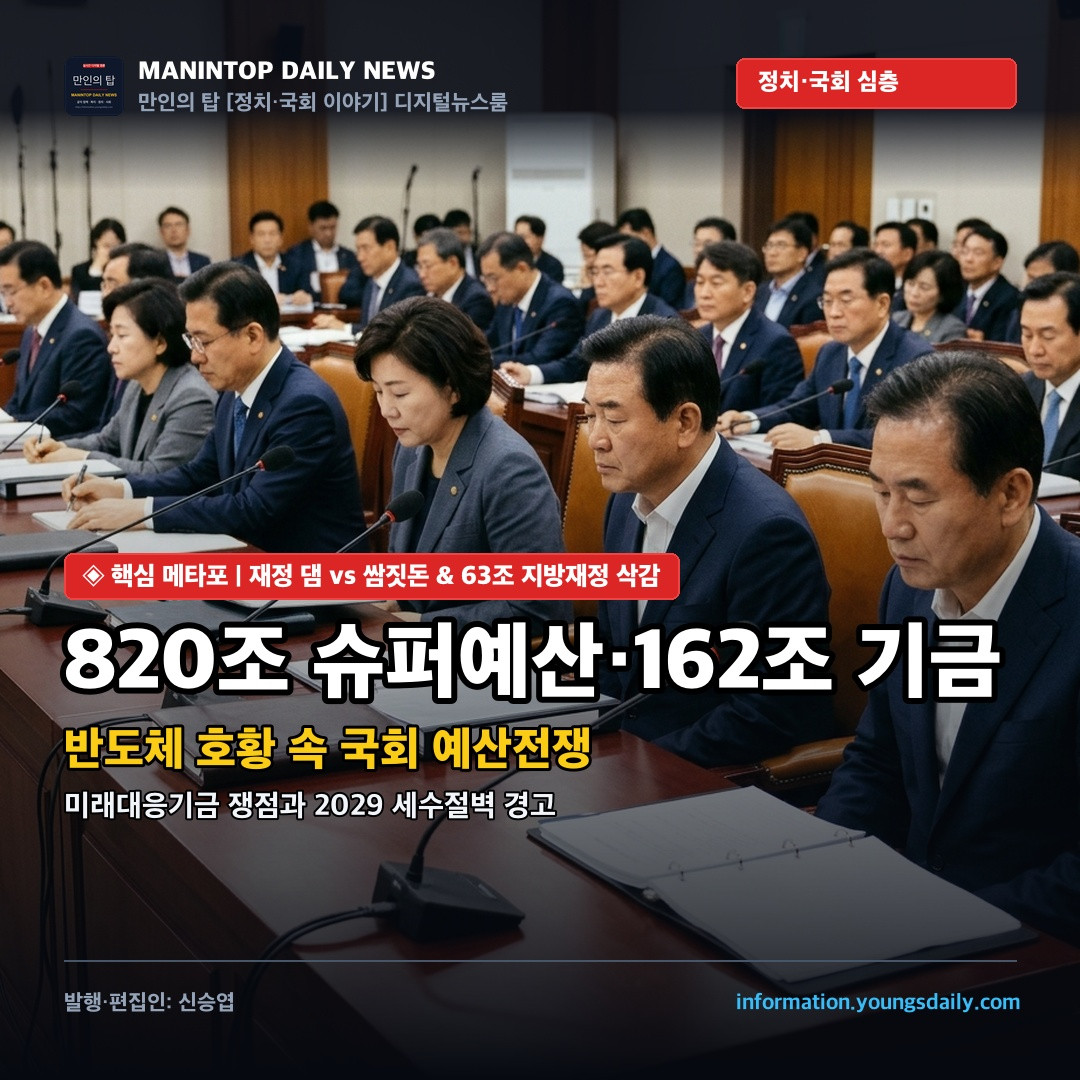
▲ 국회 예산결산특별위원회 회의실에서 여야 의원들과 정부 경제부처 당국자들이 2027년도 국가예산안을 심사하고 있다. / 보도자료사진
◈ 핵심 팩트 브리핑 (Key Fact Briefing)
820.9조 원 역대 최대 슈퍼예산과 반도체 세수 급증: 총지출 12.8% 증가율로 글로벌 금융위기(2009년 10.6%)를 경신하고 국세수입 584.4조 원 전망에 힘입어 통합재정수지 59.9조 원 흑자 전환
162.3조 원 미래대응기금 신설과 3대 지출 배분: 사업비 직접 지출 45.4조 원(28.0%), 세수 완충용 여유자금 적립 104.4조 원(64.3%), 국채 발행 축소 12.5조 원(7.7%)으로 편성
국회 예산 통제권 무력화와 지방재정 63조 원 삭감 논란: 기금 지출 변경 한도 30% 상향 및 세입·세출 외 전출입 특례 논란, 교부세 산식 개편으로 지자체·교육청 반발 격화
2029년 추가세수 소멸 경고와 134조 원 재정 조정 격돌: 국회예산정책처의 세수 절벽 경고 속 야당의 104.4조 원 국채 상환 전환 요구 및 기재부·예산처 간 5일 입법예고 갈등 노출
대한민국 정부가 반도체 수출 호황에 따른 대규모 초과세수를 바탕으로 총지출 820조 9,000억 원 규모의 2027년도 슈퍼예산안과 162조 3,000억 원 규모의 미래대응기금 신설안을 확정한 가운데, 정부의 전략적 성장 투자 기조와 국회의 재정 통제권 약화 및 지방재정 삭감을 둘러싼 여야의 정면충돌이 격화되고 있다. 역대 최고 수준인 12.8%의 지출 증가율에도 불구하고 일시적 세수 호황에 기댄 무리한 기금 설치와 2029년 세수 소멸 위험을 경고하는 목소리가 커지며 정기국회 예산 심사는 격랑 속으로 빠져들고 있다.
1. 2027년도 예산안 총괄 및 세수 여력 구조: 반도체 호황과 역대 최대 지출
정부가 국무회의를 거쳐 확정한 2027년도 예산안은 전년 본예산 대비 93조 원(12.8%) 늘어난 820조 9,000억 원으로 편성되었다. 이는 글로벌 금융위기 극복을 위해 편성했던 2009년의 10.6%를 훌쩍 뛰어넘는 사상 최대 지출 증가율이다. 정부는 지출을 파격적으로 확대하면서도 반도체 대기업들의 실적 개선에 따른 법인세와 소득세 급증 덕분에 총수입이 205조 6,000억 원 늘어난 880조 8,000억 원, 국세수입만 584조 4,000억 원에 달할 것으로 내다봤다.
이에 따라 통합재정수지는 59조 9,000억 원 흑자로 돌아서고, 관리재정수지 적자 역시 GDP 대비 0.1% 수준인 3조 1,000억 원에 그칠 것이라는 게 정부의 공식 설명이다. 확장재정의 핵심 타깃으로는 반도체 클러스터, 피지컬AI, AI데이터센터(AIDC) 등 이른바 '3대 메가프로젝트'에 올해보다 97.2% 증가한 21조 3,000억 원이 투입되며, 청년 예산에도 53.5% 늘어난 43조 3,000억 원이 배정되었다. 그러나 국가채무는 2027년 1,519조 8,000억 원에서 2030년 1,734조 1,000억 원으로 지속 증가할 것으로 전망되어 재정 건전성 논쟁을 촉발하고 있다.
구분
배정 예산 및 전년 대비 변화
주요 세부 내용 및 추진 사업
정책적 기대 효과
3대 메가프로젝트
21조 3,000억 원 (+97.2%)
반도체 메가클러스터, 피지컬AI, 국가 AI데이터센터 인프라
글로벌 첨단 제조 및 AI 3대 강국 기술 주권 확보
미래 성장엔진 확충
62조 8,000억 원
국가전략기술 R&D, 프론티어급 AI 연구, 이공계 인재 육성
잠재성장률 반등을 견인할 차세대 원천기술 생태계 구축
청년 도약 지원
43조 3,000억 원 (+53.5%)
청년미래적금 가입 요건 완화, 지방 중기 재직자 기여금 확대
초기 자산 형성 지원 및 청년층 지방 정착 유도
국가채무 전망
1,519.8조 ➔ 1,734.1조 원
2030년 총지출 1,005.2조 원 돌파 및 적자국채 누적
중장기 재정건전성 악화 및 이자 상환 부담 가중
2. 162조 3,000억 원 미래대응기금의 재원 조달 및 지출 배정 구조
이번 예산안의 최대 쟁점인 '미래대응기금'은 최근 10년간 내국세 연평균 증가율(6.2%)을 초과하는 추가세수와 세계잉여금 등을 적립하여 경기 변동에 대응하는 다부처 통합 기금이다. 조성되는 총 162조 3,000억 원은 실제 사업비 지출 45조 4,000억 원(28.0%), 세수 불황에 대비한 여유자금 적립 104조 4,000억 원(64.3%), 그리고 신규 국채 발행 축소 12조 5,000억 원(7.7%)으로 분배된다.
문제는 45조 4,000억 원에 달하는 기금 사업비가 기존 일반회계 및 특별회계 사업과 대거 중첩된다는 점이다. 청년계정(13.3조 원)은 고용보험기금 및 주택도시기금과 중복되고, 성장동력계정(14.2조 원)과 지방계정(10.3조 원) 역시 기존 부처 R&D 및 국가균형발전특별회계와 경계가 모호하다. 국회입법조사처는 기획예산처가 다부처 기금 형태로 사업 권한을 독점할 경우 각 소관 부처의 전문성과 정책 재량권이 심각하게 침해될 수 있다고 경고했다.
기금 구분 항목
예산 규모 및 전체 비중
계정별 세부 지출 내용
핵심 쟁점 및 중장기 리스크
사업비 직접 지출
45조 4,000억 원 (28.0%)
청년(13.3조), 성장동력(14.2조), 지방(10.3조), 교육(7.6조)
기존 일반회계·특별회계와의 사업 중복 및 21.2조 의무지출화
여유자금 적립
104조 4,000억 원 (64.3%)
세수 불황 대비 및 중장기 미래수요 완충 '재정 댐' 조성
국채 상환 대신 거액 유보에 따른 기회비용 및 쌈짓돈 논란
국채 발행 축소
12조 5,000억 원 (7.7%)
당해연도 적자국채 신규 발행 한도 축소 및 인수 지원
1,520조 원대 국가채무 규모 대비 상환 감축 효과 미미
총계 (기금 수입)
162조 3,000억 원 (100.0%)
내국세 추세 상회분(추가세수) 및 세계잉여금 기반
2029년 추가세수 전면 소멸 시 재원 고갈 위험 직면
3. 핵심 쟁점 ①: 국회 예산 통제권 약화와 예산총계주의 위반 논란
▲ 첨단 반도체 클러스터 클린룸에서 엔지니어들이 로봇 웨이퍼 이송 라인과 정밀 공정 텔레메트리를 점검하고 있다. / 보도자료사진
기금 설치 법률안을 둘러싼 가장 치명적인 법적 쟁점은 국회의 사전 예산 심의권 침해와 헌법상 예산총계주의 위반 논란이다. 현행 국가재정법상 일반 사업성기금의 지출 변경 한도는 20%로 제한되지만, 정부 개정안은 정책 사업 위주인 미래대응기금에 금융성기금 기준인 30%를 적용했다. 이에 따라 정부는 국회 승인 없이 사업비 45조 4,000억 원 중 무려 13조 6,000억 원을 임의로 변경할 수 있는 초법적 재량권을 확보하게 된다.
여기에 더해 초과세수를 국회 심의 없이 기금으로 자동 전입시키고, 일반회계에 세수 결손이 발생할 경우 추경 편성 없이 기금 여유자금을 끌어다 쓸 수 있도록 '세입·세출 예산 외 특례'를 신설했다. 이는 헌법이 보장한 의회의 재정 통제권을 근본적으로 형해화하고, 정부가 세수 결손을 은폐하는 비상금 창구로 기금을 악용할 수 있다는 헌법학계와 의회의 비판을 불러일으키고 있다.
4. 핵심 쟁점 ②: 지방·교육재정 63조 원 감축과 지자체 재정 자율성 갈등
미래대응기금 재원 확충의 여파는 지방재정과 교육재정의 직격탄으로 이어지고 있다. 정부는 내국세 총액에서 미래대응기금 적립액을 먼저 공제한 잔여분을 기준으로 지방교부세를 산정하도록 제도를 개편하고, 1972년 이래 유지되어 온 교육재정교부금의 내국세 연동제를 전격 폐지하기로 했다. 이로 인해 정률분 지방교부세 30조 5,000억 원과 지방교육재정교부금 32조 5,000억 원 등 총 63조 원의 법정 교부금이 삭감된다.
정부는 기금 내 지방계정(15.3조 원)과 교육계정(10.1조 원)으로 재투자하므로 총액 손실이 없다고 강변하지만, 지방자치단체와 교육청은 여야를 불문하고 집단 반발하고 있다. 전국시도지사협의회와 교육감협의회는 중앙정부가 자율 일반재원을 일방적으로 깎고 입맛대로 꼬리표를 붙인 기금 사업비로 대체하는 것은 지방자치를 훼손하는 '재정 집권'이라고 비판하며 법 개정 철회를 강력히 촉구하고 나섰다.
5. 핵심 쟁점 ③: 2029년 추가세수 소멸 경고와 여야 정치권 대치
국회예산정책처(예정처)의 심층 분석은 기금 재원의 지속 가능성에 대해 더욱 암울한 경고를 던지고 있다. 예정처 보고서에 따르면, 반도체 호황에 기댄 추가세수는 2027년과 2028년(57.3조 원)에 일시적으로 집중될 뿐, 장기 추세선 역전으로 인해 2029년부터는 추가세수 발생액이 '0원'으로 전면 소멸한다.
더욱이 사업비 45조 4,000억 원 중 46.7%인 21조 2,000억 원이 매년 줄일 수 없는 반복적·의무적 지출로 채워져 있다. 아동 기본수당과 청년미래적금 기여금 등은 세수가 끊겨도 지급을 중단할 수 없으므로, 2029년 세수 절벽이 닥치면 고스란히 국가 일반회계 적자와 국민 세금 빚으로 전가될 수밖에 없는 구조적 뇌관을 안고 있다.
이에 따라 국회 예산 심사는 극심한 정면충돌로 치닫고 있다. 여당인 더불어민주당은 잠재성장률을 반등시킬 '성장주도형 미래 투자'라고 옹호하지만, 야당인 국민의힘은 여유자금 104.4조 원 전액을 국채 상환에 투입하고 사업비를 26.9조 원 감액하는 '134조 원 재정 조정안'을 내세우며 배수진을 쳤다. 기획예산처의 5일 입법예고 강행과 재경부의 10건 수정안 전면 묵살 등 정부 내부 갈등까지 수면 위로 드러난 가운데, 820조 슈퍼예산의 향방은 대한민국 재정의 백년대계를 가를 중대한 시험대에 올랐다.
신승엽 (Seung Youb Ssin, Ph.D.) 정치·국회 전문기자 / 공학박사 본 기사는 국회 취재 및 정부 공식 예산안, 국회예산정책처 분석 보고서를 바탕으로 공정하게 편찬되었습니다. 무단 전재 및 재배포 금지.
[In-Depth Analysis] The Reality of the 820-Trillion-Won Super Budget and 162-Trillion Future Fund: Fiscal Standoff Amid the Semiconductor Boom
Published: 2026-11-01 |
Desk: Manintop Parliamentary and Political Affairs Bureau |
Author: Dr. Seung Youb Ssin
▲ Lawmakers and economic policymakers examine the 2027 fiscal budget inside the National Assembly Budget Committee chamber. / Press Documentation
Key Fact Briefing
Record 820.9 Trillion KRW Super Budget Fueled by Semiconductor Windfall: Outlay growth expands 12.8%—surpassing the 2009 financial crisis benchmark—driving a 59.9 trillion KRW consolidated fiscal surplus.
Establishment of 162.3 Trillion KRW Future Response Fund Across Three Pillars: Allocating 45.4 trillion KRW (28.0%) to programs, 104.4 trillion KRW (64.3%) to fiscal reserves, and 12.5 trillion KRW (7.7%) to bond reduction.
Erosion of Parliamentary Budget Oversight and 63 Trillion KRW Local Grant Reductions: Controversies over a 30% discretionary modification ceiling and off-budget transfers provoke severe bipartisan regional backlash.
Warnings Over Windfall Depletion by 2029 and a 134 Trillion KRW Realignment Clash: Legislative budget office forecasts tax revenue exhaustion as opposition demands redirecting the 104.4 trillion KRW reserve to debt redemption.
As the South Korean government finalizes an unprecedented 820.9 trillion KRW super budget alongside the proposed creation of a 162.3 trillion KRW Future Response Fund fueled by windfall corporate taxes from a booming semiconductor sector, severe partisan confrontations between pro-growth capital allocation and the erosion of parliamentary budgetary oversight are paralyzing the National Assembly. Despite a record 12.8 percent expenditure growth rate, mounting alarms surrounding the circumvention of constitutional gross budgeting principles, drastic reductions in local government block grants, and the looming exhaustion of temporary windfall revenues by 2029 have transformed the upcoming legislative review into a high-stakes fiscal battleground.
1. 2027 National Budget Overview and Revenue Windfall: Historic Fiscal Expansion
Endorsed through the State Council, the 2027 national budget total expenditure represents an increase of 93 trillion KRW (12.8 percent) compared to the prior fiscal year, establishing an all-time high expansion rate that surpasses the 10.6 percent growth logged during the 2009 global financial crisis. Propelled by surging corporate and personal income taxes from domestic chipmakers, the Ministry of Finance and Planning projects total revenue to surge by 205.6 trillion KRW to 880.8 trillion KRW, with gross national tax collections alone climbing to 584.4 trillion KRW.
Under these projections, authorities forecast the consolidated fiscal balance to shift into a 59.9 trillion KRW surplus, while the operational fiscal deficit is suppressed to 3.1 trillion KRW, or just 0.1 percent of national GDP. Capital appropriations aggressively prioritize three national mega-projects—semiconductor clusters, physical artificial intelligence, and AI data centers—commanding 21.3 trillion KRW, a 97.2 percent year-on-year surge, alongside a 53.5 percent boost in youth welfare appropriations totaling 43.3 trillion KRW. Nevertheless, official projections showing sovereign debt expanding from 1,519.8 trillion KRW in 2027 to 1,734.1 trillion KRW by 2030 continue to inflame fierce fiscal sustainability controversies.
Classification
Allocated Budget and YoY Change
Key Initiatives and Projects
Strategic Policy Objectives
Three Mega-Projects
21.3 Trillion KRW (+97.2%)
Semiconductor mega-clusters, physical AI, national AI data centers
Securing global technological dominance across critical AI manufacturing
Future Growth Engines
62.8 Trillion KRW
National strategic R&D, frontier artificial intelligence, STEM talent
Building foundation for potential growth rate rebound through R&D
Youth Support Schemes
43.3 Trillion KRW (+53.5%)
Youth future savings account expansion, regional SME subsidies
Accelerating initial asset accumulation and youth regional settlement
Sovereign Debt Outlook
1,519.8T ➔ 1,734.1T KRW
Total expenditure surpassing 1,005.2T KRW by 2030 with debt rollover
Escalating medium-term fiscal fragility and interest servicing burdens
2. Revenue Architecture and Resource Allocation of the 162.3 Trillion KRW Future Fund
At the epicenter of legislative debate lies the newly formulated Future Response Fund, an inter-ministerial mechanism designed to capture tax proceeds exceeding the ten-year average internal tax trajectory of 6.2 percent alongside general account surpluses to mitigate economic volatility. The total mobilized capital of 162.3 trillion KRW is apportioned into three principal envelopes: 45.4 trillion KRW (28.0 percent) for direct program expenditures, 104.4 trillion KRW (64.3 percent) locked in fiscal liquidity reserves, and 12.5 trillion KRW (7.7 percent) dedicated to curbing fresh sovereign bond issuances.
Critical scrutiny from parliamentary research bodies highlights substantial functional overlap across the 45.4 trillion KRW project allocation. Youth programs (13.3 trillion KRW) duplicate established initiatives within the Employment Insurance and Housing Urban Funds, while growth engine accounts (14.2 trillion KRW) and regional funding (10.3 trillion KRW) blur lines with existing ministerial R&D budgets and regional special accounts. The National Assembly Research Service cautioned that centralizing multi-agency execution under budgetary authorities risks undermining individual ministries' administrative expertise and policy discretion.
Duplication with general accounts and 21.2T KRW mandatory rigidity
Fiscal Reserves
104.4 Trillion KRW (64.3%)
Strategic reservoir hedging against economic downturns and demand
High opportunity costs versus debt retirement and slush fund scrutiny
Bond Issuance Curtailment
12.5 Trillion KRW (7.7%)
Offsetting fresh sovereign deficit financing bond ceilings
Marginal debt reduction impact against 1,520T KRW total liability
Total Mobilized Capital
162.3 Trillion KRW (100.0%)
Internal tax trendline windfalls and carryover balances
Severe liquidity evaporation risk once windfall expires in 2029
3. Core Dispute I: Erosion of Parliamentary Fiscal Control and Principle Breaches
▲ Cleanroom engineers inspect automated robotic wafer transfer lines and diagnostic telemetry consoles within a semiconductor cluster. / Press Documentation
The statutory framework governing the fund introduces profound constitutional disputes regarding the circumvention of legislative authorization and breaches of the statutory gross budget principle. While the National Finance Act strictly caps discretionary expenditure modifications for programmatic funds at 20 percent without parliamentary approval, the government bill classifies the fund as programmatic yet arbitrarily applies the 30 percent threshold reserved for financial institutions. Consequently, authorities could reallocate up to 13.6 trillion KRW of the 45.4 trillion KRW program budget entirely at executive discretion.
Compounding institutional friction, the bill establishes exceptional provisions permitting the transfer of surplus tax collections and general account deficit bailouts entirely outside formal revenue and expenditure accounting schedules. Legal scholars and parliamentary auditors caution that bypassing supplementary budget procedures fundamentally disenfranchises legislative scrutiny, creating an unmonitored executive reserve capable of masking severe macroeconomic miscalculations.
4. Core Dispute II: 63 Trillion KRW Local Grants Reduction and Regional Clashes
The funding mechanics of the Future Response Fund concurrently inflict devastating structural reductions upon regional and educational administrations. Under revised statutory formulas, internal tax allocations destined for local equalization grants are computed only after deducting transfers to the Future Fund, while the historic automatic revenue-sharing mechanism for educational grants dating back to 1972 is dismantled. This restructuring strips 30.5 trillion KRW from local government grants and 32.5 trillion KRW from provincial education grants, engineering an aggregate statutory loss of 63 trillion KRW.
Although the administration maintains that overall local support remains intact via dedicated regional and educational fund sub-accounts totaling 25.4 trillion KRW, municipal leaders across the political divide have mobilized unified opposition. The Governors Association of Korea and regional education superintendents formally condemned the maneuvering as centralist fiscal hegemony, emphasizing that stripping autonomous general revenues to replace them with central government earmarked grants severely paralyzes grassroots local governance.
5. Core Dispute III: Exhaustion of Windfall Revenue by 2029 and Factional Gridlock
In-depth assessments by the National Assembly Budget Office (NABO) deliver an alarming prognosis regarding long-term revenue viability. NABO empirical models demonstrate that additional tax yields driven by the semiconductor supercycle will concentrate exclusively within 2027 and 2028 (yielding 57.3 trillion KRW in 2028), before completely evaporating to zero in 2029 as long-term baseline trends overtake projected tax intake.
Critically, 46.7 percent of the fund's programmatic outlays—representing 21.2 trillion KRW annually—comprises legally mandated and recurring spending commitments, including youth savings contributions and basic child subsidies. Because statutory entitlements cannot be curtailed when cyclical windfalls vanish, the depletion of excess revenues by 2029 threatens to transfer massive unfunded liabilities directly into the general budget, saddling taxpayers with structural debt obligations.
These structural contradictions have precipitated fierce parliamentary gridlock as annual budget deliberations commence. While the ruling Democratic Party champions the package as a transformative pro-growth investment platform to avert secular stagnation, the opposition People Power Party demands a sweeping 134 trillion KRW reallocation, insisting that the entire 104.4 trillion KRW reserve be committed immediately to sovereign debt retirement while trimming 26.9 trillion KRW in duplicated programs. With deep bureaucratic rifts laid bare by an abbreviated five-day notice period and unheeded Treasury revisions, the 820 trillion KRW blueprint stands as a defining test of South Korea's long-term fiscal governance.
Dr. Seung Youb Ssin (Seung Youb Ssin, Ph.D.) Senior Political & Parliamentary Correspondent This dispatch was authored in strict adherence to journalistic integrity. All rights reserved.
PRO SOURCING ENGINE만인의 탑 빅데이터 솔루션
★ 가입 시 600 크레딧(120회) 전원 무료
내가 찾는 상품 키워드, 지금 얼마나 검색될까?
네이버 월간 검색량 + 구글 볼륨 + 아이템스카우트 실시간 상품수와 경쟁강도 배지를 0.5초 만에 무료로 확인하세요.
MANINTOP NEWSLETTER
📬 만인의 탑 뉴스레터 무료 구독
오늘 보신 정책·시사 뉴스가 유익하셨나요? 매일 엄선되는 알짜 복지 혜택과 국회 실시간 속보를 이메일로 가장 먼저 받아보세요. (평생 무료)
1월이 시작되면 감기는 이미 우리 곁에 와 있습니다. 2월, 3월, 4월까지 이어지는 추위와 건조함은 코와 목을 가장 먼저 공격합니다. 아침에 일어나자마자 막혀 있는 코. 계속 흐르는 콧물. 괜히 칼칼해지는 목. 이 증상은 “시작”일 뿐입니다. 한 번 무너지면 일주일, 길면 한 달까지 끌고 갑니다. 약을 먹으면 잠깐 괜찮아집니다. 하지만 며칠 뒤 또 반복됩니다. 왜일까요? 감기는 ‘치료’의 문제가 아니라 ‘관리’의 문제이기 때문입니다. 대부분은 감기가 오고 나서 약을 찾습니다. 하지만 진짜 중요한 건 감기가 오기 전에 코와 목을 지키는 것입니다. 건조한 실내 공기, 차가운 바깥 공기, 눈에 보이지 않는 세균. 코와 목은 매일 공격받고 있습니다. 지긋지긋하죠! 그런데도 우리는 아무 준비 없이 버티고 있습니다. 이번 겨울도 그렇게 보낼 건가요? 사실 방법은 어렵지 않습니다. 코를 깨끗하게 관리하고, 목을 따뜻하게 보호하고, 점막을 촉촉하게 유지하고, 기관지를 미리 관리하고, 외부 공기를 차단하는 것. 이 다섯 가지만 꾸준히 해도 감기약 없이 겨울을 보내는 것이 충분히 가능합니다. 🔥 이제부터 그 방법을 하나씩 살펴보겠습니다. 🔥 1. 코와 목을 먼저 관리해야 하는 과학적 이유 감기의 대부분은 코 점막에서 시작됩니다. 국제 학술지 Nature Reviews Microbiology 와 Journal of Allergy and Clinical Immunology 에 실린 호흡기 감염 관련 연구들에서는, 감기 바이러스가 비강 상피세포에 먼저 부착해 증식한다는 점을 설명하고 ...
리모델링사업이 진행 중인 아파트를 매매할 때 “계약금 10%를 언제까지 내야 하느냐”는 질문이 특히 많이 나옵니다. 이주공고(이주 안내)가 7~11월쯤이라고 들으면, 그 시점에 맞춰 계약금도 움직일 것 같아서 더 헷갈리기 쉽습니다. 하지만 실제 납부기한은 ‘이주공고가 언제냐’만으로 자동 결정되지 않는 경우가 많습니다. 1) 계약금 10% 납부기한: 결국 ‘문서에 적힌 일정’이 기준 계약금 10%를 언제까지 납부해야 하는지는, 내가 서명하는 매매계약서(특약 포함) 와 사업주체/조합이 제시한 공고·안내문 에 적힌 납부 일정이 기준이 됩니다. 실제 공고문에서는 분양대금 납부의 큰 틀(계약금→중도금→잔금)을 먼저 안내하고, 상세 일정은 별도 표나 유의사항으로 제시하는 방식이 흔합니다. 또, 계약서 문구에 따라 지급 시점이 조건부로 설정될 수도 있습니다. 예를 들어 한 사례 소개 자료에서는 용역계약서에 잔금(10%) 지급시기가 “사업승인 후”로 기재되어 있었다는 점이 언급됩니다. 이런 식으로 ‘사업 단계’와 지급을 연동하는 문구가 들어가면, 질문의 답은 계약서 문구를 확인해야만 확정됩니다. 관련 내용은 링크 에서 문구 사례를 확인할 수 있습니다. 2) 입주자모집공고에서 확인되는 ‘납부 순서’와 잔금 마감 시점 공고문에 적힌 문구를 보면, 납부 순서와 잔금 마감에 대한 기준이 비교적 명확하게 제시되는 경우가 있습니다. 예를 들어 한 입주자모집공고에는 “분양금액(주택가격)은 계약금, 중도금, 잔금의 순서로 납부”하며 “잔금은 입주(열쇠 수령일) 전에 완납”해야 한다고 안내되어 있습니다. (문구 확인: 링크 ) 이 문구가 의미하는 바는 최소 2가지입니다. 분양/공급 형태의 문서에서는 ‘계약금→중도금→잔금’ 흐름이 공식적으로 안내될 수 있습니다. 잔금은 “입주(열쇠 수령)” 이전에 완납해야 한다는 마감 기준이 문서에 적혀 있을 수 있습니다. 다만, 위 공고문 문구는 잔금 마감에 대한 기준을 보여주지만, 계약금 10%의...
윤석열 전 대통령 탄핵 인용 소식을 접하면, 가장 궁금한 지점은 ‘헌재가 정확히 무엇을 위헌·위법으로 봤는가’입니다. 또한 탄핵과 별개로 진행되는 형사재판(내란 우두머리 혐의 등)이 어디까지 왔는지도 함께 정리할 필요가 있습니다. 아래 내용은 제공된 기사/게시물 스니펫과 링크에서 확인되는 범위만 모아, 일반인이 흐름을 이해하기 쉽게 정리한 것입니다. 1) 탄핵 인용 관련: 스니펫에서 확인되는 ‘판단의 골격’ 제공된 근거 중 조국혁신당 사이트에는 헌법재판소가 윤석열 탄핵 심판에서 “피청구인의 위헌·위법행위는 국민 신임 …”이라는 취지로 판단했다는 문장이 인용돼 있습니다( 링크 ). 이 인용문만 놓고 보면, ‘위헌·위법행위’가 있었는지와 그로 인해 ‘국민의 신임’이 어떻게 평가됐는지가 핵심 축으로 소개됩니다. 다만 질문에서 요청하신 세부 항목, 즉 비상계엄 선포 자체를 문제 삼은 구체적 이유, 계엄 이후 조치(포고령, 국회 통제 등)의 어떤 지점이 헌법 위반인지, 국회의 권한행사 방해 및 정치활동 제약을 어떤 논리로 판단했는지 등은, 이번에 제공된 근거의 제목/스니펫만으로는 조항·사실관계·판단 구조가 그대로 제시돼 있지 않습니다. 따라서 이 글에서는 ‘헌재가 무엇을 문제 삼았다’는 세부 리스트를 단정적으로 재구성하기보다, 현재 확인 가능한 문구 수준의 요약(위헌·위법행위 → 국민 신임의 문제로 평가)까지만 적습니다. 만약 헌재 결정문 전문(주문 및 이유)이 추가로 확인되면, 그때는 문장 단위로 ‘어떤 행위’와 ‘어떤 헌법 원리/조항’이 연결되는지(예: 권력분립, 국회의 권한, 정치적 기본권 등) 구조화해 정리하는 것이 가장 정확합니다. 2) 형사 절차(내란 혐의) 관련: 체포영장과 1심 선고 언급 탄핵 심판과 별도로, 12·3 비상계엄 사태로 내란 혐의를 받는 윤석열 대통령에 대해 2024년 12월 31일 체포 영장이 발부됐다는 BBC 보도가 있습니다( 링크 ). 해당 보도는 ‘현직 대통령’에 대한 체포영장 발부라는 점을 함께 언급합니다. 또...