트럼프 관세 폭탄과 북미 통상 균열… 96년 만의 ‘스무트-홀리 338조’ 부활과 공급망 대혼란
만인의 탑 편집국11월 01, 2026
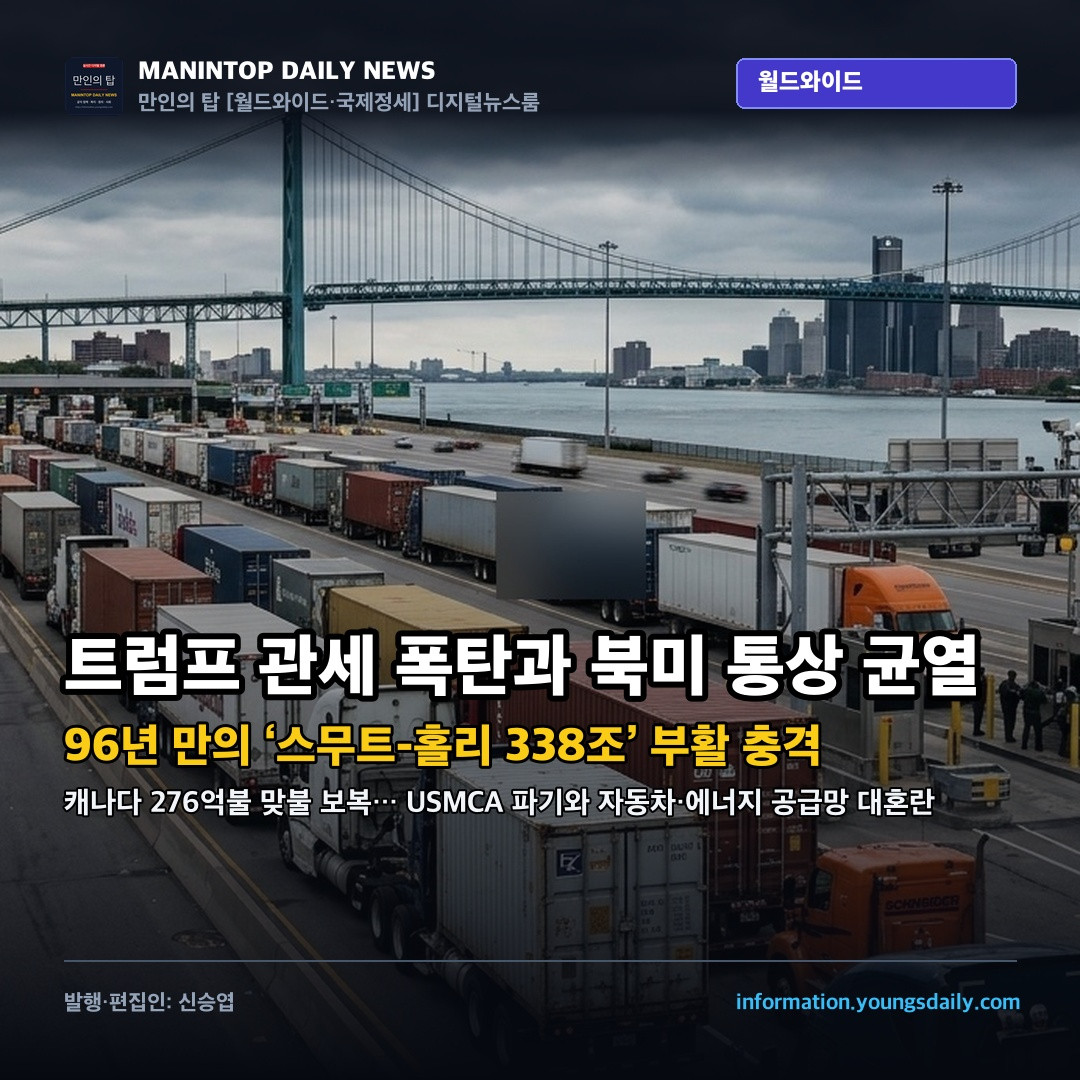
▲ 미국의 관세 폭탄과 캐나다의 맞불 보복 속에 북미 통상 질서와 단일 공급망이 거대한 균열에 직면하고 있다 (보도사진 자료)
도널드 트럼프 미국 행정부가 법원의 위법 판결로 제동이 걸린 국제긴급경제권한법(IEEPA)을 대신하여, 1930년 대공황기 제정된 뒤 96년 동안 사실상 사문화되었던 '스무트-홀리 관세법(Tariff Act of 1930) 제338조'를 전격 발동했습니다. 워싱턴 양자 협상이 최종 결렬됨에 따라 2026년 8월 22일부터 대(對)캐나다 수입품에 대한 50% 징벌적 고율 관세가 전면 시행되었으며, 철강(84억 4천만 달러)과 알루미늄(45억 4천만 달러)을 넘어 9억 6,700만 달러 규모의 수입 전면 금지 조치까지 단행되었습니다. 이에 맞서 캐나다 정부는 'Dollar-for-Dollar(달러 대 달러)' 원칙 하에 276억 캐나다 달러(미화 약 200억 달러) 규모의 보복관세를 부과하고 대미 전력 공급 차단 카드를 공론화하며 정면 충돌에 돌입했습니다. 부품이 국경을 6~8회 넘나드는 북미 자동차 밸류체인과 원유·천연가스 등 핵심 원자재 공급망이 마비 국면에 직면하고 2026년 USMCA 공동검토가 파행을 맞이하면서, 수십 년간 이어진 북미 통합 경제 질서가 돌이킬 수 없는 붕괴 위기로 치닫고 있습니다.
핵심 팩트 브리핑 (Core Fact Briefing)
96년 만의 스무트-홀리 관세법 제338조 전격 동원: IEEPA 위법 판결 직후 포고령 11046호, 11047호, 11048호를 통해 대(對)캐나다 50% 관세 발효 및 9억 6,700만 달러 수입 금지 단행
캐나다의 276억 캐나다 달러(C$27.6B) Dollar-for-Dollar 맞불 보복: 미국 핵심 경합주(위스콘신, 미시간, 버몬트) 공략 50% 및 25% 보복관세 단행 및 온타리오주 전력망 25% 할증·공급 차단 경고
부품 6~8회 국경 이동 자동차 밸류체인 마비 위기: 캐나다 부품 생산액의 50% 이상이 미국산 중간재이며 미국 수입품의 69%가 원자재·중간재인 초연결 공급망의 자멸적 비용 폭탄
거시경제적 후폭풍과 통상 질서 다변화: 캐나다 의회예산처(PBO) 실질 GDP 1.4% 감소 및 18만 5천 개 일자리 소멸 추산, 미국 가구당 연 1,100달러 인플레 전가 및 캐나다의 EU 준회원국 추진
1. 96년 만에 부활한 보호무역주의와 북미 통상 질서의 균열
2026년 8월, 2차 세계대전 이후 80여 년간 유지되어 온 다자간 자유무역주의와 북미 경제 통합의 근간이 근본적으로 흔들리고 있습니다. 도널드 트럼프 미국 대통령이 캐나다산 수입품에 대해 50%에 달하는 징벌적 고율 관세를 전격 부과하고 캐나다가 276억 캐나다 달러(미화 약 190억~200억 달러) 규모의 대미 맞불 관세로 대응하면서, 양국 간 경제 관계는 전례 없는 전면적 무역전쟁으로 치달았습니다.
이번 사태는 단순한 통상 마찰의 차원을 넘어섭니다. 미국 행정부가 법원의 위법 판결로 무력화된 긴급 행정명령을 우회하기 위해, 1930년 대공황을 촉발했던 악명 높은 '스무트-홀리 관세법(Smoot-Hawley Tariff Act)'의 비상 권한을 96년 만에 강제 호출했기 때문입니다. 1947년 '관세 및 무역에 관한 일반협정(GATT)' 출범 이후 단 한 번도 사용된 적 없던 사문화된 법 조항이 미국의 1대 무역 흑자국이자 최우방국인 캐나다를 겨냥해 재가동되었습니다.
더욱이 1965년 오토팩(Auto Pact), 1989년 미·캐나다 자유무역협정(FTA), 1994년 북미자유무역협정(NAFTA), 그리고 2020년 미국·멕시코·캐나다 협정(USMCA)으로 고도화되어 온 '단일 북미 통합 경제권'의 신뢰가 일거에 붕괴했습니다. 부품과 중간재가 하루에도 수차례 국경을 오가는 정밀 제조업 생태계와 전력·원유 등 에너지 안보망이 인질로 잡히면서, 양국 경제 모두에 회복 불가능한 자멸적 피해가 가시화되고 있습니다.
2. IEEPA 무효화와 1930년 관세법 제338조(스무트-홀리)의 전격 부활
트럼프 행정부가 1930년 관세법 제338조라는 유물을 꺼내든 배경에는 사법부의 강력한 제동이 있었습니다. 2026년 2월, 미국 국제무역법원(CIT)과 연방항소법원, 그리고 연방대법원은 트럼프 2기 행정부가 국경 안보와 마약 유입 등을 이유로 선포했던 '국제긴급경제권한법(IEEPA)' 기반의 전방위 보편관세 조치에 대해 명백한 위법이자 월권이라는 판결을 잇달아 확정했습니다. 사법부가 IEEPA를 통한 관세 부과를 원천 차단하자, 백악관 통상 참모들은 의회의 승인 없이 대통령 직권으로 발동 가능한 대체 법적 수단 발굴에 착수했습니다.
그 결과물이 바로 1930년 관세법 제338조(19 U.S.C. § 1338)입니다. 이 조항은 외국의 법률, 행정 규제, 관행이 미국 상업에 차별을 가하거나 불이익을 준다고 대통령이 판단할 경우, 해당국 수입품에 대해 최대 50%의 관세를 부과하거나 심지어 수입을 전면 금지할 수 있는 막강한 백지위임 권한을 담고 있습니다. 1947년 GATT 출범 당시 '차별 철폐와 최혜국 대우(MFN)' 원칙이 수립된 이래 단 한 차례도 소환되지 않았던 이 조항이 대통령 포고령 11046호(주류), 11047호(유제품), 11048호(자동차)를 통해 일제히 발효되었습니다.
관세 부과는 즉각적이고 단계적으로 가속화되었습니다. 8월 22일 미·캐나다 양자 실무 협상이 최종 결렬되자마자 50% 관세가 공식 시행되었으며, 9월 15일에는 84억 4천만 달러 규모의 철강과 45억 4천만 달러 규모의 알루미늄이 추가 관세 품목에 편입되었습니다. 이어 9월 29일에는 9억 6,700만 달러 규모의 캐나다산 제품에 대한 수입 전면 금지 조치가 내려졌고, 오는 2027년 1월 1일부터는 자동차 및 핵심 부품에 대한 50% 관세 부과가 예고되어 있어 전면적 경제 단절의 시계가 돌아가고 있습니다.
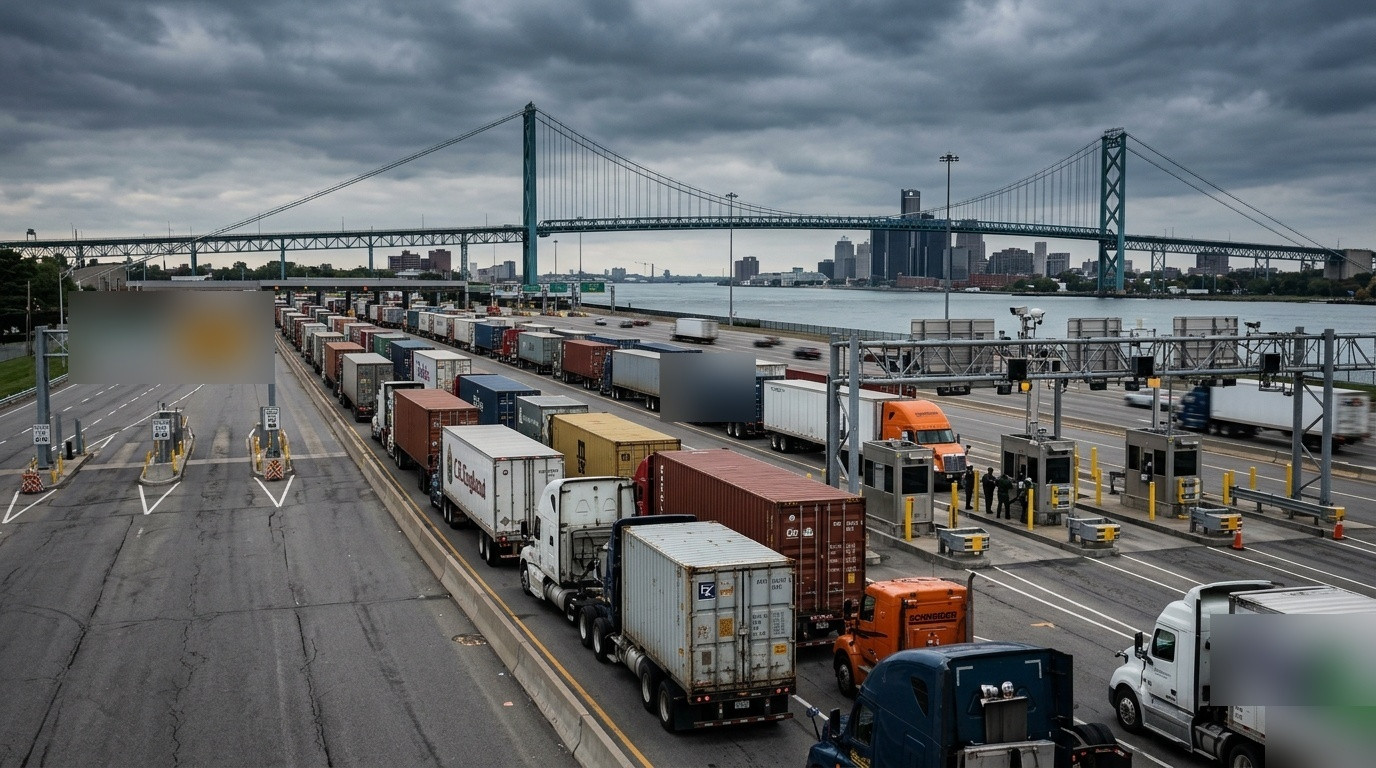
▲ 미국과 캐나다 국경 통관 검문소에서 화물 트럭들이 대기하고 있는 국제 물류 현장 (보도사진 자료)
3. 캐나다의 Dollar-for-Dollar 맞불 보복과 경합주 정밀 타깃팅
워싱턴의 초강경 조치에 대해 오타와의 캐나다 연방정부는 한 치의 물러섬 없는 'Dollar-for-Dollar(달러 대 달러)' 보복 원칙을 천명했습니다. 캐나다 재무부와 외교부는 미국의 관세 부과 총액과 정확히 일치하는 276억 캐나다 달러(미화 약 190억~200억 달러) 규모의 대미 보복관세 리스트를 확정하고 2026년 9월 8일부터 전격 징수에 돌입했습니다. 이는 2025년 3월 철강·알루미늄 232조 관세에 대응해 이미 부과 중이던 보복관세를 포함할 경우 총 520억 캐나다 달러에 육박하는 사상 최대 규모의 대항 조치입니다.
캐나다의 보복 카드는 미국 국내 정치 지형을 정밀하게 겨냥한 '외과수술식 타깃팅(Surgical Targeting)'으로 설계되었습니다. 미국산 철강과 알루미늄, 가구, 의류 완제품에 대해서는 50%의 징벌적 관세를 부과하여 미국의 대캐나다 제조업 수출 전선에 타격을 가했습니다. 동시에 백악관과 공화당의 핵심 정치적 텃밭이자 경합주인 위스콘신과 버몬트의 유제품, 오하이오의 가전제품, 그리고 미시간과 인디애나의 자동차 부품에 대해 25% 보복관세를 집중 부과함으로써 미국 정치권에 극심한 압박을 가하고 있습니다.
무엇보다 심각한 뇌관은 에너지 안보 분야에서 터져 나왔습니다. 캐나다 온타리오주의 더그 포드(Doug Ford) 주수상은 뉴욕과 미시간 등 미국 동북부 10개 주로 송전되는 캐나다산 수력 전력에 대해 25%의 '수출 할증료'를 부과하겠다고 공언하며, 미국이 관세를 철회하지 않을 경우 전력 공급을 전면 중단할 수 있음을 강력히 경고했습니다. 미국은 전체 전력 수입의 100%(연간 252억 달러)를 캐나다에 의존하고 있어, 전력 차단이 현실화될 경우 미국 주요 산업 지대의 전력망 대정전과 극심한 에너지 대란이 불가피한 실정입니다.
4. 6~8회 국경 넘는 자동차 부품 밸류체인과 에너지 상호의존의 딜레마
이번 무역 분쟁이 세계 경제에 가하는 가장 치명적인 위험은 북미 대륙이 수십 년에 걸쳐 구축해 온 '초상호의존적 단일 공급망'의 파괴에 있습니다. 일반적인 완제품 무역과 달리, 미국과 캐나다 간의 교역은 중간재와 원자재가 주를 이룹니다. 실제로 미국의 대캐나다 수입액 중 32%는 1차 원자재이며, 37%는 제조업 생산에 필수적인 가공 중간재로 구성되어 있습니다. 캐나다로부터 수입되는 물품의 69%가 미국 공장의 생산 라인을 돌리는 데 투입되는 핵심 투입물인 셈입니다.
대표적인 산업이 자동차입니다. 북미 자동차 산업 생태계에서는 완성차 한 대가 최종 조립되기까지 개별 부품과 섀시가 디트로이트와 온타리오 국경을 평균 6회에서 8회 왕복하며 정밀 가공됩니다. 특히 캐나다 자동차 부품 공장에서 생산되는 제품 가치의 50% 이상이 미국에서 제조된 원자재와 전자 제어 모듈에 기반하고 있습니다. 50%의 관세가 국경을 넘을 때마다 누적 적용될 경우, 최종 생산 원가는 천문학적으로 치솟아 디트로이트 완성차 3사(빅3)를 비롯한 북미 자동차 산업 전체가 즉각적인 조업 중단 사태에 직면하게 됩니다.
에너지와 전략 광물 분야의 상호의존성은 미국의 취약성을 더욱 극명하게 드러냅니다. 미국은 전체 원유 수입의 57.3%(연간 7,058억 달러), 천연가스 수입의 66.0%(1,039억 달러)를 캐나다산 파이프라인 공급에 전적으로 의존하고 있습니다. 더욱이 미국 방위산업과 인프라의 핵심인 알루미늄의 38.7%~56.0%(929억 달러), 미국 농업 비료의 절대적 원료인 탄산칼륨(가성칼리·포타시)의 44.8%~80.0%(348억 달러), 아연의 54.1%(132억 달러)가 캐나다산입니다. 캐나다산 수입품에 소비된 1달러 중 40센트가 미국산 원자재 구매로 재환류되는 점을 감안할 때(중국 수입품의 4센트와 대조), 관세 폭탄은 곧 미국 경제의 심장을 스스로 겨누는 자해적 부메랑이 되고 있습니다.
▲ 북미 자동차 제조 공장에서 정밀 부품 조립 라인이 가동 중인 생산 현장 (현장 보도사진)
5. USMCA 2026 공동검토 결렬과 대서양 파트너십의 지각변동
사태가 걷잡을 수 없이 격화되면서, 2026년 예정되어 있던 'USMCA 제6년차 공동검토(Joint Review)'는 사실상 사망 선고를 받았습니다. 제프리 그라움(Jeffrey Grium) 미 무역대표부(USTR) 대표는 협정의 16년 자동 연장을 공식적으로 거부했습니다. 이로써 USMCA는 매년 협정 지속 여부를 심사받아야 하는 '연례 연쇄 검토(Serial Annual Review)' 상태로 전락했으며, 이는 북미에 투자한 전 세계 제조업체들에 극심한 정책적 불확실성을 강요하고 있습니다.
거시경제적 후폭풍에 대한 학계와 공공기관의 실증적 검증 결과는 참담합니다. 캐나다 의회예산처(PBO)의 5년 영향 분석에 따르면, 현행 관세 체제가 지속될 경우 캐나다의 실질 GDP는 1.4% 감소하고 대미 수출은 7.6% 급락하며, 18만 5천 개의 양질의 제조업 일자리가 소멸할 것으로 추산되었습니다. 그러나 미국 경제가 치러야 할 대가 역시 이에 못지않습니다. 킴벌리 클라우징(Kimberly Clausing), 메리 러블리(Mary Lovely), 알베르토 카발로(Alberto Cavallo) 교수팀의 2026년 실증 연구에 따르면, 관세 비용의 90%~100%가 고스란히 미국 수입업자와 소비자에게 전가되어 소비자물가지수(CPI)를 0.8%포인트 끌어올리고 미국 가구당 연간 1,077~1,100달러의 추가 생활비 부담을 초래하는 것으로 입증되었습니다.
이러한 미증유의 통상 고립 속에서 캐나다는 역사적인 대외 경제 노선 수정을 단행하고 있습니다. 마크 카니(Mark Carney) 캐나다 총리는 '미국 중심의 단일 북미 경제권에 안주하던 시대는 끝났다'고 선언하며, 유럽연합(EU)과의 통상 안보 협력을 강화하여 역사상 최초로 EU의 '준회원국(Associate Member)' 지위를 획득하는 방안을 전격 수용했습니다. 1930년 스무트-홀리의 악령이 96년 만에 다시 불러일으킨 일방주의적 관세 전쟁이 역설적으로 북미 통상 블록의 해체와 서방 자유민주 진영 내 통상 동맹의 지각변동을 촉발하고 있습니다.
📊 북미 통상 갈등 핵심 쟁점: 미국 트럼프 행정부 조치 vs 캐나다 보복 및 산업 파급효과
정책 및 산업 영역
미국 트럼프 행정부 관세 조치
캐나다 정부 보복 및 공급망 대응
거시경제 충격 및 공급망 파급효과
법적 근거 및 관세율
1930년 관세법 제338조(스무트-홀리) 50% 관세 및 9.67억 달러 수입 금지
276억 캐나다 달러 규모 Dollar-for-Dollar 보복관세 징수 (총 520억 달러 누적)
GATT/WTO 다자 통상 규범 무력화 및 양자 보복전 격화
철강·알루미늄 및 원자재
철강 84.4억 달러, 알루미늄 45.4억 달러 추가 편입
미국산 철강·알루미늄·가구·의류에 50% 맞불 관세 부과
미국 제조업 알루미늄 수입 의존도 56% 타격 및 원자재 비용 폭등
완성차 및 자동차 부품망
포고령 11048호 의거 2027년 1월 1일 완성차·부품 50% 관세 예고
미시간·인디애나 등 미국 경합주 자동차 부품에 25% 보복관세 타깃팅
부품 국경 6~8회 이동에 따른 중복 관세로 디트로이트 빅3 조업 중단 위기
전력·원유 등 에너지 안보
캐나다산 에너지 품목 면제 배제 검토 및 압박 지속
온타리오주 대미 송전 25% 할증료 공언 및 전력 공급 차단 경고
미국 전력 수입 100%, 원유 57.3%, 가스 66% 의존에 따른 대정전·인플레 위험
USMCA 협정 및 통상 동맹
USTR 협정 16년 자동 연장 거부 및 연례 재검토 체제 강제
대미 종속 탈피 선언 및 유럽연합(EU) 최초 준회원국 가입 추진
캐나다 실질 GDP 1.4% 감소 및 미국 소비자 가구당 연 1,100달러 전가
국제통상전략 특별취재발행인 겸 편집인: 신승엽 (Seung Youb Ssin)
Global Edition (English)
Trump Tariffs and the Fracture of North American Trade: The Resurgence of the Smoot-Hawley Section 338 After 96 Years and Supply Chain Turmoil
▲ Resurgence of Section 338 Protectionism and Cross-Border Trade Disruptions / Official Press Photo Archive
Following federal judicial rulings invalidating executive tariffs imposed under the International Emergency Economic Powers Act (IEEPA), the Trump administration has unilaterally invoked Section 338 of the Tariff Act of 1930—the infamous Smoot-Hawley statute dormant for 96 years and unused since the establishment of the GATT in 1947. With the breakdown of bilateral negotiations, punitive 50 percent tariffs on Canadian imports took effect on August 22, 2026, swiftly escalating to encompass $8.44 billion in steel, $4.54 billion in aluminum, and a total import prohibition on $967 million worth of Canadian consumer goods. In direct response, the Canadian federal government activated a C$27.6 billion retaliatory package under its Dollar-for-Dollar doctrine, surgically targeting key industrial sectors across American swing states while threatening high-voltage electricity surcharges. As integrated cross-border automotive supply chains—where components cross boundaries six to eight times—face unprecedented paralysis, the collapse of the 2026 USMCA Joint Review marks an epochal rupture in continental economic integration.
Core Fact Briefing
Invocation of Section 338 of the 1930 Tariff Act after 96 years of dormancy: Proclamations 11046, 11047, and 11048 enforced 50 percent tariffs on Canadian goods and complete import bans on $967 million in commodities.
Canada executes C$27.6 billion Dollar-for-Dollar retaliatory tariffs: Targeted 50 percent and 25 percent surcharges against swing states (WI, MI, VT) coupled with Ontario's 25 percent electricity export surcharge threat.
Paralysis across cross-border automotive and manufacturing value chains: Auto components traverse the border 6 to 8 times, with 69 percent of US imports from Canada consisting of critical intermediate and primary inputs.
Macroeconomic losses and structural decoupling: Canadian PBO projects real GDP decline of 1.4 percent and 185,000 job losses, 90 to 100 percent cost pass-through to US consumers ($1,100 annual household burden), and Canada pursuing EU Associate Membership.
1. The Return of Protectionism After 96 Years and Fractures in North American Trade
In August 2026, the foundational principles of multilateral rules-based trade and North American economic integration, painstakingly constructed over eight decades since World War II, suffered a historic rupture. The unilateral imposition of 50 percent punitive tariffs on Canadian imports by the Trump administration, followed immediately by Canada's C$27.6 billion retaliatory strike, transformed continental commerce into an active, high-stakes trade confrontation.
This crisis represents far more than an ordinary bilateral dispute. To bypass judicial rulings that dismantled its emergency powers, the executive branch resurrected Section 338 of the Tariff Act of 1930—the notorious Smoot-Hawley statute that worsened the Great Depression. Completely untouched for 96 years and never once activated throughout the entire GATT and World Trade Organization (WTO) era since 1947, this archaic trade weapon has now been deployed against America's closest democratic ally and premier resource partner.
The institutional trust underpinning the unified North American production platform—evolved through the 1965 Auto Pact, the 1989 CFTA, NAFTA in 1994, and the 2020 USMCA—has unraveled. With tightly coupled automotive supply chains and cross-border electricity and hydrocarbon pipelines caught directly in the crosshairs, both nations face severe, irreversible economic self-harm.
2. Invalidation of IEEPA and the Resurgence of Section 338 Smoot-Hawley Tariffs
The executive branch's retreat to the Tariff Act of 1930 was precipitated by decisive judicial intervention. In February 2026, the U.S. Court of International Trade (CIT), the Court of Appeals for the Federal Circuit, and ultimately the Supreme Court struck down the administration's universal import surcharges imposed under the International Emergency Economic Powers Act (IEEPA), ruling that broad tariff-making powers belong exclusively to Congress under Article I, Section 8 of the Constitution. Stripped of IEEPA authority, trade advisors scoured the statutes for alternative autonomous executive powers.
Their chosen instrument was Section 338 of the Tariff Act of 1930 (19 U.S.C. § 1338). Originally designed during the high-tariff Smoot-Hawley era, Section 338 grants the President unilateral authority to levy retaliatory tariffs of up to 50 percent—or to completely prohibit imports—if the executive determines that a foreign government discriminates against American commerce in law or practice. Dormant for 96 years and fundamentally irreconcilable with GATT non-discrimination and Most Favored Nation (MFN) commitments, Section 338 was weaponized through Presidential Proclamations 11046 (alcohol), 11047 (dairy), and 11048 (vehicles).
Enforcement unfolded rapidly across targeted phases. Following the collapse of bilateral negotiations in Washington, 50 percent tariffs took effect on August 22, 2026. On September 15, the scope expanded to incorporate $8.44 billion of Canadian steel imports and $4.54 billion of aluminum. By September 29, the White House enacted complete import bans covering $967 million in Canadian commodities (87 percent alcohol products), while setting January 1, 2027, as the deadline for 50 percent tariffs on all Canadian motor vehicles and automotive components.
▲ Commercial Freight Logistics at the United States-Canada International Border Crossing / Official Press Photo Archive
3. Canada's Dollar-for-Dollar Retaliation and Precision Targeting of Swing States
Ottawa's response to Washington's aggressive posture was immediate and uncompromising. Adhering to the principle of Dollar-for-Dollar reciprocity, the Department of Finance Canada authorized a comprehensive counter-tariff package valued at C$27.6 billion (approximately $19 billion to $20 billion USD), which commenced collection on September 8, 2026. When integrated with the pre-existing retaliatory tariffs instituted in March 2025 under Section 232 disputes, Canada's total active tariff defenses reached C$52 billion—the largest retaliatory economic program in Canadian history.
The Canadian counter-offensive was meticulously structured around political economy geography. Ottawa levied punitive 50 percent tariffs on U.S. manufactured steel, aluminum, furniture, and apparel. Simultaneously, it deployed 25 percent surcharges against sensitive agricultural and manufacturing industries situated within pivotal electoral swing states—specifically targeting dairy exports from Wisconsin and Vermont, major home appliances from Ohio, and specialized automotive assemblies from Michigan and Indiana.
The confrontation reached peak escalation when energy security became a direct instrument of statecraft. Doug Ford, the Premier of Ontario, publicly threatened a 25 percent export surcharge on high-voltage electricity transmitted southward to New York, Michigan, and the broader MISO grid, warning of a potential complete power shutoff should American tariff measures persist. Given that the United States relies on Canada for 100.0 percent of its electricity imports ($25.2 billion annually), any intentional disruption threatens rolling blackouts across northeastern industrial centers.
4. Automotive Cross-Border Supply Chains and the Dilemma of Energy Interdependence
The catastrophic risk posed by this conflict lies in the structural dismantling of hyper-integrated continental supply networks. Unlike conventional consumer goods trade, U.S.-Canada commerce is dominated by intermediate manufacturing inputs and upstream resources. Empirical trade flows demonstrate that 32 percent of U.S. imports from Canada consist of primary inputs and 37 percent are semi-finished intermediate components—meaning that 69 percent of total imports directly fuel American manufacturing factories.
Nowhere is this interdependence more acute than in automotive manufacturing. Under the integrated Detroit-Windsor corridor, specialized automotive parts cross the international border between six and eight times before final vehicle assembly. Crucially, more than 50 percent of the total value of Canadian auto parts production is derived from upstream American components. Layering a cumulative 50 percent tariff upon each bilateral border crossing multiplies production costs exponentially, rendering North American vehicle manufacturing unviable against European and Asian competitors.
Critical minerals and hydrocarbons illustrate structural American vulnerability. The United States imports 57.3 percent of its foreign crude oil ($705.8 billion) and 66.0 percent of its natural gas ($103.9 billion) directly from Canadian pipeline corridors. Furthermore, U.S. domestic consumption is heavily dependent on Canadian aluminum (38.7 to 56.0 percent, $92.9 billion), agricultural potash fertilizer (44.8 to 80.0 percent, $34.8 billion), and zinc (54.1 percent, $13.2 billion). Considering that 40 cents of every dollar spent on Canadian imports returns directly to purchase American components (compared to just 4 cents for China), indiscriminate tariffs represent an act of profound industrial self-sabotage.
▲ Automated Assembly and Parts Fabrication Inside North American Manufacturing Facility / Official Press Photo
5. Breakdown of the USMCA 2026 Joint Review and Shifts in Transatlantic Alignment
As diplomatic impasse ossified into institutional fracture, the mandated 2026 USMCA Joint Review suffered functional collapse. U.S. Trade Representative Jeffrey Grium formally rejected the 16-year term extension provided under the agreement's sunset clause. Consequently, the trilateral accord transitioned into a state of volatile Serial Annual Reviews, introducing pervasive long-term capital allocation uncertainty across the North American manufacturing heartland.
Rigorous macroeconomic auditing reveals symmetric losses for both economies. The Canadian Parliamentary Budget Officer (PBO) five-year assessment projects that persistent tariff friction will contract Canadian real GDP by 1.4 percent, depress bilateral export volumes by 7.6 percent, and eliminate 185,000 full-time jobs. Concurrently, empirical incidence literature by Kimberly Clausing, Mary Lovely, and Alberto Cavallo establishes that 90 to 100 percent of American tariff burdens are absorbed by domestic consumers and downstream firms, raising headline CPI by 0.8 percentage points and imposing an annual deadweight tax of $1,100 per American household.
Confronted with the breakdown of continental integration, Ottawa initiated a historic diversification pivot. Canadian Prime Minister Mark Carney formally declared the termination of Canada's singular economic dependency on the United States, officially pursuing Associate Membership status within the European Union. In a profound geopolitical irony, the resurrection of 1930 Smoot-Hawley unilateralism has fractured North American economic solidarity, driving historic reallocation of transatlantic trade architecture.
📊 North American Trade Conflict: United States Actions vs. Canadian Retaliation and Impacts
Domain & Strategic Sector
United States Tariff Enforcement
Canadian Retaliation & Strategic Responses
Macroeconomic Impact & Supply Chain Disruptions
Legal Authority & Tariff Scale
Section 338 Tariff Act of 1930; 50% tariffs and $967M product bans
C$27.6B Dollar-for-Dollar counter-tariffs (total active C$52B)
Dismantling of GATT/WTO legal frameworks and escalation of bilateral sanctions
Steel, Aluminum & Critical Inputs
Expansion to $8.44B Canadian steel and $4.54B aluminum
50% reciprocal tariffs on US steel, aluminum, furniture, and apparel
Severe disruptions across 56% aluminum import dependence in US manufacturing
Automotive Assembly & Parts Value Chain
Proclamation 11048 mandates 50% tariffs on vehicles starting Jan 1, 2027
25% retaliatory tariffs targeting Michigan and Indiana automotive components
Cumulative cost compounding on parts crossing borders 6-8 times halts assembly
Energy Interdependence & Electric Power Grid
Rejection of broad energy exemptions under ongoing tariff reviews
Ontario threatens 25% export surcharge and complete power grid shutoff
Vulnerability across 100% electricity, 57% oil, and 66% gas import dependence
USMCA Framework & Bilateral Trade Geopolitics
USTR blocks 16-year extension, forcing volatile annual review status
Ottawa terminates US integration reliance, pursuing EU Associate Membership
Canadian GDP drops 1.4% and 90-100% tariff pass-through taxes US consumers $1,100/yr
Global Trade & Geopolitics DeskPublisher & Editor-in-Chief: Seung Youb Ssin
PRO SOURCING ENGINE만인의 탑 빅데이터 솔루션
★ 가입 시 600 크레딧(120회) 전원 무료
내가 찾는 상품 키워드, 지금 얼마나 검색될까?
네이버 월간 검색량 + 구글 볼륨 + 아이템스카우트 실시간 상품수와 경쟁강도 배지를 0.5초 만에 무료로 확인하세요.
MANINTOP NEWSLETTER
📬 만인의 탑 뉴스레터 무료 구독
오늘 보신 정책·시사 뉴스가 유익하셨나요? 매일 엄선되는 알짜 복지 혜택과 국회 실시간 속보를 이메일로 가장 먼저 받아보세요. (평생 무료)
1월이 시작되면 감기는 이미 우리 곁에 와 있습니다. 2월, 3월, 4월까지 이어지는 추위와 건조함은 코와 목을 가장 먼저 공격합니다. 아침에 일어나자마자 막혀 있는 코. 계속 흐르는 콧물. 괜히 칼칼해지는 목. 이 증상은 “시작”일 뿐입니다. 한 번 무너지면 일주일, 길면 한 달까지 끌고 갑니다. 약을 먹으면 잠깐 괜찮아집니다. 하지만 며칠 뒤 또 반복됩니다. 왜일까요? 감기는 ‘치료’의 문제가 아니라 ‘관리’의 문제이기 때문입니다. 대부분은 감기가 오고 나서 약을 찾습니다. 하지만 진짜 중요한 건 감기가 오기 전에 코와 목을 지키는 것입니다. 건조한 실내 공기, 차가운 바깥 공기, 눈에 보이지 않는 세균. 코와 목은 매일 공격받고 있습니다. 지긋지긋하죠! 그런데도 우리는 아무 준비 없이 버티고 있습니다. 이번 겨울도 그렇게 보낼 건가요? 사실 방법은 어렵지 않습니다. 코를 깨끗하게 관리하고, 목을 따뜻하게 보호하고, 점막을 촉촉하게 유지하고, 기관지를 미리 관리하고, 외부 공기를 차단하는 것. 이 다섯 가지만 꾸준히 해도 감기약 없이 겨울을 보내는 것이 충분히 가능합니다. 🔥 이제부터 그 방법을 하나씩 살펴보겠습니다. 🔥 1. 코와 목을 먼저 관리해야 하는 과학적 이유 감기의 대부분은 코 점막에서 시작됩니다. 국제 학술지 Nature Reviews Microbiology 와 Journal of Allergy and Clinical Immunology 에 실린 호흡기 감염 관련 연구들에서는, 감기 바이러스가 비강 상피세포에 먼저 부착해 증식한다는 점을 설명하고 ...
리모델링사업이 진행 중인 아파트를 매매할 때 “계약금 10%를 언제까지 내야 하느냐”는 질문이 특히 많이 나옵니다. 이주공고(이주 안내)가 7~11월쯤이라고 들으면, 그 시점에 맞춰 계약금도 움직일 것 같아서 더 헷갈리기 쉽습니다. 하지만 실제 납부기한은 ‘이주공고가 언제냐’만으로 자동 결정되지 않는 경우가 많습니다. 1) 계약금 10% 납부기한: 결국 ‘문서에 적힌 일정’이 기준 계약금 10%를 언제까지 납부해야 하는지는, 내가 서명하는 매매계약서(특약 포함) 와 사업주체/조합이 제시한 공고·안내문 에 적힌 납부 일정이 기준이 됩니다. 실제 공고문에서는 분양대금 납부의 큰 틀(계약금→중도금→잔금)을 먼저 안내하고, 상세 일정은 별도 표나 유의사항으로 제시하는 방식이 흔합니다. 또, 계약서 문구에 따라 지급 시점이 조건부로 설정될 수도 있습니다. 예를 들어 한 사례 소개 자료에서는 용역계약서에 잔금(10%) 지급시기가 “사업승인 후”로 기재되어 있었다는 점이 언급됩니다. 이런 식으로 ‘사업 단계’와 지급을 연동하는 문구가 들어가면, 질문의 답은 계약서 문구를 확인해야만 확정됩니다. 관련 내용은 링크 에서 문구 사례를 확인할 수 있습니다. 2) 입주자모집공고에서 확인되는 ‘납부 순서’와 잔금 마감 시점 공고문에 적힌 문구를 보면, 납부 순서와 잔금 마감에 대한 기준이 비교적 명확하게 제시되는 경우가 있습니다. 예를 들어 한 입주자모집공고에는 “분양금액(주택가격)은 계약금, 중도금, 잔금의 순서로 납부”하며 “잔금은 입주(열쇠 수령일) 전에 완납”해야 한다고 안내되어 있습니다. (문구 확인: 링크 ) 이 문구가 의미하는 바는 최소 2가지입니다. 분양/공급 형태의 문서에서는 ‘계약금→중도금→잔금’ 흐름이 공식적으로 안내될 수 있습니다. 잔금은 “입주(열쇠 수령)” 이전에 완납해야 한다는 마감 기준이 문서에 적혀 있을 수 있습니다. 다만, 위 공고문 문구는 잔금 마감에 대한 기준을 보여주지만, 계약금 10%의...
윤석열 전 대통령 탄핵 인용 소식을 접하면, 가장 궁금한 지점은 ‘헌재가 정확히 무엇을 위헌·위법으로 봤는가’입니다. 또한 탄핵과 별개로 진행되는 형사재판(내란 우두머리 혐의 등)이 어디까지 왔는지도 함께 정리할 필요가 있습니다. 아래 내용은 제공된 기사/게시물 스니펫과 링크에서 확인되는 범위만 모아, 일반인이 흐름을 이해하기 쉽게 정리한 것입니다. 1) 탄핵 인용 관련: 스니펫에서 확인되는 ‘판단의 골격’ 제공된 근거 중 조국혁신당 사이트에는 헌법재판소가 윤석열 탄핵 심판에서 “피청구인의 위헌·위법행위는 국민 신임 …”이라는 취지로 판단했다는 문장이 인용돼 있습니다( 링크 ). 이 인용문만 놓고 보면, ‘위헌·위법행위’가 있었는지와 그로 인해 ‘국민의 신임’이 어떻게 평가됐는지가 핵심 축으로 소개됩니다. 다만 질문에서 요청하신 세부 항목, 즉 비상계엄 선포 자체를 문제 삼은 구체적 이유, 계엄 이후 조치(포고령, 국회 통제 등)의 어떤 지점이 헌법 위반인지, 국회의 권한행사 방해 및 정치활동 제약을 어떤 논리로 판단했는지 등은, 이번에 제공된 근거의 제목/스니펫만으로는 조항·사실관계·판단 구조가 그대로 제시돼 있지 않습니다. 따라서 이 글에서는 ‘헌재가 무엇을 문제 삼았다’는 세부 리스트를 단정적으로 재구성하기보다, 현재 확인 가능한 문구 수준의 요약(위헌·위법행위 → 국민 신임의 문제로 평가)까지만 적습니다. 만약 헌재 결정문 전문(주문 및 이유)이 추가로 확인되면, 그때는 문장 단위로 ‘어떤 행위’와 ‘어떤 헌법 원리/조항’이 연결되는지(예: 권력분립, 국회의 권한, 정치적 기본권 등) 구조화해 정리하는 것이 가장 정확합니다. 2) 형사 절차(내란 혐의) 관련: 체포영장과 1심 선고 언급 탄핵 심판과 별도로, 12·3 비상계엄 사태로 내란 혐의를 받는 윤석열 대통령에 대해 2024년 12월 31일 체포 영장이 발부됐다는 BBC 보도가 있습니다( 링크 ). 해당 보도는 ‘현직 대통령’에 대한 체포영장 발부라는 점을 함께 언급합니다. 또...