AI 전력 슈퍼사이클에 '닥터 코퍼'의 부활… 구리 공급망 전쟁과 K-전선 13.6조 원 수주 잭팟
만인의 탑 편집국11월 04, 2026
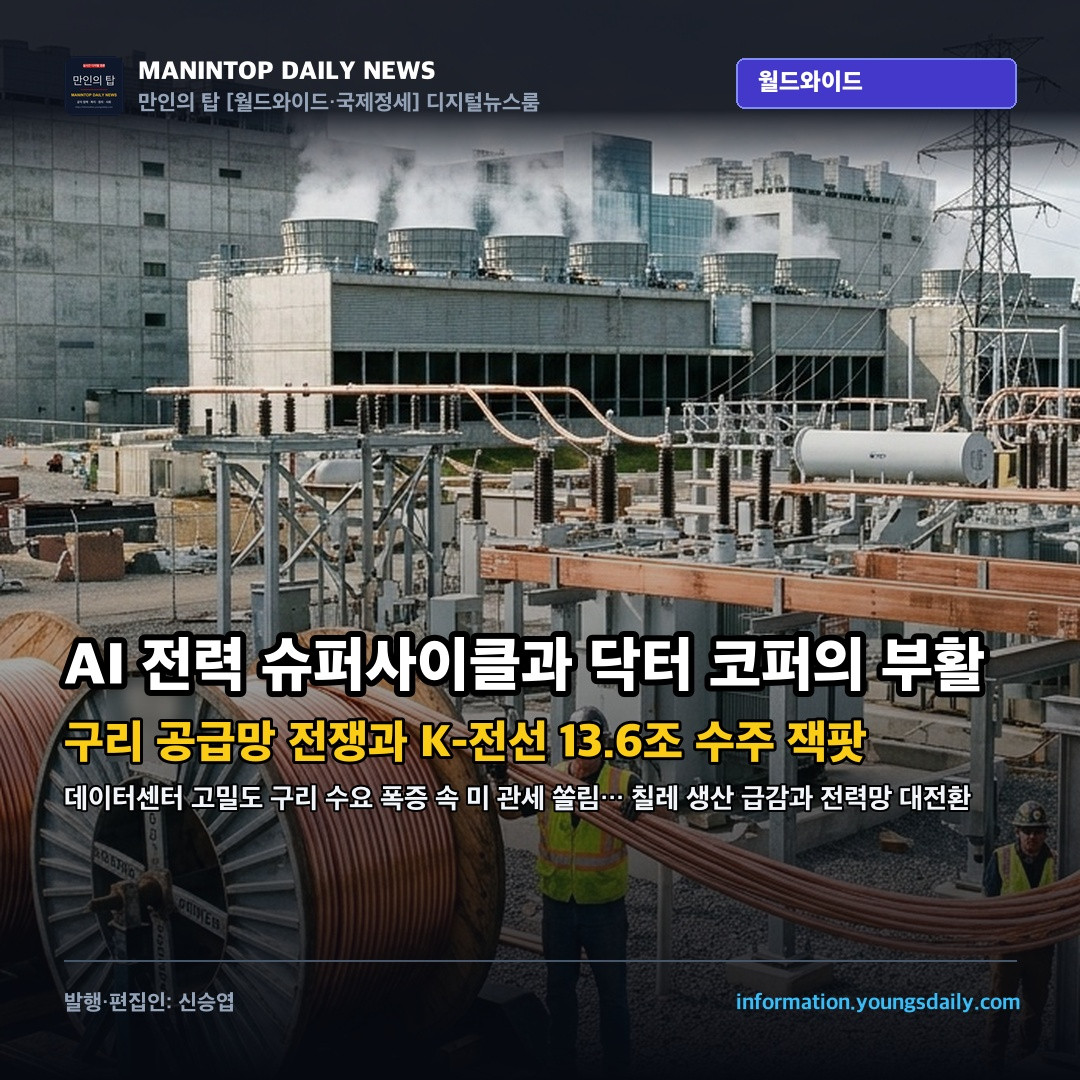
▲ AI 전력 슈퍼사이클의 도래와 함께 구리 공급망 전쟁과 K-전선의 글로벌 수주 랠리가 본격화되고 있다 (만인의 탑 그래픽 리포트)
생성형 인공지능(AI) 데이터센터의 기하급수적 증설과 전 세계적인 노후 송배전망 교체, 그리고 신재생에너지 대전환이 동시에 맞물리며 원자재 시장의 '닥터 코퍼(Dr. Copper)'가 단순한 경기선행지표를 넘어 국가 전략·안보 자산으로 화려하게 부활했습니다. 엔비디아 GB200 NVL72 1기당 약 3.2km의 고순도 구리 직결 케이블(DAC)이 투입되고 랙당 전력 소비가 최대 100kW로 치솟는 가운데, 국내 대표 전선사인 LS전선과 대한전선의 합산 수주잔고는 역대 최대인 13조 6,164억 원(약 100억 달러)을 돌파하며 유례없는 호황기를 맞이했습니다. 그러나 상류(Upstream) 광산의 평균 품위 40% 급감, 세계 최대 생산국 칠레의 15년 만의 최저 생산량, 중동 분쟁과 중국의 수출 중단에 따른 황산(Sulfuric Acid) 쇼티지, 그리고 제련 수수료(TC/RC)의 사상 초유 '마이너스 역전'으로 공급망 전반이 극심한 병목에 직면했습니다. 설상가상으로 미국의 관세 폭탄(2027년 15%→2028년 30%)을 회피하기 위해 글로벌 물량이 뉴욕 COMEX 창고로 71만 톤 넘게 동결되면서, 미국을 제외한 글로벌 시장은 2026년 한 해에만 '95만 톤의 실질 구리 숏티지'라는 기형적 왜곡에 갇혔습니다. 런던금속거래소(LME) 구리 가격이 톤당 1만 4,000달러를 돌파하며 사상 최고가를 경신하는 가운데, 글로벌 자원 안보 패권 전쟁이 본격 점화되고 있습니다.
핵심 팩트 브리핑 (Core Fact Briefing)
AI 데이터센터 구리 소요량 폭증: 랙당 소비 전력 5~10kW에서 40~100kW로 급증, 엔비디아 GB200 NVL72 1기당 3.2km 구리 직결 케이블(DAC) 소모, 광케이블 대체 불가능 영역 90% 이상 입증
K-전선 합산 수주잔고 13.6조 원 사상 최대: LS전선 9조 5,535억 원(+53.6%), 대한전선 4조 629억 원(+40.6%), 미국 버지니아 1조 원 해저케이블 공장 및 당진 640kV HVDC 공장 가동
상류 광산 품위 40% 급감과 칠레 생산 15년래 최저: 칠레 8월 생산량 36.9만 톤(-12.8%), 중동·중국발 황산 쇼티지로 SX-EW 제련 타격, 제련 수수료(TC/RC) 사상 초유 마이너스 역전
미국 관세 왜곡과 ‘미국 외 95만 톤 숏티지’ 역설: 2027년 15%·2028년 30% 관세 선제 대응으로 COMEX 재고 71.8만 톤 집중, LME 구리 톤당 1만 4,875달러 사상 최고가 기록
1. ‘닥터 코퍼’의 전략자산 대전환과 AI 데이터센터의 고밀도 구리 수요 폭증
오랜 세월 가전제품, 자동차, 주택 건설 등 전통 제조업의 기초 원자재로 쓰이며 전 세계 실물 경기를 진단하는 선행지표로 활약하던 구리(Copper)가 디지털 대전환과 에너지 안보를 좌우하는 핵심 전략자산으로 위상을 근본적으로 재정의하고 있습니다. 최근 글로벌 실물 경기 둔화 우려 속에서도 국제 구리 가격이 견고한 상승 랠리를 이어가는 배경에는, 중국 부동산 경기 침체라는 전통적 수요의 공백을 생성형 인공지능(AI) 데이터센터 증설과 신재생에너지 송배전망 확충이라는 메가트렌드가 압도적으로 대체하고 있기 때문입니다.
특히 차세대 AI 모델을 학습·추론하는 하이퍼스케일 데이터센터의 고전력 밀도화는 구리 수요를 비선형적으로 폭증시키고 있습니다. 기존 범용 서버 랙의 소비 전력이 5~10kW 수준이었던 반면, 고성능 AI 가속기를 집적한 최신 GPU 랙은 40kW에서 최대 100kW 이상의 전력을 단일 공간에서 소모합니다. 엔비디아의 차세대 AI 슈퍼컴퓨터인 'GB200 NVL72'의 경우, GPU와 고속 스위치를 연결하기 위해 시스템 1기당 무려 3.2km에 달하는 고순도 구리 직결 케이블(DAC)을 사용합니다. 여기에 발열을 해소하기 위한 구리 콜드 플레이트(Cold Plate) 기반 액체 냉각(Liquid Cooling) 설비와 대전류를 전력 손실 없이 전달하는 대형 부스바(Busbar)가 대거 투입되고 있습니다.
국제에너지기구(IEA) 분석에 따르면, 전 세계 데이터센터의 구리 수요는 2030년 최대 55만 톤에 달할 전망입니다. 일각에서 제기되는 광통신(Fibre Optic) 대체론에 대해 신한은행 여신기획부는 '광케이블 대체는 대용량 신호 전송 영역(전체 구리 수요의 5~8%)에 불과하며, 전력 전달과 전자기적 구동을 담당하는 전체 수요의 90% 이상에서는 물리적 전도 특성상 구리의 대체가 원천적으로 불가능하다'고 분석했습니다. 태양광(MW당 3~5톤)과 해상풍력(MW당 8~10톤) 등 신재생에너지 발전 설비 역시 화석연료 대비 최대 8배 많은 구리를 소모하며 전력 인프라 대전환을 견인하고 있습니다.
2. K-전선 13.6조 원 수주 잭팟… LS전선·대한전선의 북미·유럽 CAPEX 총력전
전 세계적인 전력 인프라 교체와 AI 데이터센터 발주 랠리가 맞물리면서, 뛰어난 초고압 절연 기술력과 품질 신뢰성을 보유한 대한민국 전선 업계가 사상 최대 수주 호황을 구가하고 있습니다. 2026년 상반기 말 기준 국내 대표 전선 업체인 LS전선과 대한전선의 합산 수주잔고는 무려 13조 6,164억 원(약 100억 달러)에 달합니다. LS전선의 수주잔고는 9조 5,535억 원으로 전년 동기(6조 2,197억 원) 대비 53.6% 급증했으며, 대한전선 역시 4조 629억 원으로 전년 동기 대비 40.6% 늘어났습니다.
글로벌 수주 전선도 화려합니다. LS전선은 북미 시장에서 약 7,000억 원 규모의 초고압 케이블 공급 계약을 체결했으며, 자회사 가온전선은 미국 빅테크 기업의 데이터센터 전용 발전소 프로젝트에 500억 원 규모의 배전 케이블 공급을 확정했습니다. 가온전선의 미국 현지 법인 LSCUS는 2026년 상반기 AI 데이터센터 관련 매출만 2,400억 원을 돌파하며 전년 대비 83%의 폭발적 성장을 달성했습니다. 아울러 유럽 북해 해상풍력 송전망 운영사인 테네트(TenneT) 프로젝트에 525kV급 초고압직류송전(HVDC) 해저·지중 케이블을 공급하고 있으며, 덴마크에서는 LS전선과 대한전선이 총 2,075억 원 규모의 초고압 케이블을 공동 수주했습니다. 대한전선 또한 호주 AI 데이터센터 300kV 전력 인프라(450억 원) 및 독일 등 유럽에서 5,000억 원 이상의 신규 수주를 따냈습니다.
밀려드는 물량을 적기에 생산하고 보호무역주의 관세 장벽을 넘기 위해 국내 전선사들은 전례 없는 해외 설비투자(CAPEX)를 집행하고 있습니다. LS전선 그룹은 미국 버지니아주에 약 1조 원을 투입해 북미 최대 규모의 해저케이블 생산기지를 건립 중이며, 멕시코에는 AI 데이터센터 전용 버스덕트(Busbar) 공장(2,300억 원), 미국 노스캐롤라이나에는 중전압 케이블 2배 증설(760억 원)을 진행하고 있습니다. 대한전선 역시 충남 당진에 640kV급 HVDC 해저케이블 전용 제2공장을 완공하고, 베트남 400kV 초고압 공장 건설 및 1만 1,000톤급 대형 해저케이블 포설선 '대한커넥터'를 포함한 2척의 선단을 확보하여 케이블 제조부터 해저 포설·시운전까지 아우르는 턴키 밸류체인을 완성했습니다.
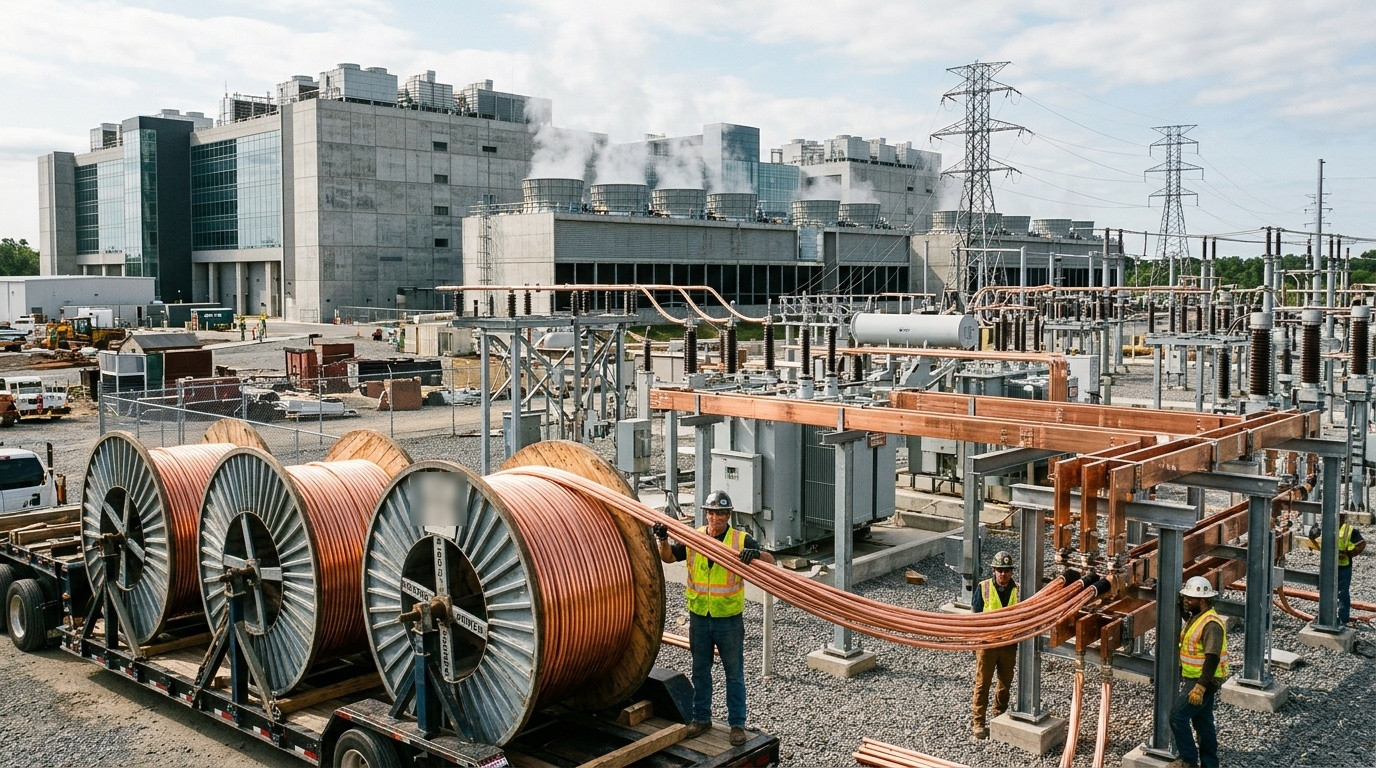
▲ AI 데이터센터 전력망에 직결되는 초고압(HVDC) 구리 케이블 및 대형 변전 설비 현장 (보도사진 자료)
3. 광산 노후화와 칠레 생산 급감… 황산(Sulfuric Acid) 쇼티지와 제련소 위기
하류(Downstream) 전선 산업의 폭발적 수요와 극명하게 대비되게, 상류(Upstream) 구리 광산의 공급 능력은 심각한 구조적 한계에 봉착했습니다. 뉴스버스와 신한은행 분석에 따르면, 전 세계 구리 광산의 평균 광석 품위(Ore Grade, 광석 내 구리 함유율)는 1991년 이후 40% 이상 급락했습니다. 특히 남미 핵심 광산의 평균 품위는 2000년 1.3%에서 2024년 0.7%로 44% 곤두박질쳤습니다. 이는 과거와 동일한 양의 정련 구리 1톤을 생산하기 위해 캐내야 하는 원석의 양과 폐기해야 하는 암석의 양이 2배 이상 늘어났음을 의미하며, 채굴 원가(Cash Cost)와 전력 소비가 천문학적으로 치솟고 있습니다.
신규 광산 발견도 사실상 고갈 상태입니다. 지난 35년 동안 전 세계에서 발견된 구리 광상(239개) 중 최근 10년(2014~2024년) 사이에 발견된 광상은 단 14개(5%)에 불과합니다. 환경영향평가와 지역 인허가 규제가 대폭 강화되면서 탐사부터 최초 상업 생산까지 걸리는 리드타임은 과거 10년 안팎에서 현재 평균 17년~28년으로 늘어났습니다. 더욱이 세계 1위 구리 생산국인 칠레의 8월 생산량은 36만 9,500톤으로 전년 동기 대비 12.8% 감소하며 15년 만에 최저치를 기록했습니다. 칠레 국영 구리기업 코델코(Codelco)의 최대 광산인 엘 테니엔테(El Teniente)에서 산사태로 작업자 6명이 사망하는 참사가 발생해 가동이 중단되었고, 안토파가스타(Centinela)와 BHP(Escondida) 광산의 노사 분규 및 엘니뇨 폭우로 도로와 전력이 끊기며 공급난이 가중되었습니다.
여기에 구리 산화광 제련에 필수적인 '황산(Sulfuric Acid)' 수급 대란이 새로운 뇌관으로 등장했습니다. 중동 호르무즈 해협의 군사적 긴장으로 유황 운송로가 위협받고 세계 최대 황산 수출국인 중국이 2026년 말까지 황산 수출을 전면 중단하면서 황산 가격이 폭등했습니다. 황산 용해 제련(SX-EW) 공정은 전 세계 구리 생산의 15%, 칠레의 20%, 콩고민주공화국(DRC)의 50%를 지탱하고 있어 직격탄을 맞았습니다. 광산 정광(Concentrate) 부족으로 인해 제련소가 광산에 지급하는 가공 수수료(TC/RC)는 톤당 80달러에서 사상 초유의 '마이너스'로 역전되었으며, 글로벌 원자재 기업 글렌코어(Glencore)가 필리핀 파사르(Pasar) 제련소 가동을 전면 중단하는 등 제련업계의 연쇄 파산 위기가 현실화되었습니다.
4. 미 관세 폭탄과 COMEX 재고 쏠림… ‘미국 외 95만 톤 숏티지’의 구조적 역설
글로벌 구리 시장은 통계적 착시와 지정학적 무역 갈등이 빚어낸 전례 없는 '유통 왜곡의 역설'에 빠져 있습니다. 시카고대학교 상품연구소(UChicago Commodities) 보고서에 따르면, 전 세계 정련 구리 수급은 장부상으로 2026년 10만 4,000톤, 2027년 36만 8,000톤의 공급 잉여를 기록할 것으로 집계됩니다. 그러나 이는 글로벌 유통 물량이 특정 지역에 동결되면서 빚어진 표면적 수치에 불과합니다.
이러한 기형적 왜곡의 진원지는 미국의 선제적 보호무역 관세 정책입니다. 미국 상무부가 수입 정련 구리에 대해 2027년 1월 1일부터 15%, 2028년부터 30%의 고율 관세를 부과하는 방안을 권고함에 따라, 글로벌 원자재 트레이더들과 헤지펀드들이 관세 발효 전 미국 내 창고로 구리를 대거 실어 나르는 '밀어내기 수입'을 감행했습니다. 2026년 7월 미국의 구리 수입량은 20만 톤을 돌파하며 12년 만에 최고치를 갈아치웠고, 뉴욕상품거래소(COMEX) 지정 창고의 구리 재고는 무려 71만 8,000톤으로 폭증했습니다.
그 결과 전 세계 유통 물량의 상당 부분이 미국 창고에 묶이면서, 정작 미국을 제외한 유럽, 아시아 등 글로벌 기타 지역(Ex-US)은 2026년 한 해에만 무려 '95만 톤에 달하는 실질적 공급 부족(Real Physical Shortage)'에 직면했습니다. 로이터(Reuters)의 수석 금속 칼럼니스트 앤디 홈(Andy Home)은 '미국 창고에 재고가 비정상적으로 집중되면서 미국 밖의 전선 제조사와 전력 유틸리티들이 극심한 현물 부족에 시달리고 있다'고 지적했습니다. 이러한 왜곡 속에 런던금속거래소(LME) 3개월물 구리 가격은 톤당 1만 4,487.50~1만 4,875달러까지 치솟아 사상 최고가를 경신했으며, 뉴욕 COMEX 구리 선물 역시 파운드당 6.89달러를 돌파했습니다. S&P Global은 2040년 전 세계 구리 수요(4,230만 톤) 대비 공급(3,220만 톤)이 1,010만 톤 부족해질 것으로 내다보며, 전력망 구축 지연이 AI 데이터센터와 반도체 공장 가동을 멈춰 세우는 산업 연쇄 마비로 이어질 수 있다고 경고했습니다.
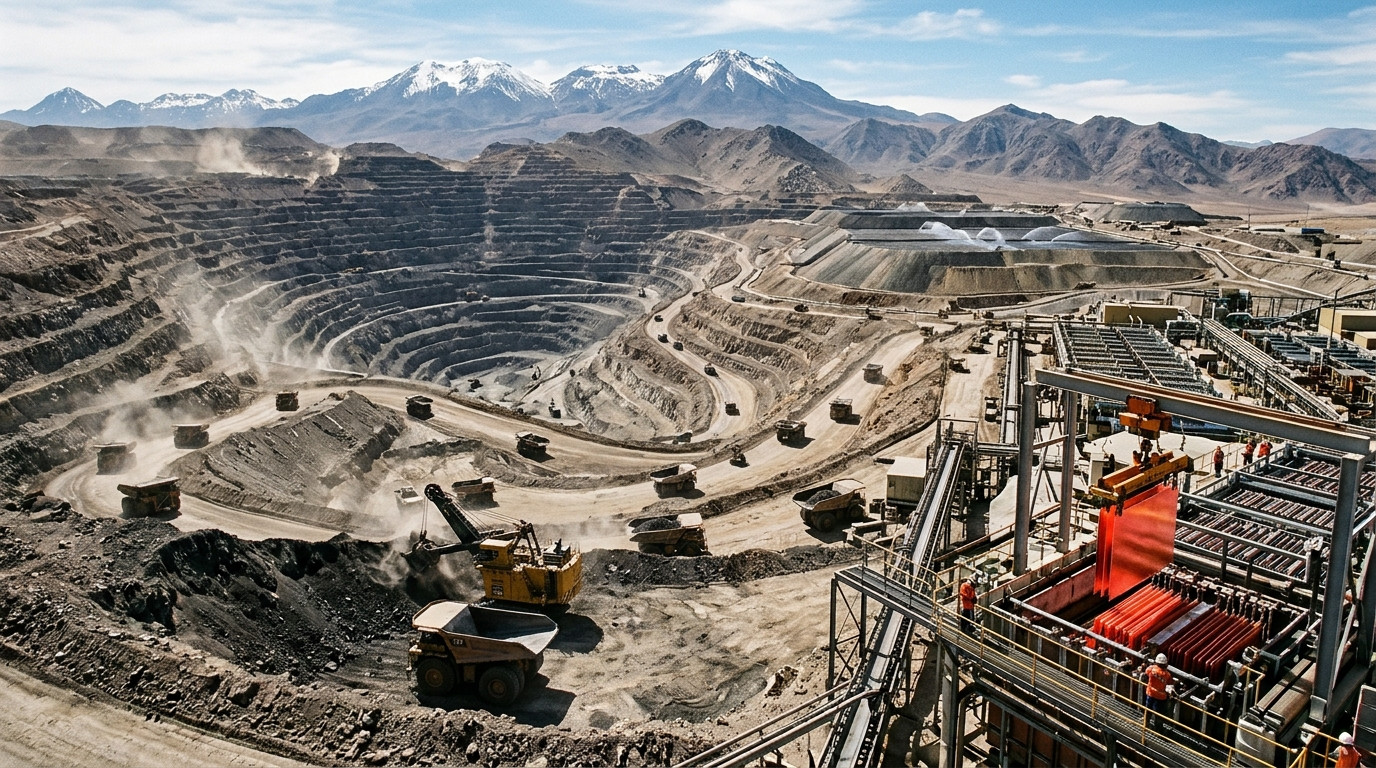
▲ 세계 최대 구리 생산국 칠레의 안데스 노천 광산 및 순수 구리 음극판 제련 시설 (현장 보도사진)
5. 스마트 마이닝 기술 혁신과 각국의 핵심광물 자원 안보 자급 로드맵
광산 품위 저하와 심각한 수급 불균형을 극복하기 위해 글로벌 광산 기업들은 인공지능(AI)과 디지털 트윈을 결합한 '스마트 마이닝(Smart Mining)' 기술을 전격 도입하고 있습니다. 인도네시아의 대표적인 구리·금 광산 기업인 PT 암만 미네랄(Amman Mineral Nusa Tenggara)은 자체 개발한 'AIDA(AI Dashboard Automation)' 시스템을 현장에 적용해 획기적인 생산성 혁신을 달성했습니다. 대용량 광석 처리 과정에서 이물질과 거대 암석으로 인해 발생하던 제련 공정 비가동 시간(Downtime)을 2024~2025년 기준 무려 90% 감축시켰으며, 4시간 주기로 AI 분석 추천 데이터를 인간 전문가 팀이 검토·승인하는 인간-AI 협업 모델을 확립했습니다.
글로벌 주요국들의 핵심광물 공급망 수호 정책도 가속화되고 있습니다. 미국은 인플레이션감축법(IRA)에 이어 수입 정련 구리에 고율 관세를 부과하며 북미 역내 생산 기반 보호에 나섰고, 유럽연합(EU)은 핵심원자재법(CRMA)과 폐기물 생산자책임재활용(EPR) 제도를 통해 도시광산(Urban Mining)과 스크랩 재활용 비중을 대폭 확대하고 있습니다. IEA에 따르면 전 세계 정련 구리 공급 중 스크랩 재활용(Secondary Supply)이 차지하는 비중은 2024년 17% 수준에서 2050년 35%까지 급증할 전망입니다.
대한민국 정부 역시 2024년 해외자원개발 투자세액공제 제도를 전격 재도입하고, 한국수출입은행과 연계해 500억 원 규모의 공급망안정화기금을 조성하는 등 민관 합동 자원 안보 체계를 가동했습니다. 이를 통해 폐배터리와 전자폐기물 리사이클링 역량을 집중 육성하여 2030년까지 10대 핵심광물의 20%를 자체 조달한다는 목표를 세웠습니다. 궁극적으로 AI 전력 슈퍼사이클에서 승리하기 위해서는, 세계 최고 수준의 케이블 제조 기술력을 갖춘 K-전선 기업들의 글로벌 영토 확장과 더불어 안정적인 상류 원자재 공급망을 확보하는 국가적 자원 안보 전략이 유기적으로 결합되어야 합니다.
📊 AI 하이퍼스케일 데이터센터 내부 구리 적용 영역 및 핵심 스펙 변화
구리 적용 핵심 영역
기술적 투입 사유 및 물리적 기능
AI 컴퓨팅 확산에 따른 스펙 변화
전력망 및 외부 배전 (HV/MV)
발전소 및 메인 변전소로부터 데이터센터 변전실까지 대용량 고전압 전력 수송
고밀도 전력 수용을 위한 초고압(HV)·중전압(MV) 케이블 포설 및 전선 규격 대형화
변압기 및 전력기기 (Transformers)
데이터센터 내부용 전압 강하/변환 및 24시간 무중단 전력 공급
변압기 내부 고순도 구리 권선(Winding) 및 대용량 전력 인덕터 투입량 비선형적 확대
부스바 및 내부 배전 (Busbars)
수만 암페어(A) 대전류를 전력 손실 및 열화 없이 서버 랙까지 안정적 분배
랙당 소비 전력이 기존 5~10kW에서 40~100kW 이상으로 급증, 대형 구리 버스덕트 필수화
액체 냉각 인프라 (Liquid Cooling)
초고성능 GPU/TPU 가속기의 극심한 발열을 해소하기 위한 고전도 열교환체
칩셋 밀착형 구리 콜드 플레이트(Cold Plate) 및 고효율 수열 교환기 전면 채택
서버 내부 직결 케이블 (DAC)
GPU 및 고속 스위치 간 제로 레이턴시(Zero-latency) 데이터 및 전력 전달
엔비디아 GB200 NVL72 시스템 1기당 약 3.2km 길이의 고순도 직결 케이블(DAC) 사용
* 자료: IEA 글로벌 에너지 전망, 신한은행 여신기획부 산업분석, 엔비디아 기술 백서 및 만인의 탑 리서치 종합
국제원자재·글로벌에너지 특별취재발행인 겸 편집인: 신승엽 (Seung Youb Ssin)
Global Edition (English)
▲ AI Power Supercycle, Doctor Copper Metamorphosis, and the $10B K-Cable Backlog Surge / Official Press Photo
The exponential scaling of generative artificial intelligence, compounded by the simultaneous overhaul of aging continental power grids and the global renewable transition, has fundamentally transformed copper—historically revered as 'Doctor Copper' for diagnosing macro growth—into an indispensable sovereign strategic asset. With next-generation Nvidia GB200 NVL72 computing racks packing 3.2 kilometers of Direct Attach Copper (DAC) interconnects and server densities surging to 100 kilowatts per rack, South Korea's premier cable manufacturers, LS Cable & System and Taihan Cable & Solution, have amassed an unprecedented combined order backlog exceeding 13.6 trillion won ($10 billion USD). However, the upstream supply chain is fracturing under systemic depletion: global copper ore grades have plunged 40 percent, Chilean output has dropped to 15-year lows, and critical sulfuric acid shortages triggered by Middle Eastern geopolitical chokepoints and Chinese export embargos have paralyzed solvent extraction refining. Exacerbating the crisis, anticipatory stockpiling ahead of looming U.S. tariffs (15 percent in 2027 rising to 30 percent in 2028) has frozen over 718,000 tons inside New York COMEX vaults. While headline balances project an optical surplus, the world outside the United States faces an acute 950,000-ton physical deficit in 2026, driving London Metal Exchange (LME) spot valuations past $14,000 per metric ton and triggering a ferocious international scramble for critical electrical infrastructure materials.
Core Fact Briefing
Exponential copper intensity in AI compute clusters: Server rack draw jumps from 5-10kW to 40-100kW+, single Nvidia GB200 NVL72 requires 3.2km of Direct Attach Copper (DAC), with 90%+ of power applications immune to fiber substitution.
South Korean cable order book reaches record 13.6 trillion won: LS Cable logs 9.55 trillion won (+53.6%) and Taihan Cable hits 4.06 trillion won (+40.6%), backed by Virginia subsea and Dangjin HVDC mega-facilities.
Upstream depletion and Chilean output crash to 15-year lows: Average ore grade drops 40%, severe sulfuric acid deficits paralyze SX-EW refining, and smelter treatment charges (TC/RC) collapse into negative territory.
U.S. tariff stockpiling sparks 950,000-ton Ex-US physical deficit: Anticipating 15-30% duties, traders locked 718,000 tons into COMEX vaults, driving LME cash copper above historic highs of $14,875 per metric ton.
1. Metamorphosis of Doctor Copper into Strategic Asset: High-Density AI Datacenter Demand
For over a century, copper served as the preeminent macroeconomic barometer—colloquially christened 'Doctor Copper' for its PhD-level ability to predict turning points in global industrial output across housing, automotive, and appliance manufacturing. Today, that cyclical paradigm has been permanently superseded: copper has ascended to the rank of a sovereign strategic asset underpinning the dual imperatives of digital compute hegemony and electrical decarbonization. Defying traditional headwinds from Chinese real estate contraction, global copper valuations remain exceptionally resilient, driven by insatiable demand vectors spanning hyperscale artificial intelligence infrastructure, grid rewiring, and distributed renewable generation.
Crucially, the structural transition of frontier AI compute clusters toward extreme power density is driving a non-linear escalation in copper intensity. While conventional enterprise server racks operate at thermal thresholds between 5 and 10 kilowatts, dense accelerated computing clusters—such as those housing Nvidia Blackwell B200 processors—command between 40 and 100 kilowatts per rack. Nvidia's flagship GB200 NVL72 liquid-cooled rack integrates approximately 3.2 kilometers of Direct Attach Copper (DAC) high-speed cabling to interconnect compute nodes and NVLink switches with near-zero latency. Furthermore, the mandatory adoption of direct-to-chip liquid cooling systems relies heavily on precision-machined solid copper cold plates and high-capacity copper busbars capable of distributing massive current loads without thermal runaway.
According to comprehensive empirical modeling by the International Energy Agency (IEA), global data center copper consumption will expand toward 550,000 metric tons annually by 2030. Discrediting assertions that optical fiber will render copper obsolete, financial and industrial analyses from Shinhan Bank emphasize that optical substitution is strictly confined to long-range telecommunication data channels (representing merely 5 to 8 percent of aggregate copper usage). In contrast, power transmission, transformer magnetics, and electromagnetic distribution—commanding over 90 percent of global demand—remain fundamentally bound to copper's superior electrical conductivity. Coupled with utility-scale solar (3 to 5 tons per megawatt) and offshore wind (8 to 10 tons per megawatt), the energy transition represents a permanent upward reset in global consumption.
2. K-Cable Giants Secure 13.6 Trillion Won Backlog: Aggressive Global CAPEX Expansion
Capitalizing on secular grid modernization and the AI data center infrastructure wave, South Korea's premier electrical cable manufacturers have established an unprecedented commercial stronghold. Anchored by advanced high-voltage cross-linked polyethylene (XLPE) insulation and high-reliability direct-current manufacturing lines, the aggregate order backlog for LS Cable & System and Taihan Cable & Solution reached a historic 13.616 trillion won ($10 billion USD) as of mid-2026. LS Cable expanded its order backlog to 9.553 trillion won (a 53.6 percent year-over-year surge from 6.219 trillion won), while Taihan Cable's backlog rose to 4.063 trillion won (up 40.6 percent from 2.890 trillion won).
Contractual milestones span key geographic hubs. In North America, LS Cable secured standalone ultra-high-voltage (HV) cable awards exceeding 700 billion won, while subsidiary Gaon Cable finalized a 50 billion won supply pact powering a hyperscale tech campus. Gaon Cable's U.S. operating arm, LSCUS, generated 240 billion won in data center-related revenue in the first half of 2026 alone—an 83 percent year-over-year jump. In Europe, LS Cable is executing key packages for grid operator TenneT's 525kV offshore High Voltage Direct Current (HVDC) transmission corridors across the North Sea, complemented by joint Danish utility awards totaling 207.5 billion won alongside Taihan Cable. Simultaneously, Taihan Cable captured a 45 billion won 300kV power interconnection contract for an Australian hyperscale data facility alongside over 500 billion won in European utility awards.
To sustain volume throughput and bypass escalating protectionist tariff boundaries, South Korean producers are executing aggressive capital expenditure (CAPEX) programs across primary export markets. LS Cable is committing approximately 1.0 trillion won to construct a flagship subsea cable manufacturing facility in Chesapeake, Virginia, while developing a 230 billion won data center busduct factory in Mexico and doubling medium-voltage throughput in North Carolina (76 billion won). Simultaneously, Taihan Cable brought its state-of-the-art 640kV HVDC subsea cable plant online in Dangjin, expanded 400kV lines in Vietnam, and acquired the 11,000-ton dedicated cable-laying vessel 'Daehan Connector'—solidifying end-to-end turnkey capability from subsea cable fabrication through maritime trenching and commissioning.
▲ Heavy-gauge HVDC copper cables and high-voltage transmission substation powering hyperscale AI facilities / Press Photo
3. Mine Depletion and Chilean Output Drop: Sulfuric Acid Deficit and Smelter Disruptions
In stark contrast to accelerating downstream electrical demand, the upstream mining sector is wrestling with severe geological and operational exhaustion. Empirical tracking from commodity analysts and global mining institutions reveals that the average ore grade of active world copper deposits has degraded by over 40 percent since 1991. Across South America's premier porphyry basins, average copper concentration collapsed from 1.3 percent in 2000 to just 0.7 percent in 2024—a 44 percent contraction. Consequently, extractive facilities must process more than double the volume of run-of-mine ore and rock to yield a single metric ton of finished cathode, driving structural escalations in unit energy consumption, diesel fuel burn, and cash production costs.
Simultaneously, greenfield geological discovery rates have stalled. Of the 239 Tier-1 and Tier-2 copper deposits discovered over the past 35 years, merely 14 deposits (5.8 percent) were identified between 2014 and 2024. Lengthening environmental permitting regimes, native title litigation, and jurisdictional pushback have stretched commercial development lead times from an historical decade to an average of 17 to 28 years. This paralysis is vividly exemplified in Chile—the world's foremost supplier—where national output in August plummeted 12.8 percent year-over-year to 369,500 metric tons, marking a 15-year nadir. State-owned enterprise Codelco suffered prolonged operational suspensions at its flagship El Teniente underground division following fatal seismic-induced rockbursts, compounded by labor disputes across BHP's Escondida and Antofagasta's Centinela mines.
Compounding geological degradation, an acute global deficit in sulfuric acid (H2SO4) has emerged as a disruptive operational bottleneck. Maritime disruptions near the Strait of Hormuz constrained elemental sulfur transshipments, while Beijing enacted sweeping export curbs on Chinese sulfuric acid through late 2026, causing regional reagent prices to spike. Because heap leaching and solvent extraction-electrowinning (SX-EW) architectures account for 15 percent of global, 20 percent of Chilean, and 50 percent of Congolese (DRC) refined supply, processing lines have been forced to curtail run-rates. Simultaneously, severe concentrate scarcity drove spot smelter treatment and refining charges (TC/RC) from historical baselines of $80 per ton into negative territory, compelling Glencore to shutter its Pasar smelting complex in the Philippines amid widening operating losses.
4. U.S. Tariff Mandates and COMEX Stockpiling: The Paradox of Ex-US 950,000-Ton Shortage
The global refined copper market is entrapped in a severe structural distortion engineered by trade policy intervention and artificial inventory hoarding. Surface-level statistical balance sheets compiled by the University of Chicago Commodities Institute forecast an apparent aggregate surplus of 104,000 metric tons in 2026 and 368,000 tons in 2027. However, this paper equilibrium conceals a dangerous logistical dislocation that has effectively balkanized international physical metal liquidity.
The primary catalyst stems from protectionist trade measures advanced by the United States Department of Commerce, which recommended implementing an aggressive tariff schedule on imported refined copper: 15 percent effective January 1, 2027, escalating to 30 percent in 2028. Anticipating these punitive duties, international trading desks, merchant houses, and algorithmic commodity pools executed an unprecedented arbitrage rotation, shipping massive physical volumes directly into U.S. jurisdictions. By July 2026, monthly U.S. copper inflows surpassed 200,000 metric tons—a 12-year high—driving bonded inventories inside New York Commodity Exchange (COMEX) warehouses to a record 718,000 metric tons.
Consequently, with hundreds of thousands of tons frozen inside North American vaults to capture tariff spreads, the international market outside the United States (Ex-US) confronts a staggering real physical deficit of 950,000 metric tons in 2026. As Reuters senior metals analyst Andy Home observed, this inventory trap has starved European and Asian cable fabricators of spot cathode, sparking intense localized bidding wars. Driven by structural scarcity, benchmark 3-month contracts on the London Metal Exchange (LME) rocketed between $14,487.50 and $14,875 per metric ton, while COMEX futures touched $6.89 per pound. Long-term forecasting from S&P Global warns of an unbridgeable 10.1 million-ton structural gap by 2040 (demand of 42.3M tons versus supply of 32.2M tons), threatening rolling infrastructure bottlenecks across semiconductor fabrication and AI computing grids.
▲ Open-pit copper mine and SX-EW cathode tankhouse high in the Chilean Andes / Field Archive
5. Smart Mining Technological Innovation and National Critical Mineral Security Roadmaps
Confronting chronic grade depletion and extraction inefficiencies, tier-one international miners are rapidly operationalizing artificial intelligence, automated dispatch algorithms, and digital twin architectures under the banner of 'Smart Mining.' In Indonesia, leading copper-gold producer PT Amman Mineral Nusa Tenggara deployed its proprietary AIDA (AI Dashboard Automation) suite, slashing operational downtime induced by oversized boulders and crushing blockages by approximately 90 percent across 2024 and 2025. Crucially, the platform operates on an iterative four-hour human-in-the-loop operational cycle, combining real-time predictive analytics with metallurgical field validation.
Concurrently, sovereign resource nationalism and critical mineral supply chain fortifications are reshaping the legislative landscape. Following the Inflation Reduction Act (IRA), the United States has leveraged protectionist tariff schedules to incentivize domestic smelting, while the European Union enacted the Critical Raw Materials Act (CRMA) paired with expanded Extended Producer Responsibility (EPR) mandates to scale secondary scrap recycling. According to IEA projections, secondary copper recycling from urban mining and scrap will expand its share of refined supply from under 17 percent in 2024 to over 35 percent by 2050, serving as a critical buffer against primary mine disruptions.
In South Korea, policymakers reinstated overseas mineral exploration tax credits while establishing a 50 billion won Sovereign Supply Chain Stabilization Fund managed via the Export-Import Bank of Korea (KEXIM). Targeting a 20 percent self-sufficiency ratio across top-ten critical minerals by 2030 through advanced e-waste urban mining and battery recycling, the nation is building strategic resilience. Ultimately, thriving within the AI power supercycle requires an integrated national strategy: marrying the peerless engineering and EPC execution of K-Cable manufacturers with sovereign raw material securing, ensuring domestic industries power the global digital transformation without supply chain chokeholds.
📊 Copper Applications and Architectural Specifications Across AI Hyperscale Data Centers
Copper Application Domain
Engineering Function & Physical Role
Specification Shift Driven by AI Scaling
Grid & Primary Distribution (HV/MV)
Bulk high-voltage power transmission from utility substations to facility switchgear
Heavy-gauge HV/MV cables deployed to support concentrated 100MW+ single-site demand
Substation Transformers & Power Gear
Step-down voltage transformation and continuous uninterrupted power conditioning
Non-linear escalation in transformer high-purity copper magnet wire windings and power inductors
Busbars & Internal Power Distribution
Lossless delivery of massive amperage loads from power distribution units to server racks
Rack power density escalates from 5-10kW to 40-100kW+, requiring heavy-gauge copper busducts
Liquid Cooling Infrastructure
Ultra-high thermal dissipation conducting heat away from AI accelerator silicon dies
Universal deployment of solid copper cold plates and high-efficiency liquid heat exchangers
Direct Attach Copper (DAC) Cables
Zero-latency, passive high-speed interconnects linking GPUs to NVLink spine switches
Single Nvidia GB200 NVL72 rack requires roughly 3.2 kilometers of high-purity copper cabling
* Sources: International Energy Agency (IEA), Shinhan Bank Industrial Research, Nvidia Technical Documentation, and ManInTop Analysis
Global Commodities & Power Infrastructure DeskPublisher & Editor-in-Chief: Seung Youb Ssin
PRO SOURCING ENGINE만인의 탑 빅데이터 솔루션
★ 가입 시 600 크레딧(120회) 전원 무료
내가 찾는 상품 키워드, 지금 얼마나 검색될까?
네이버 월간 검색량 + 구글 볼륨 + 아이템스카우트 실시간 상품수와 경쟁강도 배지를 0.5초 만에 무료로 확인하세요.
MANINTOP NEWSLETTER
📬 만인의 탑 뉴스레터 무료 구독
오늘 보신 정책·시사 뉴스가 유익하셨나요? 매일 엄선되는 알짜 복지 혜택과 국회 실시간 속보를 이메일로 가장 먼저 받아보세요. (평생 무료)
1월이 시작되면 감기는 이미 우리 곁에 와 있습니다. 2월, 3월, 4월까지 이어지는 추위와 건조함은 코와 목을 가장 먼저 공격합니다. 아침에 일어나자마자 막혀 있는 코. 계속 흐르는 콧물. 괜히 칼칼해지는 목. 이 증상은 “시작”일 뿐입니다. 한 번 무너지면 일주일, 길면 한 달까지 끌고 갑니다. 약을 먹으면 잠깐 괜찮아집니다. 하지만 며칠 뒤 또 반복됩니다. 왜일까요? 감기는 ‘치료’의 문제가 아니라 ‘관리’의 문제이기 때문입니다. 대부분은 감기가 오고 나서 약을 찾습니다. 하지만 진짜 중요한 건 감기가 오기 전에 코와 목을 지키는 것입니다. 건조한 실내 공기, 차가운 바깥 공기, 눈에 보이지 않는 세균. 코와 목은 매일 공격받고 있습니다. 지긋지긋하죠! 그런데도 우리는 아무 준비 없이 버티고 있습니다. 이번 겨울도 그렇게 보낼 건가요? 사실 방법은 어렵지 않습니다. 코를 깨끗하게 관리하고, 목을 따뜻하게 보호하고, 점막을 촉촉하게 유지하고, 기관지를 미리 관리하고, 외부 공기를 차단하는 것. 이 다섯 가지만 꾸준히 해도 감기약 없이 겨울을 보내는 것이 충분히 가능합니다. 🔥 이제부터 그 방법을 하나씩 살펴보겠습니다. 🔥 1. 코와 목을 먼저 관리해야 하는 과학적 이유 감기의 대부분은 코 점막에서 시작됩니다. 국제 학술지 Nature Reviews Microbiology 와 Journal of Allergy and Clinical Immunology 에 실린 호흡기 감염 관련 연구들에서는, 감기 바이러스가 비강 상피세포에 먼저 부착해 증식한다는 점을 설명하고 ...
리모델링사업이 진행 중인 아파트를 매매할 때 “계약금 10%를 언제까지 내야 하느냐”는 질문이 특히 많이 나옵니다. 이주공고(이주 안내)가 7~11월쯤이라고 들으면, 그 시점에 맞춰 계약금도 움직일 것 같아서 더 헷갈리기 쉽습니다. 하지만 실제 납부기한은 ‘이주공고가 언제냐’만으로 자동 결정되지 않는 경우가 많습니다. 1) 계약금 10% 납부기한: 결국 ‘문서에 적힌 일정’이 기준 계약금 10%를 언제까지 납부해야 하는지는, 내가 서명하는 매매계약서(특약 포함) 와 사업주체/조합이 제시한 공고·안내문 에 적힌 납부 일정이 기준이 됩니다. 실제 공고문에서는 분양대금 납부의 큰 틀(계약금→중도금→잔금)을 먼저 안내하고, 상세 일정은 별도 표나 유의사항으로 제시하는 방식이 흔합니다. 또, 계약서 문구에 따라 지급 시점이 조건부로 설정될 수도 있습니다. 예를 들어 한 사례 소개 자료에서는 용역계약서에 잔금(10%) 지급시기가 “사업승인 후”로 기재되어 있었다는 점이 언급됩니다. 이런 식으로 ‘사업 단계’와 지급을 연동하는 문구가 들어가면, 질문의 답은 계약서 문구를 확인해야만 확정됩니다. 관련 내용은 링크 에서 문구 사례를 확인할 수 있습니다. 2) 입주자모집공고에서 확인되는 ‘납부 순서’와 잔금 마감 시점 공고문에 적힌 문구를 보면, 납부 순서와 잔금 마감에 대한 기준이 비교적 명확하게 제시되는 경우가 있습니다. 예를 들어 한 입주자모집공고에는 “분양금액(주택가격)은 계약금, 중도금, 잔금의 순서로 납부”하며 “잔금은 입주(열쇠 수령일) 전에 완납”해야 한다고 안내되어 있습니다. (문구 확인: 링크 ) 이 문구가 의미하는 바는 최소 2가지입니다. 분양/공급 형태의 문서에서는 ‘계약금→중도금→잔금’ 흐름이 공식적으로 안내될 수 있습니다. 잔금은 “입주(열쇠 수령)” 이전에 완납해야 한다는 마감 기준이 문서에 적혀 있을 수 있습니다. 다만, 위 공고문 문구는 잔금 마감에 대한 기준을 보여주지만, 계약금 10%의...
윤석열 전 대통령 탄핵 인용 소식을 접하면, 가장 궁금한 지점은 ‘헌재가 정확히 무엇을 위헌·위법으로 봤는가’입니다. 또한 탄핵과 별개로 진행되는 형사재판(내란 우두머리 혐의 등)이 어디까지 왔는지도 함께 정리할 필요가 있습니다. 아래 내용은 제공된 기사/게시물 스니펫과 링크에서 확인되는 범위만 모아, 일반인이 흐름을 이해하기 쉽게 정리한 것입니다. 1) 탄핵 인용 관련: 스니펫에서 확인되는 ‘판단의 골격’ 제공된 근거 중 조국혁신당 사이트에는 헌법재판소가 윤석열 탄핵 심판에서 “피청구인의 위헌·위법행위는 국민 신임 …”이라는 취지로 판단했다는 문장이 인용돼 있습니다( 링크 ). 이 인용문만 놓고 보면, ‘위헌·위법행위’가 있었는지와 그로 인해 ‘국민의 신임’이 어떻게 평가됐는지가 핵심 축으로 소개됩니다. 다만 질문에서 요청하신 세부 항목, 즉 비상계엄 선포 자체를 문제 삼은 구체적 이유, 계엄 이후 조치(포고령, 국회 통제 등)의 어떤 지점이 헌법 위반인지, 국회의 권한행사 방해 및 정치활동 제약을 어떤 논리로 판단했는지 등은, 이번에 제공된 근거의 제목/스니펫만으로는 조항·사실관계·판단 구조가 그대로 제시돼 있지 않습니다. 따라서 이 글에서는 ‘헌재가 무엇을 문제 삼았다’는 세부 리스트를 단정적으로 재구성하기보다, 현재 확인 가능한 문구 수준의 요약(위헌·위법행위 → 국민 신임의 문제로 평가)까지만 적습니다. 만약 헌재 결정문 전문(주문 및 이유)이 추가로 확인되면, 그때는 문장 단위로 ‘어떤 행위’와 ‘어떤 헌법 원리/조항’이 연결되는지(예: 권력분립, 국회의 권한, 정치적 기본권 등) 구조화해 정리하는 것이 가장 정확합니다. 2) 형사 절차(내란 혐의) 관련: 체포영장과 1심 선고 언급 탄핵 심판과 별도로, 12·3 비상계엄 사태로 내란 혐의를 받는 윤석열 대통령에 대해 2024년 12월 31일 체포 영장이 발부됐다는 BBC 보도가 있습니다( 링크 ). 해당 보도는 ‘현직 대통령’에 대한 체포영장 발부라는 점을 함께 언급합니다. 또...