“도심 공원에 털 빠진 너구리 속출… 옴진드기 비상, 사람 감염 진실과 반려견 보호법”
송도국제도시와 수도권 녹지 출몰 요청 80% 폭증… 길고양이 급식소 풍선효과부터 ‘인수공통감염’ 의학 팩트체크와 2026 구충제 완전 분석
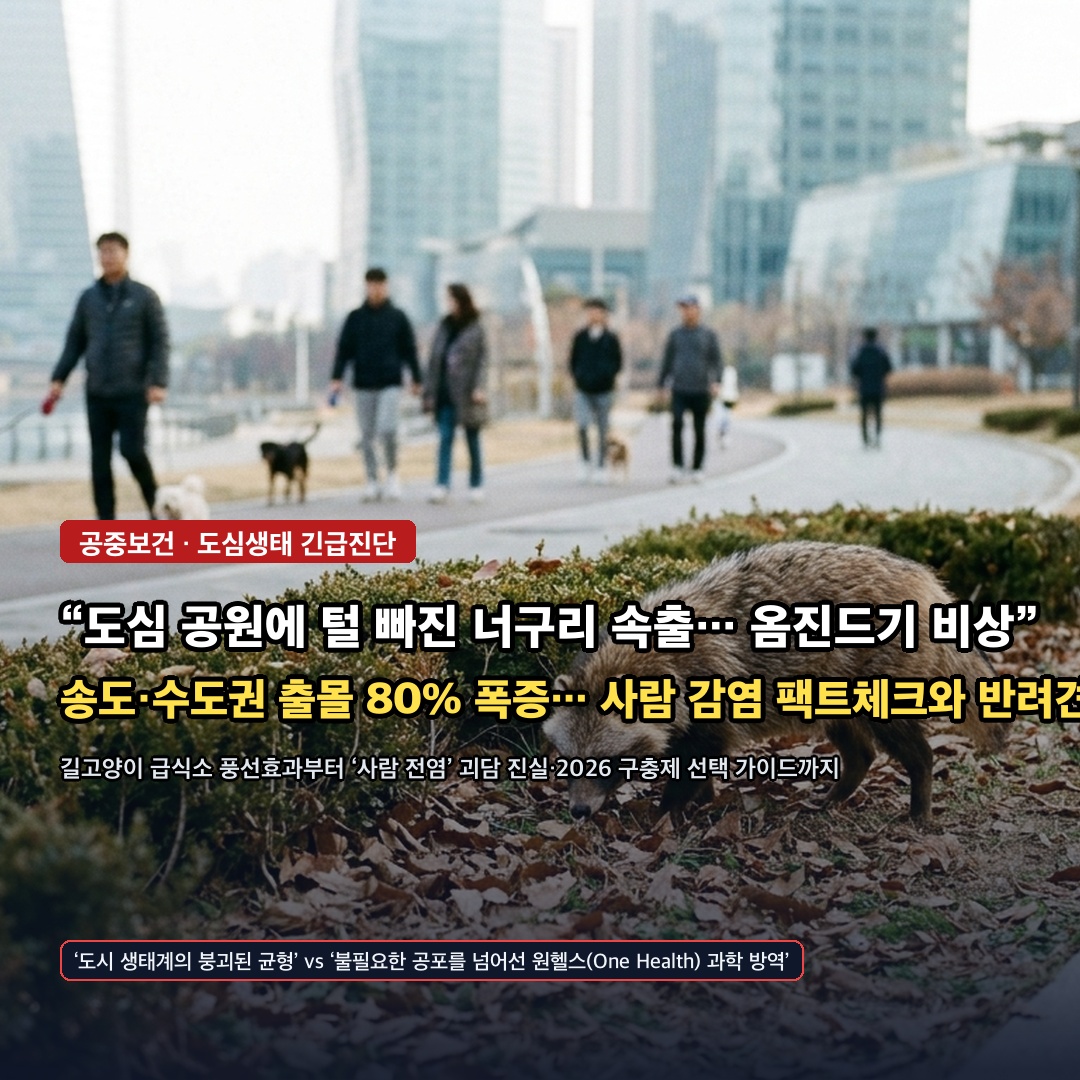
수도권 도심 공원 산책로 인근에서 목격된 야생 너구리와 거리를 유지하는 시민들. 털이 빠진 채 힘없이 배회하는 너구리가 급증하면서 공중보건 위생과 도심 생태계 관리가 중대한 시험대에 올랐다. [사진=만인의 탑 보도사진국]
“가죽만 앙상하게 남은 채 털이 흉하게 빠진 너구리가 공원 벤치 옆을 어슬렁거려요.” 최근 인천 송도국제도시와 서울 도심 녹지에서 이른바 ‘털 빠진 너구리’ 목격담이 잇따르며 시민과 반려인들의 불안이 걷잡을 수 없이 번지고 있습니다. 구조된 너구리 대다수가 악성 피부 기생충인 ‘개선충(옴진드기)’에 중증 감염된 것으로 드러나면서, “사람이나 산책 중인 강아지에게도 치명적인 전염병이 옮는 것 아니냐”는 공포가 확산되는 실정입니다. 하지만 의학적 진실과 생태학적 해법을 짚어보면 불필요한 공포를 걷어내고 현명하게 대처할 수 있는 길이 명확히 존재합니다.
1. 송도·수도권 출몰 요청 80% 폭증: 겨울철 대낮에 왜 거리를 배회하나
과거 깊은 산간에나 살던 야생 너구리가 도심 한복판 생활권으로 깊숙이 파고들었습니다. 지난 10월 30일 송도국제도시의 한 고등학교 교정에 털이 심하게 빠진 너구리가 난입해 야외활동 자제령이 내려졌고, 앞선 8월에는 센트럴파크 인공호수에 빠진 너구리가 소방대원에 의해 긴급 구조되기도 했습니다. 골프장 페어웨이와 아파트 산책로에서도 사람이 건네는 음식을 겁 없이 받아먹는 등 사람에 대한 경계심이 완전히 사라진 모습이 곳곳에서 포착됩니다.
수치로 나타난 현실은 더욱 심각합니다. 인천시 연수구와 인천야생동물구조관리센터의 공식 집계에 따르면, 올해 너구리 구조 및 포획 요청은 89건으로 전년 동기(49건) 대비 무려 81.6% 급증했습니다. 이 가운데 42.7%에 달하는 38건이 피부 질환 의심 민원이었습니다. 인천 전역에서 구조된 너구리 78마리 대다수가 옴진드기로 인해 전신 탈모와 극심한 영양실조를 겪는 중증 상태였습니다.
너구리는 본래 야행성이며 겨울에는 굴속에서 동면 상태에 들어가는 동물입니다. 그런데 왜 늦가을과 초겨울 대낮에 털이 빠진 채 차가운 아스팔트와 잔디밭을 배회하는 것일까요? 생태 전문가들은 이를 질병 악화에 따른 처절한 생존 반응으로 진단합니다. 기온이 급강하하면 면역력이 약해져 옴진드기가 폭발적으로 증식합니다. 진드기가 각질층을 파헤치며 극심한 가려움증을 유발해 너구리가 스스로 온몸을 긁어뜯게 되고, 결국 두꺼운 겨울 털이 전부 빠져나갑니다. 체온을 유지할 털을 잃어 얼어 죽기 직전의 저체온증에 처한 너구리들이 지푸라기라도 잡는 심정으로 낮 동안 햇볕이 내리쬐는 보도블록이나 잔디밭으로 기어 나와 일광욕을 시도하다 시민들의 눈에 띄는 것입니다.
| 구분 항목 | 전년도 연간 실적 | 2026년 실측 데이터 | 전년 대비 증감율 | 현장 분석 및 역학 시사점 |
|---|---|---|---|---|
| 연수구 구조·포획 요청 | 49건 | 89건 | 약 81.6% 폭증 | 송도 신도시 공원 및 주거지 밀착 출몰 급증 |
| 개선충 피부병 의심 민원 | 집계 미비 | 38건 (전체의 42.7%) | 신규 집계 | 구조 개체 절반 가까이가 옴진드기 중증 환축 |
| 인천 전역 너구리 구조 | 47마리 | 78마리 | 약 66.0% 증가 | 전신 탈모, 2차 세균감염, 영양실조 심각 |
2. 서울 면적 32%가 서식지… ‘길고양이 급식소’가 부른 풍선효과
도심 너구리의 급증은 송도만의 문제가 아닙니다. 서울연구원이 발표한 정밀 실태조사 보고서에 따르면, 서울 전체 시가화 면적의 32.2%가 너구리가 자생하기에 완벽한 서식 적합지로 분석되었습니다. 실제로 서울 도심에서 구조되는 야생 포유류 중 너구리가 41.7%로 압도적 1위를 기록했으며, 강남, 서초, 마포, 송파 등 25개 자치구 중 무려 16개 구에서 집단 출몰이 확인되었습니다.
야생 너구리가 도심에 이토록 폭발적으로 번성하게 된 데는 3대 구조적 원인이 있습니다. 첫째, 공원과 산책로 곳곳에 설치된 길고양이 사료 급식소가 사시사철 고칼로리 먹이를 공급하는 무한 뷔페 역할을 하고 있습니다. 둘째, 도시 환경에는 너구리의 상위 포식자인 늑대나 삵이 전혀 없어 새끼의 자연 도태가 일어나지 않습니다. 셋째, 수변 공원과 생태 녹지 회랑, 배수관로가 훌륭한 은신처를 제공하고 있습니다.
주목할 점은 시민 인식의 괴리입니다. 설문조사 결과 시민의 87.3%는 “자연 서식지가 줄어 도심으로 온 것”이라며 야생동물과의 공존 필요성에 공감했습니다. 하지만 정작 산책길에서 마주쳤을 때 어떻게 대처해야 하는지 안전 수칙을 알고 있는 시민은 불과 13.9%에 그쳤습니다. 막연한 동정심에 먹이를 주거나 방치하는 사이, 생태계 균형이 깨지며 집단 감염병이라는 부메랑으로 돌아온 것입니다.
야생동물에게 사료를 지속적으로 공급하면 야생성 상실과 대인 경계심 약화는 물론, 한정된 장소에 여러 야생동물이 밀집하면서 피부 접촉을 통한 개선충 교차 감염이 기하급수적으로 확산됩니다. 캣맘 활동 시 잔여 사료를 즉시 수거하고 급식 장소를 관리하는 지자체 차원의 위생 가이드라인이 시급합니다.
3. 의학 팩트체크: 사람에게도 치명적인가? 옴진드기 아종의 진실
대중이 가장 크게 두려워하는 지점은 “너구리의 옴진드기가 사람에게 옮아 평생 고생하는 것 아니냐”는 의문입니다. 결론부터 밝히자면 이는 과학적 사실과 거리가 먼 과도한 공포입니다.
옴진드기(사르콥테스 스카비에이, Sarcoptes scabiei)는 숙주 특이성(Host specificity)이 매우 뚜렷한 기생충입니다. 사람에게 기생하는 ‘사람 옴(var. hominis)’과 개·너구리에게 기생하는 ‘개 옴 / 동물 개선충(var. canis)’은 생물학적으로 완전히 다른 변종입니다.
너구리에게 붙어 있던 개선충이 산책 중인 사람의 피부에 일시적으로 옮겨붙을 수는 있습니다. 이때 팔이나 복부, 허벅지 등에 붉은 좁쌀 발진이 돋고 심한 가려움증이 나타날 수 있습니다. 그러나 동물 옴진드기는 사람의 피부 각질층 내부로 파고들어가 굴을 파거나 알을 낳고 증식할 수 없습니다. 즉, 사람의 체내에서는 번식하지 못하고 며칠 안에 자연 사멸합니다. 접촉을 차단하고 피부과에서 처방하는 퍼메트린 연고 등을 바르면 흉터 없이 깨끗하게 완치되므로, “치명적인 불치 전염병”이라는 유언비어에 동요할 필요가 전혀 없습니다.
| 비교 항목 | 사람 옴 (var. hominis) | 동물 옴 / 너구리 개선충 (var. canis) | 임상적 차이 및 핵심 요약 |
|---|---|---|---|
| 일차 숙주 | 오직 사람 | 개, 너구리, 여우 등 개과 동물 | 엄격한 숙주 특이성 존재 |
| 인체 내 번식 여부 | 피부 각질층에 굴을 파고 지속 산란·증식 | 인체 각질 내 굴 형성 불가, 알 산란 불가 | 사람 몸에서는 번식하지 못하고 사멸 |
| 주요 증상 및 병변 | 손가락 사이, 손목, 성기 부위 심야 가려움 | 접촉 부위(팔, 다리, 복부) 붉은 구진 및 소양감 | 동물 옴은 접촉 즉시 급성 가려움 유발 |
| 치료 및 예후 | 전신 살충제 도포 없이는 만성화 진행 | 원인 동물 격리 시 수일~수주 내 자연 치유 | 피부과 외용제(퍼메트린 등)로 조기 완치 |
4. 반려견 보호 가이드와 2026 구충제 스펙 완전 비교
사람과 달리 같은 개과(Canidae)에 속하는 반려견에게 너구리 개선충은 극도로 치명적입니다. 피부에 옮겨붙는 즉시 굴을 파고 번식을 시작해 전신에 맹렬한 가려움증을 유발하기 때문입니다.
반려견이 산책을 다녀온 뒤 벽이나 바닥에 몸을 심하게 문지르고 잠을 설치며 긁는다면 즉시 개선충증을 의심해야 합니다. 털이 얇은 귀 끝 가장자리, 팔꿈치 관절, 발목, 복부에 붉은 좁쌀 발진이 돋아나고, 만성화되면 피부가 코끼리 가죽처럼 두껍고 검게 변하는 ‘태선화’가 진행됩니다.
가정에서 할 수 있는 손쉬운 자가 진단법이 바로 ‘귀 긁기 반사(Pinna-pedal reflex)’입니다. 보호자가 강아지의 귀 끝 가장자리를 손가락으로 살살 비볐을 때, 강아지가 참을 수 없는 시원함과 가려움을 느끼며 같은 쪽 뒷다리를 허공에 파닥거리며 긁는 동작을 취한다면 개선충 감염 확률이 매우 높습니다. 동물병원 피부 스크래핑 현미경 검사에서 진드기가 검출되지 않더라도(위음성 확률 50% 이상), 증상이 뚜렷하다면 수의사의 판단하에 구충제를 선제 투여하는 ‘치료적 진단’이 정석입니다.
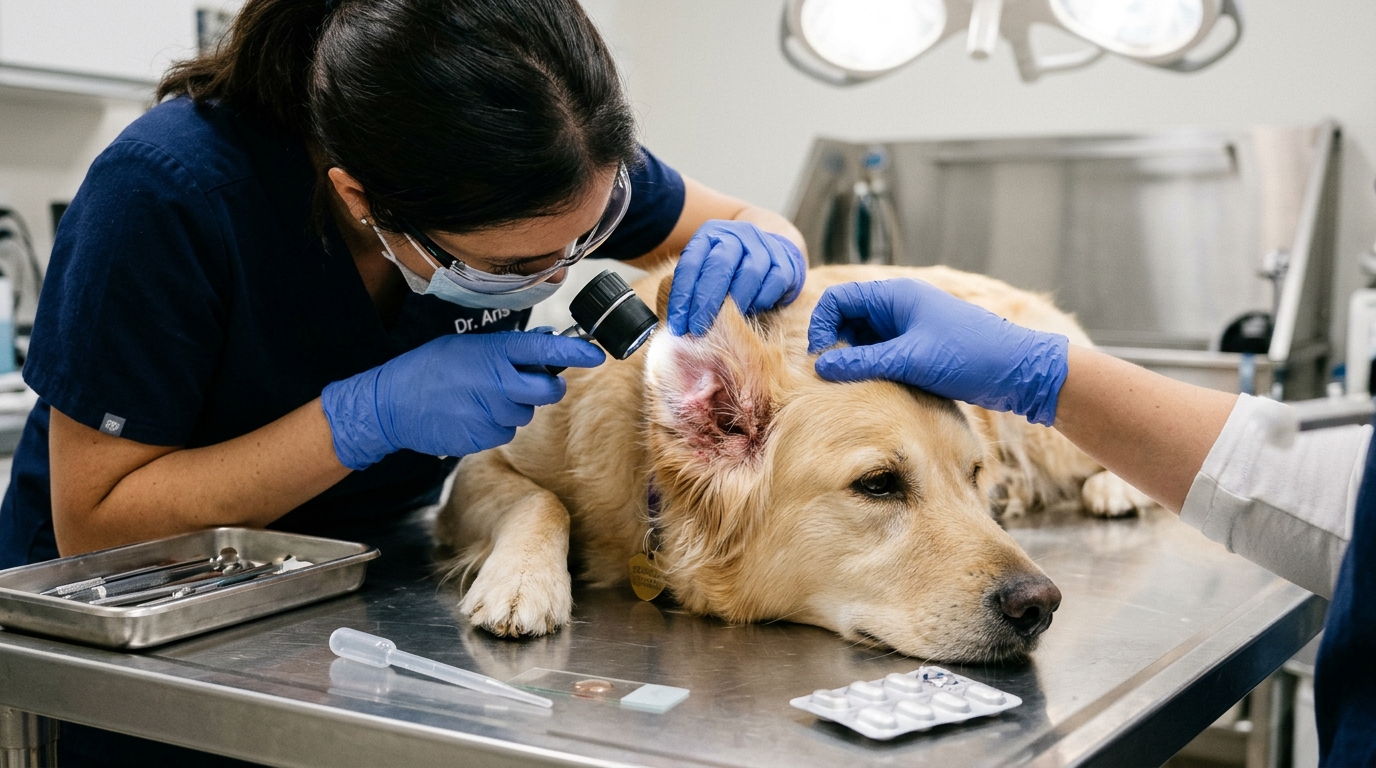
동물병원 진료대 위 수의사의 정밀 검진과 최신 구충 의약품. 산책이 잦은 반려견은 정기적인 외부기생충 구충제 투약과 풀숲 진입 통제가 최선의 예방책이다. [사진=만인의 탑 기술보건부]
2026년 현재 동물병원과 약국에서 유통되는 대표 구충제의 스펙과 특성을 비교하면 다음과 같습니다.
| 제품명 | 주요 유효 성분 | 투여 제형 및 주기 | 개선충·참진드기 방어 | 심장사상충 예방 | 보호자 맞춤 선택 팁 |
|---|---|---|---|---|---|
| 넥스가드 (NexGard) | 아폭솔라너 (Afoxolaner) | 소고기맛 츄어블 / 1개월 | 탁월 (12시간 내 박멸) | 별도 투약 필요 | 단기 외부기생충 집중 관리 시 추천 |
| 브라벡토 (Bravecto) | 플루라라너 (Fluralaner) | 간식형 츄어블 / 3개월(12주) | 탁월 (1회 투약으로 3개월 지속) | 별도 투약 필요 | 바쁜 일정으로 주기를 잊기 쉬운 보호자 최적 |
| 넥스가드 스펙트라 | 아폭솔라너 + 밀베마이신 | 츄어블 알약 / 1개월 | 탁월 | 동시 예방 가능 | 심장사상충과 내외부 기생충 올인원 케어 |
| 애드보킷 (Advocate) | 이미다클로프리드 + 목시덱틴 | 목 뒤 도포 점적형 / 1개월 | 개선충 유효 | 동시 예방 가능 | 알약을 삼키지 못하는 반려견에 적합 |
- 뇌전증·경련 병력견 주의: 넥스가드와 브라벡토 등 아이소옥사졸린 계열 약물은 신경계 질환이나 발작 이력이 있는 반려견에게 투여 시 경련을 유발할 수 있으므로 반드시 수의사 사전 문진이 필수적입니다.
- 고양이 교차 투여 절대 금지: 개 전용 외부기생충 약제는 고양이에게 치명적인 신경 독성을 일으키므로 절대로 함께 투여해서는 안 됩니다.
- 가정 내 침구류 열탕 소독: 옴진드기는 열에 극도로 취약합니다. 의심 증상 발생 시 방석과 침구류를 60도 이상 온수로 세탁하고 건조기 고온 모드로 돌려야 하며, 세탁이 힘든 물품은 비닐봉지에 3일(72시간)간 밀봉 격리하면 진드기가 100% 사멸합니다.
5. 야생동물과의 공존과 ‘원헬스(One Health)’ 도시 방역 모델
야생 너구리는 야생생물 보호 및 관리에 관한 법률에 따라 보호받는 자연 생태계의 엄연한 구성원입니다. 도심에 출몰한다는 이유만으로 무차별적인 덫을 놓거나 살처분하는 것은 생태적 해법이 될 수 없으며, 남은 개체군의 번식력이 급증하는 ‘풍선효과’를 부를 뿐입니다.
전문가들은 인간, 동물, 환경의 건강을 하나로 묶어 통합 관리하는 ‘원헬스(One Health)’ 도시 방역 체계로의 전환을 촉구합니다. 첫째, 산책로 안내판과 로드킬 방지 펜스를 확충하고 시민 대처 요령(현재 인지율 13.9%) 교육을 정례화해야 합니다. 둘째, 야생 너구리를 마주쳤을 때는 “절대 다가가거나 만지지 말고, 먹이를 주지 않으며, 2m 이내 목줄을 유지한 채 조용히 우회”하는 시민 4대 행동 수칙이 철저히 지켜져야 합니다. 셋째, 사물인터넷(IoT) 기반 야생동물 이동 경로 분석과 친환경 안전 기피제 분무, 동물보호시설 내 공기살균 정화 인프라를 연계한 스마트 과학 방제가 제도화되어야 합니다.
상처 입고 털 빠진 너구리가 던지는 메시지는 명확합니다. 인간의 무분별한 도시 확장과 불균형한 먹이 공급이 빚어낸 도심 생태계의 파전을 이제는 감정적 공포나 방치가 아닌, 과학적 방역과 성숙한 시민 의식으로 치유해야 할 때입니다.
“Hairless Wild Raccoon Dogs Infiltrate Urban Parks: The Truth Behind Sarcoptic Mange and Canine Safety”
Rescue calls surge 80% across Songdo and Seoul metro green belts… From stray cat feeder spillover to human infection facts and complete 2026 veterinary parasitic guide
A wild raccoon dog foraging along park shrubs in a metropolitan waterfront park while citizens maintain a cautious distance. With hairless, debilitated wildlife on the rise, urban public health and ecological coexistence face a crucial test. [Photo: MANINTOP Photojournalism Desk]
“A raccoon dog with its fur completely stripped away, revealing raw gray leather, was wandering aimlessly right beside the park benches.” In recent weeks, eyewitness reports of severely hairless wild raccoon dogs (Nyctereutes procyonoides) have multiplied across Songdo International City and metropolitan parks, sparking widespread anxiety among urban residents and dog owners. As official veterinary necropsies confirm that the vast majority of rescued animals are heavily infested with sarcoptic mange mites (Sarcoptes scabiei), fears of zoonotic transmission to humans and companion pets have surged. However, a rigorous medical fact-check and ecological analysis demonstrate that unnecessary panic can be averted through structured scientific precautions.
1. Rescue Requests Jump 81.6% in Songdo: The Tragic Secret of Daylight Sightings
Wild raccoon dogs, once confined to deep mountain foothills, have firmly established themselves inside high-density residential zones. On October 30, a hairless raccoon dog breached a high school courtyard in Songdo International City, prompting school administrators to restrict outdoor activities. In late August, another individual was rescued by emergency firefighters after falling into the artificial lake of Songdo Central Park. Golf course fairways and riverside greenways now witness raccoon dogs boldly approaching pedestrians for food scraps, exhibiting a total collapse of innate human avoidance behavior.
Statistical records underscore the magnitude of the issue. According to official data from Incheon Yeonsu District and the Incheon Wildlife Rescue Center, rescue and capture calls for raccoon dogs jumped 81.6% year-on-year to 89 cases, compared to 49 cases during the same period last year. Of these, 38 cases (42.7%) were specifically flagged for severe dermatological disease. Across Incheon, the majority of the 78 rescued individuals exhibited full-body alopecia, secondary bacterial infections, and life-threatening malnutrition caused by rampant mange infestations.
Raccoon dogs are naturally nocturnal creatures that hibernate or enter prolonged torpor during freezing weather. Why are they wandering asphalt sidewalks and exposed lawns in broad daylight during late autumn and early winter? Wildlife biologists explain this as a desperate survival mechanism driven by disease progression. As ambient temperatures plummet, immunosuppressed animals suffer explosive proliferation of scabies mites. The parasites burrow through epidermal keratin, triggering unbearable pruritus and self-mutilation that completely strips away their dense winter coats. Deprived of thermal insulation and on the brink of lethal hypothermia, these freezing animals crawl out onto sunlit pavements and park lawns during peak daylight hours to bask for warmth, leading to frequent encounters with pedestrians.
| Metric Category | Previous Year Record | 2026 Empirical Record | YoY Growth Rate | Field Epidemiological Analysis |
|---|---|---|---|---|
| Yeonsu Rescue Requests | 49 cases | 89 cases | +81.6% Spike | Concentrated in Songdo parks & residential complexes |
| Suspected Mange Inquiries | Unrecorded/Low | 38 cases (42.7%) | New Metric | Nearly half of calls involve severe parasitic skin disease |
| Incheon-Wide Rescues | 47 individuals | 78 individuals | +66.0% Increase | Severe alopecia, purulent infection, critical cachexia |
2. 32% of Seoul Metro Suitable for Habitat: The Cat Feeding Spillover
The urban raccoon dog phenomenon extends far beyond Songdo. According to comprehensive field research conducted by the Seoul Institute, 32.2% of Seoul's total urbanized territory is classified as prime self-sustaining habitat for wild raccoon dogs. In fact, raccoon dogs represent 41.7% of all wild mammals rescued in downtown Seoul, claiming the absolute top ranking. Recurring clusters have been officially logged across 16 of Seoul's 25 administrative districts, including Gangnam, Seocho, Mapo, and Songpa.
Three structural factors drive this explosive demographic expansion: First, ubiquitous outdoor cat feeding stations maintained along public parks and hiking trails provide an uninterrupted, high-calorie food supply year-round. Second, apex predators such as wolves, leopards, and leopard cats are entirely absent from the urban matrix, ensuring near-total cub survival. Third, interconnected wetland parks, bioswales, and urban culverts offer ideal subterranean denning sites.
A critical perception gap exacerbates the issue. In a public survey of 1,200 metropolitan citizens, 87.3% agreed that raccoon dogs migrated to cities due to habitat loss and supported ecological coexistence. However, only 13.9% possessed accurate knowledge of safety protocols or emergency reporting channels when encountering one. Unchecked feeding fueled by misplaced sympathy has inadvertently distorted ecological balances, resulting in parasitic epidemics.
Providing unmanaged dry pet food in open park environments strips wildlife of their natural foraging instincts while unnaturally concentrating multi-species populations at single feeding hubs. This dense aggregation acts as an ecological super-spreader nexus for direct parasitic transfer. Municipal authorities must urgently implement strict feeding hygiene guidelines and mandatory food removal.
3. Medical Fact-Check: Are Humans in Danger? Unpacking Scabies Subspecies
The prevailing public fear centers on whether canine mange mites can establish a permanent, incurable infestation in humans. Scientific evidence decisively refutes this misconception.
The microscopic parasite Sarcoptes scabiei exhibits strict biological host specificity. The strain adapted to human hosts (Sarcoptes scabiei var. hominis) and the animal variant carried by dogs and raccoon dogs (var. canis) represent distinct physiological subspecies.
If an animal mange mite accidentally transfers to a human during park walks or pet handling, it can trigger localized hypersensitivity, presenting as itchy erythematous papules on the arms, abdomen, or thighs. However, animal mange mites are biologically incapable of burrowing into human stratum corneum or laying eggs. Lacking the necessary biological cues to reproduce, the mites perish within a few days. The condition, known clinically as pseudo-scabies, resolves spontaneously once contact with the infected animal ceases, and topical dermatological treatments such as 5% permethrin cream ensure rapid cure without lasting harm.
| Comparison Parameter | Human Scabies (var. hominis) | Animal / Canine Scabies (var. canis) | Clinical Implications |
|---|---|---|---|
| Primary Host | Humans exclusively | Canids (Dogs, Raccoon Dogs, Foxes) | Strict biological host specificity |
| Reproduction in Humans | Excavates epidermal burrows, oviposits eggs | Incapable of burrowing or reproducing in humans | Self-limiting; mites naturally die out |
| Classic Symptoms | Nocturnal pruritus, finger webs, wrists, genitalia | Immediate contact papules (arms, torso, legs) | Presents as acute transient hypersensitivity |
| Prognosis & Therapy | Requires full-body scabicide; becomes chronic | Spontaneous resolution upon isolation | Easily resolved with topical permethrin |
4. Canine Protection Protocols and Complete 2026 Parasiticide Guide
While humans face minimal risk, domestic dogs share the same canid biology, making sarcoptic mange an excruciating and highly contagious disease. Upon contact, mites rapidly penetrate the canine epidermis, triggering devastating hypersensitivity and relentless itching.
Pet owners must remain vigilant for telltale signs following outdoor walks: intense rubbing against furniture, persistent scratching, and focal red crusts concentrating along ear margins, lateral elbows, and hocks. Chronic cases cause severe lichenification, turning skin hyperpigmented, thickened, and elephantine.
A reliable at-home clinical assessment is the Pinna-Pedal Reflex: gently rubbing the distal tip of the dog's ear flap between two fingers. If the dog involuntarily kicks its ipsilateral hind leg in a vigorous scratching reflex, sarcoptic mange is strongly suspected. Because skin scrapings frequently yield false-negative microscopic results due to low mite burdens, veterinarians routinely initiate therapeutic trials with modern isoxazolines based on clinical index of suspicion.
Veterinary dermatological examination tools and modern chewable parasiticides. For active outdoor dogs, scheduled preventative administration and keeping to cleared walking trails remain the gold standard of defense. [Photo: MANINTOP Veterinary Desk]
The following table compares the leading veterinary antiparasitic options available in 2026:
| Medication | Active Ingredient | Dosage & Frequency | Mange & Tick Efficacy | Heartworm Coverage | Protective Selection Guide |
|---|---|---|---|---|---|
| NexGard | Afoxolaner | Beef chewable / Monthly | Superior (ticks killed in 12 hrs) | Separate heartworm medication needed | Ideal for focused external parasite defense |
| Bravecto | Fluralaner | Chewable tablet / Every 12 Weeks (3 Mo) | Superior (single dose covers 3 months) | Separate heartworm medication needed | Optimal for busy owners who miss monthly doses |
| NexGard Spectra | Afoxolaner + Milbemycin | Chewable tablet / Monthly | Superior | Combined Heartworm Protection | Convenient all-in-one monthly broad spectrum |
| Advocate | Imidacloprid + Moxidectin | Topical spot-on / Monthly | Proven against sarcoptic mange | Combined Heartworm Protection | Best for dogs that refuse oral tablets |
- Caution in Neurological Conditions: Isoxazolines (NexGard, Bravecto) must be administered with extreme caution in dogs with a history of seizures or epilepsy, as they can lower seizure thresholds.
- Strict Prohibition in Cats: Never administer canine-specific parasiticides to cats; canine formulations contain active agents that induce lethal feline neurotoxicity.
- Thermal Decontamination of Bedding: Mites perish quickly under heat. Wash all dog cushions, blankets, and harnesses in water above 60°C and machine dry on high heat. Non-washable items can be sealed in airtight plastic bags for 72 hours, exceeding the mite's survival window away from a host.
5. Urban Wildlife Coexistence and the ‘One Health’ Coordinated Framework
Under South Korea's Wildlife Protection and Management Act, wild raccoon dogs are recognized as legally protected indigenous fauna. Indiscriminate culling or lethal trapping is ecologically counterproductive, as opening territorial vacuums invariably triggers compensatory birth spikes among neighboring populations.
Forward-looking municipalities are transitioning toward an integrated ‘One Health’ urban biocontrol model that balances human welfare, animal health, and environmental sustainability: First, cities must deploy clear educational signage along park corridors and bridge the public knowledge gap where only 13.9% of citizens currently know proper encounter protocols. Second, dog owners must uphold the Core 4 Field Rules: never approach, never touch, strictly prohibit feeding, and maintain a taut 2-meter leash on cleared park paths. Third, local governments should implement IoT-enabled wildlife tracking, eco-friendly perimeter repellents, and hospital-grade air sanitation across animal shelters.
The sight of a shivering, furless raccoon dog is a poignant biological alarm. The fractured balance of our urban ecosystem cannot be repaired through panic or neglect, but through evidence-based veterinary care and responsible civic coexistence.
내가 찾는 상품 키워드, 지금 얼마나 검색될까?
네이버 월간 검색량 + 구글 볼륨 + 아이템스카우트 실시간 상품수와 경쟁강도 배지를 0.5초 만에 무료로 확인하세요.


