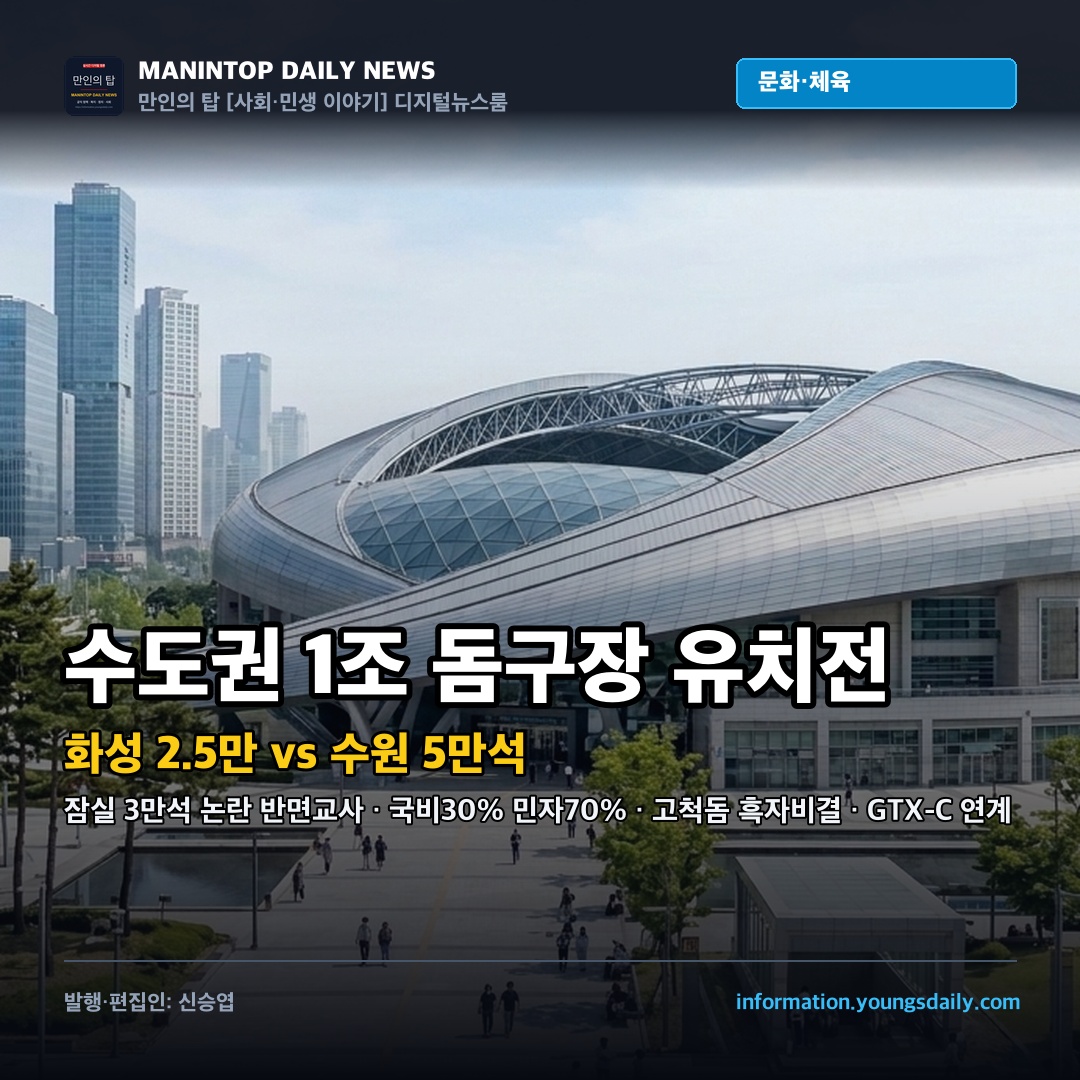
수도권 돔구장 유치전 심층 취재 기획 및 팩트 시트: 지자체별 전략 비교와 지속가능성 검증
만인의 탑 편집국11월 13, 2026
▲ 수도권 돔구장 유치전 심층 취재 기획 및 팩트 시트: 지자체별 전략 비교와 지속가능성 검증 (공식 보도 자료)
📌 핵심 브리핑 · 주요 쟁점 및 핵심 요약
문화체육관광부의 전국 단위 복합형 돔구장 건립 공모를 계기로 경기도 내 화성, 수원, 광명 등 8개 지자체가 치열한 유치전에 돌입했습니다. 15분 생활권 302만 배후 인구와 K-MARS 7대 비전을 앞세운 화성시의 2만 5,000석 스마트 돔과 100만 관중을 돌파한 KT 위즈 연고지 수원의 5만 석 초대형 복합단지가 정면 격돌한 가운데, 3조 3,000억 원을 들이고도 3만 석 '초고가 내수용' 논란에 휩싸인 서울 잠실 돔구장의 뼈아픈 반면교사, 국비 30%를 제외한 70% 민자 조달 리스크와 고척스카이돔의 연간 68억 원 흑자 비결, 그리고 GTX-C 병점과 신안산선 향남 연장을 잇는 사계절 문화 허브의 성공 방정식을 알기 쉽게 총정리합니다.
SPONSORED · ADVERTISEMENT
1. 기획 취재 개요 및 데스크 브리핑
수도권 돔구장 건립 프로젝트는 프로야구 1,200만 관중 시대의 도래, 대형 K-팝 공연 인프라의 절대적 부족, 폭염과 우천 등 기후 변화에 따른 사계절 실내 경기장 수요가 맞물려 지역 경제의 최대 승부처로 부상했다. 지방자치단체 간의 단순한 유치 선언을 넘어 초대형 인프라가 초래할 수 있는 재정 리스크와 광역 교통 혼잡, 그리고 실제 사계절 문화 허브로서의 작동 가능성을 다각도로 검증하는 심층 보도가 요구되는 시점이다.
정부가 추진하는 복합형 돔구장 건립 공모를 둘러싸고 수도권 지자체들의 유치전이 뜨겁게 달아오르고 있다. 경기도 내에서만 화성, 수원, 광명 등 8개 시·군이 출사표를 던진 가운데, 사업비 수천억에서 최대 1조 원대에 달하는 메가 프로젝트의 향방에 관심이 집중된다. 그러나 서울 잠실 돔구장이 초고가 내수용이라는 비판에 직면한 상황에서, 대규모 관객을 지속적으로 유치할 운영 콘텐츠와 70%에 달하는 민간 자본 조달 능력이 사업 성패를 가를 핵심 시험대로 떠오르고 있다.
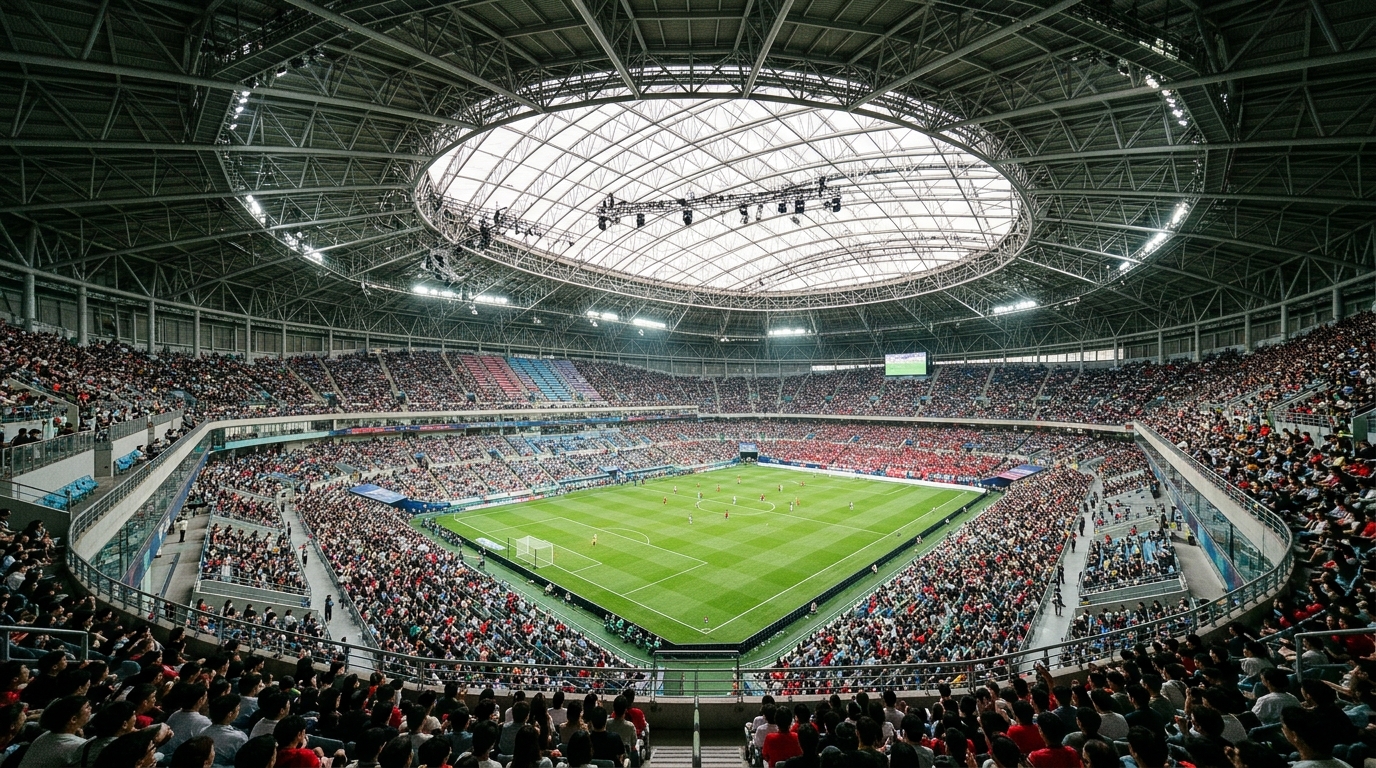
▲ 복합 돔 아레나 내부에서 사계절 스포츠 경기와 대형 K-팝 공연 무대가 펼쳐지는 하이브리드 관람석 및 최첨단 돔 천장 조명 설비 전경 / 복합 돔 인프라 현장 취재 자료
🔍 심층 팩트체크 및 구조 진단
문화체육관광부는 스포츠 경기와 대형 대중음악 공연, 국제행사를 사계절 내내 개최할 수 있는 전천후 복합 돔구장을 건립하기 위해 전국 지자체를 대상으로 후보지 공모 절차를 개시했다. 경기도는 시·군 단위의 과열 경쟁을 조율하고 전국 본선 경쟁력을 극대화하기 위해 자체 1차 관문 심사를 거쳐 문체부에 추천할 방침이다.
문체부 공모 지침 및 선정 체계:
선정 ...
2. 정부 돔구장 공모 개요와 경기도 8개 지자체 격돌 구도
문화체육관광부는 스포츠 경기와 대형 대중음악 공연, 국제행사를 사계절 내내 개최할 수 있는 전천후 복합 돔구장을 건립하기 위해 전국 지자체를 대상으로 후보지 공모 절차를 개시했다. 경기도는 시·군 단위의 과열 경쟁을 조율하고 전국 본선 경쟁력을 극대화하기 위해 자체 1차 관문 심사를 거쳐 문체부에 추천할 방침이다.
문체부 공모 지침 및 선정 체계: 선정 대상 규모는 대규모 돔구장(4만 석 이상, 전국 1개소)과 중규모 돔구장(2만~4만 석, 전국 1개소)으로 구분된다. 경기도 내부 심사 일정은 각 시·군별 유치의향서 접수에 이어 2026년 11월 13일까지 정식 사업제안서 접수를 마감한다. 경기도 자체 심사위원회의 종합 평가를 거쳐 대규모와 중규모 후보지를 각각 1곳씩 선정하여 문체부에 최종 추천할 계획이다. 평가 지표는 공간 활용계획의 타당성, 입지 적정성, 사업 실현 가능성, 지역경제 및 문화 파급효과로 구성된다.
재원 분담 구조의 핵심은 문체부 국비 지원 비율이 전체 사업비의 약 30% 안팎으로 제한된다는 점이다. 나머지 70%는 지자체 지방재정과 민간 투자 유치(민자)로 충당해야 하므로, 지자체의 재정건전성과 민간 사업성 확보가 필수 요건으로 작용한다.
경기도 8개 지자체 유치 전략 비교 분석: 1. 화성시: 중규모(25,000석), 관내 주요 거점(동탄 등), 15분 생활권 302만 배후 인구(수원·오산·용인), 도내 1만석 이상 실내 공연장 전무, K-MARS 7대 비전, 108만 특례시 재정력.
2. 수원시: 대규모(50,000석), 장안구 조원동 수원종합운동장 일대, 프로야구단 KT 위즈 연고지(홈 100만 관중 돌파), 현 구장(2만석) 대비 2.5배 확장, 경기 남부 중심축. 3. 광명시: 대규모(50,000석), 광명시흥 3기 신도시 개발 부지 등, KTX 광명역 광역철도망, 인천국제공항 접근성.
4. 부천시: 중규모(30,000석), 부천종합운동장 일대, 서해선 등 5개 철도망 교차 입지, 부천국제만화축제 연계. 5. 파주시: 중·대규모 검토, 경기 북부 대형 문화체육 인프라 소외 해소, 수도권 균형발전. 6. 평택시: 검토 중, 평택·천안·안성 메가시티 배후권.
7. 고양시: 검토 중, 킨텍스 및 일산 일대 연계, MICE 인프라. 8. 구리시: 검토 중, 서울 동북권 접경 지리적 이점, 신규 개발 연계.
구분 및 비교 항목
화성 'K-MARS' 아레나
수원 돔구장 복합단지
서울 잠실 돔구장 (비교 기준)
추진 좌석 규모
중규모 25,000석 (스포츠·공연 스마트 복합체)
대규모 50,000석 (현 구장 대비 2.5배 확장)
30,000석 (3.3조 MICE 복합개발 내 돔 야구장)
추정 총사업비
약 1조 원 (문화·상업 융합 복합 플랫폼)
약 5,000억 원 추산 (수원종합운동장 재개발)
약 3조 3,000억 원 (민간투자 40년 운영권)
연고 구단 및 콘텐츠
광역 유치 구상 (비시즌 K-팝·스마트 콘퍼런스)
KT 위즈 연고지 (홈 100만 관중 돌파 기반)
LG 트윈스 · 두산 베어스 공동 홈구장
배후 인구 및 접근성
15분 생활권 302만 명 (수원·오산·용인 연접)
수원 도심 및 경기 남부 핵심 인구 밀집지
서울 도심 및 수도권 전역 초밀집 배후권
핵심 광역 교통망
GTX-C 병점 연장(원인자부담) · 신안산선 향남(70%)
경수선 · 인동선 복합 환승 체계 연계
지하철 2·9호선 종합운동장역 · GTX-A/C
핵심 쟁점 및 과제
1조 사업비 조달 · 비시즌 자체 앵커 콘텐츠
도심 극심한 교통 체증 및 대규모 주차 대책
월드투어 유치 불가 '초고가 내수용' 논란 직면
SPONSORED · ADVERTISEMENT
3. 남부권 선두 주자의 격돌: 화성 'K-MARS' vs 수원 '5만석 복합단지'
경기도 남부권에서는 100만 인구를 돌파한 두 특례시인 화성시와 수원시가 각각 중규모(2만 5,000석)와 대규모(5만 석)를 정조준하며 가장 공격적인 행보를 보이고 있다. 화성시: 'K-MARS 아레나' 2만 5,000석 스포츠·공연 스마트 복합체.
화성시는 2026년 10월 26일 유치의향서를 제출한 데 이어 11월 11일 동탄 LH인큐베이팅센터에서 'K-MARS Arena 비전 콘퍼런스'를 열고 13일 경기도에 사업제안서를 제출했다. 단순한 야구장을 넘어 경기 남부 문화·경제 지형을 바꿀 1조 원대 복합 플랫폼으로 승부수를 던졌다.
화성시연구원의 지리정보시스템(GIS) 분석 결과, 승용차 기준 15분 반경 내에만 302만 명의 인구가 거주하는 것으로 확인됐다. 화성을 중심으로 수원, 오산, 용인 등 4개 도시가 동일 생활권을 형성하고 있어 경기 남부 전역의 문화·스포츠 수요를 흡수할 수 있는 지리적 결집력을 내세운다. 현재 경기도 내에 1만 석 이상의 대형 실내 공연·경기장이 전무하다는 점도 유치 명분을 뒷받침한다.
K-MARS 7대 추진 방향은 멈추지 않는 야구(SPORTS), 중부권 공연 거점(K-CONTENTS), 스마트 돔(TECH), 젊은 도시의 평일(FAMILY), 기업이 찾는 돔(WORKATION), 자립하는 돔(REVENUE), 모두의 돔(SHARE)으로 구성된다.
광역 교통 인프라 지원 전략으로는 GTX-C 병점 연장(수원~화성 병점~오산~평택~천안, 원인자부담 방식을 통해서라도 본선 동시 개통 추진)과 신안산선 향남 연장(여의도~광명~시흥시청~향남 22.3km, 총사업비 2,007억 원, 2026년 10월 공정률 70%)을 적극 연계하고 있다.
수원시: 5만 석 규모 대형 돔구장과 100만 관중 흥행의 결합 수원시는 장안구 조원동 수원종합운동장 일대를 리모델링 및 복합개발하여 5만 석 규모의 초대형 돔구장을 조성하겠다는 구상을 내놓았다. 현재 KT 위즈의 홈구장인 수원KT위즈파크는 공식 좌석 수가 2만 122석이다. KT 위즈가 정규시즌 홈 관중 100만 명을 돌파하며 창단 이래 단일 시즌 최다 관중 기록을 세움에 따라 주말 경기마다 극심한 입장권 매진과 좌석 부족 현상이 발생하고 있다. 5만 석 돔구장이 조성되면 현재보다 약 2만 9,000석(약 2.5배)이 증가하여 한국시리즈, 국제대회 및 초대형 문화공연을 여유롭게 소화할 수 있다. 전체 사업비는 약 5,000억 원 수준으로 추산되며, 5만 명 집중 시 교통 체증 및 대규모 주차 대책과 민자 조달 방안이 핵심 과제로 꼽힌다.
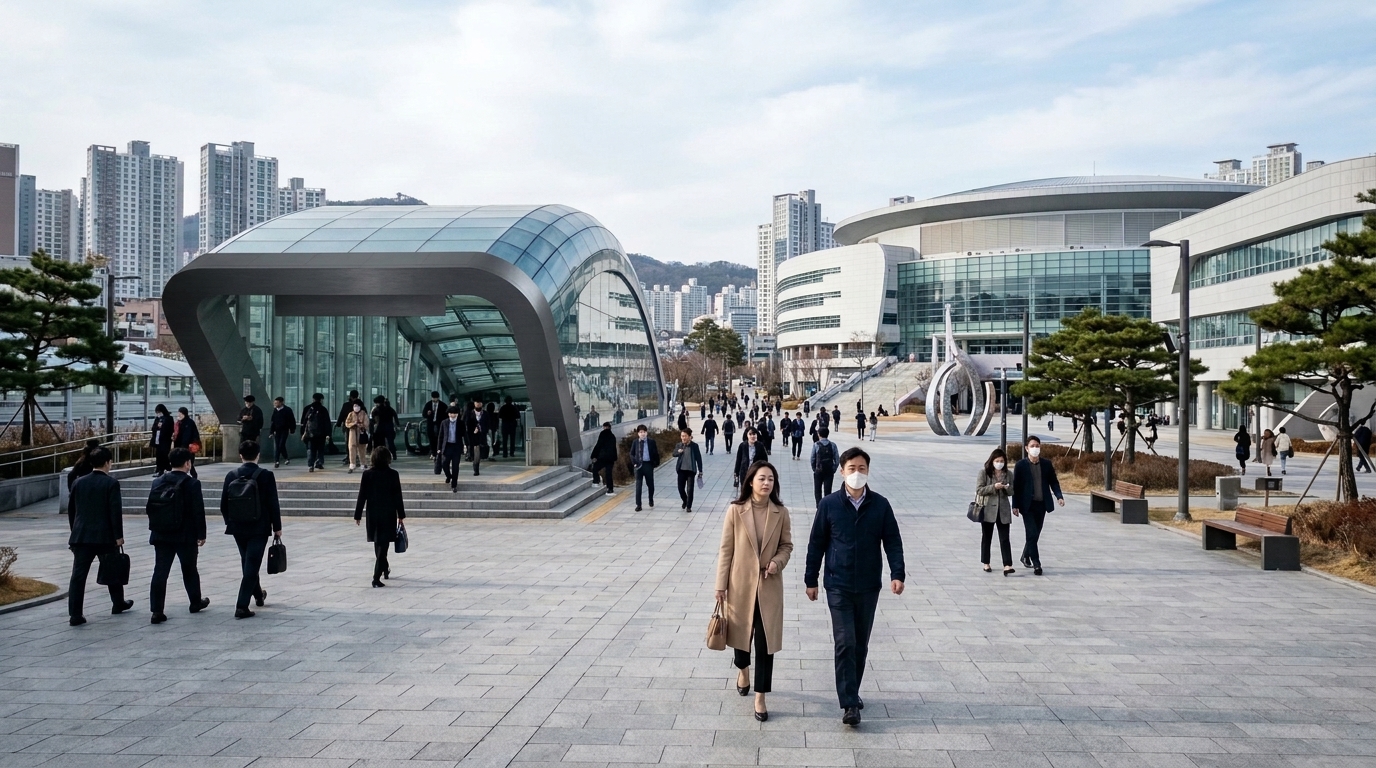
▲ 돔구장 대규모 관람객 수송과 도심 접근성을 연결하는 수도권 광역급행철도(GTX) 및 고속철도 역사 복합 광장 / 수도권 광역교통 인프라 취재 자료
🚨 피해 구제 및 법적 대응 직통 가이드
사안에 따른 긴급 신고 및 피해 구제 창구(경찰청 112, 디지털성범죄피해자지원센터 02-735-8994, 방심위 1377)를 통해 24시간 즉시 상담 및 삭제 차단 조치를 요청할 수 있습니다.
4. '잠실 3만석 돔' 논란이 던진 경고: 왜 5만석인가, 왜 복합화인가
서울시는 2032년 개장을 목표로 잠실종합운동장 일대 3조 3,000억 원 규모의 MICE 복합개발 사업을 추진하며 3만 석 규모의 돔 야구장을 계획했다. 전액 민간투자 방식으로 진행되며 민간 사업자에게 40년간의 운영권을 부여하는 구조다.
잠실 돔구장을 둘러싼 핵심 비판 쟁점: 첫째, 초고가 내수용 전락 우려다. 3조 3,000억 원의 개발 사업비와 핵심 공공 부지, 40년 운영권을 내주면서 3만 석 규모에 머무는 것은 전형적인 내수용 시설에 불과하다는 비판이 제기된다. 일본 도쿄돔(5만~5.5만 석)이나 싱가포르 국립경기장(5.5만 석)처럼 세계 정상급 아티스트의 월드 투어를 유치하려면 최소 4만 5,000~5만 명 이상의 관중 동원력이 담보되어야 한다. 테일러 스위프트, 비욘세, 콜드플레이 등 글로벌 슈퍼스타의 내한 공연 경제성을 충족하지 못해 향후 수십 년간 글로벌 투어 일정에서 배제될 위험이 높다.
둘째, 공연 전환 시 가용 좌석 급감 문제다. 돔 야구장에서 대형 콘서트를 열 경우 외야 쪽에 대형 무대와 음향 타워를 설치해야 하므로 외야 관람석이 차단된다. 3만 석 규모 구장은 실제 공연 시 가용 좌석이 2만 석 안팎으로 급감하여 글로벌 스타 유치가 더욱 어려워진다.
셋째, 야구계 편중 설계와 호텔 연계의 모순이다. KBO와 구단의 요구 위주로 결정되면서 공연 기획자나 무대 음향 전문가의 관점이 배제되었다. 야구장 조망 호텔 역시 외야 무대 설치 시 무대 뒷면이나 구조물에 시야가 가로막혀 공연을 볼 수 없는 호텔이 되는 구조적 결함을 안고 있다.
넷째, 임시 대체구장 혈세 낭비다. 새 돔을 짓는 수년간 잠실올림픽주경기장의 육상트랙과 축구장을 뜯어내 수백억 원을 들여 임시 야구장으로 개조한 뒤 다시 원상 복구하기로 결정하는 등 주먹구구식 행정으로 막대한 사회적 비용을 초래했다.
대규모 인프라 건설의 가장 치명적인 함정은 막대한 예산을 들여 완공한 뒤 유지관리비를 감당하지 못해 재정 적자의 늪에 빠지는 화이트 엘리펀트(하얀 코끼리) 현상이다. 화성시연구원은 "돔은 짓는 것보다 채우는 것이 더 어렵다"며 초기 설계 단계부터 정밀한 자립형 수익 모델이 마련되어야 한다고 지적했다.
고척스카이돔 재정 흑자 실적의 시사점: 국내 유일의 돔 야구장인 서울 고척스카이돔의 최근 운영 실적은 복합 돔구장의 흑자 가능성을 입증한다. 고척돔은 공연 기준 1만 6,000석~2만 5,000석을 수용하며, 개장 초기와 코로나19 팬데믹을 제외하고 매년 안정적 흑자를 기록 중이다. 2024년 수입 171억 8,700만 원, 지출 103억 8,600만 원으로 68억 100만 원의 흑자를 달성했고, 2025년에도 수입 152억 9,700만 원, 지출 110억 5,800만 원으로 42억 3,900만 원의 흑자를 유지했다. 프로야구 시즌 입장료와 매점 수입뿐 아니라 비시즌과 평일에 대형 K-팝 공연 및 문화행사 대관을 적극 유치한 것이 핵심 동력이었다.
돔구장 사업화의 3대 핵심 성공 요건: 1. 70% 민자 조달의 현실성: 국비 30%를 제외한 70%를 민간 자본으로 조달해야 하므로 상업시설 운영권, 네이밍 라이츠(명명권), 부대시설 개발 수익 모델이 정교해야 한다.
2. 프로 구단 유치 및 앵커 콘텐츠 확보: 연간 70회 이상의 홈경기를 치를 프로야구단 등 고정 앵커 콘텐츠가 필수적이다. 연고 구단이 없는 지자체는 중립 경기 유치나 글로벌 e스포츠 리그 등 대체 앵커 콘텐츠를 선제 확보해야 한다.
3. 사계절 복합 운영을 위한 전환성(Convertibility): 야구 경기장에서 콘서트 무대로 신속하게 전환할 수 있는 무대 반입 동선, 첨단 음향·차음 설비, 잔디 보호 시스템이 설계 단계부터 필수적이다.
In-depth Coverage Plan and Fact Sheet on the Competition for a Dome Stadium in the Capital Region: Comparative Strategies of Local Governments and Verification of Sustainability
In light of the Ministry of Culture, Sports and Tourism's nationwide competition for the construction of a multi-purpose dome stadium, eight local governments in Gyeonggi Province, including Hwaseong, Suwon, and Gwangmyeong, have entered into a fierce competition for hosting rights. Hwaseong City is promoting its 25,000-seat smart dome, backed by a population of 3.02 million within a 15-minute living radius and the K-MARS 7 Vision. Meanwhile, Suwon, home to the KT Wiz, is proposing a massive 50,000-seat complex that has already attracted over one million spectators. This competition is underscored by the painful lessons learned from the Seoul Jamsil Dome Stadium, which, despite a budget of 3.3 trillion won, faced controversy over its 30,000-seat "ultra-high-cost domestic use" designation. Additionally, the risks associated with financing 70% of the project through private investment, excluding the 30% government funding, and the annual profit of 6.8 billion won generated by the Gocheok Sky Dome are examined. Furthermore, the successful formula for a year-round cultural hub connecting the GTX-C Byeongjeom and the Shin Ansan Line Hyeongnam extensions will be clearly summarized.
📌 Key Takeaways
Guidelines for the Ministry of Culture's large-scale 40,000-seat and medium-scale 20,000-seat public competition and the first round of evaluations in Gyeonggi Province.
The 15-minute living zone of 3.02 million people and K-MARS's seven major visions versus KT Wiz's home base with 1 million people and a 2.5 times expansion.
The contradiction of a significant decrease in domestic seating capacity of 30,000 and the secret to the 6.8 billion won surplus at Gocheok Dome, along with the challenge of securing 70% private financing.
1. Planning coverage overview and desk briefing
The project to build a dome stadium in the metropolitan area has emerged as the biggest battleground for the local economy due to the advent of the era of 12 million spectators for professional baseball, the absolute lack of large-scale K-pop performance infrastructure, and the demand for indoor stadiums all year round due to climate change such as heat waves and rainy weather. It is a time when in-depth reporting is required that goes beyond simple declarations of attraction between local governments and verifies from various angles the financial risks and metropolitan traffic congestion that super-large infrastructure can cause, and the possibility of operating as an actual cultural hub in all four seasons.
The bidding war among local governments in the metropolitan area is heating up over the government-promoted competition to build a complex dome stadium. In Gyeonggi-do alone, eight cities and counties, including Hwaseong, Suwon, and Gwangmyeong, have voted to run, and attention is focused on the direction of the mega project, which has a project cost ranging from hundreds of billions of won to up to 1 trillion won. However, in a situation where Jamsil Dome Stadium in Seoul is facing criticism that it is an extremely expensive domestic market, operational content that will continue to attract large audiences and the ability to raise up to 70% of private capital are emerging as key tests that will determine the success or failure of the business.
▲ Hybrid seating and state-of-the-art dome ceiling lighting systems configured for year-round sports and mega K-pop concerts inside a multi-purpose dome arena / Dome Infrastructure Field Archive
2. Overview of the government dome stadium contest and the structure of the conflict between eight local governments in Gyeonggi-do
The Ministry of Culture, Sports and Tourism has launched a candidate site contest for local governments across the country to build an all-weather complex dome stadium that can host sports games, large-scale pop music performances, and international events all year round. In order to coordinate the heated competition at the city and county level and maximize competitiveness in the national finals, Gyeonggi Province plans to make recommendations to the Ministry of Culture, Sports and Tourism after going through its own primary screening process.
Ministry of Culture, Sports and Tourism guidelines and selection system: The size of the selection target is divided into large-scale dome stadiums (40,000 seats or more, 1 location nationwide) and medium-sized dome stadiums (20,000 to 40,000 seats, 1 location nationwide). Gyeonggi Province's internal review schedule follows the submission of letters of intent for each city and county, and closes the submission of formal business proposals by November 13, 2026. After a comprehensive evaluation by Gyeonggi Province's own review committee, one large- and medium-sized candidate site each will be selected and a final recommendation will be made to the Ministry of Culture, Sports and Tourism. Evaluation indicators consist of the feasibility of space utilization plan, location adequacy, business feasibility, and regional economic and cultural ripple effects.
The key to the resource sharing structure is that the Ministry of Culture, Sports and Tourism's national funding ratio is limited to approximately 30% of the total project cost. The remaining 70% must be covered by local finances and private investment (private investment), so securing the local government's financial soundness and private business feasibility is an essential requirement.
Comparative analysis of the attraction strategies of eight local governments in Gyeonggi-do: 1. Hwaseong City: Medium size (25,000 seats), major hubs (Dongtan, etc.), 15-minute living area, population of 3.02 million (Suwon, Osan, Yongin), no indoor performance hall with more than 10,000 seats in the province, K-MARS 7 major visions, financial power of 1.08 million special city.
2. Suwon City: Large scale (50,000 seats), area around Suwon Sports Complex in Jowon-dong, Jangan-gu, hometown of professional baseball team KT Wiz (home audience exceeds 1 million), 2.5 times larger than the current stadium (20,000 seats), central axis of southern Gyeonggi.
3. Gwangmyeong City: Large scale (50,000 seats), Gwangmyeong Siheung 3rd new town development site, etc., KTX Gwangmyeong Station metropolitan rail network, accessibility to Incheon International Airport.
4. Bucheon City: Medium-sized (30,000 seats), located at the intersection of five railway networks including the Bucheon Sports Complex area and the Seohae Line, and connected to the Bucheon International Comics Festival.
5. Paju City: Review of medium and large scale, resolution of alienation of large-scale cultural and sports infrastructure in northern Gyeonggi Province, and balanced development of the metropolitan area.
6. Pyeongtaek City: Under review, Pyeongtaek, Cheonan, and Anseong megacities hinterland. 7. Goyang City: Under review, connection to KINTEX and Ilsan area, MICE infrastructure.
8. Guri City: Under review, geographical advantage bordering the northeastern region of Seoul, connection to new development.
Category
Core Factual Findings
Socioeconomic Impact
Subsequent Measures
Proposed Seating Capacity
Medium-sized venue with 25,000 seats (Smart complex for sports and performances)
Large venue with 50,000 seats (2.5 times the current stadium capacity)
30,000 seats (Dome baseball stadium within a 3.3 trillion won MICE complex development)
Estimated Total Project Cost
Approximately 1 trillion won (Cultural and commercial convergence complex platform)
Estimated at around 500 billion won (Suwon Comprehensive Sports Complex redevelopment)
Approximately 3.3 trillion won (40-year private investment operating rights)
Home Team and Content
Regional attraction plan (K-Pop and smart conferences during the off-season)
Home base for KT Wiz (Foundation for surpassing 1 million home spectators)
Joint home stadium for LG Twins and Doosan Bears
Surrounding Population and Accessibility
3.02 million people within a 15-minute living radius (adjacent to Suwon, Osan, and Yongin)
Core population concentration in Suwon city center and southern Gyeonggi Province
Highly dense surrounding area in central Seoul and the entire metropolitan area
Key Regional Transportation Network
Extension of GTX-C to Byeongjeom (cost borne by the initiator) and Shin Ansan Line to Hyangnam (70%)
Integration of Gyeongsoo Line and Indong Line transfer systems
Subway Lines 2 and 9 at the Comprehensive Sports Complex Station, and GTX-A/C
Key Issues and Challenges
Securing 1 trillion won in project funding and developing anchor content for the off-season
Severe traffic congestion in the city center and large-scale parking solutions
Facing controversy over the inability to attract world tours, labeled as "ultra-expensive domestic use"
3. Clash between the leaders in the southern region: Hwaseong ‘K-MARS’ vs. Suwon ‘50,000-seat complex’
In the southern region of Gyeonggi-do, Hwaseong City and Suwon City, two special cities with populations exceeding 1 million, are showing the most aggressive moves by targeting medium-sized (25,000 seats) and large-scale (50,000 seats) cities, respectively.
Hwaseong City: ‘K-MARS Arena’ 25,000-seat sports and performance smart complex Hwaseong City submitted a letter of intent to host on October 26, 2026, held the 'K-MARS Arena Vision Conference' at Dongtan LH Incubating Center on November 11, and submitted a business proposal to Gyeonggi Province on the 13th. Going beyond a simple baseball stadium, they are betting on a 1 trillion won complex platform that will change the cultural and economic landscape of southern Gyeonggi Province.
As a result of Hwaseong City Research Institute's Geographic Information System (GIS) analysis, it was confirmed that 3.02 million people live within a 15-minute radius by car. Four cities, including Hwaseong, Suwon, Osan, and Yongin, form the same living area, boasting geographical cohesion that can absorb cultural and sports demands from the entire southern part of Gyeonggi Province. The fact that there are currently no large indoor performances or stadiums with more than 10,000 seats in Gyeonggi-do also supports the justification for hosting the event.
The seven major directions of K-MARS are composed of non-stop baseball (SPORTS), performance base in the central region (K-CONTENTS), smart dome (TECH), weekdays in a young city (FAMILY), dome visited by companies (WORKATION), self-reliant dome (REVENUE), and everyone's dome (SHARE).
As a strategy to support metropolitan transportation infrastructure, we are actively linking the GTX-C branch extension (Suwon~Hwaseong branch~Osan~Pyeongtaek~Cheonan, promoting simultaneous opening of the main line even through the cost-paying method) and Shinansan Line Hyangnam extension (Yeouido~Gwangmyeong~Siheung City Hall~Hyangnam 22.3km, total project cost KRW 200.7 billion, completion rate 70% in October 2026).
Suwon City: Combination of a large dome stadium with 50,000 seats and 1 million spectators Suwon City proposed a plan to create a large dome stadium with a capacity of 50,000 seats by remodeling and developing a complex around the Suwon Sports Complex in Jowon-dong, Jangan-gu.
Suwon KT Wiz Park, the current home stadium of KT Wiz, has an official seating capacity of 20,122. As KT Wiz's regular season home attendance exceeded 1 million, setting the record for the largest attendance in a single season since its founding, extreme ticket sales and seat shortages are occurring for each weekend game. When the 50,000-seat dome stadium is built, the number of seats will increase by about 29,000 (about 2.5 times) compared to the present, allowing the Korean Series, international competitions, and large-scale cultural performances to be comfortably accommodated. The total project cost is estimated to be approximately 500 billion won, and traffic congestion and large-scale parking measures and private financing measures when 50,000 people are concentrated are considered key tasks.
▲ Metropolitan express transit (GTX) plaza connecting mass transit commuters directly to the civic sports and cultural dome district / Metropolitan Transit Infrastructure Archive
4. Warning raised by the ‘Jamsil 30,000-seat dome’ controversy: Why 50,000 seats, why complex?
The Seoul Metropolitan Government is planning a 30,000-seat dome baseball stadium while promoting a MICE complex development project worth 3.3 trillion won in the Jamsil Sports Complex area with the goal of opening in 2032. It is entirely conducted through private investment and is structured to grant 40 years of operating rights to private operators.
Key criticism issues surrounding Jamsil Dome Stadium: First, there are concerns that ultra-high prices will fall to the domestic market. Criticism is being raised that staying at 30,000 seats while giving away 3.3 trillion won in development costs, key public land, and 40-year operation rights is nothing more than a typical domestic facility. In order to attract a world tour of a world-class artist, like Japan's Tokyo Dome (50,000-55,000 seats) or Singapore's National Stadium (55,000 seats), the mobilization capacity of at least 45,000-50,000 spectators must be guaranteed. There is a high risk that global superstars such as Taylor Swift, Beyoncé, and Coldplay will be excluded from the global tour schedule for decades to come as they cannot meet the economic feasibility of performing in Korea.
Second, there is the problem of a sharp decrease in available seats when changing performances. When a large concert is held at a dome baseball stadium, a large stage and sound tower must be installed in the outfield, so the outfield bleachers are blocked. In a 30,000-seat stadium, the available seats during actual performances plummet to around 20,000, making it more difficult to attract global stars.
Third, there is a contradiction between the baseball-centered design and the hotel connection. As the decision was made based on the needs of the KBO and the team, the perspectives of performance planners and stage sound experts were excluded. Hotels with a view of a baseball stadium also have structural defects in that when an outfield stage is installed, the view is blocked by the back of the stage or a structure, making it impossible to view the performance.
Fourth, the temporary replacement stadium is a waste of tax money. For several years while building a new dome, the Jamsil Olympic Stadium's athletics track and soccer field were torn down and remodeled into a temporary baseball stadium at a cost of tens of billions of won, and then decided to be restored to their original state, resulting in enormous social costs due to a haphazard administration.
The most fatal pitfall of large-scale infrastructure construction is the white elephant phenomenon, which occurs when construction costs a huge amount of money and then falls into a swamp of financial deficit due to the inability to cover maintenance costs. Hwaseong City Research Institute pointed out that “filling a dome is more difficult than building it,” and that a precise self-sustaining profit model must be established from the early design stage.
Implications of Gocheok Sky Dome’s fiscal surplus: The recent operating performance of Gocheok Sky Dome in Seoul, Korea's only dome baseball stadium, proves the possibility of a surplus for the complex dome stadium. Gocheok Dome accommodates between 16,000 and 25,000 seats for performances, and has been recording a stable surplus every year except for the early opening period and the COVID-19 pandemic. In 2024, a surplus of KRW 6.801 billion was achieved with income of KRW 17.187 billion and expenditures of KRW 10.386 billion, and in 2025, a surplus of KRW 4.239 billion was maintained with income of KRW 15.297 billion and expenditures of KRW 11.058 billion. The key driving force was not only revenue from admission fees and concessions during the professional baseball season, but also actively attracting large-scale K-pop performances and cultural event rentals during the off-season and weekdays.
Three key success requirements for dome stadium commercialization: 1. Reality of 70% private financing: Since 70%, excluding 30% from government funds, must be procured with private capital, the profit model for commercial facility operation rights, naming rights, and auxiliary facility development must be sophisticated.
2. Attracting professional teams and securing anchor content: Fixed anchor content is essential, such as for professional baseball teams that will play more than 70 home games per year. Local governments without an affiliated club must preemptively secure alternative anchor content, such as hosting neutral games or global e-sports leagues.
3. Convertibility for four-season complex operation: Stage introduction flow that can quickly change from a baseball stadium to a concert stage, advanced sound and sound insulation equipment, and a grass protection system are essential from the design stage.
Recommended Deep-Dive Investigations TOP 3
GLOBAL REPORT
1월이 시작되면 감기는 이미 우리 곁에 와 있습니다. 2월, 3월, 4월까지 이어지는 추위와 건조함은 코와 목을 가장 먼저 공격합니다. 아침에 일어나자마자 막혀 있는 코. 계속 흐르는 콧물. 괜히 칼칼해지는 목. 이 증상은 “시작”일 뿐입니다. 한 번 무너지면 일주일, 길면 한 달까지 끌고 갑니다. 약을 먹으면 잠깐 괜찮아집니다. 하지만 며칠 뒤 또 반복됩니다. 왜일까요? 감기는 ‘치료’의 문제가 아니라 ‘관리’의 문제이기 때문입니다. 대부분은 감기가 오고 나서 약을 찾습니다. 하지만 진짜 중요한 건 감기가 오기 전에 코와 목을 지키는 것입니다. 건조한 실내 공기, 차가운 바깥 공기, 눈에 보이지 않는 세균. 코와 목은 매일 공격받고 있습니다. 지긋지긋하죠! 그런데도 우리는 아무 준비 없이 버티고 있습니다. 이번 겨울도 그렇게 보낼 건가요? 사실 방법은 어렵지 않습니다. 코를 깨끗하게 관리하고, 목을 따뜻하게 보호하고, 점막을 촉촉하게 유지하고, 기관지를 미리 관리하고, 외부 공기를 차단하는 것. 이 다섯 가지만 꾸준히 해도 감기약 없이 겨울을 보내는 것이 충분히 가능합니다. 🔥 이제부터 그 방법을 하나씩 살펴보겠습니다. 🔥 1. 코와 목을 먼저 관리해야 하는 과학적 이유 감기의 대부분은 코 점막에서 시작됩니다. 국제 학술지 Nature Reviews Microbiology 와 Journal of Allergy and Clinical Immunology 에 실린 호흡기 감염 관련 연구들에서는, 감기 바이러스가 비강 상피세포에 먼저 부착해 증식한다는 점을 설명하고 ...
리모델링사업이 진행 중인 아파트를 매매할 때 “계약금 10%를 언제까지 내야 하느냐”는 질문이 특히 많이 나옵니다. 이주공고(이주 안내)가 7~11월쯤이라고 들으면, 그 시점에 맞춰 계약금도 움직일 것 같아서 더 헷갈리기 쉽습니다. 하지만 실제 납부기한은 ‘이주공고가 언제냐’만으로 자동 결정되지 않는 경우가 많습니다. 1) 계약금 10% 납부기한: 결국 ‘문서에 적힌 일정’이 기준 계약금 10%를 언제까지 납부해야 하는지는, 내가 서명하는 매매계약서(특약 포함) 와 사업주체/조합이 제시한 공고·안내문 에 적힌 납부 일정이 기준이 됩니다. 실제 공고문에서는 분양대금 납부의 큰 틀(계약금→중도금→잔금)을 먼저 안내하고, 상세 일정은 별도 표나 유의사항으로 제시하는 방식이 흔합니다. 또, 계약서 문구에 따라 지급 시점이 조건부로 설정될 수도 있습니다. 예를 들어 한 사례 소개 자료에서는 용역계약서에 잔금(10%) 지급시기가 “사업승인 후”로 기재되어 있었다는 점이 언급됩니다. 이런 식으로 ‘사업 단계’와 지급을 연동하는 문구가 들어가면, 질문의 답은 계약서 문구를 확인해야만 확정됩니다. 관련 내용은 링크 에서 문구 사례를 확인할 수 있습니다. 2) 입주자모집공고에서 확인되는 ‘납부 순서’와 잔금 마감 시점 공고문에 적힌 문구를 보면, 납부 순서와 잔금 마감에 대한 기준이 비교적 명확하게 제시되는 경우가 있습니다. 예를 들어 한 입주자모집공고에는 “분양금액(주택가격)은 계약금, 중도금, 잔금의 순서로 납부”하며 “잔금은 입주(열쇠 수령일) 전에 완납”해야 한다고 안내되어 있습니다. (문구 확인: 링크 ) 이 문구가 의미하는 바는 최소 2가지입니다. 분양/공급 형태의 문서에서는 ‘계약금→중도금→잔금’ 흐름이 공식적으로 안내될 수 있습니다. 잔금은 “입주(열쇠 수령)” 이전에 완납해야 한다는 마감 기준이 문서에 적혀 있을 수 있습니다. 다만, 위 공고문 문구는 잔금 마감에 대한 기준을 보여주지만, 계약금 10%의...
윤석열 전 대통령 탄핵 인용 소식을 접하면, 가장 궁금한 지점은 ‘헌재가 정확히 무엇을 위헌·위법으로 봤는가’입니다. 또한 탄핵과 별개로 진행되는 형사재판(내란 우두머리 혐의 등)이 어디까지 왔는지도 함께 정리할 필요가 있습니다. 아래 내용은 제공된 기사/게시물 스니펫과 링크에서 확인되는 범위만 모아, 일반인이 흐름을 이해하기 쉽게 정리한 것입니다. 1) 탄핵 인용 관련: 스니펫에서 확인되는 ‘판단의 골격’ 제공된 근거 중 조국혁신당 사이트에는 헌법재판소가 윤석열 탄핵 심판에서 “피청구인의 위헌·위법행위는 국민 신임 …”이라는 취지로 판단했다는 문장이 인용돼 있습니다( 링크 ). 이 인용문만 놓고 보면, ‘위헌·위법행위’가 있었는지와 그로 인해 ‘국민의 신임’이 어떻게 평가됐는지가 핵심 축으로 소개됩니다. 다만 질문에서 요청하신 세부 항목, 즉 비상계엄 선포 자체를 문제 삼은 구체적 이유, 계엄 이후 조치(포고령, 국회 통제 등)의 어떤 지점이 헌법 위반인지, 국회의 권한행사 방해 및 정치활동 제약을 어떤 논리로 판단했는지 등은, 이번에 제공된 근거의 제목/스니펫만으로는 조항·사실관계·판단 구조가 그대로 제시돼 있지 않습니다. 따라서 이 글에서는 ‘헌재가 무엇을 문제 삼았다’는 세부 리스트를 단정적으로 재구성하기보다, 현재 확인 가능한 문구 수준의 요약(위헌·위법행위 → 국민 신임의 문제로 평가)까지만 적습니다. 만약 헌재 결정문 전문(주문 및 이유)이 추가로 확인되면, 그때는 문장 단위로 ‘어떤 행위’와 ‘어떤 헌법 원리/조항’이 연결되는지(예: 권력분립, 국회의 권한, 정치적 기본권 등) 구조화해 정리하는 것이 가장 정확합니다. 2) 형사 절차(내란 혐의) 관련: 체포영장과 1심 선고 언급 탄핵 심판과 별도로, 12·3 비상계엄 사태로 내란 혐의를 받는 윤석열 대통령에 대해 2024년 12월 31일 체포 영장이 발부됐다는 BBC 보도가 있습니다( 링크 ). 해당 보도는 ‘현직 대통령’에 대한 체포영장 발부라는 점을 함께 언급합니다. 또...