아침 찬 공기를 마시며 집을 나서는 순간, 가슴 한가운데를 커다란 바위가 짓누르듯 묵직한 통증이 밀려옵니다. 목덜미를 타고 식은땀이 흘러내리지만, 많은 이들은 "어젯밤 먹은 야식이 체했나 보다"라며 바늘로 손가락을 따거나 소화제를 찾아 삼키고 자리에 눕습니다. 하지만 이 안일한 착각이 돌이킬 수 없는 비극을 부릅니다. 건강보험심사평가원에 따르면 국내 급성 심근경색 환자는 5년 새 16.8%나 폭증해 연간 14만 명에 육박합니다. 특히 한겨울보다 일교차가 10도 이상 벌어지는 환절기 봄·가을과 기상 직후 3시간인 '모닝 서지' 시간대에 혈관이 가장 많이 터집니다. 흉통 환자의 40%가 병원에 도착하기도 전에 목숨을 잃는 심근경색의 메커니즘과 생명을 살리는 90분 골든타임 수칙을 종합 분석합니다.

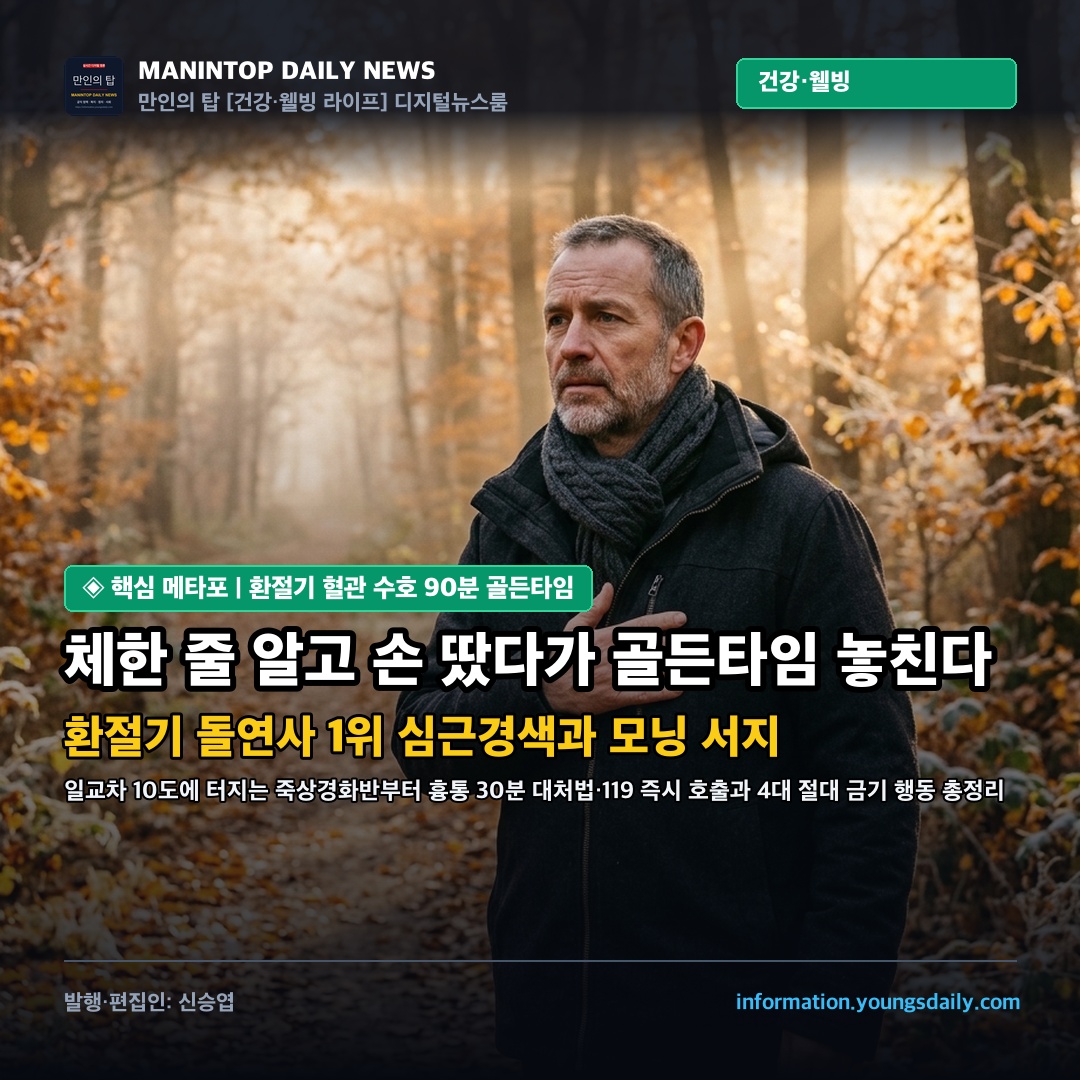
환절기 이른 아침 찬 공기에 노출되면서 급격한 혈관 수축과 흉통 위험에 직면하는 모습. 기상 직후 3시간 동안 혈압이 치솟는 '모닝 서지'는 심혈관 돌연사의 가장 위험한 방아쇠입니다.
1. 한겨울보다 환절기가 더 무섭다: 일교차 8~10도에 정점 찍는 심근경색
흔히 심장마비는 영하로 떨어지는 혹한기에 가장 많이 발생할 것이라 생각하기 쉽습니다. 그러나 국민건강보험공단과 기상청이 연계한 10개년(2005~2014년) 빅데이터 추적 관찰 연구 결과는 대중의 상식을 완전히 뒤엎습니다.
인구 10만 명당 급성 심근경색 발생률을 사계절로 비교했을 때, 봄철이 63.1명으로 사계절 중 압도적 1위를 기록했습니다. 그 뒤를 이어 겨울(61.3명), 가을(59.5명), 여름(57.1명) 순이었습니다. 월별 통계에서도 꽃샘추위가 찾아오는 3월과 계절이 바뀌는 초겨울 12월에 발병 환자가 집중되었습니다.
10개년 관찰 데이터로 본 심근경색 발생 현황과 위험 지표
- 계절별 발생률 1위: 봄철 (인구 10만 명당 63.1명) > 겨울철 (61.3명) > 가을철 (59.5명)
- 결정적 발병 촉발 인자: 단순 저온보다 하루 일교차 8~10℃ 구간 진입 시 발생률 최고
- 성별 격차: 남성 2만 5,944건 vs 여성 9,025건 (남성이 약 2.8배 빈발)
- 초응급 현실: 초기 사망률 30%, 흉통 발생 환자의 40%가 병원 도착 전 사망
학계에서는 우리 몸이 추위에 적응하지 못한 상태에서 맞닥뜨리는 '일교차 8~10도'의 급격한 기온 변화를 가장 위험한 원인으로 꼽습니다. 따뜻한 실내에 있다가 찬 바람이 부는 실외로 나서는 순간, 체온을 지키기 위해 교감신경계가 과도하게 흥분하면서 노르에피네프린이 분비되고 혈관이 좁아지며 혈압이 요동치기 때문입니다.
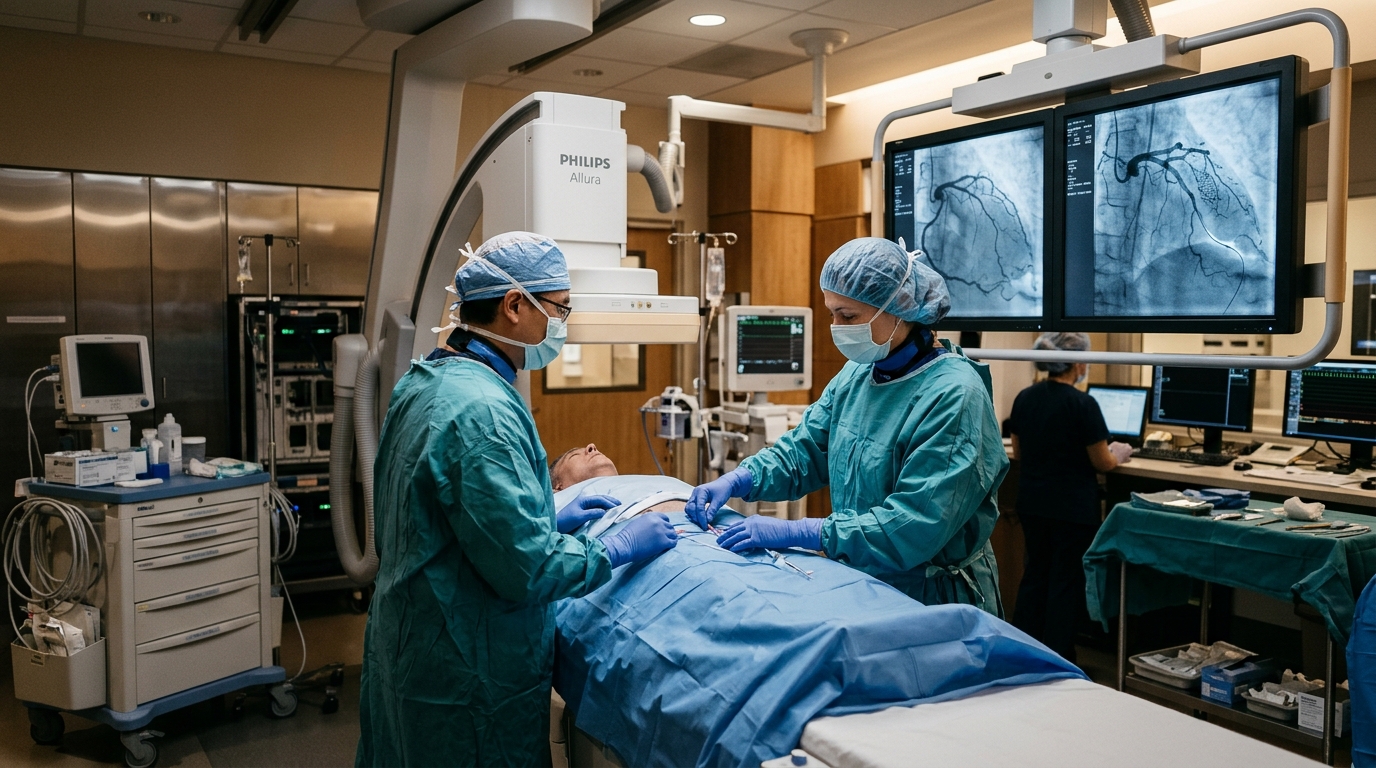
대학병원 심혈관 조영실(Cath Lab)에서 심장내과 전문의들이 형광 투시 모니터를 보며 막힌 관상동맥을 넓히는 스텐트 시술(PCI)을 시행하는 모습. 응급실 도착 90분 이내에 혈관을 뚫어야 심근 괴사를 막을 수 있습니다.
2. 기상 직후 3시간의 악몽: '모닝 서지(Morning Surge)'와 혈관 파열
심근경색 환자의 상당수는 아침에 잠에서 깬 지 3시간 이내에 쓰러집니다. 이를 의학계에서는 '모닝 서지(Morning Surge)' 현상이라고 부릅니다. 밤새 잠들어 있을 때 편안하게 떨어져 있던 혈압은 아침 기상과 동시에 몸을 깨우기 위해 자연스럽게 상승합니다. 그런데 환절기 아침의 차가운 공기가 폐와 피부로 들어오면 혈압이 걷잡을 수 없이 폭발합니다.
야간 최저 혈압에 비해 아침 기상 후 수축기 혈압이 55mmHg 이상 급등하면 뇌졸중과 심장마비 위험이 치솟습니다. 피가 끈적해진 상태에서 혈압이 거세게 몰아치면 관상동맥 내벽에 얇은 막으로 덮여 있던 기름 찌꺼기(죽상경화반)가 터져 나갑니다. 상처가 난 부위에는 혈소판이 폭발적으로 엉겨 붙어 단 몇 분 만에 거대한 피떡(혈전)을 만들어 심장 혈관을 100% 틀어막아 버립니다.
특히 2030 청년층 역시 안전지대가 아닙니다. 혈관 내경이 50% 미만으로 좁아진 초기 동맥경화는 건강검진 심전도에서 '정상'으로 나옵니다. 하지만 껍질이 얇은 이 유약한 병변이 과로, 흡연, 찬 공기 자극을 받으면 전조 증상 없이 순식간에 터지며 청년 돌연사로 직행합니다.
| 감별 진단 항목 |
협심증 (Angina Pectoris) |
급성 심근경색증 (AMI) |
역류성 식도염 / 단순 소화불량 |
| 통증의 양상 |
가슴을 조이거나 뻐근하게 누르는 압박감 |
쥐어짜는 듯함, 짓누름, 칼로 도려내는 듯한 극심한 고통 |
명치 부위가 타는 듯한 작열감, 쓰림, 더부룩함 |
| 통증 지속 시간 |
대개 5분 이내 (10분 넘기지 않음) |
20~30분 이상 쉬지 않고 계속됨 |
수십 분에서 수 시간 동안 간헐적으로 지속 |
| 통증 발생 상황 |
계단 오르기, 등산, 무거운 짐 들기 등 활동 시 |
가만히 쉴 때, 자는 도중, 아침 기상 직후에도 돌발 발생 |
식사 직후 또는 바로 누웠을 때 악화 |
| 약물 및 안정 반응 |
휴식 취하거나 니트로글리세린 복용 시 즉각 호전 |
쉬거나 니트로글리세린을 먹어도 전혀 통증 안 가라앉음 |
제산제나 위장약 복용 시 서서히 완화 |
| 통증이 뻗치는 부위 |
턱이나 왼쪽 어깨 쪽으로 경미한 방사통 |
왼쪽 어깨, 팔 안쪽, 목, 턱, 등, 명치로 강하게 뻗침 |
등이나 팔 쪽으로 통증이 뻗치는 일 거의 없음 |
| 동반되는 위험 신호 |
가벼운 숨 가쁨 |
비 오듯 쏟아지는 식은땀, 창백한 얼굴, 구토, 실신 |
신트림, 목 이물감, 속 쓰림 |
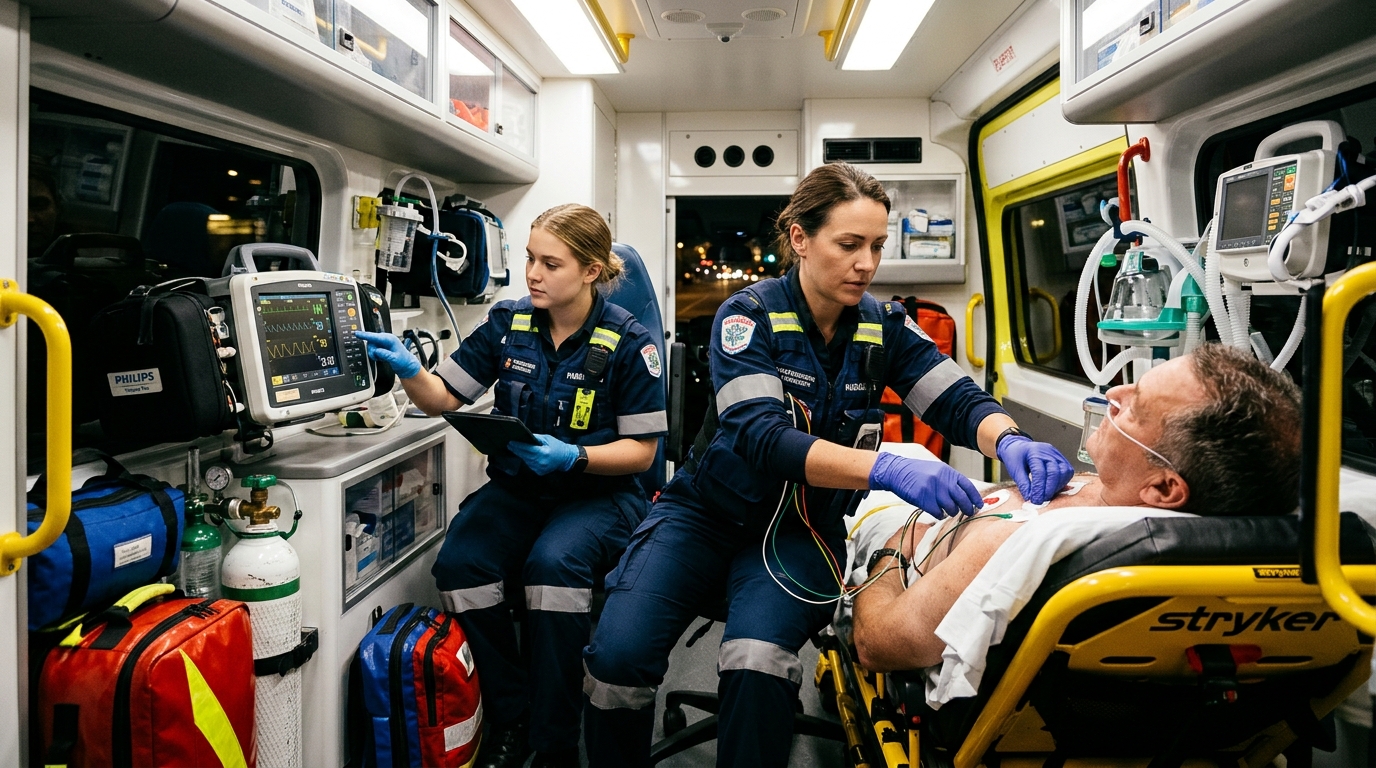
119 구급차 내에서 응급구조사가 환자에게 심전도를 부착하고 산소를 공급하며 스텐트 시술이 가능한 전문 병원으로 직송하는 모습. 흉통이 10~20분 이상 지속되면 즉시 119를 불러야 합니다.
3. 손가락 따다가 저세상 간다: 목숨을 앗아가는 4대 치명적 오판
심근경색으로 관상동맥이 꽉 막히면 2~3시간 안에 심장 근육이 죽기 시작하고, 24시간이 지나면 심장 조직 전체가 괴사해 되돌릴 수 없습니다. 그런데 우리나라 흉통 환자들이 병원에 도착하는 데 걸리는 시간은 여전히 골든타임을 훌쩍 넘깁니다. 다음의 4대 금기 행동 때문입니다.
금기 1: "체했나 보다" 바늘로 손 따고 우황청심환 먹기
손가락 끝을 따거나 찬물을 끼얹는 민간요법은 아까운 골든타임만 갉아먹습니다. 의식이 혼미한 환자에게 우황청심환을 억지로 먹이다가 기도가 막혀 질식하거나 혈압이 급변해 돌연사하는 사고가 매년 끊이지 않습니다.
금기 2: 자가용으로 운전해 가거나 가족 차 타고 가기
직접 운전대를 잡았다가 주행 중 의식을 잃고 심정지가 오면 대형 교통사고로 이어집니다. 또한 가족 차를 타고 갔다가 24시간 혈관 시술이 불가능한 작은 병원 응급실로 잘못 찾아가 재이송하느라 시간을 허비하는 치명적 실수가 빈번합니다.
금기 3: 동네 약국, 한의원, 1차 의원 경유하기
가슴이 아픈데 소화제나 파스를 사러 약국을 들르거나, 1차 병원을 들렀다가 큰 병원으로 옮기는 과정에서 사망률이 수배로 뜁니다. 흉통이 20분 이상 지속되면 무조건 119 구급차를 불러 24시간 관상동맥 중재술(PCI)이 가능한 최종 권역심뇌혈관센터로 직행해야 합니다.
금기 4: 물이나 음식물, 미확인 진통제 삼키기
병원에 도착하면 응급으로 관상동맥 중재 시술을 받아야 합니다. 이때 물이나 음식을 먹은 상태라면 시술 도중 구토를 일으켜 토사물이 기도로 넘어가는 흡인성 폐렴을 일으켜 생명을 위협받을 수 있습니다.
4. 생명을 살리는 응급 처치: '아스피린 씹어먹기'와 90분 골든타임
가슴 통증이 시작되었을 때 119를 부른 뒤 환자가 취해야 할 가장 안전한 자세는 상체를 비스듬히 세우고 편안하게 등을 기댄 상태로 앉는 것입니다. 넥타이와 벨트, 단추를 즉시 풀어 호흡을 돕고, 환자가 불안해하지 않도록 체온을 따뜻하게 유지해 주어야 합니다.
만약 집에 상비용 아스피린(100~300mg)이 있다면 물과 함께 꿀꺽 삼키지 말고, '입안에서 꼭꼭 씹어서' 복용하는 것이 의학적 공식 권고사항입니다. 씹어서 먹으면 위장에서 녹는 시간을 건너뛰어 점막으로 빠르게 흡수되어 관상동맥을 틀어막는 피떡(혈소판 엉김)을 훨씬 신속하게 차단할 수 있습니다. 단, 협심증 치료제인 니트로글리세린은 반드시 과거에 처방받은 본인의 약일 때만 혀 밑에 녹여 복용해야 하며, 남의 약을 함부로 먹으면 혈압 급락으로 위험에 빠질 수 있습니다.
병원 응급실에 도착하면 90분 이내에 손목(요골동맥)을 통해 가느다란 관을 넣어 막힌 심장 혈관에 약물 코팅 스텐트(DES)를 넣어 뚫어주어야 합니다. 최근 스텐트 시술의 발전으로 재협착률은 5~10% 수준으로 크게 떨어졌습니다.
환절기 아침, 잠에서 깨어나면 이불 속에서 2~3분간 손발을 뻗어 체온을 올린 뒤 천천히 일어나세요. 새벽 운동은 피하고 기온이 오른 낮 시간대에 모자와 목도리를 챙겨 걷는 작은 습관이 평생의 심장 혈관을 지키는 든든한 방패가 되어줍니다.
만인의 탑 심혈관 응급의학 전문 데스크 | 취재 및 집필: 신승엽 기자 (Seung Youb Ssin)
본 기사는 질병관리청 심뇌혈관질환 발생 통계, 건강보험심사평가원 보건의료빅데이터, 대한심혈관중재학회 임상 프로토콜 및 대학병원 순환기내과 전문의 검수를 거쳐 작성되었습니다.
Stepping out into the brisk morning air, a crushing weight suddenly bears down on the center of the chest like an immovable boulder. As cold sweat drenches the collar, many dismiss it as severe indigestion, pricking fingertips with needles or swallowing antacids before lying down. This tragic misjudgment costs hundreds of lives each season. Health Insurance Review and Assessment Service data reveals that acute myocardial infarction (AMI) cases surged by 16.8% over five years, approaching 140,000 annually. Crucially, vascular ruptures peak not merely in mid-winter, but during transitional seasons with 10-degree daily temperature swings and within the critical three-hour 'Morning Surge' post-awakening. Here is an exhaustive analysis of the physiological mechanics and the 90-minute golden window protocols.
Exposure to sudden morning cold triggers severe vasoconstriction and acute cardiac strain. The 'Morning Surge'—the rapid spike in blood pressure occurring within three hours of awakening—represents the most lethal trigger for cardiovascular rupture.
1. Seasonal Disparity: Peak Heart Attack Frequency in 8-10°C Temperature Swings
Public perception widely assumes that heart attacks strike most fiercely during sub-zero winter freezes. However, a ten-year epidemiological study linking National Health Insurance Service records with Meteorological Administration data shatters this misconception.
Evaluating incidence per 100,000 population across all four seasons, Spring recorded the highest frequency at 63.1 cases, followed by Winter (61.3), Autumn (59.5), and Summer (57.1). Monthly breakdowns demonstrated prominent incidence spikes in March during seasonal transition chills and early December as initial cold fronts descend.
10-Year Clinical Epidemiology on Acute Myocardial Infarction
- Highest seasonal rate: Spring (63.1 per 100k) > Winter (61.3) > Autumn (59.5)
- Primary environmental trigger: Daily temperature variance of 8-10°C
- Gender disparity: Men account for 25,944 cases vs women 9,025 cases (2.8-fold male predominance)
- Emergency reality: 30% initial mortality rate; 40% of chest pain fatalities occur prior to hospital arrival
Cardiovascular specialists attribute this vulnerability to an unacclimatized human vascular system encountering diurnal temperature fluctuations of 8 to 10 degrees. Transitioning from heated indoor rooms to crisp outdoor air abruptly stimulates the sympathetic nervous system, surging norepinephrine output, constricting peripheral arterioles, and spiking systemic blood pressure.
Interventional cardiologists performing percutaneous coronary intervention (PCI) under fluoroscopic guidance in a catheterization laboratory. Reopening occluded vessels within 90 minutes of emergency arrival prevents irreversible myocardial death.
2. The Waking Hazard: The 'Morning Surge' and Arterial Plaque Rupture
A substantial proportion of myocardial infarctions strike within three hours of waking from slumber—a medical phenomenon termed the 'Morning Surge'. Blood pressure naturally drops to its daily nadir during nocturnal sleep and rises upon waking to prepare the body for physical activity. However, when cold morning air contacts respiratory membranes and cutaneous receptors, blood pressure elevation escalates out of control.
When systolic blood pressure surges by more than 55 mmHg over nocturnal baselines, the risk of cardiovascular events and stroke compounds exponentially. Coupled with morning hemoconcentration and platelet hyperaggregability, hemodynamic turbulence tears open vulnerable, thin-capped atheromatous plaques lurking inside coronary arteries. Platelets adhere aggressively to the ruptured fissure, generating a massive occlusive thrombus in minutes that starves heart muscle of oxygenated blood.
Young adults in their twenties and thirties are increasingly vulnerable. Mild plaques narrowing lumen diameter by under 50% remain completely undetectable on standard resting ECG checkups. Yet under the stress of cold air, sleep deprivation, and smoking, these lipid-rich soft plaques rupture suddenly, transforming an asymptomatic individual into a cardiac arrest emergency without prior warning.
| Diagnostic Criteria |
Angina Pectoris |
Acute Myocardial Infarction |
Gastroesophageal Reflux (GERD) |
| Pain Quality |
Tight squeezing sensation, dull pressure |
Crushing, tearing, excruciating unbearable agony |
Burning retrosternal heartburn, sour sensation |
| Duration of Attack |
Typically under 5 minutes (rarely exceeds 10) |
Persists continuously for 20-30 minutes or longer |
Intermittent for dozens of minutes to several hours |
| Trigger Circumstance |
Exertion: climbing stairs, running, lifting |
Sudden onset at rest, during sleep, or post-waking |
Postprandial or when lying down flat |
| Therapeutic Response |
Prompt relief with rest or sublingual nitroglycerin |
Zero improvement with rest or nitroglycerin doses |
Gradual relief following antacids or water |
| Radiation Trajectory |
Mild radiation to jaw or left shoulder |
Violent radiation to left arm, neck, jaw, back, epigastrium |
Radiation to shoulders or back is extremely rare |
| Accompanying Signs |
Mild shortness of breath |
Profuse cold drenching sweat, pallor, vomiting, syncope |
Acid regurgitation, globus sensation |
Paramedics in a dedicated emergency ambulance attaching twelve-lead electrocardiography and administering supplemental oxygen while en route to a specialized cardiac center. Calling emergency services immediately is paramount.
3. Deadly Misconceptions: 4 Prohibited Acts That Waste Golden Hours
When a coronary artery is completely blocked, cellular necrosis begins within two to three hours and becomes total across all myocardium layers by 24 hours. Tragically, patients frequently exhaust their golden window due to these four lethal missteps:
Mistake 1: Relying on Folk Remedies Like Needle-Pricking and Herbal Pills
Pricking fingers or splashing cold water consumes irreplaceable time. Forcing herbal pills down the throat of a semi-conscious patient frequently causes airway obstruction, pulmonary aspiration, and fatal hemodynamic collapse.
Mistake 2: Self-Driving or Relying on Family Vehicles
Driving while experiencing acute cardiac ischemia invites sudden syncope and fatal traffic collisions. In addition, private vehicles frequently arrive at primary hospitals incapable of emergency catheterization, wasting critical hours during secondary transfers.
Mistake 3: Detouring Through Local Pharmacies and Clinics
Stopping at pharmacies for digestive pills or visiting local clinics delays primary percutaneous coronary intervention. Any crushing chest discomfort exceeding 10 to 20 minutes demands an instant call to emergency services.
Mistake 4: Ingesting Food, Water, or Unverified Painkillers
Emergency angiography and intervention require an empty stomach. Ingesting fluids or solids induces vomiting during acute sedation, precipitating deadly aspiration pneumonia.
4. Life-Saving Protocol: Chewing Aspirin and the 90-Minute Golden Reperfusion
While awaiting the ambulance, place the patient in a semi-seated posture with the back elevated and supported, easing ventricular preload. Loosen all constricting neckties, belts, and collars immediately, keeping the environment warm and reassuring.
If standard chewable aspirin (100-300mg) is available and no bleeding allergies exist, the patient should chew the tablet thoroughly without water before swallowing. Chewing bypasses stomach dissolution, achieving swift buccal and gastric absorption that halts ongoing platelet aggregation within minutes. Sublingual nitroglycerin should solely be administered if specifically prescribed to that individual.
Upon arrival at the emergency catheterization suite, interventional teams target completing primary PCI within 90 minutes. Modern drug-eluting stents (DES) deployed into the culprit lesion have suppressed restenosis rates to 5-10%, restoring vital coronary flow.
During seasonal shifts, adopt the habit of stretching under the blankets for two minutes upon waking to gently elevate core temperature before standing. Replacing early morning outdoor runs with afternoon walks and shielding the neck, head, and hands with scarves and hats forms an impenetrable shield around your cardiovascular longevity.
MANINTOP Cardiovascular & Emergency Medicine Desk | Reporting & Writing: Seung Youb Ssin, Senior Reporter
This investigative report was cross-verified using epidemiological data from the Korea Disease Control and Prevention Agency (KDCA), HIRA healthcare big data, clinical guidelines from the Korean Society of Interventional Cardiology, and reviews by university hospital cardiologists.