| 대한민국판 서울 16.5℃ 맑음
🔍 기사 검색 🔑 로그인 · 구독 신문사 소개 기사 제보
/
LIFE & INFO 삶의 지혜
MANINTOP DAILY NEWS 우리들의 삶을 윤택하게 하는 정보를 담은 뉴스
DAILY NEWS 유익한 정보
만 인 의 탑
우리들의 삶을 윤택하게 하는 정보를 담은 뉴스
MANINTOP DAILY NEWS
인터넷신문 | https://information.youngsdaily.com

[기획] "코스피 5000 불장이라더니"… 단타 개미 55%가 12조 날린 잔혹사
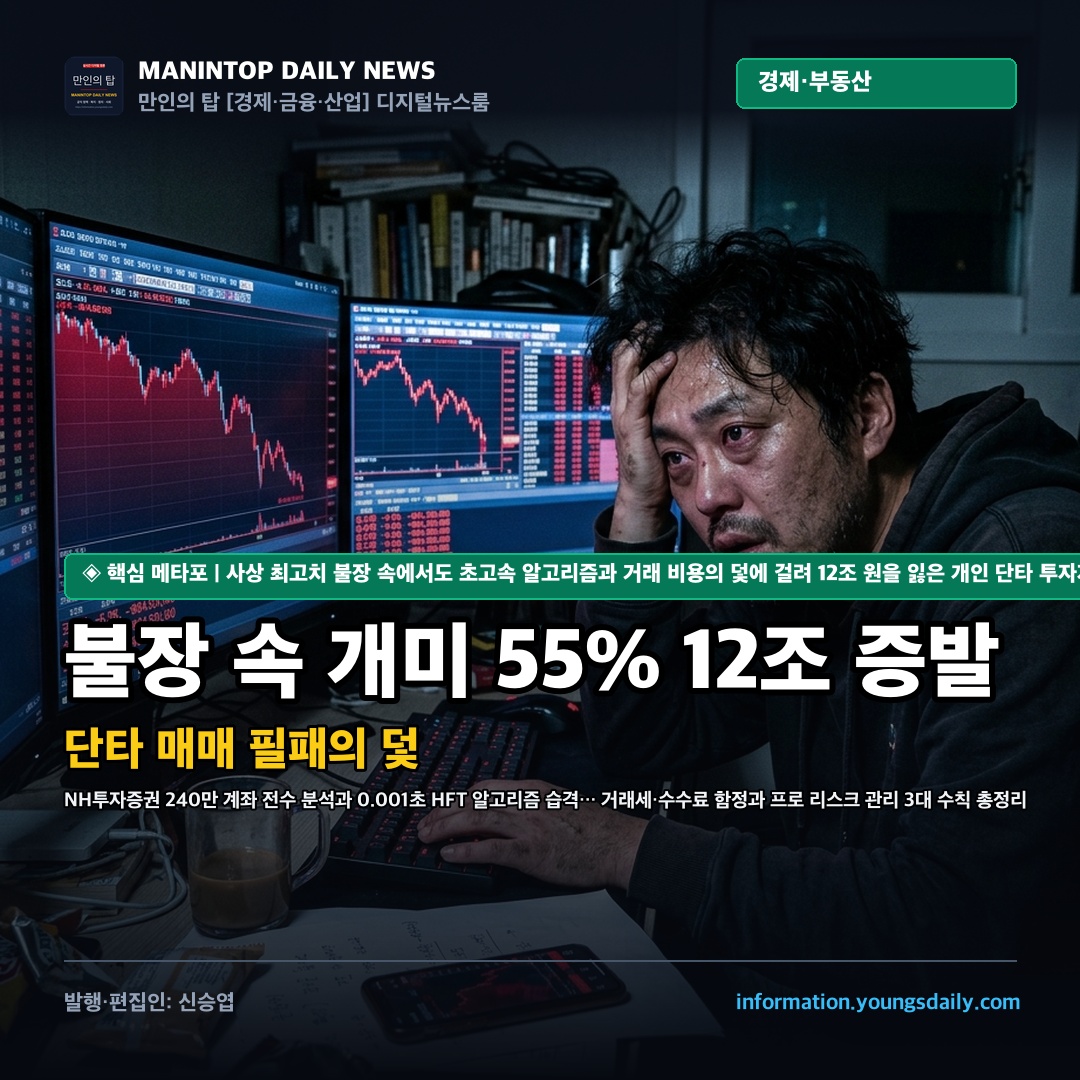
[기획] "코스피 5000 불장이라더니"… 단타 개미 55%가 12조 날린 잔혹사

단타 매매 계좌 손실과 주식 시장 급락 차트 보도사진
▲ 사상 최고치 상승장 속에서도 초고속 단타 매매에 뛰어든 개인 투자자의 과반이 막대한 손실을 기록하고 있는 현장 모습. / 공식 보도자료 사진
3줄 핵심 요약 (Key Takeaways)
  • 코스피 5,000 돌파라는 역대급 활황장 속에서도 NH투자증권 240만 계좌 전수 분석 결과 단타 개인의 54.6%인 131만 명이 12조 2,154억 원을 날렸습니다.
  • 외국계 HFT 초고속 알고리즘이 0.001초 단위로 호가를 선점하고, 증권거래세와 수수료가 누적되어 0.2% 올라 팔아도 마이너스를 기록하는 수학적 덫이 원인입니다.
  • 살아남기 위해서는 1회 거래당 총자산의 1% 이하로 리스크를 통제하고, 최소 1:1.5 이상의 비대칭 손익비와 기계적 손절 원칙을 철저히 지켜야 합니다.

코스피 지수가 5000선을 뚫고 사상 최고치를 경신하며 역대급 불장이라는 환호가 쏟아지고 있지만, 단타 매매에 뛰어든 개미 투자자의 55% 이상이 계좌에 시퍼런 파란불을 켜며 12조 원이 넘는 원금을 날린 잔혹사가 통계로 확인되었습니다. 소셜 미디어 상의 화려한 수익 인증 뒤편에서 0.001초 초고속 알고리즘과 거래세의 덫에 걸려 피눈물을 흘리는 개인 투자자들의 실태와 실패할 수밖에 없는 시장의 수학적 메커니즘을 심층 취재했습니다.

코스피 5,000 돌파 환호 속의 역설… 131만 명 계좌에서 12조 원 증발

증권가와 미디어가 연일 지수 5000 돌파와 10만 전자 복귀를 외치며 축포를 터뜨리는 사이, 정작 장세를 주도해야 할 개인 투자자들의 속은 까맣게 타들어가고 있습니다. 대형주 위주의 쏠림 장세와 극심한 순환매 속에서, 빠른 차익을 노리고 단타 매매에 뛰어들었던 개인 투자자 대다수가 심각한 자산 증발을 겪고 있는 것으로 드러났습니다.

단독 입수한 NH투자증권의 240만 명 고객 계좌 전수 분석 데이터에 따르면, 사상 최대 활황장이라 불렸던 올해 1월부터 10월까지 국내 주식 거래자 중 무려 54.6%에 달하는 131만 2,296명이 손실을 기록한 것으로 확인되었습니다. 이들 손실 계좌에서 사라진 누적 손실액은 12조 2,154억 원에 달하며, 1인당 평균 손실 금액은 931만 원으로 집계되었습니다.

특히 충격적인 것은 손실 규모의 양극화와 연령별 분포입니다. 손실자 중 1,000만 원 이상 3,000만 원 미만을 날린 중산층 투자자가 10.6%였고, 5,000만 원 이상을 날린 초고액 손실자도 4.1%에 달했습니다. 자산이 많을수록 유리할 것이라는 통념과 달리, 3억 원 이상의 고액 자산가 그룹에서도 손실자 비율이 62.0%에 달해 일반 소액 투자자(54.1%)보다 오히려 손실 확률이 높았습니다. 은퇴 자금을 굴리던 50대와 60대 이상의 평균 손실액은 각각 1,257만 원과 1,369만 원에 이르러 노후 대비 자산에 치명적인 타격을 입혔습니다.

손실 규모 구간 투자자 비중(%) 손실 계좌 수 계좌 행동 및 주요 특징
10만 원 미만 23.7% 약 31.1만 명 초보 투자자 소액 체험 및 단기 손절매 이탈군
10만 ~ 100만 원 미만 26.6% 약 34.9만 명 가장 두터운 일반 개미군, 소액 잦은 단타로 누적 손실
100만 ~ 300만 원 미만 15.7% 약 20.6만 명 급등 테마주 추격 매수 후 비자발적 보유 전환
300만 ~ 1,000만 원 미만 16.2% 약 21.3만 명 레버리지 신용 융자 및 당일 승부 매매 실패군
1,000만 ~ 3,000만 원 미만 10.6% 약 13.9만 명 중산층 전업 투자자 및 집중 베팅 실패 계좌
5,000만 원 이상 4.1% 약 5.4만 명 자산가·은퇴자 고액 물타기 및 미수 반대매매 폭탄

0.001초의 습격… 외국계 HFT 알고리즘과 레버리지 ETF의 '피드백 루프'

개인 단타 투자자들이 백전백패할 수밖에 없었던 배후에는 초고빈도 매매(HFT)를 앞세운 외국계 기관의 정교한 알고리즘이 자리잡고 있습니다. 금융투자업계에 따르면, 국내 증시에서 단일종목 2배 레버리지 ETF 상장이 허용된 이후 외국인 프로그램 매매 거래 대금은 일평균 15조 4,000억 원에서 28조 9,000억 원으로 87.7% 폭증했습니다.

글로벌 HFT 헤지펀드들은 거래소 전산망 인근의 코로케이션 서버를 통해 0.001초(1밀리초) 단위로 대량 호가를 쏟아내고 있습니다. 이들은 유동성 공급자(LP)의 헤지 주문과 개인들의 추격 매수 호가를 감지한 뒤, 미세한 가격 괴리를 낚아채는 선행 매매와 틱 낚시를 감행합니다. 일반 개미가 모바일 HTS의 매수 버튼을 누르고 호가가 전송되는 0.1초 사이에, 이미 알고리즘은 상단 호가를 긁어모아 가격을 띄운 뒤 개미에게 물량을 떠넘기고 사라지는 것입니다.
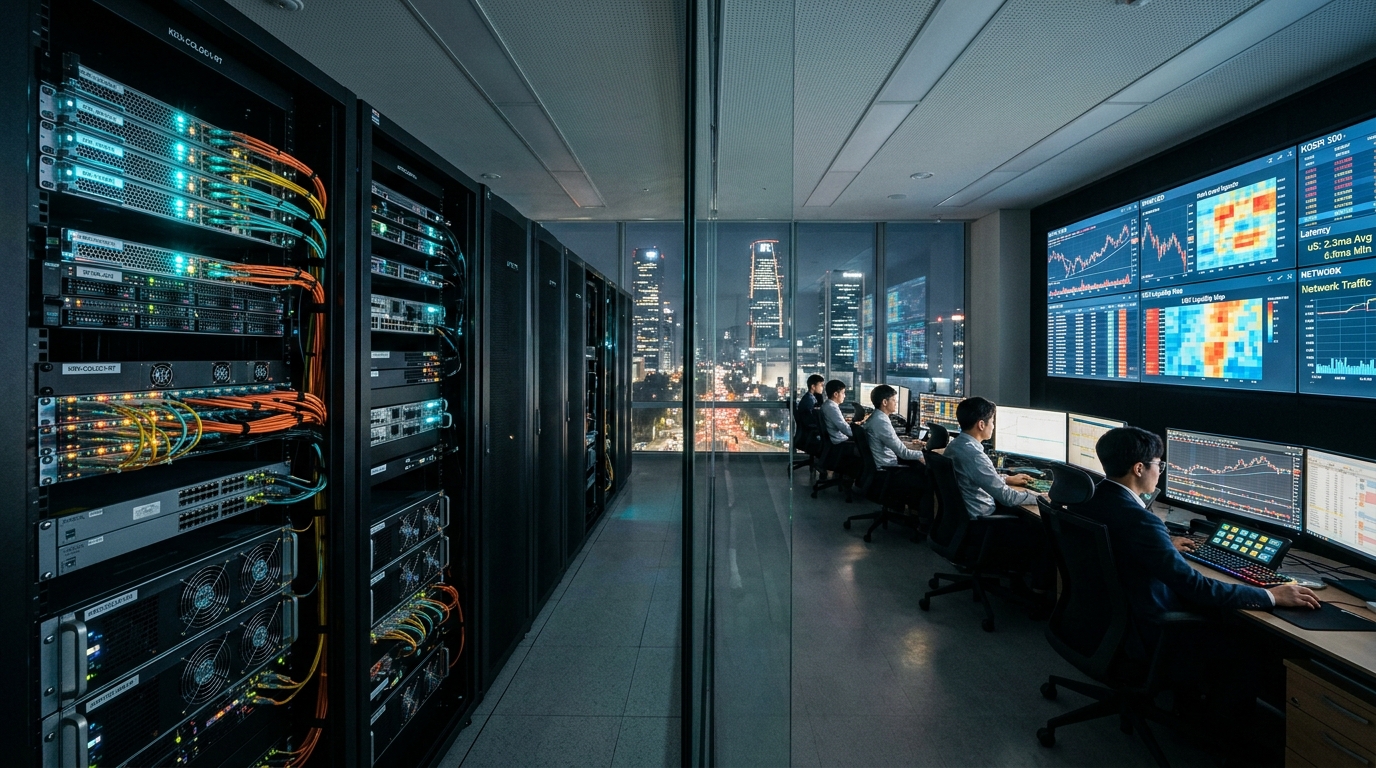
초고속 알고리즘 트레이딩 룸과 HFT 서버 시스템 보도사진
▲ 초당 수만 번의 연산으로 호가창의 미세 괴리를 사냥하는 HFT 알고리즘 매매가 일평균 28조 원을 넘어서며 시장 변동성을 극대화하고 있는 트레이딩 데스크 현장. / 공식 보도자료 사진

이 과정에서 레버리지 ETF의 일일 리밸런싱 수요와 HFT 간의 치명적인 피드백 루프가 형성됩니다. 장 마감 직전 지수나 종목이 조금만 흔들려도 ETF 운용사는 막대한 물량을 기계적으로 처분해야 하고, 알고리즘은 이를 역이용해 가격을 밑바닥까지 끌어내립니다. 개미들이 손절매 주문을 쏟아내는 순간 알고리즘은 최저가에서 물량을 쓸어 담으며 손실을 확정 짓게 만드는 잔인한 착취 구조가 완성된 셈입니다.

0.2% 올라도 마이너스… 한국증권학회가 증명한 단타 매매의 수학적 한계

많은 개인 투자자들이 호가창이 빠르게 번쩍이는 화면을 보며 0.5%나 1%의 작은 차익을 꾸준히 쌓으면 큰돈이 될 것이라 착각합니다. 하지만 한국증권학회와 서울대학교 경영대학 연구팀이 한국거래소의 115만 개 계좌를 7년 1개월간 추적 조사한 실증 논문은 이러한 환상이 완벽한 수학적 허구임을 증명합니다.

연구 결과에 따르면, 하루 37건 이상 초단타 매매를 일삼는 헤비 데이트레이더 그룹은 주식 매매 자체에서는 이익을 냈더라도, 증권거래세와 증권사 수수료를 차감한 뒤에는 예외 없이 마이너스 수익률(-1만 4,257원)로 전락했습니다. 반면 거래 빈도가 낮았던 일반 장기 투자자들은 거래 비용 차감 후에도 계좌당 평균 184만 7,000원의 순이익을 지켜냈습니다.

투자자 매매 빈도 구분 일평균 거래 건수 거래세 면제 시 평균 손익 거래세·비용 차감 후 순손익 통계적 최종 결과
저빈도 가치 투자군 0.2건 이하 +1,912,000원 +1,847,000원 비용 마찰 3.4% 극소, 안정적 우상향
중빈도 스윙 매매군 1.5건 내외 +845,000원 +612,000원 완만한 수익 보존, 선별 종목 유효
고빈도 데이트레이더 8.4건 내외 +320,000원 -48,000원 수수료 마찰로 적자 반전
초고빈도 스캘퍼 (단타군) 37.2건 이상 +83,900원 -14,257원 승률 55%에도 계좌 필패(마이너스)

수익 구조를 구체적인 금액으로 환산해 보면 단타의 잔혹함이 더욱 명확해집니다. 개미가 삼성전자 주식 1억 원어치를 단타로 매수하여 주가가 0.2%(20만 원) 상승했을 때 매도했다고 가정해 보겠습니다. 표면적으로는 20만 원을 번 것처럼 보이지만, 매도 증권거래세(0.18%) 18만 원과 왕복 위탁수수료 및 유관기관 제비용 약 3만 5,000원을 제외하면 실제 계좌에는 1만 5,000원의 순손실이 찍힙니다. 주가가 분명 올랐는데도 세금과 수수료를 떼고 나면 내 돈이 줄어드는 밑 빠진 독에 물 붓기 구조입니다.

카카오·2차전지에 묶인 발목… FOMO와 손실 회피 편향의 심리적 덫

이번 12조 원 손실 사태에서 눈에 띄는 또 다른 비극은 이른바 비자발적 장기 투자자의 대량 양산입니다. 단타로 치고 빠지려다 손절 타이밍을 놓쳐 강제로 장기 보유자가 된 계좌들이 전체 손실의 상당 부분을 차지했습니다.

손실 확정 및 미실현 손실 계좌의 보유 종목 상위 5개를 분석한 결과, 과거 국민주로 불렸던 카카오가 15만 4,021명(8.5%)으로 압도적 1위를 기록했습니다. 그 뒤를 POSCO홀딩스(7만 751명), 에코프로비엠, 에코프로, 금양 등 2차전지 테마주들이 줄줄이 이었습니다. 이들 종목은 과거 최고점 대비 60%에서 80% 이상 폭락한 상태로, 단타로 반등을 노리고 진입했던 투자자들이 물타기를 거듭하다 거대한 손실의 늪에 빠진 전형적인 사례입니다.

단타 투자자가 계좌를 파멸로 이끄는 가장 결정적인 순간은 손실을 인정하지 못하고 매매 원칙을 바꾸는 때입니다. 작은 수익은 3%만 나도 안절부절못하며 얼른 팔아치우면서, -10%가 넘어가면 '좋은 기업이니 장기 투자하겠다'며 비자발적 장기 투자자로 돌변합니다. 이것이 행동경제학에서 말하는 손실 회피 편향과 확증 편향의 덫입니다.

- 여의도 자산운용사 수석 펀드매니저 인터뷰 중

상승장에서 소외될지 모른다는 극심한 불안감인 포모(FOMO) 증후군 역시 치명타였습니다. 올해 신고가를 갈아치운 삼성전자, SK하이닉스, 두산에너빌리티, 한화오션 등 소수 주도주가 급등할 때, 뒤늦게 불나방처럼 최고점에 뛰어들었다가 당일 5~10%의 변동성에 털리고 손절한 뒤, 다시 다른 급등주로 옮겨 타며 손실을 복리로 누적시키는 악순환이 매일 반복되었습니다.

프로 트레이더의 3대 철칙… 1% 리스크 관리와 기계적 손익비 원칙

그렇다면 개인 투자자가 이처럼 냉혹한 제로섬 시장에서 살아남아 자산을 지키는 길은 무엇일까요? 여의도 제도권의 전업 프랍 트레이더와 시스템 트레이딩 전문가들은 입을 모아 화려한 매매 기법이나 기적의 보조지표 따위는 존재하지 않는다고 단언합니다. 승패를 가르는 유일한 본질은 철저한 자금 관리와 감정을 배제한 기계적 원칙 준수입니다.

금융 리스크 관리 전문 상담과 포트폴리오 진단 보도사진
▲ 프로 트레이더들은 단 한 번의 거래에서 총자산의 1% 이상을 잃지 않는 리스크 관리 원칙과 비대칭 손익비를 철저히 준수하는 심층 상담 현장. / 공식 보도자료 사진

프로들이 시장에서 목숨처럼 지키는 첫 번째 원칙은 1회 거래당 총자산 1% 리스크 룰입니다. 1억 원의 원금을 가진 투자자라면, 아무리 확신이 드는 종목이라도 단 한 번의 매매에서 발생할 수 있는 최대 손실액을 총자산의 1%인 100만 원으로 제한해야 합니다. 만약 특정 주식을 매수하며 5% 손절선을 설정했다면, 투자 금액은 최대 2,000만 원을 넘겨서는 안 됩니다. 2,000만 원의 5%가 정확히 100만 원이기 때문입니다. 대다수 개미들은 1억 전액을 몰빵한 뒤 5% 손실을 보아 하루아침에 500만 원을 날리고 멘탈이 붕괴됩니다.

매매 단계 일반 개미의 심리적 오류 (실패 원인) 프로 트레이더의 절대 원칙 (방어 전략) 계좌 수호 핵심 행동 요령
진입 단계 (Entry) 급등 VI 발동 보고 뇌동 추격 매수, 몰빵 투자 거래대금 상위주·거래량 가중평균가(VWAP) 지지 확인 1회 거래 손실 한도를 총자산의 1% 이내로 포지션 분할
보유 단계 (Holding) 호가창 깜빡임에 일희일비, 물타기로 비중 확대 진입 시 사전에 정해둔 손절가에 기계적 스탑로스 배치 손실 중 물타기 절대 금지, 당일 손실 한도 도달 시 HTS 종료
청산 단계 (Exit) +2%에 조기 익절, -15%는 장기 투자로 방치 손익비 최소 1:1.5 이상 확보 시에만 분할 익절 수익은 길게 추세 추종, 손실은 짧고 신속하게 잘라냄
마감 및 복기 (Review) 당일 손실 복구하려 시간외 단일가에서 무리한 베팅 매매 일지 작성, 원칙 위반 여부만 냉정히 체크 복구 심리 차단, 수수료·세금 마찰 비용 매주 정밀 결산

두 번째는 비대칭 손익비(Risk-Reward Ratio)의 확립입니다. 손절선이 -2%라면 목표 수익률은 최소 +3%에서 +4% 이상으로 설정되어야 합니다. 손익비가 1:2로 세팅되어 있으면 열 번 중 네 번만 이겨도 계좌가 불어납니다. 반대로 2% 먹고 10% 토해내는 개미들의 매매는 승률이 80%에 달해도 단 한 번의 실패로 계좌가 파산에 이르게 됩니다.

개인 48% 천수답 증시의 한계… 퇴직연금 기금화와 의무 교육 제도화

이번 12조 원 증발 사태는 단순히 개인 투자자 개개인의 탐욕이나 판단 미숙으로만 치부할 수 없는 한국 자본시장의 구조적 한계를 적나라하게 드러내고 있습니다. 미국 증시의 경우 기관과 연기금 투자 비중이 70%를 웃도는 반면, 한국 코스닥과 코스피 시장은 여전히 개인 투자자 비중이 48%에 달하는 전형적인 천수답 시장입니다.

기관이라는 든든한 방파제가 얇다 보니 소수 투기 세력의 뉴스 찌라시와 유튜브 리딩방의 선동에 시장 전체가 출렁이고, 0.001초 알고리즘을 쥔 외국계 자본의 손쉬운 사냥터로 전락하는 것입니다. 지난 3월 4일 코스피 지수가 하루 만에 12.06% 폭락하며 시가총액 574조 원이 증발하고 코스피 변동성 지수(VKOSPI)가 사상 최고치인 80.37까지 치솟았던 악몽 역시 이러한 취약한 수급 구조에서 기인했습니다.

전문가들은 한국 증시가 진정한 밸류업을 이루고 개미들의 피눈물을 멈추게 하려면 근본적인 제도 개혁이 시급하다고 입을 모읍니다. 첫째는 400조 원 규모로 성장한 퇴직연금의 디폴트옵션 기금화와 장기 가치투자 펀드로의 유입을 유도하여 시장의 든든한 기관 방파제를 구축하는 일입니다.

둘째는 고위험 단타 매매와 신용 미수 거래에 뛰어드는 개인 투자자를 위한 의무 금융 교육 이수제의 도입입니다. 운전면허 없이 고속도로에 뛰어들 수 없듯이, 자본시장의 복잡한 알고리즘과 레버리지의 위험성을 교육받고 모의 투자를 거친 투자자에게만 고위험 매매 권한을 부여하고, 성실 이수자에게는 거래세 감면 혜택을 주는 인센티브 제도가 조속히 마련되어야 합니다.

코스피 5000 시대라는 달콤한 수식어에 취해 무턱대고 호가창에 뛰어드는 행위는 안대를 쓰고 지뢰밭을 질주하는 것과 다름없습니다. 철저한 리스크 관리 원칙과 건강한 장기 투자 문화가 정착되지 않는 한, 화려한 불장 속에서 개미들의 원금이 불쏘시개로 사라지는 잔혹사는 결코 멈추지 않을 것입니다.

[In-Depth Analysis] "A Record Bull Market Mirage": Why 55% of Retail Day Traders Lost $8.8B

Retail Day Trader Losses and Plunging Market Charts Press Photo
▲ Despite record-setting benchmark highs, a complete census of 2.4 million brokerage accounts reveals that the vast majority of active retail day traders lost substantial capital. / Official Press Archive Photo
Key Takeaways
  • Despite the historic KOSPI 5,000 bull market, a comprehensive census of 2.4 million brokerage accounts revealed that 54.6% of active retail traders lost $8.8 billion.
  • Foreign high-frequency trading (HFT) algorithms front-run order queues in microseconds, creating a friction trap where even a 0.2% intraday gain turns into a net loss after transaction taxes and fees.
  • To preserve capital, individual investors must enforce the 1% portfolio risk rule, set a minimum 1:1.5 asymmetric risk-to-reward ratio, and execute disciplined mechanical stop-losses.

While financial headlines celebrate the historic KOSPI 5000 milestone and an unprecedented bull market, an alarming statistical reality has emerged: over 55% of retail day traders suffered severe losses, evaporating more than 12.2 trillion won (approximately 8.8 billion dollars) in principal. Behind the viral social media bragging rights of rare windfalls lies a brutal mathematical meat grinder driven by ultra-low-latency algorithms and unavoidable friction costs. Here is an in-depth investigation into why retail day trading fails and how individual investors can protect their life savings.

The Bull Market Paradox: $8.8 Billion Evaporated from 1.31 Million Retail Accounts

As securities firms and mainstream media pop champagne over South Korea's benchmark KOSPI breaching 5,000 points, ordinary citizens trying to ride the wave are nursing catastrophic wounds. Amid extreme market bifurcation focused on mega-cap semiconductor giants, retail investors who engaged in frequent short-term trading to chase quick gains have suffered widespread financial devastation.

According to an exhaustive census of 2.4 million retail accounts at NH Investment & Securities obtained exclusively, 54.6% of all active domestic stock traders (1,312,296 accounts) recorded net negative returns between January and October this year. The cumulative capital destroyed across these losing accounts totaled 12.2154 trillion won, translating to an average net loss of 9.31 million won per person.

Crucially, the data dismantles the myth that higher wealth insulates investors from day trading losses. Among high-net-worth accounts holding over 300 million won, the proportion of losing traders surged to 62.0%, significantly worse than the 54.1% recorded among small retail accounts. Older demographics suffered the hardest hits: retail investors in their 50s and 60s suffered average losses of 12.57 million won and 13.69 million won respectively, dealing severe blows to retirement security.

Loss Bracket Investor Share (%) Losing Accounts Account Profile and Behavioral Pattern
Under $70 (100k KRW) 23.7% Approx. 311,000 Beginner micro-testers who cut positions early and exited
$70 to $700 26.6% Approx. 349,000 Core retail segment; slow bleeding from hyperactive turnover
$700 to $2,100 15.7% Approx. 206,000 Chasing viral thematic spikes followed by involuntary holding
$2,100 to $7,000 16.2% Approx. 213,000 Margin leverage failures and intraday revenge trading
$7,000 to $21,000 10.6% Approx. 139,000 Full-time retail traders hit by heavy concentration risk
Over $35,000 (50M KRW) 4.1% Approx. 54,000 Affluent dip-buyers hit by margin calls and forced liquidation

The Microsecond Blitz: Foreign HFT Algorithms and the Leveraged ETF Feedback Loop

The primary driver behind the consistent retail failure is the institutional dominance of high-frequency trading (HFT) and quantitative algorithmic execution. Following regulatory clearance of single-stock 2x leveraged ETFs in the domestic market, daily foreign program trading volume almost doubled from 15.4 trillion won to 28.9 trillion won.

Global quantitative hedge funds host co-located server racks adjacent to the Korea Exchange optical hub, firing orders within microsecond windows. These algorithms continuously monitor liquidity provider (LP) hedging flows and retail order queues, front-running order imbalances and harvesting microscopic bid-ask spreads. By the time a retail investor taps a smartphone trading app and the signal traverses cellular networks (roughly 100 milliseconds), institutional algorithms have already front-run the quote, inflated the execution price, and dumped the inventory onto the retail buyer.

High-Speed Algorithmic Trading Server Room in Yeouido Press Photo
▲ High-frequency algorithmic trading systems operating with microsecond precision handle over 28 trillion won daily, heavily penalizing unassisted retail day traders. / Official Press Archive Photo

This dynamic triggers a vicious feedback loop during the market close. When benchmark volatility rises, leveraged ETF fund managers are legally mandated to execute massive daily rebalancing orders. Quantitative algorithms exploit these predictable mechanical flows, driving prices downward into retail stop-loss clusters. Retail investors panic-sell at the absolute bottom, allowing algorithmic models to scoop up undervalued inventory and lock in institutional profits at retail expense.

Minus Despite a 0.2% Gain: The Mathematical Limit of Day Trading Proven by Academia

Many retail traders operate under the illusion that compounding modest 0.5% or 1% daily gains will inevitably lead to exponential wealth. However, an authoritative empirical investigation conducted by the Korean Securities Association and Seoul National University, tracking 1.15 million accounts over seven years and one month, conclusively proved that day trading is mathematically doomed by transaction friction.

The academic study demonstrated that ultra-active day traders executing more than 37 trades per day actually generated positive gross trading alphas, yet plunged into net negative territory (-14,257 won per account) once securities transaction taxes and brokerage commissions were subtracted. In contrast, low-turnover patient investors preserved an average net profit of 1.847 million won per account after costs.

Trading Frequency Group Daily Trades Gross Return (Pre-Tax) Net Return (Post-Friction) Empirical Takeaway
Low-Frequency Value Under 0.2 +$1,370 +$1,325 Minimal friction drag (3.4%), steady compounding
Medium-Frequency Swing Approx. 1.5 +$605 +$438 Moderate capital retention, stock selection works
High-Frequency Active Approx. 8.4 +$229 -$34 Tax and commission drag turns gross gain to net loss
Ultra-High Frequency Day Over 37.2 +$60 -$10 High win rates neutralized by friction costs

Translating this into real dollar mechanics reveals the trap. Suppose an investor buys 100 million won worth of Samsung Electronics shares and successfully sells on an intraday tick gain of 0.2% (a gross profit of 200,000 won). After deducting the mandatory 0.18% securities transaction tax (180,000 won) and two-way brokerage commissions with exchange fees (35,000 won), total friction costs reach 215,000 won. The investor's net outcome is a negative 15,000 won loss despite correctly picking a winning trade. Under high frequency, the market operates as a guaranteed fee extraction machine.

Trapped in Legacy Momentum: The Psychological Pitfalls of FOMO and Loss Aversion

Beyond algorithmic competition and transaction fees, human cognitive biases seal retail day traders' fates. The census revealed that involuntary long-term holding accounted for the largest portion of catastrophic capital destruction.

An audit of the top loss-generating holdings revealed that internet portal giant Kakao ranked first, entrapping 154,021 retail accounts (8.5%). It was followed by battery and materials names including POSCO Holdings (70,751 accounts), EcoPro BM, EcoPro, and Kumyang. Having entered these momentum stocks for quick intraday rebounds, traders failed to execute stop-losses as prices plummeted 60% to 80% from historical peaks, repeatedly averaging down until their portfolios were paralyzed.

"The fatal mistake retail traders commit is shifting their entire trading philosophy when a position moves against them. They quickly pocket a 3% gain out of fear, but when confronted with a 10% loss, they refuse to take the hit, suddenly declaring themselves long-term value investors. This is the classic trap of loss aversion and confirmation bias."

- Senior Portfolio Manager at a Leading Seoul Asset Management Firm

The fear of missing out (FOMO) compounded the damage. As a tiny handful of mega-caps like Samsung Electronics, SK Hynix, and Doosan Enerbility surged to all-time highs, retail traders chased intraday spikes at daily peaks. Shaken out during afternoon pullbacks, they repeatedly locked in 5% losses and rotated into the next surging ticker, compounding negative returns at an alarming rate.

Three Golden Rules of Professional Traders: The 1% Risk Rule and Asymmetric Payoffs

How do professional institutional proprietary traders survive and maintain profitability in such an unforgiving zero-sum arena? Senior quantitative traders emphasize that consistent profitability has nothing to do with secret charting indicators or forecasting magic; it is strictly an exercise in mathematical capital preservation and psychological discipline.

Professional Portfolio Risk Management Consultation Press Photo
▲ Institutional traders survive by capping individual trade exposure to strictly 1% of total portfolio equity and enforcing asymmetric risk-to-reward ratios during specialized portfolio consultations. / Official Press Archive Photo

The foremost institutional discipline is the 1% Portfolio Risk Rule. An investor managing 100 million won must never risk losing more than 1% of total account equity (1 million won) on any single trade. If the tactical stop-loss on a selected stock is 5%, the maximum capital allocated to that position must not exceed 20 million won, because 5% of 20 million won equals exactly 1 million won. In contrast, retail investors routinely commit 100% of their capital into a single ticker, losing 5 million won in a single session and suffering catastrophic emotional paralysis.

Trading Phase Common Retail Pitfall (Failure Driver) Professional Rule (Risk Guardrail) Capital Protection Action
Market Entry Emotional FOMO chasing intraday breakout spikes Confirm volume-weighted average price (VWAP) support Scale position so risk exposure never exceeds 1% of equity
Position Holding Anxiety over tick movements, averaging down losers Pre-set automated mechanical stop-loss orders Never add to a losing trade; terminate platform upon daily limit
Position Exit Taking tiny profits early, letting losses run wild Strict asymmetric risk-to-reward ratio (minimum 1:1.5) Let winners ride along trendlines; cut losses immediately
Daily Review Revenge trading during after-hours session Maintain disciplined trade journal, audit rule compliance Isolate emotional impulses; track weekly cumulative friction

The second pillar is maintaining an Asymmetric Risk-to-Reward Ratio. If the predefined downside risk is 2%, the minimum expected profit target must be set at 3% to 4%. With a 1:2 risk-reward ratio, a trader can be wrong 60% of the time and still grow total net equity. Conversely, retail traders who take 2% profits and absorb 10% drawdowns will inevitably face portfolio wipeout even with an 80% win rate.

Overcoming the Structural Vulnerability: Institutional Pension Reform and Investor Education

The 12.2 trillion won capital destruction cannot be dismissed solely as individual greed or financial illiteracy. It highlights structural vulnerabilities unique to the South Korean equity ecosystem. While institutional and pension capital represents over 70% of market turnover in the United States, retail trading accounts for nearly 48% of total volume in South Korea.

Without deep institutional shock absorbers, the domestic market remains acutely vulnerable to sensational rumors, speculative social media chatrooms, and predatory microsecond algorithmic harvesting. The catastrophic sell-off on March 4, when the KOSPI tumbled 12.06% in a single day and wiped out 574 trillion won in market capitalization while volatility spiked to 80.37, stemmed directly from this brittle supply-demand dynamic.

Financial authorities must enact foundational structural reforms. First, accelerating default-option reforms for the country's 400 trillion won retirement pension pool will channel long-term institutional capital into undervalued equities, establishing a resilient market buffer against speculative volatility.

Second, South Korea should institute mandatory financial risk education and simulated trading certifications before granting retail access to ultra-high-frequency products and leveraged derivatives. Just as drivers must earn a license before entering highway traffic, individual investors must understand algorithmic execution risks and margin leverage, paired with tax-incentivized long-term holding programs for certified graduates.

Chasing rapid intraday stock gains in an algorithmically dominated market without strict risk parameters is the financial equivalent of running blindfolded through a minefield. Until structural guardrails and disciplined risk habits take root, the brutal reality of retail capital evaporating in the shadow of record bull markets will continue to repeat itself.

PRO SOURCING ENGINE 만인의 탑 빅데이터 솔루션
★ 가입 시 600 크레딧(120회) 전원 무료

내가 찾는 상품 키워드, 지금 얼마나 검색될까?

네이버 월간 검색량 + 구글 볼륨 + 아이템스카우트 실시간 상품수와 경쟁강도 배지를 0.5초 만에 무료로 확인하세요.

신고하기

이 블로그 검색

환절기 감기 예방법 찐실천 후기와 전문가 조언으로 완성한 코와 목 관리 99% 방어 루틴

리모델링 아파트 계약금 10%는 언제 내나요? 계약서·공고문으로 확인하는 납부 시점

윤석열 탄핵·12·3 비상계엄·내란 혐의 재판까지: 근거로 확인되는 범위만 한 번에 정리
