[생활·가전] "전자파 100% 차단이라더니"… 온수·전기·탄소매트 3대 비교와 누진세 폭탄 방지법 총정리
만인의 탑 편집국11월 15, 2026
▲ [생활·가전] "전자파 100% 차단이라더니"… 온수·전기·탄소매트 3대 비교와 누진세 폭탄 방지법 총정리 (공식 보도 자료)
📌 핵심 브리핑 · 주요 쟁점 및 핵심 요약
[생활·가전] "전자파 100% 차단이라더니"라는 식의 자극적인 광고 문구에 이끌려 겨울철 난방 매트를 새로 장만하려다가, 수만 원대 일반 전기매트부터 수십만 원을 호가하는 탄소매트와 온수매트 사이에서 혼란을 겪는 소비자들이 늘고 있습니다. 한국소비자원의 1인용 탄소매트 10개 브랜드 시험평가에 따르면, 동일한 탄소매트 이름을 달고도 가격이 3만 1,900원부터 35만 8,000원으로 최대 11.2배나 벌어졌으며 최고 표면온도 역시 39℃에서 64℃까지 극심한 편차를 보였습니다. 더욱이 '전기세 몇천 원'이라는 계산만 믿고 매트를 틀었다가 한전의 주택용 누진제 3구간을 돌파해 기본요금과 전력량 단가가 껑충 뛰는 난방비 폭탄을 맞거나, 라텍스 침구 위에 매트를 올려놓고 쓰다 화재를 부르는 사고도 연평균 470건에 달합니다. 3대 매트의 발열 원리 비교부터, 국가 기준 833mG와 EMF 민간 인증의 실체, 누진세 3구간 진입을 차단하는 전력 계산법, 그리고 37℃ 이하 저온화상 예방 수칙까지 올겨울 따뜻하고 안전하게 보내기 위한 모든 팩트를 알기 쉽고 생생하게 총정리해 드립니다.
SPONSORED · ADVERTISEMENT
1. 기술 메커니즘과 하드웨어 특성: 온수 vs 전기 vs 탄소매트 3대 비교
겨울철 보조 난방 가전 시장은 열을 발생시키고 인체에 전달하는 방식에 따라 크게 일반 전기매트, 온수매트, 탄소매트의 3대 기술 체계로 나뉩니다. 이 물리적 구조의 차이는 가동 속도, 체감 온도, 제품의 무게, 그리고 일상적인 세척과 유지보수 편의성을 완전히 갈라놓습니다.
전통적인 전기매트는 매트 내부에 포설된 금속 합금 열선(주로 니크롬선)에 전기를 흘려보내 저항열을 직접 전달하는 구조입니다. 전원을 켜고 5분 이내에 체온 수준으로 올라오는 빠른 예열 속도와 온돌방처럼 뜨끈하게 지지는 난방감이 장점이지만, 접힘에 의한 열선 단선 위험이 있습니다. 온수매트는 매트 외부에 독립된 소형 보일러를 두고 물을 끓인 뒤 실리콘 튜브로 순환시키는 간접 난방 방식입니다. 배관의 물 덕분에 전원을 꺼도 온기가 오래 유지되고 은은하고 포근한 수면 환경을 제공하지만, 10~30일마다 물을 채워야 하고 장기 보관 시 물 빼기 청소가 번거로우며 보일러 모터 고장이나 누수 위험이 따릅니다.
차세대 주자로 떠오른 탄소매트는 한국소비자원의 공식 규정에 따르면 기존 열선 내부나 피복에 탄소 성분을 함유하거나 도포하여 제작한 제품입니다. 외장 보일러가 없어 가볍고 보관이 간편하며, 최근 제품들은 방수 단자 설계를 적용해 커버 없이 드럼세탁기 울코스로 3~5회 세탁할 수 있는 편의성을 갖추고 있습니다.
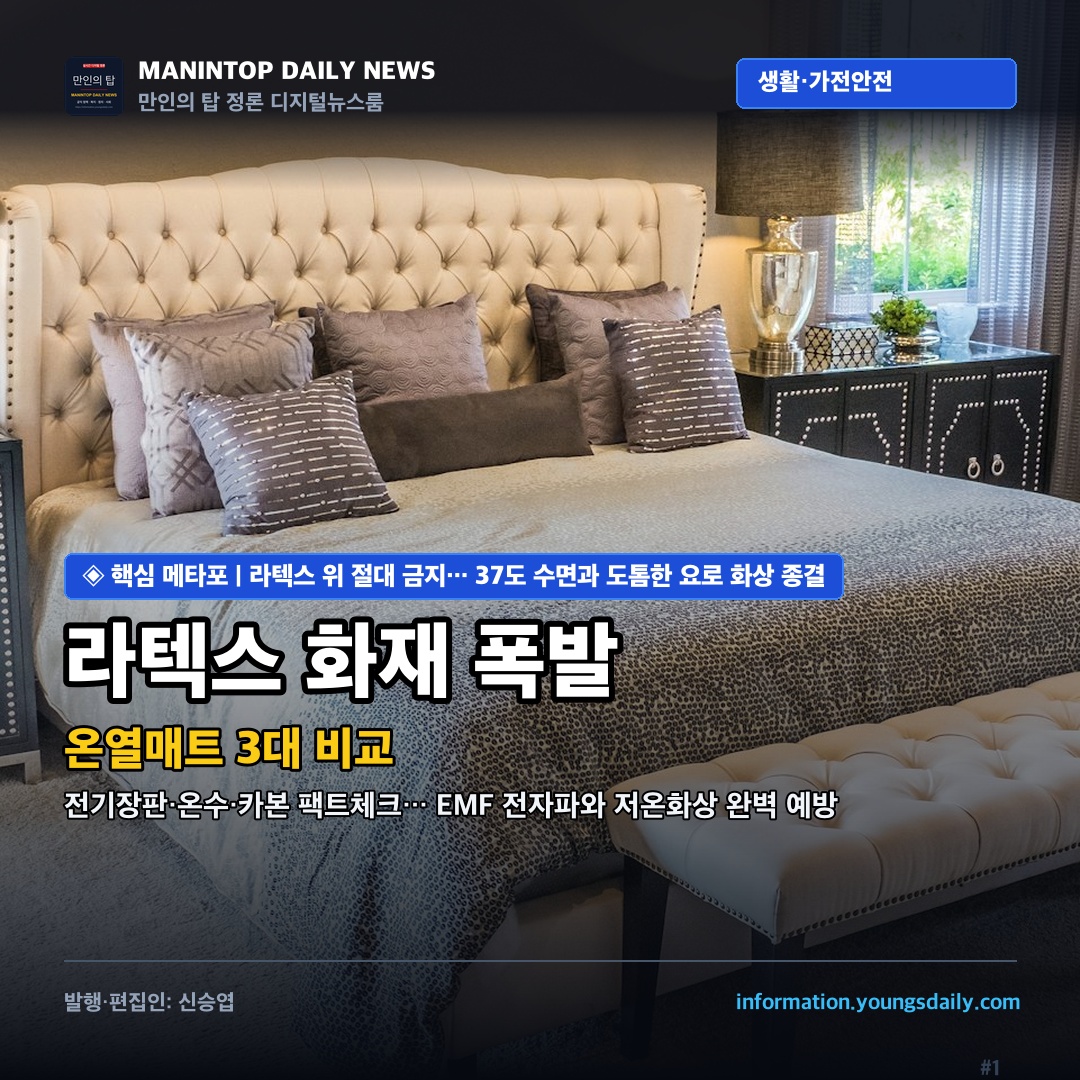
▲ 겨울철 침실 침대 위에 깔린 난방 매트와 따뜻한 침구류 인테리어 자료
2. 한국소비자원 10종 실측 평가: 가격 11.2배 격차와 과장 광고의 실체
최근 프리미엄 난방 시장에서 선풍적인 인기를 끌고 있는 탄소매트이지만, 시중 제품들의 성능과 가격은 극심하게 양극화되어 있습니다. 한국소비자원이 소비자 선호도가 높은 상위 10개 브랜드의 1인용 탄소매트를 수거해 정밀 시험평가한 결과, 동일한 '탄소매트' 이름을 달고 판매되는 제품 간의 가격이 최저 3만 1,900원(곰표한일전자)에서 최고 35만 8,000원(귀뚜라미)으로 무려 11.2배의 격차를 보였습니다.
핵심 성능 지표인 표면온도와 발열 속도에서도 제품별 차이가 뚜렷했습니다. 최고 온도로 설정했을 때 도달하는 최대 표면온도는 가장 낮은 제품이 39℃에 불과해 온도 조절 폭이 너무 좁았던 반면, 가장 높은 제품은 64℃까지 치솟았습니다. 상온 20℃에서 취침 적정 체온인 35℃까지 도달하는 시간은 한일의료기(HL-S205)가 12분으로 가장 빨랐던 반면, 일부 제품은 49분이 걸려 4배 이상의 차이를 나타냈습니다. 매트 표면의 부위별 온도 균일성에서는 귀뚜라미(KDM-921) 제품이 위치별 온도 편차 0.4℃로 매트 전 영역에서 가장 고른 온열감을 제공했습니다.
주목할 점은 유통가의 마케팅 실체입니다. 시험평가 보고서 어디에도 '원적외선 온열 치료 효과'나 '탄소 신소재의 독보적 효능' 같은 마케팅 주장은 언급되지 않았으며, 탄소매트가 일반 전기장판보다 품질이 원천적으로 우월하다고 적시한 문장 또한 존재하지 않았습니다. 아울러 경동나비엔, 귀뚜라미, 보국전자, 셀리온 등 4개 브랜드는 수면 중 머리가 과열되는 것을 막기 위해 매트 상단 20cm에 의도적으로 열선을 넣지 않는 '머리 쪽 열선 배제' 설계를 적용했으나, 제품 설명서에 이를 제대로 표시하지 않아 소비자원으로부터 시정 권고를 받기도 했습니다.
구분 유형
지원 및 적용 대상
환급 및 해결 기준
신청 및 조치 방법
일반 전기(열선)매트
금속 합금 열선 직접 저항 가열
5분 이내 급속 발열, 45~48℃
3만~7만 원대, 가성비 최고, 보관 및 접힘 단선 주의
온수매트
외장 보일러 물 가열 튜브 순환
10~20분 예열, 포근한 잔열감
10만~30만 원대, 매트 전자파 0, 물 보충 및 물 빼기 번거로움
탄소(카본)매트
열선 심선·피복 탄소 성분 가열
12~49분 예열, 39~64℃
3.1만~35.8만 원(11.2배 차이), 드럼세탁 물세탁 3~5회 지원
전자파 안전성 (AC vs DC)
AC 220V 직접 인가 vs DC 외장 어댑터
국가기준 833mG 전원 적합
DC형은 자기장 제로 수준이나 어댑터 고주파음 및 전원선 복잡
한전 누진세 3구간 폭탄
400kWh 초과 시 최고단가 적용
매트 24kWh 추가 시 기본요금 급증
평소 390kWh 가구 매트 가동 시 1.2만 원 이상 요금 폭탄
소방 화재 예방 수칙
3년간 1,411건 화재(사망 16명)
라텍스·메모리폼 위 혼용 절대 금지
매트 접힘 사용 금지 및 온도조절기·어댑터 매트 위 적재 금지
37℃ 저온화상 방지책
40~50℃ 장시간 접촉 시 단백질 변성
취침 시 37℃ 이하 설정 권고
영유아·고령자·당뇨 환자 주의 및 얇은 요 패드 깔기
SPONSORED · ADVERTISEMENT
3. 전자파 논란 팩트체크: 국가 법정기준 833mG와 EMF 민간인증의 비밀
난방 매트를 구매할 때 소비자들이 가장 두려워하는 요소는 단연 전자파입니다. 유통가에서는 '전자파 100% 제로'라는 자극적인 문구를 남발하지만, 현행 법령 어디에도 '전자파가 전혀 없다'는 법적 기준이나 공식 정의는 존재하지 않습니다.
전자파 안전성을 객관적으로 평가하려면 국가 기준과 민간 인증의 차이를 알아야 합니다. 국립전파연구원이 고시한 국가 법정 인체보호기준(전파법 기반)은 60Hz 극저주파 자기장 기준 833mG(밀리가우스)입니다. 2017년 7월부터 전기매트 품목에 이 기준이 의무화되었으므로, 시중에 정식 KC 인증을 받고 판매되는 모든 제품은 이 안전기준을 이미 통과한 제품입니다. 반면 민간 기관인 한국기계전기전자시험연구원(KTC)의 'EMF 인증'은 전기장 10V/m, 자기장 2mG 이하를 통과한 제품에 부여되는 자율 규격으로, 국가 법정기준(833mG)보다 약 400배 엄격한 기준을 적용합니다.
실제 공공기관의 실측 데이터를 보면 전자파 공포는 과장된 측면이 큽니다. 한국소비자원 시험 결과 10개 탄소매트 전 제품이 국가 기준치 대비 100% 미만으로 전원 적합 판정을 받았으며, 과학기술정보통신부의 밀착 측정에서도 카본매트는 기준 대비 0.46%~16.29%, 일반 전기매트는 0.62%, 온수매트는 0.26% 수준에 불과했습니다.
전원 방식별로는 220V 교류(AC)형은 화력이 좋지만 플러그를 꽂는 극성 방향에 따라 전자파 수치 편차가 발생할 수 있습니다. 반면 외장 어댑터를 통해 24V 직류(DC)로 변환해 공급하는 DC형 매트는 매트 표면에서 극저주파 자기장이 거의 검출되지 않는 뛰어난 안전성을 제공합니다. 온수매트의 경우 매트 패드에는 물만 흘러 전자파가 0이지만, 물을 끓이는 보일러 본체에서는 전자기장이 발생하므로 보일러를 발치 바깥으로 30cm 이상 떨어뜨려 놓아야 전자파 노출을 완벽히 피할 수 있습니다.
▲ 가정집 거실과 실내 공간에서 난방 기기와 보온 침구를 점검하는 주거 환경 자료
4. 난방비 절감과 한전 누진세 방어: 1,411건의 화재와 37℃ 저온화상 예방법
보일러 가스비를 아끼려고 전기장판을 켰다가 오히려 관리비 폭탄을 맞거나 화재 사고를 겪는 사례가 매년 반복되고 있습니다. 소비전력 100W짜리 전기매트를 하루 8시간씩 한 달간 틀면 순수 전력소비량은 24kWh입니다. 한국소비자원 계산대로 단일 단가(1kWh당 160원)를 적용하면 월 2,200원~4,300원의 푼돈이지만, 현실에서는 한전의 '주택용 누진제'가 작동합니다. 주택용 저압 기준 전력량 요금은 1구간(200kWh 이하) 120.0원에서 2구간 214.6원, 3구간(400kWh 초과) 307.3원으로 급증하며, 기본요금 역시 1구간 910원에서 3구간 7,300원으로 무려 8배 폭등합니다. 만약 평소 전력사용량이 390kWh인 가구가 매트를 켜서 420kWh로 3구간을 넘어서면, 기본요금 5,700원이 즉시 인상되고 초과분에 최고 단가가 붙어 실제 청구액은 1만 2,000원 이상 늘어나게 됩니다.
안전사고 방지도 타협할 수 없는 원칙입니다. 행정안전부와 소방청 통계에 따르면 최근 3년간 국내 전열기기 화재는 총 1,411건에 달하며 16명이 목숨을 잃었습니다. 가장 위험한 행동은 라텍스나 고밀도 메모리폼 침구 위에 온열 매트를 깔고 사용하는 것입니다. 라텍스는 열 축적률이 극단적으로 높아 열선 피복이 녹거나 발화점에 도달해 화재로 직결됩니다. 또한 매트를 접거나 구긴 채 쓰면 열선이 꺾여 스파크가 튀며, 온도조절기나 외장 어댑터를 매트 위에 올려두면 과열로 불이 날 수 있습니다.
마지막으로 피부가 40℃~50℃에 장시간 노출되어 피부 조직이 손상되는 '저온화상'을 막기 위해, 취침 시에는 온도를 반드시 37℃ 이하로 낮추고 매트 위에 얇은 면 패드를 깔아 피부에 열선이 직접 닿지 않도록 관리해야 합니다.
[Life & Home Appliances] "They Claimed 100% EMF Blocking": A Complete Guide to Hot Water, Electric, and Carbon Mats Plus Progressive Utility Tax Defense
[Life & Home Appliances] "They Claimed 100% EMF Blocking" captures the mounting frustration of consumers navigating winter heating appliances, caught between budget electric mats, premium hot water systems, and carbon fiber mats priced at steep premiums. Official laboratory evaluations conducted by the Korea Consumer Agency on ten carbon mat brands reveal a dramatic 11.2-fold price chasm—ranging from ₩31,900 to ₩358,000—alongside peak surface temperatures varying widely between 39°C and 64°C. Furthermore, households lured by simplistic 'pennies-a-day' claims often cross into KEPCO’s punitive Tier 3 progressive electricity tariff, triggering steep rate surcharges, while improper pairing with latex bedding drives approximately 470 heating appliance fires annually. Deconstructing heating mechanisms across all three categories, verifying national 833mG limits against private EMF badges, neutralizing progressive electric bill spikes, and enforcing 37°C low-temperature burn safeguards, this comprehensive guide decodes smart, safe winter warmth.
📌 Key Takeaways
Three Types of Heating Mats Mechanism: Rapid Heating Electric Mats vs Gentle Residual Heat Water Mats vs Washable Carbon Mats
Consumer Reports on 10 Models: Price Discrepancy of 11.2 Times (30,000 to 350,000 Won) and Verification of Maximum Temperatures Ranging from 39 to 64°C with 0.4°C Uniformity
Electromagnetic Radiation and Safety Fact Check: National Standard of 833mG vs EMF Certification, Progressive Three-Tier Rate Defense, and Latex Fire Prevention
1. Technical Mechanisms and Hardware Specifications: The Three-Way Heating Matrix
The auxiliary home heating landscape divides along three foundational physical mechanisms: traditional metallic electric mats, circulating hot water systems, and carbon fiber heating pads. These architectural divergences directly govern preheat velocity, tactile thermal comfort, hardware mass, and everyday maintenance.
Traditional electric mats channel alternating current through internal metallic resistance wires (predominantly nichrome alloys), radiating direct conductive heat. Reaching physiological temperatures within five minutes, they deliver immediate, concentrated warmth reminiscent of heated floorboards, though repetitive bending stresses risk internal wire severance. Hot water mats deploy an external boiler reservoir to heat water, circulating it through flexible silicone tubes via micro-pumps. Capitalizing on high thermal capacity, they preserve lingering warmth with soft ambient distributions, yet mandate periodic water refills every 10 to 30 days, manual draining for seasonal storage, and carry vulnerability to pump cavitation or joint leaks.
Carbon mats—officially defined by the Korea Consumer Agency as heating wires incorporating carbon elements within the core or protective sheath—eliminate bulky external boilers. Modern variants integrate waterproof connectors, supporting three to five drum-washer wool-cycle runs directly without separate encasements.
▲ Cozy bedroom bed setup with warm winter blanket and heating mat appliance
2. Consumer Agency 10-Brand Benchmark: The 11.2-Fold Price Gap and Marketing Realities
While carbon mats dominate current premium heating retail channels, empirical testing reveals stark performance disparities. In rigorous evaluations conducted by the Korea Consumer Agency across ten leading single-size carbon mat models, retail pricing swung 11.2-fold, from ₩31,900 (Gompyo Hanil) to ₩358,000 (Kiturami).
Core thermal benchmarks exhibited extreme divergence. Under maximum dial settings, peak surface temperatures ranged from an underwhelming 39°C to a scorching 64°C. The elapsed duration required to elevate ambient 20°C temperatures to the 35°C sleep threshold spanned 12 minutes (Hanil Medical HL-S205) up to 49 minutes—a fourfold temporal gap. For surface temperature uniformity across zones, Kiturami (KDM-921) led with a razor-thin 0.4°C variance, delivering uninterrupted thermal consistency.
Critically, regulatory findings debunk pervasive commercial mythology: official reports contain zero validation for 'far-infrared therapeutic healing' or 'carbon miracle fibers,' nor any claim of intrinsic material superiority over standard electric blankets. Furthermore, four major brands—Navien, Kiturami, Boguk, and Cellion—omitted heating wires across the upper 20 centimeters to prevent cranial overheating, yet initially failed to label this orientation on packaging, receiving official agency warnings to correct consumer instructions.
Category
Target Scope
Standard / Benefit
Procedure / Action
Traditional Electric Mats
Metallic alloy wire direct resistance
Under 5-min rapid heating, 45-48°C
₩30K-₩70K, prime cost-efficiency, avoid folding/creasing
Hot Water Heating Mats
External boiler circulating warm water
10-20 min preheat, lingering warmth
₩100K-₩300K, zero pad EMF, requires periodic water refills
Carbon (Carbon Fiber) Mats
Carbon elements applied to wire core
12-49 min preheat, 39-64°C
₩31.9K-₩358K (11.2x gap), supports wool cycle wash 3-5 times
EMF Safety Profiles (AC vs DC)
AC 220V direct vs DC 24V adapter
100% meet 833mG national limit
DC yields near-zero magnetic fields but adds adapter bulk
Progressive Tariff Tier 3 Shock
Rates surge above 400kWh monthly
Adding 24kWh spikes baseline fees
Households near 390kWh face ₩12,000+ jumps into Tier 3
Fire Prevention Protocols
1,411 fires and 16 fatalities in 3 yrs
Strictly ban latex & memory foam pairing
Never fold while active; keep controllers/adapters off mats
Low-Temperature Burn Defense
Dermal protein damage at 40-50°C
Set sleep mode strictly below 37°C
Protect infants, elderly, and diabetics with thin cotton pads
Electromagnetic field (EMF) anxieties dominate consumer purchasing behavior, fueling rampant retail claims of '100% EMF Zero.' In reality, statutory frameworks provide zero legal basis for absolute zero-emission classifications.
Evaluating EMF safety demands distinguishing statutory mandates from private certifications. Korea’s legal threshold (National Radio Research Agency Notice 2023-12) establishes an 833 milligauss (mG) ceiling for 60Hz extremely low-frequency magnetic fields, following international ICNIRP benchmarks. Mandatory for all KC-certified heating products since 2017, all legally distributed goods meet this threshold. In contrast, the private EMF badge issued by the Korea Testing Certification Institute (KTC) applies voluntary metrics—electric fields under 10 V/m and magnetic fields under 2 mG—roughly 400 times more stringent than national baselines.
Empirical agency testing validates high compliance: all ten Consumer Agency test models cleared safety limits, while Ministry of Science field measurements revealed carbon mats emitting only 0.46% to 16.29% of statutory limits, standard electric mats 0.62%, and hot water units 0.26%.
Architecturally, AC 220V mats generate superior thermal output but fluctuate with outlet polarity. Conversely, DC 24V adapter-driven systems eliminate magnetic field oscillations across the pad entirely. For hot water systems, while sleeping pads carry zero radiation, external boiler pumps generate active fields, necessitating placing the boiler unit at least 30 centimeters away from the bedside to achieve near-total field dissipation.
▲ Domestic living room interior inspecting home heating appliances and warm thermal blankets
4. Progressive Electricity Tariff Defense and Fire Safety: Preventing 37°C Low-Temp Burns
Substituting central heating with auxiliary electric blankets frequently triggers severe progressive utility shocks or catastrophic fire hazards.
A standard 100W mat running eight hours daily consumes 24kWh monthly. Under flat-rate estimates, this appears negligible at ₩2,200 to ₩4,300. However, KEPCO’s progressive residential tariffs alter the equation dramatically. Low-voltage rates escalate from ₩120.0/kWh in Tier 1 (under 200kWh) to ₩214.6 in Tier 2, and ₩307.3 in Tier 3 (over 400kWh), alongside base fees rocketing 8-fold from ₩910 to ₩7,300. A household averaging 390kWh that adds a 30kWh mat breaches the 400kWh ceiling, triggering an immediate ₩5,700 base-fee hike and Tier 3 rates, swelling utility costs by over ₩12,000.
Fire prevention commands rigorous discipline: National Fire Agency records tally 1,411 heating appliance fires and 16 fatalities across the past three years. The single most lethal practice is overlaying mats upon latex or memory-foam bedding; these materials trap thermal dissipation completely, accelerating internal heat accumulation until wiring melts into spontaneous combustion. Furthermore, folding operational mats fractures internal elements into electrical arcs, while resting controllers or power bricks directly on heated surfaces provokes component meltdown.
Finally, avoiding insidious 'low-temperature burns'—where sustained 40°C to 50°C contact provokes irreversible dermal necrosis without immediate pain—mandates capping sleep modes strictly below 37°C while always buffering heating surfaces with thin cotton protective covers.
Recommended Deep-Dive Investigations TOP 3
GLOBAL REPORT
1월이 시작되면 감기는 이미 우리 곁에 와 있습니다. 2월, 3월, 4월까지 이어지는 추위와 건조함은 코와 목을 가장 먼저 공격합니다. 아침에 일어나자마자 막혀 있는 코. 계속 흐르는 콧물. 괜히 칼칼해지는 목. 이 증상은 “시작”일 뿐입니다. 한 번 무너지면 일주일, 길면 한 달까지 끌고 갑니다. 약을 먹으면 잠깐 괜찮아집니다. 하지만 며칠 뒤 또 반복됩니다. 왜일까요? 감기는 ‘치료’의 문제가 아니라 ‘관리’의 문제이기 때문입니다. 대부분은 감기가 오고 나서 약을 찾습니다. 하지만 진짜 중요한 건 감기가 오기 전에 코와 목을 지키는 것입니다. 건조한 실내 공기, 차가운 바깥 공기, 눈에 보이지 않는 세균. 코와 목은 매일 공격받고 있습니다. 지긋지긋하죠! 그런데도 우리는 아무 준비 없이 버티고 있습니다. 이번 겨울도 그렇게 보낼 건가요? 사실 방법은 어렵지 않습니다. 코를 깨끗하게 관리하고, 목을 따뜻하게 보호하고, 점막을 촉촉하게 유지하고, 기관지를 미리 관리하고, 외부 공기를 차단하는 것. 이 다섯 가지만 꾸준히 해도 감기약 없이 겨울을 보내는 것이 충분히 가능합니다. 🔥 이제부터 그 방법을 하나씩 살펴보겠습니다. 🔥 1. 코와 목을 먼저 관리해야 하는 과학적 이유 감기의 대부분은 코 점막에서 시작됩니다. 국제 학술지 Nature Reviews Microbiology 와 Journal of Allergy and Clinical Immunology 에 실린 호흡기 감염 관련 연구들에서는, 감기 바이러스가 비강 상피세포에 먼저 부착해 증식한다는 점을 설명하고 ...
리모델링사업이 진행 중인 아파트를 매매할 때 “계약금 10%를 언제까지 내야 하느냐”는 질문이 특히 많이 나옵니다. 이주공고(이주 안내)가 7~11월쯤이라고 들으면, 그 시점에 맞춰 계약금도 움직일 것 같아서 더 헷갈리기 쉽습니다. 하지만 실제 납부기한은 ‘이주공고가 언제냐’만으로 자동 결정되지 않는 경우가 많습니다. 1) 계약금 10% 납부기한: 결국 ‘문서에 적힌 일정’이 기준 계약금 10%를 언제까지 납부해야 하는지는, 내가 서명하는 매매계약서(특약 포함) 와 사업주체/조합이 제시한 공고·안내문 에 적힌 납부 일정이 기준이 됩니다. 실제 공고문에서는 분양대금 납부의 큰 틀(계약금→중도금→잔금)을 먼저 안내하고, 상세 일정은 별도 표나 유의사항으로 제시하는 방식이 흔합니다. 또, 계약서 문구에 따라 지급 시점이 조건부로 설정될 수도 있습니다. 예를 들어 한 사례 소개 자료에서는 용역계약서에 잔금(10%) 지급시기가 “사업승인 후”로 기재되어 있었다는 점이 언급됩니다. 이런 식으로 ‘사업 단계’와 지급을 연동하는 문구가 들어가면, 질문의 답은 계약서 문구를 확인해야만 확정됩니다. 관련 내용은 링크 에서 문구 사례를 확인할 수 있습니다. 2) 입주자모집공고에서 확인되는 ‘납부 순서’와 잔금 마감 시점 공고문에 적힌 문구를 보면, 납부 순서와 잔금 마감에 대한 기준이 비교적 명확하게 제시되는 경우가 있습니다. 예를 들어 한 입주자모집공고에는 “분양금액(주택가격)은 계약금, 중도금, 잔금의 순서로 납부”하며 “잔금은 입주(열쇠 수령일) 전에 완납”해야 한다고 안내되어 있습니다. (문구 확인: 링크 ) 이 문구가 의미하는 바는 최소 2가지입니다. 분양/공급 형태의 문서에서는 ‘계약금→중도금→잔금’ 흐름이 공식적으로 안내될 수 있습니다. 잔금은 “입주(열쇠 수령)” 이전에 완납해야 한다는 마감 기준이 문서에 적혀 있을 수 있습니다. 다만, 위 공고문 문구는 잔금 마감에 대한 기준을 보여주지만, 계약금 10%의...
윤석열 전 대통령 탄핵 인용 소식을 접하면, 가장 궁금한 지점은 ‘헌재가 정확히 무엇을 위헌·위법으로 봤는가’입니다. 또한 탄핵과 별개로 진행되는 형사재판(내란 우두머리 혐의 등)이 어디까지 왔는지도 함께 정리할 필요가 있습니다. 아래 내용은 제공된 기사/게시물 스니펫과 링크에서 확인되는 범위만 모아, 일반인이 흐름을 이해하기 쉽게 정리한 것입니다. 1) 탄핵 인용 관련: 스니펫에서 확인되는 ‘판단의 골격’ 제공된 근거 중 조국혁신당 사이트에는 헌법재판소가 윤석열 탄핵 심판에서 “피청구인의 위헌·위법행위는 국민 신임 …”이라는 취지로 판단했다는 문장이 인용돼 있습니다( 링크 ). 이 인용문만 놓고 보면, ‘위헌·위법행위’가 있었는지와 그로 인해 ‘국민의 신임’이 어떻게 평가됐는지가 핵심 축으로 소개됩니다. 다만 질문에서 요청하신 세부 항목, 즉 비상계엄 선포 자체를 문제 삼은 구체적 이유, 계엄 이후 조치(포고령, 국회 통제 등)의 어떤 지점이 헌법 위반인지, 국회의 권한행사 방해 및 정치활동 제약을 어떤 논리로 판단했는지 등은, 이번에 제공된 근거의 제목/스니펫만으로는 조항·사실관계·판단 구조가 그대로 제시돼 있지 않습니다. 따라서 이 글에서는 ‘헌재가 무엇을 문제 삼았다’는 세부 리스트를 단정적으로 재구성하기보다, 현재 확인 가능한 문구 수준의 요약(위헌·위법행위 → 국민 신임의 문제로 평가)까지만 적습니다. 만약 헌재 결정문 전문(주문 및 이유)이 추가로 확인되면, 그때는 문장 단위로 ‘어떤 행위’와 ‘어떤 헌법 원리/조항’이 연결되는지(예: 권력분립, 국회의 권한, 정치적 기본권 등) 구조화해 정리하는 것이 가장 정확합니다. 2) 형사 절차(내란 혐의) 관련: 체포영장과 1심 선고 언급 탄핵 심판과 별도로, 12·3 비상계엄 사태로 내란 혐의를 받는 윤석열 대통령에 대해 2024년 12월 31일 체포 영장이 발부됐다는 BBC 보도가 있습니다( 링크 ). 해당 보도는 ‘현직 대통령’에 대한 체포영장 발부라는 점을 함께 언급합니다. 또...