3.3㎡당 500만 원대이던 서울 정비사업 공사비가 1,000만 원을 돌파하며 전국 사업장에 공사 중단 셧다운 위기가 확산되고 있습니다. 시공사 증액 요구액 중 1.3조 원을 깎아낸 한국부동산원의 공사비 검증 실태와, 집 한 채로 버티는 고령 조합원들의 분담금 딜레마를 현장 취재로 입체 해부합니다.
신승엽 경제·부동산 전문기자|2026. 11. 05. 04:53 송고
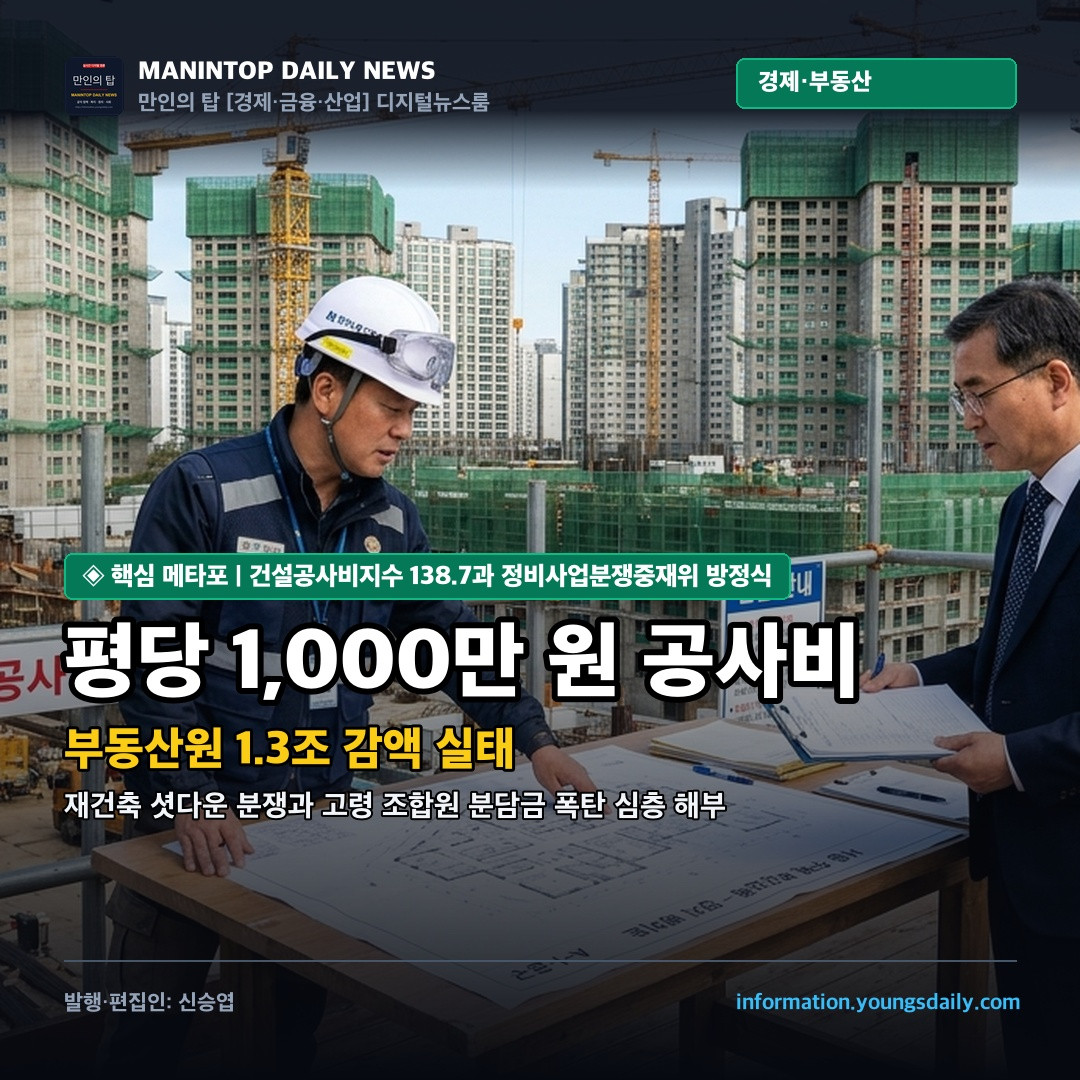
▲ 보도자료사진 — 서울 시내 대규모 재건축 정비사업 건설 현장에서 기술 엔지니어와 조합 관계자가 콘크리트 골조와 타워크레인을 배경으로 공사비 산출 내역서를 면밀히 검토하고 있다.
1. 평당 1,000만 원 시대, 공사비 급등의 원인과 구조적 진단
도시 및 주거환경정비사업 현장에서 발생하는 공사비 증액 갈등이 과거 시공사와 조합 간 민간 계약상의 비공식 다툼을 넘어 도시 주택 공급을 뒤흔드는 핵심 뇌관으로 부상했습니다. 코로나19 팬데믹과 글로벌 공급망 위기, 원자재 가격 폭등, 고금리 기조, 건설 인력 고령화가 복합 작용하면서 정비사업 전반의 속도와 사업성을 송두리째 압박하고 있습니다.
불과 몇 년 전까지만 해도 서울 재건축·재개발 사업장의 3.3㎡(1평)당 평균 공사비는 500만~600만 원 선을 유지했으나, 최근 서울 핵심지에서는 800만 원을 넘어 1,000만 원을 돌파하는 사례가 속출하고 있습니다. 서초구 신반포22차의 경우 최초 계약 당시 3.3㎡당 560만 원이던 공사비가 1,300만 원으로 증액되며 132.1%라는 기록적인 폭등세를 기록했습니다.
국회 국토교통위원회 자료에 따르면 최근 5년간 서울 시내 정비사업 공사비 분쟁은 총 75건 발생했으며, 합의에 도달한 60개 사업장의 평균 공사비 인상률은 38.2%에 달했습니다. 한국건설기술연구원의 건설공사비지수 역시 2020년 100 기준점에서 2026년 8월 138.7까지 치솟아 소비자물가지수 상승률의 2배를 웃도는 가파른 상승세를 나타냈습니다.
정비사업 분석 지표
실측 수치 및 변동폭
비교 기준 및 최고치
정비사업 시장 핵심 파장
서울 정비사업 공사비 분쟁
최근 5년간 75건
2023년 21건으로 정점
시공사-조합 간 갈등 상시화 및 사업 장기화
분쟁 합의 사업장 인상률
평균 38.2% 상승
60개 정비구역 실측
조합원 추가 분담금 수억 원대 폭탄 직결
최고 공사비 인상 사업장
3.3㎡당 1,300만 원
신반포22차 (132.1%↑)
서울 강남권 하이엔드 공사비 현실 반영
건설공사비지수 추이
138.7 (2026년 8월)
2020년(100) 대비 38.7%↑
자재비·노무비 폭등에 따른 원가 하방경직성
건설 원가 급등의 가장 큰 비중을 차지하는 요인은 자재비로, 건설공사비지수 상승 기여도의 53.0%를 차지하고 있습니다. 시멘트 제조 원가의 핵심인 유연탄 가격이 하락 안정화되었음에도 시멘트 가격은 4년 만에 49.3% 상승한 뒤 하방경직성을 보이고 있으며, 레미콘(41.3%↑)과 부순 모래(24.5%↑) 역시 높은 가격대를 유지하고 있습니다. 여기에 50대 이상 건설 취업자가 55.2%에 달하는 현장 고령화와 청년층 기피, 제로에너지 건축 의무화 등 친환경 규제 비용까지 가중되며 공사비 상승을 부채질하고 있습니다.
2. 한국부동산원 공사비 검증 제도의 성과와 법적 쟁점
조합의 전문성 부족을 보완하고 시공사의 무분별한 증액 요구를 견제하기 위해 도시정비법 제29조의2에 근거한 공사비 검증 제도가 운영되고 있습니다. 정비사업 조합원의 5분의 1 이상이 요청하거나 사업시행인가 전후 시공사 선정 시점에 따라 5~10% 이상 공사비가 오를 경우 한국부동산원에 의무적으로 검증을 신청해야 합니다.
국회 국토교통위원회 김남근 의원실 자료에 따르면, 2026년 1월부터 9월까지 한국부동산원이 공사비 검증을 완료한 전국 33개 정비사업장의 결과를 분석한 결과 대규모 거품 감액 성과가 확인되었습니다. 시공사들이 요구한 총 증액 요청액 4조 8,122억 원 중 부동산원이 적정성으로 인정한 금액은 3조 4,854억 원에 그쳐, 총 1조 3,268억 원(평균 감액률 27.6%)이 삭감되었습니다.
사업장당 평균 402억 원의 공사비가 절감되었으며, 33곳 중 13곳(39.4%)은 요청액의 30% 이상이 깎였습니다. 공종별로는 건축 공종에서 4,444억 원(34.0%)이 감액되어 규모가 가장 컸고, 사업비 2,195억 원, 물가변동 2,146억 원, 전기 1,012억 원(감액률 45.8%) 순이었습니다. 경기 팔달1구역은 요청액 2,109억 원 중 77.0%(1,624억 원)가 깎였고, 서울 방배5구역도 1,486억 원(44.3%)이 감액되는 등 시공사의 증액 요구에 상당한 거품이 끼어 있었음이 실증되었습니다.
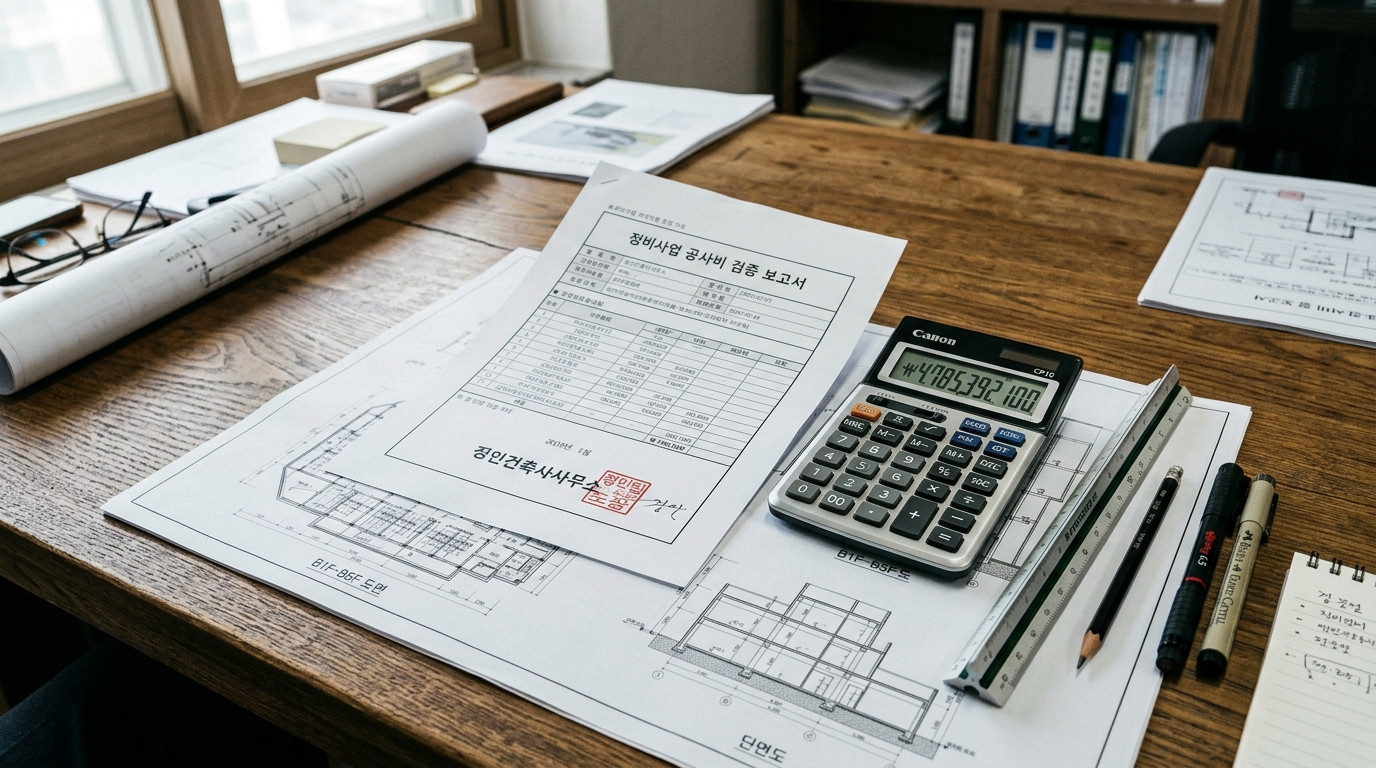
▲ 공식 보도사진 — 건축 설계 도면과 한국부동산원 정비사업 공사비 검증 보고서가 놓인 집무 테이블 위에서 재료비와 노무비 적정성을 정밀 대조하고 있다.
그러나 이러한 감액 성과에도 불구하고 현행 제도는 법적 강제력이 없는 권고사항에 불과하다는 치명적 한계를 안고 있습니다. 시공사가 검증 결과를 거부하고 계약된 증액을 고수할 경우 조합은 공사 중단이나 계약 해지 소송이라는 극단적 상황에 내몰리게 됩니다. 더욱이 최근 서울고등법원 판례(2024나2029879)에서 공사비 검증 절차를 거치지 않은 총회 결의를 단속규정으로 보아 유효하다고 판단하면서, 사법적 구속력을 둘러싼 법적 공방이 한층 가열되고 있습니다.
3. 고령 조합원과 정비사업 '분담금 딜레마'
서울 정비사업 현장의 공사비 갈등이 해결되지 못하는 근저에는 소유주의 인구구조적 고령화라는 사회적 구조가 깊게 자리 잡고 있습니다. 법원 등기정보광장 데이터에 따르면 강남 3구 집합건물 소유자의 47.9%가 60세 이상 고령자이며, 노원구(50.5%), 도봉구(48.3%), 강북구(47.5%) 등 강북권 노후 주거지 역시 소유자의 절반 이상이 은퇴 고령층입니다.
은퇴 후 고정 수입이 없거나 월평균 73만 7,000원에 불과한 국민연금에 의지하는 고령 조합원들에게 수억 원대의 추가 분담금 고지서는 치명적인 주거 위협입니다. 거주하는 노후 주택 한 채가 자산의 전부인 상황에서 현금 동원 능력이 전무하다 보니, 조합 총회에서 공사비 증액안에 결사반대하며 조합 내부의 찬반 갈등과 사업 표류를 초래하게 됩니다.
설상가상으로 서울 시내 46개 단지에 조합원 1인당 평균 1억 2,174만 원 부과가 예상되는 재건축초과이익환수제(재초환) 부담금까지 중첩되고 있습니다. 여기에 투기과열지구 내 조합원 지위양도 제한 규제로 인해 집을 처분하거나 작은 평형으로 갈아타는 출구 전략마저 법적으로 차단되어, 고령 조합원들은 꼼짝없이 분담금 덫에 갇히는 삼중고를 겪고 있습니다.
▲ 공식 현장사진 — 서울시 정비사업 분쟁 조정 회의실에서 전문 코디네이터가 고령 조합원 대표와 시공사 관계자 간 공사비 증액 및 공사 재개 조건을 중재하고 있다.
이는 결과적으로 사업성 양극화와 도심 공급 절벽으로 이어집니다. 일반분양가가 높은 강남권은 공사비 인상분을 일반분양자에게 전가해 버틸 수 있지만, 분양가 상한선이 낮은 강북권과 외곽 지역은 분담금 폭탄을 견디지 못하고 공사가 셧다운되고 있습니다. 도심 정비사업의 좌초는 중장기 신규 아파트 공급 차질을 빚어 서울 주택 시장의 불안을 장기화시키는 구조적 악순환을 낳고 있습니다.
4. 정부·지자체 정책 대응과 분쟁 조정 체계
공사비 갈등이 주택 공급망 전체를 위협하자 정부와 지자체는 적극적인 행정 개입과 법제화에 나서고 있습니다. 정부는 2024년 10월 관계부처 합동으로 '건설공사비 안정화 방안'을 발표하고, 최근 3년간 연 8.5%씩 폭등하던 공사비 상승률을 2026년까지 연 2% 내외로 통제하겠다는 중장기 로드맵을 가동했습니다.
정부 대책의 핵심은 자재비 불법·불공정행위 합동점검반 가동, 시멘트·골재 수급협의체 법제화, 해외 시멘트 수입 지원, 그리고 외국인 인력(E-9)의 동일 사업주 내 현장 이동 제한 완화입니다. 아울러 3기 신도시 등 공공공사에서 발주처의 관급자재 직접구매를 허용하고 입지별 공사비 보정기준을 세분화하여 공사 원가의 숨통을 틔우기로 했습니다.
서울특별시 역시 공사비 갈등을 공공 관리 영역으로 규정하고 서울주택도시공사(SH) 공사비 검증 및 찾아가는 '공사비 120센터'를 신설했습니다. 지난 2년간 도시정비·법률 전문가로 구성된 코디네이터를 37개 분쟁 사업장에 급파하여 신반포4지구 등 대형 사업장의 시공 계약 해지 위기를 봉합하는 실질적 성과를 거두었습니다.
나아가 국회에서는 국토교통부 장관 산하에 50인 이내 전문가로 구성된 '정비사업분쟁중재위원회'를 신설하는 도시정비법 개정안이 발의되었습니다. 중재위의 판정에 법원 확정판결과 동일한 사법적 구속력을 부여하고 90일 이내에 신속 판정하도록 규정함으로써, 기존 조정 제도의 강제력 부재 한계를 원천적으로 보완하겠다는 구상입니다.
5. 언론인을 위한 실무 취재 및 기사 작성 가이드
정비사업 공사비 분쟁을 취재할 때에는 단순한 시공사 대 조합의 감정적 대립 구도를 탈피하여 객관적 데이터를 검증하는 3대 취재 프레임워크를 견지해야 합니다. 첫째는 시공사가 요구한 증액 내역서와 한국부동산원 검증 인정액의 세부 공종별 편차를 입수하여 물가변동과 간접비 거품을 수치로 검증하는 방식입니다.
둘째는 고령 조합원의 소득 실태와 분담금 수용 한계를 인류학적으로 조명하는 심층 접근입니다. 은퇴 고령자의 낮은 연금 수급액과 추가 분담금 통보가 초래하는 주거 박탈감을 조명하고, 청년층과 고령층 간 조합 내부의 이해관계 충돌을 균형 있게 다루어야 합니다.
셋째는 정책 및 사법 제도의 실효성 점검입니다. 부동산원 검증 권고의 강제력 한계와 정비사업분쟁중재위원회의 실효성 쟁점, 그리고 공사도급계약 체결 시 건설공사비지수와 생산자물가지수의 적용 차이에 따른 법적 리스크를 정밀하게 분석해야 합니다. 특히 취재 시 시공사에 지급되는 순수 공사비와 조합 운영비·금융비용이 포함된 정비사업비를 명확히 구분하여 독자들에게 정확한 사실관계를 전달해야 합니다.
재건축·재개발 공사비 및 검증 제도 핵심 Q&A
Q1. 한국부동산원의 공사비 검증 결과는 법적 구속력을 갖나요?
현행 도시정비법상 공사비 검증 신청은 의무 사항이지만, 검증 결과 자체는 강제력이 없는 권고안입니다. 따라서 시공사가 결과를 수용하지 않고 증액을 고수하면 사법적 소송으로 이어질 수 있습니다.
Q2. 공사비 검증을 받지 않고 공사비를 올린 총회 결의는 무효인가요?
하급심 법원의 판단이 엇갈리고 있습니다. 과거 무효 판결이 내려진 사례가 있는 반면, 서울고등법원 2025년 1월 선고 판결에서는 단속규정으로 보아 결의를 유효로 판단하여 향후 대법원 확정 판결이 주목됩니다.
Q3. 정부가 신설 추진 중인 정비사업분쟁중재위원회의 핵심 차별점은 무엇인가요?
기존의 자치구 도시분쟁조정위원회와 달리, 중재위원회의 판정이 내려지면 법원의 확정판결과 동일한 사법적 구속력을 지니게 되어 이행을 강제할 수 있다는 점이 가장 큰 차이점입니다.
Exclusive In-Depth AnalysisEconomy & Real Estate
[In-Depth Analysis] Era of KRW 10M per Pyeong Construction Costs: Inside the KRW 1.3T Cut by Real Estate Board and the Redevelopment Shutdown Crisis
With construction costs in Seoul apartment redevelopments shattering the KRW 10 million per pyeong benchmark, shutdown crises are paralyzing reconstruction sites nationwide. This comprehensive journalistic investigation uncovers the KRW 1.3 trillion audit reduction achieved by the Korea Real Estate Board and analyzes the severe contribution dilemma confronting elderly property owners.
By Seung Youb Ssin, Senior Real Estate Correspondent|Published Nov. 05, 2026, 04:53 KST
▲ Editorial Documentary Photo — A civil engineering specialist and redevelopment union representative review cost estimates against towering concrete frames and cranes at a major Seoul apartment reconstruction site. (Press Archive)
1. Era of KRW 10M per Pyeong: Root Causes and Structural Diagnosis of Construction Cost Surges
Construction cost inflation in urban redevelopment and reconstruction projects has escalated far beyond routine private contractual disputes, emerging as a critical structural roadblock paralyzing metropolitan housing supply. Compounding impacts from the pandemic aftermath, global supply chain bottlenecks, raw material spikes, sustained high interest rates, and an aging workforce have severely compressed financial feasibility across projects.
While average construction costs in Seoul historically ranged between KRW 5 million and KRW 6 million per 3.3 square meters, recent contracts in prime districts routinely exceed KRW 8 million and frequently breach KRW 10 million. In Seocho district Sinbanpo 22nd complex, unit costs skyrocketed from an initial KRW 5.6 million to KRW 13 million, recording a staggering 132.1% surge that underscores new cost realities.
Parliamentary audit records submitted to the National Assembly indicate 75 major cost disputes erupted across Seoul over the past five years, with settled sites absorbing an average 38.2% cost escalation. The Construction Cost Index compiled by the Korea Institute of Civil Engineering and Building Technology climbed from 100 in 2020 to 138.7 by August 2026, rising at more than double the annual pace of consumer price inflation.
Market Assessment Metric
Recorded Figure & Volatility
Benchmark Baseline
Key Impact on Urban Redevelopment
Seoul Construction Disputes
75 cases over 5 years
Peaked at 21 in 2023
Chronic project suspensions and prolonged litigation
Settled Site Cost Hike
Average 38.2% increase
60 verified projects
Direct escalation of member contribution burdens
Highest Unit Escalation
KRW 13M per 3.3 sq m
Sinbanpo 22nd (132.1%↑)
Severe cost realities of prime high-end developments
Construction Cost Index
138.7 (August 2026)
Up 38.7% from 2020 base
Downward rigidity in material and labor inputs
Material costs represent the primary driver of this inflationary cycle, contributing 53.0% of the total index increase. Despite significant easing in bituminous coal prices from historic peaks, wholesale cement prices rose 49.3% over four years and exhibit strict downward rigidity, while ready-mix concrete and crushed sand have sustained heavy price advances. Furthermore, labor constraints where workers aged 50 and older constitute 55.2% of construction employment, alongside mandatory zero-energy building codes, have added lasting upward pressure on base building expenses.
2. Achievements and Legal Dilemmas of Real Estate Board Cost Verification Framework
To offset technical disparities between reconstruction unions and major general contractors, statutory cost verification procedures were institutionalized under Article 29-2 of the Act on the Improvement of Urban Areas. Statutory verification becomes mandatory when requested by at least one-fifth of union members or whenever proposed increases exceed 5% to 10% depending on timing relative to business approval.
Parliamentary audit records compiled from 33 redevelopment sites verified by the Korea Real Estate Board between January and September 2026 demonstrate substantial audit reductions. Out of KRW 4.812 trillion in cumulative contractor expansion claims, the public board recognized only KRW 3.485 trillion as legitimate, eliminating KRW 1.326 trillion in unjustified claims for an average reduction rate of 27.6%.
Individual projects realized an average cost saving of KRW 40.2 billion, with nearly 40% of inspected sites having over 30% of requested increases stripped away. Structural architecture accounted for the largest volume cut at KRW 444.4 billion, followed by general project fees, price escalation allowances, and electrical engineering where 45.8% of requested hikes were rejected. Flagship examples include Gyeonggi Paldal 1st district where 77.0% of claims were eliminated and Bangbae 5th district where KRW 148.6 billion was cut.
▲ Official Press Photo — Detailed architectural floor plans and official cost verification documents from the Korea Real Estate Board are audited with financial calculators to eliminate ungrounded budget expansion. (Press Archive)
Notwithstanding these demonstrable savings, the current verification mechanism is hobbled by its non-binding advisory character. When general contractors reject verification findings and demand original contractual escalations, redevelopment unions face immediate work stoppages or costly contract rescission lawsuits. Furthermore, conflicting judicial rulings, exemplified by a January 2025 Seoul High Court decision treating verification mandates as regulatory rather than invalidating provisions, have introduced ongoing legal uncertainty.
3. Elderly Union Members and the Redevelopment Contribution Dilemma
At the center of persistent redevelopment deadlocks lies a profound demographic shift among urban property owners. Judicial registry statistics indicate that 47.9% of multi-unit dwelling owners in Seoul Gangnam, Seocho, and Songpa districts are aged 60 or older, while aging northern districts like Nowon (50.5%) and Dobong (48.3%) display even higher proportions of retired residents.
Elderly homeowners living on limited retirement assets and average monthly pensions of merely KRW 737,000 face existential financial crises when confronted with additional contribution demands of several hundred million won. Because the family home represents their sole illiquid capital asset, these seniors lack cash liquidity to fund sudden assessments, prompting fierce opposition during general assemblies and triggering paralyzing factional warfare.
Compounding this impasse, anticipated reconstruction excess profit levies averaging KRW 121.7 million per member across 46 Seoul complexes add another layer of cash obligations. Strict regulatory prohibitions against transferring union membership titles within overheated speculative zones legally block elderly owners from liquidating holdings or downsizing, trapping them in a severe three-fold liquidity bind.
▲ Official Coverage Photo — Municipal dispute coordinators mediate tense negotiations over construction cost adjustments and project resumption between elderly union delegates and contractor executives in Seoul. (Press Archive)
This dynamic has intensified polarization in project viability and exacerbated metropolitan housing shortages. While affluent Gangnam sites can offset inflated construction costs by passing expenses onto open-market buyers through high presale prices, outer northern projects cannot raise sales caps sufficiently, leading to immediate site shutdowns. Halting urban renewal projects threatens long-term housing completions, fueling price volatility across Seoul.
4. Government and Municipal Policy Responses and Dispute Mediation Frameworks
Recognizing that construction disputes pose systemic threats to national housing targets, government agencies and local administrations are expanding direct interventions. The Ministry of Economy and Finance and the Ministry of Land, Infrastructure and Transport launched the Construction Cost Stabilization Plan, targeting a moderation of cost inflation to roughly 2% annually through 2026.
Key countermeasures include joint enforcement task forces to eradicate collusive pricing, statutory supply committees for cement and aggregates, state support for alternative cement imports, and regulatory flexibility allowing non-professional foreign workers under E-9 visas to transition across project sites. Additionally, public procurement rules are being revamped to permit direct purchasing of core materials by state developers.
The Seoul Metropolitan Government has categorized construction disputes as public administrative priorities, deploying specialized technical coordinators and launching the Cost 120 Center under the Seoul Housing and Communities Corporation. Over the past two years, expert coordinators intervened in 37 troubled redevelopment sites, successfully de-escalating termination crises at major complexes such as Sinbanpo 4th district.
Legislative efforts are also progressing through parliamentary amendments to establish a statutory Redevelopment Dispute Arbitration Committee under the Ministry of Land, Infrastructure and Transport. By endowing arbitration rulings with the legal force of final judicial court decisions and imposing strict 90-day review windows, the new mechanism aims to overcome historical shortcomings of non-binding municipal mediation.
5. Practical Reporting and Editorial Guide on Construction Disputes
When investigating construction cost conflicts in urban renewal, journalists must employ three rigorous analytical frameworks rather than reducing disputes to simplistic narratives. The first approach centers on forensic data verification, scrutinizing discrepancy ratios between contractor claims and certified public board allowances across structural, electrical, and contingency categories.
The second perspective examines sociological and demographic dynamics by investigating the financial vulnerabilities of elderly property owners. Reporting should contrast the living realities of low-pension seniors against astronomical contribution assessments, detailing internal union cleavages between capital-constrained retirees and younger residents seeking rapid asset appreciation.
The third analytical dimension focuses on institutional and judicial assessment. Reporters must evaluate the legal enforceability of public audit recommendations, the operational viability of proposed binding arbitration boards, and contractually binding price adjustment formulas comparing the Construction Cost Index against the Producer Price Index. Crucially, news coverage must maintain precise distinctions between direct construction costs and overall project expenditures to provide accurate public clarity.
Reconstruction Cost Disputes & Verification System FAQ
Q1. Are findings from the Korea Real Estate Board legally binding on contractors?
While requesting verification is mandatory under the Urban Improvement Act, the issued results represent non-binding administrative recommendations. If general contractors reject findings and insist upon contract escalations, judicial litigation typically ensues.
Q2. Are union assembly approvals invalid if executed without prior cost verification?
Judicial precedents are currently divided. While earlier lower court decisions declared such resolutions void, a January 2025 Seoul High Court ruling held the verification clause to be regulatory rather than invalidating, leaving final determination to the Supreme Court.
Q3. What makes the newly proposed Redevelopment Dispute Arbitration Committee distinct?
Unlike existing municipal reconciliation bodies that lack enforcement power, rulings issued by the proposed national arbitration committee carry the legal authority of final judicial judgments, enabling immediate enforcement.
1월이 시작되면 감기는 이미 우리 곁에 와 있습니다. 2월, 3월, 4월까지 이어지는 추위와 건조함은 코와 목을 가장 먼저 공격합니다. 아침에 일어나자마자 막혀 있는 코. 계속 흐르는 콧물. 괜히 칼칼해지는 목. 이 증상은 “시작”일 뿐입니다. 한 번 무너지면 일주일, 길면 한 달까지 끌고 갑니다. 약을 먹으면 잠깐 괜찮아집니다. 하지만 며칠 뒤 또 반복됩니다. 왜일까요? 감기는 ‘치료’의 문제가 아니라 ‘관리’의 문제이기 때문입니다. 대부분은 감기가 오고 나서 약을 찾습니다. 하지만 진짜 중요한 건 감기가 오기 전에 코와 목을 지키는 것입니다. 건조한 실내 공기, 차가운 바깥 공기, 눈에 보이지 않는 세균. 코와 목은 매일 공격받고 있습니다. 지긋지긋하죠! 그런데도 우리는 아무 준비 없이 버티고 있습니다. 이번 겨울도 그렇게 보낼 건가요? 사실 방법은 어렵지 않습니다. 코를 깨끗하게 관리하고, 목을 따뜻하게 보호하고, 점막을 촉촉하게 유지하고, 기관지를 미리 관리하고, 외부 공기를 차단하는 것. 이 다섯 가지만 꾸준히 해도 감기약 없이 겨울을 보내는 것이 충분히 가능합니다. 🔥 이제부터 그 방법을 하나씩 살펴보겠습니다. 🔥 1. 코와 목을 먼저 관리해야 하는 과학적 이유 감기의 대부분은 코 점막에서 시작됩니다. 국제 학술지 Nature Reviews Microbiology 와 Journal of Allergy and Clinical Immunology 에 실린 호흡기 감염 관련 연구들에서는, 감기 바이러스가 비강 상피세포에 먼저 부착해 증식한다는 점을 설명하고 ...
리모델링사업이 진행 중인 아파트를 매매할 때 “계약금 10%를 언제까지 내야 하느냐”는 질문이 특히 많이 나옵니다. 이주공고(이주 안내)가 7~11월쯤이라고 들으면, 그 시점에 맞춰 계약금도 움직일 것 같아서 더 헷갈리기 쉽습니다. 하지만 실제 납부기한은 ‘이주공고가 언제냐’만으로 자동 결정되지 않는 경우가 많습니다. 1) 계약금 10% 납부기한: 결국 ‘문서에 적힌 일정’이 기준 계약금 10%를 언제까지 납부해야 하는지는, 내가 서명하는 매매계약서(특약 포함) 와 사업주체/조합이 제시한 공고·안내문 에 적힌 납부 일정이 기준이 됩니다. 실제 공고문에서는 분양대금 납부의 큰 틀(계약금→중도금→잔금)을 먼저 안내하고, 상세 일정은 별도 표나 유의사항으로 제시하는 방식이 흔합니다. 또, 계약서 문구에 따라 지급 시점이 조건부로 설정될 수도 있습니다. 예를 들어 한 사례 소개 자료에서는 용역계약서에 잔금(10%) 지급시기가 “사업승인 후”로 기재되어 있었다는 점이 언급됩니다. 이런 식으로 ‘사업 단계’와 지급을 연동하는 문구가 들어가면, 질문의 답은 계약서 문구를 확인해야만 확정됩니다. 관련 내용은 링크 에서 문구 사례를 확인할 수 있습니다. 2) 입주자모집공고에서 확인되는 ‘납부 순서’와 잔금 마감 시점 공고문에 적힌 문구를 보면, 납부 순서와 잔금 마감에 대한 기준이 비교적 명확하게 제시되는 경우가 있습니다. 예를 들어 한 입주자모집공고에는 “분양금액(주택가격)은 계약금, 중도금, 잔금의 순서로 납부”하며 “잔금은 입주(열쇠 수령일) 전에 완납”해야 한다고 안내되어 있습니다. (문구 확인: 링크 ) 이 문구가 의미하는 바는 최소 2가지입니다. 분양/공급 형태의 문서에서는 ‘계약금→중도금→잔금’ 흐름이 공식적으로 안내될 수 있습니다. 잔금은 “입주(열쇠 수령)” 이전에 완납해야 한다는 마감 기준이 문서에 적혀 있을 수 있습니다. 다만, 위 공고문 문구는 잔금 마감에 대한 기준을 보여주지만, 계약금 10%의...
윤석열 전 대통령 탄핵 인용 소식을 접하면, 가장 궁금한 지점은 ‘헌재가 정확히 무엇을 위헌·위법으로 봤는가’입니다. 또한 탄핵과 별개로 진행되는 형사재판(내란 우두머리 혐의 등)이 어디까지 왔는지도 함께 정리할 필요가 있습니다. 아래 내용은 제공된 기사/게시물 스니펫과 링크에서 확인되는 범위만 모아, 일반인이 흐름을 이해하기 쉽게 정리한 것입니다. 1) 탄핵 인용 관련: 스니펫에서 확인되는 ‘판단의 골격’ 제공된 근거 중 조국혁신당 사이트에는 헌법재판소가 윤석열 탄핵 심판에서 “피청구인의 위헌·위법행위는 국민 신임 …”이라는 취지로 판단했다는 문장이 인용돼 있습니다( 링크 ). 이 인용문만 놓고 보면, ‘위헌·위법행위’가 있었는지와 그로 인해 ‘국민의 신임’이 어떻게 평가됐는지가 핵심 축으로 소개됩니다. 다만 질문에서 요청하신 세부 항목, 즉 비상계엄 선포 자체를 문제 삼은 구체적 이유, 계엄 이후 조치(포고령, 국회 통제 등)의 어떤 지점이 헌법 위반인지, 국회의 권한행사 방해 및 정치활동 제약을 어떤 논리로 판단했는지 등은, 이번에 제공된 근거의 제목/스니펫만으로는 조항·사실관계·판단 구조가 그대로 제시돼 있지 않습니다. 따라서 이 글에서는 ‘헌재가 무엇을 문제 삼았다’는 세부 리스트를 단정적으로 재구성하기보다, 현재 확인 가능한 문구 수준의 요약(위헌·위법행위 → 국민 신임의 문제로 평가)까지만 적습니다. 만약 헌재 결정문 전문(주문 및 이유)이 추가로 확인되면, 그때는 문장 단위로 ‘어떤 행위’와 ‘어떤 헌법 원리/조항’이 연결되는지(예: 권력분립, 국회의 권한, 정치적 기본권 등) 구조화해 정리하는 것이 가장 정확합니다. 2) 형사 절차(내란 혐의) 관련: 체포영장과 1심 선고 언급 탄핵 심판과 별도로, 12·3 비상계엄 사태로 내란 혐의를 받는 윤석열 대통령에 대해 2024년 12월 31일 체포 영장이 발부됐다는 BBC 보도가 있습니다( 링크 ). 해당 보도는 ‘현직 대통령’에 대한 체포영장 발부라는 점을 함께 언급합니다. 또...