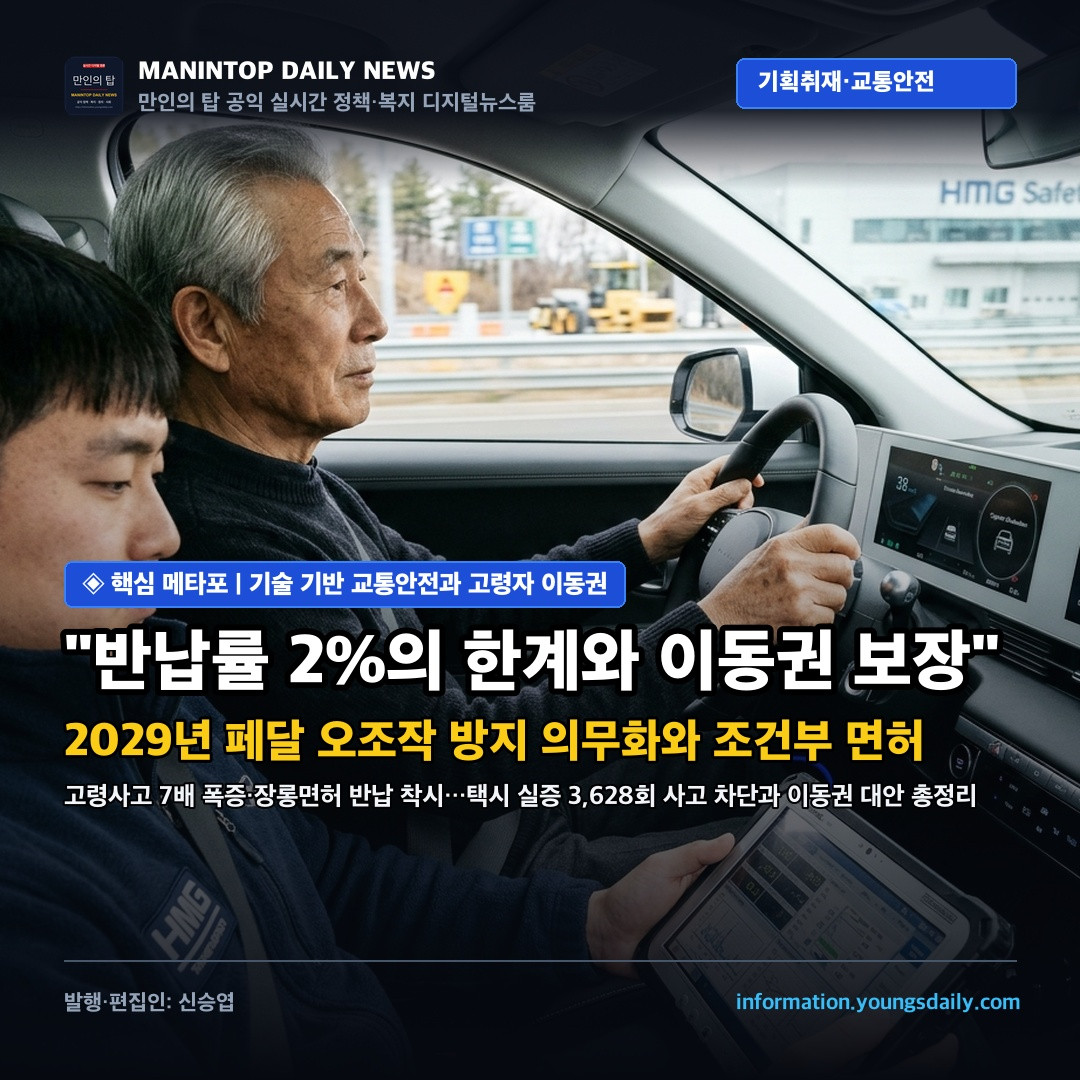
[기획취재·교통안전] "반납률 2%의 한계와 이동권 보장"…2029년 페달 오조작 방지 장치(PMA) 의무화와 고령자 조건부 면허제 심층 분석
만인의 탑 편집국11월 05, 2026
기획취재 · 교통안전
[기획취재·교통안전] “반납률 2%의 한계와 이동권 보장”…2029년 페달 오조작 방지 장치(PMA) 의무화와 고령자 조건부 면허제 심층 분석
대한민국이 65세 이상 인구 20%를 돌파하며 공식 초고령사회에 진입한 가운데, 고령운전자 가해 사고 비중이 20년 만에 7배 이상 급증하며 도로 교통안전의 최대 현안으로 부상했습니다. 지자체의 운전면허 자진반납 제도가 8년째 시행되고 있으나 실제 반납률은 2.2%에 그치고, 비운전자의 이른바 ‘장롱면허’ 반납으로 인한 정책 효율 저하 문제가 실증 연구를 통해 확인되었습니다. 이에 정부는 2029년 페달 오조작 방지 장치(PMA) 신차 의무 장착 입법예고와 함께 고령자 조건부 면허제, 대체 이동권 확충을 아우르는 기술·제도적 대전환에 착수했습니다. 고령운전자 교통안전의 현주소와 해법을 전방위로 심층 분석합니다.
▲ 교통안전 평가 센터 차량 내부에서 고령 운전자가 첨단 운전자 보조 시스템 평가를 받고 있다. 정부는 단순한 면허 박탈 대신 페달 오조작 방지 장치 등 첨단 제어 기술과 조건부 면허를 결합한 종합 안전망 구축에 속도를 내고 있다. [사진=만인의 탑 특별취재팀]
📌 핵심 브리핑 (Key Takeaways)
65세 이상 고령운전자 면허 소지자가 517만 명을 돌파하며 전체의 14.9%를 차지했고, 전체 교통사고 중 고령운전자 가해 사고 비중은 2005년 2.9%에서 2024년 21.6%(4만 2,369건)로 7.4배 폭증했습니다.
10만~20만 원 상당의 인센티브를 지급하는 면허 자진반납 제도가 8년째 운영 중이나, 이동권 제약과 생계 유지 등의 이유로 실제 반납률은 2.2%에 불과하며 고령층의 55%는 반납 거부 의사를 밝혔습니다.
학술 패널 분석 결과, 면허 반납 1건당 연간 42만 원의 사회적 비용 절감 효과가 확인되었으나, 최근에는 실제 운전을 하지 않는 ‘장롱면허’ 고령자의 반납 비중이 83%를 웃돌며 정책 효율이 급격히 저하되었습니다.
국과수 감정 결과 급발진 의심 사고의 80~90%가 페달 오조작으로 판명됨에 따라, 국토교통부는 2029년부터 신규 승용차에 페달 오조작 방지 장치(PMA) 장착을 전면 의무화합니다.
법인택시 227대 대상 실증 사업에서 PMA가 3개월간 3,628회의 급가속 오조작을 완벽 차단했으며, 정부는 안전장치 부착을 전제로 한 조건부 면허제와 농어촌 100원 복지택시 등 대체 이동권 확충을 병행 추진합니다.
1. 초고령사회 진입과 고령운전자 가해사고 7.4배 폭증 실태
대한민국은 2024년 12월 만 65세 이상 고령인구 비율이 전체의 20%를 돌파하며 명실상부한 초고령사회에 진입했다. 통계청 장래인구추계에 따르면 2025년 20.3%에 달하는 고령화율은 2040년 34.3%, 2050년 40.1%까지 가파르게 치솟을 전망이다. 인구 고령화의 급물살은 도로 교통 생태계의 판도를 근본적으로 뒤흔들고 있다.
국회예산정책처 분석에 따르면 2024년 기준 994만 명의 고령인구 중 절반이 넘는 517만 명이 운전면허를 보유하고 있다. 전체 면허 소지자 중 65세 이상 비중은 2015년 7.6%에서 2024년 14.9%로 불과 9년 사이에 두 배 가까이 뛰었다. 청장년층 면허 소지자가 정체되거나 감소하는 반면 고령층 면허 소지자는 매년 가파른 순증세를 보이고 있다.
📊 대한민국 고령화율 및 고령운전자 사고 비중 20년 추이 (도로교통공단 TAAS)
구분 지표
과거 (2005/2015)
현재 (2024/2025)
변화율 및 정책 시사점
65세 이상 고령화율
9.3% (2005년)
20.3% (2025년)
초고령사회 공식 진입 완료
고령운전자 면허 비중
7.6% (2015년)
14.9% (517만 명)
9년 만에 면허 비중 약 2배 급증
고령운전자 가해사고 비중
2.9% (2005년)
21.6% (2024년)
20년 사이 7.4배 폭증
고령운전자 가해사고 건수
약 0.6만 건 (2005년)
42,369건 (2024년)
역대 최고치 기록 경신
한국도로교통공단 교통사고분석시스템(TAAS) 통계에 따르면 2024년 총 19만 6,349건의 교통사고 중 65세 이상 운전자가 낸 사고는 4만 2,369건으로 21.6%에 달했다. 차량 안전장치와 도로 개선으로 전 연령대의 운전자 1만 명당 사고 건수가 감소세를 보이는 것과 정반대로, 고령층에서만 가해 사고가 폭발적으로 늘고 있어 특화된 안전 대책이 시급한 상황이다.
2. 면허 자진반납 제도의 현주소와 '장롱면허' 착시 현상
경찰청과 지자체는 2018년부터 65세 또는 70세 이상 운전자가 면허를 자진 반납할 경우 10만~20만 원 상당의 선불 교통카드나 지역화폐를 지급하는 반납 인센티브 제도를 운용해 왔다. 국민 인지도는 59%, 고령자 인지도는 75%에 달하고 응답자의 73%가 사고 예방 취지에 공감하고 있으나, 2024년 기준 실제 반납률은 2.2%로 극히 저조하다. 당사자의 55%는 “향후에도 반납할 의사가 없다”고 단언한다.
🚫 고령운전자들이 면허 반납을 거부하는 4대 현실적 이유
건강 및 운전 능력에 대한 자신감 (59%): “신체적·인지적으로 아무런 문제가 없어 여전히 안전하게 운전할 수 있다”는 주관적 확신.
자유로운 이동권 박탈 우려 (58%): 버스·지하철 배차 간격과 환승 불편으로 대중교통만으로는 생활 반경 유지가 불가능.
일상생활 유지의 절대적 필수성 (54%): 정기적인 병원 진료, 장보기, 복지관 방문 등 필수적인 Daily Life 영위에 차량이 필수.
생계 유지 수단 (50%): 택시, 소형 화물, 배송, 농업 등 운전 자체가 노후 소득 창출의 직결된 수단.
면허 반납 적정 연령에 대해서도 일반 국민은 평균 71.8세로 인식하는 반면, 고령운전자 스스로는 78.2세로 평가해 약 7년의 뚜렷한 세대 간 인식 격차가 존재한다. 더욱이 국립군산대 최재훈 교수와 부산대 염윤호 교수의 전국 215개 시·군·구 패널분석(2017~2022년) 결과, 제도 초기(2018~2020년)에는 반납 1건당 연간 125만 원의 사회적 비용 절감 효과가 나타났으나, 최근(2020~2022년)에는 통계적 유의성이 사라졌다.
이는 실제 운전을 하지 않는 고령층이 10만 원 지원금을 받기 위해 면허를 반납하는 ‘장롱면허 착시 현상’ 때문이다. 실제 운전 여부를 보험가입증명서로 검증한 지자체 사례에 따르면, 전체 반납자 중 실제 운전자는 15.2~16.5%에 불과했다. 즉, 투입 예산 대비 사고 감축 효율을 극대화하려면 실제 운전자를 겨냥한 선별적 인센티브 구조 개편이 불가피하다.
▲ 기술 행정 데스크 위에 놓인 페달 오조작 방지 장치(PMA) 전자 센서 모듈과 운전면허증, 성능 점검 보고서. 페달 오조작을 기술적으로 원천 차단하는 장치가 2029년 신차 장착 의무화로 추진된다. [사진=만인의 탑 포토데스크]
3. 기술적 돌파구: 페달 오조작 방지장치(PMA)와 2029년 국토부 의무화
국립과학수사연구원의 급발진 의심 사고 감정 결과에 따르면, 의뢰 건수의 80~90%가 차량 기계 결함이 아닌 운전자의 페달 오조작으로 판명되었다. 일본 경찰청 통계에서도 75세 이상 사망사고 원인의 27.6%가 페달 오조작이었다. 이에 따라 일방적인 면허 박탈 대신 기술로 신체적 인지 저하를 보완하는 ‘페달 오조작 방지장치(PMA, Prevent of Unintended Acceleration)’가 핵심 대안으로 급부상했다.
⚙️ 페달 오조작 방지장치(PMA) 4대 핵심 제어 메커니즘
제어 항목
작동 조건 및 기준
사고 차단 원리
정지·저속 급가속 차단
정지 또는 15km/h 이하 주행 중
전후방 1~1.5m 내 장애물 감지 시 가속 페달 입력 무력화
주행 중 고RPM 제어
주행 속도 무관
엔진 회전수 4,500 rpm 이상 급상승 시 연료 분사 차단
최고속도 제한
과속 카메라 단속 구간 및 고속 주행
규정 속도 준수 유도 및 차량 최고속도 140km/h로 전자적 제한
비상 긴급 해제
추월 등 긴급 순간 가속 필요 시
물리 해제 버튼 조작 시 1분간 안전 기능 일시 해제
TS한국교통안전공단이 전국 법인택시 227대(총 운행거리 211만 km)를 대상으로 3개월간 진행한 실증사업 결과, 페달 오조작 방지 기능이 총 3,628회, 속도제한 기능이 총 31만 6,099회 개입하며 단 한 건의 추돌 사고도 발생하지 않았다. 운전자들의 오조작 빈도 역시 3개월 만에 53.4% 급감해 운전 습관 개선 효과가 입증되었다.
국토교통부는 2029년 1월 1일부터 신규 제작·수입되는 모든 승용차에, 2030년 1월 1일부터는 3.5톤 이하 승합·화물 신차에 PMA 장착을 의무화하는 입법예고를 단행했다. 서울시 역시 2026년 3월부터 70세 이상 고령자 차량 200대에 PMA를 무상 장착하는 실증특례 시범사업에 본격 돌입한다.
4. 글로벌 선별적 면허 관리와 조건부 면허제 수용성
주요 선진국은 획일적 연령 규제 대신 정밀한 의학적·인지적 검증을 거친 ‘선별적 면허 관리’와 ‘조건부 면허’를 도입해 안전과 이동권을 조화시키고 있다.
🌐 주요국 고령운전자 면허 갱신 및 관리 제도 비교
국가 및 지역
갱신 주기 및 기준
선별 및 조건부 면허 특징
대한민국
65~74세 5년 / 75세 이상 3년
75세 이상 치매선별검사 및 교통안전교육 의무화
일본
70~74세 3~4년 / 75세 이상 3년
안전장치 탑재차만 운전 가능한 ‘서포트카(사포카) 한정면허’ 발급
미국 (캘리포니아)
70세 이상 5년
방문 갱신, 시력 검사 및 정밀 도로주행 시험 실시
미국 (메릴랜드)
경찰·의료진 신고제 운용
의료심사위원회 정밀 평가 거쳐 보고된 75세 이상의 20%만 면허 유지
국민 인식 조사(리얼미터)에서도 단순 주기 단축(16.6%)보다 안전장치 의무화(26.5%)와 인지능력 검사 강화(19.9%)를 지지하는 여론이 높았다. 고령운전자(한국리서치) 역시 첨단 안전장치 부착(69%)이나 최고속도 제한(55%) 등 기술 기반 완화 조건에는 긍정적인 반면, 야간 운전 금지나 고속도로 진입 차단 등 물리적 이동을 통제하는 방식에는 70% 이상이 거부감을 나타냈다.
5. 고령자 이동권 보장 모빌리티와 보험 체계 개편 과제
OECD는 고령자가 살던 지역에서 존엄하게 여생을 보내는 ‘Aging-in-place’ 실현을 위해 이동권 보장이 필수적이라고 강조한다. 카렐 마르텐스(Karel Martens) 교수의 교통 정의(Transport Justice) 이론 역시 취약계층의 이동 도달 가능성을 보장하지 않는 강제적 면허 회수는 사회적 고립과 간병 비용 폭증이라는 더 큰 부작용을 낳는다고 경고한다.
대체 교통 인프라 혁신: 1회성 10만 원 지급을 탈피해 공공 콜택시 이용권(48% 선호), 농어촌 100원 복지택시 및 수요응답형 버스(DRT) 대폭 확충.
미래 자율주행 모빌리티(MaaS) 연계: 4단계 자율주행 로보택시를 고령자 병원 통원 및 일상 이동 맞춤형 서비스로 연계하고 원터치 호출 앱 지원.
자동차보험 유인부합적 개편: 실운전자 면허 반납 시 30만 원 상당 차등 보상, PMA 장착 차량 대상 자동차보험료 할인 특약 신설, 무사고 이력 연계 요율 세분화.
6. 결론: 획일적 반납 강요를 넘어 '기술과 포용'의 교통 생태계로
초고령사회의 교통안전은 고령자를 잠재적 가해자로 낙인찍고 면허를 빼앗는 손쉬운 방식으로는 결코 달성될 수 없다. 반납률 2%가 웅변하듯, 운전은 고령층의 생계이자 사회적 생명선이다.
2029년 페달 오조작 방지 장치 신차 의무화와 사포카식 조건부 면허 도입, 그리고 촘촘한 대체 이동권 인프라 구축이 결합될 때 비로소 시민의 생명 안전과 고령자의 존엄한 이동권이 상생하는 지속 가능한 교통 생태계가 완성될 것이다.
만인의 탑 교통정책 취재팀은 PMA 법제화 과정과 고령자 이동권 인프라 확충 실태를 지속적으로 추적 보도할 계획이다.
[Special Investigation · Traffic Safety] “The 2% Surrender Dilemma and Mobility Rights”: Inside Korea's 2029 Pedal Misapplication Prevention Mandate and Senior Conditional Licensing
As South Korea officially entered a super-aged society with citizens aged 65 and older surpassing 20% of the total population, the proportion of traffic collisions caused by senior drivers has surged 7.4-fold over two decades, emerging as the nation’s most pressing public safety priority. While municipal voluntary license surrender programs have operated for eight years, actual surrender rates languish at just 2.2%, with empirical econometric studies revealing a policy illusion caused by inactive ‘closet license’ surrenders. In response, the government has advanced major technological and legislative paradigms, including the mandatory installation of Pedal Misapplication Acceleration Prevention (PMA) systems on new vehicles by 2029, conditional senior driver licensing, and expanded alternative mobility networks. This comprehensive investigation examines the status, technology, and policy roadmaps governing senior traffic safety.
▲ A senior driver undergoes an advanced cognitive and technical driving capability evaluation inside a vehicle at an automotive safety testing facility. Rather than blunt license revocation, authorities are accelerating the rollout of sensor-based control technologies and conditional licensing to harmonize safety and mobility. [Photo: Manintop Special Investigation Team]
📌 Executive Key Takeaways
Senior drivers aged 65+ surpassed 5.17 million individuals (14.9% of all license holders), while traffic accidents caused by senior drivers surged from 2.9% in 2005 to 21.6% (42,369 cases) in 2024.
Voluntary license surrender programs offering 100,000 to 200,000 KRW in transit credits have achieved an actual surrender rate of only 2.2%, with 55% of senior drivers firmly rejecting surrender due to mobility needs and livelihood dependence.
Academic panel regression models reveal that while each license surrendered initially saved 420,000 to 1.25 million KRW annually in social costs, recent policy efficiency has eroded because over 83% of surrenders represent inactive ‘closet’ drivers.
Forensic analyses by the National Forensic Service show that 80% to 90% of suspected unintended acceleration incidents stem from pedal misapplication, prompting the Ministry of Land, Infrastructure and Transport to mandate PMA systems on all new passenger cars by 2029.
In a nationwide pilot on 227 commercial taxis, PMA successfully intervened 3,628 times to completely avert pedal error collisions, driving comprehensive policy shifts toward conditional licensing and rural on-demand subsidized transit.
1. The Demographic Shift and the 7.4-Fold Surge in Senior-Caused Accidents
In December 2024, South Korea officially crossed the demographic threshold into a super-aged society, with citizens aged 65 and older exceeding 20% of the aggregate population. Projections from Statistics Korea indicate this aging ratio will climb from 20.3% in 2025 to 34.3% by 2040 and 40.1% by 2050, fundamentally reordering the nation’s road traffic landscape.
National Assembly Budget Office audits report that over half of Korea’s 9.94 million senior citizens—roughly 5.17 million people—possess active driver’s licenses. The proportion of senior license holders jumped from 7.6% in 2015 to 14.9% in 2024, nearly doubling in nine years while younger driver cohorts stagnated or contracted.
📊 Two-Decade Evolution of Senior Population and Traffic Collisions (KoROAD TAAS)
Statistical Metric
Historical (2005/2015)
Contemporary (2024/2025)
Rate of Change & Significance
Senior Demographic Ratio
9.3% (2005)
20.3% (2025)
Official Super-Aged Transition
Senior License Share
7.6% (2015)
14.9% (5.17M drivers)
Doubled in less than a decade
Senior At-Fault Accident Share
2.9% (2005)
21.6% (2024)
Surged 7.4-fold over 20 years
Annual Senior Accident Volume
~6,000 cases (2005)
42,369 cases (2024)
Historic peak in traffic registries
According to KoROAD’s Traffic Accident Analysis System (TAAS), senior drivers accounted for 42,369 of 196,349 total accidents in 2024 (21.6%). In stark contrast to general accident trends—where collisions per 10,000 drivers are declining due to vehicle safety systems—accidents caused by senior drivers continue to climb unabated, underscoring the urgent necessity for customized safety interventions.
2. The 2.2% Voluntary Surrender Paradox and the ‘Closet License’ Effect
Since 2018, police agencies and local authorities have offered prepaid transit cards or local vouchers valued at 100,000 to 200,000 KRW to seniors who surrender their licenses. While 75% of senior drivers are aware of the policy and 73% of citizens endorse its intent, actual surrender rates stalled at 2.2% in 2024. A decisive 55% of senior drivers state they have no intention of surrendering their licenses.
🚫 4 Primary Obstacles Driving Senior Resistance to License Surrender
Driving Capability Self-Confidence (59%): Strong personal conviction that physical health and cognitive faculties remain unimpaired.
Mobility Rights Deprivation (58%): Public transit intervals and complex transfer systems in suburban/rural areas render daily navigation unfeasible.
Daily Life Essentiality (54%): Access to medical centers, grocery markets, and social engagements depends strictly on personal vehicle use.
Livelihood Sustenance (50%): Freight shipping, taxi services, parcel deliveries, and agricultural transport serve as direct household income sources.
Generational perceptions regarding appropriate surrender ages diverge widely: general citizens recommend an average age of 71.8, whereas senior drivers cite 78.2 years—a seven-year gap. Furthermore, econometric panel regression covering 215 municipalities from 2017 to 2022 (Prof. Choi Jae-hoon of Kunsan National Univ. and Prof. Yeom Yoon-ho of Pusan National Univ.) reveals that while surrenders reduced social costs by 1.25 million KRW per case between 2018 and 2020, statistical significance vanished during the 2020–2022 window.
This decline stems from inactive ‘closet drivers’ surrendering licenses primarily to collect vouchers. In pilot regions verifying active driving through insurance certificates, active drivers constituted only 15.2% to 16.5% of total surrender applicants. Maximizing cost efficiency demands restructuring incentive models strictly around active drivers.
▲ An electronic Pedal Misapplication Prevention (PMA) sensor assembly alongside a smart driver’s license and regulatory performance sheets. Sensor-based intervention is legally scheduled to become mandatory on all new passenger cars in Korea by 2029. [Photo: Manintop Photo Desk]
3. The Technological Breakthrough: PMA Systems and Korea's 2029 Mandate
Forensic investigations by the National Forensic Service show that 80% to 90% of suspected unintended sudden acceleration cases result from pedal confusion rather than mechanical or electronic defects. In Japan, 27.6% of fatal crashes involving drivers aged 75+ stem from pedal errors. Consequently, the deployment of Pedal Misapplication Acceleration Prevention (PMA) systems has emerged as the definitive technical remedy.
⚙️ PMA 4-Stage Core Electronic Safety Control Architecture
Control Protocol
Trigger Parameters
Accident Interception Mechanism
Low-Speed Obstacle Cutoff
Stationary or ≤ 15 km/h
Overrides accelerator when obstacles exist within 1.0–1.5m.
Caps maximum vehicle velocity electronically at 140 km/h.
Emergency Driver Override
Critical passing maneuvers
Disables intervention for 60 seconds upon physical button toggle.
TS Korea Transportation Safety Authority’s 3-month field trial on 227 commercial taxis (covering 2.11 million km) recorded 3,628 PMA interventions and 316,099 speed-limit calibrations, maintaining a zero-collision record throughout the trial. Crucially, recurring driver errors dropped 53.4%, demonstrating habit-remediation benefits.
Under revised automotive safety regulations, the Ministry of Land, Infrastructure and Transport will mandate PMA on all new passenger cars starting January 1, 2029, and on light commercial vehicles by 2030. The Seoul Metropolitan Government is rolling out a regulatory sandbox initiative installing PMA units free of charge on 200 senior-operated vehicles beginning March 2026.
4. Global Precedents and Social Acceptance of Conditional Licensing
Rather than blunt age cutoffs, advanced economies rely on precise medical evaluations and conditional licenses to balance safety and individual mobility.
🌐 International Senior License Renewal and Risk Screening Comparison
Jurisdiction
Renewal Cadence
Targeted Screening & Conditional Models
South Korea
Ages 65–74: 5 yrs / 75+: 3 yrs
Mandatory cognitive screening and safety education for ages 75+.
Japan
Ages 70–74: 3–4 yrs / 75+: 3 yrs
Issues ‘Support Car (Sapocar) Restricted Licenses’ restricting driving to sensor-equipped vehicles.
United States (California)
Ages 70+: 5 years
Mandatory in-person renewal, vision testing, and targeted road evaluations.
United States (Maryland)
Physician & Police Referral Model
Medical Advisory Board screening allows only ~20% of flagged 75+ drivers to retain full licenses.
National survey data (Realmeter) reveals that citizens strongly prioritize mandatory safety devices (26.5%) and intensified cognitive assessments (19.9%) over arbitrary renewal shortening (16.6%). Senior drivers (Hankook Research) widely support technology-based conditional licenses (69% endorsement for safety modules), but more than 70% reject strict geographic bans or highway driving prohibitions that curtail basic freedom of movement.
5. Mobility Rights Infrastructure and Insurance Reforms
The OECD highlights the principle of ‘Aging-in-place,’ noting that preserving mobility is essential to avoid premature institutionalization and escalating social welfare costs. Transportation Justice theory (Prof. Karel Martens) confirms that revoking licenses without accessible mobility alternatives precipitates severe social isolation.
Transit Infrastructure Expansion: Moving beyond token vouchers to provide subsidized taxi vouchers (48% preference) and expanding on-demand transit (DRT) and rural 100-KRW welfare taxis.
Autonomous Mobility (MaaS) Integration: Deploying Level 4 autonomous robotaxis for outpatient medical trips, integrated with simplified senior-friendly dispatch interfaces.
Incentive-Aligned Insurance Reforms: Differentiating surrender compensation for proven active drivers, introducing auto insurance premium discounts for vehicles equipped with PMA, and refining risk premiums by accident-free records rather than raw age brackets.
6. Conclusion: Moving from Coercive Surrender to Inclusive Safety Ecosystems
Traffic safety in a super-aged society cannot be achieved by stigmatizing seniors as latent offenders and forcing license surrenders. As the 2.2% surrender rate demonstrates, driving remains an irreplaceable economic and social lifeline for older adults.
By coupling the 2029 mandatory rollout of PMA systems with conditional licensing and robust rural transit networks, South Korea can safeguard road safety while preserving the mobility and dignity of its senior citizens.
The Manintop Transport Policy Desk will continue monitoring the legislative trajectory of PMA standards and the implementation of senior mobility infrastructure nationwide.
1월이 시작되면 감기는 이미 우리 곁에 와 있습니다. 2월, 3월, 4월까지 이어지는 추위와 건조함은 코와 목을 가장 먼저 공격합니다. 아침에 일어나자마자 막혀 있는 코. 계속 흐르는 콧물. 괜히 칼칼해지는 목. 이 증상은 “시작”일 뿐입니다. 한 번 무너지면 일주일, 길면 한 달까지 끌고 갑니다. 약을 먹으면 잠깐 괜찮아집니다. 하지만 며칠 뒤 또 반복됩니다. 왜일까요? 감기는 ‘치료’의 문제가 아니라 ‘관리’의 문제이기 때문입니다. 대부분은 감기가 오고 나서 약을 찾습니다. 하지만 진짜 중요한 건 감기가 오기 전에 코와 목을 지키는 것입니다. 건조한 실내 공기, 차가운 바깥 공기, 눈에 보이지 않는 세균. 코와 목은 매일 공격받고 있습니다. 지긋지긋하죠! 그런데도 우리는 아무 준비 없이 버티고 있습니다. 이번 겨울도 그렇게 보낼 건가요? 사실 방법은 어렵지 않습니다. 코를 깨끗하게 관리하고, 목을 따뜻하게 보호하고, 점막을 촉촉하게 유지하고, 기관지를 미리 관리하고, 외부 공기를 차단하는 것. 이 다섯 가지만 꾸준히 해도 감기약 없이 겨울을 보내는 것이 충분히 가능합니다. 🔥 이제부터 그 방법을 하나씩 살펴보겠습니다. 🔥 1. 코와 목을 먼저 관리해야 하는 과학적 이유 감기의 대부분은 코 점막에서 시작됩니다. 국제 학술지 Nature Reviews Microbiology 와 Journal of Allergy and Clinical Immunology 에 실린 호흡기 감염 관련 연구들에서는, 감기 바이러스가 비강 상피세포에 먼저 부착해 증식한다는 점을 설명하고 ...
리모델링사업이 진행 중인 아파트를 매매할 때 “계약금 10%를 언제까지 내야 하느냐”는 질문이 특히 많이 나옵니다. 이주공고(이주 안내)가 7~11월쯤이라고 들으면, 그 시점에 맞춰 계약금도 움직일 것 같아서 더 헷갈리기 쉽습니다. 하지만 실제 납부기한은 ‘이주공고가 언제냐’만으로 자동 결정되지 않는 경우가 많습니다. 1) 계약금 10% 납부기한: 결국 ‘문서에 적힌 일정’이 기준 계약금 10%를 언제까지 납부해야 하는지는, 내가 서명하는 매매계약서(특약 포함) 와 사업주체/조합이 제시한 공고·안내문 에 적힌 납부 일정이 기준이 됩니다. 실제 공고문에서는 분양대금 납부의 큰 틀(계약금→중도금→잔금)을 먼저 안내하고, 상세 일정은 별도 표나 유의사항으로 제시하는 방식이 흔합니다. 또, 계약서 문구에 따라 지급 시점이 조건부로 설정될 수도 있습니다. 예를 들어 한 사례 소개 자료에서는 용역계약서에 잔금(10%) 지급시기가 “사업승인 후”로 기재되어 있었다는 점이 언급됩니다. 이런 식으로 ‘사업 단계’와 지급을 연동하는 문구가 들어가면, 질문의 답은 계약서 문구를 확인해야만 확정됩니다. 관련 내용은 링크 에서 문구 사례를 확인할 수 있습니다. 2) 입주자모집공고에서 확인되는 ‘납부 순서’와 잔금 마감 시점 공고문에 적힌 문구를 보면, 납부 순서와 잔금 마감에 대한 기준이 비교적 명확하게 제시되는 경우가 있습니다. 예를 들어 한 입주자모집공고에는 “분양금액(주택가격)은 계약금, 중도금, 잔금의 순서로 납부”하며 “잔금은 입주(열쇠 수령일) 전에 완납”해야 한다고 안내되어 있습니다. (문구 확인: 링크 ) 이 문구가 의미하는 바는 최소 2가지입니다. 분양/공급 형태의 문서에서는 ‘계약금→중도금→잔금’ 흐름이 공식적으로 안내될 수 있습니다. 잔금은 “입주(열쇠 수령)” 이전에 완납해야 한다는 마감 기준이 문서에 적혀 있을 수 있습니다. 다만, 위 공고문 문구는 잔금 마감에 대한 기준을 보여주지만, 계약금 10%의...
윤석열 전 대통령 탄핵 인용 소식을 접하면, 가장 궁금한 지점은 ‘헌재가 정확히 무엇을 위헌·위법으로 봤는가’입니다. 또한 탄핵과 별개로 진행되는 형사재판(내란 우두머리 혐의 등)이 어디까지 왔는지도 함께 정리할 필요가 있습니다. 아래 내용은 제공된 기사/게시물 스니펫과 링크에서 확인되는 범위만 모아, 일반인이 흐름을 이해하기 쉽게 정리한 것입니다. 1) 탄핵 인용 관련: 스니펫에서 확인되는 ‘판단의 골격’ 제공된 근거 중 조국혁신당 사이트에는 헌법재판소가 윤석열 탄핵 심판에서 “피청구인의 위헌·위법행위는 국민 신임 …”이라는 취지로 판단했다는 문장이 인용돼 있습니다( 링크 ). 이 인용문만 놓고 보면, ‘위헌·위법행위’가 있었는지와 그로 인해 ‘국민의 신임’이 어떻게 평가됐는지가 핵심 축으로 소개됩니다. 다만 질문에서 요청하신 세부 항목, 즉 비상계엄 선포 자체를 문제 삼은 구체적 이유, 계엄 이후 조치(포고령, 국회 통제 등)의 어떤 지점이 헌법 위반인지, 국회의 권한행사 방해 및 정치활동 제약을 어떤 논리로 판단했는지 등은, 이번에 제공된 근거의 제목/스니펫만으로는 조항·사실관계·판단 구조가 그대로 제시돼 있지 않습니다. 따라서 이 글에서는 ‘헌재가 무엇을 문제 삼았다’는 세부 리스트를 단정적으로 재구성하기보다, 현재 확인 가능한 문구 수준의 요약(위헌·위법행위 → 국민 신임의 문제로 평가)까지만 적습니다. 만약 헌재 결정문 전문(주문 및 이유)이 추가로 확인되면, 그때는 문장 단위로 ‘어떤 행위’와 ‘어떤 헌법 원리/조항’이 연결되는지(예: 권력분립, 국회의 권한, 정치적 기본권 등) 구조화해 정리하는 것이 가장 정확합니다. 2) 형사 절차(내란 혐의) 관련: 체포영장과 1심 선고 언급 탄핵 심판과 별도로, 12·3 비상계엄 사태로 내란 혐의를 받는 윤석열 대통령에 대해 2024년 12월 31일 체포 영장이 발부됐다는 BBC 보도가 있습니다( 링크 ). 해당 보도는 ‘현직 대통령’에 대한 체포영장 발부라는 점을 함께 언급합니다. 또...