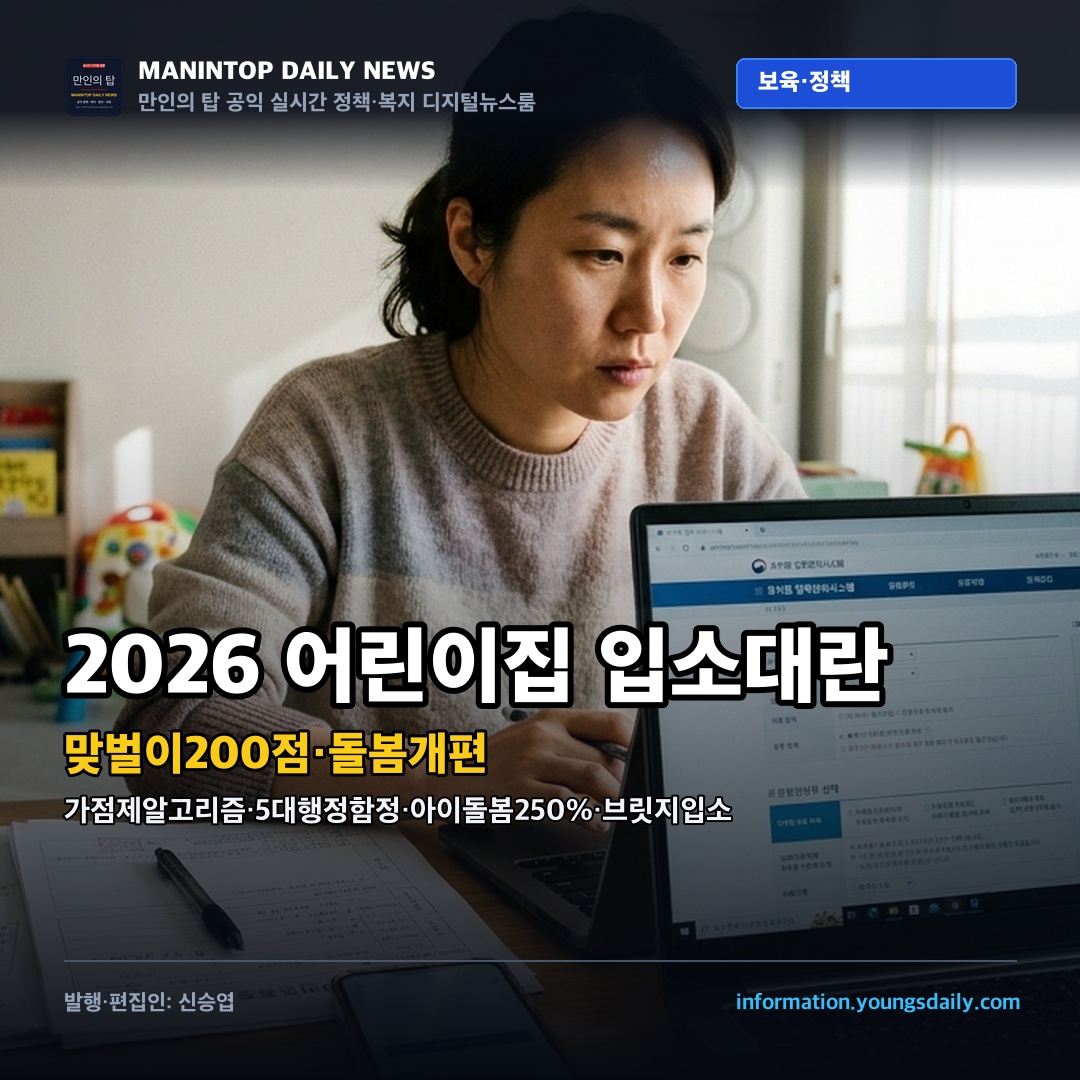
2026 어린이집 입소 대란과 보육 정책 완전정복: 맞벌이 200점 증빙부터 5대 행정 함정과 아이돌봄 개편 총정리
만인의 탑 편집국11월 16, 2026
▲ 2026 어린이집 입소 대란과 보육 정책 완전정복: 맞벌이 200점 증빙부터 5대 행정 함정과 아이돌봄 개편 총정리 (공식 보도 자료)
📌 핵심 브리핑 · 주요 쟁점 및 핵심 요약
매년 신학기를 앞두고 수백 번대 대기 번호에 발을 구르는 영유아 학부모들의 불안이 고조되는 가운데, 어린이집 입소 대기의 성패를 가르는 행정 시스템과 2026~2027년 최신 보육 정책의 핵심 쟁점이 수면 위로 떠올랐습니다. '선착순'이 아닌 영유아보육법상 '우선순위 점수 합산제'로 작동하여 며칠 전 신청한 700점 고가점 가구에 순번이 역전되는 가점제 알고리즘의 실체부터, 아르바이트·프리랜서·구직자도 주 15시간(월 60시간) 소득 증빙과 최저임금 역산 검증을 거쳐 획득하는 '맞벌이 200점' 인정 요건, 입소 후 7일 이내 대기 연장 미신청 시 타 기관 전산 자동 취소와 '15일의 법칙' 등 5대 치명적 행정 함정, 만 0세 반 3월 신학기 진입 및 국공립·공공형·민간 3종 분산과 '브릿지 입소' 실전 전략, 그리고 대기 탈락 가구를 구제하는 2026년 정부 아이돌봄서비스의 중위소득 250% 이하(라형) 전격 확대와 시간당 12,790원 개편까지 학부모가 꼭 알아야 할 핵심 팩트를 알기 쉽고 흥미롭게 총정리합니다.
SPONSORED · ADVERTISEMENT
1. 어린이집 입소 대기 선착순 오해와 우선순위 가점제 알고리즘의 실체
아이를 낳자마자 산후조리원에서 어린이집 대기 신청을 걸어두고 안도했던 초보 부모들이 신학기를 앞두고 분통을 터뜨리는 일이 매년 반복되고 있습니다. 대기 번호 10번대였던 우리 아이 순번이 어느 날 갑자기 50번, 100번 뒤로 밀려나는 기현상 때문입니다. 많은 부모가 어린이집 입소를 '먼저 신청한 사람이 먼저 들어가는 선착순'으로 잘못 알고 있지만, 대한민국 영유아보육법이 규정하는 입소 시스템의 본질은 철저한 '우선순위 점수 합산제'입니다.
영유아보육법 시행규칙 제29조에 따르면 결원이 발생했을 때 가장 먼저 입소 자격을 얻는 아동은 접수 순서와 상관없이 가장 높은 배점을 확보한 1순위 고가점자입니다. 아무리 1년 전, 출생 당일 대기를 걸어두었더라도 입소 직전에 맞벌이와 다자녀 혜택을 모두 갖춘 700점 만점 가정이 신청하면 기존 대기자는 전산상 뒤로 밀려날 수밖에 없습니다.
현행 법정 배점표를 살펴보면 기초생활수급자, 차상위계층, 한부모가족 등은 각 항목당 100점이 주어지며, 부모가 모두 월 60시간 이상 일하는 맞벌이 가구는 200점의 강력한 특례 가점을 받습니다. 자녀가 3명 이상인 다자녀 가구 역시 200점(영유아 2명 가구는 100점)을 부여받습니다. 특히 맞벌이이면서 자녀가 3명 이상인 가구는 기본 400점에 추가 300점이 더해져 총 700점이라는 압도적인 점수를 획득하게 됩니다. 반면 다문화가족이나 동일 어린이집 재원 형제자매 등이 속한 2순위는 항목당 50점에 불과합니다.
여기서 가장 중요한 행정 룰은 2순위 항목을 아무리 많이 합산하여 150점을 채우더라도, 1순위 한 항목(100점)을 가진 가정을 결코 앞지를 수 없다는 점입니다. 오직 동일한 1순위 내에서 점수가 완벽히 같을 때에만 비로소 '임신육아종합포털 아이사랑에 접수한 일시'가 최종 당락의 기준선으로 작동합니다. 따라서 막연히 대기 순번만 믿고 기다릴 것이 아니라, 본인 가구의 법정 가점을 1점이라도 끌어올리는 현실적인 서류 전략이 선행되어야 합니다.
▲ 인가 어린이집 영아반 교실에서 교사가 아이들과 안전 매트 위에서 따뜻하게 보육 및 놀이 활동을 지도하는 모습 / 어린이집 보육 현장 포커스
2. 맞벌이 200점 획득 요건과 어린이집 서류 심사 최저임금 역산 검증법
어린이집 입소 전쟁의 승패를 가르는 가장 결정적인 열쇠는 바로 '맞벌이 200점'입니다. 많은 부모들이 4대 사회보험이 적용되는 번듯한 정규직 직장인만 맞벌이로 인정받는 줄 알고 포기하지만, 보건복지부와 교육부의 공식 지침은 아르바이트, 프리랜서, 자영업자, 심지어 취업준비생(구직자)에게도 문호를 활짝 열어두고 있습니다. 단, 문턱이 넓어진 만큼 지자체와 원장의 서류 검증 기준은 현미경처럼 매서워졌습니다.
보육사업안내 지침에 규정된 취업의 법적 최소 요건은 '주 15시간 이상 또는 월 60시간 이상 근로'입니다. 4대 보험에 가입된 직장인은 회사 직인이 찍힌 재직증명서와 함께 건강보험자격득실확인서나 근로소득원천징수영수증 중 1부를 제출하면 되며, 육아휴직자 역시 재직 상태로 온전히 인정받습니다.
파트타임이나 아르바이트 등 단시간 근로자의 경우 계약 기간과 주 15시간(월 60시간) 이상 근무 조건, 급여액이 명시된 근로계약서와 함께 '최근 3개월 이상의 급여이체내역서'를 은행에서 발급받아 필수로 내야 합니다. 현금 수령은 증빙이 불가능하므로 인정되지 않습니다. 프리랜서는 위촉계약서와 3개월 급여 통장 내역 또는 세무서 소득금액증명원으로 소득의 정기성을 입증해야 하며, 개인사업자는 사업자등록증명과 함께 부가가치세과세표준증명원을 제출해야 합니다. 매출이 0원이거나 증빙이 없으면 실질적인 사업 영위로 인정되지 않아 반려됩니다. 취업준비자는 고용24(워크넷)에서 구직등록확인증을 발급받되, 입소일 직전 최소 3개월 이상 구직등록이 유지되어 있어야 합니다. 둘째를 임신 중인 외동 가구라면 출산예정일이 적힌 병원 진단서를 제출해 다자녀 100점 가점을 선제적으로 챙길 수 있습니다.
특히 최근 현장에서 가장 강력하게 작동하는 검증 장치는 '최저임금 역산 검증'입니다. 계약서상에는 월 60시간 일한다고 적어놓고 실제 통장에는 월 20만~30만 원만 입금된 경우, 지자체는 이를 위장 취업으로 간주해 즉시 불합격 처리합니다. 허위 서류가 적발되면 해당 아동이 신청한 전국 모든 어린이집의 대기 신청이 일괄 강제 취소되므로 규정에 부합하는 실질적 소득 증빙을 갖추어야 합니다.
제도 및 행정 핵심 부문
종전 규정 및 오해
2026년 개편 핵심 내용
학부모 필수 유의사항 및 실전 팁
입소 대기 순번 원칙
출생 직후 신청한 선착순 대기 오해
법정 1순위 고가점자 우선 배정 알고리즘
2순위 누적 점수 높아도 1순위 추월 불가
맞벌이 가점 자격 요건
4대 보험 가입 정규직만 가능 오해
주 15시간/월 60시간 이상(알바·프리랜서 포함)
최근 3개월 급여이체내역 및 최저임금 역산 검증
신청 한도 및 대기 관리
무제한 신청으로 인한 전산 왜곡
미재원 3곳, 재원 2곳 신청 한도 제한
입소 후 7일 이내 연장 미신청 시 타 기관 자동 취소
보육료 바우처 전환 기준
월 중도 입소 시 일할 계산 복잡
매월 15일의 법칙 (16일 이후 자부담 발생)
가정양육수당/부모급여에서 15일 이전 전환 권장
3월 신학기 골든타임
특정 기관(국공립)만 단독 몰림
기관 3종 믹스(국공립+공공형+민간/가정)
만 0세 반 필수 공략 및 브릿지 입소 전원 전략
2026 아이돌봄서비스
중위소득 200% 이하 가~다형만 지원
기준 중위소득 250% 이하(라형 15%) 전격 확대
시간당 12,790원, 어린이집 하원 후 시간 지원
SPONSORED · ADVERTISEMENT
3. 부모들이 가장 많이 당하는 어린이집 입소 행정 5대 치명적 실수
어린이집 입소 대기는 정교한 전산망으로 운영되기 때문에, 규정을 잘못 알아 클릭 한 번을 잘못하거나 날짜를 넘기면 수년간 공들여 쌓아온 대기 순번이 한순간에 날아가는 낭패를 겪게 됩니다. 첫 번째 실수는 '3곳 신청 한도' 초과입니다. 현재 어린이집에 다니지 않는 미재원 아동은 전국 최대 3곳, 이미 다른 어린이집에 다니고 있는 재원 아동은 최대 2곳까지만 대기를 걸 수 있습니다. 무제한 신청으로 인한 전산 왜곡을 막기 위한 필수 규칙입니다.
두 번째이자 가장 많은 부모들이 눈물 흘리는 덫은 '입소 후 7일 자동 취소 규정'입니다. 대기 중이던 어린이집 중 한 곳에 최종 입소하여 등원 처리가 완료되면, 입소일로부터 정확히 7일이 지난 자정에 다른 대기 중인 모든 어린이집의 신청 내역이 시스템상에서 영구 자동 삭제됩니다. 만약 임시로 한 곳에 다니면서 원래 원하던 국공립 어린이집의 대기(최대 2곳)를 계속 유지하고 싶다면, 입소일로부터 7일 이내에 반드시 아이사랑 누리집에 로그인하여 '대기 연장 신청'을 직접 클릭해야 합니다.
세 번째는 '증빙서류 제출 7일 기한 도과'입니다. 원장으로부터 입소 확정 연락을 받으면 입소일 전 7일 이내에 맞벌이 증빙 등 모든 우선순위 서류 원본을 어린이집에 제출해야 합니다. 기한 내 서류를 내지 못하거나 자격을 소명하지 못하면 입소가 직권 취소되고 기회는 다음 순번으로 넘어갑니다.
네 번째는 보육료 지원과 부모급여의 갈림길인 '15일의 법칙'입니다. 보육료 바우처 전환은 행정상 매달 15일을 기준으로 나뉩니다. 만약 16일 이후에 어린이집에 입소하면 당월 부모급여 현금 지급과 보육료 바우처 간의 일할 정산 문제로 인해 수만 원에서 수십만 원의 부모 자부담금이 발생할 수 있으므로 가급적 15일 이전에 입소 절차를 마치는 것이 유리합니다.
다섯 번째는 '연간 대기 연장 갱신 누락'입니다. 아이사랑 포털의 대기 신청은 영구적인 것이 아니며, 주기적으로 연장 의사를 확인하지 않거나 만 5세(장애아동 만 12세) 연령 상한을 초과하면 사전 통보 없이 자동 삭제되므로 정기적인 접속 관리가 필수적입니다.
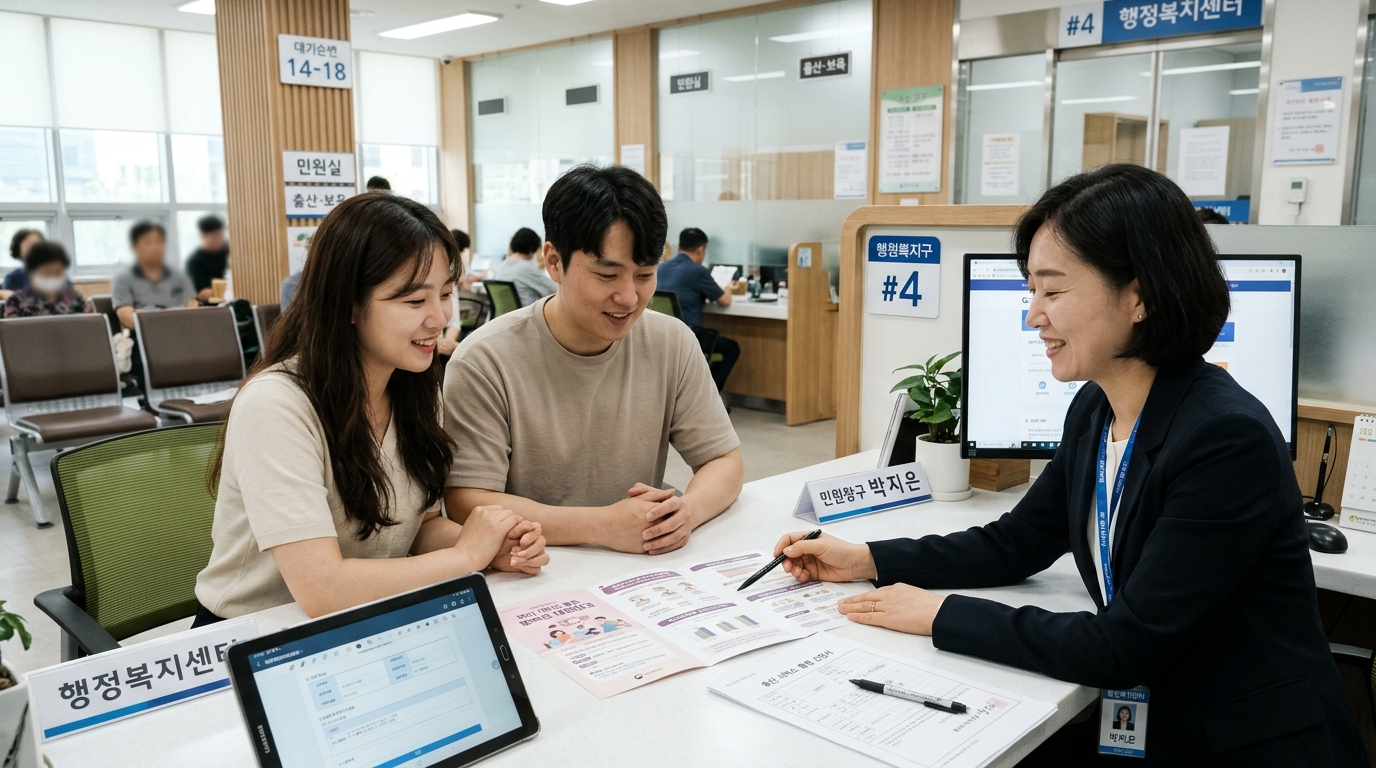
▲ 지자체 행정복지센터 보육복지 창구에서 학부모가 공무원과 어린이집 입소 우선순위 증빙 및 보육료 바우처 전환을 상담하는 모습 / 행정복지 상담 현장 자료
4. 3월 신학기 골든타임 공략과 어린이집 기관 믹스 브릿지 입소 전략
어린이집 입소의 성패는 점수뿐 아니라 대규모 정원 변동이 일어나는 '타이밍'에서 판가름 납니다. 연중 결원이 가장 쏟아지는 시기는 단연 3월 신학기입니다. 국내 보육 학제는 매년 3월 1일 시작됩니다. 3월은 기존 7세 아동들이 초등학교나 유치원으로 졸업하고, 재원생들이 상위 연령 반으로 진급하면서 일 년 중 가장 거대한 규모의 신규 공석(T/O)이 열리는 '골든 게이트'입니다. 모든 신입 원아가 동시에 적응 프로그램을 시작하므로 아이의 정서 안정에도 가장 유리합니다. 반면 9월은 여름휴가 후 부모 복직이나 가을 이사로 소규모 틈새 결원이 발생하는 2차 타이밍입니다.
연령별로는 돌 전 신생아가 속하는 '만 0세 반'의 경쟁이 가장 치열합니다. 교사 대 아동 비율이 1:3으로 매우 낮아 물리적 정원 자체가 귀하고 중도 퇴소도 거의 없기 때문입니다. 따라서 출생신고를 마치는 즉시 대기를 걸어야 하며, 정부의 '6+6 부모육아휴직제' 종료 시점을 3월 신학기에 정밀하게 맞추는 전략이 필요합니다. 만 1~2세 반은 활동량 증가와 이사 등으로 연중 간헐적 결원이 발생하므로 맞벌이 200점을 확보했다면 수시 입소를 노려볼 만합니다.
기관 선택 시 국공립 어린이집만 3곳 몰아서 신청하는 것은 탈락 확률을 높이는 위험한 선택입니다. 입소 가능성을 극대화하려면 선호도가 높은 국공립 1곳, 우수 민간 시설에 정부 지원이 더해진 공공형 1곳, 그리고 집 앞 민간이나 20인 이하 가정어린이집 1곳 등 '포트폴리오 분산 믹스'를 구성해야 합니다. 또한 정원이 넉넉한 민간이나 가정어린이집에 먼저 입소해 아이를 맡긴 뒤, 최선호 국공립 기관의 대기를 유지(재원자 자격 2곳)하며 순번을 기다리다 전원하는 '브릿지 입소' 전략을 현명하게 구사해야 합니다.
한국사회보장정보원 공시에 따르면 2027년도 3월 신학기 입소 대상 순번은 2026년 11월 2일 오전 10시부터 아이사랑 포털에서 일제히 공개되었습니다. 신학기 입소 확정 시 별도의 문자 통보가 가지 않으므로 원장 유선 연락과 포털 현황을 수시로 확인해야 합니다.
어린이집 대기 순번이 끝내 닿지 않아 복직을 앞두고 발을 구르는 가정이라면, 정부가 가정으로 전문 인력을 파견해 주는 '아이돌봄서비스'로 신속히 전환해야 합니다. 2026년은 성평등가족부의 대대적인 제도 개편으로 정부 지원 대상이 파격적으로 확대되었습니다.
올해 가장 큰 변화는 소득 기준의 상향입니다. 기존 기준 중위소득 200% 이하 가구까지만 주어지던 정부 지원 혜택이 2026년부터 '기준 중위소득 250% 이하' 가구까지 전격 확대되었습니다. 이에 따라 종전에 전액 자부담(마형)으로 이용해야 했던 맞벌이 중산층(중위소득 200~250% 구간)도 신설된 '라형'으로 편입되어 15%의 정부 지원을 받게 되었습니다.
2026년도 시간당 기본요금은 전년도 12,180원에서 12,790원으로 현실화되었습니다. 소득 유형별로는 중위소득 75% 이하 가형은 85%를 정부가 지원해 시간당 실부담이 약 1,900원 선에 불과하며, 120% 이하 나형은 60%, 150% 이하 다형은 30%, 250% 이하 라형은 15%를 지원받습니다. 다자녀 감면 기준도 '12세 이하 3명'에서 '12세 이하 2명'으로 완화되어 다자녀 가정은 본인부담금의 10%를 추가 할인받으며, 법정 취약가구는 연간 지원 시간이 1,080시간으로 120시간 늘어났습니다. 또한 2026년 4월부터는 국가 공인 교육을 마친 전문 인력만 활동하는 '아이돌봄사 국가자격제'가 전면 도입되어 안전성과 전문성이 크게 높아졌습니다.
다만 아이돌봄서비스를 이용할 때는 어린이집 보육료 바우처를 받는 낮 시간대에는 정부 지원이 중복 적용되지 않는다는 점을 명심해야 합니다. 정부 지원은 어린이집 하원 이후 시간부터 온전히 적용됩니다. 아울러 아이돌봄 누리집에서 무턱대고 예약부터 하면 전액 본인 부담이 청구되므로, 반드시 복지로 누리집이나 주민센터를 통해 '정부지원 자격 판정'을 먼저 신청하여 소득 유형을 부여받은 뒤 국민행복카드로 결제해야 지원 혜택을 온전히 누릴 수 있습니다.
Mastering the 2026 Daycare Admission Crisis and Childcare Policies: A Comprehensive Overview of Evidence for Dual-Income Families, the Five Major Administrative Pitfalls, and Revisions to Childcare Services.
As the new school year approaches each year, the anxiety of parents with infants and toddlers, who find themselves waiting with hundreds of others, is intensifying. Key issues surrounding the administrative system that determines the success or failure of daycare admissions and the latest childcare policies for 2026-2027 have come to the forefront.
The system operates not on a 'first-come, first-served' basis but rather through a 'priority score accumulation system' as stipulated by the Infant and Toddler Care Act. This has led to a situation where families with high scores, such as those who applied just days ago with a score of 700, can find their order reversed due to the algorithm that favors additional points.
Moreover, the criteria for recognizing 'dual-income families' with a 200-point bonus require proof of income for part-time workers, freelancers, and job seekers, which must be validated against the minimum wage over a 15-hour work week (60 hours monthly). There are also five critical administrative pitfalls to be aware of, including automatic cancellation of applications by other institutions if a waiting extension is not requested within seven days of admission, and the '15-day rule.'
Additionally, strategies for entering the new school year in March for infants aged zero, the distribution of public, public-type, and private daycare options, and the concept of 'bridge admissions' are essential considerations. Furthermore, the government’s plan to expand childcare services in 2026 for families with incomes below 250% of the median income (category L) and the revision of the hourly rate to 12,790 won are crucial facts that parents must understand clearly and engagingly.
📌 Key Takeaways
To clarify the misunderstanding regarding the first-come, first-served policy, a score of 200 points will be granted if the payroll transfer records show 15 hours per week (60 hours per month) and meet the minimum wage calculation requirements.
If the waiting extension is not clicked within seven days of admission, the application will be deleted from the system. This measure is to prevent self-burdening of childcare fees before the 15th and to facilitate bridge admissions.
A new category has been established for those with an income level below 250% of the median income, offering 15% support. The hourly wage is set at 12,790 won, and benefits can be utilized after qualification assessment through the welfare system.
1. The Misunderstanding of the First-Come, First-Served System for Daycare Admission and the Reality of the Priority Point System Algorithm
New parents, who felt relieved after applying for daycare as soon as their child was born, often find themselves frustrated as the new school year approaches. This annual frustration stems from the sudden shift in their child's waiting number from the 10s to the 50s or even 100s. Many parents mistakenly believe that daycare admission operates on a "first-come, first-served" basis, but the essence of the admission system as defined by South Korea's Child Care Act is a thorough "priority point accumulation system.".
According to Article 29 of the Enforcement Rules of the Child Care Act, when vacancies occur, the child who first qualifies for admission is not determined by the order of application but by having the highest score. Even if a family applied a year ago on the day of birth, if a dual-income family with multiple children applies just before admission and scores a perfect 700 points, existing applicants will inevitably be pushed back in the system.
The current legal scoring table awards 100 points for families in need, low-income households, and single-parent families, while dual-income households where both parents work over 60 hours a month receive a strong bonus of 200 points. Families with three or more children also receive 200 points (100 points for families with two young children). Notably, dual-income families with three or more children start with a base of 400 points and receive an additional 300 points, totaling an overwhelming 700 points. In contrast, the second priority group, which includes multicultural families or siblings already enrolled in the same daycare, receives only 50 points per category.
The most crucial administrative rule is that no matter how many second-priority points are accumulated to reach 150 points, they cannot surpass a family with even one first-priority point (100 points). Only when scores are perfectly equal within the same first-priority group does the "date of application submitted to the Comprehensive Pregnancy and Childcare Portal" serve as the final criterion for admission. Therefore, rather than blindly trusting the waiting number, families should prioritize a realistic documentation strategy to increase their legal points by even one point.
▲ Nursery teacher guiding infants and toddlers in a safe, nurturing daycare classroom / Childcare and Nursery Focus
2. Requirements for Earning 200 Points for Dual-Income Families and Minimum Wage Verification Method for Daycare Document Review
The most decisive factor in winning the daycare admission battle is the "200 points for dual-income families." Many parents give up, believing that only regular employees covered by the four major social insurances are recognized as dual-income, but the official guidelines from the Ministry of Health and Welfare and the Ministry of Education are open to part-time workers, freelancers, self-employed individuals, and even job seekers. However, with the expanded criteria, local governments and daycare directors have tightened their document verification standards significantly.
The legal minimum requirement for employment, as stated in the Child Care Business Guidelines, is "working at least 15 hours per week or 60 hours per month." Employees covered by the four major insurances need to submit a certificate of employment stamped by their company along with either a health insurance eligibility confirmation or a withholding tax receipt. Those on parental leave are also fully recognized as employed.
For part-time or temporary workers, a work contract specifying the contract period and the requirement to work at least 15 hours per week (60 hours per month), along with a bank statement showing salary transfers for the last three months, must be submitted. Cash payments are not recognized due to lack of proof. Freelancers must provide a contract and bank statements for three months or an income certificate from the tax office to prove income regularity, while self-employed individuals need to submit a business registration certificate along with a value-added tax standard certificate. If there are no sales or proof, they will not be recognized as operating a legitimate business. Job seekers must obtain a job registration confirmation from Employment 24 (Worknet) and must have maintained their registration for at least three months prior to the admission date. If a single-child family is expecting a second child, they can submit a hospital diagnosis letter with the expected delivery date to proactively secure the 100-point bonus for multiple children.
Recently, the most powerful verification tool in the field is the "minimum wage reverse calculation verification." If a contract states that a person works 60 hours a month but only shows deposits of 200,000 to 300,000 won in their bank account, local governments will consider this as disguised employment and immediately disqualify the application. If false documents are detected, all waiting applications for the child at every daycare across the country will be forcibly canceled, so it is essential to have legitimate income proof that complies with regulations.
Category
Target Scope
Standard / Benefit
Procedure / Action
Principles of Admission Waiting List Order
Misunderstanding of First-Come, First-Served Applications Right After Birth
Second-Priority Applicants Cannot Surpass First-Priority Even with Higher Cumulative Points
Eligibility Requirements for Dual-Income Bonus Points
Misunderstanding that Only Regular Employees with Four Major Insurances Are Eligible
Must Work at Least 15 Hours a Week or 60 Hours a Month (Including Part-Time and Freelance Work)
Verification of Salary Transfer Records for the Last Three Months and Minimum Wage Calculation
Application Limits and Waiting List Management
Distortion in the System Due to Unlimited Applications
Limitations on Applications for Three Non-Registered and Two Registered Institutions
Automatic Cancellation by Other Institutions if Extension is Not Requested Within Seven Days After Admission
Criteria for Converting Childcare Fee Vouchers
Complex Pro-Rated Calculations for Mid-Month Admissions
The Rule of the 15th of Each Month (Self-Payment Begins After the 16th)
Recommended Conversion from Home Childcare Allowance/Parental Benefits Before the 15th
Golden Time for the New School Year in March
Concentration Only in Specific Institutions (Public and National)
Mix of Three Types of Institutions (Public, Public-Type, and Private/Home)
Essential Strategy for Targeting Zero-Year-Old Classes and Full Enrollment Before Bridge Admissions
2026 Childcare Services
Support Only for Categories A to D with Income Below 200% of Median Income
Dramatic Expansion for Those Below 250% of Median Income (Category L 15%)
Hourly Rate of 12,790 Won, Support for Hours After Childcare Center Dismissal
3. The Five Most Common Fatal Mistakes Parents Make in Daycare Admission
The daycare admission waiting list operates through a sophisticated computerized system, and a single misclick or missing a deadline can result in years of effort being lost in an instant.
The first mistake is exceeding the "limit of applying to three places." Currently, children who are not enrolled in any daycare can apply to a maximum of three places, while those already attending can only apply to two. This is a necessary rule to prevent system distortion due to unlimited applications.
The second and most common pitfall that brings tears to many parents is the "automatic cancellation rule after 7 days of admission." Once a child is finally admitted to one of the daycares they were waiting for, all applications for other daycares will be permanently deleted from the system at midnight exactly 7 days after the admission date. If parents wish to maintain their waiting status at their preferred public daycare while temporarily attending another, they must log into the Child Care Portal and click "extend waiting status" within 7 days of admission.
The third mistake is "missing the 7-day deadline for submitting documentation." Upon receiving confirmation of admission from the director, parents must submit all original priority documents, including proof of dual-income, to the daycare within 7 days before the admission date. Failure to submit documents on time or to prove eligibility will result in automatic cancellation of admission, and the opportunity will pass to the next applicant.
The fourth mistake involves the "15-day rule," which is a crossroads for childcare fee support and parental benefits. The conversion to childcare vouchers is administratively divided based on the 15th of each month. If a child is admitted after the 16th, there may be a significant parental out-of-pocket expense due to prorated calculations between cash payments for parental benefits and childcare vouchers, so it is advantageous to complete the admission process before the 15th whenever possible.
The fifth mistake is "failing to renew the annual waiting status." Applications on the Child Care Portal are not permanent and will be automatically deleted without prior notice if parents do not periodically confirm their intention to extend or if their child exceeds the age limit of 5 years (12 years for children with disabilities), making regular access management essential.
▲ Parent consulting with a municipal welfare official regarding daycare admission priority verification and childcare vouchers / Administrative Consultation Archive
4. Strategies for Targeting the Golden Time of March and Mixed Bridge Admissions for Daycare Institutions
The success of daycare admission is determined not only by points but also by the "timing" of significant enrollment changes. The period with the highest number of vacancies throughout the year is undoubtedly the March school year start.
In South Korea, the childcare academic year begins on March 1 each year. March is when existing 7-year-old children graduate to elementary school or kindergarten, and current students advance to higher age groups, creating the largest number of new vacancies in the year, referred to as the "Golden Gate." Since all new students start their adaptation programs simultaneously, it is also the most favorable time for children's emotional stability. In contrast, September is a secondary timing when small vacancies occur due to parents returning to work after summer vacations or moving in the fall.
Among age groups, competition is fiercest in the "0-year-old class," which includes newborns. The teacher-to-child ratio is very low at 1:3, making physical capacity scarce and mid-term withdrawals almost nonexistent. Therefore, parents should apply for waiting status as soon as they complete their birth registration and strategically align the end of the government's "6+6 parental leave system" with the March school year start. For the 1-2 year-old classes, intermittent vacancies occur throughout the year due to increased activity and moving, so if parents have secured the 200 points for dual-income, they should consider aiming for admission at any time.
When selecting institutions, applying to three public daycares is a risky choice that increases the likelihood of rejection. To maximize admission possibilities, parents should create a diversified portfolio by applying to one preferred public daycare, one excellent private facility with government support, and one nearby private or home daycare with fewer than 20 children. Additionally, they should strategically employ a "bridge admission" strategy by first enrolling in a private or home daycare with ample capacity, while maintaining waiting status at their top-choice public institution (qualifying for two spots) and waiting for their turn to transfer.
According to the Korea Social Security Information Service, the waiting numbers for admission in March 2027 were released simultaneously on the Child Care Portal starting at 10 AM on November 2, 2026. There will be no separate text notifications for confirmed admissions, so parents should regularly check both the director's contact and the portal status.
For families who find themselves unable to secure a daycare spot and are anxious about returning to work, they should quickly transition to the "Childcare Service," which sends professional personnel to homes. In 2026, a significant reform by the Ministry of Gender Equality and Family dramatically expanded the scope of government support.
The most significant change this year is the increase in income thresholds. Previously, government support was only available to households with incomes below 200% of the median income, but starting in 2026, this will be expanded to households earning below 250% of the median income. As a result, dual-income middle-class families (earning between 200% and 250% of the median income) who previously had to bear all costs will now receive 15% government support under the newly established "Type L.".
The basic hourly rate for 2026 has been adjusted from 12,180 won to 12,790 won. For income types, households earning below 75% of the median income (Type A) will receive 85% government support, resulting in a net cost of about 1,900 won per hour. Households earning below 120% (Type B) will receive 60%, those below 150% (Type C) will receive 30%, and those below 250% (Type L) will receive 15% support. The criteria for multi-child discounts have also been relaxed from "three children under 12" to "two children under 12," allowing multi-child families to receive an additional 10% discount on their out-of-pocket expenses. Additionally, the annual support hours for legally vulnerable households have increased by 120 hours to 1,080 hours. Starting in April 2026, a national qualification system for childcare workers will be fully implemented, significantly enhancing safety and professionalism.
However, it is essential to remember that when using the childcare service, government support does not apply during daytime hours when receiving childcare fee vouchers. Government support is fully applicable only after daycare hours. Furthermore, if parents make reservations without proper procedures on the childcare service website, they will be billed the full amount, so it is crucial to first apply for "government support qualification assessment" through the welfare website or local community center to receive the appropriate income type before making payments with the Happiness Card to fully benefit from the support.
Recommended Deep-Dive Investigations TOP 3
GLOBAL REPORT
1월이 시작되면 감기는 이미 우리 곁에 와 있습니다. 2월, 3월, 4월까지 이어지는 추위와 건조함은 코와 목을 가장 먼저 공격합니다. 아침에 일어나자마자 막혀 있는 코. 계속 흐르는 콧물. 괜히 칼칼해지는 목. 이 증상은 “시작”일 뿐입니다. 한 번 무너지면 일주일, 길면 한 달까지 끌고 갑니다. 약을 먹으면 잠깐 괜찮아집니다. 하지만 며칠 뒤 또 반복됩니다. 왜일까요? 감기는 ‘치료’의 문제가 아니라 ‘관리’의 문제이기 때문입니다. 대부분은 감기가 오고 나서 약을 찾습니다. 하지만 진짜 중요한 건 감기가 오기 전에 코와 목을 지키는 것입니다. 건조한 실내 공기, 차가운 바깥 공기, 눈에 보이지 않는 세균. 코와 목은 매일 공격받고 있습니다. 지긋지긋하죠! 그런데도 우리는 아무 준비 없이 버티고 있습니다. 이번 겨울도 그렇게 보낼 건가요? 사실 방법은 어렵지 않습니다. 코를 깨끗하게 관리하고, 목을 따뜻하게 보호하고, 점막을 촉촉하게 유지하고, 기관지를 미리 관리하고, 외부 공기를 차단하는 것. 이 다섯 가지만 꾸준히 해도 감기약 없이 겨울을 보내는 것이 충분히 가능합니다. 🔥 이제부터 그 방법을 하나씩 살펴보겠습니다. 🔥 1. 코와 목을 먼저 관리해야 하는 과학적 이유 감기의 대부분은 코 점막에서 시작됩니다. 국제 학술지 Nature Reviews Microbiology 와 Journal of Allergy and Clinical Immunology 에 실린 호흡기 감염 관련 연구들에서는, 감기 바이러스가 비강 상피세포에 먼저 부착해 증식한다는 점을 설명하고 ...
리모델링사업이 진행 중인 아파트를 매매할 때 “계약금 10%를 언제까지 내야 하느냐”는 질문이 특히 많이 나옵니다. 이주공고(이주 안내)가 7~11월쯤이라고 들으면, 그 시점에 맞춰 계약금도 움직일 것 같아서 더 헷갈리기 쉽습니다. 하지만 실제 납부기한은 ‘이주공고가 언제냐’만으로 자동 결정되지 않는 경우가 많습니다. 1) 계약금 10% 납부기한: 결국 ‘문서에 적힌 일정’이 기준 계약금 10%를 언제까지 납부해야 하는지는, 내가 서명하는 매매계약서(특약 포함) 와 사업주체/조합이 제시한 공고·안내문 에 적힌 납부 일정이 기준이 됩니다. 실제 공고문에서는 분양대금 납부의 큰 틀(계약금→중도금→잔금)을 먼저 안내하고, 상세 일정은 별도 표나 유의사항으로 제시하는 방식이 흔합니다. 또, 계약서 문구에 따라 지급 시점이 조건부로 설정될 수도 있습니다. 예를 들어 한 사례 소개 자료에서는 용역계약서에 잔금(10%) 지급시기가 “사업승인 후”로 기재되어 있었다는 점이 언급됩니다. 이런 식으로 ‘사업 단계’와 지급을 연동하는 문구가 들어가면, 질문의 답은 계약서 문구를 확인해야만 확정됩니다. 관련 내용은 링크 에서 문구 사례를 확인할 수 있습니다. 2) 입주자모집공고에서 확인되는 ‘납부 순서’와 잔금 마감 시점 공고문에 적힌 문구를 보면, 납부 순서와 잔금 마감에 대한 기준이 비교적 명확하게 제시되는 경우가 있습니다. 예를 들어 한 입주자모집공고에는 “분양금액(주택가격)은 계약금, 중도금, 잔금의 순서로 납부”하며 “잔금은 입주(열쇠 수령일) 전에 완납”해야 한다고 안내되어 있습니다. (문구 확인: 링크 ) 이 문구가 의미하는 바는 최소 2가지입니다. 분양/공급 형태의 문서에서는 ‘계약금→중도금→잔금’ 흐름이 공식적으로 안내될 수 있습니다. 잔금은 “입주(열쇠 수령)” 이전에 완납해야 한다는 마감 기준이 문서에 적혀 있을 수 있습니다. 다만, 위 공고문 문구는 잔금 마감에 대한 기준을 보여주지만, 계약금 10%의...
윤석열 전 대통령 탄핵 인용 소식을 접하면, 가장 궁금한 지점은 ‘헌재가 정확히 무엇을 위헌·위법으로 봤는가’입니다. 또한 탄핵과 별개로 진행되는 형사재판(내란 우두머리 혐의 등)이 어디까지 왔는지도 함께 정리할 필요가 있습니다. 아래 내용은 제공된 기사/게시물 스니펫과 링크에서 확인되는 범위만 모아, 일반인이 흐름을 이해하기 쉽게 정리한 것입니다. 1) 탄핵 인용 관련: 스니펫에서 확인되는 ‘판단의 골격’ 제공된 근거 중 조국혁신당 사이트에는 헌법재판소가 윤석열 탄핵 심판에서 “피청구인의 위헌·위법행위는 국민 신임 …”이라는 취지로 판단했다는 문장이 인용돼 있습니다( 링크 ). 이 인용문만 놓고 보면, ‘위헌·위법행위’가 있었는지와 그로 인해 ‘국민의 신임’이 어떻게 평가됐는지가 핵심 축으로 소개됩니다. 다만 질문에서 요청하신 세부 항목, 즉 비상계엄 선포 자체를 문제 삼은 구체적 이유, 계엄 이후 조치(포고령, 국회 통제 등)의 어떤 지점이 헌법 위반인지, 국회의 권한행사 방해 및 정치활동 제약을 어떤 논리로 판단했는지 등은, 이번에 제공된 근거의 제목/스니펫만으로는 조항·사실관계·판단 구조가 그대로 제시돼 있지 않습니다. 따라서 이 글에서는 ‘헌재가 무엇을 문제 삼았다’는 세부 리스트를 단정적으로 재구성하기보다, 현재 확인 가능한 문구 수준의 요약(위헌·위법행위 → 국민 신임의 문제로 평가)까지만 적습니다. 만약 헌재 결정문 전문(주문 및 이유)이 추가로 확인되면, 그때는 문장 단위로 ‘어떤 행위’와 ‘어떤 헌법 원리/조항’이 연결되는지(예: 권력분립, 국회의 권한, 정치적 기본권 등) 구조화해 정리하는 것이 가장 정확합니다. 2) 형사 절차(내란 혐의) 관련: 체포영장과 1심 선고 언급 탄핵 심판과 별도로, 12·3 비상계엄 사태로 내란 혐의를 받는 윤석열 대통령에 대해 2024년 12월 31일 체포 영장이 발부됐다는 BBC 보도가 있습니다( 링크 ). 해당 보도는 ‘현직 대통령’에 대한 체포영장 발부라는 점을 함께 언급합니다. 또...