2027학년도 유치원과 어린이집 입학 전형이 단일 창구인 '유보통합포털(childinfo.go.kr)'에서 본격 가동된 가운데, 관심 기관 찜하기와 공공 마이데이터 20종 원클릭 서류 연계 등 3대 편의 기능이 신설되었습니다. 복수 선발 시 단 1곳만 선택 가능한 우선모집 48시간 등록 골든타임, 미등록 잔여 공석의 일반모집 100% 이월 반전, 1희망 탈락자부터 배정되는 희망순 중복선발제한 추첨 알고리즘, 그리고 상시 점수제와 추첨제를 둘러싼 정책 쟁점까지 학부모가 꼭 알아야 할 핵심 팩트를 알기 쉽게 총정리합니다.
SPONSORED · ADVERTISEMENT
1. 2027학년도 유보통합포털 3대 서비스 개편과 원클릭 마이데이터 서류 연계
어린이집 입소 신청 창구인 아이사랑과 유치원 입학 창구인 처음학교로가 하나로 통합된 유보통합포털이 2027학년도를 맞아 부모들의 실질적 편의를 돕는 세 가지 핵심 기능을 신설하고 대폭 강화했습니다. 매년 여러 사이트를 번거롭게 오가며 증빙 서류를 떼고 일정을 직접 챙겨야 했던 번거로움을 덜어주기 위한 디지털 혁신 조치입니다.
첫 번째 변화는 복지멤버십 시스템과 연계된 선제적 알림 서비스입니다. 기존에는 부모가 교육청이나 각 기관의 홈페이지를 일일이 찾아다니며 모집 요강을 확인해야 했습니다. 하지만 2027학년도부터는 0세부터 5세 자녀를 둔 보호자의 휴대전화로 신청 시기와 주요 전형 일정, 집 근처 인근 기관 정보가 알림톡으로 사전에 친절하게 자동 안내됩니다.
두 번째 변화는 관심 기관을 한눈에 담아두는 찜하기 기능의 신설입니다. 이제는 어린이집과 유치원을 따로 검색할 필요 없이 포털 안에서 두 기관을 통합 검색하고 별표를 눌러 하나의 관심 목록에 찜해 둘 수 있습니다. 원서 접수가 시작되면 이 찜 목록에서 곧바로 지원 단계로 진입할 수 있어 신청 시간을 대폭 아낄 수 있습니다. 다만 찜하기는 관심 기관을 장바구니처럼 담아두는 기능일 뿐 실제 입학 신청이 완료되는 것이 아니므로, 반드시 정해진 원서 접수 기간에 본 신청을 진행하고 접수 완료 상태를 확인해야 합니다.
세 번째 변화는 가족 정보 연계를 통한 원클릭 자녀 등록과 공공 마이데이터 서류 연계입니다. 아이의 주민등록번호와 인적사항을 매번 직접 입력할 필요 없이 클릭 한 번으로 불러올 수 있으며, 주민등록등본, 가족관계증명서, 기초생활수급자 증명서, 맞벌이 증빙 건강보험자격득실확인서 등 어린이집 6종, 유치원 14종에 이르는 최대 20종의 공인 증빙서류가 행정안전부 시스템을 통해 온라인으로 자동 확인·제출됩니다.
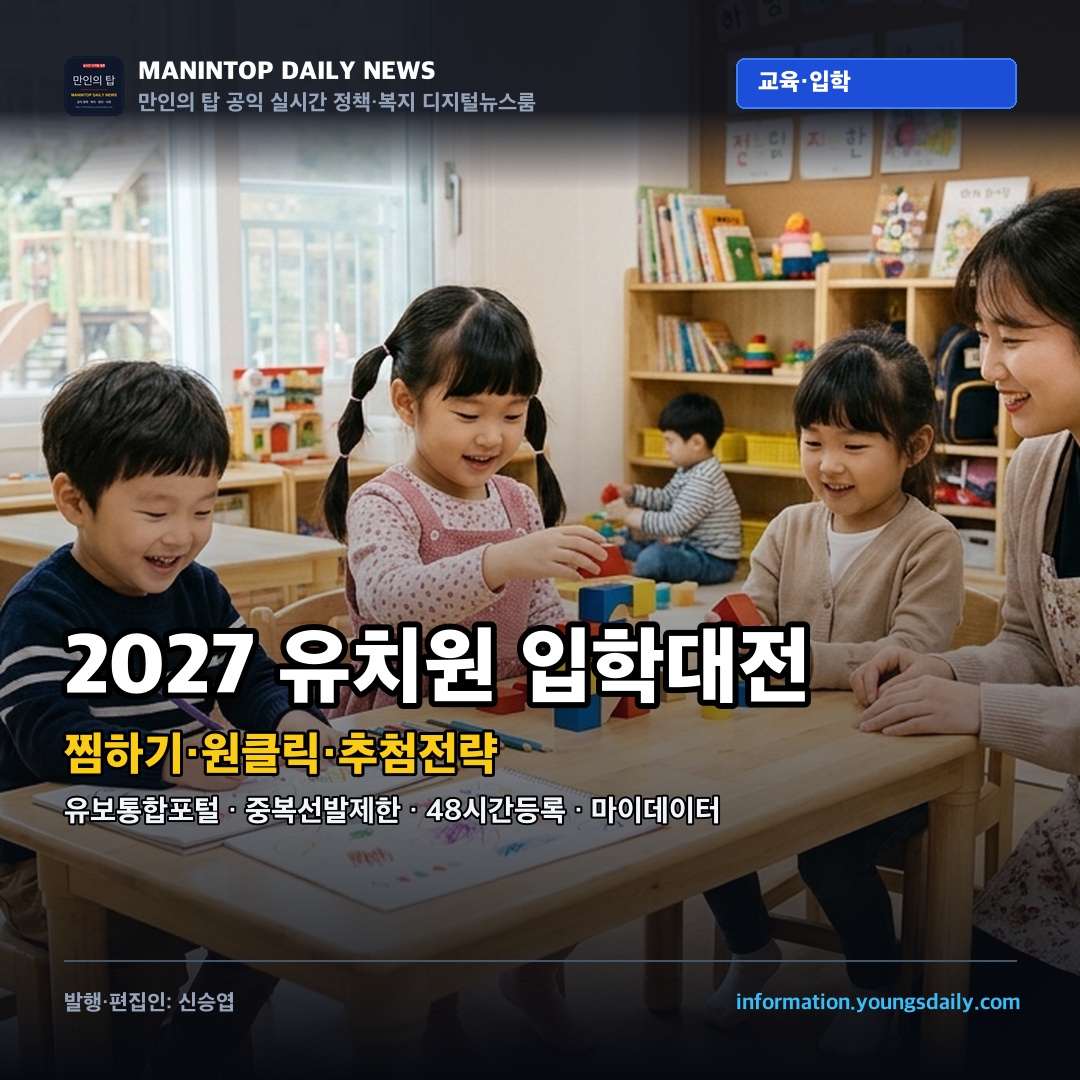
▲ 유치원 입학 상담실에서 학부모가 유보통합포털을 통한 2027학년도 유아모집 요강과 교육과정 안내 자료를 검토하는 모습 / 교육 정책 현장 취재 자료
2. 2027학년도 유치원 입학 공식 타임라인과 단계별 핵심 전형 일정
2027학년도 유치원 입학 전형은 만 3세(2023년생)부터 취학 전 유아를 대상으로 우선모집, 일반모집, 추가모집의 3단계로 엄격하게 순차 진행됩니다. 각 단계마다 엄격한 마감 시간과 등록 기한을 두고 있으며, 기한 내에 등록하지 않으면 합격 권리가 자동으로 취소되므로 일정 관리가 필수적입니다.
우선모집은 2026년 11월 2일부터 4일까지 접수를 진행하며, 법정 저소득층, 국가보훈대상자, 북한이탈주민 및 재원생 형제자매, 다자녀 등 원별 재량 조건을 갖춘 가정을 대상으로 합니다. 공립과 사립 구분 없이 최대 3곳까지 순위를 매겨 지원할 수 있으며 11월 9일 오후 3시에 선발 결과가 발표됩니다. 가장 주의해야 할 대목은 등록 기간인 11월 10일 오전 9시부터 11일 오후 6시까지의 48시간 골든타임입니다. 지원한 3곳 모두 합격하더라도 반드시 단 1곳만 선택하여 등록해야 하며, 마감 시간까지 등록을 마치지 않으면 선발된 모든 유치원의 합격이 자동으로 취소됩니다.
일반모집은 우선모집에서 선발되지 않은 유아를 대상으로 11월 17일부터 23일까지 진행됩니다. 우선모집에서 미등록으로 발생한 잔여 공석은 일반모집 정원으로 100% 전량 이월되므로, 11월 16일 저녁 6시 이후 포털에 공고되는 최종 선발 정원을 반드시 확인해야 합니다. 일반모집 추첨 결과는 11월 26일 오후 3시에 발표되며, 선발된 유치원은 11월 27일부터 30일까지 등록을 마쳐야 합니다. 이어 결원에 따른 대기자 순차 선발이 12월 한 달간 진행되고, 미달된 유치원은 12월부터 이듬해 2월 12일까지 추가모집을 실시합니다.
전형 단계 및 구분
2027학년도 핵심 일정
선발 및 대기 배정 원리
학부모 필수 유의사항
우선모집 발표·등록
발표 11.9(월) / 등록 11.10(화)~11(수) 18시
복수 합격 시 단 1곳만 등록 (타 원 자동 포기)
대기번호 전무(선발/탈락만 표시), 18시 이후 구제 불가
일반모집 최종 정원
요강 조회 11.16(월) 18시 이후
우선모집 잔여 공석 100% 전량 일반 정원 이월
우선모집 탈락자 포트폴리오 재편 및 이월 정원 확인 필수
일반모집 원서 접수
11.17(화) 09:00 ~ 11.23(월) 18:00
최대 3개 유치원 희망순 접수 (중복선발 제한)
자동접수 체크자도 정원마감·모집단위 변경 시 접수 무효 주의
일반모집 결과·등록
발표 11.26(목) / 등록 11.27(금)~30(월)
1희망 선발 시 2·3희망 자동 제외, 대기 1~3그룹 배정
선발 시 실질 2일 내 등록, 선발원 등록 시 타원 대기 자동 삭제
12월 대기자 관리
12.1(화) ~ 12.31(목) 23:59
매일 새벽 00:10 일괄 갱신, 선발 시 2일 내 등록
12.31 선발자는 당일 등록 필수, 추가모집 등록 시 대기 포기
SPONSORED · ADVERTISEMENT
3. 희망순 중복선발제한 추첨 메커니즘과 지망 순위 배치 전략
일반모집의 당락을 좌우하는 결정적인 알고리즘은 바로 희망순 중복선발제한 추첨 방식입니다. 이 시스템의 원리를 정확히 알지 못하면 가장 원하던 유치원에 합격할 기회를 스스로 날려버리는 안타까운 실수를 범할 수 있습니다.
일반모집 추첨은 1희망 유치원부터 순차적으로 실행됩니다. 1희망으로 지원한 유아들을 모아 전산 무작위 추첨을 진행한 뒤, 1희망에 선발되는 즉시 2희망과 3희망 추첨 명단에서 해당 아이의 데이터가 완전히 제외됩니다. 반면 1희망에서 탈락한 아이들만 2희망 추첨군에 포함되며, 2희망에서도 떨어진 아이들만 3희망 추첨으로 넘어갑니다.
이 때문에 경쟁률이 높다고 해서 1희망을 덜 선호하는 안전한 유치원으로 낮춰 쓰는 하향 지원은 절대 피해야 합니다. 1희망으로 낮춰 쓴 유치원에 덜컥 붙어버리면, 정작 가장 보내고 싶었던 최선호 유치원은 추첨 기회조차 얻지 못하고 끝나기 때문입니다. 1희망 추첨에서 떨어지더라도 2희망에서 동등하게 다시 추첨 기회가 주어지므로, 1희망은 무조건 제일 가고 싶은 곳에 소신 지원하는 것이 최선의 전략입니다.
학부모에게 추천되는 3개 기관 포트폴리오는 1희망 최선호 인기 유치원, 2희망 교육 여건이 우수하면서 상대적으로 경쟁이 덜한 곳, 3희망은 집 근처에서 안정적으로 통학 가능한 곳으로 분산하는 것입니다. 아울러 맞벌이 가정은 방과후 과정반 선발 방식을 꼼꼼히 살펴야 합니다. 정규 교육과정반과 방과후 과정반을 처음부터 따로 뽑는 분리 선발형 유치원의 경우 방과후반 경쟁률이 훨씬 높으므로 지원 전 세심한 확인이 필요합니다. 쌍둥이 가정의 경우 쌍생아 추첨 옵션을 신청하면 두 아이가 함께 선발되거나, 정원 끝단에서 1명만 붙었을 때 나머지 1명에게 최우선 대기번호를 부여하는 구제책이 적용됩니다.
▲ 아침 햇살 속 유치원 통학버스와 교문 앞에서 교사와 원아들이 밝은 표정으로 등원하는 모습 / 유치원 현장 자료
4. 유보통합기관 입학 기준 격돌과 상시 점수제 대 추첨제 논란
향후 출범할 유보통합기관의 정식 입학 선발 기준을 두고 학부모와 현장의 찬반 논란이 뜨겁게 달아오르고 있습니다. 현재 어린이집은 맞벌이와 다자녀 가정에 법정 가점을 부여해 순번을 매기는 상시 입소 대기 점수제를 운영하는 반면, 유치원은 매년 11월에 일제히 원서를 받아 무작위 전산 추첨을 돌리는 방식을 채택하고 있어 두 제도의 철학이 정면 충돌하고 있기 때문입니다.
교육부와 한국보육진흥원의 정책 토론회에서 공개된 영유아 학부모 1,979명 대상 설문조사 결과에 따르면, 현행 어린이집식 상시 대기 점수제를 선호한다는 응답(51.4%)과 유치원식 추첨제를 선호한다는 응답(48.6%)이 팽팽한 양상을 보였습니다. 우선순위 가중치 평가에서는 한부모·조손 가족(15.3%), 기초생활수급자(15.0%), 맞벌이 가정(12.1%)이 최우선 지원 대상으로 꼽혔으며, 3자녀 이상 다자녀 가정도 높은 중요도를 나타냈습니다.
정책 전문가들은 영아와 유아의 발달 특성을 고려해 0~2세 영아는 부모의 복직 시기가 연중 흩어져 있으므로 상시 대기 점수제를 유지하고, 3~5세 유아는 3월 신학기 정규 교육과정 입학이 중요한 만큼 추첨제를 기본 틀로 하되 맞벌이·취약계층에 가점을 주는 혼합형 모델을 유력한 대안으로 제시하고 있습니다. 기존에 수년씩 어린이집 대기를 걸어둔 학부모들의 신뢰 보호와 정규직·비정규직 차별 없는 실질적 맞벌이 증빙 기준 마련이 향후 유보통합 안착의 핵심 과제로 꼽힙니다.
Reform Strategies for the 2027 Kindergarten and Childcare Admission Competition: From Bookmarking and One-Click Document Submission to Tips for Duplicate Selection Lottery Based on Preference Order.
The admission process for kindergartens and daycare centers for the 2027 academic year has officially commenced through the single portal 'Child Integration Portal (childinfo.go.kr)'. New features have been introduced, including the ability to bookmark interested institutions and a one-click document linkage for 20 types of public MyData. Key points that parents need to know have been summarized clearly, including the 48-hour registration golden time for priority admissions where only one institution can be selected in case of multiple selections, the 100% rollover of unregistered vacancies during the general admissions, the lottery algorithm for the hope selection system that assigns spots starting from those who were not accepted in their first choice, and ongoing policy issues surrounding the scoring and lottery systems.
📌 Key Takeaways
Advance notification for welfare membership, integration of daycare and kindergarten reservation, and one-click automatic linkage for up to 20 types of public documents.
Registration is strictly limited to one location from November 10 to 11; failure to register will result in automatic cancellation, and the general recruitment quota will be confirmed on the 16th at 6 PM.
When selecting first preferences, lower preferences will be immediately excluded; first preference must be firm, second preference should be reasonable, and third preference should ensure stability, along with measures for twins.
1. The 2027 Early Childhood Integrated Portal Revamps Three Major Services and Links One-Click MyData Documents
The Early Childhood Integrated Portal, which combines the application channels for daycare centers (Aisarang) and kindergartens (First School), has introduced and significantly enhanced three key features to assist parents with practical convenience for the 2027 academic year. This digital innovation aims to alleviate the hassle of navigating multiple websites each year to gather documentation and manage schedules.
The first change is a proactive notification service linked to the welfare membership system. Previously, parents had to individually check the recruitment guidelines on the education office or various institutions' websites. However, starting from the 2027 academic year, guardians of children aged 0 to 5 will receive automatic notifications via text message on their mobile phones, providing information about application periods, key selection dates, and nearby institutions.
The second change is the introduction of a "favorites" feature that allows users to keep track of institutions of interest at a glance. Parents can now search for both daycare centers and kindergartens within the portal without needing to search separately, and can mark them as favorites to create a single list. When the application period begins, they can directly enter the application stage from this favorites list, significantly saving time. However, it is important to note that marking favorites is merely a way to keep track of interested institutions and does not complete the actual application process; parents must still apply during the designated application period and confirm their registration status.
The third change is the one-click child registration and public MyData document linkage through family information integration. Parents can retrieve their child's resident registration number and personal details with a single click, eliminating the need for repeated manual entry. Up to 20 types of official documentation, including resident registration certificates, family relationship certificates, basic livelihood recipient certificates, and dual-income verification health insurance eligibility certificates, will be automatically verified and submitted online through the Ministry of the Interior and Safety's system.
▲ Parent reviewing 2027 kindergarten admissions guidelines and curriculum documents at an admissions counseling desk / Education Policy Field Archive
2. Official Timeline and Key Selection Dates for Kindergarten Admissions in the 2027 Academic Year
The kindergarten admission process for the 2027 academic year will be strictly conducted in three phases: priority recruitment, general recruitment, and supplementary recruitment, targeting children aged 3 (born in 2023) and pre-schoolers. Each phase has strict deadlines for applications and registrations, and failure to register within these timeframes will automatically cancel the right to admission, making schedule management essential.
Priority recruitment will take place from November 2 to 4, 2026, targeting families that meet specific discretionary criteria, such as low-income households, national merit recipients, North Korean defectors, siblings of current students, and families with multiple children. Parents can rank up to three institutions, regardless of whether they are public or private, and the selection results will be announced on November 9 at 3 PM. It is crucial to note the registration period, which is a 48-hour "golden time" from 9 AM on November 10 to 6 PM on November 11. Even if a child is accepted to all three institutions applied to, they must choose only one to register; failure to complete registration by the deadline will result in the automatic cancellation of acceptance at all selected kindergartens.
General recruitment will be conducted from November 17 to 23 for children who were not selected in the priority recruitment phase. Any vacancies resulting from unregistered spots in priority recruitment will be fully carried over to the general recruitment quota, so it is essential to check the final selection quota announced on the portal after 6 PM on November 16. The results of the general recruitment lottery will be announced on November 26 at 3 PM, and selected kindergartens must complete registration from November 27 to 30. Following this, a sequential selection of waitlisted candidates will occur throughout December, and kindergartens with insufficient enrollment will conduct supplementary recruitment from December until February 12 of the following year.
Category
Target Scope
Standard / Benefit
Procedure / Action
Priority Recruitment Announcement and Registration
Announcement on November 9 (Monday) / Registration from November 10 (Tuesday) to November 11 (Wednesday) until 18:00
In case of multiple acceptances, registration is allowed at only one institution (automatic forfeiture of others)
No waiting numbers will be issued (only acceptance/rejection will be indicated), and no remedies will be available after 18:00
Final Quota for General Recruitment
Guidelines will be available for review after 18:00 on November 16 (Monday)
100% of remaining vacancies from priority recruitment will be carried over to the general quota
It is mandatory for applicants who were rejected in priority recruitment to reorganize their portfolios and confirm the carryover quota
General Recruitment Application
From November 17 (Tuesday) 09:00 to November 23 (Monday) 18:00
Applications can be submitted for up to three kindergartens in order of preference (duplicate selections are restricted)
Applicants who check for automatic registration should be cautious as applications will be invalidated if the quota is filled or if there are changes in the recruitment unit
General Recruitment Results and Registration
Announcement on November 26 (Thursday) / Registration from November 27 (Friday) to November 30 (Monday)
If selected for the first choice, the second and third choices will be automatically excluded, and waiting groups 1-3 will be assigned
Registration must be completed within two days of selection, and automatic deletion of waiting lists for other institutions will occur upon registration at the selected institution
Management of Waiting List in December
From December 1 (Tuesday) to December 31 (Thursday) 23:59
Daily updates will occur at 00:10, and registration must be completed within two days of selection
Those selected on December 31 must register on the same day, and forfeiture of the waiting list will occur upon registration for additional recruitment
3. Mechanism for Limiting Duplicate Selections in the Lottery System and Strategy for Ranking Preferences
The decisive algorithm that determines the outcomes of general recruitment is the mechanism for limiting duplicate selections based on preference rankings. Without a clear understanding of this system, parents may inadvertently miss their chance to be accepted into their desired kindergarten.
The general recruitment lottery is conducted sequentially, starting with the first-choice kindergarten. Children who applied to their first-choice kindergarten are grouped together for a random computerized lottery, and once selected, their data is completely excluded from the lists for the second and third-choice lotteries. Conversely, only children who were not selected from their first choice will be included in the second-choice lottery, and only those who do not succeed in the second choice will move on to the third-choice lottery.
Therefore, parents should avoid the strategy of applying to a less preferred, safer kindergarten simply because it has a higher acceptance rate. If a child is unexpectedly accepted into a lower-ranked kindergarten, they may miss the opportunity to even enter the lottery for their most desired kindergarten. Even if a child does not succeed in the first-choice lottery, they will have an equal chance to be drawn again in the second-choice lottery, so applying to the first choice should always be for the most desired institution.
Parents are advised to create a portfolio of three institutions: the first choice should be the most preferred kindergarten, the second choice should be one with good educational conditions and relatively lower competition, and the third choice should be a nearby institution that allows for stable commuting. Additionally, dual-income families should carefully examine the selection process for after-school programs. In kindergartens that separate the selection of regular education classes and after-school programs from the outset, competition for after-school programs is often much higher, necessitating careful verification before applying. For families with twins, applying for the twin selection option allows both children to be selected together, or if only one is accepted, the other will receive the highest priority waitlist number.
▲ Children arriving safely with their teacher in front of the kindergarten school bus and colorful front gate in the morning / Kindergarten Education Archive
4. Clash of Admission Criteria for Integrated Early Childhood Institutions and Controversy Over Continuous Scoring vs. Lottery Systems
The formal admission selection criteria for the upcoming integrated early childhood institutions have sparked heated debate among parents and practitioners. Currently, daycare centers operate a continuous admission waiting score system that grants legal points to dual-income and multi-child families, while kindergartens adopt a random computerized lottery system for applications submitted in November, leading to a fundamental clash in the philosophies of the two systems.
According to a survey conducted among 1,979 parents of infants and toddlers during a policy discussion hosted by the Ministry of Education and the Korea Childcare Promotion Institute, responses showed a nearly even split between those who preferred the current continuous waiting score system (51.4%) and those who favored the lottery system used by kindergartens (48.6%). In terms of priority weighting, single-parent and grandparent-headed families (15.3%), basic livelihood recipients (15.0%), and dual-income families (12.1%) were identified as the top priority support groups, with families with three or more children also receiving significant importance.
Policy experts suggest that considering the developmental characteristics of infants and toddlers, the continuous waiting score system should be maintained for children aged 0 to 2, as parents' return-to-work timings are scattered throughout the year. For children aged 3 to 5, they propose a mixed model that retains the lottery system as the basic framework while providing additional points for dual-income and vulnerable families. Protecting the trust of parents who have been waiting for daycare placements for years and establishing practical verification standards for dual-income families without discrimination between regular and non-regular workers are seen as key tasks for the successful integration of early childhood education systems in the future.
Recommended Deep-Dive Investigations TOP 3
GLOBAL REPORT
1월이 시작되면 감기는 이미 우리 곁에 와 있습니다. 2월, 3월, 4월까지 이어지는 추위와 건조함은 코와 목을 가장 먼저 공격합니다. 아침에 일어나자마자 막혀 있는 코. 계속 흐르는 콧물. 괜히 칼칼해지는 목. 이 증상은 “시작”일 뿐입니다. 한 번 무너지면 일주일, 길면 한 달까지 끌고 갑니다. 약을 먹으면 잠깐 괜찮아집니다. 하지만 며칠 뒤 또 반복됩니다. 왜일까요? 감기는 ‘치료’의 문제가 아니라 ‘관리’의 문제이기 때문입니다. 대부분은 감기가 오고 나서 약을 찾습니다. 하지만 진짜 중요한 건 감기가 오기 전에 코와 목을 지키는 것입니다. 건조한 실내 공기, 차가운 바깥 공기, 눈에 보이지 않는 세균. 코와 목은 매일 공격받고 있습니다. 지긋지긋하죠! 그런데도 우리는 아무 준비 없이 버티고 있습니다. 이번 겨울도 그렇게 보낼 건가요? 사실 방법은 어렵지 않습니다. 코를 깨끗하게 관리하고, 목을 따뜻하게 보호하고, 점막을 촉촉하게 유지하고, 기관지를 미리 관리하고, 외부 공기를 차단하는 것. 이 다섯 가지만 꾸준히 해도 감기약 없이 겨울을 보내는 것이 충분히 가능합니다. 🔥 이제부터 그 방법을 하나씩 살펴보겠습니다. 🔥 1. 코와 목을 먼저 관리해야 하는 과학적 이유 감기의 대부분은 코 점막에서 시작됩니다. 국제 학술지 Nature Reviews Microbiology 와 Journal of Allergy and Clinical Immunology 에 실린 호흡기 감염 관련 연구들에서는, 감기 바이러스가 비강 상피세포에 먼저 부착해 증식한다는 점을 설명하고 ...
리모델링사업이 진행 중인 아파트를 매매할 때 “계약금 10%를 언제까지 내야 하느냐”는 질문이 특히 많이 나옵니다. 이주공고(이주 안내)가 7~11월쯤이라고 들으면, 그 시점에 맞춰 계약금도 움직일 것 같아서 더 헷갈리기 쉽습니다. 하지만 실제 납부기한은 ‘이주공고가 언제냐’만으로 자동 결정되지 않는 경우가 많습니다. 1) 계약금 10% 납부기한: 결국 ‘문서에 적힌 일정’이 기준 계약금 10%를 언제까지 납부해야 하는지는, 내가 서명하는 매매계약서(특약 포함) 와 사업주체/조합이 제시한 공고·안내문 에 적힌 납부 일정이 기준이 됩니다. 실제 공고문에서는 분양대금 납부의 큰 틀(계약금→중도금→잔금)을 먼저 안내하고, 상세 일정은 별도 표나 유의사항으로 제시하는 방식이 흔합니다. 또, 계약서 문구에 따라 지급 시점이 조건부로 설정될 수도 있습니다. 예를 들어 한 사례 소개 자료에서는 용역계약서에 잔금(10%) 지급시기가 “사업승인 후”로 기재되어 있었다는 점이 언급됩니다. 이런 식으로 ‘사업 단계’와 지급을 연동하는 문구가 들어가면, 질문의 답은 계약서 문구를 확인해야만 확정됩니다. 관련 내용은 링크 에서 문구 사례를 확인할 수 있습니다. 2) 입주자모집공고에서 확인되는 ‘납부 순서’와 잔금 마감 시점 공고문에 적힌 문구를 보면, 납부 순서와 잔금 마감에 대한 기준이 비교적 명확하게 제시되는 경우가 있습니다. 예를 들어 한 입주자모집공고에는 “분양금액(주택가격)은 계약금, 중도금, 잔금의 순서로 납부”하며 “잔금은 입주(열쇠 수령일) 전에 완납”해야 한다고 안내되어 있습니다. (문구 확인: 링크 ) 이 문구가 의미하는 바는 최소 2가지입니다. 분양/공급 형태의 문서에서는 ‘계약금→중도금→잔금’ 흐름이 공식적으로 안내될 수 있습니다. 잔금은 “입주(열쇠 수령)” 이전에 완납해야 한다는 마감 기준이 문서에 적혀 있을 수 있습니다. 다만, 위 공고문 문구는 잔금 마감에 대한 기준을 보여주지만, 계약금 10%의...
윤석열 전 대통령 탄핵 인용 소식을 접하면, 가장 궁금한 지점은 ‘헌재가 정확히 무엇을 위헌·위법으로 봤는가’입니다. 또한 탄핵과 별개로 진행되는 형사재판(내란 우두머리 혐의 등)이 어디까지 왔는지도 함께 정리할 필요가 있습니다. 아래 내용은 제공된 기사/게시물 스니펫과 링크에서 확인되는 범위만 모아, 일반인이 흐름을 이해하기 쉽게 정리한 것입니다. 1) 탄핵 인용 관련: 스니펫에서 확인되는 ‘판단의 골격’ 제공된 근거 중 조국혁신당 사이트에는 헌법재판소가 윤석열 탄핵 심판에서 “피청구인의 위헌·위법행위는 국민 신임 …”이라는 취지로 판단했다는 문장이 인용돼 있습니다( 링크 ). 이 인용문만 놓고 보면, ‘위헌·위법행위’가 있었는지와 그로 인해 ‘국민의 신임’이 어떻게 평가됐는지가 핵심 축으로 소개됩니다. 다만 질문에서 요청하신 세부 항목, 즉 비상계엄 선포 자체를 문제 삼은 구체적 이유, 계엄 이후 조치(포고령, 국회 통제 등)의 어떤 지점이 헌법 위반인지, 국회의 권한행사 방해 및 정치활동 제약을 어떤 논리로 판단했는지 등은, 이번에 제공된 근거의 제목/스니펫만으로는 조항·사실관계·판단 구조가 그대로 제시돼 있지 않습니다. 따라서 이 글에서는 ‘헌재가 무엇을 문제 삼았다’는 세부 리스트를 단정적으로 재구성하기보다, 현재 확인 가능한 문구 수준의 요약(위헌·위법행위 → 국민 신임의 문제로 평가)까지만 적습니다. 만약 헌재 결정문 전문(주문 및 이유)이 추가로 확인되면, 그때는 문장 단위로 ‘어떤 행위’와 ‘어떤 헌법 원리/조항’이 연결되는지(예: 권력분립, 국회의 권한, 정치적 기본권 등) 구조화해 정리하는 것이 가장 정확합니다. 2) 형사 절차(내란 혐의) 관련: 체포영장과 1심 선고 언급 탄핵 심판과 별도로, 12·3 비상계엄 사태로 내란 혐의를 받는 윤석열 대통령에 대해 2024년 12월 31일 체포 영장이 발부됐다는 BBC 보도가 있습니다( 링크 ). 해당 보도는 ‘현직 대통령’에 대한 체포영장 발부라는 점을 함께 언급합니다. 또...