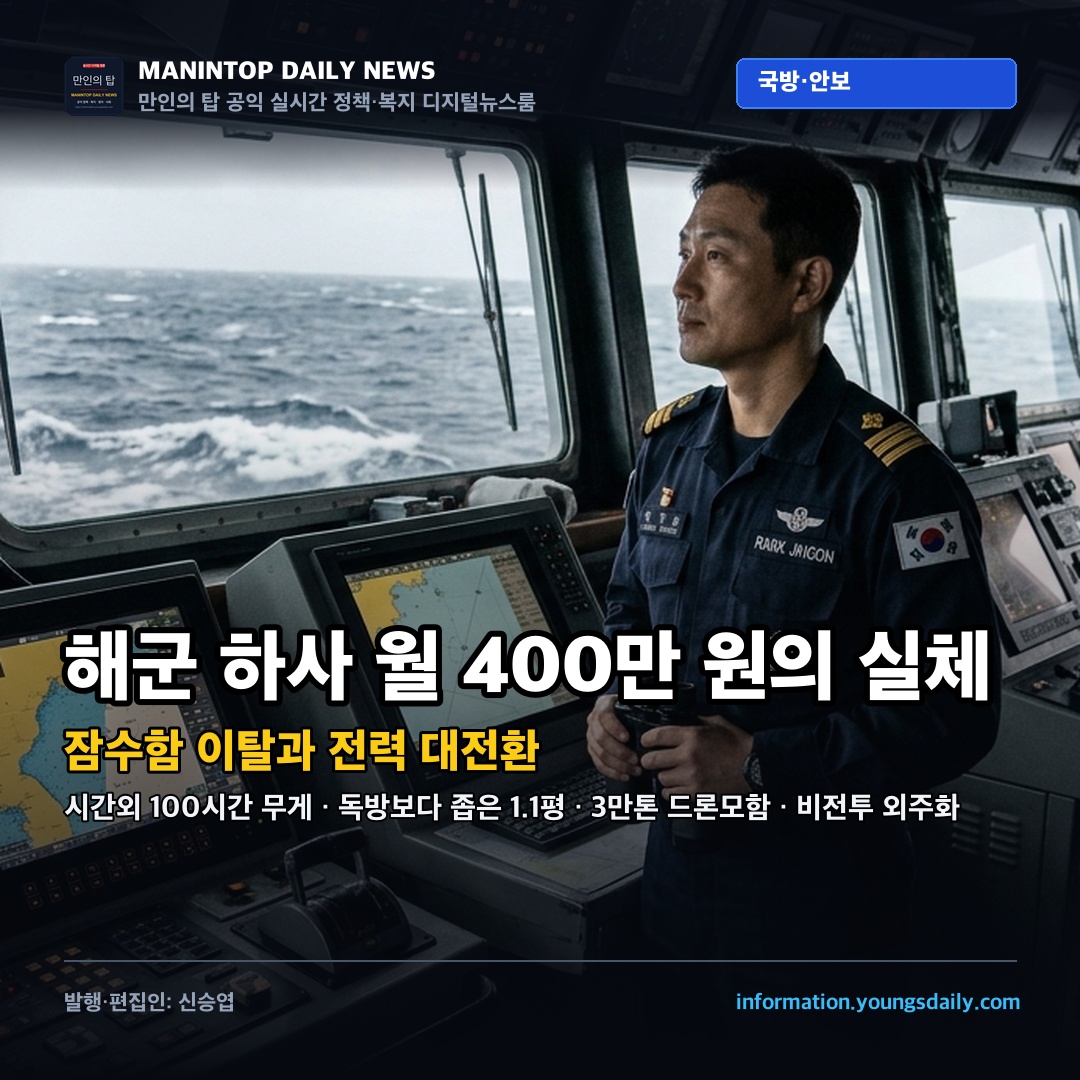
▲ 대한민국 해군 전력 혁신과 장병 처우 개선: 보도·취재용 심층 팩트체크 브리핑 (공식 보도 자료)
📌 핵심 브리핑 · 주요 쟁점 및 핵심 요약
해군 함정 복무 초임 하사의 월 실수령액이 세후 400만 원에 달한다는 실제 급여 명세서가 공개되며 촉발된 군 처우 논쟁부터, 교도소 독방보다 협소한 1.1평의 거주 공간과 가혹한 밀폐 환경을 견디지 못하고 매년 양성 인원 전체에 맞먹는 인원이 군을 떠나는 잠수함 승조원 이탈 실태, 그리고 기존 경항공모함 사업을 해상무인전투기와 자폭드론 중심의 3만 톤급 이상 '유·무인전력모함'으로 전면 수정한 미래 해양 전력의 패러다임 전환까지 대한민국 해군의 현주소와 핵심 팩트를 알기 쉽게 심층 분석합니다.
SPONSORED · ADVERTISEMENT
1. 취재 앵글 및 핵심 헤드라인 가이드
국방·사회·노동 분야 취재 데스크 및 담당 기자가 대중적 화제성과 심층성을 동시에 확보할 수 있는 4대 기사 프레임과 추천 헤드라인은 다음과 같다.
프레임 A. 급여 논란 팩트체크: '세후 400만 원' 하사 월급의 이면
* 추천 헤드라인: "초임 하사 통장에 찍힌 400만 원…'파격 대우' 뒤에 숨은 '월 100시간' 초과근무의 무게" / "배 타면 400만 원 받는다? 해군 서울함 급여 명세서 전격 해부" * 취재 포인트: 단순한 기본급 인상이 아닌, 1일 8시간·월 100시간으로 확대한 시간외근무수당 실적 인정의 영향과 24시간 교대 대비태세라는 해상 노동의 특수성을 규명한다.
프레임 B. 국방 인프라 및 인력 위기: 교도소보다 좁은 잠수함, 탈출하는 승조원
* 추천 헤드라인: "독방 기준 1.63평인데 잠수함은 1.1평…교도소보다 열악한 수중에서 3년간 241명 떠났다" / "좌변기 1개로 25명이 버틴다…수억 들여 키운 잠수함 정예 요원 '복무 염증'에 와르르" * 취재 포인트: 손원일급·장보고급 잠수함의 물리적 거주성 실측 데이터, 침대를 교대로 쓰는 핫 번킹(Hot Bunking), 대기 기준 8.3배가 넘는 이산화탄소 농도 등 극단적 환경과 숙련 인력 유출의 상관관계를 고발한다.
프레임 C. 군 내부 체질 혁신: 홋줄 작업과 함정 청소의 민간 외주화
* 추천 헤드라인: "배 들어오면 청소·홋줄 대신 휴식…해군, 5대 비전투 업무 민간 위탁으로 '워라밸' 찾는다" / "탄약 나르고 밥 짓던 전투병의 변화, 해군 진해기지 외주화 실험이 입증한 것" * 취재 포인트: 입항 시 승조원에게 2~3일의 실질적 재충전 시간을 보장한 비전투 임무 외주용역, 탄약 하역의 민간 전담을 통한 휴일 근무 4분의 1 급감 성과를 추적한다.
프레임 D. 미래 전력 패러다임 전환: 경항모 백지화와 유·무인 복합전력모함
* 추천 헤드라인: "유인 전투기 대신 자폭드론 싣는다…해군, 3만 톤급 '드론 항모'로 2040 전력 대전환" / "핵추진잠수함 추진단 띄우고 KDDX 잇는다…해군이 그리는 미래 해양 3축체계" * 취재 포인트: 우크라이나 전쟁 이후 무인 무기체계의 위력과 병역 자원 감소에 대응하여, 경사형 갑판을 갖춘 유·무인전력모함으로 소요를 전격 전환한 전략적 배경을 분석한다.
▲ 좁은 통로와 3단 침상이 빽빽하게 들어찬 잠수함 내부 거주 구역에서 승조원이 교대로 휴식을 취하는 모습 / 해군 잠수함 복무 환경 현장 자료
2. [심층 팩트체크 1] 해군 초임 하사 '세후 400만 원'의 급여 명세서 실측
해군 공식 채널과 현장 취재를 통해 해군 제2함대 서울함에서 복무 중인 하사 2호봉의 급여 명세서가 공개되며 큰 화제를 모았다. 확인된 명세서는 기본급과 시간외수당, 함정근무수당이 결합되어 본봉에 맞먹는 수당이 붙는 특수한 군 보수 체계를 보여준다.
서울함 하사 2호봉 실제 급여 명세서 세부 내역
공개된 급여 명세서에 따르면 기본급은 일반 9급 공무원 수준이지만, 장기간 해상 출동 임무를 수행하는 함정 근무의 특성이 반영되면서 실적급 수당이 대폭 가산되는 구조를 지닌다.
언론 보도시 유의해야 할 팩트체크 전제조건
기사 작성 시 단순히 "초임 하사도 월 400만 원을 받는다"는 단편적 제목을 달 경우 독자에게 군 보수 현실에 대한 중대한 오해를 유발할 수 있으므로, 아래 세 가지 전제 조건을 명시해야 한다. * 시간외수당 100시간 확대 조치의 영향: 과거 군인들은 '비현업 공무원'으로 분류되어 시간외수당 인정 한도가 1일 4시간, 월 57시간에 불과했다. 군인들은 실제 일한 만큼 수당을 받지 못해 경찰이나 소방 등 현업 공무원과의 심각한 형평성 문제가 제기되어 왔다. 이에 정부가 대통령령으로 관련 규정을 개정해 경계부대 및 함정 근무자 등 24시간 교대 대비태세 인력에 대해 1일 8시간, 월 100시간까지 한도를 확대한 것이 급여 상승의 결정적 계기가 되었다. 이 조치로 최전방 및 함정 초급간부의 연간 소득은 이전보다 700만 원 이상 높아졌다.
* 최대 노동 실적을 전제한 수치: 월 163만 원대의 실적급 시간외수당은 장기 출동 중 하루 8시간의 기본 당직 외에도 정비, 훈련, 야간 비상대기 등을 수행하여 월 100시간의 초과근무를 완전히 채웠을 때만 발생한다. 육상 기지에 정박하거나 출동이 적은 달에는 수령액이 크게 감소한다.
* 추가 복지 및 자산 형성 지원: 월급 외에도 연 2회 본봉의 60% 상당 명절휴가비와 연 1회 성과상여금이 지급된다. 또한 3년간 월 30만 원씩 총 1,080만 원을 납입하면 정부가 1,080만 원을 동일하게 매칭 지원하여 원금의 100% 수익률(만기 시 2,160만 원 수령)을 제공하는 '장기간부 도약적금' 혜택이 적용된다. 생활관은 1인 1실 숙소로 개선되고 있으며, 단체 실손보험도 지원된다. 국방부는 2029년까지 초급간부 연봉을 중견기업 수준으로 인상하는 정책을 추진 중이다.
구분 및 핵심 영역
해군 잠수함 승조 환경
교도소 독방 (법정 기준)
일반 전투함 (수상함)
1인당 거주 면적
손원일급 1.2평 / 장보고급 1.1평
독방 최소 1.63평 (법무시설기준규칙)
약 2.0~2.5평 수준
위생 설비 비율
좌변기 1개당 15~25명 공용 사용
독방별 전용 화장실 완비
침실·구역별 화장실 구비
침실 운용 방식
핫 번킹 (3명이 침대 2개 교대 사용)
개인별 단독 침구 보장
개인 지정 침대 운용
실내 공기질 환경
이산화탄소 대기 대비 8.3배 (밀폐)
정기 환기 및 자연 통풍 보장
함내 공조 및 외부 환기 가능
최근 3년간 유출
총 241명 이탈 (양성인원 100% 상쇄)
해당 없음
상대적 완만 (지원율 70%선)
SPONSORED · ADVERTISEMENT
3. [심층 팩트체크 2] 잠수함 승조원 이탈 실태와 '교도소 독방' 거주성 논란
급여 홍보의 밝은 면 뒤편에는 국가 핵심 전략자산인 잠수함 사령부의 인력 공동화 현상이 심각한 안보 위험으로 대두되고 있다. 국회 국방위원회 황희 의원(더불어민주당)이 해군본부로부터 제출받은 자료에 따르면, 1인당 수천만 원에서 수억 원의 국비를 투입해 양성한 정예 잠수함 요원들이 극단적인 근무 여건으로 인해 군을 대거 이탈하고 있다.
승조원 유출 실태와 지원 기피 통계
연간 80~100명 안팎으로 양성되는 잠수함 승조원의 규모를 감안할 때, 최근의 전역 및 자격 해제 통계는 신규 양성 규모 전체를 상쇄하는 수준이다. * 최근 3년간(2022~2024년) 유출 인원: 2022년 90명, 2023년 71명, 2024년 80명 등 총 241명이 조기전역하거나 승조자격을 자진 해제하고 수상함 원대복귀를 택했다.
* 10년간(2010~2019년) 누적 유출율: 국회 국방위원장을 역임한 민홍철 의원실 자료에 따르면, 해당 기간 양성된 인원 904명 중 473명이 이탈하여 누적 유출율이 52.3%에 달했다. * 지원율 하락세: 잠수함 승조원 신규 지원율은 필요 인원 대비 65.9%에 불과했으며, 특히 핵심 기술 인력인 부사관 지원율은 58.9%까지 떨어져 전력 유지에 적신호가 켜졌다.
교도소 수용 기준과 비교한 잠수함 환경 실측 데이터
황희 의원실 분석에 따르면 잠수함 내부의 물리적·위생적 거주 환경은 법무부의 법무시설기준규칙에 정해진 교도소 독방 최소 설계 기준에도 미치지 못한다. 황희 의원은 "잠수함 승조원들은 1인당 연간 수천만 원의 교육비를 들여 양성한 핵심 전문 인력이자 국가 전략자산"이라며 "장려수당 대폭 인상과 근본적 복무 환경 개선을 위한 특단의 대책이 즉각 마련되지 않는다면 잠수함 전력 공백이 불가피하다"고 강력히 촉구했다.
▲ 경사형 비행갑판 위에 스텔스 해상무인전투기와 자폭드론을 탑재하고 작전 해역을 항해하는 3만 톤급 유·무인전력모함 전경 / 미래 해군 전력 개념도 자료
4. 특수업무수당 및 장려수당 제도 개편 분석 (2026년 개정 규칙)
잠수함과 수상함 요원들의 복무 이탈을 막기 위해 국방부는 2026년 10월 16일 '군인 등의 특수근무수당에 관한 규칙' 별표 2를 개정했다. 과거에는 수상이나 잠항 항해 구분 없이 1일 1만 원 수준의 동일한 항해수당이 지급되었으나, 개정을 통해 위험도와 난이도를 반영한 체계적 보상 체계가 수립되었다.
2026년 개정 특수업무수당(선박 및 함정 등 근무수당) 체계
개정된 규칙에 따라 잠수함정 승무원은 선박 및 함정 등 근무수당 (갑)을, 일반 전투함 승무원은 (을)을 적용받는다.
잠수함 승조원 장려수당(경력별 차등 지급) 신설
승조 자격을 획득한 후 조기 전역하거나 자격을 해제하는 숙련 인력을 붙잡기 위해, 실제 승조 경력이 3년을 초과한 장교와 부사관에게는 매월 별도의 장려수당이 차등 지급된다. * 실제 승조 경력 3년 초과 7년 미만: 월 300,000원.
* 실제 승조 경력 7년 이상 10년 미만: 월 400,000원 * 실제 승조 경력 10년 이상: 월 500,000원 * 잠수함 교관 및 양성부대 피교육생, 승무유지훈련 요원: 하사 월 189,000원, 중·상·원사 월 228,000원, 위관급 월 271,000~340,000원, 영관급 월 422,000원 지급 (파견 승조 임무 시 1일당 10,000원 가산금 지급).
해군은 장병들이 출동 후 피로가 누적된 상태에서 잡무에 시달리던 구조를 타파하고 전투 임무에만 매진할 수 있도록, 함정 정박 시 발생하는 고강도 비전투 업무를 민간 전문업체에 위탁하는 혁신 사업을 본격 시행하고 있다.
비전투 임무 5대 항목 외주용역 시범사업
해군은 진해 해군기지를 중심으로 함정 출·입항 시 다수의 병력이 투입되던 5대 필수 비전투 업무를 외주화했다. 1. 위탁 대상 5대 항목: 함정을 부두에 묶고 푸는 계류삭(홋줄) 작업, 육상전원 케이블 연결·철거·정비, 유류 공·수급 작업, 함정에 쌓인 염분과 오염물을 세척하는 내·외부 청소(함정 클리닝), 정비 폐기물 수거 및 운반.
2. 운영 성과: 진해기지 입항 함정 45척을 대상으로 157회 실시한 결과, 장기 출동을 마친 함정 1척당 승조원들에게 약 2~3일의 정비 및 휴식 시간이 추가로 확보되었다. 해군은 이를 연말까지 500여 회로 확대 적용한다.
3. 탄약 적재·하역 민간용역의 수상함 확대: 무거운 탄약을 옮기는 위험 작업의 경우, 잠수함을 대상으로 1년간 시범 운영한 결과 평일 업무 효율이 향상되며 휴일 근무가 기존의 4분의 1 수준으로 급감했다. 이에 따라 수상함까지 전면 확대되어 포장 해체, 볼트 탈착, 육상·함상 운반 전 과정을 민간 전문 인력이 도맡고 승조원은 함 내 탄약 작업만 수행하게 되었다.
4. 함정 점심 급식지원 서비스: 진해기지에 정박한 전 함정을 대상으로 신청 함정에 한해 평일 점심식사를 육상 식당에서 전문 조리해 선박으로 배송하고 수거까지 완료하는 시스템을 정착시켜 함정 조리 요원들의 격무를 덜었다.
성동일 해군본부 함정장비관리과장(대령)은 "병력 부족 상황에 적극 대응하고 장병들이 본연의 전투임무에 매진하며 충분한 휴식을 누릴 수 있도록 비전투 업무의 민간 위탁을 확대하고 있다"며 "장병 복무 여건 개선과 함께 민간 일자리 창출이라는 시너지 효과를 거두고 있다"고 설명했다.
신규 함정 거주성 설계 기준 개정
해군은 지난해 12월 '함정 거주성 설계 기준'을 전면 개정하여 앞으로 건조되는 모든 함정의 생활 환경을 획기적으로 개선한다. * 침실 탑승 인원 대폭 축소: 간부 침실은 2~4명, 병사 침실은 6명 이하로 제한하여 다인실 과밀 수용을 금지했다.
* 편의시설 의무화: 개인 침대 공간을 대폭 넓히고 침실별 전용 화장실을 구비하도록 규정했다. * 거주 구역 20% 확장: 신규 소요 추진 함정은 기존 동급 함정 대비 거주 구역 면적이 약 20% 증가한다. * '나두(NAvy DO) 2.0' 운동: 불필요한 행정과 관행적 의전을 철폐하고 집중 근무와 일·생활 균형을 보장하는 조직 문화 개선 운동을 2026년 9월부터 시행하고 있다.
South Korea's Navy Power Innovation and Improvement of Service Members' Welfare: In-Depth Fact-Checking Briefing for Reporting and Coverage
The recent release of a pay stub revealing that the monthly net salary of a newly enlisted petty officer in the Navy amounts to 4 million won has sparked a debate over military treatment. This discussion is further fueled by the alarming reality that submarine crew members are leaving the service in numbers equivalent to the total annual intake, unable to endure their cramped living conditions of just 1.1 pyeong, which are even smaller than solitary confinement cells, along with the harsh and confined environment. Additionally, there is a significant shift in the future paradigm of naval power, as the existing light aircraft carrier project is being completely revised to focus on a 30,000-ton 'manned and unmanned combat power carrier' centered around maritime unmanned combat aircraft and suicide drones. This analysis aims to provide a clear and in-depth understanding of the current state of the Republic of Korea Navy and its key facts.
📌 Key Takeaways
The price of extreme labor combined with a base salary of 2.34 million won and 1.63 million won for 100 hours of overtime per month.
A cramped living space of 1.1 pyeong, with 25 people sharing one toilet, and a staggering 241 individuals leaving due to hot-bunking conditions over three years.
Transition to a 30,000-ton inclined deck drone carrier and the outsourcing of five non-combat roles to secure rest periods.
1. Guide to reporting angles and key headlines
The four major article frames and recommended headlines that enable the reporting desk and reporters in charge of the defense, society, and labor fields to secure both popular topicality and depth are as follows.
Frame A. Salary controversy fact check: The other side of the sergeant’s salary of ‘4 million won after tax’
* Recommended headline: "4 million won stamped in the bankbook of a first-time petty officer... The weight of '100 hours a month' overtime hidden behind 'extraordinary treatment'" / "You get 4 million won when you board a ship? A full-blown dissection of the Navy's Seoul ship's pay slip.".
* Coverage points: Rather than simply increasing basic pay, we investigate the impact of recognition of overtime pay, which has been expanded to 8 hours per day and 100 hours per month, and the special characteristics of maritime labor such as 24-hour shift readiness.
Frame B. Defense infrastructure and manpower crisis: Submarines smaller than a prison, crews escaping
* Recommended headline: "Solitary confinement is 1.63 pyeong, but the submarine is 1.1 pyeong... 241 people left for 3 years in water worse than prison" / "25 people survive with just one toilet seat... Elite submarine agent raised with hundreds of millions of dollars rumbles at 'sickness of service'".
* Coverage points: It exposes the correlation between extreme environments such as actual physical habitability data of Son Won-il and Jang Bogo-class submarines, hot bunking where beds are alternated, and carbon dioxide concentration exceeding 8.3 times the atmospheric standard, and the outflow of skilled manpower.
Frame C. Innovation in the military’s internal structure: Private outsourcing of rope work and trap cleaning
* Recommended headline: "When the ship comes in, take a break instead of cleaning and stringing...Navy finds 'work-life balance' by outsourcing five major non-combat tasks to the private sector" / "Change in combat soldiers who used to carry ammunition and cook meals, proven by outsourcing experiment at Navy Jinhae Base".
* Reporting point: We track the drastic reduction in holiday work by a quarter through outsourcing of non-combat missions and civilian responsibility for unloading ammunition, which guarantees 2-3 days of practical recharge time for crew members upon entering port.
Frame D. Future power paradigm shift: Abolishment of light aircraft carriers and manned/unmanned combined force carriers
* Recommended headline: "Carrying suicide drones instead of manned fighter jets...Navy makes major transition to 2040 power with 30,000-ton 'drone carrier'" / "Launches nuclear-powered submarine propulsion group and connects KDDX...Future maritime 3-axis system envisioned by Navy".
* Coverage point: In response to the power of unmanned weapon systems and the decline in military resources after the Ukraine War, we analyze the strategic background of the sudden shift in demand to manned and unmanned power carriers with inclined decks.
▲ Extremely cramped berthing quarters and stacked bunk beds inside an operational naval submarine during underwater mission / Naval Submarine Operational Archive
2. [In-depth fact check 1] Actual salary statement of a first-time Navy petty officer earning 4 million won after tax
Through the Navy's official channels and on-site coverage, the pay slip of Petty Officer 2, serving on the Navy's 2nd Fleet Seoul, was released and attracted a lot of attention. The confirmed statement shows a special military compensation system in which basic pay, overtime pay, and ship duty pay are combined to provide an allowance equivalent to regular salary.
Details of the actual salary statement of Sergeant No. 2 in Seoul
According to the published salary statement, the basic salary is at the level of a general 9th grade civil servant, but the performance allowance is significantly added to reflect the characteristics of ship work that involves long-term sea dispatch missions.
Fact-checking prerequisites to keep in mind when reporting in the media
When writing an article, simply using a fragmentary title such as "Even first-time sergeants receive 4 million won per month" may cause serious misunderstanding in readers about the reality of military compensation, so the three prerequisites below must be specified.
* Impact of the measure to expand overtime pay to 100 hours: In the past, soldiers were classified as ‘non-working civil servants’ and the limit for overtime pay was only 4 hours per day and 57 hours per month. Soldiers do not receive pay in proportion to their actual work, raising serious issues of fairness with civil servants such as police and firefighters. Accordingly, the government revised related regulations by presidential decree and expanded the limit to 8 hours per day and 100 hours per month for 24-hour shift readiness personnel such as guard units and ship workers, which became a decisive opportunity for salary increases. As a result of this measure, the annual income of entry-level officers on the front lines and ships increased by more than 7 million won compared to before.
* Figure based on maximum labor performance: Performance-based overtime pay of KRW 1.63 million per month accrues only when 100 hours of overtime per month are fully completed by performing maintenance, training, night emergency standby, etc. in addition to the basic duty of 8 hours a day during long-term deployment. The amount received is greatly reduced during months when the ship is anchored at a land base or has low dispatch.
* Additional welfare and asset building support: In addition to monthly salary, holiday vacation expenses equivalent to 60% of base salary are paid twice a year and performance bonuses are paid once a year. In addition, if you pay a total of 10.8 million won at 300,000 won per month for 3 years, the government will match the same amount of 10.8 million won and apply the 'Long-Term Leap Savings Savings' benefit, which provides a 100% return on the principal amount (21.6 million won received at maturity). The dormitories are being improved to provide single-room accommodations per person, and group actual loss insurance is also provided. The Ministry of National Defense is pursuing a policy to increase the salaries of entry-level executives to the level of mid-sized companies by 2029.
Category
Target Scope
Standard / Benefit
Procedure / Action
Per Capita Living Space
Son Won-il Class: 1.2 pyeong / Jang Bo-go Class: 1.1 pyeong
Minimum for single rooms: 1.63 pyeong (according to legal facility standards)
Approximately 2.0 to 2.5 pyeong level
Hygiene Facility Ratio
One toilet shared among 15 to 25 people
Each single room equipped with a private bathroom
Bathrooms available in bedrooms and areas
Bedroom Operation Method
Hot Bunking (3 people sharing 2 beds in shifts)
Individual bedding guaranteed
Designated beds for each individual
Indoor Air Quality Environment
Carbon dioxide levels 8.3 times higher than normal (enclosed space)
Regular ventilation and natural airflow ensured
Internal air conditioning and external ventilation possible
Recent Three-Year Outflow
Total of 241 individuals departed (100% offset by positive personnel)
Not applicable
Relatively mild (support rate around 70%)
3. [In-depth fact check 2] The reality of submarine crew desertion and the controversy over ‘prison solitary confinement’ residency
Behind the bright side of salary promotion, the phenomenon of manpower pooling in the submarine command, a key national strategic asset, is emerging as a serious security risk. According to data submitted by Navy Headquarters to Rep. Hwang Hee of the National Assembly's National Defense Committee (Democratic Party of Korea), elite submarine personnel trained with government funds worth tens to hundreds of millions of won per person are leaving the military in large numbers due to extreme working conditions.
Statistics on crew leakage and avoidance of support
Considering the size of the submarine crew trained at around 80 to 100 people per year, recent discharge and decertification statistics offset the entire number of new trainees.
* Personnel leaked over the past three years (2022-2024): A total of 241 people, including 90 in 2022, 71 in 2023, and 80 in 2024, were discharged early or voluntarily revoked their crew qualifications and chose to return to service on surface ships.
* Cumulative outflow rate over 10 years (2010-2019): According to data from the office of Rep. Min Hong-cheol, who served as chairman of the National Defense Committee, 473 of the 904 people trained during that period left, resulting in a cumulative outflow rate of 52.3%.
* Declining application rate: The application rate for new submarine crew members was only 65.9% of the required number of people, and in particular, the application rate for noncommissioned officers, a core technical workforce, fell to 58.9%, raising a red flag for maintaining power.
Submarine environmental measurement data compared to prison acceptance standards
According to an analysis by Rep. Hwang Hee's office, the physical and sanitary living environment inside the submarine does not even meet the minimum design standards for prison cells set forth in the Ministry of Justice's Legal Facilities Standards Rules.
Rep. Hwang Hee said, “Submarine crews are core professional personnel and national strategic assets trained at a cost of tens of millions of won per person per year for training,” and strongly urged, “If special measures are not immediately prepared to significantly increase incentive allowances and fundamentally improve the service environment, a vacuum in submarine power is inevitable.”
4. Analysis of special work allowance and incentive allowance system reform (2026 revised rules)
In order to prevent submarine and surface ship personnel from leaving their service, the Ministry of National Defense revised Appendix 2 of the ‘Rules on Special Service Allowance for Soldiers, etc.’ on October 16, 2026. In the past, the same voyage allowance of 10,000 won per day was paid regardless of whether the voyage was on the water or submerged, but through revisions, a systematic compensation system was established that reflects the level of risk and difficulty.
2026 revised special work allowance (ship and vessel work allowance, etc.) system
According to the revised rules, submarine boat crews are subject to ship and vessel service allowances (A), and general combat ship crews are subject to allowances (B).
Establishment of new submarine crew incentive allowance (differential payment according to experience)
In order to retain skilled personnel who are discharged or disqualified early after obtaining qualifications for sailing, separate incentive allowances are paid differentially each month to officers and non-commissioned officers with actual sailing experience of more than 3 years.
* Actual sailing experience exceeding 3 years but less than 7 years: KRW 300,000 per month * Actual sailing experience of 7 to 10 years: 400,000 won per month.
* More than 10 years of actual sailing experience: 500,000 won per month * Submarine instructors, training unit trainees, and crew maintenance training personnel: 189,000 won per month for sergeants, 228,000 won per month for lieutenants, sergeants, and sergeants, 271,000 to 340,000 won per month for lieutenants, and 422,000 won per month for warrant officers (an additional fee of 10,000 won per day is paid for dispatched crew missions).
The Navy is implementing an innovative project to outsource high-intensity non-combat tasks that occur when ships are docked to private specialized companies so that soldiers can break the structure of being burdened with chores while fatigued after deployment and focus only on combat missions.
Pilot project for outsourcing 5 major non-combat missions
The Navy outsourced five essential non-combat tasks that required large numbers of troops when ships departed or entered port, centering around the Jinhae Naval Base.
1. Five major items to be entrusted: mooring line work to tie and untie a ship to the dock, connection/removal/maintenance of land power cables, oil supply/supply work, interior/exterior cleaning to wash salt and contaminants accumulated in the ship (ship cleaning), and collection and transportation of maintenance waste.
2. Operational results: As a result of conducting the survey 157 times on 45 ships entering Jinhae Base, approximately 2 to 3 days of additional maintenance and rest time were secured for the crews of each ship that completed a long-term deployment. The Navy will expand this application to about 500 times by the end of the year.
3. Expansion of surface ships as civilian service for loading and unloading ammunition: In the case of dangerous work transporting heavy ammunition, a one-year pilot operation on submarines improved work efficiency on weekdays and sharply reduced work on holidays to one-fourth of the previous level. Accordingly, it was expanded to include surface ships, with civilian professionals taking charge of the entire process of unpacking, bolt removal, and transport on land and on board ships, while crew members only performed ammunition work within the ship.
4. Ship Lunch Support Service: For all ships anchored at Jinhae Base, a system has been established in which weekday lunches are professionally prepared at a land restaurant, delivered to the ship, and completed for collection only for ships that apply, thereby reducing the burden on ship cooks.
Colonel Seong Dong-il, head of the Ship Equipment Management Department at the Naval Headquarters, explained, "We are actively responding to the troop shortage situation and expanding the outsourcing of non-combat tasks to the private sector so that soldiers can focus on their original combat missions and enjoy sufficient rest. We are reaping the synergy effect of improving soldier service conditions and creating civilian jobs.".
Revision of new ship habitability design standards
The Navy completely revised the 'ship habitability design standards' in December of last year to dramatically improve the living environment of all ships built in the future.
* Significantly reduced number of occupants in bedrooms: Executive bedrooms were limited to 2 to 4 people and soldier bedrooms were limited to 6 or less, preventing overcrowding in multi-occupancy rooms.
* Mandatory convenience facilities: Personal bed space was significantly expanded and each bedroom was required to have its own bathroom.
* Expansion of living area by 20%: The new Soyo propulsion ship has a living area area increased by approximately 20% compared to existing ships of the same class.
* 'NAvy DO 2.0' movement: A movement to improve organizational culture that eliminates unnecessary administration and customary protocols and ensures focused work and work-life balance is being implemented from September 2026.
Recommended Deep-Dive Investigations TOP 3
GLOBAL REPORT
1월이 시작되면 감기는 이미 우리 곁에 와 있습니다. 2월, 3월, 4월까지 이어지는 추위와 건조함은 코와 목을 가장 먼저 공격합니다. 아침에 일어나자마자 막혀 있는 코. 계속 흐르는 콧물. 괜히 칼칼해지는 목. 이 증상은 “시작”일 뿐입니다. 한 번 무너지면 일주일, 길면 한 달까지 끌고 갑니다. 약을 먹으면 잠깐 괜찮아집니다. 하지만 며칠 뒤 또 반복됩니다. 왜일까요? 감기는 ‘치료’의 문제가 아니라 ‘관리’의 문제이기 때문입니다. 대부분은 감기가 오고 나서 약을 찾습니다. 하지만 진짜 중요한 건 감기가 오기 전에 코와 목을 지키는 것입니다. 건조한 실내 공기, 차가운 바깥 공기, 눈에 보이지 않는 세균. 코와 목은 매일 공격받고 있습니다. 지긋지긋하죠! 그런데도 우리는 아무 준비 없이 버티고 있습니다. 이번 겨울도 그렇게 보낼 건가요? 사실 방법은 어렵지 않습니다. 코를 깨끗하게 관리하고, 목을 따뜻하게 보호하고, 점막을 촉촉하게 유지하고, 기관지를 미리 관리하고, 외부 공기를 차단하는 것. 이 다섯 가지만 꾸준히 해도 감기약 없이 겨울을 보내는 것이 충분히 가능합니다. 🔥 이제부터 그 방법을 하나씩 살펴보겠습니다. 🔥 1. 코와 목을 먼저 관리해야 하는 과학적 이유 감기의 대부분은 코 점막에서 시작됩니다. 국제 학술지 Nature Reviews Microbiology 와 Journal of Allergy and Clinical Immunology 에 실린 호흡기 감염 관련 연구들에서는, 감기 바이러스가 비강 상피세포에 먼저 부착해 증식한다는 점을 설명하고 ...
리모델링사업이 진행 중인 아파트를 매매할 때 “계약금 10%를 언제까지 내야 하느냐”는 질문이 특히 많이 나옵니다. 이주공고(이주 안내)가 7~11월쯤이라고 들으면, 그 시점에 맞춰 계약금도 움직일 것 같아서 더 헷갈리기 쉽습니다. 하지만 실제 납부기한은 ‘이주공고가 언제냐’만으로 자동 결정되지 않는 경우가 많습니다. 1) 계약금 10% 납부기한: 결국 ‘문서에 적힌 일정’이 기준 계약금 10%를 언제까지 납부해야 하는지는, 내가 서명하는 매매계약서(특약 포함) 와 사업주체/조합이 제시한 공고·안내문 에 적힌 납부 일정이 기준이 됩니다. 실제 공고문에서는 분양대금 납부의 큰 틀(계약금→중도금→잔금)을 먼저 안내하고, 상세 일정은 별도 표나 유의사항으로 제시하는 방식이 흔합니다. 또, 계약서 문구에 따라 지급 시점이 조건부로 설정될 수도 있습니다. 예를 들어 한 사례 소개 자료에서는 용역계약서에 잔금(10%) 지급시기가 “사업승인 후”로 기재되어 있었다는 점이 언급됩니다. 이런 식으로 ‘사업 단계’와 지급을 연동하는 문구가 들어가면, 질문의 답은 계약서 문구를 확인해야만 확정됩니다. 관련 내용은 링크 에서 문구 사례를 확인할 수 있습니다. 2) 입주자모집공고에서 확인되는 ‘납부 순서’와 잔금 마감 시점 공고문에 적힌 문구를 보면, 납부 순서와 잔금 마감에 대한 기준이 비교적 명확하게 제시되는 경우가 있습니다. 예를 들어 한 입주자모집공고에는 “분양금액(주택가격)은 계약금, 중도금, 잔금의 순서로 납부”하며 “잔금은 입주(열쇠 수령일) 전에 완납”해야 한다고 안내되어 있습니다. (문구 확인: 링크 ) 이 문구가 의미하는 바는 최소 2가지입니다. 분양/공급 형태의 문서에서는 ‘계약금→중도금→잔금’ 흐름이 공식적으로 안내될 수 있습니다. 잔금은 “입주(열쇠 수령)” 이전에 완납해야 한다는 마감 기준이 문서에 적혀 있을 수 있습니다. 다만, 위 공고문 문구는 잔금 마감에 대한 기준을 보여주지만, 계약금 10%의...
윤석열 전 대통령 탄핵 인용 소식을 접하면, 가장 궁금한 지점은 ‘헌재가 정확히 무엇을 위헌·위법으로 봤는가’입니다. 또한 탄핵과 별개로 진행되는 형사재판(내란 우두머리 혐의 등)이 어디까지 왔는지도 함께 정리할 필요가 있습니다. 아래 내용은 제공된 기사/게시물 스니펫과 링크에서 확인되는 범위만 모아, 일반인이 흐름을 이해하기 쉽게 정리한 것입니다. 1) 탄핵 인용 관련: 스니펫에서 확인되는 ‘판단의 골격’ 제공된 근거 중 조국혁신당 사이트에는 헌법재판소가 윤석열 탄핵 심판에서 “피청구인의 위헌·위법행위는 국민 신임 …”이라는 취지로 판단했다는 문장이 인용돼 있습니다( 링크 ). 이 인용문만 놓고 보면, ‘위헌·위법행위’가 있었는지와 그로 인해 ‘국민의 신임’이 어떻게 평가됐는지가 핵심 축으로 소개됩니다. 다만 질문에서 요청하신 세부 항목, 즉 비상계엄 선포 자체를 문제 삼은 구체적 이유, 계엄 이후 조치(포고령, 국회 통제 등)의 어떤 지점이 헌법 위반인지, 국회의 권한행사 방해 및 정치활동 제약을 어떤 논리로 판단했는지 등은, 이번에 제공된 근거의 제목/스니펫만으로는 조항·사실관계·판단 구조가 그대로 제시돼 있지 않습니다. 따라서 이 글에서는 ‘헌재가 무엇을 문제 삼았다’는 세부 리스트를 단정적으로 재구성하기보다, 현재 확인 가능한 문구 수준의 요약(위헌·위법행위 → 국민 신임의 문제로 평가)까지만 적습니다. 만약 헌재 결정문 전문(주문 및 이유)이 추가로 확인되면, 그때는 문장 단위로 ‘어떤 행위’와 ‘어떤 헌법 원리/조항’이 연결되는지(예: 권력분립, 국회의 권한, 정치적 기본권 등) 구조화해 정리하는 것이 가장 정확합니다. 2) 형사 절차(내란 혐의) 관련: 체포영장과 1심 선고 언급 탄핵 심판과 별도로, 12·3 비상계엄 사태로 내란 혐의를 받는 윤석열 대통령에 대해 2024년 12월 31일 체포 영장이 발부됐다는 BBC 보도가 있습니다( 링크 ). 해당 보도는 ‘현직 대통령’에 대한 체포영장 발부라는 점을 함께 언급합니다. 또...