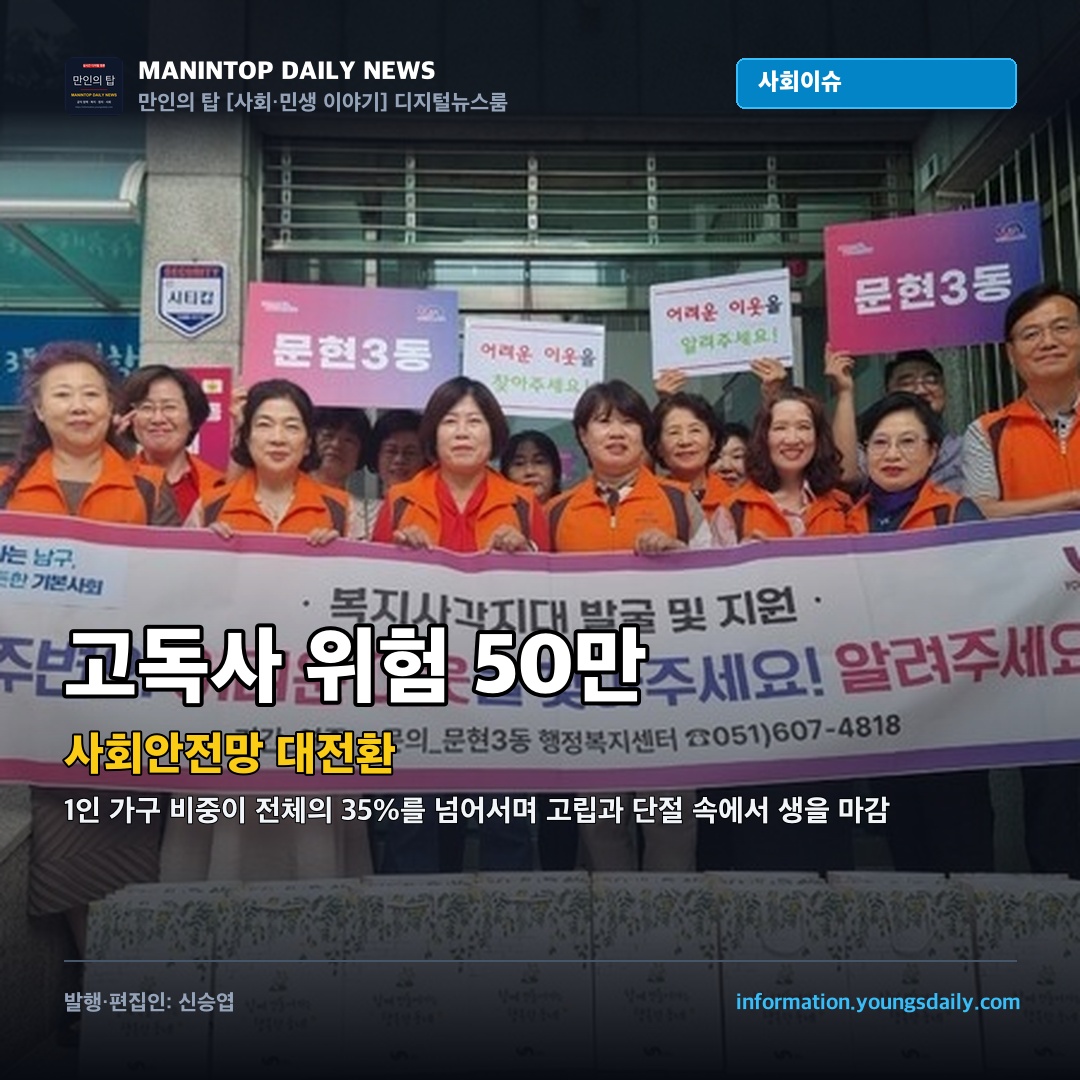
통계로 드러난 단절의 그늘: 5060 남성과 고립 청년의 이중 위기
대한민국 사회의 급격한 인구 구조 변화 속에서 1인 가구 비율은 통계청 집계 기준 750만 가구를 돌파하며 전체 가구의 35%에 육박했다. 이러한 거대한 구조적 변화 이면에는 가족 해체, 실직, 경제적 빈곤으로 인한 극단적 사회적 고립이 자리 잡고 있다. 특히 보건복지부가 집계한 고독사 실태조사에 따르면, 연간 발생하는 고독사 사례 중 절반 이상이 50대와 60대 남성에게 집중되어 있는 것으로 나타났다. 이들은 은퇴와 이혼, 실직 등으로 경제적 기반과 사회적 연결망을 동시에 상실한 뒤 건강 악화와 우울감을 겪으며 외부와의 접촉을 완전히 차단하는 경향을 보인다.
더욱 심각한 문제는 최근 2030 청년층에서도 은둔형 외톨이와 고립 상태가 장기화되면서 청년 고독사 위험이 동반 상승하고 있다는 점이다. 청년 취업난과 사회적 경쟁 압박, 주거 불안정 속에서 청년 1인 가구는 사회적 지원 체계와 접점을 찾지 못한 채 물리적·심리적 고립에 방치되고 있다. 전문가들은 고독사를 단순한 개인의 불행이나 독거노인의 문제로 국한해서는 안 되며, 사회적 단절과 경제적 취약성이 결합하여 전 세대에 걸쳐 발생하는 구조적 사회 병리 현상으로 인식해야 한다고 지적한다.
공공 빅데이터와 AI 기반의 촘촘한 위기 신호 포착망
기존의 복지 지원 방식은 당사자가 직접 주민센터를 방문해 신청하는 '신청주의'에 의존해 왔다. 그러나 고립 위험군은 우울증과 자포자기 상태로 인해 스스로 도움을 요청하지 못하는 특성이 있어, 기존 제도 아래에서는 사각지대에 방치되기 일쑤였다. 이에 따라 정부는 단전, 단수, 건강보험료 및 통신비 체납, 주거 취약 정보 등 45종의 공공 행정 데이터를 통합 분석하는 차세대 복지 사각지대 발굴 시스템을 본격 가동했다.
현장 지자체들도 첨단 기술을 활용한 상시 모니터링 체계를 도입하고 있다. 가정 내 전력 사용량 급감이나 조도 변화를 감지하는 '스마트 플러그', 인공지능이 주 1~2회 전화를 걸어 건강과 식사 여부를 확인하는 'AI 돌봄 안부콜', 수도 사용량이 멈췄을 때 즉각 복지 담당관에게 통보되는 원격 검침 시스템이 대표적이다. 이러한 비대면 감지 기술은 사생활 침해 우려를 최소화하면서도 이상 징후 발생 시 48시간 이내에 현장 확인으로 연결되는 즉각적인 조기 경보망 역할을 수행하고 있다.
| 구분 유형 | 지원 및 적용 대상 | 환급 및 해결 기준 | 신청 및 조치 방법 |
|---|---|---|---|
| 위기 가구 발굴 | 당사자 직접 방문 신청 위주 | 45종 공공 빅데이터 기반 AI 자동 산출 | 신청 사각지대 해소 및 조기 개입률 제고 |
| 상시 모니터링 | 월 1회 통·이장 대면 방문 | 스마트 플러그 및 AI 케어콜 상시 연계 | 이상 징후 발생 시 48시간 내 현장 출동 |
| 지원 대상 범위 | 기초생활수급 독거노인 집중 | 5060 중장년 및 2030 고립 청년 포괄 | 생애주기 전반 고독사 취약군 선제 보호 |
| 지역사회 연대 | 지자체 공무원 중심 대응 | 동네 상점·약국 연계 명예복지공무원망 | 생활 밀착형 감시망 구축 및 사회 복귀 지원 |
물리적 감시를 넘어 사회적 관계망 복원으로: 커뮤니티 케어의 과제
스마트 기술을 통한 이상 징후 감지는 긴급 구조를 위한 1차 방어선일 뿐, 근본적인 해결책은 결국 사람과 사람을 잇는 사회적 관계망의 복원에 있다. 아무리 정교한 센서와 인공지능이 작동하더라도, 고립된 개인이 삶의 의지를 회복하고 지역사회 구성원으로 다시 복귀할 수 있는 공동체 프로그램이 결합되지 않는다면 고독사의 악순환을 끊을 수 없다. 실제로 해외 주요 복지 선진국들은 고독과 고립을 전담하는 정책 부서를 신설하고, 동네 단위의 소셜 다이닝이나 공유 부엌, 취미 공동체 등을 적극 육성해 정서적 유대감을 재건하고 있다.
국내에서도 일부 지자체를 중심으로 고립 중장년층이 함께 모여 요리를 배우고 식사하는 '공동 밥상', 청년들의 재취업과 대인관계 회복을 돕는 '마음건강 상담소' 등 참여형 복지 모델이 긍정적인 평가를 받고 있다. 이러한 정책적 실험들이 일회성 지원에 그치지 않고 지속 가능한 지역사회 인프라로 안착하기 위해서는 중앙정부의 안정적인 예산 지원과 전담 사회복지 인력의 처우 개선이 병행되어야 한다는 지적이 잇따른다.
Shadow of Silent Deaths: South Korea Confronts Surge in Solitary Fatalities with Overhauled Social Safety Nets
- According to a survey by the Ministry of Health and Welfare, the annual number of deaths from loneliness has surpassed 3,600, with men in their 50s and 60s accounting for more than 54% of the total.
- A system has been activated to monitor 500,000 high-risk individuals by analyzing 45 types of crisis indicators, such as power and water cutoffs and health insurance payment defaults, using AI and big data.
- The nationwide expansion of smart plugs for checking on individuals, AI care call services, and 'visiting welfare teams' in towns and villages is underway.
The Shadow of Isolation: The Dual Crisis of Middle-Aged Men and Isolated Youth
Amid rapid demographic shifts in South Korea, single-person households have surpassed 7.5 million, accounting for nearly 35 percent of the total population. Lurking behind this monumental societal transition is severe social isolation driven by family dissolution, unemployment, and economic deprivation. According to official surveys by the Ministry of Health and Welfare, more than half of all annual solitary deaths are concentrated among men in their 50s and 60s. After abruptly losing their economic livelihoods and social relationships through retirement, divorce, or layoffs, this group often suffers from deteriorating physical health and severe depression, completely cutting off contact with the outside world.
Equally alarming is the rising risk among youth in their 20s and 30s, where prolonged social withdrawal and isolation are fueling solitary fatalities among younger demographics. Struggling with severe job market barriers, intense societal pressures, and housing instability, young single-person households frequently remain disconnected from public safety nets. Policy experts emphasize that solitary deaths cannot be treated merely as individual misfortunes or issues confined exclusively to the elderly; rather, they represent systemic social pathologies stemming from severe interpersonal rupture and economic vulnerability across all generations.
Data-Driven Detection: AI and Big Data Capture Invisible Distress Signals
Traditional welfare assistance heavily relied on applicant-driven models where individuals in distress were expected to visit local community centers to request aid. However, isolated individuals trapped in severe depression or apathy rarely seek assistance voluntarily, leaving them entirely outside conventional safety nets. In response, authorities have integrated 45 distinct types of public administrative data—including electricity and water shutoffs, arrears in health insurance premiums, telecom defaults, and housing vulnerabilities—into an advanced identification engine that proactively pinpoints high-risk households.
Local governments are simultaneously deploying cutting-edge non-invasive monitoring systems. These include smart plugs that register sudden drops in household electricity consumption, automated AI-powered wellness call systems that regularly assess dietary intake and emotional well-being, and remote smart water metering that alerts caseworkers when water flow ceases. Such non-invasive technologies protect individual privacy while functioning as real-time early warning networks that trigger on-site welfare inspections within 48 hours of detected abnormalities.
Beyond Surveillance: Restoring Social Connectivity through Community Care
While digital monitoring and sensor technologies serve as vital first lines of defense for emergency rescue, the definitive solution lies in restoring organic human relationships. No matter how advanced sensors and automated systems become, the vicious cycle of solitary deaths cannot be broken unless isolated individuals are reintegrated into supportive community frameworks that rekindle their will to live. Leading welfare nations have established dedicated offices for loneliness and actively promote neighborhood-level communal kitchens, shared workshops, and mutual-aid circles to rebuild social bonds.
Domestically, progressive municipalities are pioneering participatory community models, such as shared cooking dining programs for middle-aged men and specialized mental health recovery hubs for disconnected young adults. For these localized experiments to evolve into sustainable community infrastructure nationwide, long-term fiscal support from the central government and substantially improved working conditions for specialized social workers remain indispensable prerequisites.
The rapid expansion of single-person households and the dissolution of traditional nuclear family structures represent irreversible societal transformations. Solitary deaths must now be decisively redefined from private tragedies into pressing matters of public health and fundamental rights requiring comprehensive collective intervention. Only by uniting rigorous data-driven proactive detection with compassionate, grassroots communal solidarity can South Korea build a truly resilient social safety net where no citizen is left to perish in isolation.
| Category | Eligible Scope | Standard / Benefit | Procedure |
|---|---|---|---|
| Identifying At-Risk Households | Focus on Direct Visits and Applications by Individuals | AI Automatic Calculation Based on 45 Types of Public Big Data | Addressing Application Blind Spots and Enhancing Early Intervention Rates |
| Continuous Monitoring | Monthly Face-to-Face Visits by Community Leaders | Continuous Integration of Smart Plugs and AI Care Calls | On-Site Response Within 48 Hours of Detecting Anomalies |
| Scope of Support | Focus on Elderly Living Alone Receiving Basic Livelihood Support | Inclusion of Middle-Aged Adults in Their 50s and 60s and Isolated Youth in Their 20s and 30s | Proactive Protection of Vulnerable Groups to Solitary Death Across the Life Cycle |
| Community Solidarity | Response Centered on Local Government Officials | Honorary Welfare Officer Network Linked with Local Shops and Pharmacies | Establishment of a Community-Based Surveillance Network and Support for Social Reintegration |




0 댓글