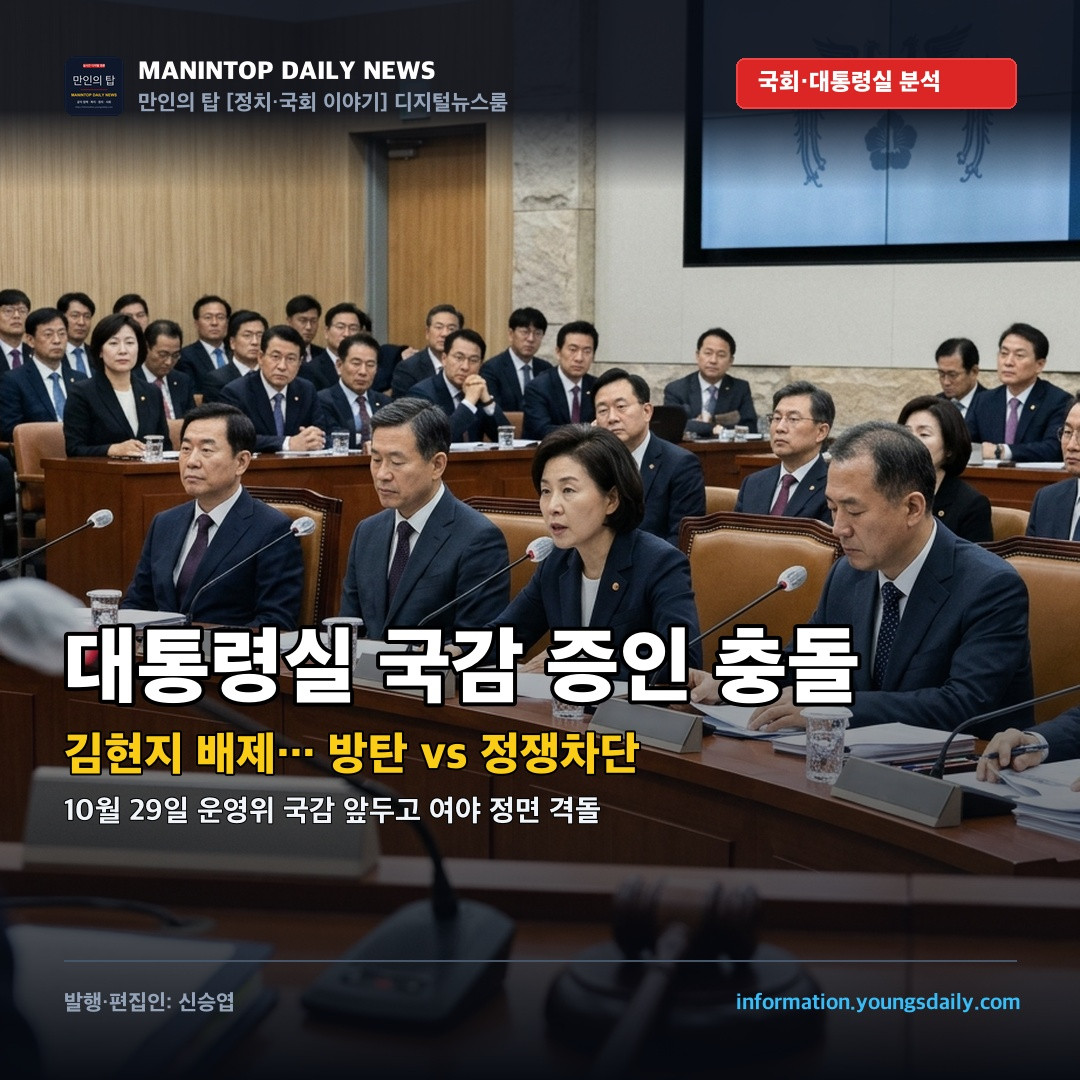
▲ 오는 10월 29일 열리는 국회 운영위원회의 대통령비서실 및 국가안보실 국정감사를 앞두고 여당 주도로 기관증인만 채택되고 야당이 요구한 핵심 일반증인이 전원 부결되면서, 행정부 감시권과 정쟁 차단을 둘러싼 여야의 정면충돌이 격화되고 있다. ⓒ 만인의 탑
2026년도 국정감사의 최종 피날레인 국회 운영위원회의 대통령비서실·국가안보실 국정감사(10월 29일)를 앞두고, 여야가 핵심 증인 채택 문제를 둘러싸고 정면충돌했다. 더불어민주당이 다수 의석을 앞세워 임광현 비서실장과 하준경 정책실장 등 공식 ‘기관증인’만을 단독 채택하고 야당이 줄기차게 요구해 온 김현지 제1부속실장과 정진상 전 실장 등 핵심 ‘일반증인’ 출석을 전원 부결시키자, 국민의힘은 “진실을 은폐하려는 사상 최악의 방탄·맹탕 국감”이라며 강력 반발하고 나섰다.
1. 10월 29일 대통령실 국감의 뇌관: 일반증인 ‘전원 부결’ 사태
국회 국회운영위원회는 지난 전체회의에서 오는 10월 29일 예정된 대통령비서실, 국가안보실, 대통령경호처, 국가인권위원회를 대상으로 한 2026년도 국정감사 증인 명단을 의결했다.
문제는 증인 명단의 구성이었다. 여당 주도로 임광현 대통령비서실장, 하준경 정책실장 등 현직 수석비서관급 기관증인 30여 명은 통과되었으나, 야당인 국민의힘이 핵심 출석 대상으로 요구했던 주요 인사들은 단 한 명도 채택되지 못했다. 국민의힘이 요구한 명단에는 대통령실 실세로 거론되는 김현지 제1부속실장을 비롯해 김용범 전 정책실장, 강훈식 전 비서실장, 그리고 정진상 전 민주당 정무조정실장 등이 포함되어 있었다.
2. 여야의 극명한 공방: “인사개입 의혹 방탄” vs “정쟁용 흠집내기 차단”
증인 채택이 무산되자 국회 운영위 소속 국민의힘 의원들은 국회 소통관에서 긴급 기자회견을 열고 여당의 표결 폭거를 규탄했다.
야당은 대통령실 내부의 ‘경기·성남라인’ 비선 인사 개입 의혹과 정권 출범 초기 경제·부동산 정책의 혼선 책임을 밝히기 위해서는 핵심 실무자인 김현지 부속실장과 전직 정책·비서실장의 출석이 필수적이라고 주장했다. 야당 원내지도부는 “살아있는 권력의 핵심 실세들을 의석수로 모조리 가로막는 것은 입법부의 행정부 감시 권능을 스스로 내팽개친 헌정사 유례없는 ‘방탄 국감’”이라며, 29일 국감 당일 현장에서 동행명령장 발부 표결을 강력히 밀어붙이겠다고 경고했다.
반면 더불어민주당은 야당의 증인 요구를 ‘국정 발목잡기용 정치 공세’로 규정하며 단호한 입장을 견지했다. 민주당 운영위 간사단은 “국정감사는 국정 운영의 성과와 정책적 대안을 논의하는 엄중한 자리이지, 야당이 근거 없는 지라시성 의혹으로 흑색선전을 펼치는 난장판이 아니다”라고 맞받아쳤다. 또한 현직 비서실장과 정책실장이 국정 전반에 대해 책임 있게 증언할 예정인 만큼, 불필요한 증인을 무더기로 불러 대통령실의 정상적 기능을 마비시키려는 정략적 시도를 사전에 차단한 정당한 조치라고 강조했다.
구분
야당 (국민의힘) 증인 신청 사유 및 주장
여당 (더불어민주당) 반대 논리 및 결정
김현지 제1부속실장
대통령실 ‘경기·성남라인’ 핵심 실세 인사 개입 및 부속실 운영 의혹 규명
부속실장은 대통령 최측근 보좌 인력으로 전례상 비출석 대상, 정쟁성 음해 차단 (부결)
김용범 전 정책실장 / 강훈식 전 비서실장
임기 초기 부동산 및 거시경제 정책 혼선, 주요 인사 검증 실패의 정책적 책임 추궁
이미 퇴임한 전직 참모들로 현직 기관장이 국정 책임 전반을 포괄 설명 가능 (부결)
정진상 전 정무조정실장
비공식 라인을 통한 국정 개입 및 당정 소통 과정의 막후 영향력 실태 검증
현재 공직자가 아니며 사법적 재판이 진행 중인 사인(私人)을 국감에 소환하는 것은 부적절 (부결)
임광현 비서실장 등 30여 명
기관증인 출석만으로는 비선 인사 개입 및 은밀한 의사결정의 실체 규명 불가
대통령비서실·안보실·경호처 수장 전원 출석으로 국정 통제권의 실효성 100% 보장 (가결)
3. 헌정적 함의: 입법부의 국정통제권과 증인 채택 다수결의 딜레마
이번 사태는 국회법 제49조 및 ‘국회에서의 증언·감정 등에 관한 법률’상 다수결 증인 채택 제도의 구조적 맹점을 여실히 드러냈다는 평가를 받는다.
헌법 제61조는 국회에 국정감사권을 부여하여 행정부의 전횡을 견제하도록 규정하고 있으나, 국회 의결 절차상 다수당이 단독으로 증인 채택 여부를 결정할 수 있어 정권이 교체될 때마다 '방탄 국감'과 '정쟁 국감'의 악순환이 되풀이되고 있다. 정치학계에서는 대통령실 등 권력 핵심 기관에 대해서는 일정 비율 이상의 야당 의원 요구 시 최소한의 필수 증인 출석을 의무화하거나, 청문회 방식을 정례화하는 등 제도적 견제 장치의 보완이 시급하다고 지적한다.
4. 10월 29일 운영위 국감 전망: 파행과 충돌의 카운트다운
10월 29일 열리는 대통령실 국정감사는 시작과 동시에 여야의 거친 설전으로 얼룩질 가능성이 매우 높다.
국민의힘은 감사 시작 직후 의사진행 발언을 통해 김현지 부속실장 등의 증인 채택 거부를 강도 높게 성토하고, 불출석 증인에 대한 동행명령장 발부를 현장에서 표결에 부칠 것을 요구할 방침이다. 이에 대해 더불어민주당이 맞불을 놓을 경우 개의 직후 정회와 속개가 거듭되는 파행이 불가피하다. 국정감사의 대미를 장식할 대통령실 국감이 정책 대안을 검증하는 본연의 장이 될지, 아니면 예산 정국을 앞둔 극단적 정쟁의 낭떠러지로 전락할지 정치권의 시선이 집중되고 있다.
만인의 탑 정치·국회 에디토리얼 데스크
발행·편집인: 신승엽 | 기사 등록: 2026년 10월 26일 | 출처: 국회 국회운영위원회 전체회의 속기록, 의안정보시스템
▲ Ahead of the October 29 National Assembly House Steering Committee audit of the Presidential Secretariat and National Security Office, ruling and opposition parties fiercely clashed as majority lawmakers approved only official institutional witnesses while rejecting all key external aides sought by the opposition. ⓒ Manintop Daily
Ahead of the grand finale of the 2026 annual parliamentary audits—the National Assembly House Steering Committee’s scheduled examination of the Presidential Secretariat and National Security Office on October 29—ruling and opposition lawmakers have entered a fierce confrontation over witness subpoenas. With the majority Democratic Party exclusively passing official agency heads while blocking all key external witnesses demanded by the opposition—including First Personal Secretary Kim Hyun-ji and former aides—the conservative People Power Party has condemned the proceeding as an unconstitutional "shield audit" designed to conceal systemic administrative interference.
1. Flashpoint Ahead of October 29: Complete Rejection of Key Witnesses
The National Assembly House Steering Committee passed its official list of subpoenaed witnesses for the upcoming October 29 audit, covering the Presidential Secretariat, the National Security Office, the Presidential Security Service, and the National Human Rights Commission.
However, the roster composition ignited instant political fury. While approximately 30 active high-ranking institutional officials—including Chief of Staff Lim Gwang-hyun and Policy Chief Ha Joon-kyung—were approved under ruling party backing, every single individual witness demanded by the People Power Party was rejected. The opposition’s subpoena list featured central figures such as First Personal Secretary Kim Hyun-ji, former Policy Chief Kim Yong-beom, former Chief of Staff Kang Hoon-sik, and former political aide Jeong Jin-sang.
2. Partisan Confrontation: "Shielding Unofficial Power" vs "Halting Smear Tactics"
Immediately following the committee vote, opposition lawmakers staged an emergency briefing at the parliamentary press room to denounce what they called legislative tyranny.
The People Power Party asserted that questioning Secretary Kim Hyun-ji—widely regarded as a pivotal behind-the-scenes aide from the President’s past municipal and provincial administrations—is essential to probe allegations of unauthorized personnel interference and policy opacity. Opposition leaders warned: "Deploying raw majority votes to block scrutiny over the executive's inner sanctum paralyzes the parliament’s constitutional duty to inspect state affairs." They vowed to demand physical subpoena accompaniment orders on the hearing floor.
Conversely, the Democratic Party rebuffed the demands as a destructive political stunt. Committee leadership emphasized that parliamentary inspections are serious constitutional venues meant to assess the efficacy of executive policies, rather than partisan circus rings for groundless character assassination. Ruling lawmakers asserted that because active chiefs of staff will testify extensively on comprehensive state affairs, precluding external witnesses was an entirely justified procedural safeguard against executive gridlock.
Subpoena Target
Opposition (PPP) Rationale & Demands
Ruling Party (DP) Defense & Decision
Kim Hyun-ji (1st Personal Secretary)
Probing allegations of unauthorized personnel influence and inner circle dominance
President's personal secretary traditionally exempt; rejected as political harassment (Rejected)
Kim Yong-beom & Kang Hoon-sik (Former Chiefs)
Holding former senior leadership accountable for early economic and real estate policy turmoil
Former aides are retired from office; current chiefs hold full administrative accountability (Rejected)
Jeong Jin-sang (Former Political Aide)
Verifying private-channel policy intervention and informal ruling coalition leverage
Private individual currently undergoing judicial trial; inappropriate for audit summons (Rejected)
Full attendance of active chiefs guarantees 100% comprehensive constitutional oversight (Approved)
3. Constitutional Dilemma: Majoritarian Voting and Legislative Oversight
This impasse exposes chronic structural vulnerabilities within Article 49 of the National Assembly Act and the Act on Testimony and Appraisal Before the National Assembly.
While Article 61 of the Constitution mandates robust parliamentary inspections to check executive supremacy, statutory majoritarian rules empower ruling coalitions to selectively filter witness rosters. Whenever executive accountability clashes with legislative arithmetic, the cycle of obstruction and boycott recurs. Scholars emphasize that safeguarding constitutional balance requires statutory reforms—such as mandatory minority witness allocations or institutionalized committee hearings for high-profile executive bureaus.
4. October 29 Outlook: Countdown to Hearing Room Gridlock
The October 29 presidential audit is poised to descend into volatile shouting matches from its opening gavel.
The People Power Party plans to initiate immediate procedural filibusters and demand floor votes on accompaniment orders for excluded witnesses. If the Democratic Party resists, repeated recesses and legislative paralysis appear inevitable. As the final act of this year’s audits, the presidential inspection will serve as an unyielding bellwether for the upcoming winter budget showdown and high-stakes legislative warfare.
Manintop Daily Political & Legislative Editorial Desk
Publisher & Editor-in-Chief: Seung Youb Ssin | Published: October 26, 2026 | Source: National Assembly House Steering Committee Records
MANINTOP NEWSLETTER
📬 만인의 탑 뉴스레터 무료 구독
오늘 보신 정책·시사 뉴스가 유익하셨나요? 매일 엄선되는 알짜 복지 혜택과 국회 실시간 속보를 이메일로 가장 먼저 받아보세요. (평생 무료)
Computer Programmer who love programming.
Computer Programmer Who love Riding Bicycle.
Computer Programmer who love trip in abroad.
Computer Programmer who love studying about programming
- even if sometimes it's very boring.
Computer Programmer who love talking with person.
- I love communication with person.
1월이 시작되면 감기는 이미 우리 곁에 와 있습니다. 2월, 3월, 4월까지 이어지는 추위와 건조함은 코와 목을 가장 먼저 공격합니다. 아침에 일어나자마자 막혀 있는 코. 계속 흐르는 콧물. 괜히 칼칼해지는 목. 이 증상은 “시작”일 뿐입니다. 한 번 무너지면 일주일, 길면 한 달까지 끌고 갑니다. 약을 먹으면 잠깐 괜찮아집니다. 하지만 며칠 뒤 또 반복됩니다. 왜일까요? 감기는 ‘치료’의 문제가 아니라 ‘관리’의 문제이기 때문입니다. 대부분은 감기가 오고 나서 약을 찾습니다. 하지만 진짜 중요한 건 감기가 오기 전에 코와 목을 지키는 것입니다. 건조한 실내 공기, 차가운 바깥 공기, 눈에 보이지 않는 세균. 코와 목은 매일 공격받고 있습니다. 지긋지긋하죠! 그런데도 우리는 아무 준비 없이 버티고 있습니다. 이번 겨울도 그렇게 보낼 건가요? 사실 방법은 어렵지 않습니다. 코를 깨끗하게 관리하고, 목을 따뜻하게 보호하고, 점막을 촉촉하게 유지하고, 기관지를 미리 관리하고, 외부 공기를 차단하는 것. 이 다섯 가지만 꾸준히 해도 감기약 없이 겨울을 보내는 것이 충분히 가능합니다. 🔥 이제부터 그 방법을 하나씩 살펴보겠습니다. 🔥 1. 코와 목을 먼저 관리해야 하는 과학적 이유 감기의 대부분은 코 점막에서 시작됩니다. 국제 학술지 Nature Reviews Microbiology 와 Journal of Allergy and Clinical Immunology 에 실린 호흡기 감염 관련 연구들에서는, 감기 바이러스가 비강 상피세포에 먼저 부착해 증식한다는 점을 설명하고 ...
리모델링사업이 진행 중인 아파트를 매매할 때 “계약금 10%를 언제까지 내야 하느냐”는 질문이 특히 많이 나옵니다. 이주공고(이주 안내)가 7~11월쯤이라고 들으면, 그 시점에 맞춰 계약금도 움직일 것 같아서 더 헷갈리기 쉽습니다. 하지만 실제 납부기한은 ‘이주공고가 언제냐’만으로 자동 결정되지 않는 경우가 많습니다. 1) 계약금 10% 납부기한: 결국 ‘문서에 적힌 일정’이 기준 계약금 10%를 언제까지 납부해야 하는지는, 내가 서명하는 매매계약서(특약 포함) 와 사업주체/조합이 제시한 공고·안내문 에 적힌 납부 일정이 기준이 됩니다. 실제 공고문에서는 분양대금 납부의 큰 틀(계약금→중도금→잔금)을 먼저 안내하고, 상세 일정은 별도 표나 유의사항으로 제시하는 방식이 흔합니다. 또, 계약서 문구에 따라 지급 시점이 조건부로 설정될 수도 있습니다. 예를 들어 한 사례 소개 자료에서는 용역계약서에 잔금(10%) 지급시기가 “사업승인 후”로 기재되어 있었다는 점이 언급됩니다. 이런 식으로 ‘사업 단계’와 지급을 연동하는 문구가 들어가면, 질문의 답은 계약서 문구를 확인해야만 확정됩니다. 관련 내용은 링크 에서 문구 사례를 확인할 수 있습니다. 2) 입주자모집공고에서 확인되는 ‘납부 순서’와 잔금 마감 시점 공고문에 적힌 문구를 보면, 납부 순서와 잔금 마감에 대한 기준이 비교적 명확하게 제시되는 경우가 있습니다. 예를 들어 한 입주자모집공고에는 “분양금액(주택가격)은 계약금, 중도금, 잔금의 순서로 납부”하며 “잔금은 입주(열쇠 수령일) 전에 완납”해야 한다고 안내되어 있습니다. (문구 확인: 링크 ) 이 문구가 의미하는 바는 최소 2가지입니다. 분양/공급 형태의 문서에서는 ‘계약금→중도금→잔금’ 흐름이 공식적으로 안내될 수 있습니다. 잔금은 “입주(열쇠 수령)” 이전에 완납해야 한다는 마감 기준이 문서에 적혀 있을 수 있습니다. 다만, 위 공고문 문구는 잔금 마감에 대한 기준을 보여주지만, 계약금 10%의...
윤석열 전 대통령 탄핵 인용 소식을 접하면, 가장 궁금한 지점은 ‘헌재가 정확히 무엇을 위헌·위법으로 봤는가’입니다. 또한 탄핵과 별개로 진행되는 형사재판(내란 우두머리 혐의 등)이 어디까지 왔는지도 함께 정리할 필요가 있습니다. 아래 내용은 제공된 기사/게시물 스니펫과 링크에서 확인되는 범위만 모아, 일반인이 흐름을 이해하기 쉽게 정리한 것입니다. 1) 탄핵 인용 관련: 스니펫에서 확인되는 ‘판단의 골격’ 제공된 근거 중 조국혁신당 사이트에는 헌법재판소가 윤석열 탄핵 심판에서 “피청구인의 위헌·위법행위는 국민 신임 …”이라는 취지로 판단했다는 문장이 인용돼 있습니다( 링크 ). 이 인용문만 놓고 보면, ‘위헌·위법행위’가 있었는지와 그로 인해 ‘국민의 신임’이 어떻게 평가됐는지가 핵심 축으로 소개됩니다. 다만 질문에서 요청하신 세부 항목, 즉 비상계엄 선포 자체를 문제 삼은 구체적 이유, 계엄 이후 조치(포고령, 국회 통제 등)의 어떤 지점이 헌법 위반인지, 국회의 권한행사 방해 및 정치활동 제약을 어떤 논리로 판단했는지 등은, 이번에 제공된 근거의 제목/스니펫만으로는 조항·사실관계·판단 구조가 그대로 제시돼 있지 않습니다. 따라서 이 글에서는 ‘헌재가 무엇을 문제 삼았다’는 세부 리스트를 단정적으로 재구성하기보다, 현재 확인 가능한 문구 수준의 요약(위헌·위법행위 → 국민 신임의 문제로 평가)까지만 적습니다. 만약 헌재 결정문 전문(주문 및 이유)이 추가로 확인되면, 그때는 문장 단위로 ‘어떤 행위’와 ‘어떤 헌법 원리/조항’이 연결되는지(예: 권력분립, 국회의 권한, 정치적 기본권 등) 구조화해 정리하는 것이 가장 정확합니다. 2) 형사 절차(내란 혐의) 관련: 체포영장과 1심 선고 언급 탄핵 심판과 별도로, 12·3 비상계엄 사태로 내란 혐의를 받는 윤석열 대통령에 대해 2024년 12월 31일 체포 영장이 발부됐다는 BBC 보도가 있습니다( 링크 ). 해당 보도는 ‘현직 대통령’에 대한 체포영장 발부라는 점을 함께 언급합니다. 또...




0 댓글