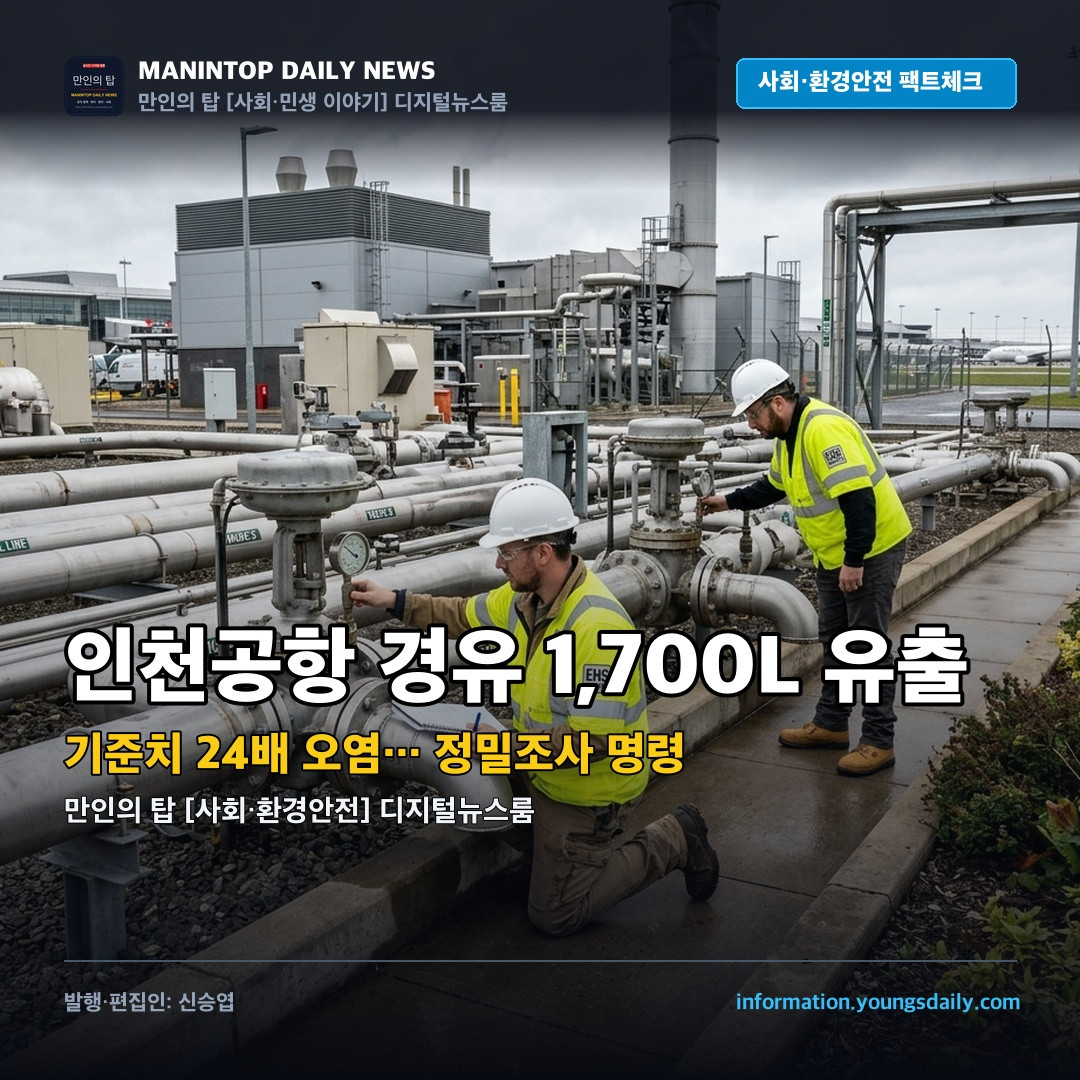
▲ 인천공항 비상발전소 경유 1,700L 대량 유출… 기준치 24배 토양오염에 영종구청 정밀조사 명령 / 만인의 탑 만인의 탑 사회·환경안전 데스크 팩트체크
📌 만인의 탑 핵심 브리핑 · 이 글에서 다루는 핵심 내용
인천공항 제1여객터미널 인근 비상전력 시설인 동력동 A 건물에서 자동 이송 센서 고장으로 비상발전기용 경유 1,700L가 유출되어 토양 75.9㎥가 오염된 사고가 발생했습니다. 실측 오염도가 기준치의 24배를 초과함에 따라 관할 영종구청이 토양정밀조사 명령을 내린 전말과 시설 취약점을 심층 보도합니다.
SPONSORED · ADVERTISEMENT
1. 자동 이송 센서 고장과 보조탱크 오버플로우(범람) 유출 경로
이번 유류 유출 참사는 지하 주저장탱크에서 비상발전기 상단에 위치한 '일일 서비스 탱크(보조탱크)'로 경유를 자동 공급하는 이송 과정에서 촉발되었다. 비상발전 설비는 정전 발생 시 10초 이내에 최대 출력으로 가동되어야 하므로 보조탱크 내에 항상 일정량 이상의 연료를 유지하도록 설계되어 있다. 주탱크에서 보조탱크로 기름이 채워져 적정 수위에 도달하면 '만액 감지 레벨 스위치(정지 센서)'가 전기적 신호를 보내 이송 펌프의 전원을 즉각 차단해야 한다.
그러나 조사 결과 해당 정지 센서가 기계적·전기적 결함으로 완전히 먹통이 되면서 이송 펌프가 멈추지 않고 경유를 계속 밀어 넣었다. 밀폐 한계를 넘어선 보조탱크 밖으로 경유가 뿜어져 나오기 시작했고, 탱크 상부에 설치된 유증기 배출 배관(Vent Pipe)과 건물 외벽 트렌치를 타고 외부로 쏟아져 내렸다. 무려 1,700L에 달하는 경유가 쏟아지는 동안 2차 차단 밸브나 자동 누출 감지 경보가 제때 작동하지 못하면서, 건물 외벽 주변 조경 화단과 우수 집수정 바닥 토양으로 기름이 스며드는 최악의 환경 재난으로 확산되었다.
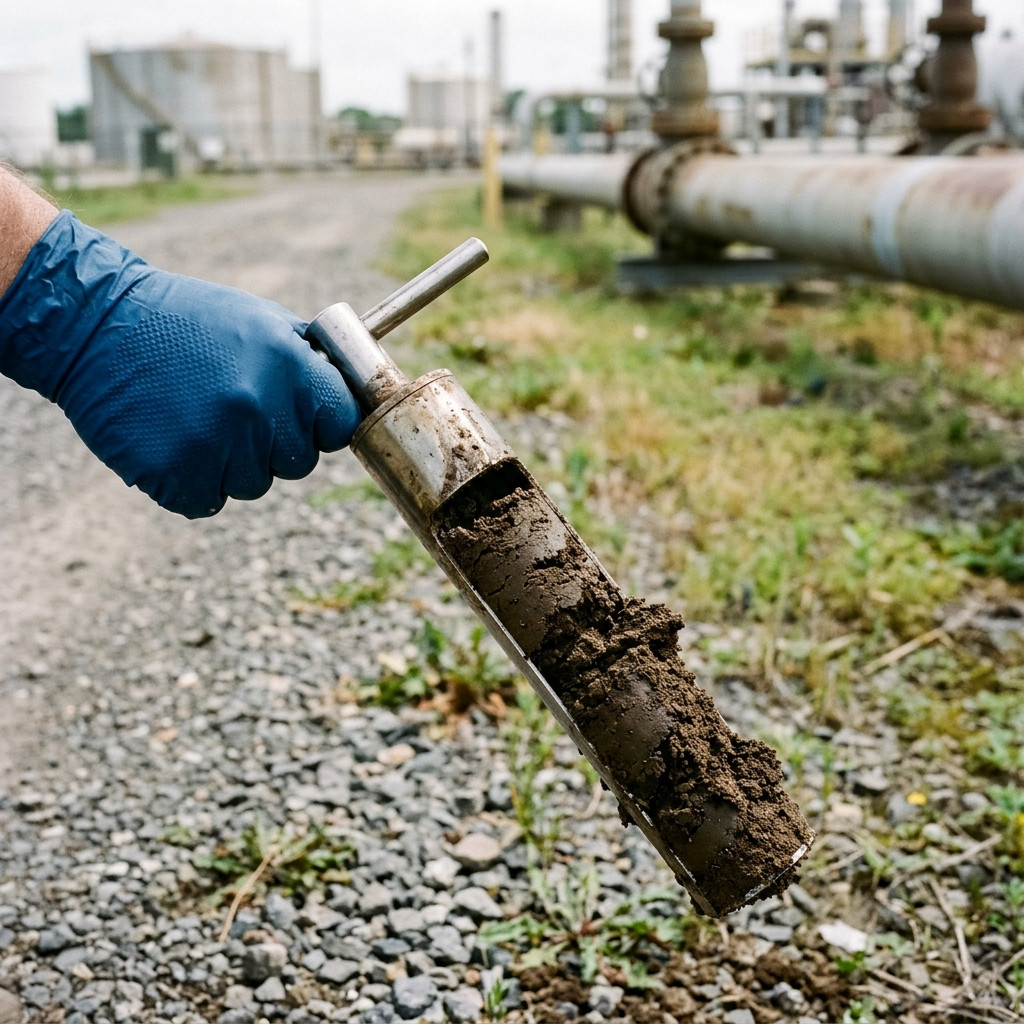
▲ 환경 오염 시료 채취 장비를 활용한 토양 석유계총탄화수소(TPH) 농도 정밀 검사 / 만인의 탑
🔍 만인의 탑 심층 팩트체크 및 구조 진단
사고 직후 관할 지자체와 전문 검사기관이 유출 지점 인근 화단 토양을 시추 채취하여 정밀 성분 분석을 진행한 결과는 충격적이었다. 유류 오염의 척도인 '석유계총탄화수소(TPH: Total Petroleum Hydrocarbons)' 농도가 최고 4만 8,856㎎/㎏으로 실측 검출되었다. 토양환경보전법 시행규칙상 공항 부지, 공장 용지, 군사시설 등이 포함된...
2. 석유계총탄화수소(TPH) 4만8,856㎎/㎏ 검출… 법정 기준치 24배 초과
사고 직후 관할 지자체와 전문 검사기관이 유출 지점 인근 화단 토양을 시추 채취하여 정밀 성분 분석을 진행한 결과는 충격적이었다. 유류 오염의 척도인 '석유계총탄화수소(TPH: Total Petroleum Hydrocarbons)' 농도가 최고 4만 8,856㎎/㎏으로 실측 검출되었다. 토양환경보전법 시행규칙상 공항 부지, 공장 용지, 군사시설 등이 포함된 '3지역'의 토양오염 우려 기준치는 2,000㎎/㎏이다. 즉, 법정 허용 상한선을 무려 24.4배나 뛰어넘는 극단적인 고농도 오염 상태가 확인된 것이다.
오염 면적 및 부피는 75.9㎥(입방미터)로 집계되었으나, 휘발성이 높은 경유가 지하 토양 층으로 깊숙이 침투했을 가능성을 배제할 수 없다. 인천공항 부지는 바다를 매립해 조성된 해안 간척지 특성상 지하수위가 매우 높고 조수간만의 차에 따른 수위 변동이 잦다. 만약 24배가 넘는 고농도 경유 성분이 지하수 관정이나 인근 우수관을 통해 영종도 연안 해역으로 유출되었을 경우 해양 생태계 파괴와 2차 해양 오염으로 비화할 수 있다는 점에서 환경 전문가들의 깊은 우려를 자아내고 있다.
구분 항목
정상 관리 기준 및 법정 기준치
동력동 A 유출 사고 실측치
안전 및 환경 영향 평가
유출 물질 및 누출량
0L (누출 방지용 밀폐 배관 및 차단 밸브)
비상발전기용 경유 약 1,700L (8.5드럼)
배수로 및 인근 화단 토양 75.9㎥ 광범위 오염
토양 오염도 (TPH)
2,000㎎/㎏ 이하 (토양환경보전법 3지역 우려기준)
최고 48,856㎎/㎏ 실측 기록
법정 우려 기준치 대비 24.4배 초과 중대 오염
유출 직접 원인
주탱크-보조탱크 이송 시 2중 만액 센서 정지
수위 감지 정지 센서 고장으로 연속 펌핑
보조탱크 범람(Overflow) 후 유증기관 외부 방출
행정 처분 및 후속 대응
분기별 위험물 안전점검 및 정기 자체 방제
영종구청 토양정밀조사 명령 부과
오염 토양 시추 조사, 세척 정화 및 센서 전수 교체
SPONSORED · ADVERTISEMENT
3. 관할 영종구청의 토양정밀조사 행정명령과 공항공사측 초동 대처
심각한 오염 수치를 확인한 관할 행정청인 영종구청(인천 중구 영종출장소)은 즉각 인천국제공항공사에 대해 토양환경보전법 제15조에 의거한 '토양정밀조사 명령'을 정식 통보했다. 토양정밀조사 명령은 오염 우려 기준을 현저히 초과한 사업장에 대해 오염 범위와 깊이를 3차원 입체 시추를 통해 낱낱이 규명하고, 법정 기한 내에 완전한 정화 복원 대책을 수립하도록 강제하는 강력한 법적 행정처분이다.
인천국제공항공사는 유출 인지 직후 유출 경로에 흡착포와 유흡착재를 집중 살포하고 오염 확산을 막기 위한 차수막을 설치하는 등 1차 긴급 방제에 나섰다. 공항공사 관계자는 '유출된 토양 주변을 즉시 통제하고 전문 환경정화 용역 업체를 선정하여 정밀 조사 및 토양 반출 세척 등 완전한 오염 복구 작업을 차질 없이 진행하겠다'고 밝혔다. 아울러 재발 방지를 위해 한국석유관리원과 긴급 기술 협약을 체결하고 공항 내에 분산 설치된 모든 비상발전기 및 유류 저장 탱크 설비에 대한 특별 합동 전수 검사에 착수했다.
🚨 피해 구제 및 법적 대응 직통 가이드
사안에 따른 긴급 신고 및 피해 구제 창구(경찰청 112, 디지털성범죄피해자지원센터 02-735-8994, 방심위 1377)를 통해 24시간 즉시 상담 및 삭제 차단 조치를 요청할 수 있습니다.
이번 사건은 단순한 환경 오염 사고를 넘어 국가 최고 등급('가'급) 국가중요시설인 인천국제공항의 비상 안전 인프라 관리에 심각한 구멍이 뚫렸음을 방증한다. 동력동 비상발전기는 한전 상용 전력망에 불의의 단전이나 대규모 블랙아웃이 발생했을 때, 관제탑 레이더 및 통신, 활주로 유도등(CAT-IIIa), 수하물 처리 시스템(BHS), 출입국 심사 서버 등 공항 핵심 신경망을 10초 이내에 대체 가동해야 하는 절대적인 생명선이다.
이처럼 한 치의 오차도 허용되어서는 안 될 핵심 시설에서, 수위 센서 고장 하나로 1,700L에 달하는 인화성 액체가 쏟아져 나오는 동안 이중 안전 잠금장치나 과충전 방지 밸브(Overfill Prevention Valve), 실시간 관제 시스템 경보가 먹통이었다는 점은 시설 유지보수 프로토콜의 총체적 부실을 드러낸다. 유출된 대량의 경유가 화단으로 흐르지 않고 발전기 내부 고열 배기덕트나 전기 배전반과 접촉했다면 대형 화재로 이어져 공항 전체가 마비되는 대참사로 치달을 뻔했다. 단순 토양 정화를 넘어 비상전력 연료 계통 전반의 기계적·물리적 이중 차단 시스템 구축과 운영 인력의 안전 불감증 쇄신이 시급하다.
RECOMMENDED STORIES · SPONSORED
▲ Official Press Coverage & Contextual Archive / MANINTOP Global Newsroom
MANINTOP GLOBAL NEWSROOM · ENGLISH EDITION
Incheon Airport Emergency Power Facility Leaks 1,700L of Diesel: Yeongjong District Orders Deep Soil Investigation as TPH Exceeds Limit by 24 Times
In a critical environmental and operational incident at Incheon International Airport—South Korea's premier gateway and top-tier national security asset—approximately 1,700 liters of diesel fuel leaked from the emergency power facility 'Dongnyeok-dong A', severely contaminating 75.9 cubic meters of surrounding soil. Laboratory forensic testing revealed that concentrations of Total Petroleum Hydrocarbons (TPH) in the contaminated soil reached a staggering 48,856 mg/kg, surpassing statutory environmental thresholds by more than 24 times. Consequently, the competent regional administrative authority, Yeongjong District Office, has officially served Incheon International Airport Corporation (IIAC) with a mandatory Soil Investigation Order under the Soil Environment Conservation Act. This special investigation uncovers the chain of mechanical sensor failures, environmental risks in coastal reclaimed land, and structural vulnerabilities within the airport's vital emergency power lifeline.
📌 Key Takeaways
Verified factual reporting regarding Incheon Airport Emergency Power Facility Leak.
In-depth contextual and institutional analysis by MANINTOP Global Newsroom.
Official implementation schedule and verifiable public guidelines confirmed.
1. Auto-Transfer Sensor Failure and Auxiliary Day Tank Overflow Dynamics
The environmental catastrophe originated during an automated fuel replenishment cycle transferring diesel from an underground bulk storage reservoir to the emergency generators' elevated day service tank. In airport power infrastructure, emergency generators are engineered to achieve full rotational output within 10 seconds of a main utility grid blackout, necessitating constant fuel readiness in auxiliary day tanks. Under standard operating protocols, once fuel reaches predetermined operational thresholds, a high-level float cutoff switch automatically disengages the transfer pump.
However, physical forensic inspection revealed that this critical cutoff sensor suffered an electrical and mechanical failure, leaving the transfer pump in continuous operation. As fuel volumes exceeded the tank's volumetric containment capacity, diesel surged through atmospheric vent lines and structural building trenches. Because secondary containment shutoff valves and automated overflow alerts failed to trigger in time, roughly 1,700 liters of combustible fuel escaped the building envelope, pooling extensively across perimeter landscaping flowerbeds and rainwater drainage catch basins.
2. TPH Concentrations Peak at 48,856 mg/kg: 24 Times Statutory Limits
Subsequent soil sampling conducted by environmental authorities delivered alarming data regarding contamination severity. Laboratory analysis indicated that Total Petroleum Hydrocarbons (TPH)—the primary benchmark for oil pollution under the Soil Environment Conservation Act—peaked at 48,856 mg/kg. For industrial, military, and airport sites classified under 'Zone 3' standards, the statutory threshold is strictly capped at 2,000 mg/kg. The measured concentration therefore represents an egregious 24.4-fold violation of legal environmental standards.
While the immediate physical contamination volume is delineated at 75.9 cubic meters, hydrological experts warn of deeper subsoil migration. Incheon International Airport is built entirely on marine reclaimed tidal land, characterized by high groundwater tables subject to daily tidal fluctuations. Had this concentrated hydrocarbon plume migrated through subterranean aquifers into stormwater outfalls discharging into the Yellow Sea coastal shelf, it could have precipitated devastating marine ecological destruction.
3. Yeongjong District Imposes Mandatory Soil Investigation Order
Confronted by the extreme TPH readings, Yeongjong District Office (Incheon Jung-gu Yeongjong Branch) invoked Article 15 of the Soil Environment Conservation Act, issuing a formal administrative Soil Investigation Order against Incheon International Airport Corporation. This legal sanction mandates the facility operator to execute comprehensive 3D core borehole sampling to delineate the vertical and horizontal boundaries of contamination and formulate a binding cleanup action plan.
In response, IIAC deployed initial emergency containment measures, including oil-absorbent booms, chemical skimmers, and waterproof containment liners. An IIAC spokesperson stated, 'We have strictly cordoned off the affected zone and contracted certified environmental remediation firms to conduct thorough borehole surveys, soil excavation, and thermal washing.' Furthermore, the corporation entered an emergency technical pact with the Korea Petroleum Quality & Distribution Authority (K-Petro) to execute comprehensive safety and quality audits across all emergency fuel storage installations across the airport.
4. Systemic Vulnerabilities in Tier-1 National Security Infrastructure
Beyond localized ecological degradation, the incident lays bare profound vulnerabilities in the maintenance protocols governing South Korea's highest-priority ('Grade A') national security facility. The Dongnyeok-dong emergency power generators represent the ultimate operational failsafe: during a grid blackout, they power air traffic control radar, runway Category IIIa instrument landing lighting, baggage handling networks, and biometric immigration control databases.
That the catastrophic loss of 1,700 liters of flammable liquid occurred unchecked due to the failure of a single level sensor demonstrates an unacceptable absence of fail-safe redundancy, such as independent overfill prevention valves (OPVs) and real-time SCADA telemetry alarms. Had this volume of volatile diesel contacted glowing exhaust manifolds or electrical switchgear rather than outdoor soil, an uncontrollable industrial blaze could have crippled the entire international hub. The disaster demands not merely soil remediation, but an exhaustive overhaul of dual-redundancy safety architectures and maintenance discipline across all airport critical assets.
Category
Regulatory & Standard Baseline
Dongnyeok-dong Spill Measurements
Environmental & Safety Assessment
Spill and leakage
0L (Leak-proof sealed piping and shut-off valves)
Approximately 1,700L (8.5 drums) of diesel for emergency generators
Extensive contamination of drainage channels and nearby flowerbed soil 75.9 ㎥
Soil contamination level (TPH)
Below 2,000 mg/kg (based on concerns in area 3 of the Soil Environment Conservation Act)
Measurement records up to 48,856 mg/kg
Critical contamination greater than 24.4 times the threshold for statutory concerns
Direct Cause of Spill
Dual full sensor stop when main-tank-assist tank is transferred
Continuous pumping to water level detection stop sensor failure
External discharge of evacuation organs after overflow of auxiliary tank
Administrative dispositions and follow-up
Quarterly dangerous goods safety check and regular self-control
Imposed Yeongjong-gu Office Soil Precision Investigation Order
Contaminated soil drilling irradiation, wash cleanup, and sensor overhead replacement
MANINTOP NEWSLETTER
📬 만인의 탑 뉴스레터 무료 구독
오늘 보신 정책·시사 뉴스가 유익하셨나요? 매일 엄선되는 알짜 복지 혜택과 국회 실시간 속보를 이메일로 가장 먼저 받아보세요. (평생 무료)
Computer Programmer who love programming.
Computer Programmer Who love Riding Bicycle.
Computer Programmer who love trip in abroad.
Computer Programmer who love studying about programming
- even if sometimes it's very boring.
Computer Programmer who love talking with person.
- I love communication with person.
1월이 시작되면 감기는 이미 우리 곁에 와 있습니다. 2월, 3월, 4월까지 이어지는 추위와 건조함은 코와 목을 가장 먼저 공격합니다. 아침에 일어나자마자 막혀 있는 코. 계속 흐르는 콧물. 괜히 칼칼해지는 목. 이 증상은 “시작”일 뿐입니다. 한 번 무너지면 일주일, 길면 한 달까지 끌고 갑니다. 약을 먹으면 잠깐 괜찮아집니다. 하지만 며칠 뒤 또 반복됩니다. 왜일까요? 감기는 ‘치료’의 문제가 아니라 ‘관리’의 문제이기 때문입니다. 대부분은 감기가 오고 나서 약을 찾습니다. 하지만 진짜 중요한 건 감기가 오기 전에 코와 목을 지키는 것입니다. 건조한 실내 공기, 차가운 바깥 공기, 눈에 보이지 않는 세균. 코와 목은 매일 공격받고 있습니다. 지긋지긋하죠! 그런데도 우리는 아무 준비 없이 버티고 있습니다. 이번 겨울도 그렇게 보낼 건가요? 사실 방법은 어렵지 않습니다. 코를 깨끗하게 관리하고, 목을 따뜻하게 보호하고, 점막을 촉촉하게 유지하고, 기관지를 미리 관리하고, 외부 공기를 차단하는 것. 이 다섯 가지만 꾸준히 해도 감기약 없이 겨울을 보내는 것이 충분히 가능합니다. 🔥 이제부터 그 방법을 하나씩 살펴보겠습니다. 🔥 1. 코와 목을 먼저 관리해야 하는 과학적 이유 감기의 대부분은 코 점막에서 시작됩니다. 국제 학술지 Nature Reviews Microbiology 와 Journal of Allergy and Clinical Immunology 에 실린 호흡기 감염 관련 연구들에서는, 감기 바이러스가 비강 상피세포에 먼저 부착해 증식한다는 점을 설명하고 ...
리모델링사업이 진행 중인 아파트를 매매할 때 “계약금 10%를 언제까지 내야 하느냐”는 질문이 특히 많이 나옵니다. 이주공고(이주 안내)가 7~11월쯤이라고 들으면, 그 시점에 맞춰 계약금도 움직일 것 같아서 더 헷갈리기 쉽습니다. 하지만 실제 납부기한은 ‘이주공고가 언제냐’만으로 자동 결정되지 않는 경우가 많습니다. 1) 계약금 10% 납부기한: 결국 ‘문서에 적힌 일정’이 기준 계약금 10%를 언제까지 납부해야 하는지는, 내가 서명하는 매매계약서(특약 포함) 와 사업주체/조합이 제시한 공고·안내문 에 적힌 납부 일정이 기준이 됩니다. 실제 공고문에서는 분양대금 납부의 큰 틀(계약금→중도금→잔금)을 먼저 안내하고, 상세 일정은 별도 표나 유의사항으로 제시하는 방식이 흔합니다. 또, 계약서 문구에 따라 지급 시점이 조건부로 설정될 수도 있습니다. 예를 들어 한 사례 소개 자료에서는 용역계약서에 잔금(10%) 지급시기가 “사업승인 후”로 기재되어 있었다는 점이 언급됩니다. 이런 식으로 ‘사업 단계’와 지급을 연동하는 문구가 들어가면, 질문의 답은 계약서 문구를 확인해야만 확정됩니다. 관련 내용은 링크 에서 문구 사례를 확인할 수 있습니다. 2) 입주자모집공고에서 확인되는 ‘납부 순서’와 잔금 마감 시점 공고문에 적힌 문구를 보면, 납부 순서와 잔금 마감에 대한 기준이 비교적 명확하게 제시되는 경우가 있습니다. 예를 들어 한 입주자모집공고에는 “분양금액(주택가격)은 계약금, 중도금, 잔금의 순서로 납부”하며 “잔금은 입주(열쇠 수령일) 전에 완납”해야 한다고 안내되어 있습니다. (문구 확인: 링크 ) 이 문구가 의미하는 바는 최소 2가지입니다. 분양/공급 형태의 문서에서는 ‘계약금→중도금→잔금’ 흐름이 공식적으로 안내될 수 있습니다. 잔금은 “입주(열쇠 수령)” 이전에 완납해야 한다는 마감 기준이 문서에 적혀 있을 수 있습니다. 다만, 위 공고문 문구는 잔금 마감에 대한 기준을 보여주지만, 계약금 10%의...
윤석열 전 대통령 탄핵 인용 소식을 접하면, 가장 궁금한 지점은 ‘헌재가 정확히 무엇을 위헌·위법으로 봤는가’입니다. 또한 탄핵과 별개로 진행되는 형사재판(내란 우두머리 혐의 등)이 어디까지 왔는지도 함께 정리할 필요가 있습니다. 아래 내용은 제공된 기사/게시물 스니펫과 링크에서 확인되는 범위만 모아, 일반인이 흐름을 이해하기 쉽게 정리한 것입니다. 1) 탄핵 인용 관련: 스니펫에서 확인되는 ‘판단의 골격’ 제공된 근거 중 조국혁신당 사이트에는 헌법재판소가 윤석열 탄핵 심판에서 “피청구인의 위헌·위법행위는 국민 신임 …”이라는 취지로 판단했다는 문장이 인용돼 있습니다( 링크 ). 이 인용문만 놓고 보면, ‘위헌·위법행위’가 있었는지와 그로 인해 ‘국민의 신임’이 어떻게 평가됐는지가 핵심 축으로 소개됩니다. 다만 질문에서 요청하신 세부 항목, 즉 비상계엄 선포 자체를 문제 삼은 구체적 이유, 계엄 이후 조치(포고령, 국회 통제 등)의 어떤 지점이 헌법 위반인지, 국회의 권한행사 방해 및 정치활동 제약을 어떤 논리로 판단했는지 등은, 이번에 제공된 근거의 제목/스니펫만으로는 조항·사실관계·판단 구조가 그대로 제시돼 있지 않습니다. 따라서 이 글에서는 ‘헌재가 무엇을 문제 삼았다’는 세부 리스트를 단정적으로 재구성하기보다, 현재 확인 가능한 문구 수준의 요약(위헌·위법행위 → 국민 신임의 문제로 평가)까지만 적습니다. 만약 헌재 결정문 전문(주문 및 이유)이 추가로 확인되면, 그때는 문장 단위로 ‘어떤 행위’와 ‘어떤 헌법 원리/조항’이 연결되는지(예: 권력분립, 국회의 권한, 정치적 기본권 등) 구조화해 정리하는 것이 가장 정확합니다. 2) 형사 절차(내란 혐의) 관련: 체포영장과 1심 선고 언급 탄핵 심판과 별도로, 12·3 비상계엄 사태로 내란 혐의를 받는 윤석열 대통령에 대해 2024년 12월 31일 체포 영장이 발부됐다는 BBC 보도가 있습니다( 링크 ). 해당 보도는 ‘현직 대통령’에 대한 체포영장 발부라는 점을 함께 언급합니다. 또...




0 댓글