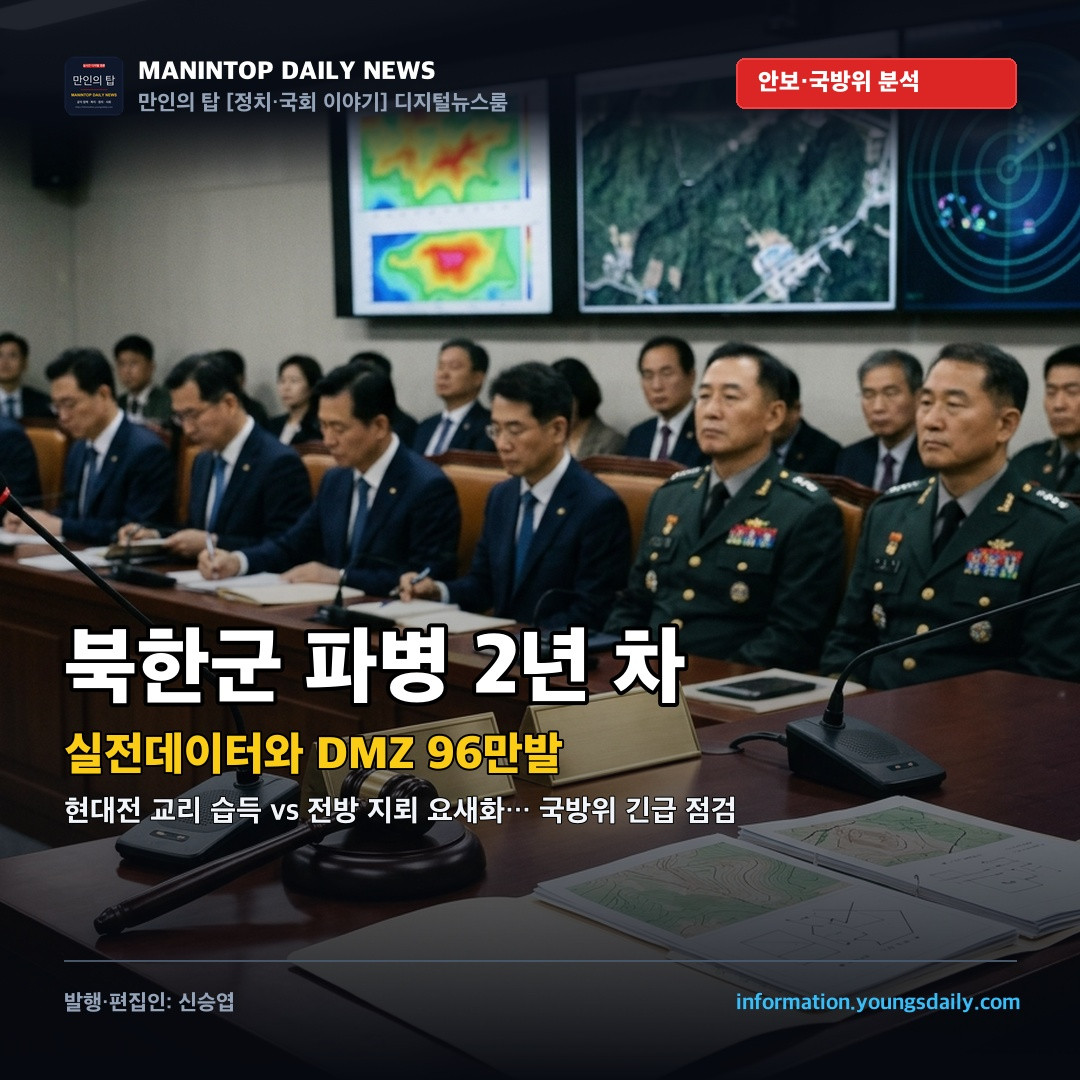
▲ 국회 국방위원회와 정보위원회가 북한군 러시아 파병 2년 차에 따른 현대전 실전 교리 습득과 비무장지대(DMZ) 일대 96만 발 지뢰 매설 및 전방 요새화 실태를 보고받고 국가 안보 대비태세를 긴급 점검하고 있다. ⓒ 만인의 탑
북한군의 러시아-우크라이나 전선 파병이 2년 차에 접어든 가운데, 국회 국방위원회와 정보위원회가 합동참모본부와 국방정보본부의 긴급 현안 보고를 받고 대북 안보 위협을 심층 점검했다. 북한군이 드론 운용과 참호전 등 현대전 실전 교리를 체계적으로 축적하고 러시아로부터 첨단 무기 기술을 이전받는 정황이 포착된 데다, 비무장지대(DMZ) 군사분계선 일대에 누적 96만여 발의 지뢰를 매설하며 전방 요새화를 굳히고 있어 국가 안보의 복합 위기가 고조되고 있다.
1. 북한군 파병 2년 차의 위험성: 현대전 실전 교리와 데이터의 내재화
2024년 10월 첫 파병 확인 이후 1년을 넘긴 북한군의 우크라이나 전장 배치는 단순한 병력 지원을 넘어 군사적 질적 도약의 계기로 작용하고 있다는 것이 군 당국의 판단이다.
국회 국방위원회에 제출된 군사정보 분석에 따르면, 북한군 특수작전부대(폭풍군단 등)와 정예 포병 전력은 러시아 쿠르스크 등 격전지에서 1인칭 시점(FPV) 자폭 드론 및 정찰 드론 운용, 서방제 전자전 재밍(Jamming) 극복, 그리고 현대식 정밀 타격 교리를 직접 체득하고 있다. 지난 70여 년간 실전 경험이 전무했던 북한군이 서방의 첨단 무기체계와 교전을 벌이며 획득한 '실전 데이터'는 북한 전술부대의 작전 지침서 전면 개정으로 이어지고 있다.
아울러 북한이 러시아에 제공한 KN-23·KN-24 단거리 탄도미사일과 122mm·152mm 포탄 수백만 발의 탄착 및 결함 데이터가 북한 내 군수공장으로 실시간 피드백되면서, 대남 타격용 미사일의 정밀도와 발사 신뢰도가 비약적으로 개량되고 있는 것으로 확인되었다.
2. DMZ 전방 요새화: 96만 발 지뢰 매설과 ‘적대적 두 국가론’의 고착화
전방 군사분계선(MDL) 일대에서는 북한의 물리적 장벽 구축과 대규모 지뢰 매설이 위험 수위를 넘어서고 있다.
국회 국방위원회 유용원 의원실 등에 제출된 합참 자료에 따르면, 북한군은 전선 전역에 걸쳐 대전차 방벽과 철조망을 설치하고 대인(목함·나비) 및 대전차 지뢰를 집중 매설해 왔으며, 현재 그 누적 매설량이 약 96만 발에 달하는 것으로 추산된다. 이는 김정은 국무위원장이 선언한 '적대적 두 국가론'을 지상에서 물리적으로 영구화하려는 조치로 풀이된다. 무리한 속도전 매설 과정에서 북한군 다수의 지뢰 폭발 사상자가 발생하고 있으며, 장마철 폭우 시 유실된 지뢰가 임진강 및 한강 하구로 유입될 위험이 상존해 아군 경계 병력과 접경지 주민 안전에 상시적 위협이 되고 있다.
안보 위협 영역
군 당국 보고 실태 및 팩트 분석
대남 안보 파장 및 국회 쟁점
러시아 파병 2년 차
특수작전군 및 포병의 FPV 드론 실전 운용, 참호전·전자전 교리 전면 습득
70년 만의 실전 경험 축적으로 북한 비대칭 전력의 대남 기습 타격 능력 고도화
미사일·포탄 성능 피드백
KN-23/24 미사일 실사격 탄착 데이터 환류를 통한 유도장치 및 신뢰성 개량
킬체인(Kill Chain) 및 KAMD 한국형 미사일방어망 회피 기술 완성 우려
러시아 첨단기술 이전
군사정찰위성 발사체 궤도 진입 기술, ICBM 대기권 재진입 열차폐 기술 전수
핵잠수함 및 대륙간탄도미사일 기술 완성을 통한 미국의 확장억제 약화 기도
DMZ 96만 발 지뢰 요새화
MDL 북측 10~50m 전 구간 대전차 방벽 가설 및 누적 96만 발 지뢰 매설
'적대적 두 국가' 물리적 고착화, 장마철 지뢰 유실에 따른 접경지 안전 위협
3. 북·중·러 삼각 밀착: 김정은 방중과 신압록강대교 개통의 함의
군사적 위협에 더해 최근 김정은 위원장의 전격적인 중국 단둥 방문과 신압록강대교 개통은 동북아 안보 지형에 중대한 지각변동을 예고하고 있다.
파병을 계기로 러시아와의 '포괄적 전략적 동반자 관계'를 혈맹 수준으로 격상시킨 북한이 중국과의 경제·외교 협력까지 전면 복원하면서, 한·미·일 안보 협력에 맞서는 북·중·러 신냉전 연대가 가시화되고 있다. 국회 정보위원회에서는 북한이 러시아로부터 군사기술을, 중국으로부터 경제적 뒷배를 확보하는 '외교적 양날개'를 달게 됨으로써 대남 군사 도발의 문턱을 크게 낮출 수 있다는 경고가 제기되었다.
4. 국회 안보 대책: 확장억제 실행력 강화와 2027년도 국방예산 심사
국회 국방위원회 회의에서 여야 의원들은 북한의 복합 안보 위협에 대응하기 위한 군의 정밀 타격 능력 확충과 방호 체계 보강을 한목소리로 주문했다.
더불어민주당은 한미 연합 감시정찰 자산의 24시간 가동과 함께 접경지역의 우발적 충돌을 막기 위한 위기관리 채널의 정밀한 가동을 요구했다. 국민의힘은 북한군의 드론 실전 교리 습득에 맞서 안티드론(Anti-Drone) 방공망을 전방 군단에 조기 전력화하고, 2027년도 국방예산 심사에서 군사정찰위성 추가 확보와 DMZ 원격 지뢰탐지 장비 예산을 대폭 증액해야 한다고 강조했다. 벼랑 끝으로 치닫는 대북 안보 지형 속에서 대한민국 군의 실질적 억제력 확보가 국가적 최우선 과제로 떠올랐다.
만인의 탑 정치·외교안보 에디토리얼 데스크
발행·편집인: 신승엽 | 기사 등록: 2026년 10월 26일 | 출처: 국회 국방위원회·정보위원회 현안보고 속기록, 합동참모본부 공보
▲ The National Assembly's National Defense and Intelligence Committees reviewed critical security intelligence regarding North Korea's real-world combat data acquisition in Ukraine and the fortification of the DMZ with an estimated 960,000 landmines. ⓒ Manintop Daily
As North Korea's military deployment to the Russia-Ukraine theater entered its second year, the National Assembly’s National Defense and Intelligence Committees convened urgent briefings with the Joint Chiefs of Staff and the Defense Intelligence Agency to evaluate escalating national security threats. With North Korean forces systematically assimilating modern tactical doctrines—including drone warfare and trench maneuvers—and receiving advanced Russian military technology, combined with the fortification of the Demilitarized Zone (DMZ) through an estimated 960,000 newly laid landmines, the Korean peninsula faces a profound compound security crisis.
1. Entering Year Two of Russian Deployment: Absorbing Real-World Combat Doctrines
Surpassing one year since the initial deployment confirmation in October 2024, military authorities assess that Pyongyang's presence on Ukrainian frontlines transcends symbolic manpower support, functioning instead as a structural upgrade of its conventional forces.
According to intelligence reports submitted to the parliamentary defense committee, North Korean special operation forces (including the 11th "Storm" Corps) and elite artillery brigades stationed in Kursk have directly mastered first-person-view (FPV) loitering munitions, reconnaissance drone maneuvers, Western electronic warfare jamming countermeasures, and modern precision strike doctrines. Denied combat experience for over seven decades, North Korean field commanders are now systematically revising tactical manuals based on real-world engagements against Western weapon platforms.
Furthermore, live-fire telemetry from millions of 122mm/152mm artillery shells and KN-23/24 short-range ballistic missiles supplied to Russia is being channeled back into North Korean defense production plants, exponentially enhancing targeting accuracy and mechanical reliability for tactical assets targeted at South Korea.
2. DMZ Fortification: 960,000 Landmines and Physical Division
Along the Military Demarcation Line (MDL), North Korea’s construction of physical barriers and minefields has reached unprecedented levels.
Reports submitted to Defense Committee lawmaker Yoo Yong-won reveal that North Korean troops have erected anti-tank barriers across the frontline and densely laid approximately 960,000 anti-personnel (wooden-box and butterfly mines) and anti-tank munitions. This massive engineering undertaking serves as the physical codification of Kim Jong Un's "hostile two-state doctrine." Rushed operations have produced numerous explosion casualties among North Korean troops, while monsoon flooding routinely displaces unexploded ordnance into the Imjin and Han rivers, presenting continuous threats to South Korean border patrols and civilians.
Security Domain
Military Intelligence Findings
Strategic Impact on South Korea
Russian Deployment (Year 2)
Assimilation of FPV drone operations, trench warfare, and electronic countermeasure tactics
Acquisition of modern combat experience enhances asymmetric surprise attack lethality
Missile & Shell Telemetry
Live combat telemetry feedback refining KN-23/24 guidance packages and artillery fuses
Heightened threat of defeating Kill Chain preemptive strikes and KAMD missile shields
Russian Technology Transfer
Assistance on reconnaissance satellite launch vehicles, ICBM reentry heat-shielding
Accelerated nuclear submarine and multi-warhead ICBM programs eroding US extended deterrence
DMZ 960,000 Landmine Barrier
Anti-tank walls and intensive minefields deployed 10–50 meters north of the MDL
Permanent physical border closure; perennial civilian risks from displaced mines during floods
3. Trilateral Alignment: Kim Jong Un’s Visit to Dandong and China Ties
Beyond battlefield integration, Kim Jong Un’s surprise visit to Dandong, China, marking the opening of the New Yalu River Bridge, portends a fundamental realignment across Northeast Asian geopolitics.
Having elevated relations with Moscow to a de facto military alliance through wartime deployments, Pyongyang is actively restoring strategic and economic cooperation with Beijing. Intelligence committee lawmakers warned that this emerging DPRK-Russia-China authoritarian bloc significantly lowers the threshold for North Korean military provocations against Seoul by securing Russian technological assistance and Chinese economic backing simultaneously.
4. Parliamentary Defense Countermeasures and 2027 Budget Priorities
During committee deliberations, ruling and opposition lawmakers united in demanding robust upgrades to South Korea’s precision strike capabilities and force protection assets.
The Democratic Party emphasized round-the-clock bilateral surveillance with US forces alongside disciplined crisis-management mechanisms to avert accidental escalation. Concurrently, the People Power Party called for the urgent frontline fielding of anti-drone defense grids and substantial budget increases for military reconnaissance satellites and remote mine-clearing hardware in the 2027 national defense budget. In the face of structural geopolitical shifts, solidifying South Korea’s deterrent posture stands as the paramount national priority.
Manintop Daily National Defense & Security Editorial Desk
Publisher & Editor-in-Chief: Seung Youb Ssin | Published: October 26, 2026 | Source: National Assembly Defense Committee Records & Joint Chiefs of Staff Briefings
MANINTOP NEWSLETTER
📬 만인의 탑 뉴스레터 무료 구독
오늘 보신 정책·시사 뉴스가 유익하셨나요? 매일 엄선되는 알짜 복지 혜택과 국회 실시간 속보를 이메일로 가장 먼저 받아보세요. (평생 무료)
Computer Programmer who love programming.
Computer Programmer Who love Riding Bicycle.
Computer Programmer who love trip in abroad.
Computer Programmer who love studying about programming
- even if sometimes it's very boring.
Computer Programmer who love talking with person.
- I love communication with person.
1월이 시작되면 감기는 이미 우리 곁에 와 있습니다. 2월, 3월, 4월까지 이어지는 추위와 건조함은 코와 목을 가장 먼저 공격합니다. 아침에 일어나자마자 막혀 있는 코. 계속 흐르는 콧물. 괜히 칼칼해지는 목. 이 증상은 “시작”일 뿐입니다. 한 번 무너지면 일주일, 길면 한 달까지 끌고 갑니다. 약을 먹으면 잠깐 괜찮아집니다. 하지만 며칠 뒤 또 반복됩니다. 왜일까요? 감기는 ‘치료’의 문제가 아니라 ‘관리’의 문제이기 때문입니다. 대부분은 감기가 오고 나서 약을 찾습니다. 하지만 진짜 중요한 건 감기가 오기 전에 코와 목을 지키는 것입니다. 건조한 실내 공기, 차가운 바깥 공기, 눈에 보이지 않는 세균. 코와 목은 매일 공격받고 있습니다. 지긋지긋하죠! 그런데도 우리는 아무 준비 없이 버티고 있습니다. 이번 겨울도 그렇게 보낼 건가요? 사실 방법은 어렵지 않습니다. 코를 깨끗하게 관리하고, 목을 따뜻하게 보호하고, 점막을 촉촉하게 유지하고, 기관지를 미리 관리하고, 외부 공기를 차단하는 것. 이 다섯 가지만 꾸준히 해도 감기약 없이 겨울을 보내는 것이 충분히 가능합니다. 🔥 이제부터 그 방법을 하나씩 살펴보겠습니다. 🔥 1. 코와 목을 먼저 관리해야 하는 과학적 이유 감기의 대부분은 코 점막에서 시작됩니다. 국제 학술지 Nature Reviews Microbiology 와 Journal of Allergy and Clinical Immunology 에 실린 호흡기 감염 관련 연구들에서는, 감기 바이러스가 비강 상피세포에 먼저 부착해 증식한다는 점을 설명하고 ...
리모델링사업이 진행 중인 아파트를 매매할 때 “계약금 10%를 언제까지 내야 하느냐”는 질문이 특히 많이 나옵니다. 이주공고(이주 안내)가 7~11월쯤이라고 들으면, 그 시점에 맞춰 계약금도 움직일 것 같아서 더 헷갈리기 쉽습니다. 하지만 실제 납부기한은 ‘이주공고가 언제냐’만으로 자동 결정되지 않는 경우가 많습니다. 1) 계약금 10% 납부기한: 결국 ‘문서에 적힌 일정’이 기준 계약금 10%를 언제까지 납부해야 하는지는, 내가 서명하는 매매계약서(특약 포함) 와 사업주체/조합이 제시한 공고·안내문 에 적힌 납부 일정이 기준이 됩니다. 실제 공고문에서는 분양대금 납부의 큰 틀(계약금→중도금→잔금)을 먼저 안내하고, 상세 일정은 별도 표나 유의사항으로 제시하는 방식이 흔합니다. 또, 계약서 문구에 따라 지급 시점이 조건부로 설정될 수도 있습니다. 예를 들어 한 사례 소개 자료에서는 용역계약서에 잔금(10%) 지급시기가 “사업승인 후”로 기재되어 있었다는 점이 언급됩니다. 이런 식으로 ‘사업 단계’와 지급을 연동하는 문구가 들어가면, 질문의 답은 계약서 문구를 확인해야만 확정됩니다. 관련 내용은 링크 에서 문구 사례를 확인할 수 있습니다. 2) 입주자모집공고에서 확인되는 ‘납부 순서’와 잔금 마감 시점 공고문에 적힌 문구를 보면, 납부 순서와 잔금 마감에 대한 기준이 비교적 명확하게 제시되는 경우가 있습니다. 예를 들어 한 입주자모집공고에는 “분양금액(주택가격)은 계약금, 중도금, 잔금의 순서로 납부”하며 “잔금은 입주(열쇠 수령일) 전에 완납”해야 한다고 안내되어 있습니다. (문구 확인: 링크 ) 이 문구가 의미하는 바는 최소 2가지입니다. 분양/공급 형태의 문서에서는 ‘계약금→중도금→잔금’ 흐름이 공식적으로 안내될 수 있습니다. 잔금은 “입주(열쇠 수령)” 이전에 완납해야 한다는 마감 기준이 문서에 적혀 있을 수 있습니다. 다만, 위 공고문 문구는 잔금 마감에 대한 기준을 보여주지만, 계약금 10%의...
윤석열 전 대통령 탄핵 인용 소식을 접하면, 가장 궁금한 지점은 ‘헌재가 정확히 무엇을 위헌·위법으로 봤는가’입니다. 또한 탄핵과 별개로 진행되는 형사재판(내란 우두머리 혐의 등)이 어디까지 왔는지도 함께 정리할 필요가 있습니다. 아래 내용은 제공된 기사/게시물 스니펫과 링크에서 확인되는 범위만 모아, 일반인이 흐름을 이해하기 쉽게 정리한 것입니다. 1) 탄핵 인용 관련: 스니펫에서 확인되는 ‘판단의 골격’ 제공된 근거 중 조국혁신당 사이트에는 헌법재판소가 윤석열 탄핵 심판에서 “피청구인의 위헌·위법행위는 국민 신임 …”이라는 취지로 판단했다는 문장이 인용돼 있습니다( 링크 ). 이 인용문만 놓고 보면, ‘위헌·위법행위’가 있었는지와 그로 인해 ‘국민의 신임’이 어떻게 평가됐는지가 핵심 축으로 소개됩니다. 다만 질문에서 요청하신 세부 항목, 즉 비상계엄 선포 자체를 문제 삼은 구체적 이유, 계엄 이후 조치(포고령, 국회 통제 등)의 어떤 지점이 헌법 위반인지, 국회의 권한행사 방해 및 정치활동 제약을 어떤 논리로 판단했는지 등은, 이번에 제공된 근거의 제목/스니펫만으로는 조항·사실관계·판단 구조가 그대로 제시돼 있지 않습니다. 따라서 이 글에서는 ‘헌재가 무엇을 문제 삼았다’는 세부 리스트를 단정적으로 재구성하기보다, 현재 확인 가능한 문구 수준의 요약(위헌·위법행위 → 국민 신임의 문제로 평가)까지만 적습니다. 만약 헌재 결정문 전문(주문 및 이유)이 추가로 확인되면, 그때는 문장 단위로 ‘어떤 행위’와 ‘어떤 헌법 원리/조항’이 연결되는지(예: 권력분립, 국회의 권한, 정치적 기본권 등) 구조화해 정리하는 것이 가장 정확합니다. 2) 형사 절차(내란 혐의) 관련: 체포영장과 1심 선고 언급 탄핵 심판과 별도로, 12·3 비상계엄 사태로 내란 혐의를 받는 윤석열 대통령에 대해 2024년 12월 31일 체포 영장이 발부됐다는 BBC 보도가 있습니다( 링크 ). 해당 보도는 ‘현직 대통령’에 대한 체포영장 발부라는 점을 함께 언급합니다. 또...




0 댓글