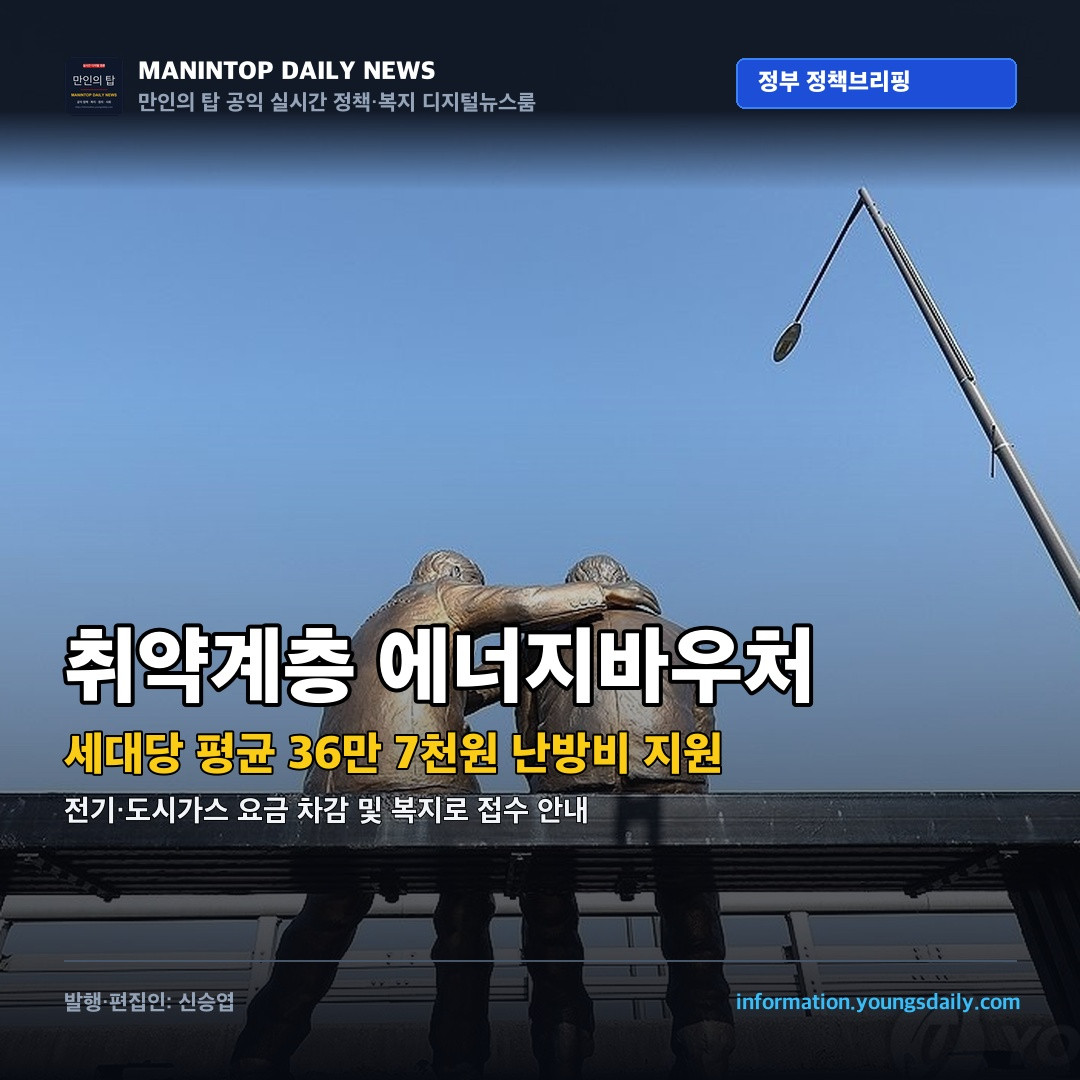
▲ 산업통상자원부, 2026년 동절기 취약계층 에너지바우처 세대당 평균 36만 7000원 난방비 지원 공고 / 만인의 탑 만인의 탑 민생정책 데스크
📌 만인의 탑 핵심 브리핑 · 이 글에서 다루는 핵심 내용
산업통상자원부와 보건복지부가 다가오는 혹한기 취약계층의 동절기 난방비 부담을 완화하기 위해 2026년 에너지바우처 지원 단가를 세대당 평균 36만 7,000원으로 확정 공고했다. 기초생활보장 생계·의료·주거·교육급여 수급 가구 중 노인, 영유아, 장애인, 임산부, 희귀·중증질환자 등이 포함된 취약 세대를 대상으로 1인 가구 29만 5,200원에서 4인 이상 가구 70만 1,300원까지 차등 지급되며, 전기·도시가스·지역난방 고지서 요금 감면 및 실물 국민행복카드 바우처를 통해 2026년 10월부터 2027년 5월까지 8개월간 집중 지원된다.
SPONSORED · ADVERTISEMENT
2026년 동절기 에너지바우처 수급 자격과 세부 소득·가구원 기준
산업통상자원부는 겨울철 에너지 소외계층의 기본적 난방권 보장을 위해 2026년도 에너지바우처 사업의 세부 지원 기준을 확정하고 전국 지자체 및 유관 기관을 통해 본격 시행에 들어갔습니다. 이번 에너지바우처 제도는 국민기초생활 보장법상 생계급여, 의료급여, 주거급여, 교육급여 수급자이면서 동시에 특정 가구원 기준을 충족해야 하는 이중 적격 심사 체계로 운영됩니다.
가구원 특성 기준으로는 만 65세 이상 어르신(1961년 12월 31일 이전 출생자), 만 7세 이하 영유아(2019년 1월 1일 이후 출생자), 장애인복지법상 등록 장애인, 임산부, 국민건강보험법 시행령에 따른 중증난치질환 및 희귀질환 산정특례 등록자, 한부모가족지원법에 따른 한부모가족, 소년소녀가정 등이 포함됩니다. 다만 보장시설 수급자나 긴급복지 연료비 지원, 연탄쿠폰 및 등유나눔카드 중복 수혜자는 공공재정 중복 지원 방지 원칙에 따라 대상에서 제외됩니다.
▲ 산업통상자원부 대응 및 관련 현장 취재 자료 / 만인의 탑 정책브리핑팀
가구원 수별 법정 바우처 단가와 4대 난방 에너지원 결제 방식 비교
2026년 에너지바우처 지원 금액은 최근 지속된 에너지 원자재 가격 상승과 취약계층의 동절기 생계 부담을 정밀하게 반영하여 가구원 수에 따라 4단계로 세분화되어 차등 지급됩니다. 세대당 평균 지원 규모는 약 36만 7,000원에 달하며, 동절기 난방 수요가 급증하는 기간에 집중적으로 혜택이 돌아가도록 설계되었습니다.
구체적인 가구원 수별 지원 단가를 살펴보면 1인 가구는 총 29만 5,200원, 2인 가구는 40만 7,500원, 3인 가구는 53만 2,700원, 4인 이상 다인가구는 최대 70만 1,300원이 각각 배정됩니다. 수급 세대는 난방 방식에 따라 전기, 도시가스, 지역난방 청구서에서 해당 금액만큼 자동 감면받는 '요금 차감' 방식이나, 등유, LPG, 연탄 등을 주유소 및 판매점에서 직접 결제할 수 있는 실물 '국민행복카드' 방식 중 하나를 자율 선택하여 맞춤형 혜택을 누릴 수 있습니다.
가구원 수 구분
동절기 총 바우처 단가
주요 난방 지원 수단
신청 및 요금 적용 방식
1인 가구
29만 5,200원
전기·도시가스·연탄·LPG
고지서 요금 자동 차감
2인 가구
40만 7,500원
전기·도시가스·등유·지역난방
복지로 또는 주민센터 접수
3인 가구
53만 2,700원
도시가스·전기·LPG·등유
국민행복카드 실물 결제
4인 이상 가구
70만 1,300원
전기·가스·지역난방·등유
12월 31일까지 신청 필수
SPONSORED · ADVERTISEMENT
고지서 자동 요금 차감과 실물 국민행복카드 바우처 활용 요령
📱 원스톱 간편 조회 및 신청 로드맵
1
복지로(bokjiro.go.kr) 또는 에너지바우처 포털에서 기초생활수급 및 가구원 요건 모의조회
2
온라인 복지로 또는 주소지 관할 읍·면·동 행정복지센터 방문 접수 (요금차감/국민행복카드 선택)
3
관할 지자체 심사 승인 확인 후 고지서 자동 감면 또는 국민행복카드 난방연료 결제
에너지바우처의 효율적인 사용을 위해서는 주거 형태와 주 난방원에 따른 결제 수단 선택이 매우 중요합니다. 아파트나 중앙난방식 연립주택 거주자의 경우 공과금 고지서에 명시된 고객번호를 등록해 '요금 차감'을 신청하면 별도의 카드 결제 없이도 매달 청구되는 전기요금이나 도시가스 요금에서 바우처 잔액이 자동으로 소진되어 가장 편리합니다.
반면 등유 보일러를 사용하거나 LPG 가스통, 연탄 등을 사용하는 개별 난방 세대는 실물 국민행복카드를 발급받아 동네 주유소나 가스 공급점, 연탄 판매점에서 체크카드나 신용카드 형태로 직접 결제해야 합니다. 바우처 사용 유효 기간은 2026년 10월 1일부터 2027년 5월 25일까지이며, 기한 내 사용하지 않은 잔액은 현금 환급이나 익년도 이월 없이 전액 국고로 소멸되므로 반드시 유효 기간 종료 전에 난방 연료를 선제적으로 구입해 소진해야 합니다.
🚨 신청 기한 및 주의사항 경고
2026년도 에너지바우처 신규 신청은 오는 12월 31일까지 상시 접수되므로, 요건을 충족하는 가구는 지체 없이 신청 절차를 밟아야 합니다. 기존 수급자 중 정보 변동(이사, 가구원 변동 등)이 없는 세대는 별도 신청 없이 자동으로 자격이 갱신되지만, 이사 등으로 거주지가 변경되었거나 가구원 수에 변동이 있는 경우에는 관할 주민센터에 반드시 재신청해야 합니다.
신청 경로는 온라인과 오프라인 두 가지로 열려 있습니다. 거동이 불편하거나 온라인 활용이 익숙한 세대는 복지로 포털(bokjiro.go.kr)에 공동인증서나 간편인증으로 로그인한 뒤 '복지서비스 신청' 메뉴에서 에너지바우처를 선택해 몇 번의 클릭만으로 간편하게 접수할 수 있습니다. 방문 신청을 원하는 경우 신분증과 가장 최근에 납부한 전기·가스요금 고지서를 지참하고 주민등록상 주소지 관할 읍·면·동 행정복지센터를 방문하면 복지 담당 공무원의 안내를 받아 즉시 접수 처리가 완료됩니다.
RECOMMENDED STORIES · SPONSORED
▲ Official Press Coverage & Contextual Archive / MANINTOP Global Newsroom
MANINTOP GLOBAL NEWSROOM · ENGLISH EDITION
Ministry of Trade, Industry and Energy, Winter 2026 Energy Vouchers for Disadvantaged Groups Average 367,000 KRW Heating Costs per Household Announcement
The Ministry of Trade, Industry and Energy and the Ministry of Health and Welfare have announced the average energy voucher support amount for 2026, set at 367,000 won per household, to alleviate the heating cost burden for vulnerable groups during the upcoming cold season. The support will be provided to vulnerable households among those receiving basic living security benefits, including the elderly, infants, people with disabilities, pregnant women, and individuals with rare or severe illnesses. The assistance will vary from 295,200 won for single-person households to 701,300 won for households with four or more members. This support will include discounts on electricity, city gas, and district heating bills, as well as physical vouchers through the National Happiness Card, and will be concentrated from October 2026 to May 2027 for a total of eight months.
📌 Key Takeaways
Vulnerable households receiving livelihood, medical, housing, and educational benefits include the elderly, infants, disabled individuals, and pregnant women.
Support ranges from 295,200 won for single-person households to 701,300 won for households with four or more members, with an average of 367,000 won per household.
Applications can be submitted at community centers and through the Welfare Portal until December 31, 2026, with usage permitted until May 25, 2027.
Eligibility criteria for the 2026 winter energy voucher and detailed income and household member standards
The Ministry of Trade, Industry and Energy has finalized the detailed support criteria for the 2026 Energy Voucher Program to ensure basic heating rights for energy-vulnerable groups during the winter season. The program has officially commenced through local governments and relevant agencies. The Energy Voucher system operates under a dual eligibility assessment framework, targeting recipients of livelihood assistance, medical assistance, housing assistance, and educational assistance under the National Basic Livelihood Security Act, while also meeting specific household member criteria.
The household member criteria include seniors aged 65 and older (born before December 31, 1961), infants aged 7 and under (born after January 1, 2019), registered disabled individuals under the Welfare of Persons with Disabilities Act, pregnant women, individuals registered for severe chronic diseases and rare diseases under the Enforcement Decree of the National Health Insurance Act, single-parent families under the Single-Parent Family Support Act, and youth homes. However, recipients of guaranteed facility support, emergency welfare fuel cost support, coal coupons, and kerosene sharing cards are excluded from eligibility to prevent overlapping public financial support.
Comparison of the legal voucher unit price by the number of household members and payment methods for the four major heating energy sources
The support amount for the 2026 Energy Voucher has been precisely adjusted to reflect the recent rise in energy raw material prices and the winter living burdens faced by vulnerable groups, with payments differentiated into four tiers based on household size. The average support per household is approximately 367,000 won, designed to provide concentrated benefits during the peak heating demand period in winter.
Specifically, the support amounts per household size are as follows: 295,200 won for single-person households, 407,500 won for two-person households, 532,700 won for three-person households, and up to 701,300 won for households with four or more members. Beneficiary households can choose between two methods for receiving support: a 'fee deduction' method, where the specified amount is automatically deducted from their electricity, city gas, or district heating bills based on their heating method, or a physical 'National Happiness Card' that allows direct payment for kerosene, LPG, or coal at gas stations and retailers.
To use the Energy Voucher efficiently, selecting the payment method based on housing type and primary heating source is crucial. For residents of apartments or centrally heated multi-family homes, registering the customer number indicated on their utility bill to apply for 'fee deduction' allows the voucher balance to be automatically depleted from their monthly electricity or city gas bills, making it the most convenient option without the need for a separate card payment.
Guidelines for automatic bill deductions and the use of the physical National Happiness Card voucher
In contrast, households using oil boilers or individual heating sources such as LPG gas cylinders or coal must obtain a physical National Happiness Card and make direct payments at local gas stations, gas supply points, or coal retailers using a debit or credit card. The validity period for using the vouchers is from October 1, 2026, to May 25, 2027, and any unused balance after the deadline will be forfeited to the national treasury without cash refunds or carryovers to the following year. Therefore, it is essential to proactively purchase heating fuel before the expiration date to utilize the full voucher amount.
New applications for the 2026 Energy Voucher will be accepted on a rolling basis until December 31. Households that meet the eligibility requirements should proceed with the application process without delay. Existing recipients whose information has not changed (such as moving or changes in household members) will have their eligibility automatically renewed without a separate application. However, those who have changed their residence due to moving or have had changes in the number of household members must reapply at their local community center.
Applications can be submitted through two channels: online and offline. Households that have difficulty moving or are not familiar with online processes can log in to the Welfare Portal (bokjiro.go.kr) using a joint certificate or simple authentication, then select the Energy Voucher option under the 'Welfare Service Application' menu for a quick and easy application process with just a few clicks. For those who prefer to apply in person, they should bring their identification and the most recent utility bill for electricity or gas, and visit the administrative welfare center in their registered address area, where they will receive guidance from welfare officials to complete the application immediately.
Category
Target Scope
Standard / Benefit
Procedure / Action
Single-person household
295,200 KRW
Electricity, city gas, briquettes, LPG
Automatic deduction of bill charges
Two-person household
407,500 KRW
Electricity, city gas, kerosene, district heating
Application through Welfare Portal or community center
Three-person household
532,700 KRW
City gas, electricity, LPG, kerosene
Physical payment with the National Happiness Card
Households with four or more members
701,300 KRW
Electricity, gas, district heating, kerosene
Application required by December 31
MANINTOP NEWSLETTER
📬 만인의 탑 뉴스레터 무료 구독
오늘 보신 정책·시사 뉴스가 유익하셨나요? 매일 엄선되는 알짜 복지 혜택과 국회 실시간 속보를 이메일로 가장 먼저 받아보세요. (평생 무료)
Computer Programmer who love programming.
Computer Programmer Who love Riding Bicycle.
Computer Programmer who love trip in abroad.
Computer Programmer who love studying about programming
- even if sometimes it's very boring.
Computer Programmer who love talking with person.
- I love communication with person.
1월이 시작되면 감기는 이미 우리 곁에 와 있습니다. 2월, 3월, 4월까지 이어지는 추위와 건조함은 코와 목을 가장 먼저 공격합니다. 아침에 일어나자마자 막혀 있는 코. 계속 흐르는 콧물. 괜히 칼칼해지는 목. 이 증상은 “시작”일 뿐입니다. 한 번 무너지면 일주일, 길면 한 달까지 끌고 갑니다. 약을 먹으면 잠깐 괜찮아집니다. 하지만 며칠 뒤 또 반복됩니다. 왜일까요? 감기는 ‘치료’의 문제가 아니라 ‘관리’의 문제이기 때문입니다. 대부분은 감기가 오고 나서 약을 찾습니다. 하지만 진짜 중요한 건 감기가 오기 전에 코와 목을 지키는 것입니다. 건조한 실내 공기, 차가운 바깥 공기, 눈에 보이지 않는 세균. 코와 목은 매일 공격받고 있습니다. 지긋지긋하죠! 그런데도 우리는 아무 준비 없이 버티고 있습니다. 이번 겨울도 그렇게 보낼 건가요? 사실 방법은 어렵지 않습니다. 코를 깨끗하게 관리하고, 목을 따뜻하게 보호하고, 점막을 촉촉하게 유지하고, 기관지를 미리 관리하고, 외부 공기를 차단하는 것. 이 다섯 가지만 꾸준히 해도 감기약 없이 겨울을 보내는 것이 충분히 가능합니다. 🔥 이제부터 그 방법을 하나씩 살펴보겠습니다. 🔥 1. 코와 목을 먼저 관리해야 하는 과학적 이유 감기의 대부분은 코 점막에서 시작됩니다. 국제 학술지 Nature Reviews Microbiology 와 Journal of Allergy and Clinical Immunology 에 실린 호흡기 감염 관련 연구들에서는, 감기 바이러스가 비강 상피세포에 먼저 부착해 증식한다는 점을 설명하고 ...
리모델링사업이 진행 중인 아파트를 매매할 때 “계약금 10%를 언제까지 내야 하느냐”는 질문이 특히 많이 나옵니다. 이주공고(이주 안내)가 7~11월쯤이라고 들으면, 그 시점에 맞춰 계약금도 움직일 것 같아서 더 헷갈리기 쉽습니다. 하지만 실제 납부기한은 ‘이주공고가 언제냐’만으로 자동 결정되지 않는 경우가 많습니다. 1) 계약금 10% 납부기한: 결국 ‘문서에 적힌 일정’이 기준 계약금 10%를 언제까지 납부해야 하는지는, 내가 서명하는 매매계약서(특약 포함) 와 사업주체/조합이 제시한 공고·안내문 에 적힌 납부 일정이 기준이 됩니다. 실제 공고문에서는 분양대금 납부의 큰 틀(계약금→중도금→잔금)을 먼저 안내하고, 상세 일정은 별도 표나 유의사항으로 제시하는 방식이 흔합니다. 또, 계약서 문구에 따라 지급 시점이 조건부로 설정될 수도 있습니다. 예를 들어 한 사례 소개 자료에서는 용역계약서에 잔금(10%) 지급시기가 “사업승인 후”로 기재되어 있었다는 점이 언급됩니다. 이런 식으로 ‘사업 단계’와 지급을 연동하는 문구가 들어가면, 질문의 답은 계약서 문구를 확인해야만 확정됩니다. 관련 내용은 링크 에서 문구 사례를 확인할 수 있습니다. 2) 입주자모집공고에서 확인되는 ‘납부 순서’와 잔금 마감 시점 공고문에 적힌 문구를 보면, 납부 순서와 잔금 마감에 대한 기준이 비교적 명확하게 제시되는 경우가 있습니다. 예를 들어 한 입주자모집공고에는 “분양금액(주택가격)은 계약금, 중도금, 잔금의 순서로 납부”하며 “잔금은 입주(열쇠 수령일) 전에 완납”해야 한다고 안내되어 있습니다. (문구 확인: 링크 ) 이 문구가 의미하는 바는 최소 2가지입니다. 분양/공급 형태의 문서에서는 ‘계약금→중도금→잔금’ 흐름이 공식적으로 안내될 수 있습니다. 잔금은 “입주(열쇠 수령)” 이전에 완납해야 한다는 마감 기준이 문서에 적혀 있을 수 있습니다. 다만, 위 공고문 문구는 잔금 마감에 대한 기준을 보여주지만, 계약금 10%의...
윤석열 전 대통령 탄핵 인용 소식을 접하면, 가장 궁금한 지점은 ‘헌재가 정확히 무엇을 위헌·위법으로 봤는가’입니다. 또한 탄핵과 별개로 진행되는 형사재판(내란 우두머리 혐의 등)이 어디까지 왔는지도 함께 정리할 필요가 있습니다. 아래 내용은 제공된 기사/게시물 스니펫과 링크에서 확인되는 범위만 모아, 일반인이 흐름을 이해하기 쉽게 정리한 것입니다. 1) 탄핵 인용 관련: 스니펫에서 확인되는 ‘판단의 골격’ 제공된 근거 중 조국혁신당 사이트에는 헌법재판소가 윤석열 탄핵 심판에서 “피청구인의 위헌·위법행위는 국민 신임 …”이라는 취지로 판단했다는 문장이 인용돼 있습니다( 링크 ). 이 인용문만 놓고 보면, ‘위헌·위법행위’가 있었는지와 그로 인해 ‘국민의 신임’이 어떻게 평가됐는지가 핵심 축으로 소개됩니다. 다만 질문에서 요청하신 세부 항목, 즉 비상계엄 선포 자체를 문제 삼은 구체적 이유, 계엄 이후 조치(포고령, 국회 통제 등)의 어떤 지점이 헌법 위반인지, 국회의 권한행사 방해 및 정치활동 제약을 어떤 논리로 판단했는지 등은, 이번에 제공된 근거의 제목/스니펫만으로는 조항·사실관계·판단 구조가 그대로 제시돼 있지 않습니다. 따라서 이 글에서는 ‘헌재가 무엇을 문제 삼았다’는 세부 리스트를 단정적으로 재구성하기보다, 현재 확인 가능한 문구 수준의 요약(위헌·위법행위 → 국민 신임의 문제로 평가)까지만 적습니다. 만약 헌재 결정문 전문(주문 및 이유)이 추가로 확인되면, 그때는 문장 단위로 ‘어떤 행위’와 ‘어떤 헌법 원리/조항’이 연결되는지(예: 권력분립, 국회의 권한, 정치적 기본권 등) 구조화해 정리하는 것이 가장 정확합니다. 2) 형사 절차(내란 혐의) 관련: 체포영장과 1심 선고 언급 탄핵 심판과 별도로, 12·3 비상계엄 사태로 내란 혐의를 받는 윤석열 대통령에 대해 2024년 12월 31일 체포 영장이 발부됐다는 BBC 보도가 있습니다( 링크 ). 해당 보도는 ‘현직 대통령’에 대한 체포영장 발부라는 점을 함께 언급합니다. 또...




0 댓글