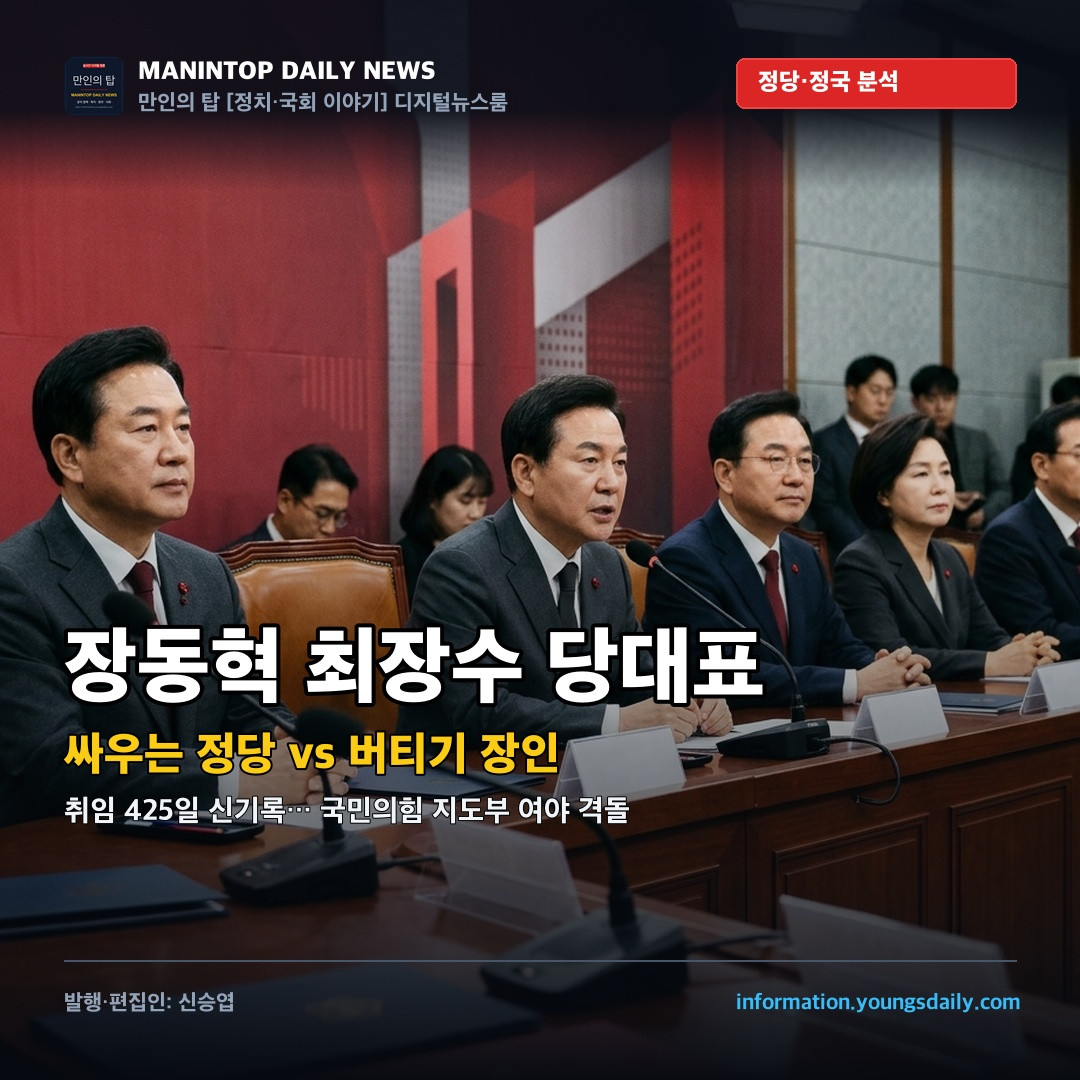
▲ 국민의힘 장동혁 대표가 2020년 9월 당명 변경 이후 이준석 전 대표를 제치고 역대 최장수 당대표 기록(425일)을 경신한 가운데, 보수 재건의 성과라는 자평과 혁신 없는 장기 집권이라는 비판이 팽팽히 맞서고 있다. ⓒ 만인의 탑
국민의힘 장동혁 대표가 2026년 10월 25일 자로 취임 425일을 돌파하며, 2020년 9월 ‘국민의힘’으로 당명을 개칭한 이래 역대 최장수 당대표 기록을 공식 경신했다. 비상대책위원회와 중도 사퇴가 반복되던 보수정당의 해묵은 리더십 불안정을 종식시키고 ‘싸우는 야당’의 체제를 안착시켰다는 여당 측의 자평과, 잇따른 선거 패배와 계파 갈등 속에서도 자리 지키기에만 급급했던 ‘버티기 장인’에 불과하다는 야권의 맹공이 격돌하며 정국의 새로운 뇌관으로 부상하고 있다.
1. 425일의 기록: 이준석 전 대표를 넘어선 ‘국민의힘 최장수 대표’
장동혁 대표는 10월 25일을 기점으로 종전 최고 기록이었던 이준석 전 대표(424일)의 재임 기간을 넘어서며 단일 대표 체제 최장수 기록을 달성했다.
국민의힘의 전신을 포함한 보수 정당사는 그간 '당대표의 무덤'이라 불릴 만큼 극심한 리더십 부침을 겪어왔다. 2020년 9월 당명 변경 이후 김종인 비대위 체제를 거쳐 선출되었던 이준석 전 대표는 당 중앙윤리위원회 징계와 가처분 사태로 임기를 다 채우지 못했고, 김기현 전 대표는 9개월 만에 강서구청장 보궐선거 패배의 책임을 지고 물러났다. 뒤이어 총선을 지휘했던 한동훈 전 비대위원장과 전당대회 당선 대표들 역시 거센 당내 파고를 넘지 못하고 잇따라 낙마했다. 이러한 악순환 속에서 장 대표는 숱한 사퇴 압박과 내홍을 뚫고 1년 2개월을 넘겨 지도부를 사수했다.
2. 여야의 엇갈린 평가: “보수 재건과 투쟁력 안착” vs “쇄신 없는 버티기 장인”
최장수 당대표 기록을 둘러싼 정치권의 해석은 극단적으로 갈리고 있다.
국민의힘 지도부와 장동혁 대표 측은 "보수 진영이 궤멸적 위기에 처했던 절체절명의 시기에 당원 중심의 조직 혁신과 선명한 대여 투쟁 노선을 정립했다"고 자평했다. 거대 여당의 입법 독주에 맞서 장외 집회와 국회 내 필리버스터를 유기적으로 결합하며 당의 지지율 반등의 교두보를 마련했다는 논리다. 장 대표 측 관계자는 “잦은 지도부 붕괴로 인한 무기력증을 극복하고 강력한 단일 대오를 구축한 것 자체가 헌정사적 성과”라고 강조했다.
반면 더불어민주당은 박성준 수석대변인의 공식 브리핑을 통해 “국민을 두려워하지 않는 오만과 불통의 상징”이라고 맹폭을 퍼부었다. 민주당은 “지방선거 참패와 잇따른 민심 이반, 당내 쇄신 요구 속에서도 혁신은커녕 친윤·친한 줄타기와 강성 지지층 결집으로 자리만 보전한 ‘버티기 장인’에 불과하다”고 규탄했다. 이어 “제1야당의 퇴행과 반사이익에만 기댄 무능한 지도체제가 길어질수록 국민의 피로감과 분노는 극에 달할 것”이라며 “연임을 거론하기 전에 국민 앞에서의 주제 파악부터 하라”고 날을 세웠다.
역대 지도부
재임 일수 및 체제 성격
퇴임 사유 및 정치적 귀결
장동혁 대표 (현직)
425일+ (진행 중 / 역대 1위) 단일 정규 지도체제, 대여 강경 투쟁 노선
당원 결속과 지도부 안정 유지 중이나 외연 확장(중도층 공략) 과제 봉착
이준석 전 대표
424일 (2021.06 ~ 2022.08) 세대결합론 기반 30대 원외 당대표
당 윤리위 중징계 및 비대위 전환 가처분 법적 분쟁 끝에 축출
김기현 전 대표
280일 (2023.03 ~ 2023.12) 친윤계 전폭 지원 합의추대형 지도부
강서구청장 보선 참패 및 인요한 혁신위와의 갈등 끝에 전격 사퇴
한동훈 비대위/지도부
수개월 단위 중도 종료 총선 구원투수 및 전당대회 선출
총선 참패 책임 사퇴 및 당정 갈등 격화로 지도체제 붕괴
3. 구조적 딜레마: 안정적 리더십의 그늘과 ‘중도층 확장’의 벽
정치학계에서는 장동혁 대표의 425일 재임 기록이 보수정당에 절실했던 '지도부 안정성'을 회복했다는 점에서는 의미가 있으나, 구조적인 '외연 확장의 한계'를 노출했다고 진단한다.
강성 당원 중심의 결속을 통해 당내 반대파를 제압하고 체제를 유지하는 데는 성공했으나, 중도층과 무당층을 흡수할 수 있는 유연한 정책 비전이나 혁신적 쇄신안은 제시하지 못했다는 지적이다. 특히 수도권과 청년층에서의 지지율 정체 현상이 지속되면서, 강경 보수층에 갇힌 폐쇄적 정당 구조가 고착화되고 있다는 당 안팎의 우려가 끊이지 않고 있다.
4. 향후 정국 시험대: 예산정국·특검 대치와 차기 당권의 향방
최장수 당대표라는 타이틀을 거머쥔 장동혁 대표의 앞길에는 정국의 거대한 파고가 기다리고 있다.
당장 10월 29일 대통령실 국정감사를 끝으로 돌입하는 677조 원 규모의 2027년도 예산안 심사와 거야(巨野)의 특검법 공세 속에서 제1야당의 원내 투쟁과 협상력을 어떻게 조율할 것인지가 첫 번째 시험대다. 아울러 내년도 다가올 전당대회와 선거 국면을 앞두고 당내 계파 갈등을 원만히 봉합하고 대선주자급 리더십으로 도약할 수 있을지, 아니면 '버티기'의 한계에 부딪혀 거센 쇄신 압박에 직면할지가 장동혁 체제의 최종 운명을 가를 전망이다.
만인의 탑 정치·정당 에디토리얼 데스크
발행·편집인: 신승엽 | 기사 등록: 2026년 10월 26일 | 출처: 중앙선거관리위원회 정당 통계, 국민의힘 최고위원회 회의록, 더불어민주당 공식 브리핑
▲ People Power Party Leader Jang Dong-hyeok surpassed former leader Lee Jun-seok to become the longest-serving party chief (425 days) since the 2020 re-branding, sparking heated national debate over party resilience versus entrenched factional resistance. ⓒ Manintop Daily
Surpassing the 425-day milestone on October 25, 2026, People Power Party (PPP) Leader Jang Dong-hyeok has officially broken the historic record for the longest-serving party chief since the conservative party adopted its current name in September 2020. While the ruling party extols this tenure as a triumphant restoration of institutional stability and militant opposition combativeness following years of chronic leadership implosions, the progressive opposition fiercely denounces it as a hollow exercise in factional entrenchment and unyielding survival without public reform.
1. A Landmark 425 Days: Eclipsing Former Leader Lee Jun-seok
By remaining at the helm past October 25, Representative Jang Dong-hyeok eclipsed the previous benchmark of 424 days set by former party leader Lee Jun-seok, achieving the longest uninterrupted leadership run under the modern PPP banner.
South Korea’s conservative mainstream had long suffered from what commentators termed a "graveyard for party chairs." Since the rebranding in late 2020, leaders repeatedly fell victim to factional civil wars and interim emergency committees. Former leader Lee Jun-seok was ousted following disciplinary battles and court injunctions, while his successor Kim Gi-hyeon resigned after merely 280 days following a catastrophic by-election defeat. Subsequent interim committees headed by Han Dong-hoon also crumbled under sharp election setbacks and regime friction. Defying recurring calls for his resignation, Leader Jang managed to consolidate grassroots party membership to sustain single leadership across 14 demanding months.
2. Partisan Polarization: "Combat-Ready Party" vs "Art of Survival"
Assessments regarding this institutional milestone diverge sharply along partisan lines.
Party leadership and Jang's allies celebrated the feat, claiming that "at a moment of existential crisis for the conservative bloc, the party successfully rebuilt grassroots organizational discipline and established a fierce parliamentary combat doctrine." Proponents highlighted his coordination of legislative filibusters and public rallies to halt the super-majority's legislative pushes, establishing a baseline for polling recovery. Party insiders described overcoming chronic defeatism as an institutional triumph in South Korea's constitutional governance.
Conversely, the main opposition Democratic Party launched an unsparing offensive via Chief Spokesperson Park Sung-joon. Labeling Jang an emblem of arrogance and political deafness, the DP asserted: "Despite disastrous electoral defeats, economic failures, and internal calls for overhaul, he remains merely a survival artist clinging to office by catering to hardline partisans." The spokesperson warned that prolonged conservative regression would only deepen public fatigue and outrage, urging the PPP leader to "face public reality before contemplating reelection."
Leadership Era
Tenure & Structural Posture
Departure Rationale & Political Outcome
Jang Dong-hyeok (Incumbent)
425+ Days (Ongoing / Historic Record) Regular single leadership; militant legislative combat
Sustains organizational unity; faces pressing imperatives to attract moderate voters
Lee Jun-seok (Former)
424 Days (Jun 2021 – Aug 2022) Youth-oriented generational coalition
Ousted following party disciplinary sanctions and protracted court battles
Kim Gi-hyeon (Former)
280 Days (Mar 2023 – Dec 2023) Pro-establishment consensus leadership
Abrupt resignation following crushing defeat in Seoul Gangseo district by-election
Han Dong-hoon (Interim)
Short-lived Tenures General election emergency leadership
Resigned following heavy general election defeat and escalating ruling faction frictions
3. The Underlying Dilemma: Stability at the Cost of Moderate Expansion
Political scientists observe that while Jang's 425-day record provided the institutional continuity desperately needed by the conservative bloc, it exposed profound limits in expanding beyond core partisan loyalists.
While consolidating hardline grassroots networks successfully suppressed internal mutinies, it hindered the emergence of pragmatic policy visions capable of capturing uncommitted centrists and younger demographics. Continued electoral stagnation in the Seoul capital region reflects deepening concerns that the party is boxing itself into an ideological redoubt isolated from mainstream sentiment.
4. Upcoming Flashpoints: Winter Budget Deliberations and Party Primaries
Despite securing the title of longest-serving chief, tumultuous legislative battles loom immediately ahead for Leader Jang.
Following the October 29 presidential audit, the National Assembly will transition directly into deliberations over the massive 677-trillion-won 2027 national budget and contentious special prosecutor motions. How Jang orchestrates parliamentary negotiation alongside ideological combat will test his strategic maturity. Navigating winter legislative gridlock while healing internal factional divides ahead of party conventions will ultimately decide whether his record-setting tenure marks a genuine conservative resurgence or the peak of entrenched resistance.
Manintop Daily Political & Party Editorial Desk
Publisher & Editor-in-Chief: Seung Youb Ssin | Published: October 26, 2026 | Source: National Election Commission Records & People Power Party Gazette
MANINTOP NEWSLETTER
📬 만인의 탑 뉴스레터 무료 구독
오늘 보신 정책·시사 뉴스가 유익하셨나요? 매일 엄선되는 알짜 복지 혜택과 국회 실시간 속보를 이메일로 가장 먼저 받아보세요. (평생 무료)
Computer Programmer who love programming.
Computer Programmer Who love Riding Bicycle.
Computer Programmer who love trip in abroad.
Computer Programmer who love studying about programming
- even if sometimes it's very boring.
Computer Programmer who love talking with person.
- I love communication with person.
1월이 시작되면 감기는 이미 우리 곁에 와 있습니다. 2월, 3월, 4월까지 이어지는 추위와 건조함은 코와 목을 가장 먼저 공격합니다. 아침에 일어나자마자 막혀 있는 코. 계속 흐르는 콧물. 괜히 칼칼해지는 목. 이 증상은 “시작”일 뿐입니다. 한 번 무너지면 일주일, 길면 한 달까지 끌고 갑니다. 약을 먹으면 잠깐 괜찮아집니다. 하지만 며칠 뒤 또 반복됩니다. 왜일까요? 감기는 ‘치료’의 문제가 아니라 ‘관리’의 문제이기 때문입니다. 대부분은 감기가 오고 나서 약을 찾습니다. 하지만 진짜 중요한 건 감기가 오기 전에 코와 목을 지키는 것입니다. 건조한 실내 공기, 차가운 바깥 공기, 눈에 보이지 않는 세균. 코와 목은 매일 공격받고 있습니다. 지긋지긋하죠! 그런데도 우리는 아무 준비 없이 버티고 있습니다. 이번 겨울도 그렇게 보낼 건가요? 사실 방법은 어렵지 않습니다. 코를 깨끗하게 관리하고, 목을 따뜻하게 보호하고, 점막을 촉촉하게 유지하고, 기관지를 미리 관리하고, 외부 공기를 차단하는 것. 이 다섯 가지만 꾸준히 해도 감기약 없이 겨울을 보내는 것이 충분히 가능합니다. 🔥 이제부터 그 방법을 하나씩 살펴보겠습니다. 🔥 1. 코와 목을 먼저 관리해야 하는 과학적 이유 감기의 대부분은 코 점막에서 시작됩니다. 국제 학술지 Nature Reviews Microbiology 와 Journal of Allergy and Clinical Immunology 에 실린 호흡기 감염 관련 연구들에서는, 감기 바이러스가 비강 상피세포에 먼저 부착해 증식한다는 점을 설명하고 ...
리모델링사업이 진행 중인 아파트를 매매할 때 “계약금 10%를 언제까지 내야 하느냐”는 질문이 특히 많이 나옵니다. 이주공고(이주 안내)가 7~11월쯤이라고 들으면, 그 시점에 맞춰 계약금도 움직일 것 같아서 더 헷갈리기 쉽습니다. 하지만 실제 납부기한은 ‘이주공고가 언제냐’만으로 자동 결정되지 않는 경우가 많습니다. 1) 계약금 10% 납부기한: 결국 ‘문서에 적힌 일정’이 기준 계약금 10%를 언제까지 납부해야 하는지는, 내가 서명하는 매매계약서(특약 포함) 와 사업주체/조합이 제시한 공고·안내문 에 적힌 납부 일정이 기준이 됩니다. 실제 공고문에서는 분양대금 납부의 큰 틀(계약금→중도금→잔금)을 먼저 안내하고, 상세 일정은 별도 표나 유의사항으로 제시하는 방식이 흔합니다. 또, 계약서 문구에 따라 지급 시점이 조건부로 설정될 수도 있습니다. 예를 들어 한 사례 소개 자료에서는 용역계약서에 잔금(10%) 지급시기가 “사업승인 후”로 기재되어 있었다는 점이 언급됩니다. 이런 식으로 ‘사업 단계’와 지급을 연동하는 문구가 들어가면, 질문의 답은 계약서 문구를 확인해야만 확정됩니다. 관련 내용은 링크 에서 문구 사례를 확인할 수 있습니다. 2) 입주자모집공고에서 확인되는 ‘납부 순서’와 잔금 마감 시점 공고문에 적힌 문구를 보면, 납부 순서와 잔금 마감에 대한 기준이 비교적 명확하게 제시되는 경우가 있습니다. 예를 들어 한 입주자모집공고에는 “분양금액(주택가격)은 계약금, 중도금, 잔금의 순서로 납부”하며 “잔금은 입주(열쇠 수령일) 전에 완납”해야 한다고 안내되어 있습니다. (문구 확인: 링크 ) 이 문구가 의미하는 바는 최소 2가지입니다. 분양/공급 형태의 문서에서는 ‘계약금→중도금→잔금’ 흐름이 공식적으로 안내될 수 있습니다. 잔금은 “입주(열쇠 수령)” 이전에 완납해야 한다는 마감 기준이 문서에 적혀 있을 수 있습니다. 다만, 위 공고문 문구는 잔금 마감에 대한 기준을 보여주지만, 계약금 10%의...
윤석열 전 대통령 탄핵 인용 소식을 접하면, 가장 궁금한 지점은 ‘헌재가 정확히 무엇을 위헌·위법으로 봤는가’입니다. 또한 탄핵과 별개로 진행되는 형사재판(내란 우두머리 혐의 등)이 어디까지 왔는지도 함께 정리할 필요가 있습니다. 아래 내용은 제공된 기사/게시물 스니펫과 링크에서 확인되는 범위만 모아, 일반인이 흐름을 이해하기 쉽게 정리한 것입니다. 1) 탄핵 인용 관련: 스니펫에서 확인되는 ‘판단의 골격’ 제공된 근거 중 조국혁신당 사이트에는 헌법재판소가 윤석열 탄핵 심판에서 “피청구인의 위헌·위법행위는 국민 신임 …”이라는 취지로 판단했다는 문장이 인용돼 있습니다( 링크 ). 이 인용문만 놓고 보면, ‘위헌·위법행위’가 있었는지와 그로 인해 ‘국민의 신임’이 어떻게 평가됐는지가 핵심 축으로 소개됩니다. 다만 질문에서 요청하신 세부 항목, 즉 비상계엄 선포 자체를 문제 삼은 구체적 이유, 계엄 이후 조치(포고령, 국회 통제 등)의 어떤 지점이 헌법 위반인지, 국회의 권한행사 방해 및 정치활동 제약을 어떤 논리로 판단했는지 등은, 이번에 제공된 근거의 제목/스니펫만으로는 조항·사실관계·판단 구조가 그대로 제시돼 있지 않습니다. 따라서 이 글에서는 ‘헌재가 무엇을 문제 삼았다’는 세부 리스트를 단정적으로 재구성하기보다, 현재 확인 가능한 문구 수준의 요약(위헌·위법행위 → 국민 신임의 문제로 평가)까지만 적습니다. 만약 헌재 결정문 전문(주문 및 이유)이 추가로 확인되면, 그때는 문장 단위로 ‘어떤 행위’와 ‘어떤 헌법 원리/조항’이 연결되는지(예: 권력분립, 국회의 권한, 정치적 기본권 등) 구조화해 정리하는 것이 가장 정확합니다. 2) 형사 절차(내란 혐의) 관련: 체포영장과 1심 선고 언급 탄핵 심판과 별도로, 12·3 비상계엄 사태로 내란 혐의를 받는 윤석열 대통령에 대해 2024년 12월 31일 체포 영장이 발부됐다는 BBC 보도가 있습니다( 링크 ). 해당 보도는 ‘현직 대통령’에 대한 체포영장 발부라는 점을 함께 언급합니다. 또...




0 댓글