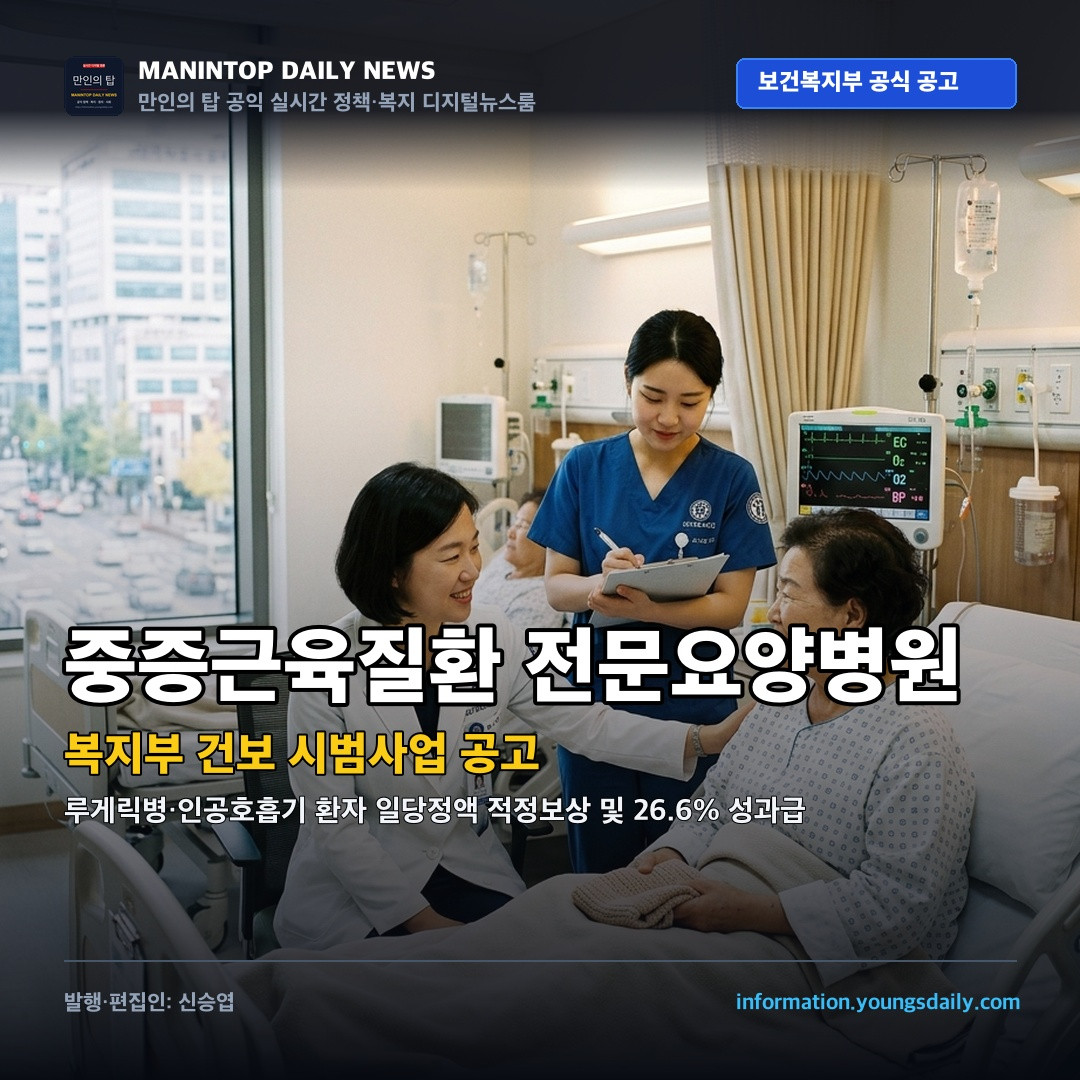
인공호흡기·위루관 달수록 적자 보던 요양병원… 복지부 ‘중증근육질환 전문요양병원 건강보험 시범사업’ 전격 공고
▲ 인공호흡기·위루관 달수록 적자 보던 요양병원… 복지부 ‘중증근육질환 전문요양병원 건강보험 시범사업’ 전격 공고 / 만인의 탑 만인의 탑 보건복지 데스크
📌 만인의 탑 핵심 브리핑 · 이 글에서 다루는 핵심 내용

보건복지부가 23일 ‘보건복지부 공고 제2026-802호’를 통해 루게릭병 등 중증 근육성 희귀질환 환자를 돌보는 요양병원의 만성 적자 구조를 혁신하고, 생명유지장치 환자에 대한 의료 질을 획기적으로 끌어올리는 「중증근육성희귀질환 전문요양병원 건강보험 시범사업」 참여기관 공모를 전격 발표했다. 인공호흡기와 위루관을 단 중증 환자를 돌볼수록 병원이 적자를 보던 현행 일당정액수가 한계를 깨고, 실제 소요 진료비와 급성기 1등급 간호인력 인건비 차액을 일시불로 보전하는 ‘사전지원금(Lump-sum)’과 평가 결과에 따른 ‘사후 최대 26.6% 성과급’을 도입해 공공 의료 안전망을 전면 가동한다.

SPONSORED · ADVERTISEMENT
지원 대상 및 신청 자격
루게릭병(호흡기+위루관 동시장착 80% 이상) 전문 요양병원
지원·환급 규모
사전 진료비 차액 일시불 + 성과급 최대 26.6%

1. 인공호흡기 달수록 적자… 현행 일당정액수가의 구조적 한계와 공고 배경

보건복지부가 2026년 10월 23일 ‘보건복지부 공고 제2026-802호’를 통해 「중증근육성희귀질환 전문요양병원 건강보험 시범사업」 참여기관 공모를 전격 발표했다. 이번 시범사업은 루게릭병(근위축성축삭경화증) 등 중증 근육성 희귀질환자가 급증하고 있음에도, 기존 의료 체계의 구조적 결함으로 인해 환자와 병원 모두가 겪어야 했던 심각한 의료 사각지대를 해소하기 위해 마련됐다.

실제 국민건강보험공단 통계에 따르면 주상병 기준 근위축성축삭경화증(G12.21) 환자 수는 2020년 2,484명에서 2024년 3,025명으로 불과 4년 만에 21.8% 급증했다. 호흡근 마비와 삼킴 장애로 24시간 인공호흡기(NIPPV/TIV)와 위루관 영양 공급이 필수적인 이들 환자는 고난도 의료 처치와 숙련된 간호 인력이 집중 투입되어야 한다. 그러나 현행 요양병원 제도는 환자의 중증도나 투입 자원과 무관하게 1인당 1일 약 87,710원만을 일괄 지급하는 ‘일당정액수가’를 적용해 왔다. 이로 인해 생명유지장치를 단 중증 환자를 입원시킬수록 병원의 적자가 눈덩이처럼 불어나 환자 입원을 기피하고, 그 간병의 고통과 경제적 파탄이 오롯이 환자 가족에게 전가되는 악순환이 지속되어 왔다.
만인의 탑 현장 보도 실사
▲ 정부 공인 포털 및 모바일 간편 신청 화면 / 정책 데스크

2. 사전 럼섬(Lump-sum) + 사후 최대 26.6% 성과급… 파격적 적정보상 체계 신설

이번 보건복지부 시범사업의 핵심은 기존 일당정액제의 틀을 깨고, 의료기관의 실제 투입 자원을 전액 보전하는 혁신적 이중 보상 모델을 도입한 점이다. 정부는 시범기관으로 지정된 요양병원에 대해 일당정액수가(87,710원)와 실제 소요된 진료비 및 급성기 병원 1등급 수준의 간호인력 인건비 차액을 산출하여 기관 단위 일시불인 ‘사전지원금(Lump-sum)’으로 선지급한다.

여기에 더해 중증근육희귀질환 특화 전주기 케어 성과에 따라 최대 26.6%에 달하는 ‘사후지원금’을 차등 지급한다. 평가는 효과성, 환자중심성, 공공성 등 3개 핵심 영역의 정밀 지표를 통해 이루어지며, 의료의 질을 높이고 환자 안전을 철저히 담보한 우수 병원일수록 더 두터운 재정적 보상을 받게 된다. 이는 의료기관이 수익성 악화 우려 없이 최상위 전문 의료진과 장비를 투입할 수 있도록 든든한 제도적 방파제를 구축한 것으로 평가받는다.

구분 항목 현행 일당정액수가 시범사업 개편 모델 기대 효과 및 변화
보상 체계 1일 정액 약 87,710원 고정 사전지원금(Lump-sum) + 사후 성과급(최대 26.6%) 처치량·인력 비례 적정보상 실현
대상 환자 모든 요양병원 환자 획일 적용 근위축성축삭경화증(호흡기+위루관 80% 이상) 고난도 의료 필요 중증환자 집중 케어
인력 기준 요양병원 일반 인력 등급 의사·간호인력 1등급(급성기 상급병원 수준) 숙련 간호사 24시간 안전 감시
병상 운영 장기 입원 위주 획일적 병상 1~4주 단기집중(중간)병상 신설 및 재택 연계 가정 복귀 적응 및 응급 악화 방지
SPONSORED · ADVERTISEMENT

3. 의사·간호사 1등급 및 호흡기 환자 80% 요건… ‘단기집중병상’과 6대 협진 모델 가동

📱 원스톱 간편 조회 및 신청 로드맵
1
1단계: 참여 신청서 및 시범사업 운영계획서 접수 (2026.10.23 ~ 11.5 18:00, 건강보험심사평가원 공문/이메일 접수)
2
2단계: 서류심사 및 시범사업협의체 심의 (중증환자 80% 비율, 의료인력 1등급, 인공호흡기 등 필수 장비 평가)
3
3단계: 참여기관 최종 선정 결과 발표 (11월 중 보건복지부 홈페이지 알림 공고)
4
4단계: 이행약정 체결 및 사전지원금 일시 지급 후 3개년 시범운영 착수 (2026.11 ~ 2029.10)

공모에 참여할 수 있는 대상은 의료법 제3조에 따른 요양병원으로, 엄격한 질적 기준을 통과해야 한다. 지정 기준요건은 크게 세 가지로 압축된다. 첫째, 입원 환자 중 인공호흡기와 위루관을 동시에 착용한 근위축성축삭경화증 환자 비율이 80% 이상이어야 한다. 둘째, 의사 및 간호인력 확보 수준이 급성기 상급병원에 준하는 1등급이어야 한다. 셋째, 물리치료실과 작업치료실은 물론 간헐적 양압흡입기 등 고난도 호흡재활 장비와 침상형 응급 검사 시스템을 완비해야 한다.

특히 이번 사업을 통해 ‘단기집중관리(중간)병상’이 새롭게 도입된다. 대형 대학병원에서 급성기 수술 및 시술을 마친 환자가 가정으로 복귀하기 전 1~4주간 집중 호흡·영양 훈련과 보호자 교육을 받을 수 있도록 지원하며, 재택 돌봄 중 갑작스러운 호흡 곤란이나 감염 등 악화가 발생했을 때도 1~4주간 긴급 입원하여 집중 케어를 받을 수 있다. 아울러 의사, 간호사, 물리치료사, 작업치료사, 사회복지사가 한 팀을 이루는 ‘다학제 6대 전문진료(다학제 협진, 호흡관리, 위루관리, 호흡재활, 신체물리치료, 삼킴·언어 작업치료)’와 안구마우스 등 보조공학기를 활용한 의사소통 지원 시스템이 전면 가동된다.

🚨 신청 기한 및 주의사항 경고
시범사업 참여를 희망하는 요양병원은 10월 23일부터 11월 5일 오후 6시까지 시범사업 참여 신청서와 운영계획서, 이행약정서를 구비하여 건강보험심사평가원 요양병원혁신추진부에 공문 또는 이메일(jdw172@hira.or.kr)로 제출해야 한다. 심평원 서류심사와 보건복지부 시범사업협의체 심의를 거쳐 11월 중 최종 선정 결과가 발표된다. 선정된 병원은 2026년 11월부터 2029년 10월까지 향후 3년간 시범사업을 수행하게 된다. 복지부는 이번 시범사업을 통해 축적된 임상 데이터와 수가 정산 결과를 면밀히 분석하여, 향후 다른 중증 희귀난치성 질환 요양병원으로 적정보상 모델을 단계적으로 확대 적용하고 건강보험 본사업으로 제도화할 방침이다. 환자와 가족이 겪어온 간병 파탄의 비극을 공공 건강보험 체계가 끌어안는 결정적 전환점이 될 것으로 기대를 모으고 있다.
RECOMMENDED STORIES · SPONSORED
발행·편집인: 신승엽
Nursing Hospitals Deficit-Ridden from Ventilator Care: MOHW Officially Announces Severe Neuromuscular Rare Disease Specialized Nursing Hospital Health Insurance Pilot Project
▲ Official Press Coverage & Contextual Archive / MANINTOP Global Newsroom
MANINTOP GLOBAL NEWSROOM · ENGLISH EDITION

Nursing Hospitals Deficit-Ridden from Ventilator Care: MOHW Officially Announces Severe Neuromuscular Rare Disease Specialized Nursing Hospital Health Insurance Pilot Project

The Ministry of Health and Welfare officially announced Public Notice No. 2026-802 on October 23, launching the open recruitment for participating institutions in the Severe Neuromuscular Rare Disease Specialized Nursing Hospital Health Insurance Pilot Project to reform the chronic deficit structure of long-term care hospitals treating ventilator-dependent ALS patients.
📌 Key Takeaways
  • Ministry of Health and Welfare officially announced Public Notice No. 2026-802 for the Severe Neuromuscular Rare Disease Nursing Hospital Health Insurance Pilot Project.
  • Innovative two-tier compensation introduced: Lump-sum pre-payment covering actual medical and grade-1 nursing costs, plus up to 26.6% post-evaluation performance incentives.
  • Designation criteria require 80% or more patients with ALS on ventilators and feeding tubes, along with newly established 1-4 week short-term transitional intensive care beds.

Structural Deficits of Fixed Daily Per Diem System and Official Public Notice Background

The Ministry of Health and Welfare (MOHW) officially announced Public Notice No. 2026-802 on October 23, 2026, launching the open recruitment for participating institutions in the Severe Neuromuscular Rare Disease Specialized Nursing Hospital Health Insurance Pilot Project. This milestone initiative is designed to dismantle long-standing healthcare blind spots caused by the chronic financial strain placed on nursing hospitals caring for severe rare diseases such as Amyotrophic Lateral Sclerosis (ALS). According to official National Health Insurance Service (NHIS) epidemiological statistics, the number of primary ALS patients (ICD code G12.21) surged by 21.8% from 2,484 in 2020 to 3,025 in 2024. These critically ill patients require 24-hour mechanical ventilation and gastrostomy enteral nutrition due to progressive respiratory muscle paralysis and severe dysphagia. However, under the legacy fixed daily per diem system (approximately 87,710 KRW per patient per day), healthcare institutions accumulated severe operating deficits as they admitted more patients requiring intensive medical interventions and skilled nursing care.

Two-Tier Compensation Overhaul: Lump-Sum Pre-Payment and Up to 26.6% Post-Incentive

The cornerstone of this MOHW pilot project is the introduction of an unprecedented dual-compensation model that fully offsets the actual clinical resources deployed by specialized healthcare providers. For designated pilot nursing hospitals, the government calculates the differential between the legacy fixed per diem reimbursement and the actual treatment expenditures alongside personnel costs for Grade 1 acute-level nursing staffing, paying this difference upfront as an institutional lump-sum pre-payment. Furthermore, the ministry will disburse up to an additional 26.6% in post-evaluation performance bonuses based on comprehensive assessments across three core domains: clinical effectiveness, patient-centered care, and public accountability. This financial safeguard allows specialized hospitals to deploy elite medical teams and advanced life-support equipment without fearing institutional insolvency.

Strict Designation Standards: 80% Ventilator Patient Threshold and Transitional Beds

Eligible applicants are long-term care hospitals established under Article 3 of the Medical Service Act that satisfy rigorous clinical and infrastructural prerequisites. First, at least 80% of admitted patients must be ALS patients concurrently fitted with mechanical ventilators and gastrostomy feeding tubes. Second, physician and registered nurse staffing ratios must meet Grade 1 standards equivalent to top-tier acute care university hospitals. Third, institutions must be fully equipped with specialized physical therapy and occupational therapy facilities, non-invasive positive pressure ventilators (NIPPV), and bedside point-of-care laboratory, electrocardiogram, and radiography diagnostic units. Notably, the pilot introduces transitional intensive care beds offering 1 to 4 weeks of structured respiratory rehabilitation and caregiver education before patients transition home.

Application Submissions Open Until November 5 with 3-Year Institutional Roadmap

Eligible long-term care hospitals must submit official application forms, operational business proposals, and compliance agreements to the Nursing Hospital Innovation Department of the Health Insurance Review and Assessment Service (HIRA) by 18:00 on November 5, 2026. Following document screening and evaluation by the MOHW Pilot Project Deliberation Committee, the final list of selected institutions will be officially published in November. The designated institutions will operate the pilot model for three consecutive years from November 2026 through October 2029. MOHW plans to analyze clinical outcome registries and reimbursement settlement data to expand appropriate payment models across other severe intractable rare diseases and institutionalize the framework into the permanent National Health Insurance benefit scheme.

Category Target Scope Standard / Benefit Procedure / Action
Payment Framework Fixed per diem ~87,710 KRW Lump-sum pre-payment + up to 26.6% bonus Value-based healthcare reimbursement
Target Cohort Uniform long-term care patients ALS patients (ventilator + feeding tube >=80%) High-complexity intensive care focus
Staffing Standard General nursing home grade Physician and nurse Grade 1 (acute level) Skilled 24-hour continuous monitoring
Ward Operation Standard long-term stay beds 1-4 week transitional beds and home link Home adaptation and acute crisis mitigation
Publisher & Editor-in-Chief: Seung Youb Ssin, Ph.D.
Global Newsroom: MANINTOP GLOBAL NEWSROOM
