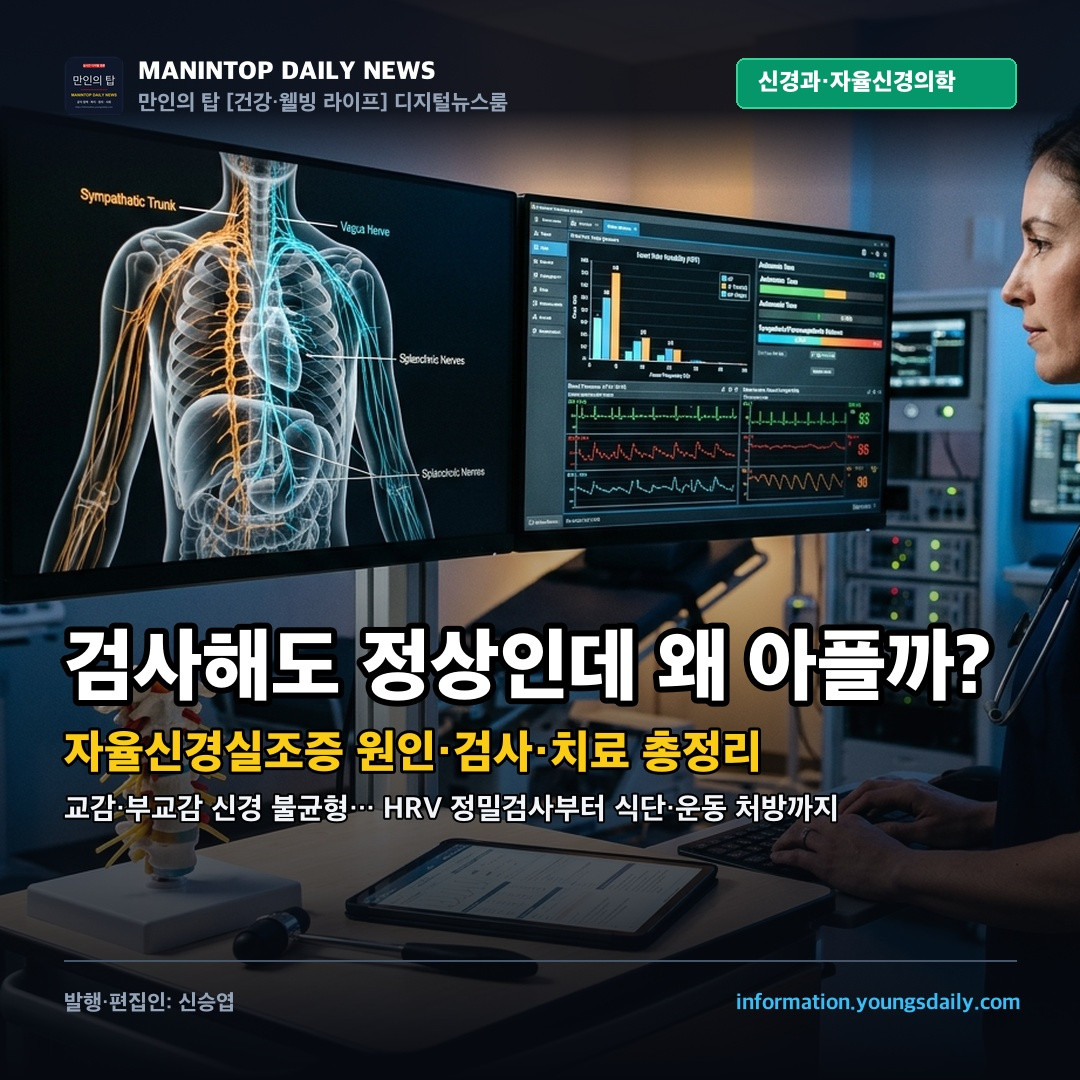
병원에서 혈액 검사, 심전도, 위내시경, 뇌 MRI 등 온갖 정밀 검사를 받아도 “아무런 이상이 없다”는 진단을 받지만, 정작 본인은 머리가 띵하고 가슴이 두근거리며 자도 자도 피로가 풀리지 않아 일상생활이 붕괴되는 환자들이 급증하고 있습니다. 이처럼 병명조차 찾지 못하는 원인 불명의 다발성 신체 이상 증상 배후에는 인체의 자동 생체 조절 장치인 **'자율신경계(Autonomic Nervous System)'의 불균형**이 자리 잡고 있습니다. 자율신경실조증은 단순한 일시적 스트레스 반응이 아니라 체내 항상성 유지가 무너진 명백한 의학적 상태로, 정확한 원인 규명과 조기 진단, 생활 습관 개입이 필수적입니다.
📌 핵심 요약 (Key Takeaways)
- 항상성 조절 시스템의 고장: 자율신경계는 심박수, 혈압, 소화, 체온을 24시간 자동 관리하는 중앙 통제 장치. 교감신경(엑셀)과 부교감신경(브레이크)의 시소 균형 붕괴가 발병 핵심.
- 거북목과 체형 왜곡의 악순환: 스마트폰 사용으로 인한 일자목·거북목 자세가 경추 주변 자율신경절을 물리적으로 압박하여 교감신경 과흥분 및 근육 경직의 만성 악순환 유발.
- 다발성 복합 증상: 순환기(두근거림, 기립성 어지럼), 소화기(만성 소화불량, 담적병), 신경계(만성 두통, 수족냉증, 이상 발한), 수면·감정(불면증, 브레인포그) 동시 발현.
- 5대 정밀 자율신경 검사: 심박변이도(HRV), 기립경사 테이블 검사(Tilt Table Test), 심호흡시 심박동 반응 검사(HRDB), 교감피부반응(SSR), 발살바 검사로 정량적 진단.
- 비수술적 의학 치료: 척추 신경절 주변 신경 유착을 해소하는 SNEPI(자율신경 주사) 및 SoDDA(신경 유착 박리술), 도수 및 영양 수액 치료 병행.
- 자율신경 맞춤 식단과 운동: GABA 풍부한 토마토, 세로토닌 합성 바나나, 장내 유익균 발효식품 섭취 및 교감신경 과흥분을 막는 30분 느린 걷기·요가 실천.
1. 자율신경계의 생리적 작동 원리와 불균형의 악순환
자율신경계(Autonomic Nervous System)는 인간이 대뇌에서 의식적으로 통제하지 않아도 심장 박동, 혈압, 호흡수, 체온 조절, 위장 운동, 땀 분비 등 생명 유지에 필수적인 생리 기능을 24시간 자동으로 관리하는 인체의 '항상성 조절 중앙처리장치(CPU)'입니다. 마치 자동차의 지능형 자동 변속기처럼, 신체 내외부의 급격한 환경 변화에 실시간으로 대응하여 장기들의 활동 수준을 최적의 상태로 유지합니다.
자율신경계는 정반대의 길항 작용을 수행하는 두 축의 정밀한 협력으로 작동합니다:
- 교감신경 (가속 페달, 엑셀): 신체가 위기 상황에 직면하거나 긴장·흥분 상태일 때 작동합니다. 심박수를 가속하고 혈압을 높이며 말초 혈관을 수축시키고 근육을 긴장시켜 '투쟁-도피(Fight-or-Flight)' 각성 상태를 형성합니다.
- 부교감신경 (감속 페달, 브레이크): 신체가 휴식과 수면, 회복 상태에 들어갈 때 가동됩니다. 심박수를 안정시키고 위장관 연동 운동과 소화액 분비를 촉진하며 면역 기능을 활성화하고 손상된 조직을 치유합니다.
두 신경이 시소처럼 완벽한 동적 평형을 이루어야 건강한 생체 리듬이 유지되지만, 만성 스트레스, 수면 결핍, 과로가 장기간 누적되면 이 시소 균형이 처참하게 붕괴됩니다. 특히 현대인에게 흔히 발생하는 일자목과 거북목 체형 왜곡은 자율신경 불균형을 가속하는 물리적 도화선입니다. 고개가 앞으로 1cm 튀어나올 때마다 목뼈에 걸리는 하중은 2~3kg씩 증가하며, 경추 주변에 밀집된 자율신경절(성상신경절 등)을 직접적으로 자극하고 압박합니다. 근육의 과긴장은 뇌로 향하는 추골동맥 혈류를 차단하고, 이는 다시 자율신경 중추를 과흥분시켜 근육을 더욱 굳어지게 만드는 '파괴적 악순환'을 낳습니다.
2. 신체 전반을 흔드는 다발성 증상 체계와 응급 위험 신호
자율신경망은 인체의 거의 모든 내장 기관과 혈관에 거미줄처럼 뻗어 있습니다. 따라서 불균형이 초래되면 특정 장기 한곳에 머무르지 않고 전신에 걸쳐 복합적인 다발성 증상으로 터져 나옵니다. 환자들이 초기에 소화기내과, 순환기내과, 이비인후과, 정신건강의학과를 전전하며 '닥터쇼핑'을 하게 되는 근본적 이유입니다.
| 신체 계통 분류 | 주요 발현 임상 증상 | 생리적 유발 기전 |
|---|---|---|
| 순환기계 | 가슴 두근거림(심계항진), 흉부 압박감, 혈압 널뛰기, 기립성 어지럼증 | 교감신경 과항진으로 인한 심근 수축력 증가 및 기립 시 혈관 수축 반사 지연 |
| 소화기계 | 만성 신경성 소화불량, 속쓰림, 복부 팽만감, 변비·설사 교대, 담적병 | 부교감 미주신경 저하로 위장 연동 운동 정체 및 소화 효소 분비 불균형 |
| 신경 및 전신계 | 원인 불명 긴장성 두통, 만성 피로, 손발 저림, 수족냉증, 비정상적 식은땀 | 말초 미세혈관 수축 조절 실패, 체온 조절 중추 오작동 및 감각 신경 과민화 |
| 수면 및 정서계 | 입면 장애, 잦은 야간 각성, 만성 불안, 브레인포그(기억·집중력 감퇴) | 야간 교감신경 차단 실패로 뇌 각성 지속, 멜라토닌 및 세로토닌 합성 저하 |
⚠️ 응급 진료가 필요한 위험 신호 (Red Flags)
자율신경 기능성 이상과 달리, 갑작스러운 의식 상실이나 실신, 쥐어짜는 듯한 극심한 흉통과 호흡 곤란, 고열을 동반한 전신 증상, 심한 복통 및 흑색변·위장관 출혈이 동반된다면 심근경색, 뇌졸중 등 치명적인 기질적 응급 질환일 가능성이 높으므로 즉시 119 또는 응급의료센터를 찾아야 합니다. 특히 한쪽 팔다리 마비나 어눌한 발음, 보행 장애는 뇌혈관 질환의 강력한 징후입니다.

▲ 대학병원 신경과 자율신경 생리검사실에서 전문의가 기립경사 테이블(Tilt Table)과 실시간 심박변이도(HRV) 모니터를 통해 환자의 혈역학 반응과 자율신경 균형을 정밀 측정하고 있다. (제공: 만인의 탑 의학전문 취재팀)
3. 원인을 정량적으로 규명하는 5대 정밀 자율신경 기능 검사
자율신경실조증을 올바르게 진단하기 위해서는 먼저 혈액 검사, 심전도, 갑상선 기능 검사, 심장 초음파, 뇌 MRI 등을 통해 종양이나 염증 등 기질적 질환을 완전히 배제하는 '배제 진단(Differential Exclusion)'을 거칩니다. 이후 기질적 손상이 없음이 입증되면, 신경과 전문 검사실에서 자율신경계의 정량적 조절력을 수치화하는 5대 정밀 검사를 진행합니다.
① 심박변이도 검사 (HRV, Heart Rate Variability): 심장 박동 간격의 미세한 밀리초(ms) 단위 변화를 주파수 스펙트럼으로 분석합니다. 저주파(LF)는 교감신경, 고주파(HF)는 부교감신경의 활성도를 나타내며, 총 전력(Total Power)으로 신체 스트레스 저항력과 자율신경 총량을 객관적 숫자로 진단합니다.
② 기립경사 테이블 검사 (Tilt Table Test): 특수 전동 침대에 누운 상태에서 침대를 약 70도로 기립시켜 혈압과 심박수 변화를 실시간 추적합니다. 기립 후 3분 내 수축기 혈압이 20mmHg 이상 떨어지는 '기립성 저혈압'이나, 혈압 하강 없이 맥박이 분당 30회 이상 치솟는 '기립성 빈맥 증후군(POTS)', '미주신경성 실신'을 완벽 감별합니다.
③ 심호흡시 심박동 반응 검사 (HRDB): 일정한 리듬에 맞춰 깊은 호흡을 유도하면서 흡기와 호기 시 심박수 변동 폭을 측정합니다. 정상적인 호흡성 부정맥 반응이 둔화되어 있다면 심장을 조율하는 미주신경(부교감신경)의 기능 부전을 의미합니다.
④ 교감피부반응(SSR) 및 정량적 발한 검사: 손발바닥에 미세 전기 자극을 가해 피부 땀샘 활성화에 따른 전기 저항 변화를 측정함으로써 말초 교감신경의 손상 여부와 당뇨병성 자율신경병증을 조기 감별합니다.
⑤ 발살바 검사 (Valsalva Maneuver): 계측기에 연결된 마우스피스를 입에 물고 일정 압력(40mmHg)으로 15초간 숨을 강하게 불어 넣으며 흉곽 및 복강 내압을 높였을 때 유발되는 압반사(Baroreflex) 심혈관 반응을 평가합니다.
정확한 검사를 위해서는 사전 수칙을 철저히 지켜야 합니다. 항콜린제, 베타차단제 등 자율신경에 영향을 주는 약물은 검사 48시간 전에 중단해야 하며, 검사 전 24시간 동안 과격한 운동을 피하고, 3~4시간 전부터는 카페인 섭취와 흡연을 엄격히 금해야 합니다.
4. 자율신경 균형을 회복하는 의학적 치료와 생활 수칙
치료의 대원칙은 과흥분된 교감신경을 진정시키고, 바닥난 부교감신경을 재활성화하는 것입니다. 생활 습관 교정만으로 호전되지 않는 중등도 이상의 환자에게는 신경의 물리적 포착을 해소하는 정밀 의학 시술이 시행됩니다.
- SNEPI (자율신경 주사치료): 고해상도 C-arm 방사선 영상 장비를 통해 경추 및 흉추 주변의 예민해진 자율신경절 분지와 신경막 부위에 미세 주사바늘로 접근하여 신경 주변의 유착을 풀고 교감신경의 과도한 흥분 전파를 차단합니다. 즉각적인 혈관 이완과 혈류 개선 효과를 유도합니다.
- SoDDA (신경 유착 박리술): 장기간의 근육 경직으로 엉겨 붙은 신경 주변의 미세 조직 공간을 생리식염수 등의 정밀 수압을 이용해 물리적으로 박리하여 신경 압박을 해소합니다. 가슴 두근거림, 상열감, 만성 무기력증을 신속히 완화합니다.
- 도수치료 및 신경 영양 수액: 거북목과 굽은 등을 교정하여 척추 기립근 긴장을 낮추는 전문 도수치료와 신경세포 미토콘드리아 대사를 촉진하는 고농도 항산화 수액 요법을 병행합니다.
생활 속에서는 수면 환경 온도를 18~20℃로 서늘하게 맞추고, 취침 2시간 전 전자기기 화면을 차단하는 수면 위생 확립이 필수적입니다. 또한 하루 3회 목 뒤 근육을 이완하는 신전 스트레칭과 귀 뒤 흉쇄유돌근 상부 마사지, 뒤통수 아래 두판상근 지압을 실천하면 뇌 혈류 순환이 촉진되어 자율신경 안정에 큰 도움이 됩니다.
5. 자율신경을 살리는 식단과 운동 가이드: 장-뇌 축(Gut-Brain Axis)과 맞춤 처방
자율신경계는 장(Gut)과 미주신경을 통해 실시간으로 신호를 주고받는 '장-뇌 축(Gut-Brain Axis)'에 직접 종속되어 있습니다. 따라서 뇌 신경전달물질의 원료가 되는 영양소와 장내 미생물 생태계를 복원하는 식단이 완치의 핵심 열쇠입니다.
🥗 자율신경 재생을 돕는 4대 필수 영양소
- 토마토 (천연 GABA 공급원): 뇌 신경세포의 과흥분을 억제하고 불안을 가라앉히는 감마-아미노부티르산(GABA)이 풍부합니다. 나이가 들수록 체내 GABA가 급감하므로 매일 완숙 토마토 1개 섭취가 권장됩니다.
- 바나나 (세로토닌 원료): 행복 호르몬 세로토닌의 전구물질인 트립토판과 비타민 B6가 결합되어 있어 교감신경을 안정시키고 양질의 수면을 유도합니다.
- 브로콜리 (항스트레스 비타민 C): 부신에서 스트레스 호르몬(코르티솔)을 분비할 때 급격히 고갈되는 비타민 C가 레몬의 3배 이상 응축되어 있습니다.
- 장내 유익균 활성화 식단: 김치, 된장, 낫토 등 발효식품과 고구마, 양배추, 버섯 등 식이섬유 식품을 꾸준히 섭취하여 장내 단쇄지방산(SCFA) 생성을 촉진해야 합니다.
운동 처방에 있어서는 '강도의 역설'을 반드시 기억해야 합니다. 자율신경이 무너진 상태에서 무리하게 헬스장에서 고중량 스쿼트를 하거나 고강도 인터벌 트레이닝(HIIT), 스피닝, 마라톤을 하면 교감신경을 다시 과흥분시켜 극심한 피로와 현기증, 가슴 두근거림을 촉발합니다. 대신 하루 30분 느린 걷기, 요가, 태극권, 가벼운 스트레칭과 같이 심박수를 급격히 올리지 않고 부교감신경을 자극하는 '이완 중심 운동'을 선택해야 합니다.
| 운동 구분 | 추천되는 좋은 운동 (부교감 활성화) | 피해야 할 나쁜 운동 (교감신경 자극) |
|---|---|---|
| 운동 종목 | 요가, 마음챙김 산책, 필라테스 스트레칭, 태극권 | 크로스핏, 고중량 웨이트, 인터벌 러닝, 격렬한 스피닝 |
| 생리적 반응 | 깊은 호흡 유도로 미주신경 자극 및 심박 안정 | 급격한 아드레날린 분비 및 혈압 급상승으로 신경 과부하 |
| 실행 가이드 | 운동 후 편안함과 활력이 남는 강도로 매일 20~30분 | 운동 후 어지럼증, 탈진, 손떨림이 발생하면 즉각 중단 |
6. [종합 제언] 조기 진단과 체계적 생활 관리가 완치의 열쇠
자율신경실조증은 마음의 꾀병이 아니며, 인체의 정밀 제어 네트워크에 과부하가 걸려 신음하는 명백한 의학적 질환입니다. 원인 모를 다발성 통증과 피로로 고통받고 있다면 더 이상 혼자 고민하지 말고, 신경과 전문 검사실을 찾아 정밀 자율신경 기능 검사를 받아야 합니다. 정확한 원인 진단을 거쳐 자세 교정, 수면 환경 개선, 장내 미생물 식단, 이완 운동을 체계적으로 실천한다면 망가진 신체의 항상성을 100% 정상으로 되돌릴 수 있습니다.
만인의 탑 신경과 & 자율신경의학 전문 특별취재팀 | 발행·편집인: 신승엽
자료 출처: 대한신경과학회 임상진료지침, 대한자율신경병학회 공식 학술지, 미국자율신경학회(AAS) 진단 가이드라인
“Why Do I Ache When Every Test Is Clear?”: A Comprehensive Clinical Guide to Autonomic Dysfunction, Diagnostics, and Recovery
Across modern medical institutions, an increasing number of patients undergo extensive diagnostic testing—including comprehensive blood panels, resting EKGs, upper endoscopies, and high-resolution brain MRIs—only to be assured that everything is 'completely normal.' Yet, these same individuals suffer daily from persistent tension headaches, unprovoked heart palpitations, postural dizziness, and relentless fatigue. Beneath these elusive, multisystem somatic complaints lies a fundamental breakdown in the human body's master automated regulatory mechanism: Autonomic Nervous System Dysfunction, clinically diagnosed as Dysautonomia. Far from an imaginary psychosomatic reaction, dysautonomia is an established clinical failure of biological homeostasis requiring objective diagnostics, specialized neuromodulatory interventions, and targeted lifestyle retraining.
📌 Key Takeaways
- Homeostatic Control Architecture: The autonomic nervous system regulates heart rate, blood pressure, digestion, and temperature 24/7. Disease stems from a dynamic failure between the sympathetic accelerator and parasympathetic brake.
- Forward Head Posture Vicious Cycle: Forward head posture and hyper-extended neck alignment physically compress cervical-thoracic autonomic ganglia, provoking chronic sympathetic hyperarousal and vascular constriction.
- Multisystem Clinical Presentation: Encompasses cardiovascular fluctuations (palpitations, orthostatic intolerance), gastrointestinal dysfunction (gastroparesis, IBS), vasomotor instability (cold extremities, abnormal sweating), and neurocognitive sleep fragmentation.
- 5 Gold-Standard Autonomic Tests: Heart Rate Variability (HRV), Tilt Table Testing (TTT), Heart Rate Response to Deep Breathing (HRDB), Sympathetic Skin Response (SSR), and Valsalva Maneuver.
- Non-Surgical Medical Interventions: SNEPI (selective autonomic nerve block injections) and SoDDA (nerve hydrodissection) release physical tethering around vertebral autonomic trunks, coupled with manual spinal therapy.
- Gut-Brain Axis & Exercise Prescription: Incorporates GABA-rich tomatoes, tryptophan-dense bananas, fermented prebiotics, and strictly avoids high-intensity interval training (HIIT) in favor of vagal-stimulating slow walking and yoga.
1. Physiological Principles of the Autonomic System and the Vicious Cycle of Imbalance
The Autonomic Nervous System (ANS) operates as the human body's subconscious central processing unit (CPU), regulating vital homeostatic functions—including chronotropic cardiac rate, vascular resistance, respiration, core temperature, gastrointestinal peristalsis, and sudoromotor output—around the clock without requiring conscious cognitive effort. Like an intelligent dual-clutch automotive transmission, it continually recalibrates organ performance to match environmental stressors and internal demands.
This dynamic equilibrium is governed by two anatomically and functionally distinct branches operating in coordinated antagonism:
- Sympathetic Nervous System (The Accelerator): Mobilizes physiological energy during acute threat or intense activity. Originating from thoracolumbar spinal levels, it increases heart rate, elevates systemic blood pressure, constricts splanchnic vascular beds, and triggers the adaptive 'Fight-or-Flight' response.
- Parasympathetic Nervous System (The Brake): Dominates during periods of quiescence, digestion, and sleep. Predominantly mediated by the cranial vagus nerve (Cranial Nerve X), it decelerates cardiac chronotropy, stimulates digestive secretions and gut motility, conserves metabolic fuel, and orchestrates cellular repair.
When chronic psychosocial stress, circadian disruption, and occupational exhaustion persist, this delicate seesaw collapses into Dysautonomia. Crucially, physical biomechanical distortion serves as an under-diagnosed mechanical driver. The ubiquitous forward head posture ('tech neck') places immense strain on the cervical-thoracic junction. Every inch of forward head tilt doubles mechanical load on cervical paraspinous musculature, directly entrapping the stellate and superior cervical sympathetic ganglia. This entrapment impairs vertebral artery hemodynamics to the brainstem, driving a self-sustaining loop of autonomic overactivation, muscular spasm, and microvascular hypoperfusion.
2. Multisystem Symptom Architecture and Critical Red Flag Warnings
Because autonomic nerve fibers innervate virtually every vascular bed and visceral organ, regulatory failures manifest as a complex, diffuse syndrome. Rather than experiencing isolated pathology in a single organ, patients present with cross-system dysfunctions that frequently baffle specialty-bound clinicians.
| Physiological Domain | Key Clinical Symptoms | Pathophysiological Mechanism |
|---|---|---|
| Cardiovascular | Palpitations (sinus tachycardia), chest constriction, labile blood pressure, orthostatic dizziness | Sympathetic hyperarousal and delayed baroreceptor vasoconstrictive reflexes upon standing |
| Gastrointestinal | Functional dyspepsia, acid reflux, postprandial bloating, alternating constipation and diarrhea | Suppressed vagal signaling causing delayed gastric emptying and dysregulated mucosal secretions |
| Neuromuscular / General | Tension-type headaches, chronic unrefreshing fatigue, paresthesias, cold extremities, diaphoresis | Vasomotor failure in peripheral microcirculation, hypothalamic thermoregulatory instability |
| Sleep & Neurocognitive | Sleep onset insomnia, frequent nocturnal arousals, generalized anxiety, brain fog, poor working memory | Persistent nocturnal sympathetic tone preventing delta-wave restorative sleep; neuroinflammation |
⚠️ Emergency Red Flag Warnings
In contrast to functional dysautonomia, symptoms such as sudden syncope with loss of consciousness, crushing substernal chest pressure, acute dyspnea, high fever, severe abdominal guarding, or gastrointestinal bleeding warrant immediate emergency evaluation for life-threatening structural conditions like myocardial infarction or pulmonary embolism. Furthermore, unilateral focal neurological deficits—including facial droop, hemiparesis, dysarthria, or ataxia—demand rapid emergency stroke protocols.
▲ Inside a university autonomic testing suite, a neurologist evaluates continuous arterial blood pressure waveforms and spectral HRV parameters during a motorized Tilt Table Test. (Photo: ManInTop Medical Newsroom)
3. Quantifying Autonomic Failure: The 5 Gold-Standard Diagnostic Tests
Establishing an objective diagnosis requires a rigorous two-step protocol: first, excluding macro-structural organ pathology via blood tests, standard 12-lead EKGs, thyroid panels, echocardiography, and cerebral MRI; and second, conducting specialized quantitative autonomic reflex testing in an accredited autonomic neurophysiology laboratory.
1. Heart Rate Variability (HRV) Spectral Analysis: Measures beat-to-beat (R-R interval) millisecond fluctuations under resting conditions. Fast Fourier Transform breaks data into low-frequency (LF, sympathetic-baroreflex marker) and high-frequency (HF, pure parasympathetic vagal marker) bands, calculating total autonomic power and physiological adaptability.
2. Head-Up Tilt Table Test (HUTT): The patient is positioned on a motorized table tilted to 70 degrees while continuous beat-to-beat arterial tonometry monitors hemodynamic stability. Differentiates Classic Orthostatic Hypotension (systolic drop >20 mmHg within 3 minutes), Postural Orthostatic Tachycardia Syndrome (POTS, sustained pulse rise >30 bpm without hypotension), and Vasovagal Neurocardiogenic Syncope.
3. Heart Rate Response to Deep Breathing (HRDB): Evaluates respiratory sinus arrhythmia (RSA) during paced deep breathing (6 breaths per minute). A blunted heart rate oscillation indicates damaged efferent vagal parasympathetic innervation to the cardiac sinoatrial node.
4. Sympathetic Skin Response (SSR) & Sudomotor Testing: Measures transient electrical skin resistance changes across the palms and soles in response to electrical stimulation, quantitatively assessing unmyelinated postganglionic sympathetic sudomotor fibers to detect early peripheral autonomic neuropathies.
5. Valsalva Maneuver Hemodynamic Analysis: The patient blows into a pressurized mouthpiece maintaining 40 mmHg expiratory pressure for 15 seconds. Continuous blood pressure tracking through Phases I to IV evaluates sympathetic vasoconstrictor tone and parasympathetic baroreflex sensitivity.
Patients must observe strict pre-test protocols: anticholinergic agents, beta-blockers, and sympathomimetics must be withheld for 48 hours; strenuous physical exertion should be avoided for 24 hours; and caffeine, alcohol, and nicotine must be strictly abstained from for at least 4 hours prior to evaluation.
4. Interventional Therapeutics and Daily Self-Regulation Guidelines
Clinical therapeutic strategy centers on damping pathological sympathetic hyper-reactivity while systematically restoring parasympathetic vagal resilience. For patients exhibiting moderate-to-severe autonomic entrapment unresponsive to conservative rest, specialized interventional modalities yield dramatic efficacy:
- SNEPI (Selective Nerve Block / Autonomic Injections): Utilizing high-resolution fluoroscopic C-arm guidance, ultra-fine needles target hypersensitized sympathetic chain ganglia and fascial layers along the cervical and upper thoracic spine, interrupting aberrant sympathetic firing and promoting profound vascular vasodilation.
- SoDDA (Selective Nerve Adhesiolysis): Gentle fluid hydrodissection releases fibrotic micro-adhesions constricting peripheral autonomic branches caused by chronic muscular spasm, relieving palpitations, paroxysmal hot flashes, and visceral distress.
- Spinal Decompression & Neuro-Nutrient Infusions: Clinical manual therapy targeting upper cervical vertebrae aligns autonomic centers, while high-potency antioxidant intravenous infusions support mitochondrial ATP synthesis within recovering neuronal membranes.
At home, rigorous sleep hygiene is paramount: bedrooms should be maintained at 18–20°C, and screens must be eliminated 2 hours prior to sleep to preserve melatonin secretion. Daily biomechanical self-care should include gentle cervical extensions, bilateral sternocleidomastoid (SCM) myofascial release, and suboccipital trigger point compression below the base of the skull to augment cranial-cerebral blood flow.
5. The Gut-Brain Axis and Exercise Prescription: Harnessing Vagal Plasticity
The autonomic nervous system is inextricably tied to the gastrointestinal microbiome via the bidirectional Gut-Brain Axis. Over 80% of vagal nerve fibers are afferent, constantly transmitting gut-derived biochemical signals to the brainstem. Consequently, dietary optimization directly influences autonomic equilibrium:
🥗 Four Pillar Nutritional Strategies for Autonomic Renewal
- Tomatoes (GABA Source): Rich in natural gamma-aminobutyric acid (GABA), the principal inhibitory neurotransmitter that tempers central neuronal excitability. One ripe tomato daily is strongly recommended as endogenous GABA synthesis declines after age 40.
- Bananas (Serotonin Precursors): Deliver optimal ratios of L-tryptophan, vitamin B6, and carbohydrates necessary to synthesize daytime serotonin and nocturnal melatonin, stabilizing circadian rhythms.
- Broccoli (Adrenal Vitamin C): Packed with triple the vitamin C of citrus fruits, protecting adrenal glands from oxidative depletion during prolonged cortisol mobilization.
- Fermented Probiotic Foods: Kimchi, natto, and fiber-rich prebiotics (sweet potatoes, mushrooms, garlic) foster short-chain fatty acid (SCFA) synthesis, directly enhancing vagal anti-inflammatory signaling.
In physical rehabilitation, clinicians emphasize the 'Paradox of Exercise Intensity.' Engaging in high-intensity interval training (HIIT), heavy weightlifting, or competitive spinning shocks a destabilized autonomic nervous system, inducing massive catecholamine surges that exacerbate post-exercise exhaustion, dizziness, and insomnia. Instead, patients should adhere to parasympathetic-enhancing restorative exercise: 30 minutes of brisk, mindful walking, restorative yoga, or Tai Chi.
| Dimension | Recommended Modalities (Parasympathetic Restorative) | Contraindicated Modalities (Sympathetic Exhaustion) |
|---|---|---|
| Exercise Types | Hatha Yoga, mindful walking, Tai Chi, light swimming | CrossFit, heavy powerlifting, HIIT sprints, intense spin classes |
| Physiological Impact | Diaphragmatic breathing stimulates vagal tone and stabilizes heart rate | Triggers massive adrenaline surges and vascular constriction, spiking fatigue |
| Prescription Guide | 20–30 minutes daily at a conversational pace leaving the patient invigorated | Cease immediately if lightheadedness, tremors, or post-exertional malaise occurs |
6. Summary & Clinical Outlook: Structured Management Is the Key to Lasting Remission
Autonomic dysfunction is neither an imaginary psychological weakness nor an incurable lifelong sentence. It is a concrete, quantifiable neurophysiological crisis resulting from modern environmental overload on human biology. By moving past unhelpful trial-and-error doctor shopping and securing comprehensive autonomic testing, patients can obtain accurate diagnostic roadmaps. With precise interventional therapies, ergonomic postural corrections, gut-brain nutritional renewal, and parasympathetic breathing disciplines, restoring complete autonomic equilibrium and vibrant daily wellness is entirely achievable.
ManInTop Neurology & Autonomic Medicine Desk | Publisher & Editor-in-Chief: Seung Youb Ssin, Ph.D.
Sources: Korean Neurological Association Clinical Guidelines, Korean Autonomic Nervous System Society, American Autonomic Society Diagnostic Standards




0 댓글