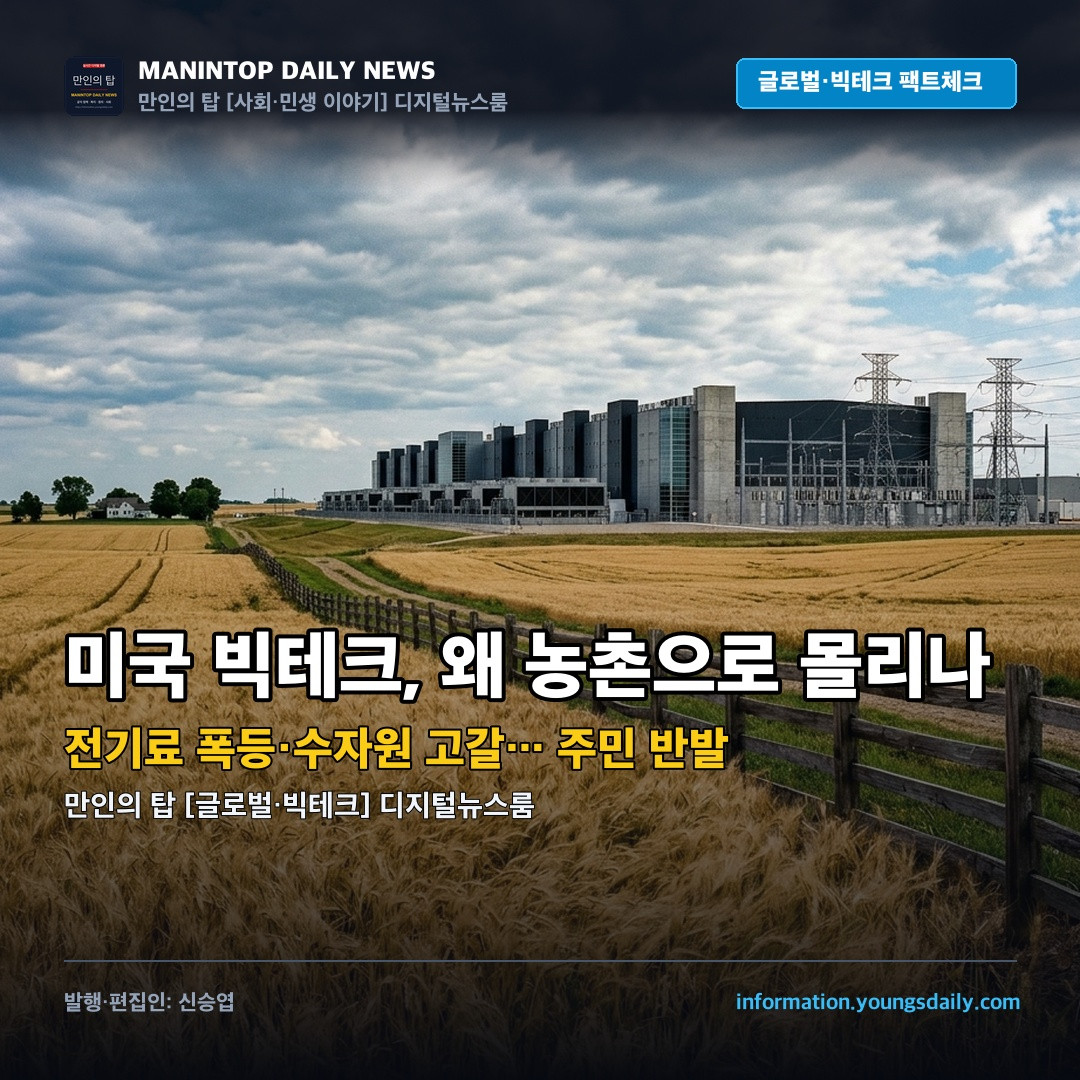
▲ 미국 빅테크는 왜 농촌으로 데이터센터를 옮기나… 전기요금 폭등과 수자원 고갈 속 주민 반발 확산 / 만인의 탑 만인의 탑 글로벌·사회분석 데스크 팩트체크
📌 만인의 탑 핵심 브리핑 · 이 글에서 다루는 핵심 내용
마이크로소프트, 구글, 아마존, 메타 등 미국 빅테크 기업들이 AI 모델 훈련을 위한 초대형 하이퍼스케일 데이터센터를 전통적 대도시에서 미국 중서부·남부 농촌 지역으로 대거 이전하고 있습니다. 신규 시설의 67%가 농촌으로 향하는 배경과 함께, 가정용 전기요금 폭등, 지하수 고갈, 고용 착시로 촉발된 농촌 지역사회의 거센 반발을 심층 보도합니다.
SPONSORED · ADVERTISEMENT
1. AI 하이퍼스케일의 공간 갈증과 대도시 전력망 포화의 한계
생성형 AI 모델 훈련과 대규모 클라우드 연산에 투입되는 최신 데이터센터는 과거 도심 오피스 빌딩 몇 층을 임대하던 전산실과 차원이 다르다. 수만 대의 초고성능 AI 가속기(GPU) 랙과 대형 변전소, 냉각탑, 비상 디젤 발전기 수백 대가 유기적으로 결합된 하이퍼스케일 캠퍼스는 단일 단지만으로 수백 에이커(수십만 평)에 달하는 광활한 부지를 필요로 한다. 이미 개발이 포화된 대도시나 교외에서는 이처럼 막대한 면적의 연속된 평지를 확보하는 것이 물리적으로 불가능할 뿐만 아니라 토지 매입 비용 역시 천문학적으로 치솟았다.
더욱 심각한 문제는 전력망의 물리적 병목이다. 미국 데이터센터의 수도로 불리던 북부 버지니아의 '데이터센터 앨리(Data Center Alley)'나 캘리포니아 실리콘밸리는 기존 송전망 용량이 이미 한계치에 도달했다. 전력회사(Dominion Energy 등)에 신규 대용량 기가와트(GW)급 전력 연결을 신청하더라도 계통 연계까지 5~7년 이상의 기나긴 대기 시간이 소요되는 실정이다. 초 단위로 치열하게 전개되는 글로벌 AI 주도권 경쟁 속에서 빅테크 기업들로서는 5년 이상을 기다릴 여유가 없었기에, 즉각적인 전력 인입과 대규모 토지 매입이 가능한 미국 전역의 농촌으로 눈을 돌릴 수밖에 없었다.
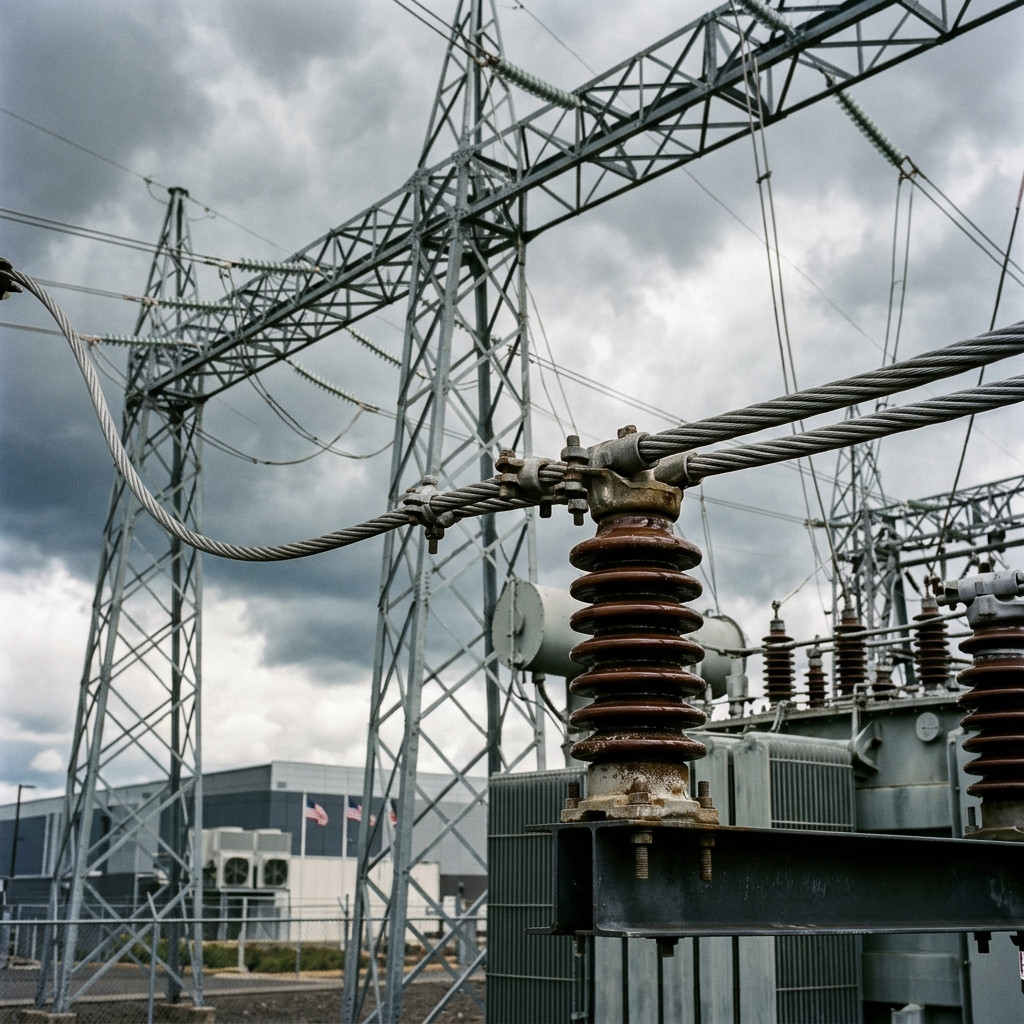
▲ 미국 농촌 지역 데이터센터에 대규모 전력을 공급하는 고압 변전소 및 송전 철탑 설비 / 만인의 탑
🔍 만인의 탑 심층 팩트체크 및 구조 진단
퓨리서치센터의 최신 공간 데이터 분석에 따르면, 미국 전역에서 현재 추진 중인 신규 데이터센터 프로젝트의 67%가 인구 밀도가 낮은 농촌(Rural) 및 비도시권으로 향하고 있다. 아이오와, 오하이오, 인디애나 등 중서부의 옥수수·대두 농경지와 텍사스, 조지아, 테네시 등 남부의 광활한 평야 지대가 빅테크의 새로운 요충지로 급부상했다. 이 지역들은 도심 대...
2. 신규 시설 67%의 농촌 집중… 파격적 세제 혜택과 저렴한 토지의 유혹
퓨리서치센터의 최신 공간 데이터 분석에 따르면, 미국 전역에서 현재 추진 중인 신규 데이터센터 프로젝트의 67%가 인구 밀도가 낮은 농촌(Rural) 및 비도시권으로 향하고 있다. 아이오와, 오하이오, 인디애나 등 중서부의 옥수수·대두 농경지와 텍사스, 조지아, 테네시 등 남부의 광활한 평야 지대가 빅테크의 새로운 요충지로 급부상했다. 이 지역들은 도심 대비 평당 수십 분의 일 수준에 불과한 저렴한 지가로 수백 에이커의 토지를 일괄 매입할 수 있는 최적의 지리적 조건을 갖추고 있다.
여기에 재정난에 허덕이던 농촌 카운티(County) 지방정부들의 공격적인 러브콜이 결합되었다. 제조업 공동화와 인구 감소로 세수가 메마른 농촌 지자체들은 수십억 달러(수조 원) 규모의 빅테크 투자를 유치하기 위해 파격적인 세제 감면 혜택을 쏟아냈다. 수천만 달러에 달하는 부동산 재산세 감면, 서버 장비 구입 시 판매세(Sales Tax) 면제, 복잡한 환경영향평가와 조닝(Zoning) 인허가를 초고속으로 통과시켜 주는 패스트트랙 조례를 앞다퉈 신설하며 빅테크의 농촌 진입로를 활짝 열어주었다.
구분 항목
전통적 대도시 데이터센터 (기존)
미국 농촌 하이퍼스케일 (신규)
지역사회 및 인프라 파급 영향
부지 규모 및 입지
도심 빌딩 임대 또는 수십 에이커 부지
수백 에이커(수십만 평) 광활한 농경지
목가적 농촌 풍경의 거대 산업단지화
전력 조달 및 송전망
도심 전력망 포화로 신규 연결 5~7년 지연
농촌 전력협동조합·송전선로 직접 연결
주민 가정용 전기요금 두 자릿수 폭등 초래
냉각 수자원 소비
폐쇄형 공랭식 또는 도심 상수도망 이용
하루 수백만 갤런(수천 톤) 지하수 증발 냉각
농업용수 고갈 및 지하수 관정(Well) 고갈 위기
고용 및 경제적 효과
IT 인재 풀 풍부, 연구개발 인력 상주
수조 원대 투자 대비 상주 인력 30~50명
세수 증대 혜택 대비 자원 착취형 불균형 반발
SPONSORED · ADVERTISEMENT
3. 주민 전기료 폭등과 일 수백만 갤런 지하수 고갈… 농촌의 신음
그러나 장밋빛 약속 뒤에 숨겨진 청구서는 고스란히 농촌 주민들의 몫으로 돌아왔다. 데이터센터는 1년 365일 단 1초도 쉬지 않고 중소 도시 전체에 필적하는 막대한 전력을 소모하는 '전력 먹는 하마'다. 농촌 지역 전력회사들은 급증한 데이터센터 수요를 감당하기 위해 새로운 변전소를 짓고 고전압 송전선로를 가설하고 있는데, 주 공공유틸리티위원회(PUC) 승인을 거쳐 이 막대한 인프라 구축 비용을 일반 주택용·농업용 전기요금에 전가하고 있다. 이로 인해 조용하던 농촌 마을 주민들의 월간 가정용 전기요금 고지서가 20~30% 이상 폭등하는 사태가 속출하고 있다.
수자원 고갈 문제는 더욱 치명적이다. 수만 대의 서버가 뿜어내는 열기를 식히기 위해 다수의 데이터센터는 물을 증발시켜 냉각하는 방식을 채택하고 있는데, 단일 시설에서 하루 평균 수백만 갤런(수천 톤)의 지하수를 퍼 올린다. 이는 가뭄에 취약한 농촌 지역의 지하 대수층(Aquifer) 수위를 급격히 떨어뜨려, 수십 년간 농사를 지어온 인근 농가들의 관정(Well)이 말라붙고 가축 사육과 작물 재배에 쓸 농업용수가 바닥나는 심각한 생존권 위기를 초래하고 있다. 여기에 대형 냉각팬이 뿜어내는 24시간 연속 저주파 소음(85~100dB)과 비상 발전기 시험 가동에 따른 디젤 매연까지 더해져 주민들의 평온한 삶이 산산조각 나고 있다.
🚨 피해 구제 및 법적 대응 직통 가이드
사안에 따른 긴급 신고 및 피해 구제 창구(경찰청 112, 디지털성범죄피해자지원센터 02-735-8994, 방심위 1377)를 통해 24시간 즉시 상담 및 삭제 차단 조치를 요청할 수 있습니다.
농촌 주민들이 가장 큰 배신감을 느끼는 대목은 바로 '일자리 착시'다. 수조 원의 천문학적 자본이 투입되지만, 1~2년간의 건설 공사가 끝나고 나면 거대한 하이퍼스케일 시설에 상주하는 정규직 고용 인원은 서버 관리 엔지니어와 경비 요원 등 고작 30~50명 수준에 불과하다. 지역 주민들은 '우리 고장의 소중한 물과 전기, 고요한 자연환경을 싹쓸이해 가면서 정작 지역사회에 남겨주는 영구 일자리는 몇십 개에 불과한 현대판 자원 약탈'이라며 분통을 터뜨리고 있다.
AP-NORC의 최신 여론조사에 따르면 미국 성인의 53%가 AI 데이터센터의 환경 파괴에 대해 '매우 우려한다'고 답했으며, 응답자의 60% 이상이 데이터센터 신규 건설 상한제와 송전망 증설 비용의 빅테크 100% 자부담 원칙에 찬성표를 던졌다. 이에 따라 버지니아, 조지아, 인디애나 등 미국 전역의 카운티 의회에서는 분노한 농민과 주민들의 집단 반발에 밀려 데이터센터 신규 인허가를 전면 동결하는 '모라토리엄(Moratorium)' 조례를 잇달아 통과시키고 있다. 무한 질주하던 빅테크의 AI 인프라 확장이 농촌 공동체의 거센 저항이라는 거대한 암초를 만난 형국이다.
RECOMMENDED STORIES · SPONSORED
▲ Official Press Coverage & Contextual Archive / MANINTOP Global Newsroom
MANINTOP GLOBAL NEWSROOM · ENGLISH EDITION
Why Big Tech is Flocking to Rural America for AI Data Centers: Surging Electricity Bills, Water Depletion, and Grassroots Backlash
Driven by the insatiable computational demands of the artificial intelligence boom, Big Tech titans—including Microsoft, Alphabet/Google, Amazon AWS, and Meta—are rapidly shifting their infrastructure footprint away from traditional metropolitan hubs and into the pastoral heartlands of rural America. While approximately 87% of legacy facilities were historically concentrated in urban and suburban technology clusters such as Northern Virginia's 'Data Center Alley', a landmark spatial analysis by the Pew Research Center reveals that an astonishing 67% of new and planned data centers are now targeting rural and semi-rural regions across the Midwest and the American South. Eager to secure massive contiguous acreage and bypass multi-year electrical grid interconnection bottlenecks, tech giants have capitalized on aggressive tax abatements rolled out by cash-strapped local county boards. However, as round-the-clock hyperscale facilities trigger soaring residential utility rates, exhaust agricultural aquifers through evaporative cooling, and yield negligible permanent local employment, rural communities across the nation are mobilizing in an unprecedented grassroots rebellion, demanding binding moratoria on tech expansion.
📌 Key Takeaways
Verified factual reporting regarding Why Big Tech is Flocking to Rural America for.
In-depth contextual and institutional analysis by MANINTOP Global Newsroom.
Official implementation schedule and verifiable public guidelines confirmed.
1. AI Hyperscale Spatial Demands and the Urban Grid Capacity Wall
The infrastructural anatomy required to train state-of-the-art Large Language Models (LLMs) bears virtually no resemblance to the leased urban server rooms of past decades. Modern hyperscale campuses integrate tens of thousands of high-density GPU racks, massive high-voltage substations, mechanical cooling chiller yards, and extensive arrays of diesel backup generators—requiring single continuous footprints spanning hundreds of acres. In mature metropolitan tech markets, acquiring contiguous parcels of this magnitude is physically impossible or financially prohibitive.
More critically, urban electric grids have collided with an immovable physical capacity wall. In Northern Virginia and Silicon Valley, regional transmission corridors are so heavily congested that utility interconnect queues for gigawatt-scale loads stretch out 5 to 7 years. In a fiercely competitive geopolitical and corporate race where AI leadership is measured in quarters, tech conglomerates cannot afford half-decade delays. Rural America—served by rural electric cooperatives and crisscrossed by bulk transmission lines adjacent to nuclear, wind, and solar generation—suddenly emerged as the only viable frontier capable of immediate large-scale energization.
2. 67% of New Projects Shift to the Heartland: Cheap Land and Tax Bounties
Data from the Pew Research Center delineates a stark geographic pivot: two-thirds of newly proposed data center projects are now concentrated in rural or semi-rural counties across Iowa, Ohio, Indiana, Texas, Georgia, and Tennessee. These rural agricultural jurisdictions offer expansive tracts of agricultural soil at land acquisition costs that are a tiny fraction of suburban real estate. A tech developer can quietly assemble hundreds of acres of former farmland with minimal parcel fragmentation.
This corporate land rush was aggressively facilitated by rural municipal governments starved for public revenue. Grappling with decades of deindustrialization and population decline, county commissions rolled out the red carpet to capture multi-billion-dollar investments. Local officials routinely granted multi-million-dollar property tax abatements, sales tax exemptions on expensive server hardware, and fast-tracked zoning variances that bypassed standard environmental review cycles, creating an irresistible economic haven for hyperscale developers.
3. Double-Digit Utility Rate Spikes and Depleted Aquifers: The Rural Cost
However, the hidden externalities of these modern computing monoliths are landing squarely on the shoulders of local residents. Data centers operate continuously under full baseloads, consuming energy volumes equivalent to medium-sized cities. To accommodate these unprecedented industrial draws, regional electric utilities are forced to execute rapid substation and transmission expansions. With regulatory approval from state Public Utility Commissions (PUCs), utilities routinely socialize these capital costs across the broader rate base, resulting in jarring double-digit increases in residential and farm electric bills.
Even more alarming for rural agrarian communities is the rapid depletion of local water supplies. To dissipate extreme thermal loads from clustered processing chips, many hyperscale facilities rely on evaporative cooling towers that consume millions of gallons of potable water daily. In drought-sensitive regions, this massive draw significantly depresses water tables, causing shallow agricultural wells to run dry and threatening livestock operations. Compounded by continuous low-frequency acoustic hums (85~100 dB) from giant chiller fans and diesel particulate emissions during maintenance testing, rural quality of life has suffered severe degradation.
4. 'All the Resources, Only 30 Jobs': The Grassroots Rebellion and Moratoria
The sharpest catalyst for community anger is the profound disparity between resource consumption and permanent job creation. While construction generates a brief, lucrative influx of transient trade workers, once a multi-billion-dollar facility is commissioned, day-to-day operations require merely 30 to 50 permanent staff—primarily security guards and facility technicians. Rural taxpayers increasingly realize they have entered an asymmetric bargain: sacrificing their quiet pastoral heritage, water security, and grid affordability for automated server banks that enrich coastal shareholders while offering negligible long-term local career opportunities.
According to a national AP-NORC poll, 53% of Americans express deep anxiety regarding the environmental toll of AI data centers, with over 60% supporting statutory caps on new facility construction and mandatory requirements forcing tech giants to fund 100% of grid upgrades. In response to furious town hall confrontations, local county boards in Virginia, Georgia, and the Midwest have begun enacting binding moratoria, freezing data center permits and rescinding proposed tax subsidies. Big Tech's rural computing expansion has encountered a formidable wall of civic resistance.
Category
Traditional Urban Facilities (Legacy)
Rural Hyperscale Campuses (New)
Community & Infrastructure Impact
Site size and location
Urban building rental or dozens of acres
Hundreds of acres (hundreds of thousands of hectares) of vast agricultural land
Industrial mega-complexification of an idyllic rural landscape
Power Procurement and Power Grid
5-7 years delay in new connections due to urban grid saturation
Direct connection to rural power cooperatives and transmission lines
Residents' household electricity bill rises by double digits
Cooling water consumption
Access to closed air-cooled or urban water networks
Millions of gallons (thousands of tons) per day groundwater evaporative cooling
Crisis of depletion of agricultural water and well depletion of groundwater management
Employment and economic impact
IT talent pool abundance, R&D personnel presence
30-50 resident workers compared to trillions of won investment
Resource Exploitation Unbalance Pushback vs Tax Increase Benefit
MANINTOP NEWSLETTER
📬 만인의 탑 뉴스레터 무료 구독
오늘 보신 정책·시사 뉴스가 유익하셨나요? 매일 엄선되는 알짜 복지 혜택과 국회 실시간 속보를 이메일로 가장 먼저 받아보세요. (평생 무료)
Computer Programmer who love programming.
Computer Programmer Who love Riding Bicycle.
Computer Programmer who love trip in abroad.
Computer Programmer who love studying about programming
- even if sometimes it's very boring.
Computer Programmer who love talking with person.
- I love communication with person.
1월이 시작되면 감기는 이미 우리 곁에 와 있습니다. 2월, 3월, 4월까지 이어지는 추위와 건조함은 코와 목을 가장 먼저 공격합니다. 아침에 일어나자마자 막혀 있는 코. 계속 흐르는 콧물. 괜히 칼칼해지는 목. 이 증상은 “시작”일 뿐입니다. 한 번 무너지면 일주일, 길면 한 달까지 끌고 갑니다. 약을 먹으면 잠깐 괜찮아집니다. 하지만 며칠 뒤 또 반복됩니다. 왜일까요? 감기는 ‘치료’의 문제가 아니라 ‘관리’의 문제이기 때문입니다. 대부분은 감기가 오고 나서 약을 찾습니다. 하지만 진짜 중요한 건 감기가 오기 전에 코와 목을 지키는 것입니다. 건조한 실내 공기, 차가운 바깥 공기, 눈에 보이지 않는 세균. 코와 목은 매일 공격받고 있습니다. 지긋지긋하죠! 그런데도 우리는 아무 준비 없이 버티고 있습니다. 이번 겨울도 그렇게 보낼 건가요? 사실 방법은 어렵지 않습니다. 코를 깨끗하게 관리하고, 목을 따뜻하게 보호하고, 점막을 촉촉하게 유지하고, 기관지를 미리 관리하고, 외부 공기를 차단하는 것. 이 다섯 가지만 꾸준히 해도 감기약 없이 겨울을 보내는 것이 충분히 가능합니다. 🔥 이제부터 그 방법을 하나씩 살펴보겠습니다. 🔥 1. 코와 목을 먼저 관리해야 하는 과학적 이유 감기의 대부분은 코 점막에서 시작됩니다. 국제 학술지 Nature Reviews Microbiology 와 Journal of Allergy and Clinical Immunology 에 실린 호흡기 감염 관련 연구들에서는, 감기 바이러스가 비강 상피세포에 먼저 부착해 증식한다는 점을 설명하고 ...
리모델링사업이 진행 중인 아파트를 매매할 때 “계약금 10%를 언제까지 내야 하느냐”는 질문이 특히 많이 나옵니다. 이주공고(이주 안내)가 7~11월쯤이라고 들으면, 그 시점에 맞춰 계약금도 움직일 것 같아서 더 헷갈리기 쉽습니다. 하지만 실제 납부기한은 ‘이주공고가 언제냐’만으로 자동 결정되지 않는 경우가 많습니다. 1) 계약금 10% 납부기한: 결국 ‘문서에 적힌 일정’이 기준 계약금 10%를 언제까지 납부해야 하는지는, 내가 서명하는 매매계약서(특약 포함) 와 사업주체/조합이 제시한 공고·안내문 에 적힌 납부 일정이 기준이 됩니다. 실제 공고문에서는 분양대금 납부의 큰 틀(계약금→중도금→잔금)을 먼저 안내하고, 상세 일정은 별도 표나 유의사항으로 제시하는 방식이 흔합니다. 또, 계약서 문구에 따라 지급 시점이 조건부로 설정될 수도 있습니다. 예를 들어 한 사례 소개 자료에서는 용역계약서에 잔금(10%) 지급시기가 “사업승인 후”로 기재되어 있었다는 점이 언급됩니다. 이런 식으로 ‘사업 단계’와 지급을 연동하는 문구가 들어가면, 질문의 답은 계약서 문구를 확인해야만 확정됩니다. 관련 내용은 링크 에서 문구 사례를 확인할 수 있습니다. 2) 입주자모집공고에서 확인되는 ‘납부 순서’와 잔금 마감 시점 공고문에 적힌 문구를 보면, 납부 순서와 잔금 마감에 대한 기준이 비교적 명확하게 제시되는 경우가 있습니다. 예를 들어 한 입주자모집공고에는 “분양금액(주택가격)은 계약금, 중도금, 잔금의 순서로 납부”하며 “잔금은 입주(열쇠 수령일) 전에 완납”해야 한다고 안내되어 있습니다. (문구 확인: 링크 ) 이 문구가 의미하는 바는 최소 2가지입니다. 분양/공급 형태의 문서에서는 ‘계약금→중도금→잔금’ 흐름이 공식적으로 안내될 수 있습니다. 잔금은 “입주(열쇠 수령)” 이전에 완납해야 한다는 마감 기준이 문서에 적혀 있을 수 있습니다. 다만, 위 공고문 문구는 잔금 마감에 대한 기준을 보여주지만, 계약금 10%의...
윤석열 전 대통령 탄핵 인용 소식을 접하면, 가장 궁금한 지점은 ‘헌재가 정확히 무엇을 위헌·위법으로 봤는가’입니다. 또한 탄핵과 별개로 진행되는 형사재판(내란 우두머리 혐의 등)이 어디까지 왔는지도 함께 정리할 필요가 있습니다. 아래 내용은 제공된 기사/게시물 스니펫과 링크에서 확인되는 범위만 모아, 일반인이 흐름을 이해하기 쉽게 정리한 것입니다. 1) 탄핵 인용 관련: 스니펫에서 확인되는 ‘판단의 골격’ 제공된 근거 중 조국혁신당 사이트에는 헌법재판소가 윤석열 탄핵 심판에서 “피청구인의 위헌·위법행위는 국민 신임 …”이라는 취지로 판단했다는 문장이 인용돼 있습니다( 링크 ). 이 인용문만 놓고 보면, ‘위헌·위법행위’가 있었는지와 그로 인해 ‘국민의 신임’이 어떻게 평가됐는지가 핵심 축으로 소개됩니다. 다만 질문에서 요청하신 세부 항목, 즉 비상계엄 선포 자체를 문제 삼은 구체적 이유, 계엄 이후 조치(포고령, 국회 통제 등)의 어떤 지점이 헌법 위반인지, 국회의 권한행사 방해 및 정치활동 제약을 어떤 논리로 판단했는지 등은, 이번에 제공된 근거의 제목/스니펫만으로는 조항·사실관계·판단 구조가 그대로 제시돼 있지 않습니다. 따라서 이 글에서는 ‘헌재가 무엇을 문제 삼았다’는 세부 리스트를 단정적으로 재구성하기보다, 현재 확인 가능한 문구 수준의 요약(위헌·위법행위 → 국민 신임의 문제로 평가)까지만 적습니다. 만약 헌재 결정문 전문(주문 및 이유)이 추가로 확인되면, 그때는 문장 단위로 ‘어떤 행위’와 ‘어떤 헌법 원리/조항’이 연결되는지(예: 권력분립, 국회의 권한, 정치적 기본권 등) 구조화해 정리하는 것이 가장 정확합니다. 2) 형사 절차(내란 혐의) 관련: 체포영장과 1심 선고 언급 탄핵 심판과 별도로, 12·3 비상계엄 사태로 내란 혐의를 받는 윤석열 대통령에 대해 2024년 12월 31일 체포 영장이 발부됐다는 BBC 보도가 있습니다( 링크 ). 해당 보도는 ‘현직 대통령’에 대한 체포영장 발부라는 점을 함께 언급합니다. 또...




0 댓글