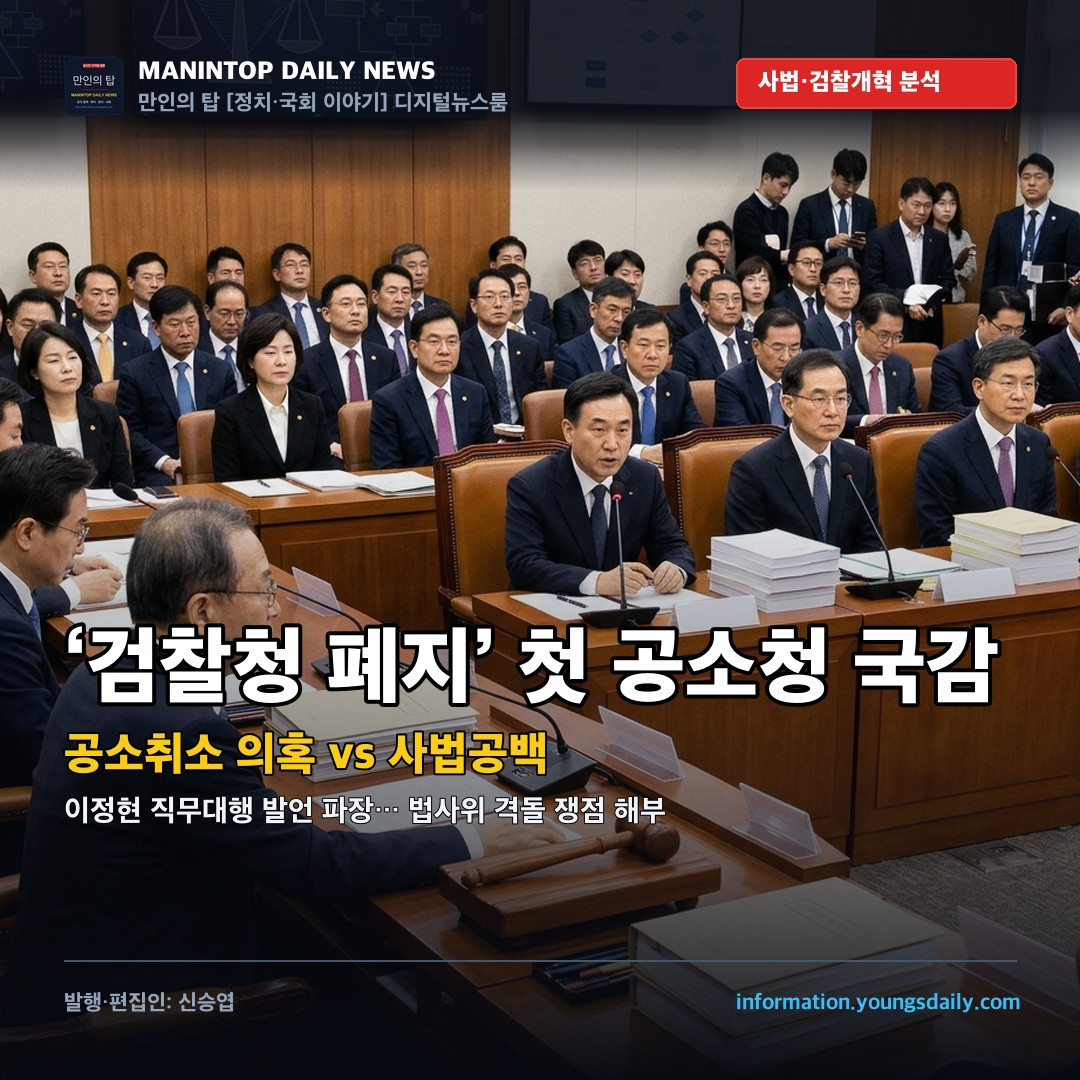
▲ 2026년 10월 2일 78년 만에 검찰청이 폐지되고 수사·기소 분리에 따라 출범한 공소청의 사상 첫 국회 법제사법위원회 국정감사에서 여야가 공소취소 의혹과 수사권 조정에 따른 사법 공백을 두고 정면충돌하고 있다. ⓒ 만인의 탑
2026년 10월 2일 대한민국 건국 78년 만에 검찰청이 공식 폐지되고 수사와 기소가 완전히 분리된 신설 독립기관 ‘공소청’이 출범한 이후, 사상 처음으로 국회 법제사법위원회 국정감사가 실시되었다. 첫 시험대에 오른 공소청 본청 국감에서 여야는 주요 정치인 사건의 ‘공소취소’ 검토 의혹, 과거 특수통 중심의 표적 수사 관행을 둘러싼 직무대행의 거침없는 폭로 발언, 그리고 수사권 이관에 따른 일선 ‘사법 시스템 공백’과 미제 사건 적체 문제를 두고 격렬하게 맞부딪쳤다.
1. 역사적 첫 국감: 검찰청 폐지와 ‘공소청’ 출범의 제도적 변혁
이번 국정감사는 70여 년간 대한민국 형사사법 체계의 정점에 군림했던 대검찰청과 일선 검찰청이 문을 닫고, 기소와 공소유지만을 전담하는 공소청 체제 하에서 열린 사상 첫 국감이라는 점에서 헌정사적 이목이 집중되었다.
공소청 체제 개편에 따라 기존 검찰의 직접 수사 기능은 중대범죄수사청(중수청)과 경찰청 국가수사본부로 전면 이관되었으며, 공소청은 영장청구와 기소 판단, 법정 공소유지 전문 기관으로 역할을 압축했다. 이번 국감에 증인으로 출석한 이정현 공소청장 직무대행은 기소 독점과 수사권 남용으로 지탄받았던 과거 검찰의 구조적 폐단을 청산하고, 법치주의와 인권 보호에 충실한 새로운 형사사법 질서를 확립하겠다는 다짐으로 감사를 시작했다.
2. 국감장을 뒤흔든 3대 핵심 쟁점과 여야 공방
국회 법사위 종합국감 현장에서는 공소청의 향후 행보와 과거 수사 관행을 둘러싸고 여야 의원 간에 날카로운 공방이 꼬리를 물었다.
첫 번째 쟁점은 야당인 국민의힘이 제기한 이재명 대통령 관련 사건 ‘공소취소’ 의혹이었다. 국민의힘은 법무부 검찰인권존중미래위원회의 진상조사 결과 등을 빌미로 공소청이 정권의 눈치를 보며 기소된 사건들의 공소취소를 검토하는 것 아니냐고 집중 추궁했다. 이에 대해 이정현 직무대행은 “공소취소와 관련해 외부나 상부의 어떠한 지시도 없었으며 검토한 바도 전혀 없다”며 “미래위 권고는 구속력이 없고, 공소유지는 일선 담당 검사와 부장검사·검사장이 법과 증거에 따라 독립적으로 판단할 사안”이라고 일축했다.
두 번째 파장은 이 직무대행의 과거 검찰 수사 관행 폭로였다. 이 직무대행은 윤석열 전 대통령이 검찰총장 시절 “애매하고 자백하지 않는 사건은 기소해서 3~5년씩 재판받게 하고 고통을 줘야 한다”고 발언했던 일화를 전하며, 과거 특수부의 ‘먼지털이식 표적 수사’와 철저히 단절하겠다고 선언했다. 나아가 조직에 가장 악영향을 미친 인물로 윤석열 전 대통령과 한동훈 의원을 지목해 여야 간에 격한 고성이 오갔다.
핵심 쟁점
야당 (국민의힘) 비판 및 추궁
공소청 답변 및 여당 (더불어민주당) 엄호
대통령 사건 공소취소 의혹
법무부 미래위 권고를 빌미로 주요 재판의 정치적 공소취소를 획책하는 사전 정지 작업
지시나 검토 사실 전무. 미래위 권고는 구속력 없으며 일선 검사가 법과 원칙대로 독립 결정
과거 수사 관행 및 조직 발언
공소청 수장이 전직 총장들을 정파적으로 저격하며 사법부 신뢰를 훼손하고 정치적 중립 위배
과거 무리한 표적 기소와 별건 수사 폐단을 직시하고 반성해야 진정한 사법 신뢰 회복 가능
수사권 분리 후 사법 공백
검사 부족, 중수청-경찰 간 사건 핑퐁으로 고소·고발 사건 처리 지연 및 미제 급증으로 국민 피해
70년 검찰 독점 타파한 불가피한 과도기. 공소유지 전문화 지원과 중수청 협력 모델 조기 안착
공소권 행사의 독립성
정권 교체와 외압에 휘둘리는 ‘정치 하청 기구’로 전락할 위험 농후
영장심의위 및 기소심의 제도화를 통해 권력 유착을 원천 차단하고 공정성 보장
3. 사법 시스템 공백과 미제 사건 적체: 최대 민생 과제로 부상
정치적 공방 이면에 자리 잡은 가장 무거운 화두는 수사·기소 분리 과도기에 발생하는 ‘형사사법 시스템의 공백’ 문제였다.
국민의힘 의원들은 검찰청 폐지와 중수청 분리 이후 일선 수사 현장에서 고소·고발 사건이 장기 표류하고 미제 사건이 기하급수적으로 늘어나는 실태를 수치로 제시했다. 수사기관 간의 관할 다툼과 사건 떠넘기기로 인해 일반 시민들이 범죄 피해를 보고도 신속한 구제를 받지 못하는 사법 정체 현상이 심화되고 있다는 것이다. 더불어민주당 역시 이러한 과도기적 문제를 인정하면서도, 수사권 남용을 방지하는 개혁의 대의를 훼손할 수 없으며 공소청과 중수청 간의 유기적 공조 시스템과 검사 증원을 통해 혼선을 조기에 수습해야 한다고 강조했다.
4. 헌정사적 함의: 수사·기소 분리 시대, 공소청의 독립성과 미래
이번 국정감사는 수사권이 완전히 배제된 공소청이 어떻게 독자적인 위상을 정립하고 정치적 중립성을 수호할 것인지를 가늠하는 중대한 분수령이었다.
전문가들은 공소청이 과거 검찰의 권력 지향적 그림자에서 벗어나 진정한 ‘공익의 대표자’로 거듭나기 위해서는 정권의 외압에 흔들리지 않는 인사 독립성 확보와 더불어, 법정에서 증거 능력을 엄밀히 검증하는 공소유지 전문성이 제도적으로 뒷받침되어야 한다고 제언한다. 사상 첫 국감을 마친 공소청이 사법 공백의 우려를 불식시키고 국민의 신뢰를 얻는 사법 기구로 연착륙할 수 있을지 헌정 질서의 시선이 집중되고 있다.
만인의 탑 정치·사법 에디토리얼 데스크
발행·편집인: 신승엽 | 기사 등록: 2026년 10월 25일 | 출처: 국회 법제사법위원회 국정감사 속기록, 공소청 공식 공보
▲ The National Assembly's Legislation and Judiciary Committee conducted its historic first audit of the Public Prosecution Office following the dissolution of the 78-year-old Supreme Prosecutors' Office, clashing over case dismissal rumors and structural judicial vacuums. ⓒ Manintop Daily
Following the historic dissolution of South Korea’s 78-year-old Supreme Prosecutors' Office on October 2, 2026, and the complete institutional separation of investigation and indictment, the National Assembly’s Legislation and Judiciary Committee convened its first-ever parliamentary audit of the newly minted Public Prosecution Office. In this inaugural examination, ruling and opposition lawmakers fiercely clashed over rumors of political case dismissals for high-profile political figures, controversial revelations by the acting chief regarding past abusive investigative practices, and widespread judicial backlogs stemming from systemic prosecutorial restructuring.
1. A Historic Milestone: Dissolution of the Prosecution and the New Era of the Public Prosecution Office
This parliamentary audit commanded unprecedented constitutional attention as it marked the transition from the all-powerful Supreme Prosecutors' Office—which had dominated the pinnacle of South Korean criminal justice for seven decades—to an institution solely dedicated to indictment and trial litigation.
Under this overhaul, direct investigative authority was entirely transferred to the Major Crimes Investigation Bureau and the National Police Agency, leaving the Public Prosecution Office as a specialized organ handling warrants, indictments, and trial proceedings. Appearing as the lead witness, Acting Chief Public Prosecutor Lee Jung-hyun opened the hearing by affirming the agency’s commitment to eradicating past structural abuses—such as monopolized indictments and targeted investigations—and establishing a judicial framework faithful to human rights and the rule of law.
2. Three Flashpoints at the Hearing: Partisan Clashes Unfold
The committee hearing erupted into consecutive rounds of heated confrontations surrounding the new office’s political posture and past investigative legacies.
The premier dispute focused on opposition allegations that the office was laying the groundwork to drop charges against President Lee Jae-myung. The conservative People Power Party pressed whether recommendations from the Justice Ministry’s Future Committee were being utilized as pretext to dismiss pending presidential trials. Acting Chief Lee firmly rebuffed the accusations, stating: "I have neither received external instructions nor reviewed any dismissal of indictments. The Future Committee's recommendations carry no legal binding force, and decisions regarding trial maintenance rest autonomously with front-line prosecutors based on law and evidence."
A second tremor struck when Acting Chief Lee recounted an anecdote from former President Yoon Suk-yeol’s tenure as Prosecutor General, alleging Yoon remarked that ambiguous, unconfessed suspects should be indicted to endure three to five years of agonizing trials. Vowing a complete rupture from such targeted practices, Lee went so far as to identify Yoon Suk-yeol and Lawmaker Han Dong-hoon as figures who inflicted the greatest institutional damage on the prosecution, triggering shouting matches across party lines.
Core Dispute
Opposition (PPP) Allegations
Agency Response & Ruling Party (DP) Defense
Dismissal of Presidential Cases
Pretextual maneuvering to politically dismiss ongoing presidential trials via advisory committees
Zero directives received or reviewed; front-line prosecutors decide strictly based on evidence
Targeted Investigation Legacies
Agency leadership engaging in partisan attacks against former chiefs, eroding neutrality
Confronting past arbitrary indictments and abusive practices is vital for genuine judicial trust
Post-Reform Judicial Vacuum
Shortage of prosecutors and bureaucratic finger-pointing causing severe backlogs and public harm
Inevitable transitional friction in dismantling 70-year monopoly; systemic coordination underway
Prosecutorial Independence
Risk of devolving into a politically subservient administrative subcontractor for the regime
Institutionalizing indictment review panels to prevent partisan entanglement and secure fairness
3. Judicial System Vacuums and Case Backlogs: An Urgent Public Grievance
Beneath the political warfare lay the pressing question of criminal justice gridlock resulting from the bifurcation of investigative and prosecutorial powers.
Opposition lawmakers produced statistics demonstrating that complaints and criminal reports have stalled across regional precincts, with backlogs mounting exponentially. Jurisdictional squabbles between the new investigative bureau and the police have left ordinary crime victims stranded without timely judicial relief. While acknowledging these transitional hurdles, the Democratic Party maintained that the broader mission of preventing investigative abuse cannot be derailed, pledging budgetary expansion and coordinated liaison protocols to stabilize the justice pipeline.
4. Constitutional Horizon: Securing Autonomy in the Post-Prosecution Era
This inaugural audit served as an essential litmus test for how the Public Prosecution Office will assert its constitutional identity and safeguard political neutrality without investigative teeth.
Legal scholars emphasize that to emerge as true guardians of the public interest, the agency must secure robust personnel independence from executive overreach while developing uncompromising litigation expertise to rigorously evaluate evidence before the courts. As it concludes its first parliamentary review, the Public Prosecution Office faces the monumental task of dispelling judicial vacuum anxieties and cementing its legitimacy in South Korea’s evolving constitutional democracy.
Manintop Daily Judicial & Political Editorial Desk
Publisher & Editor-in-Chief: Seung Youb Ssin | Published: October 25, 2026 | Source: National Assembly Legislation Committee Records & Public Prosecution Office Gazette
MANINTOP NEWSLETTER
📬 만인의 탑 뉴스레터 무료 구독
오늘 보신 정책·시사 뉴스가 유익하셨나요? 매일 엄선되는 알짜 복지 혜택과 국회 실시간 속보를 이메일로 가장 먼저 받아보세요. (평생 무료)
Computer Programmer who love programming.
Computer Programmer Who love Riding Bicycle.
Computer Programmer who love trip in abroad.
Computer Programmer who love studying about programming
- even if sometimes it's very boring.
Computer Programmer who love talking with person.
- I love communication with person.
1월이 시작되면 감기는 이미 우리 곁에 와 있습니다. 2월, 3월, 4월까지 이어지는 추위와 건조함은 코와 목을 가장 먼저 공격합니다. 아침에 일어나자마자 막혀 있는 코. 계속 흐르는 콧물. 괜히 칼칼해지는 목. 이 증상은 “시작”일 뿐입니다. 한 번 무너지면 일주일, 길면 한 달까지 끌고 갑니다. 약을 먹으면 잠깐 괜찮아집니다. 하지만 며칠 뒤 또 반복됩니다. 왜일까요? 감기는 ‘치료’의 문제가 아니라 ‘관리’의 문제이기 때문입니다. 대부분은 감기가 오고 나서 약을 찾습니다. 하지만 진짜 중요한 건 감기가 오기 전에 코와 목을 지키는 것입니다. 건조한 실내 공기, 차가운 바깥 공기, 눈에 보이지 않는 세균. 코와 목은 매일 공격받고 있습니다. 지긋지긋하죠! 그런데도 우리는 아무 준비 없이 버티고 있습니다. 이번 겨울도 그렇게 보낼 건가요? 사실 방법은 어렵지 않습니다. 코를 깨끗하게 관리하고, 목을 따뜻하게 보호하고, 점막을 촉촉하게 유지하고, 기관지를 미리 관리하고, 외부 공기를 차단하는 것. 이 다섯 가지만 꾸준히 해도 감기약 없이 겨울을 보내는 것이 충분히 가능합니다. 🔥 이제부터 그 방법을 하나씩 살펴보겠습니다. 🔥 1. 코와 목을 먼저 관리해야 하는 과학적 이유 감기의 대부분은 코 점막에서 시작됩니다. 국제 학술지 Nature Reviews Microbiology 와 Journal of Allergy and Clinical Immunology 에 실린 호흡기 감염 관련 연구들에서는, 감기 바이러스가 비강 상피세포에 먼저 부착해 증식한다는 점을 설명하고 ...
리모델링사업이 진행 중인 아파트를 매매할 때 “계약금 10%를 언제까지 내야 하느냐”는 질문이 특히 많이 나옵니다. 이주공고(이주 안내)가 7~11월쯤이라고 들으면, 그 시점에 맞춰 계약금도 움직일 것 같아서 더 헷갈리기 쉽습니다. 하지만 실제 납부기한은 ‘이주공고가 언제냐’만으로 자동 결정되지 않는 경우가 많습니다. 1) 계약금 10% 납부기한: 결국 ‘문서에 적힌 일정’이 기준 계약금 10%를 언제까지 납부해야 하는지는, 내가 서명하는 매매계약서(특약 포함) 와 사업주체/조합이 제시한 공고·안내문 에 적힌 납부 일정이 기준이 됩니다. 실제 공고문에서는 분양대금 납부의 큰 틀(계약금→중도금→잔금)을 먼저 안내하고, 상세 일정은 별도 표나 유의사항으로 제시하는 방식이 흔합니다. 또, 계약서 문구에 따라 지급 시점이 조건부로 설정될 수도 있습니다. 예를 들어 한 사례 소개 자료에서는 용역계약서에 잔금(10%) 지급시기가 “사업승인 후”로 기재되어 있었다는 점이 언급됩니다. 이런 식으로 ‘사업 단계’와 지급을 연동하는 문구가 들어가면, 질문의 답은 계약서 문구를 확인해야만 확정됩니다. 관련 내용은 링크 에서 문구 사례를 확인할 수 있습니다. 2) 입주자모집공고에서 확인되는 ‘납부 순서’와 잔금 마감 시점 공고문에 적힌 문구를 보면, 납부 순서와 잔금 마감에 대한 기준이 비교적 명확하게 제시되는 경우가 있습니다. 예를 들어 한 입주자모집공고에는 “분양금액(주택가격)은 계약금, 중도금, 잔금의 순서로 납부”하며 “잔금은 입주(열쇠 수령일) 전에 완납”해야 한다고 안내되어 있습니다. (문구 확인: 링크 ) 이 문구가 의미하는 바는 최소 2가지입니다. 분양/공급 형태의 문서에서는 ‘계약금→중도금→잔금’ 흐름이 공식적으로 안내될 수 있습니다. 잔금은 “입주(열쇠 수령)” 이전에 완납해야 한다는 마감 기준이 문서에 적혀 있을 수 있습니다. 다만, 위 공고문 문구는 잔금 마감에 대한 기준을 보여주지만, 계약금 10%의...
윤석열 전 대통령 탄핵 인용 소식을 접하면, 가장 궁금한 지점은 ‘헌재가 정확히 무엇을 위헌·위법으로 봤는가’입니다. 또한 탄핵과 별개로 진행되는 형사재판(내란 우두머리 혐의 등)이 어디까지 왔는지도 함께 정리할 필요가 있습니다. 아래 내용은 제공된 기사/게시물 스니펫과 링크에서 확인되는 범위만 모아, 일반인이 흐름을 이해하기 쉽게 정리한 것입니다. 1) 탄핵 인용 관련: 스니펫에서 확인되는 ‘판단의 골격’ 제공된 근거 중 조국혁신당 사이트에는 헌법재판소가 윤석열 탄핵 심판에서 “피청구인의 위헌·위법행위는 국민 신임 …”이라는 취지로 판단했다는 문장이 인용돼 있습니다( 링크 ). 이 인용문만 놓고 보면, ‘위헌·위법행위’가 있었는지와 그로 인해 ‘국민의 신임’이 어떻게 평가됐는지가 핵심 축으로 소개됩니다. 다만 질문에서 요청하신 세부 항목, 즉 비상계엄 선포 자체를 문제 삼은 구체적 이유, 계엄 이후 조치(포고령, 국회 통제 등)의 어떤 지점이 헌법 위반인지, 국회의 권한행사 방해 및 정치활동 제약을 어떤 논리로 판단했는지 등은, 이번에 제공된 근거의 제목/스니펫만으로는 조항·사실관계·판단 구조가 그대로 제시돼 있지 않습니다. 따라서 이 글에서는 ‘헌재가 무엇을 문제 삼았다’는 세부 리스트를 단정적으로 재구성하기보다, 현재 확인 가능한 문구 수준의 요약(위헌·위법행위 → 국민 신임의 문제로 평가)까지만 적습니다. 만약 헌재 결정문 전문(주문 및 이유)이 추가로 확인되면, 그때는 문장 단위로 ‘어떤 행위’와 ‘어떤 헌법 원리/조항’이 연결되는지(예: 권력분립, 국회의 권한, 정치적 기본권 등) 구조화해 정리하는 것이 가장 정확합니다. 2) 형사 절차(내란 혐의) 관련: 체포영장과 1심 선고 언급 탄핵 심판과 별도로, 12·3 비상계엄 사태로 내란 혐의를 받는 윤석열 대통령에 대해 2024년 12월 31일 체포 영장이 발부됐다는 BBC 보도가 있습니다( 링크 ). 해당 보도는 ‘현직 대통령’에 대한 체포영장 발부라는 점을 함께 언급합니다. 또...




0 댓글